light SUBARU TRIBECA 2009 1.G Service Workshop Manual
[x] Cancel search | Manufacturer: SUBARU, Model Year: 2009, Model line: TRIBECA, Model: SUBARU TRIBECA 2009 1.GPages: 2453, PDF Size: 46.32 MB
Page 1434 of 2453
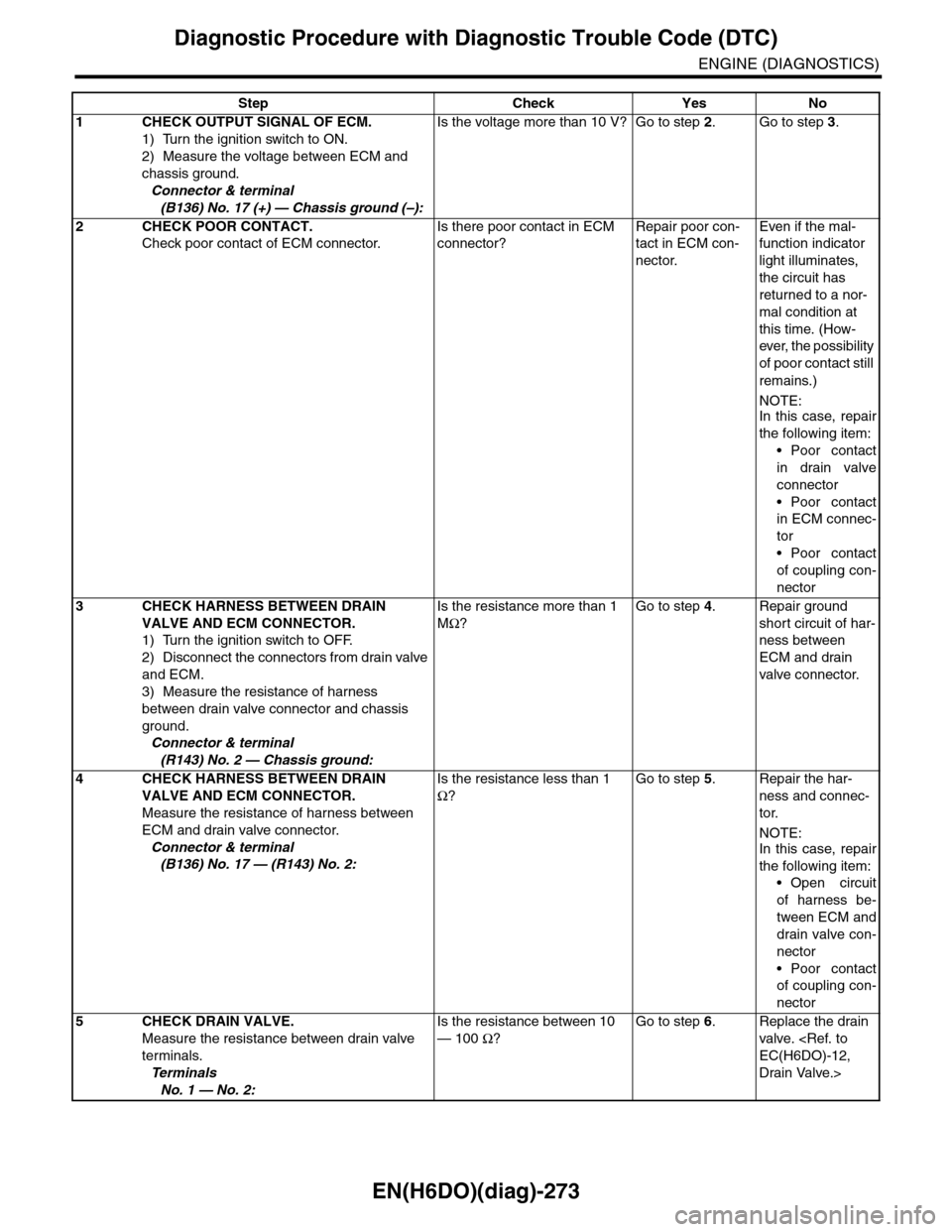
EN(H6DO)(diag)-273
Diagnostic Procedure with Diagnostic Trouble Code (DTC)
ENGINE (DIAGNOSTICS)
Step Check Yes No
1CHECK OUTPUT SIGNAL OF ECM.
1) Turn the ignition switch to ON.
2) Measure the voltage between ECM and
chassis ground.
Connector & terminal
(B136) No. 17 (+) — Chassis ground (–):
Is the voltage more than 10 V? Go to step 2.Go to step 3.
2CHECK POOR CONTACT.
Check poor contact of ECM connector.
Is there poor contact in ECM
connector?
Repair poor con-
tact in ECM con-
nector.
Even if the mal-
function indicator
light illuminates,
the circuit has
returned to a nor-
mal condition at
this time. (How-
ever, the possibility
of poor contact still
remains.)
NOTE:In this case, repair
the following item:
•Poor contact
in drain valve
connector
•Poor contact
in ECM connec-
tor
•Poor contact
of coupling con-
nector
3CHECK HARNESS BETWEEN DRAIN
VALVE AND ECM CONNECTOR.
1) Turn the ignition switch to OFF.
2) Disconnect the connectors from drain valve
and ECM.
3) Measure the resistance of harness
between drain valve connector and chassis
ground.
Connector & terminal
(R143) No. 2 — Chassis ground:
Is the resistance more than 1
MΩ?
Go to step 4.Repair ground
short circuit of har-
ness between
ECM and drain
valve connector.
4CHECK HARNESS BETWEEN DRAIN
VALVE AND ECM CONNECTOR.
Measure the resistance of harness between
ECM and drain valve connector.
Connector & terminal
(B136) No. 17 — (R143) No. 2:
Is the resistance less than 1
Ω?
Go to step 5.Repair the har-
ness and connec-
tor.
NOTE:In this case, repair
the following item:
•Open circuit
of harness be-
tween ECM and
drain valve con-
nector
•Poor contact
of coupling con-
nector
5CHECK DRAIN VALVE.
Measure the resistance between drain valve
terminals.
Te r m i n a l s
No. 1 — No. 2:
Is the resistance between 10
— 100 Ω?
Go to step 6.Replace the drain
valve.
Drain Valve.>
Page 1437 of 2453
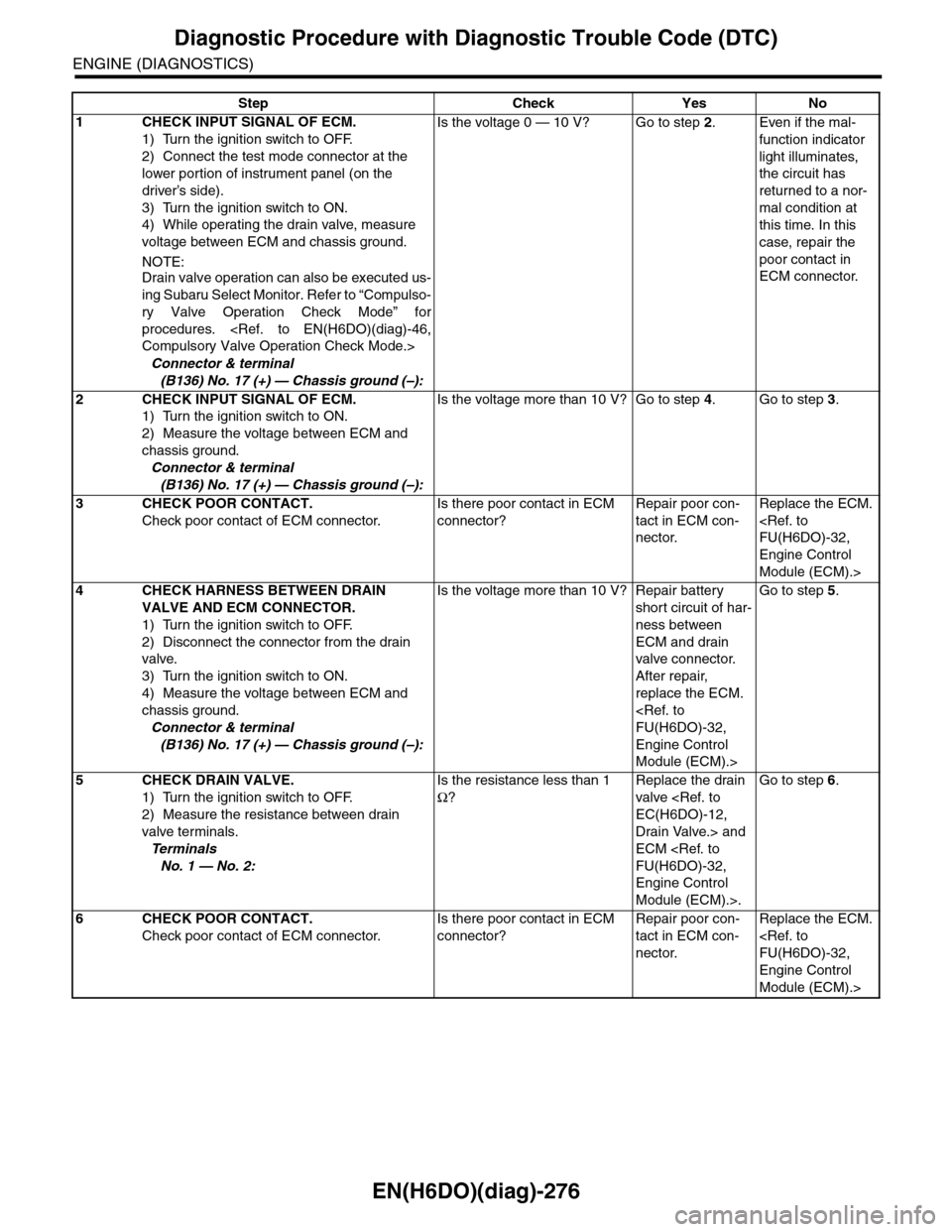
EN(H6DO)(diag)-276
Diagnostic Procedure with Diagnostic Trouble Code (DTC)
ENGINE (DIAGNOSTICS)
Step Check Yes No
1CHECK INPUT SIGNAL OF ECM.
1) Turn the ignition switch to OFF.
2) Connect the test mode connector at the
lower portion of instrument panel (on the
driver’s side).
3) Turn the ignition switch to ON.
4) While operating the drain valve, measure
voltage between ECM and chassis ground.
NOTE:
Drain valve operation can also be executed us-
ing Subaru Select Monitor. Refer to “Compulso-
ry Valve Operation Check Mode” for
procedures.
Connector & terminal
(B136) No. 17 (+) — Chassis ground (–):
Is the voltage 0 — 10 V? Go to step 2.Even if the mal-
function indicator
light illuminates,
the circuit has
returned to a nor-
mal condition at
this time. In this
case, repair the
poor contact in
ECM connector.
2CHECK INPUT SIGNAL OF ECM.
1) Turn the ignition switch to ON.
2) Measure the voltage between ECM and
chassis ground.
Connector & terminal
(B136) No. 17 (+) — Chassis ground (–):
Is the voltage more than 10 V? Go to step 4.Go to step 3.
3CHECK POOR CONTACT.
Check poor contact of ECM connector.
Is there poor contact in ECM
connector?
Repair poor con-
tact in ECM con-
nector.
Replace the ECM.
Engine Control
Module (ECM).>
4CHECK HARNESS BETWEEN DRAIN
VALVE AND ECM CONNECTOR.
1) Turn the ignition switch to OFF.
2) Disconnect the connector from the drain
valve.
3) Turn the ignition switch to ON.
4) Measure the voltage between ECM and
chassis ground.
Connector & terminal
(B136) No. 17 (+) — Chassis ground (–):
Is the voltage more than 10 V? Repair battery
short circuit of har-
ness between
ECM and drain
valve connector.
After repair,
replace the ECM.
Engine Control
Module (ECM).>
Go to step 5.
5CHECK DRAIN VALVE.
1) Turn the ignition switch to OFF.
2) Measure the resistance between drain
valve terminals.
Te r m i n a l s
No. 1 — No. 2:
Is the resistance less than 1
Ω?
Replace the drain
valve
Drain Valve.> and
ECM
Engine Control
Module (ECM).>.
Go to step 6.
6CHECK POOR CONTACT.
Check poor contact of ECM connector.
Is there poor contact in ECM
connector?
Repair poor con-
tact in ECM con-
nector.
Replace the ECM.
Engine Control
Module (ECM).>
Page 1441 of 2453
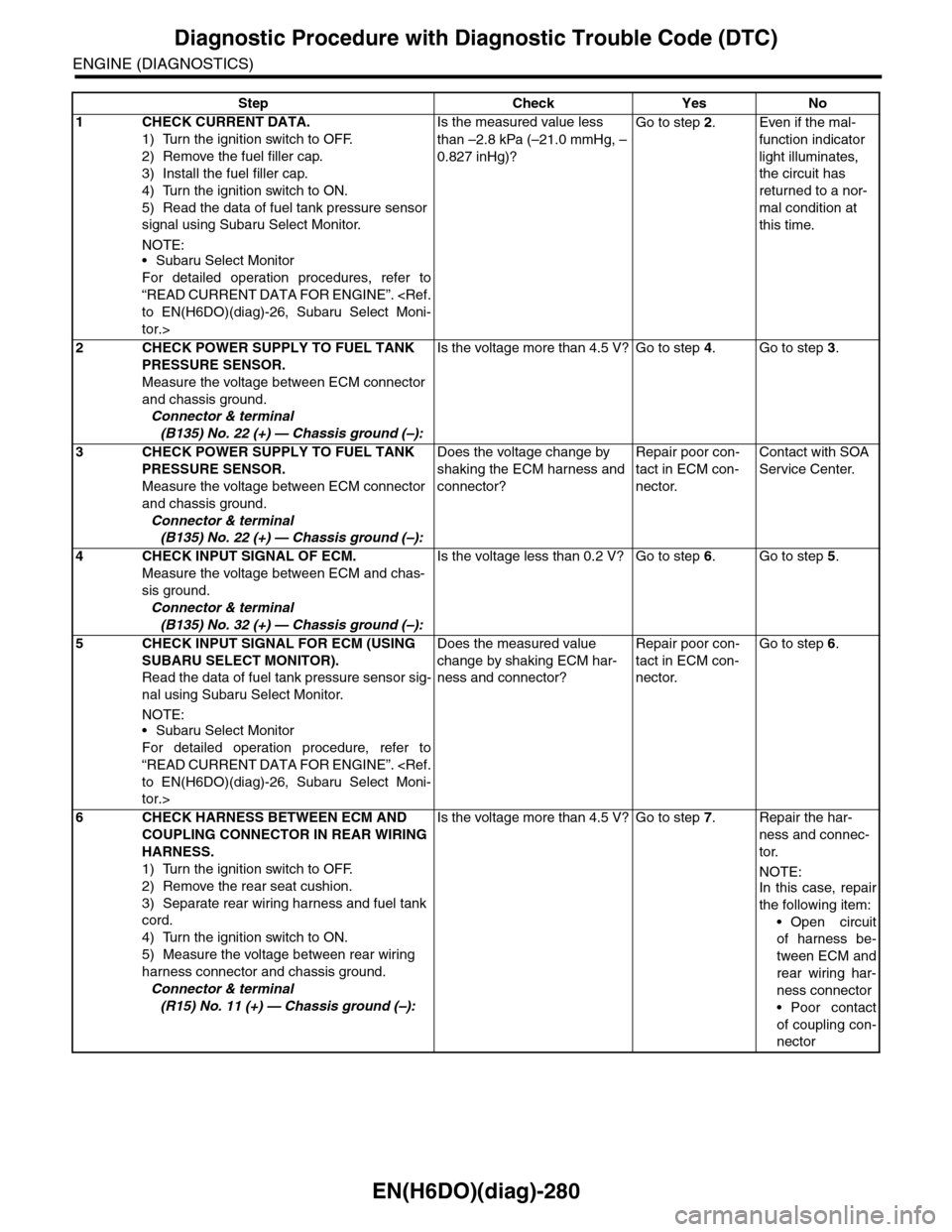
EN(H6DO)(diag)-280
Diagnostic Procedure with Diagnostic Trouble Code (DTC)
ENGINE (DIAGNOSTICS)
Step Check Yes No
1CHECK CURRENT DATA.
1) Turn the ignition switch to OFF.
2) Remove the fuel filler cap.
3) Install the fuel filler cap.
4) Turn the ignition switch to ON.
5) Read the data of fuel tank pressure sensor
signal using Subaru Select Monitor.
NOTE:•Subaru Select Monitor
For detailed operation procedures, refer to
“READ CURRENT DATA FOR ENGINE”.
tor.>
Is the measured value less
than –2.8 kPa (–21.0 mmHg, –
0.827 inHg)?
Go to step 2.Even if the mal-
function indicator
light illuminates,
the circuit has
returned to a nor-
mal condition at
this time.
2CHECK POWER SUPPLY TO FUEL TANK
PRESSURE SENSOR.
Measure the voltage between ECM connector
and chassis ground.
Connector & terminal
(B135) No. 22 (+) — Chassis ground (–):
Is the voltage more than 4.5 V? Go to step 4.Go to step 3.
3CHECK POWER SUPPLY TO FUEL TANK
PRESSURE SENSOR.
Measure the voltage between ECM connector
and chassis ground.
Connector & terminal
(B135) No. 22 (+) — Chassis ground (–):
Does the voltage change by
shaking the ECM harness and
connector?
Repair poor con-
tact in ECM con-
nector.
Contact with SOA
Service Center.
4CHECK INPUT SIGNAL OF ECM.
Measure the voltage between ECM and chas-
sis ground.
Connector & terminal
(B135) No. 32 (+) — Chassis ground (–):
Is the voltage less than 0.2 V? Go to step 6.Go to step 5.
5CHECK INPUT SIGNAL FOR ECM (USING
SUBARU SELECT MONITOR).
Read the data of fuel tank pressure sensor sig-
nal using Subaru Select Monitor.
NOTE:
•Subaru Select Monitor
For detailed operation procedure, refer to
“READ CURRENT DATA FOR ENGINE”.
tor.>
Does the measured value
change by shaking ECM har-
ness and connector?
Repair poor con-
tact in ECM con-
nector.
Go to step 6.
6CHECK HARNESS BETWEEN ECM AND
COUPLING CONNECTOR IN REAR WIRING
HARNESS.
1) Turn the ignition switch to OFF.
2) Remove the rear seat cushion.
3) Separate rear wiring harness and fuel tank
cord.
4) Turn the ignition switch to ON.
5) Measure the voltage between rear wiring
harness connector and chassis ground.
Connector & terminal
(R15) No. 11 (+) — Chassis ground (–):
Is the voltage more than 4.5 V? Go to step 7.Repair the har-
ness and connec-
tor.
NOTE:In this case, repair
the following item:
•Open circuit
of harness be-
tween ECM and
rear wiring har-
ness connector
•Poor contact
of coupling con-
nector
Page 1451 of 2453
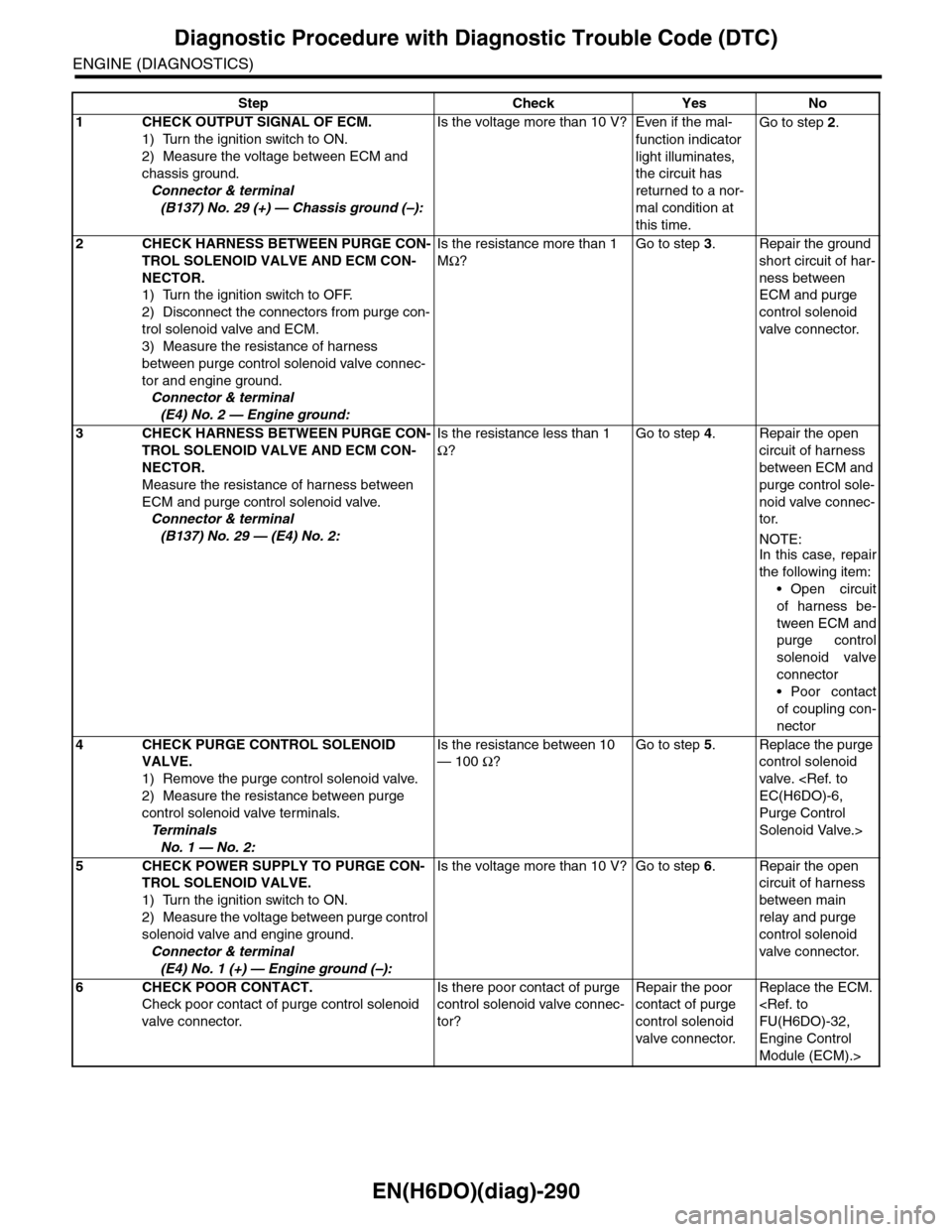
EN(H6DO)(diag)-290
Diagnostic Procedure with Diagnostic Trouble Code (DTC)
ENGINE (DIAGNOSTICS)
Step Check Yes No
1CHECK OUTPUT SIGNAL OF ECM.
1) Turn the ignition switch to ON.
2) Measure the voltage between ECM and
chassis ground.
Connector & terminal
(B137) No. 29 (+) — Chassis ground (–):
Is the voltage more than 10 V? Even if the mal-
function indicator
light illuminates,
the circuit has
returned to a nor-
mal condition at
this time.
Go to step 2.
2CHECK HARNESS BETWEEN PURGE CON-
TROL SOLENOID VALVE AND ECM CON-
NECTOR.
1) Turn the ignition switch to OFF.
2) Disconnect the connectors from purge con-
trol solenoid valve and ECM.
3) Measure the resistance of harness
between purge control solenoid valve connec-
tor and engine ground.
Connector & terminal
(E4) No. 2 — Engine ground:
Is the resistance more than 1
MΩ?
Go to step 3.Repair the ground
short circuit of har-
ness between
ECM and purge
control solenoid
valve connector.
3CHECK HARNESS BETWEEN PURGE CON-
TROL SOLENOID VALVE AND ECM CON-
NECTOR.
Measure the resistance of harness between
ECM and purge control solenoid valve.
Connector & terminal
(B137) No. 29 — (E4) No. 2:
Is the resistance less than 1
Ω?
Go to step 4.Repair the open
circuit of harness
between ECM and
purge control sole-
noid valve connec-
tor.
NOTE:In this case, repair
the following item:
•Open circuit
of harness be-
tween ECM and
purge control
solenoid valve
connector
•Poor contact
of coupling con-
nector
4CHECK PURGE CONTROL SOLENOID
VALVE.
1) Remove the purge control solenoid valve.
2) Measure the resistance between purge
control solenoid valve terminals.
Te r m i n a l s
No. 1 — No. 2:
Is the resistance between 10
— 100 Ω?
Go to step 5.Replace the purge
control solenoid
valve.
Purge Control
Solenoid Valve.>
5CHECK POWER SUPPLY TO PURGE CON-
TROL SOLENOID VALVE.
1) Turn the ignition switch to ON.
2) Measure the voltage between purge control
solenoid valve and engine ground.
Connector & terminal
(E4) No. 1 (+) — Engine ground (–):
Is the voltage more than 10 V? Go to step 6.Repair the open
circuit of harness
between main
relay and purge
control solenoid
valve connector.
6CHECK POOR CONTACT.
Check poor contact of purge control solenoid
valve connector.
Is there poor contact of purge
control solenoid valve connec-
tor?
Repair the poor
contact of purge
control solenoid
valve connector.
Replace the ECM.
Engine Control
Module (ECM).>
Page 1453 of 2453
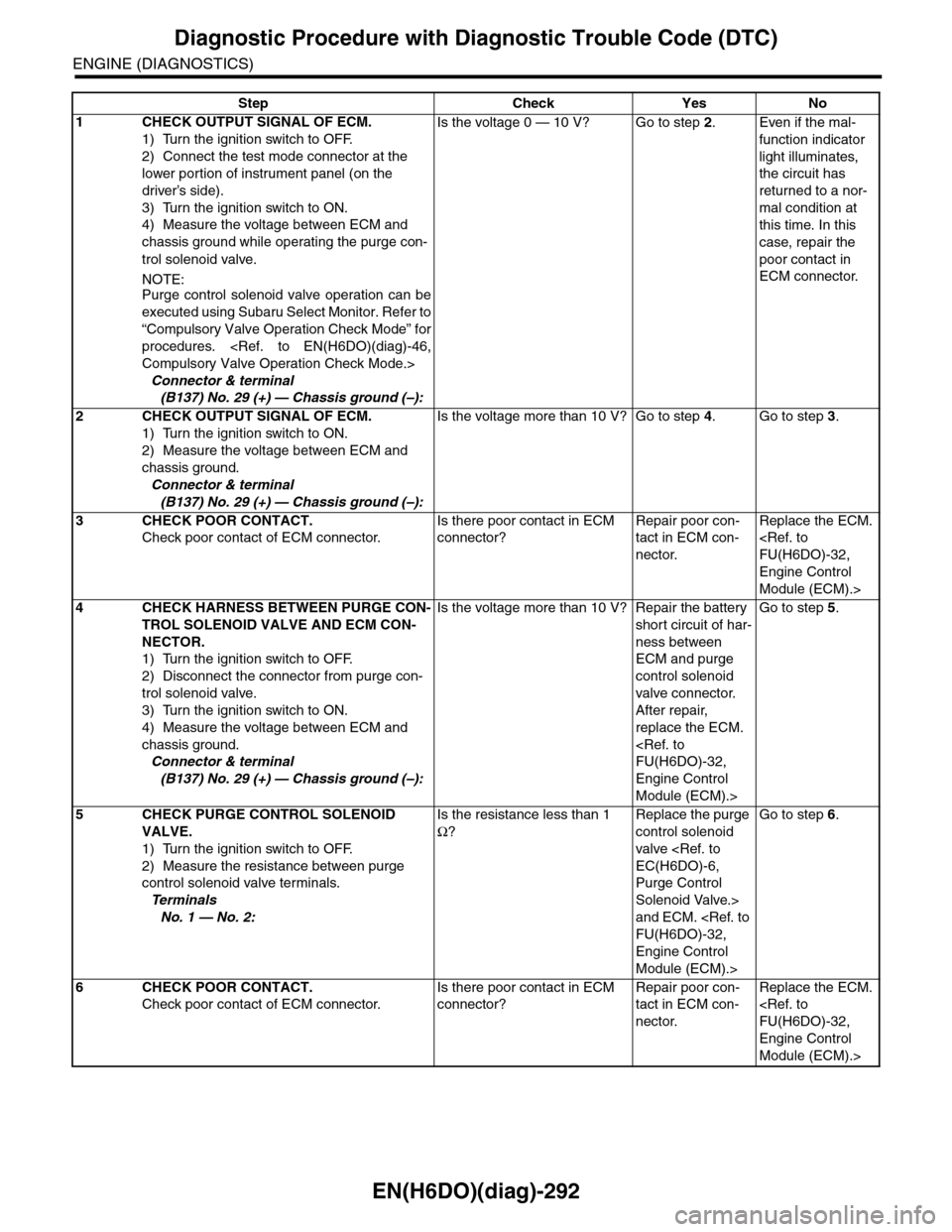
EN(H6DO)(diag)-292
Diagnostic Procedure with Diagnostic Trouble Code (DTC)
ENGINE (DIAGNOSTICS)
Step Check Yes No
1CHECK OUTPUT SIGNAL OF ECM.
1) Turn the ignition switch to OFF.
2) Connect the test mode connector at the
lower portion of instrument panel (on the
driver’s side).
3) Turn the ignition switch to ON.
4) Measure the voltage between ECM and
chassis ground while operating the purge con-
trol solenoid valve.
NOTE:Purge control solenoid valve operation can be
executed using Subaru Select Monitor. Refer to
“Compulsory Valve Operation Check Mode” for
procedures.
Connector & terminal
(B137) No. 29 (+) — Chassis ground (–):
Is the voltage 0 — 10 V? Go to step 2.Even if the mal-
function indicator
light illuminates,
the circuit has
returned to a nor-
mal condition at
this time. In this
case, repair the
poor contact in
ECM connector.
2CHECK OUTPUT SIGNAL OF ECM.
1) Turn the ignition switch to ON.
2) Measure the voltage between ECM and
chassis ground.
Connector & terminal
(B137) No. 29 (+) — Chassis ground (–):
Is the voltage more than 10 V? Go to step 4.Go to step 3.
3CHECK POOR CONTACT.
Check poor contact of ECM connector.
Is there poor contact in ECM
connector?
Repair poor con-
tact in ECM con-
nector.
Replace the ECM.
Engine Control
Module (ECM).>
4CHECK HARNESS BETWEEN PURGE CON-
TROL SOLENOID VALVE AND ECM CON-
NECTOR.
1) Turn the ignition switch to OFF.
2) Disconnect the connector from purge con-
trol solenoid valve.
3) Turn the ignition switch to ON.
4) Measure the voltage between ECM and
chassis ground.
Connector & terminal
(B137) No. 29 (+) — Chassis ground (–):
Is the voltage more than 10 V? Repair the battery
short circuit of har-
ness between
ECM and purge
control solenoid
valve connector.
After repair,
replace the ECM.
Engine Control
Module (ECM).>
Go to step 5.
5CHECK PURGE CONTROL SOLENOID
VALVE.
1) Turn the ignition switch to OFF.
2) Measure the resistance between purge
control solenoid valve terminals.
Te r m i n a l s
No. 1 — No. 2:
Is the resistance less than 1
Ω?
Replace the purge
control solenoid
valve
Purge Control
Solenoid Valve.>
and ECM.
Engine Control
Module (ECM).>
Go to step 6.
6CHECK POOR CONTACT.
Check poor contact of ECM connector.
Is there poor contact in ECM
connector?
Repair poor con-
tact in ECM con-
nector.
Replace the ECM.
Engine Control
Module (ECM).>
Page 1622 of 2453
GD(H6DO)-10
Diagnostic Trouble Code (DTC) Detecting Criteria
GENERAL DESCRIPTION
4. GENERAL DRIVING CYCLE
1. Crankshaft Timing Diagnosis
Perform the diagnosis continuously after starting engine and while AVCS is not operating.
2. Slow Response Diagnosis
Perform the diagnosis continuously after warm-up, while AVCS is operating and the target timing advance is
small.
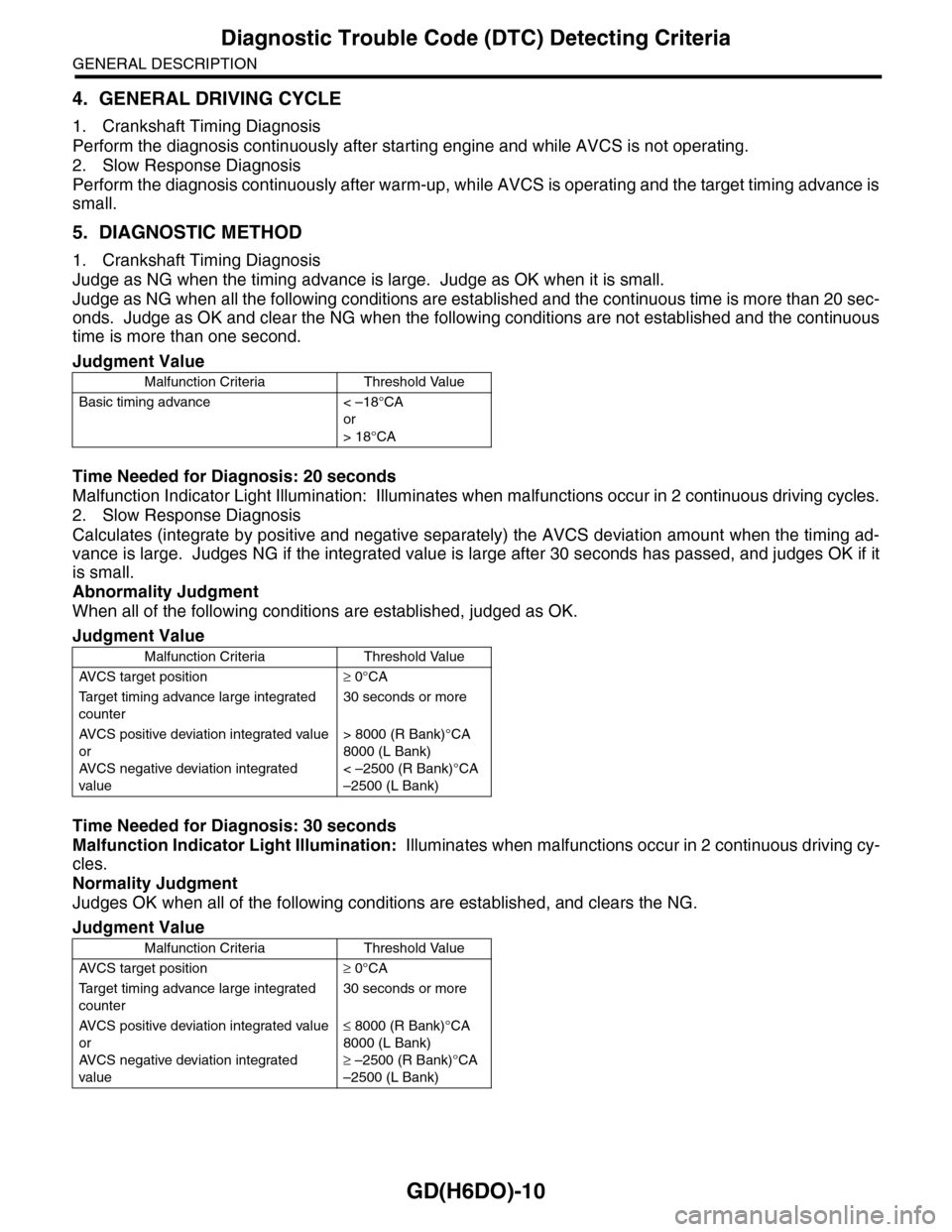
5. DIAGNOSTIC METHOD
1. Crankshaft Timing Diagnosis
Judge as NG when the timing advance is large. Judge as OK when it is small.
Judge as NG when all the following conditions are established and the continuous time is more than 20 sec-
onds. Judge as OK and clear the NG when the following conditions are not established and the continuous
time is more than one second.
Time Needed for Diagnosis: 20 seconds
Malfunction Indicator Light Illumination: Illuminates when malfunctions occur in 2 continuous driving cycles.
2. Slow Response Diagnosis
Calculates (integrate by positive and negative separately) the AVCS deviation amount when the timing ad-
vance is large. Judges NG if the integrated value is large after 30 seconds has passed, and judges OK if it
is small.
Abnormality Judgment
When all of the following conditions are established, judged as OK.
Time Needed for Diagnosis: 30 seconds
Malfunction Indicator Light Illumination: Illuminates when malfunctions occur in 2 continuous driving cy-
cles.
Normality Judgment
Judges OK when all of the following conditions are established, and clears the NG.
Judgment Value
Malfunction Criteria Threshold Value
Basic timing advance < –18°CA
or
> 18°CA
Judgment Value
Malfunction Criteria Threshold Value
AV C S t a r g e t p o s i t i o n≥ 0°CA
Ta r g e t t i m i n g a d v a n c e l a r g e i n t e g r a t e d
counter
30 seconds or more
AV C S p o s i t i v e d ev i a t i o n i n t e g r a t e d va l u e
or
AV C S n e g a t i v e d ev i a t i o n i n t e g r a t e d
value
> 8000 (R Bank)°CA
8000 (L Bank)
< –2500 (R Bank)°CA
–2500 (L Bank)
Judgment Value
Malfunction Criteria Threshold Value
AV C S t a r g e t p o s i t i o n≥ 0°CA
Ta r g e t t i m i n g a d v a n c e l a r g e i n t e g r a t e d
counter
30 seconds or more
AV C S p o s i t i v e d ev i a t i o n i n t e g r a t e d va l u e
or
AV C S n e g a t i v e d ev i a t i o n i n t e g r a t e d
value
≤ 8000 (R Bank)°CA
8000 (L Bank)
≥ –2500 (R Bank)°CA
–2500 (L Bank)
Page 1623 of 2453
GD(H6DO)-11
Diagnostic Trouble Code (DTC) Detecting Criteria
GENERAL DESCRIPTION
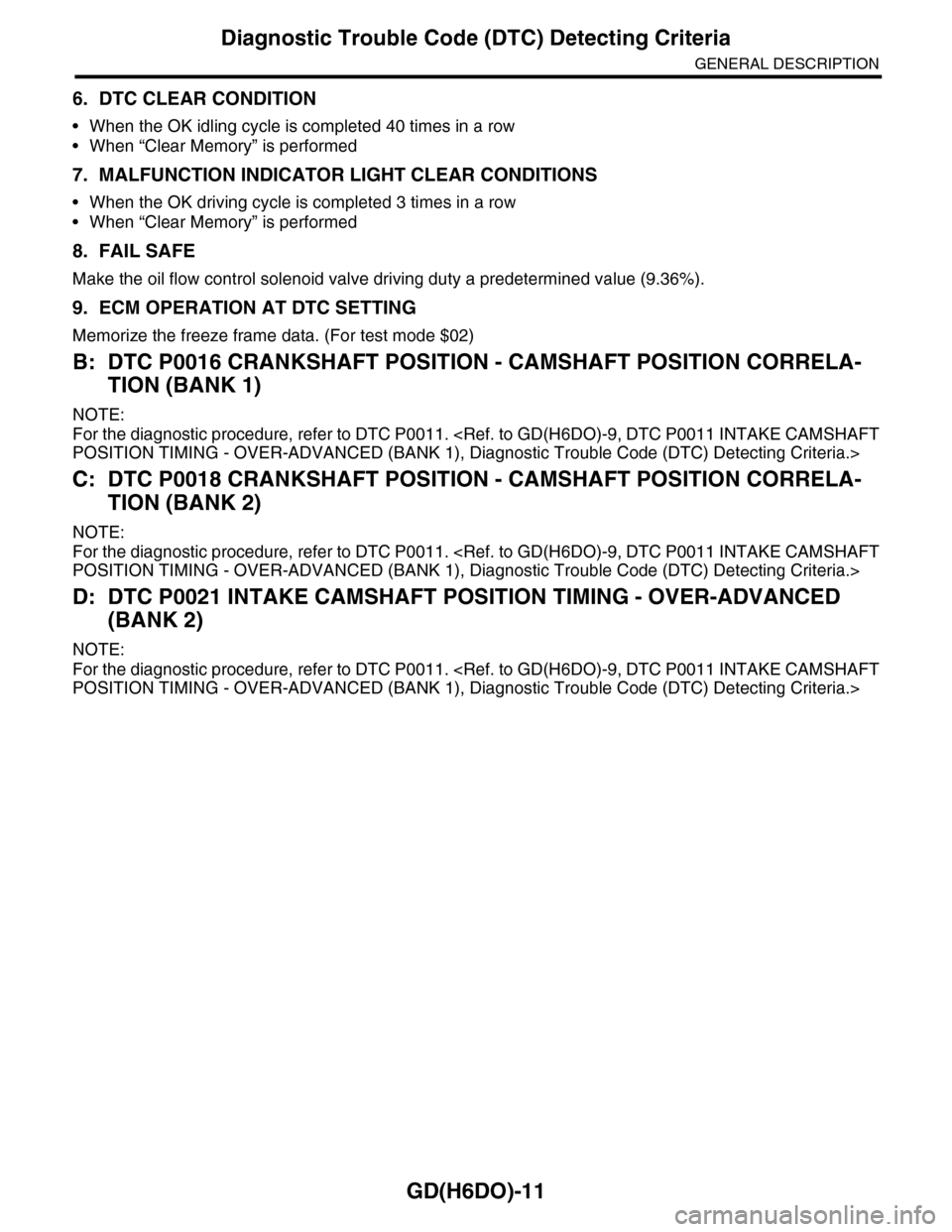
6. DTC CLEAR CONDITION
•When the OK idling cycle is completed 40 times in a row
•When “Clear Memory” is performed
7. MALFUNCTION INDICATOR LIGHT CLEAR CONDITIONS
•When the OK driving cycle is completed 3 times in a row
•When “Clear Memory” is performed
8. FAIL SAFE
Make the oil flow control solenoid valve driving duty a predetermined value (9.36%).
9. ECM OPERATION AT DTC SETTING
Memorize the freeze frame data. (For test mode $02)
B: DTC P0016 CRANKSHAFT POSITION - CAMSHAFT POSITION CORRELA-
TION (BANK 1)
NOTE:
For the diagnostic procedure, refer to DTC P0011.
C: DTC P0018 CRANKSHAFT POSITION - CAMSHAFT POSITION CORRELA-
TION (BANK 2)
NOTE:
For the diagnostic procedure, refer to DTC P0011.
D: DTC P0021 INTAKE CAMSHAFT POSITION TIMING - OVER-ADVANCED
(BANK 2)
NOTE:
For the diagnostic procedure, refer to DTC P0011.
Page 1626 of 2453
GD(H6DO)-14
Diagnostic Trouble Code (DTC) Detecting Criteria
GENERAL DESCRIPTION
4. GENERAL DRIVING CYCLE
Perform the diagnosis continuously 6 seconds after engine start while variable valve lift is being controlled.
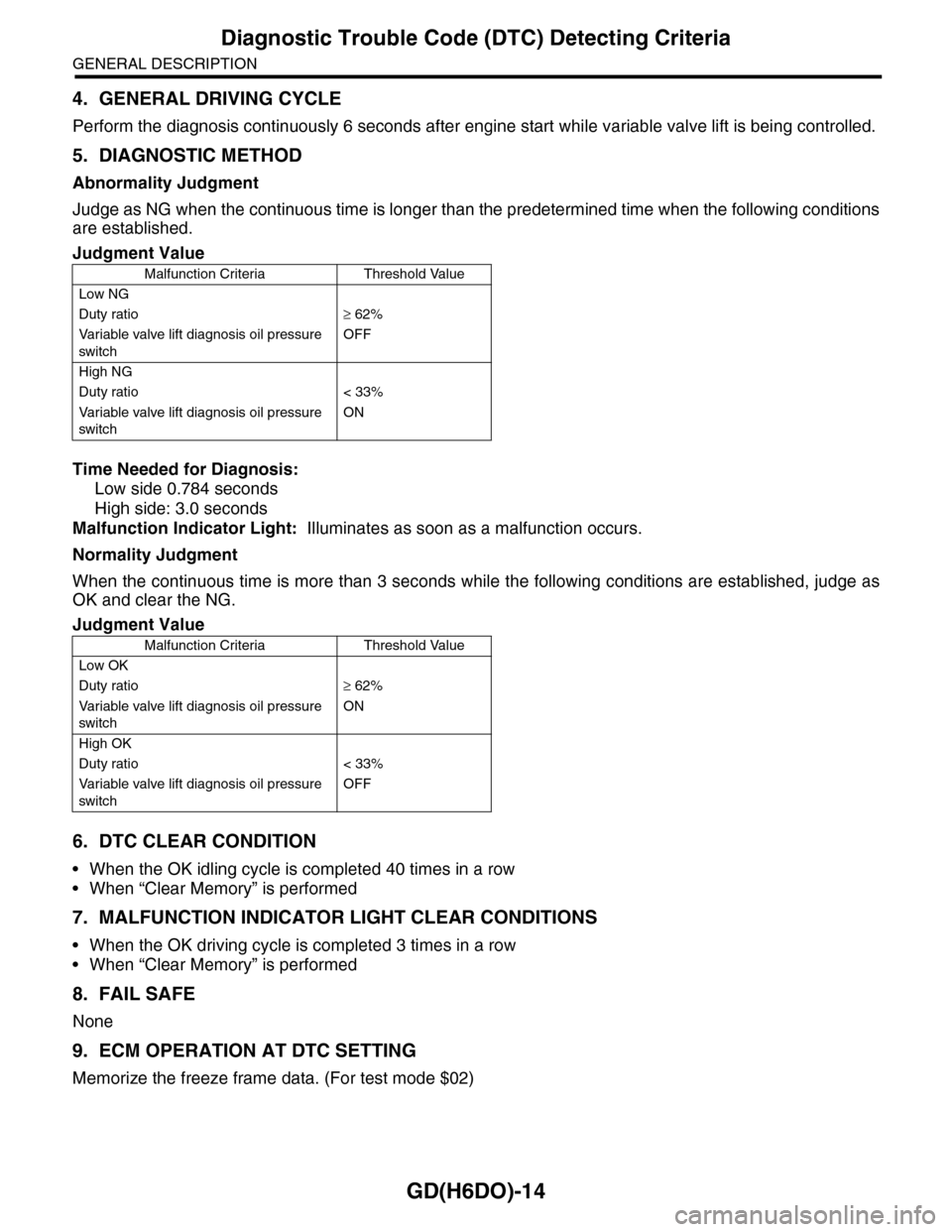
5. DIAGNOSTIC METHOD
Abnormality Judgment
Judge as NG when the continuous time is longer than the predetermined time when the following conditions
are established.
Time Needed for Diagnosis:
Low side 0.784 seconds
High side: 3.0 seconds
Malfunction Indicator Light: Illuminates as soon as a malfunction occurs.
Normality Judgment
When the continuous time is more than 3 seconds while the following conditions are established, judge as
OK and clear the NG.
6. DTC CLEAR CONDITION
•When the OK idling cycle is completed 40 times in a row
•When “Clear Memory” is performed
7. MALFUNCTION INDICATOR LIGHT CLEAR CONDITIONS
•When the OK driving cycle is completed 3 times in a row
•When “Clear Memory” is performed
8. FAIL SAFE
None
9. ECM OPERATION AT DTC SETTING
Memorize the freeze frame data. (For test mode $02)
Judgment Value
Malfunction Criteria Threshold Value
Low NG
Duty ratio≥ 62%
Va r i a b l e va l v e l i f t d i a g n o s i s o i l p r e s s u r e
switch
OFF
High NG
Duty ratio < 33%
Va r i a b l e va l v e l i f t d i a g n o s i s o i l p r e s s u r e
switch
ON
Judgment Value
Malfunction Criteria Threshold Value
Low OK
Duty ratio≥ 62%
Va r i a b l e va l v e l i f t d i a g n o s i s o i l p r e s s u r e
switch
ON
High OK
Duty ratio < 33%
Va r i a b l e va l v e l i f t d i a g n o s i s o i l p r e s s u r e
switch
OFF
Page 1628 of 2453
GD(H6DO)-16
Diagnostic Trouble Code (DTC) Detecting Criteria
GENERAL DESCRIPTION
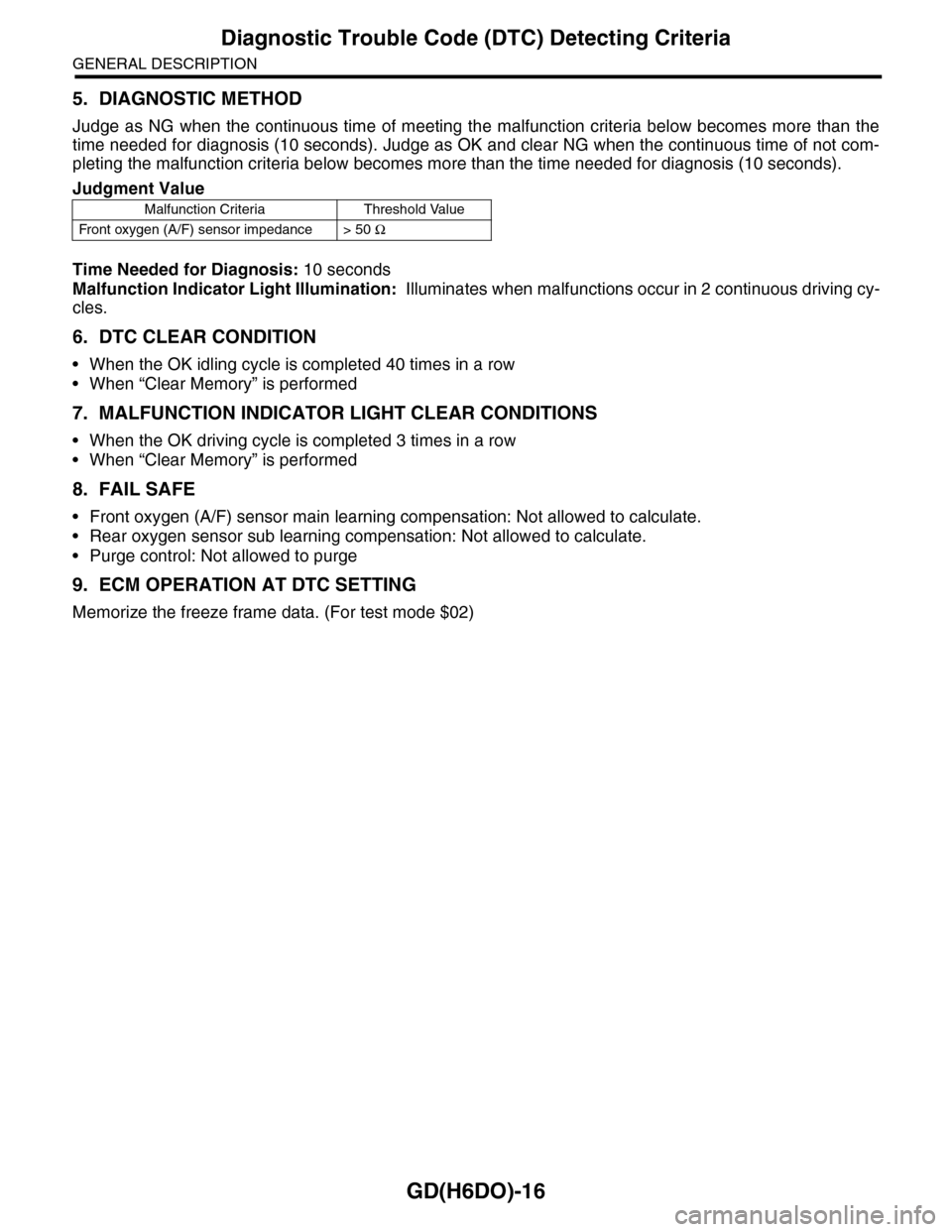
5. DIAGNOSTIC METHOD
Judge as NG when the continuous time of meeting the malfunction criteria below becomes more than the
time needed for diagnosis (10 seconds). Judge as OK and clear NG when the continuous time of not com-
pleting the malfunction criteria below becomes more than the time needed for diagnosis (10 seconds).
Time Needed for Diagnosis: 10 seconds
Malfunction Indicator Light Illumination: Illuminates when malfunctions occur in 2 continuous driving cy-
cles.
6. DTC CLEAR CONDITION
•When the OK idling cycle is completed 40 times in a row
•When “Clear Memory” is performed
7. MALFUNCTION INDICATOR LIGHT CLEAR CONDITIONS
•When the OK driving cycle is completed 3 times in a row
•When “Clear Memory” is performed
8. FAIL SAFE
•Front oxygen (A/F) sensor main learning compensation: Not allowed to calculate.
•Rear oxygen sensor sub learning compensation: Not allowed to calculate.
•Purge control: Not allowed to purge
9. ECM OPERATION AT DTC SETTING
Memorize the freeze frame data. (For test mode $02)
Judgment Value
Malfunction Criteria Threshold Value
Fr o nt ox yg e n ( A / F) s en so r im pe d an c e > 5 0 Ω
Page 1629 of 2453
GD(H6DO)-17
Diagnostic Trouble Code (DTC) Detecting Criteria
GENERAL DESCRIPTION
H: DTC P0031 HO2S HEATER CONTROL CIRCUIT LOW (BANK 1 SENSOR 1)
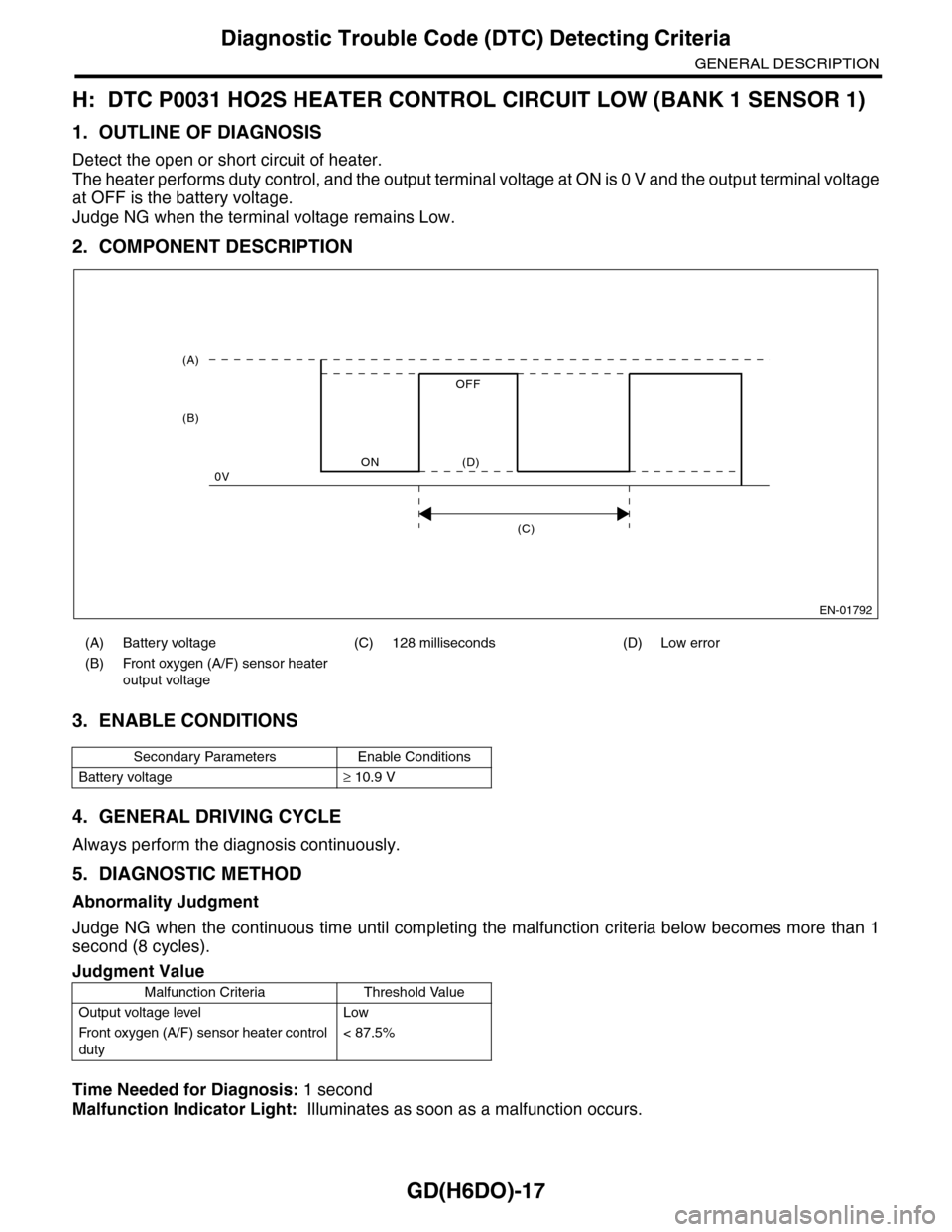
1. OUTLINE OF DIAGNOSIS
Detect the open or short circuit of heater.
The heater performs duty control, and the output terminal voltage at ON is 0 V and the output terminal voltage
at OFF is the battery voltage.
Judge NG when the terminal voltage remains Low.
2. COMPONENT DESCRIPTION
3. ENABLE CONDITIONS
4. GENERAL DRIVING CYCLE
Always perform the diagnosis continuously.
5. DIAGNOSTIC METHOD
Abnormality Judgment
Judge NG when the continuous time until completing the malfunction criteria below becomes more than 1
second (8 cycles).
Time Needed for Diagnosis: 1 second
Malfunction Indicator Light: Illuminates as soon as a malfunction occurs.
(A) Battery voltage (C) 128 milliseconds (D) Low error
(B) Front oxygen (A/F) sensor heater
output voltage
Secondary Parameters Enable Conditions
Battery voltage≥ 10.9 V
Judgment Value
Malfunction Criteria Threshold Value
Output voltage level Low
Fr o nt ox yg en (A / F ) se ns or h ea t er co n tr o l
duty
< 87.5%
EN-01792
(C)
(A)
(B)
ON
OFF
0V(D)