Transmission speed sensor SUBARU TRIBECA 2009 1.G Service Service Manual
[x] Cancel search | Manufacturer: SUBARU, Model Year: 2009, Model line: TRIBECA, Model: SUBARU TRIBECA 2009 1.GPages: 2453, PDF Size: 46.32 MB
Page 2171 of 2453
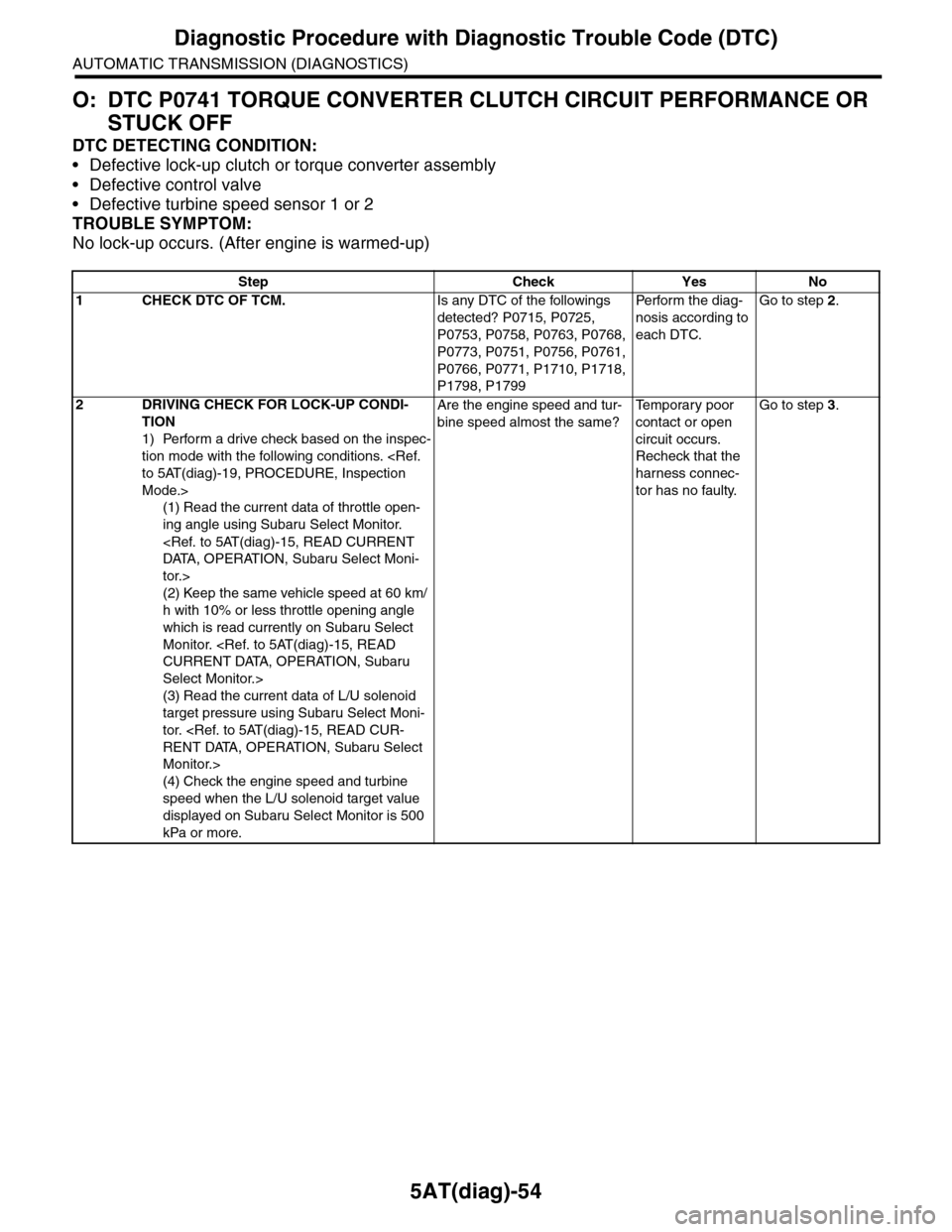
5AT(diag)-54
Diagnostic Procedure with Diagnostic Trouble Code (DTC)
AUTOMATIC TRANSMISSION (DIAGNOSTICS)
O: DTC P0741 TORQUE CONVERTER CLUTCH CIRCUIT PERFORMANCE OR
STUCK OFF
DTC DETECTING CONDITION:
•Defective lock-up clutch or torque converter assembly
•Defective control valve
•Defective turbine speed sensor 1 or 2
TROUBLE SYMPTOM:
No lock-up occurs. (After engine is warmed-up)
Step Check Yes No
1CHECK DTC OF TCM.Is any DTC of the followings
detected? P0715, P0725,
P0753, P0758, P0763, P0768,
P0773, P0751, P0756, P0761,
P0766, P0771, P1710, P1718,
P1798, P1799
Pe r for m t h e d ia g -
nosis according to
each DTC.
Go to step 2.
2DRIVING CHECK FOR LOCK-UP CONDI-
TION
1) Perform a drive check based on the inspec-
tion mode with the following conditions.
Mode.>
(1) Read the current data of throttle open-
ing angle using Subaru Select Monitor.
tor.>
(2) Keep the same vehicle speed at 60 km/
h with 10% or less throttle opening angle
which is read currently on Subaru Select
Monitor.
Select Monitor.>
(3) Read the current data of L/U solenoid
target pressure using Subaru Select Moni-
tor.
Monitor.>
(4) Check the engine speed and turbine
speed when the L/U solenoid target value
displayed on Subaru Select Monitor is 500
kPa or more.
Are the engine speed and tur-
bine speed almost the same?
Te m p o r a r y p o o r
contact or open
circuit occurs.
Recheck that the
harness connec-
tor has no faulty.
Go to step 3.
Page 2218 of 2453
5AT(diag)-101
Diagnostic Procedure with Diagnostic Trouble Code (DTC)
AUTOMATIC TRANSMISSION (DIAGNOSTICS)
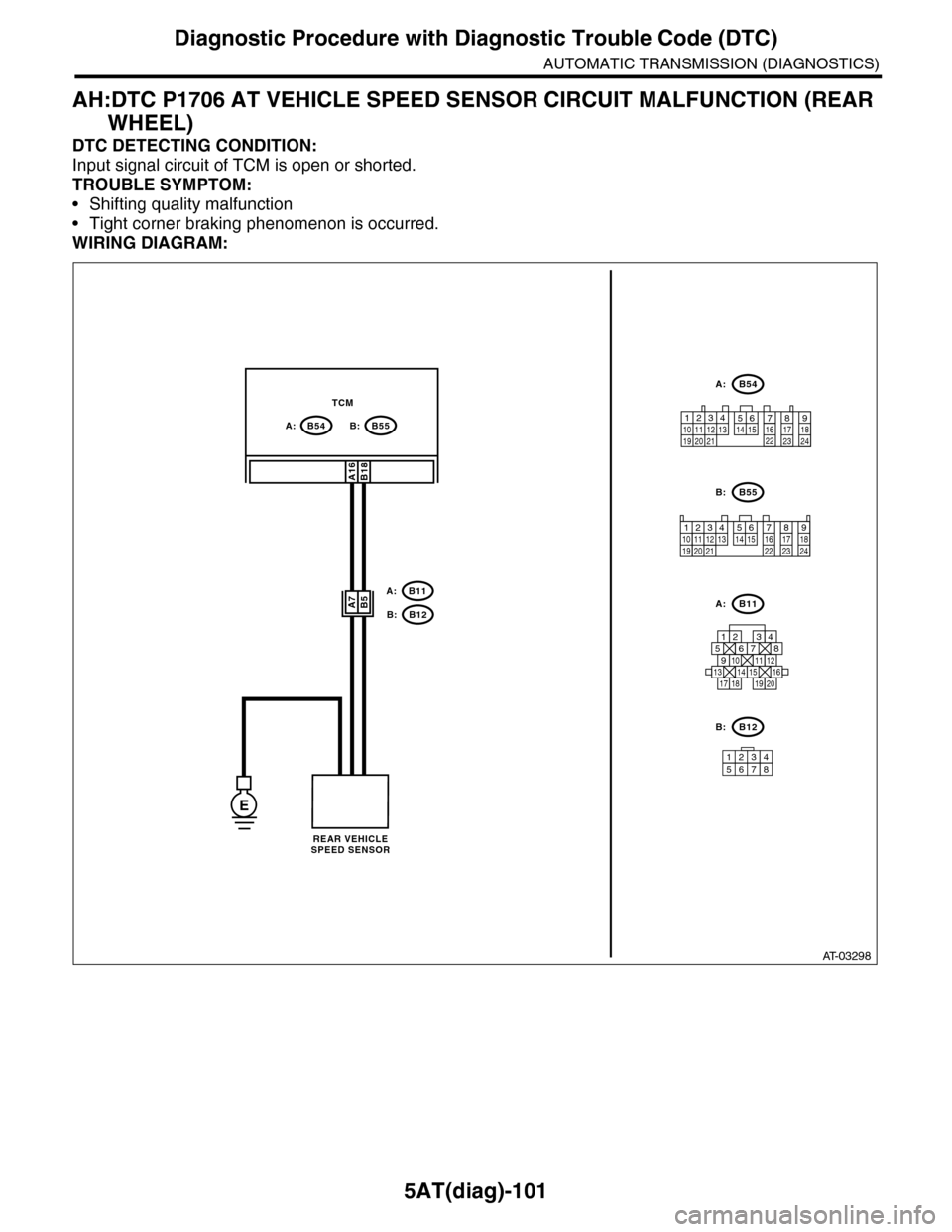
AH:DTC P1706 AT VEHICLE SPEED SENSOR CIRCUIT MALFUNCTION (REAR
WHEEL)
DTC DETECTING CONDITION:
Input signal circuit of TCM is open or shorted.
TROUBLE SYMPTOM:
•Shifting quality malfunction
•Tight corner braking phenomenon is occurred.
WIRING DIAGRAM:
AT-03298
12341011 121920 21135614 1578916 17 1822 23 24
B54B55B:A:
A:
B:A:
B:
A:
B:
12345678
A16
A7B11
B12
TCM
B54
B55
12789563410 11 1219 20 2113 14 15 16 17 18222324
B11
B12
B18
B5
125678
131415169101112
34
17181920
E
REAR VEHICLESPEED SENSOR
Page 2219 of 2453
5AT(diag)-102
Diagnostic Procedure with Diagnostic Trouble Code (DTC)
AUTOMATIC TRANSMISSION (DIAGNOSTICS)
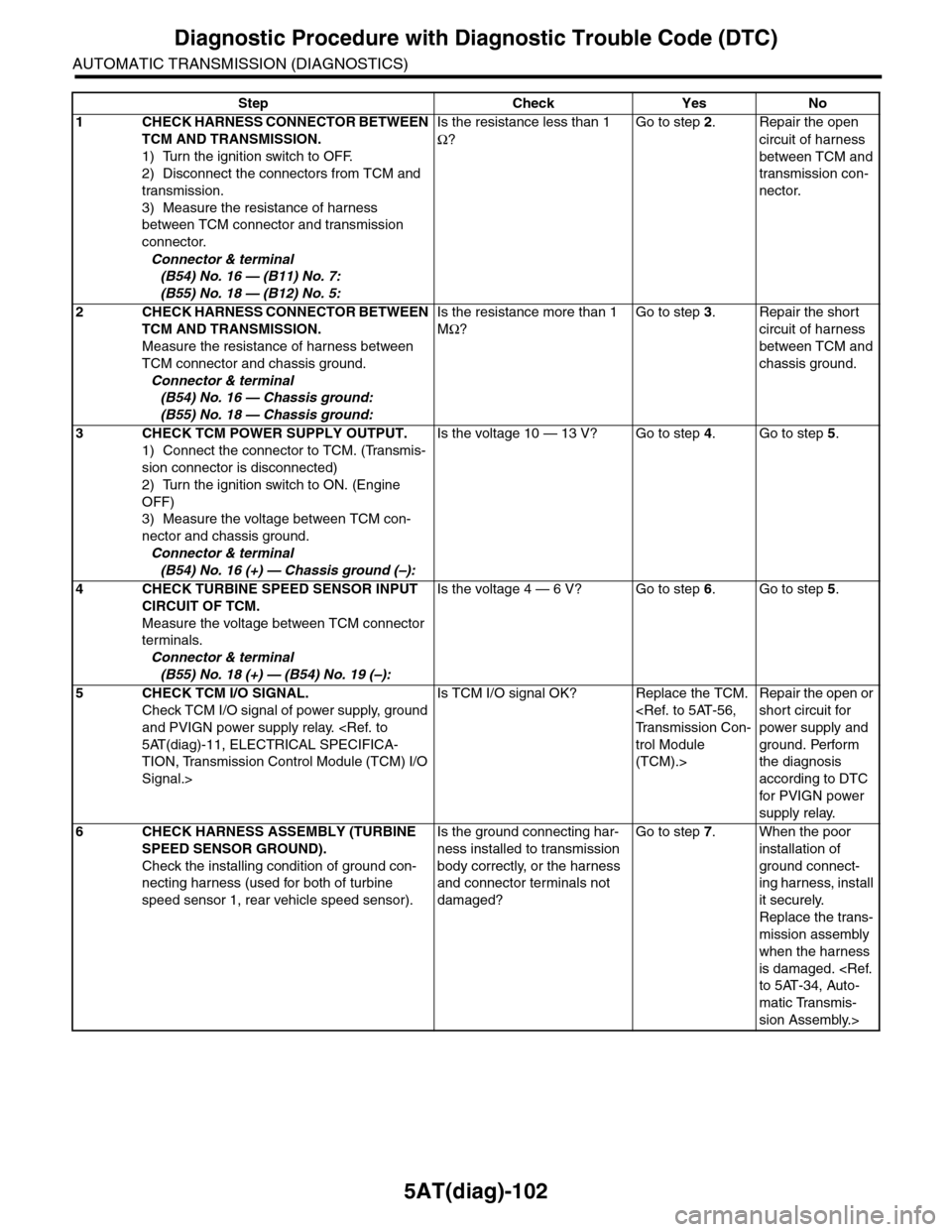
Step Check Yes No
1CHECK HARNESS CONNECTOR BETWEEN
TCM AND TRANSMISSION.
1) Turn the ignition switch to OFF.
2) Disconnect the connectors from TCM and
transmission.
3) Measure the resistance of harness
between TCM connector and transmission
connector.
Connector & terminal
(B54) No. 16 — (B11) No. 7:
(B55) No. 18 — (B12) No. 5:
Is the resistance less than 1
Ω?
Go to step 2.Repair the open
circuit of harness
between TCM and
transmission con-
nector.
2CHECK HARNESS CONNECTOR BETWEEN
TCM AND TRANSMISSION.
Measure the resistance of harness between
TCM connector and chassis ground.
Connector & terminal
(B54) No. 16 — Chassis ground:
(B55) No. 18 — Chassis ground:
Is the resistance more than 1
MΩ?
Go to step 3.Repair the short
circuit of harness
between TCM and
chassis ground.
3CHECK TCM POWER SUPPLY OUTPUT.
1) Connect the connector to TCM. (Transmis-
sion connector is disconnected)
2) Turn the ignition switch to ON. (Engine
OFF)
3) Measure the voltage between TCM con-
nector and chassis ground.
Connector & terminal
(B54) No. 16 (+) — Chassis ground (–):
Is the voltage 10 — 13 V? Go to step 4.Go to step 5.
4CHECK TURBINE SPEED SENSOR INPUT
CIRCUIT OF TCM.
Measure the voltage between TCM connector
terminals.
Connector & terminal
(B55) No. 18 (+) — (B54) No. 19 (–):
Is the voltage 4 — 6 V? Go to step 6.Go to step 5.
5CHECK TCM I/O SIGNAL.
Check TCM I/O signal of power supply, ground
and PVIGN power supply relay.
TION, Transmission Control Module (TCM) I/O
Signal.>
Is TCM I/O signal OK? Replace the TCM.
trol Module
(TCM).>
Repair the open or
short circuit for
power supply and
ground. Perform
the diagnosis
according to DTC
for PVIGN power
supply relay.
6CHECK HARNESS ASSEMBLY (TURBINE
SPEED SENSOR GROUND).
Check the installing condition of ground con-
necting harness (used for both of turbine
speed sensor 1, rear vehicle speed sensor).
Is the ground connecting har-
ness installed to transmission
body correctly, or the harness
and connector terminals not
damaged?
Go to step 7.When the poor
installation of
ground connect-
ing harness, install
it securely.
Replace the trans-
mission assembly
when the harness
is damaged.
matic Transmis-
sion Assembly.>
Page 2220 of 2453
5AT(diag)-103
Diagnostic Procedure with Diagnostic Trouble Code (DTC)
AUTOMATIC TRANSMISSION (DIAGNOSTICS)
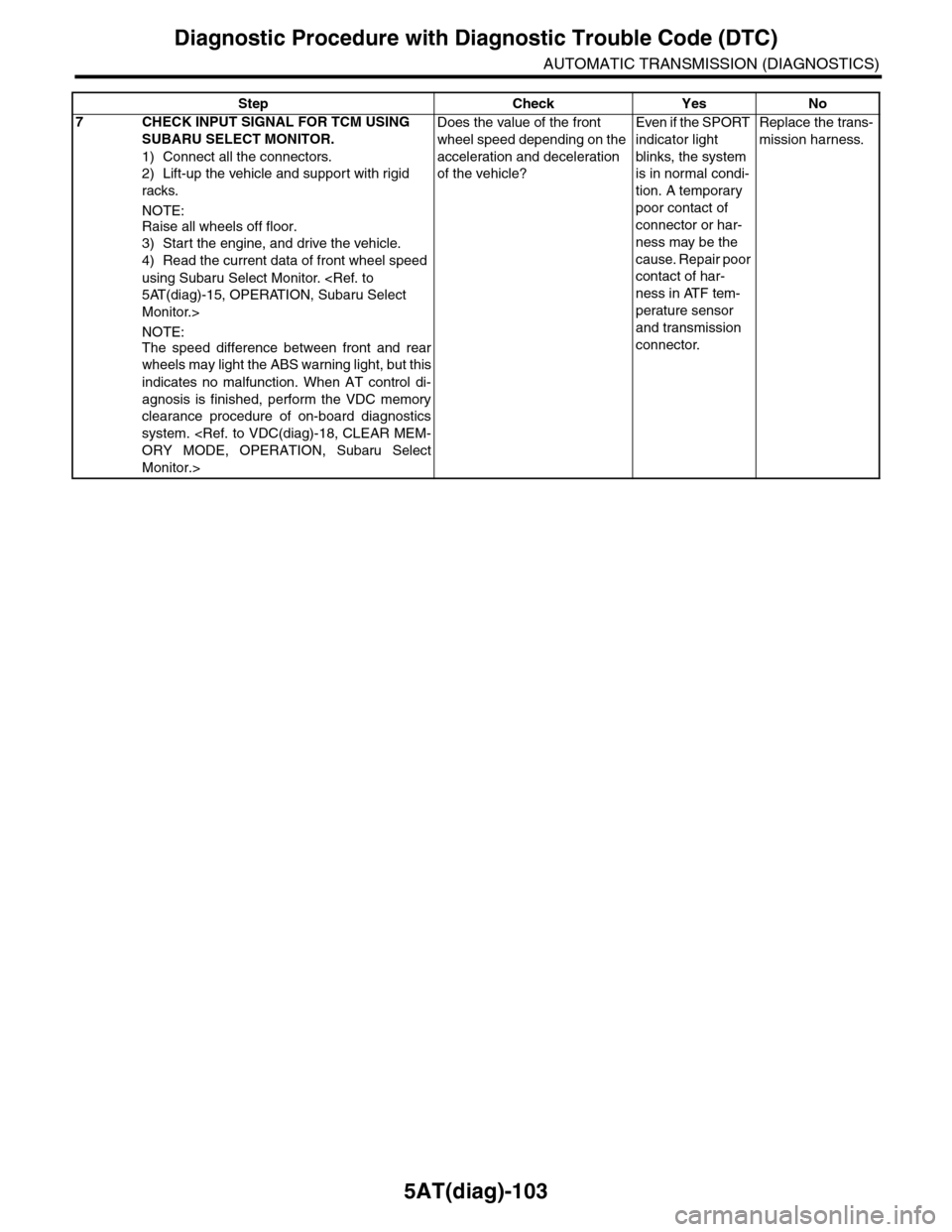
7CHECK INPUT SIGNAL FOR TCM USING
SUBARU SELECT MONITOR.
1) Connect all the connectors.
2) Lift-up the vehicle and support with rigid
racks.
NOTE:
Raise all wheels off floor.
3) Start the engine, and drive the vehicle.
4) Read the current data of front wheel speed
using Subaru Select Monitor.
Monitor.>
NOTE:
The speed difference between front and rear
wheels may light the ABS warning light, but this
indicates no malfunction. When AT control di-
agnosis is finished, perform the VDC memory
clearance procedure of on-board diagnostics
system.
Monitor.>
Does the value of the front
wheel speed depending on the
acceleration and deceleration
of the vehicle?
Even if the SPORT
indicator light
blinks, the system
is in normal condi-
tion. A temporary
poor contact of
connector or har-
ness may be the
cause. Repair poor
contact of har-
ness in ATF tem-
perature sensor
and transmission
connector.
Replace the trans-
mission harness.
Step Check Yes No
Page 2224 of 2453
5AT(diag)-107
Diagnostic Procedure with Diagnostic Trouble Code (DTC)
AUTOMATIC TRANSMISSION (DIAGNOSTICS)
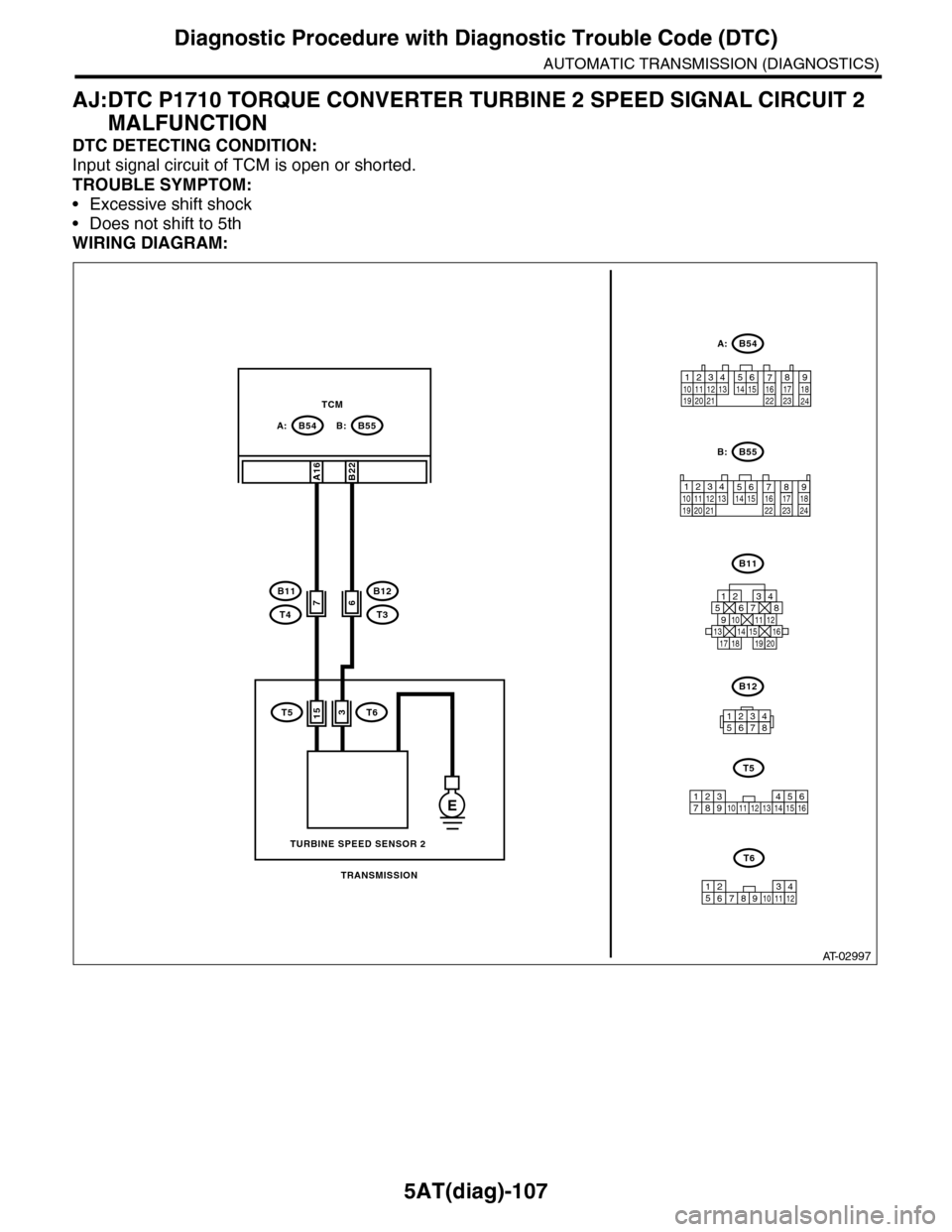
AJ:DTC P1710 TORQUE CONVERTER TURBINE 2 SPEED SIGNAL CIRCUIT 2
MALFUNCTION
DTC DETECTING CONDITION:
Input signal circuit of TCM is open or shorted.
TROUBLE SYMPTOM:
•Excessive shift shock
•Does not shift to 5th
WIRING DIAGRAM:
AT-02997
12341011 121920 21135614 1578916 17 1822 23 24
12345678
B54
B55
12789563410 11 1219 20 2113 14 15 16 17 18222324
B11
B12
125678
131415169101112
34
17181920
B54A:B55B:
A16
7B11
T4
B12
T3
TCM
TURBINE SPEED SENSOR 2
TRANSMISSION
B22
6
E
B:
A:
T5T6
123 68910 11 12 13 14451516
T5
7
12586910 113412
T6
7
315
Page 2225 of 2453
5AT(diag)-108
Diagnostic Procedure with Diagnostic Trouble Code (DTC)
AUTOMATIC TRANSMISSION (DIAGNOSTICS)
Step Check Yes No
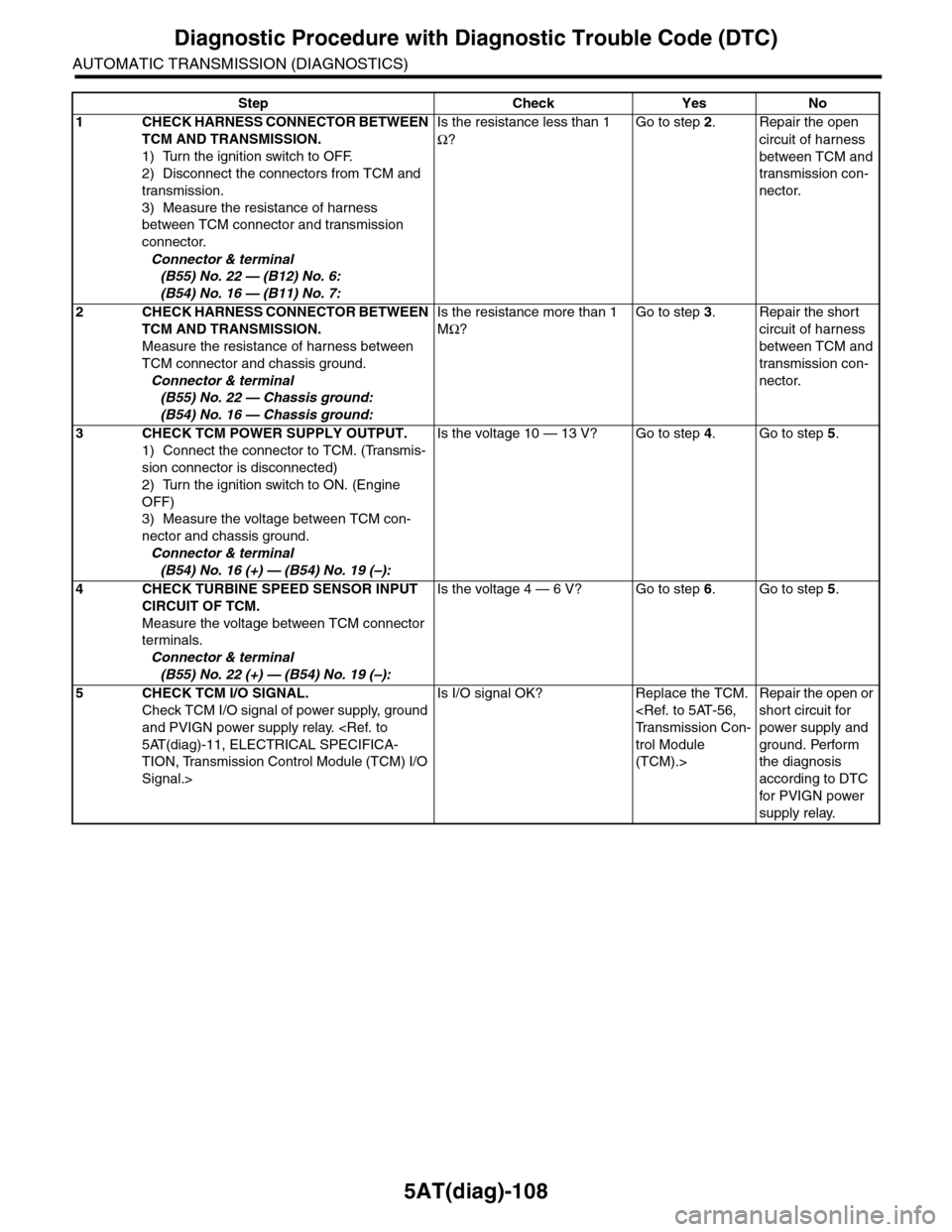
1CHECK HARNESS CONNECTOR BETWEEN
TCM AND TRANSMISSION.
1) Turn the ignition switch to OFF.
2) Disconnect the connectors from TCM and
transmission.
3) Measure the resistance of harness
between TCM connector and transmission
connector.
Connector & terminal
(B55) No. 22 — (B12) No. 6:
(B54) No. 16 — (B11) No. 7:
Is the resistance less than 1
Ω?
Go to step 2.Repair the open
circuit of harness
between TCM and
transmission con-
nector.
2CHECK HARNESS CONNECTOR BETWEEN
TCM AND TRANSMISSION.
Measure the resistance of harness between
TCM connector and chassis ground.
Connector & terminal
(B55) No. 22 — Chassis ground:
(B54) No. 16 — Chassis ground:
Is the resistance more than 1
MΩ?
Go to step 3.Repair the short
circuit of harness
between TCM and
transmission con-
nector.
3CHECK TCM POWER SUPPLY OUTPUT.
1) Connect the connector to TCM. (Transmis-
sion connector is disconnected)
2) Turn the ignition switch to ON. (Engine
OFF)
3) Measure the voltage between TCM con-
nector and chassis ground.
Connector & terminal
(B54) No. 16 (+) — (B54) No. 19 (–):
Is the voltage 10 — 13 V? Go to step 4.Go to step 5.
4CHECK TURBINE SPEED SENSOR INPUT
CIRCUIT OF TCM.
Measure the voltage between TCM connector
terminals.
Connector & terminal
(B55) No. 22 (+) — (B54) No. 19 (–):
Is the voltage 4 — 6 V? Go to step 6.Go to step 5.
5CHECK TCM I/O SIGNAL.
Check TCM I/O signal of power supply, ground
and PVIGN power supply relay.
TION, Transmission Control Module (TCM) I/O
Signal.>
Is I/O signal OK? Replace the TCM.
trol Module
(TCM).>
Repair the open or
short circuit for
power supply and
ground. Perform
the diagnosis
according to DTC
for PVIGN power
supply relay.
Page 2226 of 2453
5AT(diag)-109
Diagnostic Procedure with Diagnostic Trouble Code (DTC)
AUTOMATIC TRANSMISSION (DIAGNOSTICS)
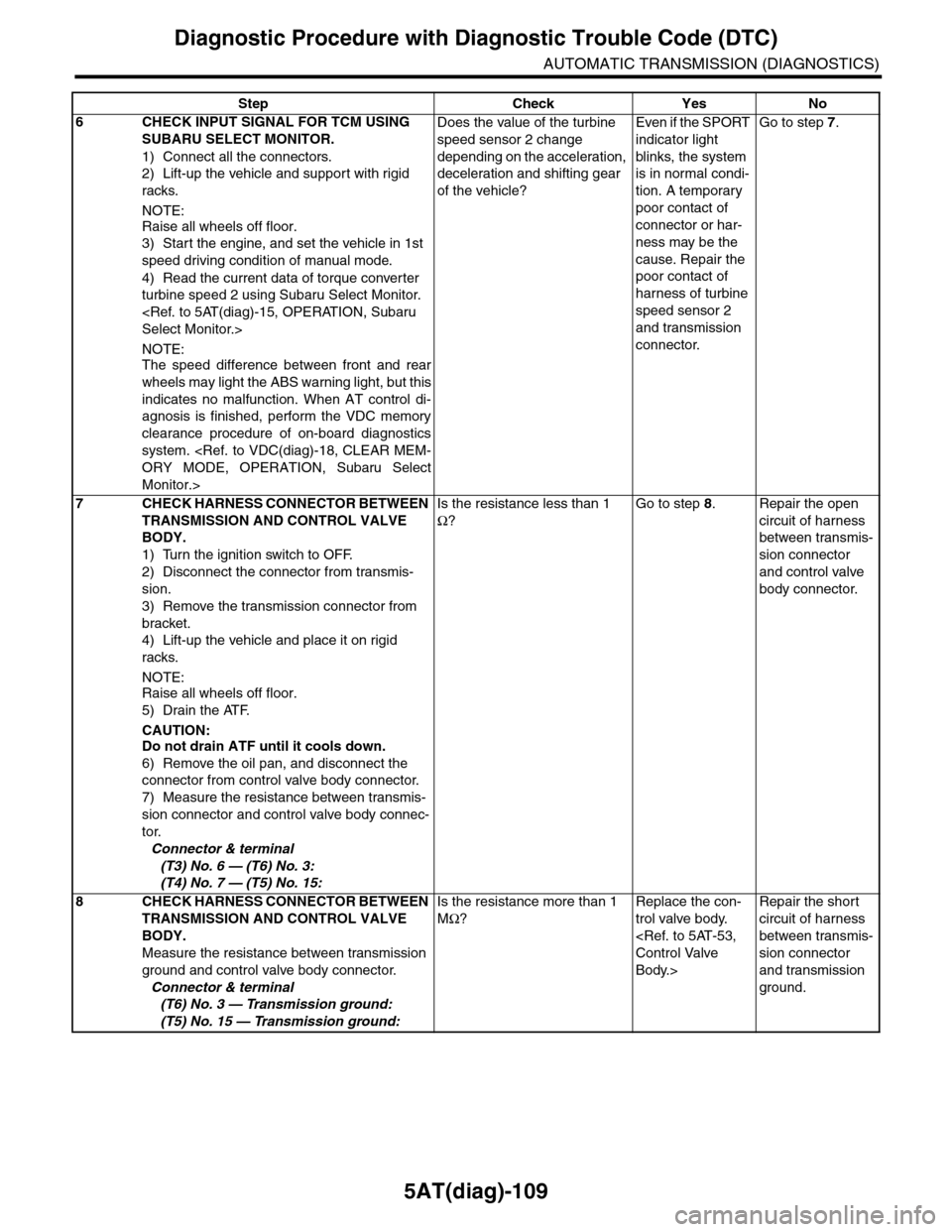
6CHECK INPUT SIGNAL FOR TCM USING
SUBARU SELECT MONITOR.
1) Connect all the connectors.
2) Lift-up the vehicle and support with rigid
racks.
NOTE:
Raise all wheels off floor.
3) Start the engine, and set the vehicle in 1st
speed driving condition of manual mode.
4) Read the current data of torque converter
turbine speed 2 using Subaru Select Monitor.
NOTE:The speed difference between front and rear
wheels may light the ABS warning light, but this
indicates no malfunction. When AT control di-
agnosis is finished, perform the VDC memory
clearance procedure of on-board diagnostics
system.
Monitor.>
Does the value of the turbine
speed sensor 2 change
depending on the acceleration,
deceleration and shifting gear
of the vehicle?
Even if the SPORT
indicator light
blinks, the system
is in normal condi-
tion. A temporary
poor contact of
connector or har-
ness may be the
cause. Repair the
poor contact of
harness of turbine
speed sensor 2
and transmission
connector.
Go to step 7.
7CHECK HARNESS CONNECTOR BETWEEN
TRANSMISSION AND CONTROL VALVE
BODY.
1) Turn the ignition switch to OFF.
2) Disconnect the connector from transmis-
sion.
3) Remove the transmission connector from
bracket.
4) Lift-up the vehicle and place it on rigid
racks.
NOTE:
Raise all wheels off floor.
5) Drain the ATF.
CAUTION:Do not drain ATF until it cools down.
6) Remove the oil pan, and disconnect the
connector from control valve body connector.
7) Measure the resistance between transmis-
sion connector and control valve body connec-
tor.
Connector & terminal
(T3) No. 6 — (T6) No. 3:
(T4) No. 7 — (T5) No. 15:
Is the resistance less than 1
Ω?
Go to step 8.Repair the open
circuit of harness
between transmis-
sion connector
and control valve
body connector.
8CHECK HARNESS CONNECTOR BETWEEN
TRANSMISSION AND CONTROL VALVE
BODY.
Measure the resistance between transmission
ground and control valve body connector.
Connector & terminal
(T6) No. 3 — Transmission ground:
(T5) No. 15 — Transmission ground:
Is the resistance more than 1
MΩ?
Replace the con-
trol valve body.
Body.>
Repair the short
circuit of harness
between transmis-
sion connector
and transmission
ground.
Step Check Yes No
Page 2245 of 2453
5AT(diag)-128
General Diagnostic Table
AUTOMATIC TRANSMISSION (DIAGNOSTICS)
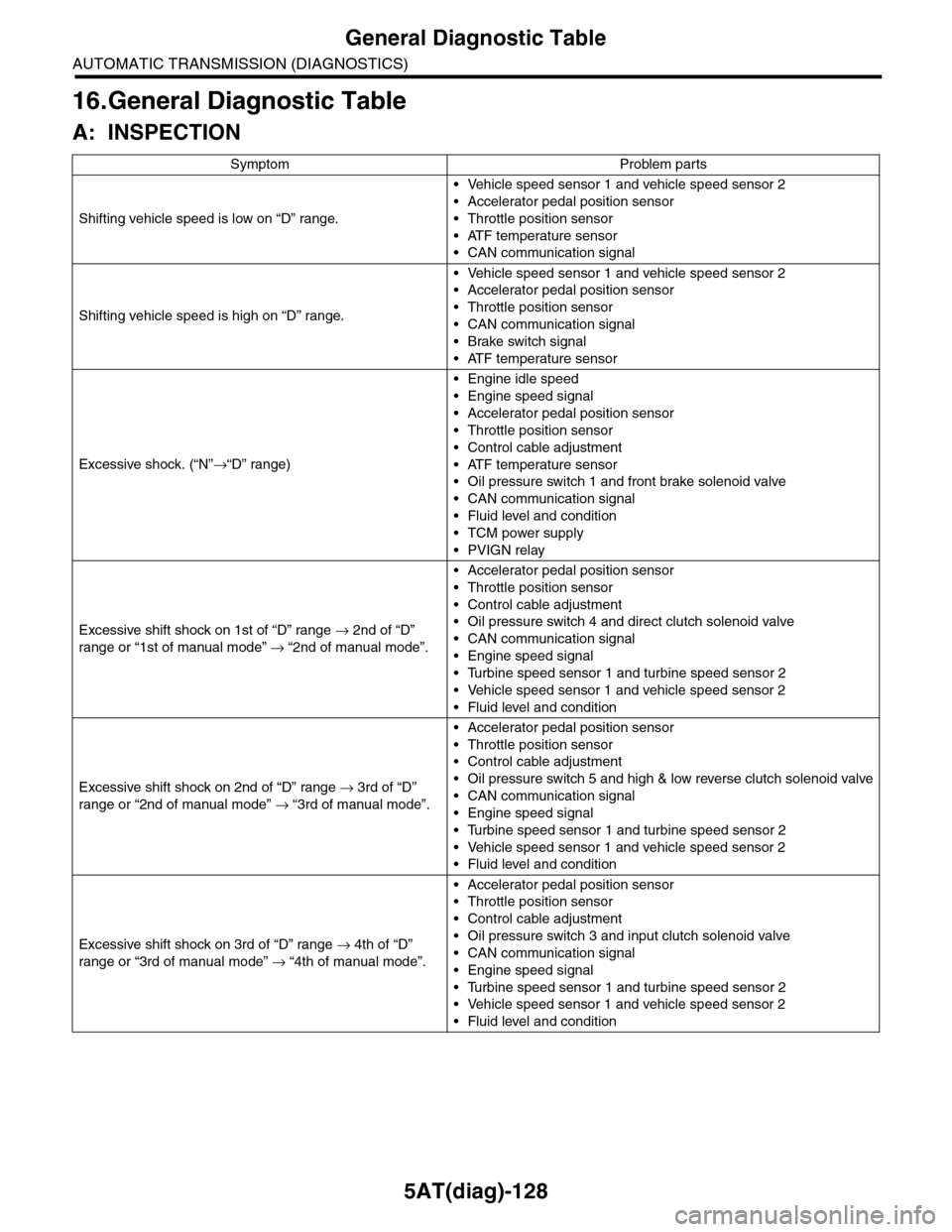
16.General Diagnostic Table
A: INSPECTION
Symptom Problem parts
Shifting vehicle speed is low on “D” range.
•Vehicle speed sensor 1 and vehicle speed sensor 2
•Accelerator pedal position sensor
•Throttle position sensor
•ATF temperature sensor
•CAN communication signal
Shifting vehicle speed is high on “D” range.
•Vehicle speed sensor 1 and vehicle speed sensor 2
•Accelerator pedal position sensor
•Throttle position sensor
•CAN communication signal
•Brake switch signal
•ATF temperature sensor
Excessive shock. (“N”→“D” range)
•Engine idle speed
•Engine speed signal
•Accelerator pedal position sensor
•Throttle position sensor
•Control cable adjustment
•ATF temperature sensor
•Oil pressure switch 1 and front brake solenoid valve
•CAN communication signal
•Fluid level and condition
•TCM power supply
•PVIGN relay
Excessive shift shock on 1st of “D” range → 2nd of “D”
range or “1st of manual mode” → “2nd of manual mode”.
•Accelerator pedal position sensor
•Throttle position sensor
•Control cable adjustment
•Oil pressure switch 4 and direct clutch solenoid valve
•CAN communication signal
•Engine speed signal
•Turbine speed sensor 1 and turbine speed sensor 2
•Vehicle speed sensor 1 and vehicle speed sensor 2
•Fluid level and condition
Excessive shift shock on 2nd of “D” range → 3rd of “D”
range or “2nd of manual mode” → “3rd of manual mode”.
•Accelerator pedal position sensor
•Throttle position sensor
•Control cable adjustment
•Oil pressure switch 5 and high & low reverse clutch solenoid valve
•CAN communication signal
•Engine speed signal
•Turbine speed sensor 1 and turbine speed sensor 2
•Vehicle speed sensor 1 and vehicle speed sensor 2
•Fluid level and condition
Excessive shift shock on 3rd of “D” range → 4th of “D”
range or “3rd of manual mode” → “4th of manual mode”.
•Accelerator pedal position sensor
•Throttle position sensor
•Control cable adjustment
•Oil pressure switch 3 and input clutch solenoid valve
•CAN communication signal
•Engine speed signal
•Turbine speed sensor 1 and turbine speed sensor 2
•Vehicle speed sensor 1 and vehicle speed sensor 2
•Fluid level and condition
Page 2246 of 2453
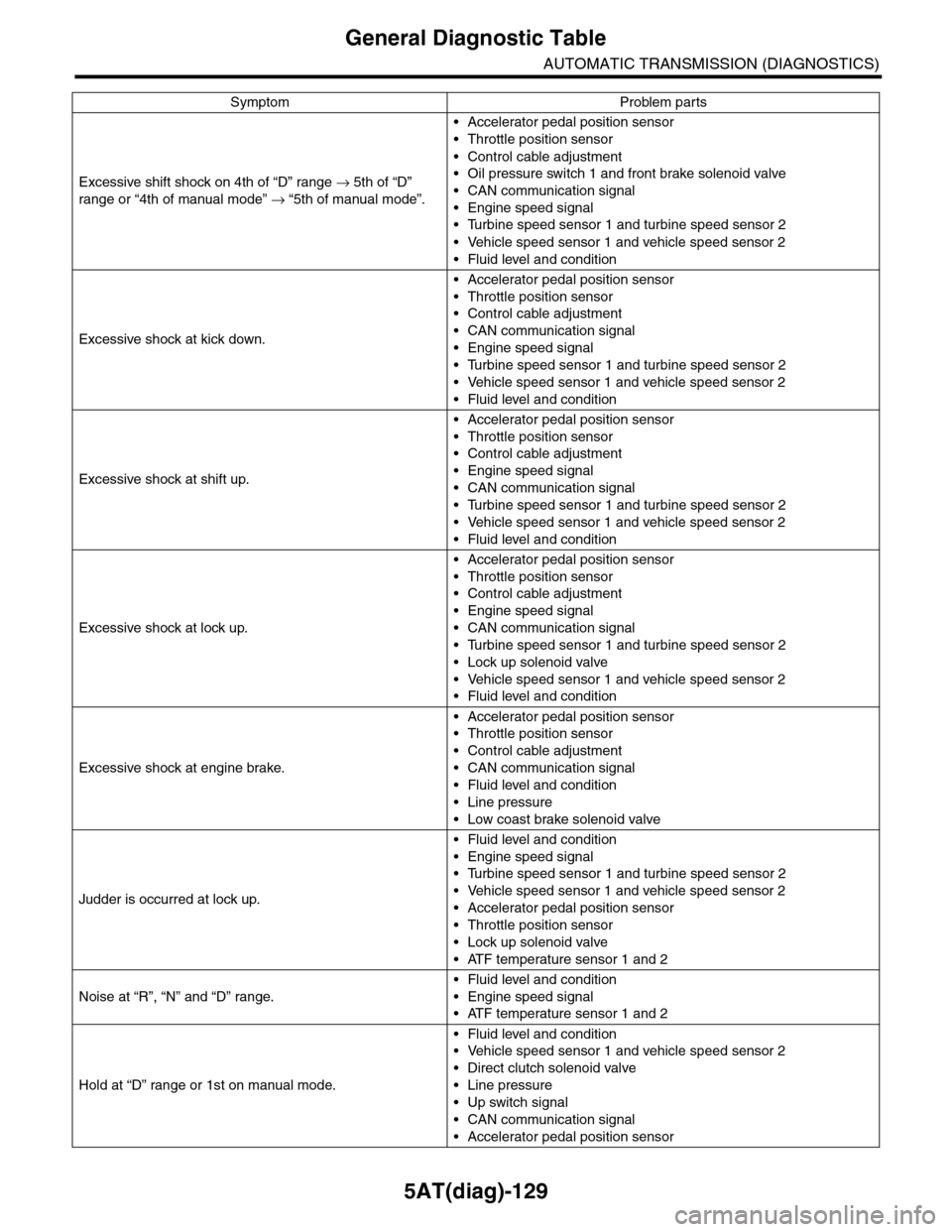
5AT(diag)-129
General Diagnostic Table
AUTOMATIC TRANSMISSION (DIAGNOSTICS)
Excessive shift shock on 4th of “D” range → 5th of “D”
range or “4th of manual mode” → “5th of manual mode”.
•Accelerator pedal position sensor
•Throttle position sensor
•Control cable adjustment
•Oil pressure switch 1 and front brake solenoid valve
•CAN communication signal
•Engine speed signal
•Turbine speed sensor 1 and turbine speed sensor 2
•Vehicle speed sensor 1 and vehicle speed sensor 2
•Fluid level and condition
Excessive shock at kick down.
•Accelerator pedal position sensor
•Throttle position sensor
•Control cable adjustment
•CAN communication signal
•Engine speed signal
•Turbine speed sensor 1 and turbine speed sensor 2
•Vehicle speed sensor 1 and vehicle speed sensor 2
•Fluid level and condition
Excessive shock at shift up.
•Accelerator pedal position sensor
•Throttle position sensor
•Control cable adjustment
•Engine speed signal
•CAN communication signal
•Turbine speed sensor 1 and turbine speed sensor 2
•Vehicle speed sensor 1 and vehicle speed sensor 2
•Fluid level and condition
Excessive shock at lock up.
•Accelerator pedal position sensor
•Throttle position sensor
•Control cable adjustment
•Engine speed signal
•CAN communication signal
•Turbine speed sensor 1 and turbine speed sensor 2
•Lock up solenoid valve
•Vehicle speed sensor 1 and vehicle speed sensor 2
•Fluid level and condition
Excessive shock at engine brake.
•Accelerator pedal position sensor
•Throttle position sensor
•Control cable adjustment
•CAN communication signal
•Fluid level and condition
•Line pressure
•Low coast brake solenoid valve
Judder is occurred at lock up.
•Fluid level and condition
•Engine speed signal
•Turbine speed sensor 1 and turbine speed sensor 2
•Vehicle speed sensor 1 and vehicle speed sensor 2
•Accelerator pedal position sensor
•Throttle position sensor
•Lock up solenoid valve
•ATF temperature sensor 1 and 2
Noise at “R”, “N” and “D” range.
•Fluid level and condition
•Engine speed signal
•ATF temperature sensor 1 and 2
Hold at “D” range or 1st on manual mode.
•Fluid level and condition
•Vehicle speed sensor 1 and vehicle speed sensor 2
•Direct clutch solenoid valve
•Line pressure
•Up switch signal
•CAN communication signal
•Accelerator pedal position sensor
Symptom Problem parts
Page 2247 of 2453
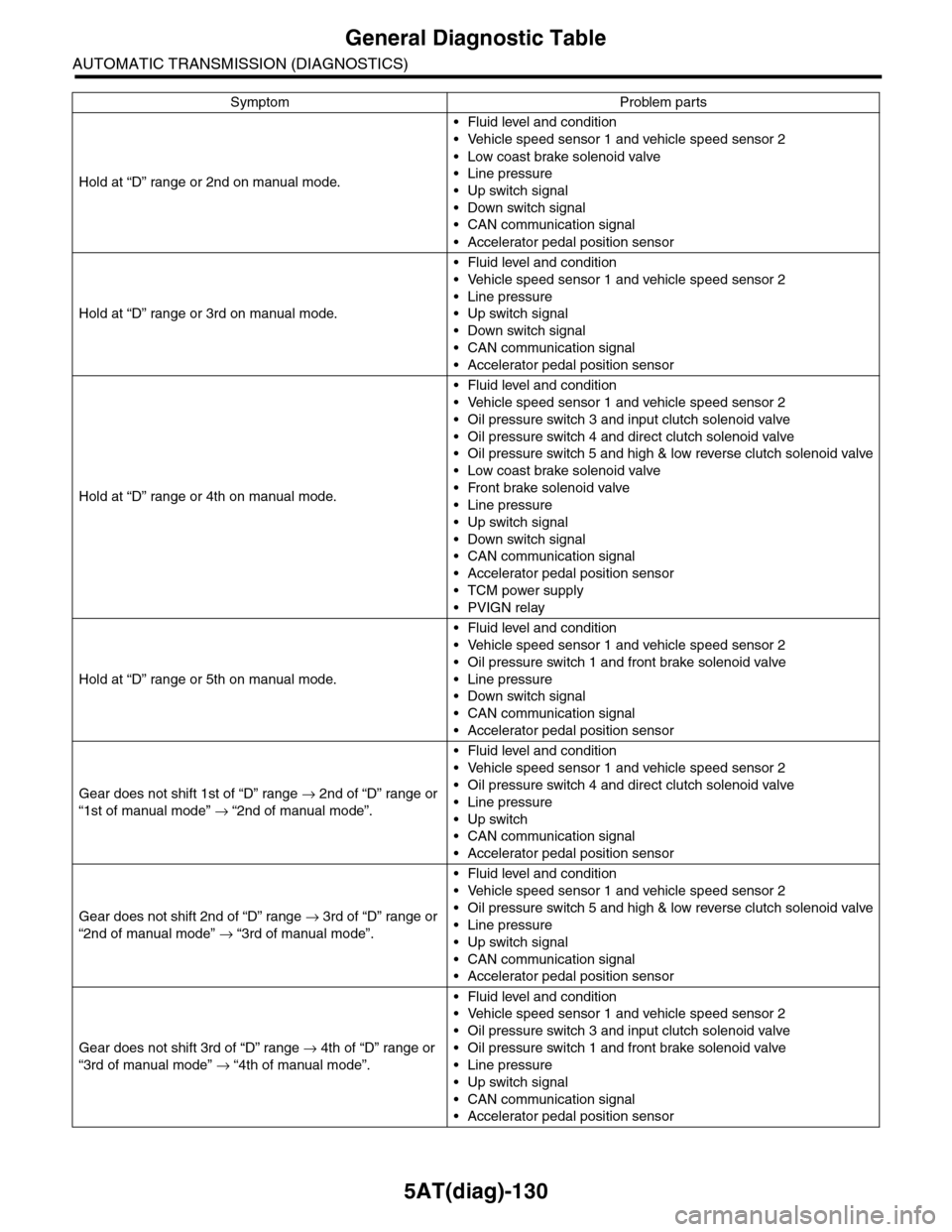
5AT(diag)-130
General Diagnostic Table
AUTOMATIC TRANSMISSION (DIAGNOSTICS)
Hold at “D” range or 2nd on manual mode.
•Fluid level and condition
•Vehicle speed sensor 1 and vehicle speed sensor 2
•Low coast brake solenoid valve
•Line pressure
•Up switch signal
•Down switch signal
•CAN communication signal
•Accelerator pedal position sensor
Hold at “D” range or 3rd on manual mode.
•Fluid level and condition
•Vehicle speed sensor 1 and vehicle speed sensor 2
•Line pressure
•Up switch signal
•Down switch signal
•CAN communication signal
•Accelerator pedal position sensor
Hold at “D” range or 4th on manual mode.
•Fluid level and condition
•Vehicle speed sensor 1 and vehicle speed sensor 2
•Oil pressure switch 3 and input clutch solenoid valve
•Oil pressure switch 4 and direct clutch solenoid valve
•Oil pressure switch 5 and high & low reverse clutch solenoid valve
•Low coast brake solenoid valve
•Front brake solenoid valve
•Line pressure
•Up switch signal
•Down switch signal
•CAN communication signal
•Accelerator pedal position sensor
•TCM power supply
•PVIGN relay
Hold at “D” range or 5th on manual mode.
•Fluid level and condition
•Vehicle speed sensor 1 and vehicle speed sensor 2
•Oil pressure switch 1 and front brake solenoid valve
•Line pressure
•Down switch signal
•CAN communication signal
•Accelerator pedal position sensor
Gear does not shift 1st of “D” range → 2nd of “D” range or
“1st of manual mode” → “2nd of manual mode”.
•Fluid level and condition
•Vehicle speed sensor 1 and vehicle speed sensor 2
•Oil pressure switch 4 and direct clutch solenoid valve
•Line pressure
•Up switch
•CAN communication signal
•Accelerator pedal position sensor
Gear does not shift 2nd of “D” range → 3rd of “D” range or
“2nd of manual mode” → “3rd of manual mode”.
•Fluid level and condition
•Vehicle speed sensor 1 and vehicle speed sensor 2
•Oil pressure switch 5 and high & low reverse clutch solenoid valve
•Line pressure
•Up switch signal
•CAN communication signal
•Accelerator pedal position sensor
Gear does not shift 3rd of “D” range → 4th of “D” range or
“3rd of manual mode” → “4th of manual mode”.
•Fluid level and condition
•Vehicle speed sensor 1 and vehicle speed sensor 2
•Oil pressure switch 3 and input clutch solenoid valve
•Oil pressure switch 1 and front brake solenoid valve
•Line pressure
•Up switch signal
•CAN communication signal
•Accelerator pedal position sensor
Symptom Problem parts