lock SUZUKI AERIO 2007 1.G Workshop Manual
[x] Cancel search | Manufacturer: SUZUKI, Model Year: 2007, Model line: AERIO, Model: SUZUKI AERIO 2007 1.GPages: 232, PDF Size: 3.34 MB
Page 166 of 232
Downloaded from www.Manualslib.com manuals search engine 9-13 INSPECTION AND MAINTENANCE
54G27-03E
Replace the Oil Filter
60A198
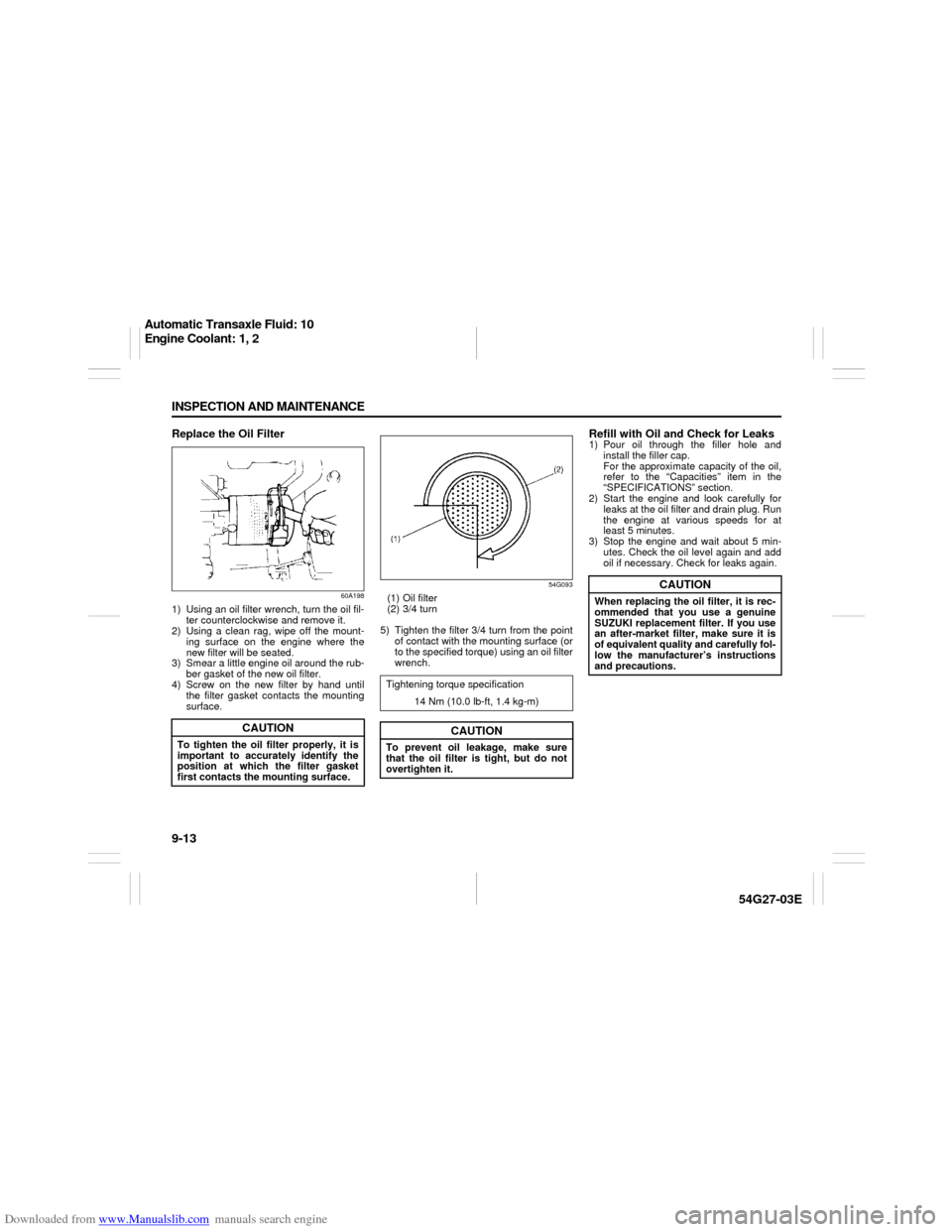
1) Using an oil filter wrench, turn the oil fil-
ter counterclockwise and remove it.
2) Using a clean rag, wipe off the mount-
ing surface on the engine where the
new filter will be seated.
3) Smear a little engine oil around the rub-
ber gasket of the new oil filter.
4) Screw on the new filter by hand until
the filter gasket contacts the mounting
surface.
54G093
(1) Oil filter
(2) 3/4 turn
5) Tighten the filter 3/4 turn from the point
of contact with the mounting surface (or
to the specified torque) using an oil filter
wrench.
Refill with Oil and Check for Leaks1) Pour oil through the filler hole and
install the filler cap.
For the approximate capacity of the oil,
refer to the “Capacities” item in the
“SPECIFICATIONS” section.
2) Start the engine and look carefully for
leaks at the oil filter and drain plug. Run
the engine at various speeds for at
least 5 minutes.
3) Stop the engine and wait about 5 min-
utes. Check the oil level again and add
oil if necessary. Check for leaks again.
CAUTION
To tighten the oil filter properly, it is
important to accurately identify the
position at which the filter gasket
first contacts the mounting surface.
Tightening torque specification
14 Nm (10.0 lb-ft, 1.4 kg-m)
CAUTION
To prevent oil leakage, make sure
that the oil filter is tight, but do not
overtighten it.
CAUTION
When replacing the oil filter, it is rec-
ommended that you use a genuine
SUZUKI replacement filter. If you use
an after-market filter, make sure it is
of equivalent quality and carefully fol-
low the manufacturer’s instructions
and precautions.
Automatic Transaxle Fluid: 10
Engine Coolant: 1, 2
Page 177 of 232
Downloaded from www.Manualslib.com manuals search engine 9-24 INSPECTION AND MAINTENANCE
54G27-03E
Parking Brake Lever
60A226
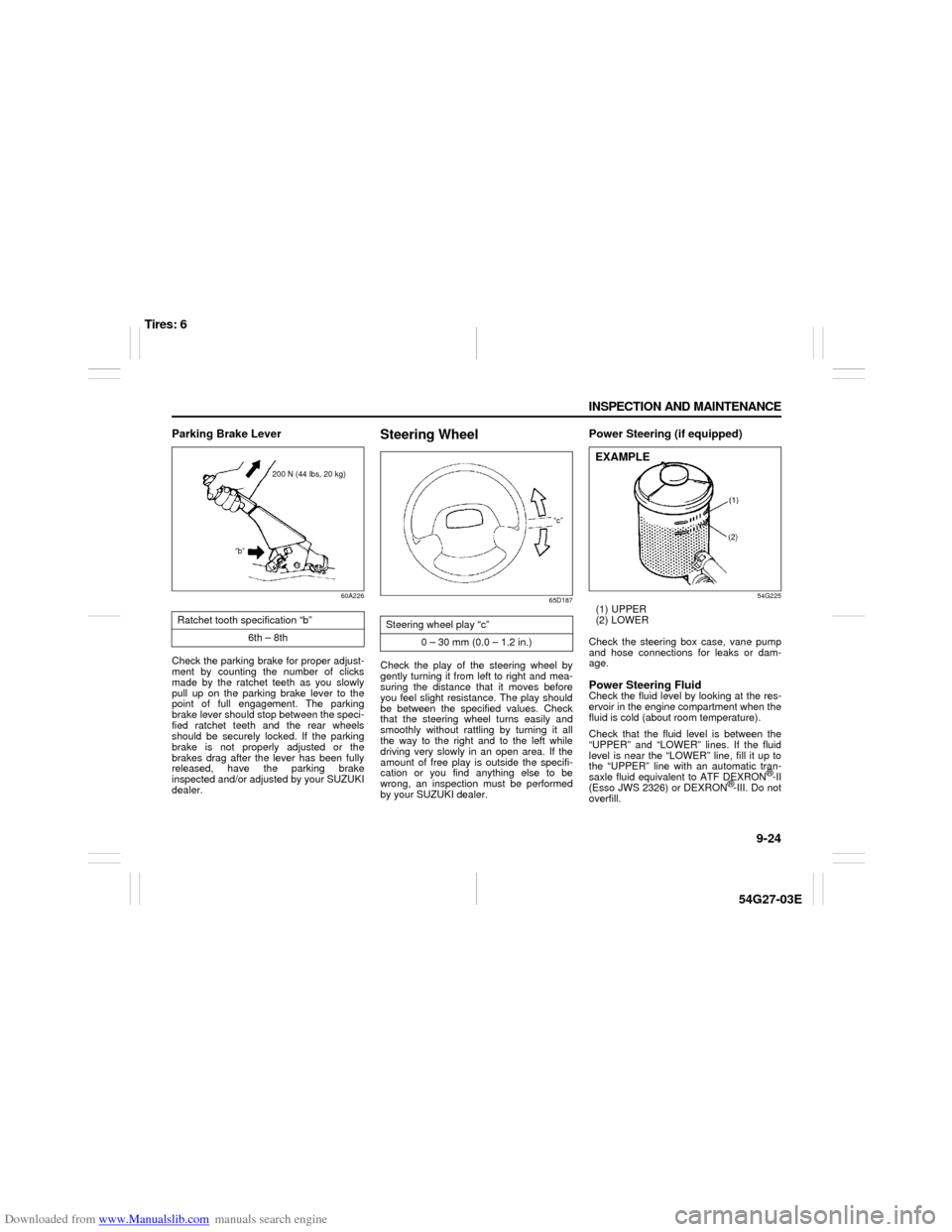
Check the parking brake for proper adjust-
ment by counting the number of clicks
made by the ratchet teeth as you slowly
pull up on the parking brake lever to the
point of full engagement. The parking
brake lever should stop between the speci-
fied ratchet teeth and the rear wheels
should be securely locked. If the parking
brake is not properly adjusted or the
brakes drag after the lever has been fully
released, have the parking brake
inspected and/or adjusted by your SUZUKI
dealer.
Steering Wheel
65D187
Check the play of the steering wheel by
gently turning it from left to right and mea-
suring the distance that it moves before
you feel slight resistance. The play should
be between the specified values. Check
that the steering wheel turns easily and
smoothly without rattling by turning it all
the way to the right and to the left while
driving very slowly in an open area. If the
amount of free play is outside the specifi-
cation or you find anything else to be
wrong, an inspection must be performed
by your SUZUKI dealer.
Power Steering (if equipped)
54G225
(1) UPPER
(2) LOWER
Check the steering box case, vane pump
and hose connections for leaks or dam-
age.Power Steering FluidCheck the fluid level by looking at the res-
ervoir in the engine compartment when the
fluid is cold (about room temperature).
Check that the fluid level is between the
“UPPER” and “LOWER” lines. If the fluid
level is near the “LOWER” line, fill it up to
the “UPPER” line with an automatic tran-
saxle fluid equivalent to ATF DEXRON
®-II
(Esso JWS 2326) or DEXRON
®-III. Do not
overfill. Ratchet tooth specification “b”
6th – 8th
200 N (44 lbs, 20 kg)
“b”
Steering wheel play “c”
0 – 30 mm (0.0 – 1.2 in.)
“c”
EXAMPLE
Tires: 6
Page 180 of 232
Downloaded from www.Manualslib.com manuals search engine 9-27 INSPECTION AND MAINTENANCE
54G27-03E
54G307
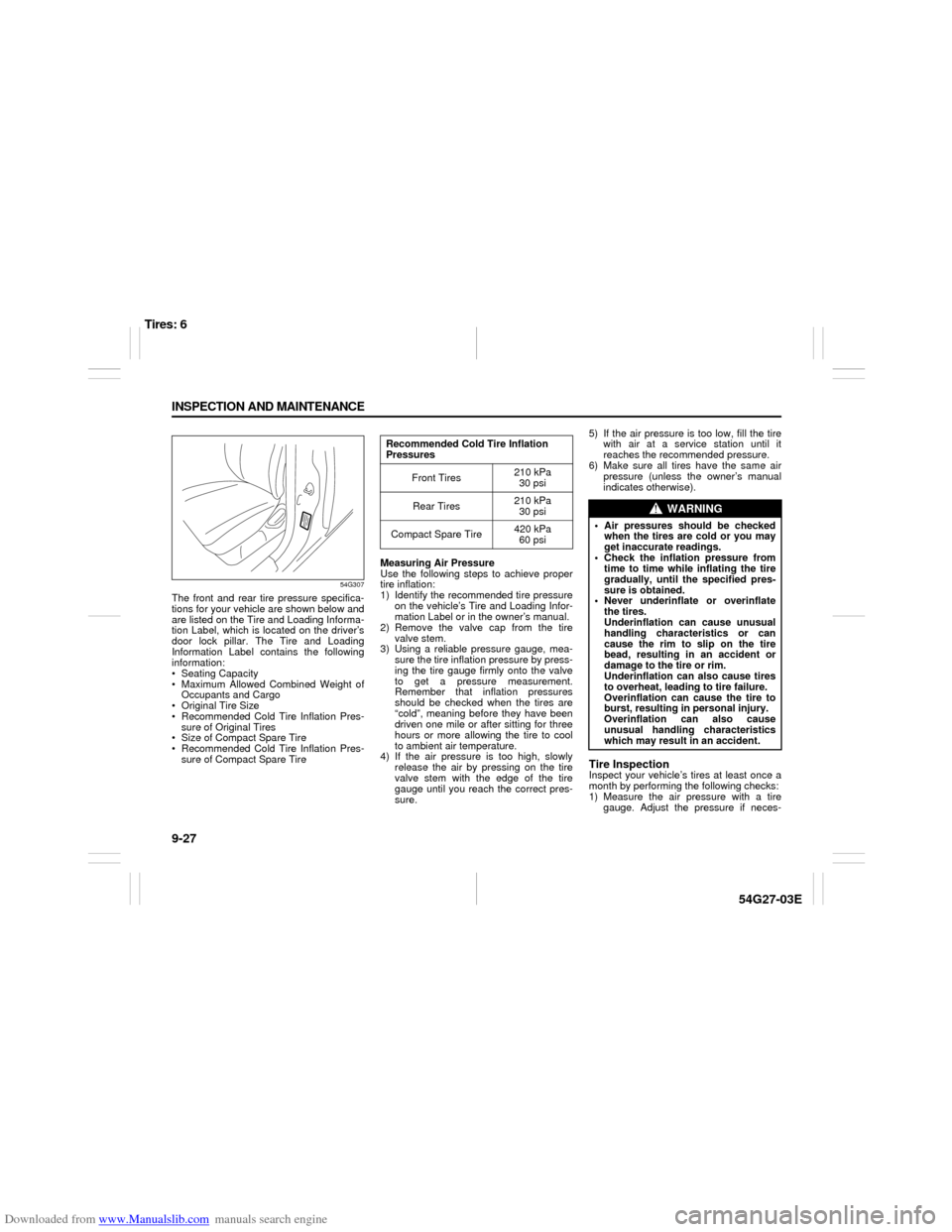
The front and rear tire pressure specifica-
tions for your vehicle are shown below and
are listed on the Tire and Loading Informa-
tion Label, which is located on the driver’s
door lock pillar. The Tire and Loading
Information Label contains the following
information:
Seating Capacity
Maximum Allowed Combined Weight of
Occupants and Cargo
Original Tire Size
Recommended Cold Tire Inflation Pres-
sure of Original Tires
Size of Compact Spare Tire
Recommended Cold Tire Inflation Pres-
sure of Compact Spare TireMeasuring Air Pressure
Use the following steps to achieve proper
tire inflation:
1) Identify the recommended tire pressure
on the vehicle’s Tire and Loading Infor-
mation Label or in the owner’s manual.
2) Remove the valve cap from the tire
valve stem.
3) Using a reliable pressure gauge, mea-
sure the tire inflation pressure by press-
ing the tire gauge firmly onto the valve
to get a pressure measurement.
Remember that inflation pressures
should be checked when the tires are
“cold”, meaning before they have been
driven one mile or after sitting for three
hours or more allowing the tire to cool
to ambient air temperature.
4) If the air pressure is too high, slowly
release the air by pressing on the tire
valve stem with the edge of the tire
gauge until you reach the correct pres-
sure.5) If the air pressure is too low, fill the tire
with air at a service station until it
reaches the recommended pressure.
6) Make sure all tires have the same air
pressure (unless the owner’s manual
indicates otherwise).
Tire InspectionInspect your vehicle’s tires at least once a
month by performing the following checks:
1) Measure the air pressure with a tire
gauge. Adjust the pressure if neces-
Recommended Cold Tire Inflation
Pressures
Front Tires210 kPa
30 psi
Rear Tires210 kPa
30 psi
Compact Spare Tire420 kPa
60 psi
WARNING
Air pressures should be checked
when the tires are cold or you may
get inaccurate readings.
Check the inflation pressure from
time to time while inflating the tire
gradually, until the specified pres-
sure is obtained.
Never underinflate or overinflate
the tires.
Underinflation can cause unusual
handling characteristics or can
cause the rim to slip on the tire
bead, resulting in an accident or
damage to the tire or rim.
Underinflation can also cause tires
to overheat, leading to tire failure.
Overinflation can cause the tire to
burst, resulting in personal injury.
Overinflation can also cause
unusual handling characteristics
which may result in an accident.
Tires: 6
Page 192 of 232
Downloaded from www.Manualslib.com manuals search engine 9-39 INSPECTION AND MAINTENANCE
54G27-03E
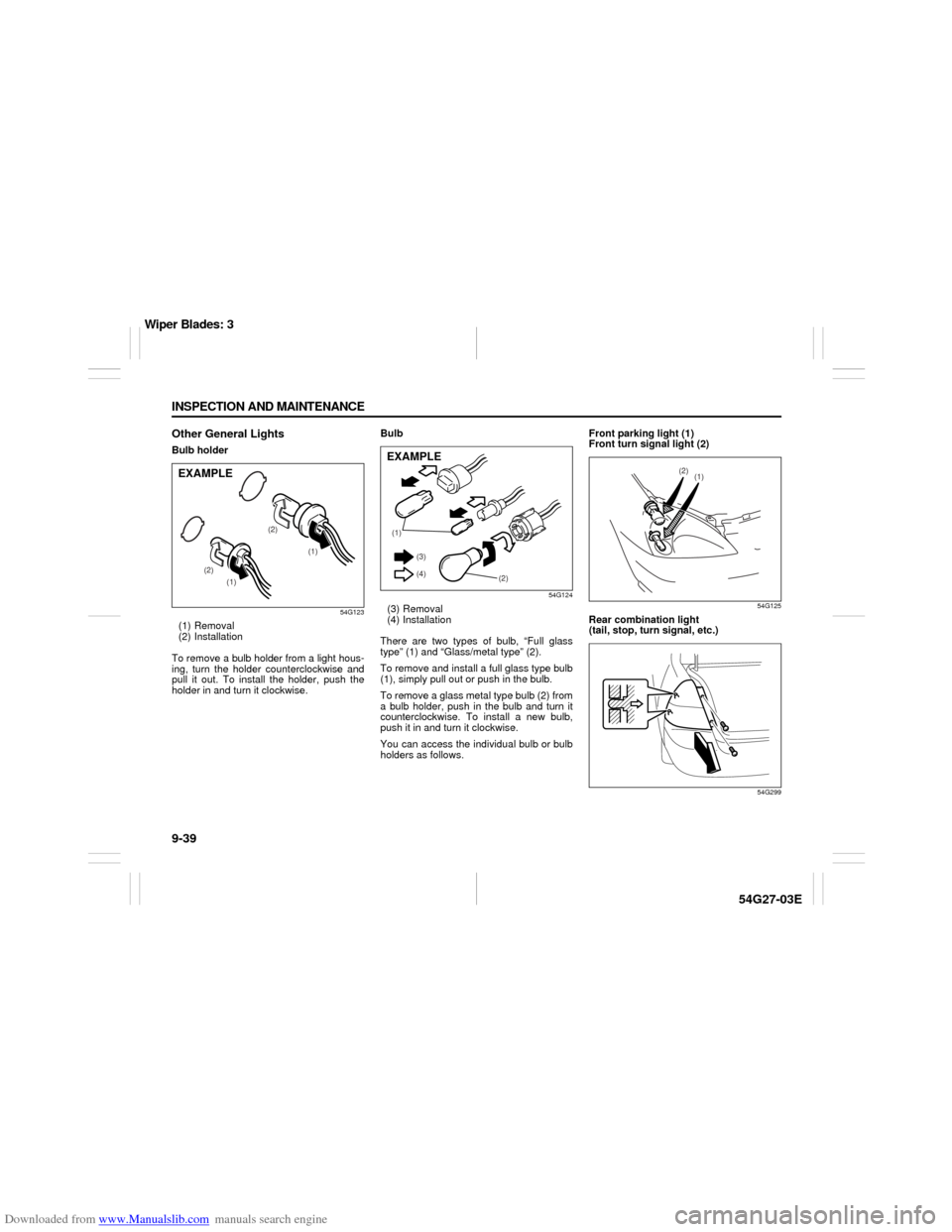
Other General LightsBulb holder
54G123
(1) Removal
(2) Installation
To remove a bulb holder from a light hous-
ing, turn the holder counterclockwise and
pull it out. To install the holder, push the
holder in and turn it clockwise.Bulb
54G124
(3) Removal
(4) Installation
There are two types of bulb, “Full glass
type” (1) and “Glass/metal type” (2).
To remove and install a full glass type bulb
(1), simply pull out or push in the bulb.
To remove a glass metal type bulb (2) from
a bulb holder, push in the bulb and turn it
counterclockwise. To install a new bulb,
push it in and turn it clockwise.
You can access the individual bulb or bulb
holders as follows.Front parking light (1)
Front turn signal light (2)
54G125
Rear combination light
(tail, stop, turn signal, etc.)
54G299
(1)
(1) (2)(2)
EXAMPLE
(1)
(2) (3)
(4)EXAMPLE
(1) (2)
Wiper Blades: 3
Page 195 of 232
Downloaded from www.Manualslib.com manuals search engine 9-42 INSPECTION AND MAINTENANCE
54G27-03E
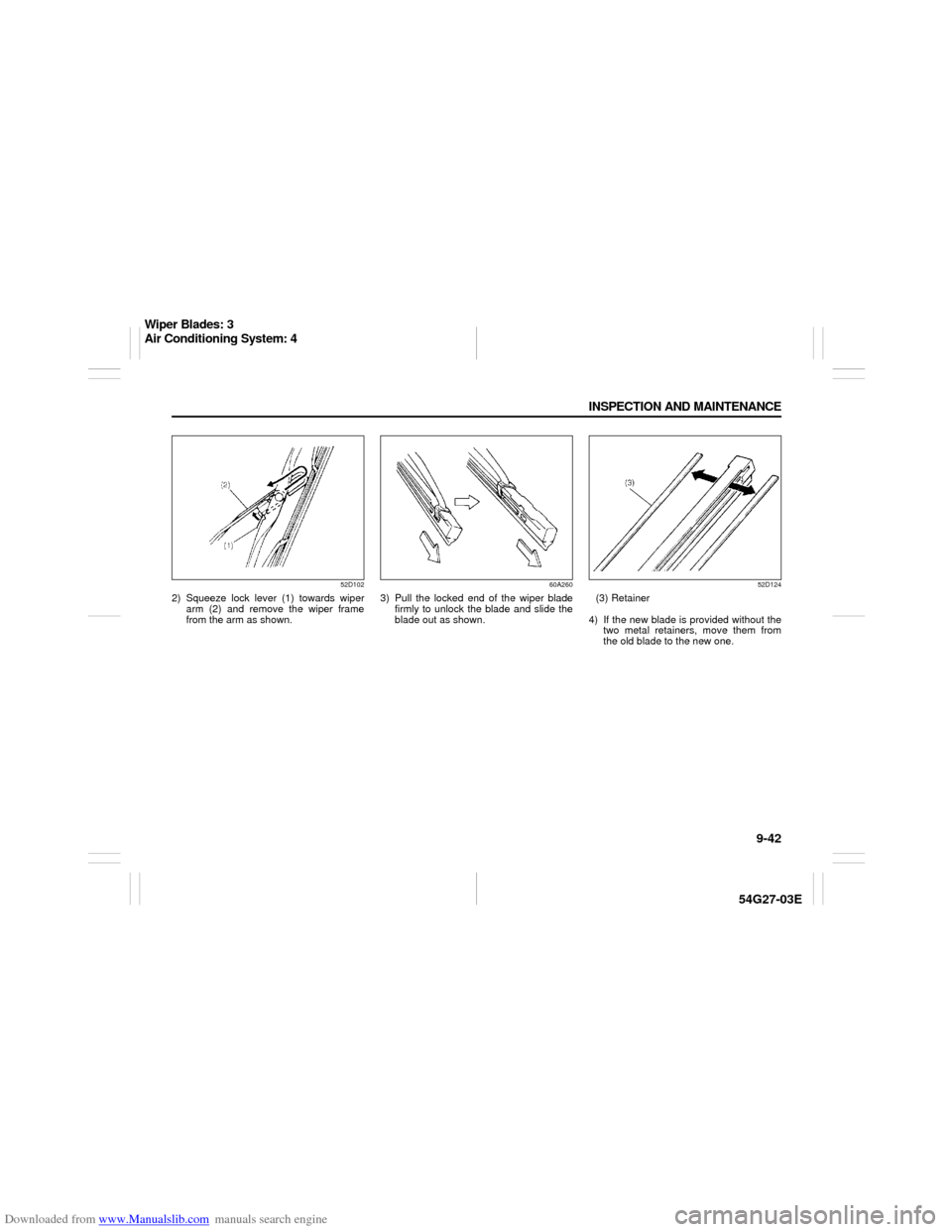
52D102
2) Squeeze lock lever (1) towards wiper
arm (2) and remove the wiper frame
from the arm as shown.
60A260
3) Pull the locked end of the wiper blade
firmly to unlock the blade and slide the
blade out as shown.
52D124
(3) Retainer
4) If the new blade is provided without the
two metal retainers, move them from
the old blade to the new one.
Wiper Blades: 3
Air Conditioning System: 4
Page 196 of 232
Downloaded from www.Manualslib.com manuals search engine 9-43 INSPECTION AND MAINTENANCE
54G27-03E
Installation
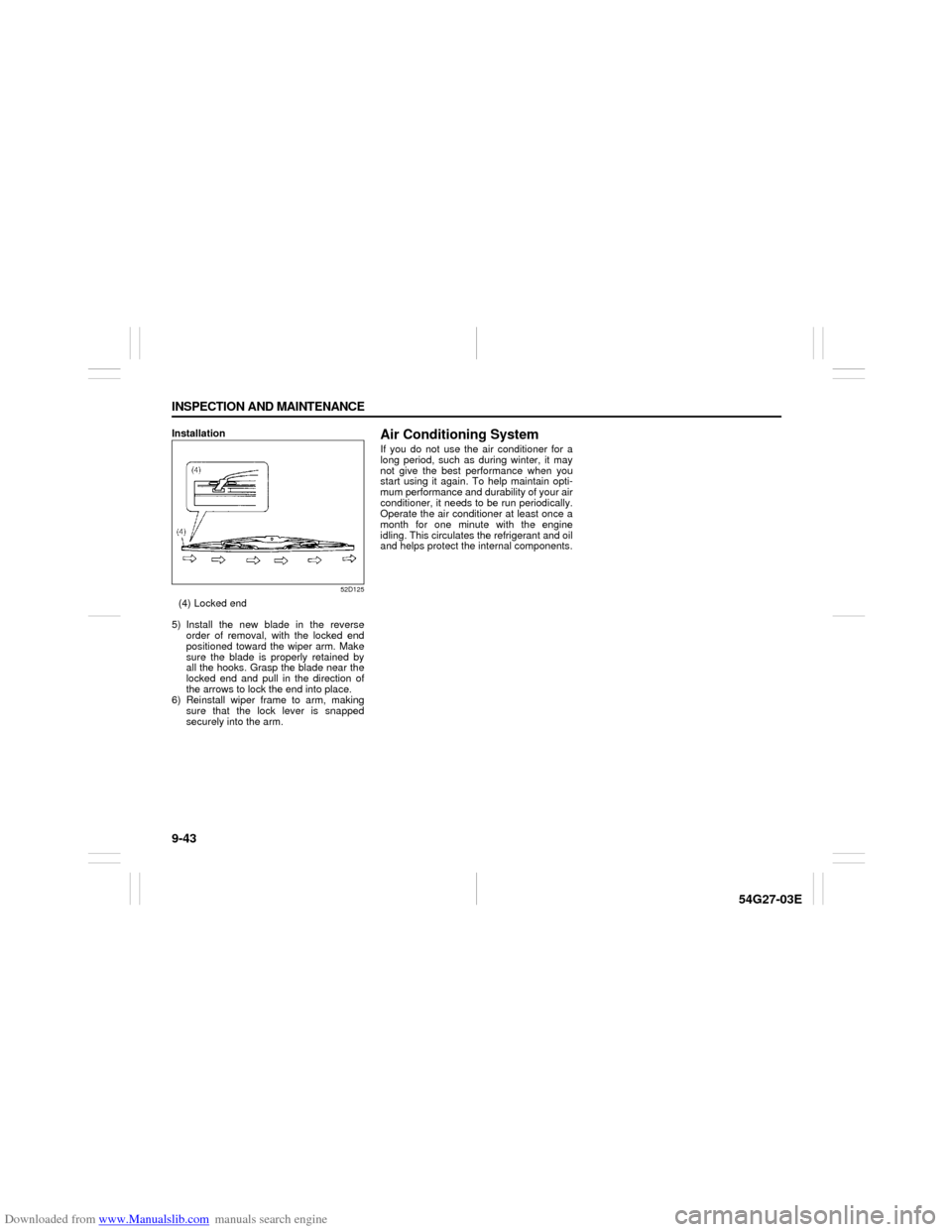
52D125
(4) Locked end
5) Install the new blade in the reverse
order of removal, with the locked end
positioned toward the wiper arm. Make
sure the blade is properly retained by
all the hooks. Grasp the blade near the
locked end and pull in the direction of
the arrows to lock the end into place.
6) Reinstall wiper frame to arm, making
sure that the lock lever is snapped
securely into the arm.
Air Conditioning SystemIf you do not use the air conditioner for a
long period, such as during winter, it may
not give the best performance when you
start using it again. To help maintain opti-
mum performance and durability of your air
conditioner, it needs to be run periodically.
Operate the air conditioner at least once a
month for one minute with the engine
idling. This circulates the refrigerant and oil
and helps protect the internal components.
Page 198 of 232
Downloaded from www.Manualslib.com manuals search engine 10-1 EMERGENCY SERVICE
54G27-03E
Jacking Instructions
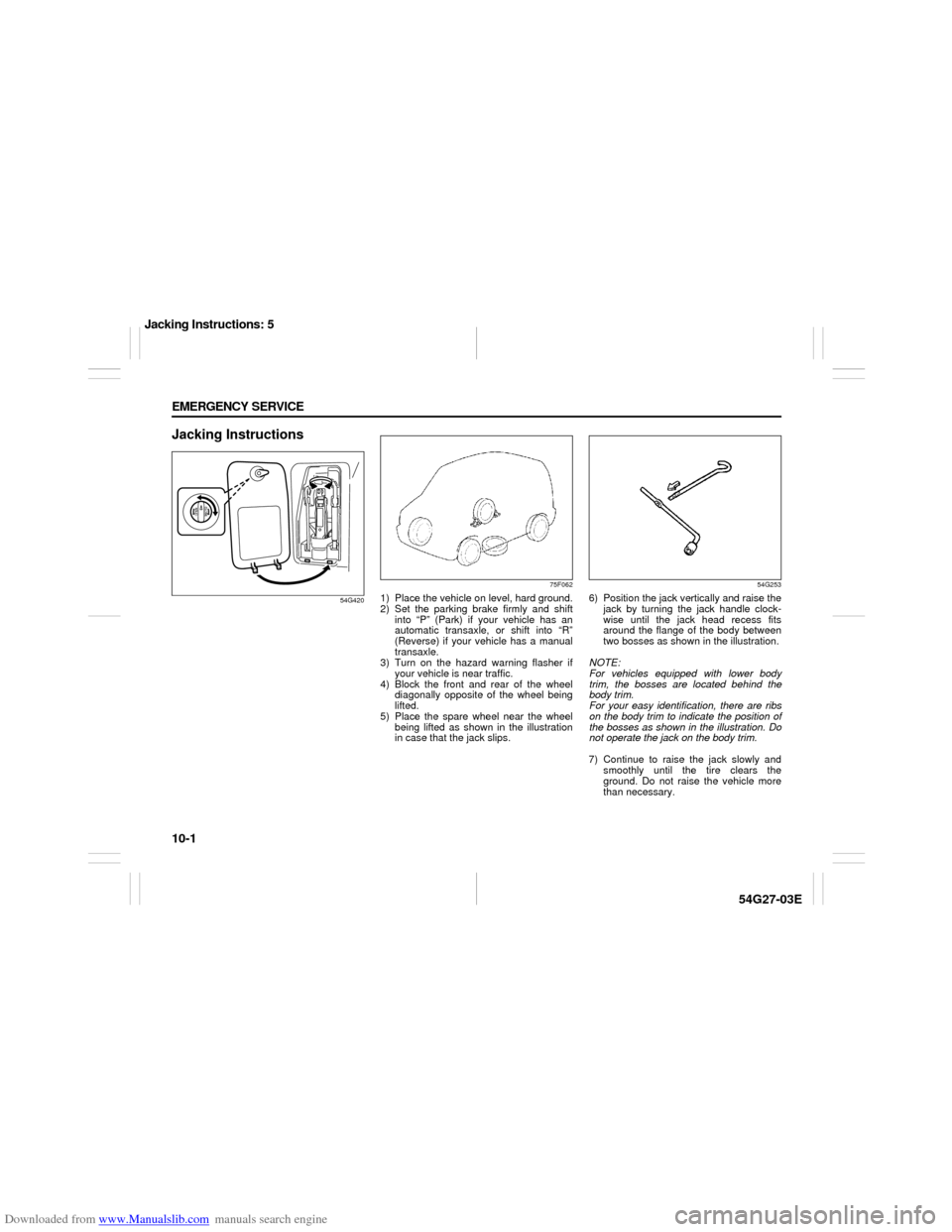
54G42075F062
1) Place the vehicle on level, hard ground.
2) Set the parking brake firmly and shift
into “P” (Park) if your vehicle has an
automatic transaxle, or shift into “R”
(Reverse) if your vehicle has a manual
transaxle.
3) Turn on the hazard warning flasher if
your vehicle is near traffic.
4) Block the front and rear of the wheel
diagonally opposite of the wheel being
lifted.
5) Place the spare wheel near the wheel
being lifted as shown in the illustration
in case that the jack slips.
54G253
6) Position the jack vertically and raise the
jack by turning the jack handle clock-
wise until the jack head recess fits
around the flange of the body between
two bosses as shown in the illustration.
NOTE:
For vehicles equipped with lower body
trim, the bosses are located behind the
body trim.
For your easy identification, there are ribs
on the body trim to indicate the position of
the bosses as shown in the illustration. Do
not operate the jack on the body trim.
7) Continue to raise the jack slowly and
smoothly until the tire clears the
ground. Do not raise the vehicle more
than necessary.
Jacking Instructions: 5
Page 205 of 232
Downloaded from www.Manualslib.com manuals search engine 10-8 EMERGENCY SERVICE
54G27-03E
If You Can Not Shift
Automatic Transaxle
Gearshift Lever Out of “P”
(PARK)
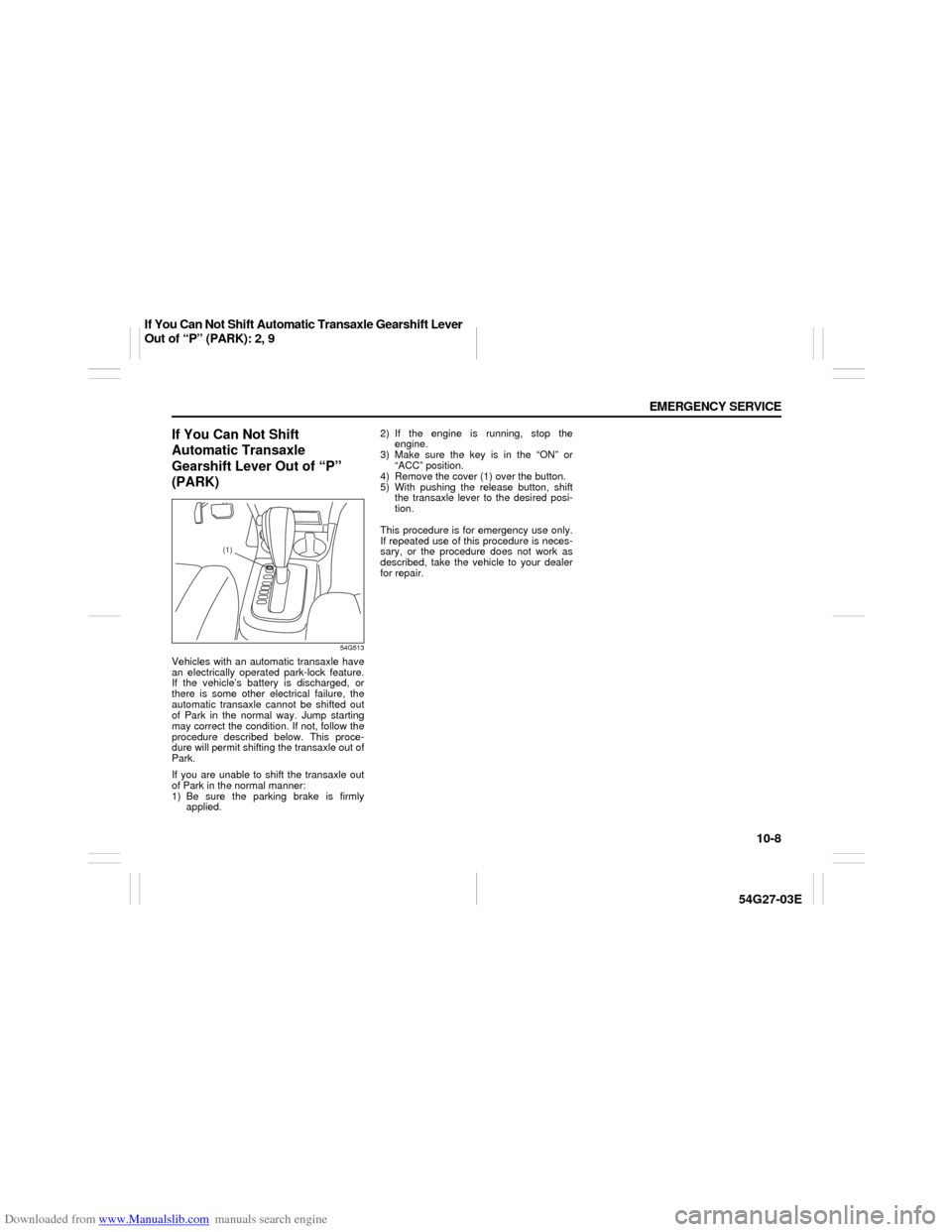
54G513
Vehicles with an automatic transaxle have
an electrically operated park-lock feature.
If the vehicle’s battery is discharged, or
there is some other electrical failure, the
automatic transaxle cannot be shifted out
of Park in the normal way. Jump starting
may correct the condition. If not, follow the
procedure described below. This proce-
dure will permit shifting the transaxle out of
Park.
If you are unable to shift the transaxle out
of Park in the normal manner:
1) Be sure the parking brake is firmly
applied.2) If the engine is running, stop the
engine.
3) Make sure the key is in the “ON” or
“ACC” position.
4) Remove the cover (1) over the button.
5) With pushing the release button, shift
the transaxle lever to the desired posi-
tion.
This procedure is for emergency use only.
If repeated use of this procedure is neces-
sary, or the procedure does not work as
described, take the vehicle to your dealer
for repair.
(1)
If You Can Not Shift Automatic Transaxle Gearshift Lever
Out of “P” (PARK): 2, 9
Page 214 of 232
Downloaded from www.Manualslib.com manuals search engine 12-1 GENERAL INFORMATION
54G27-03E
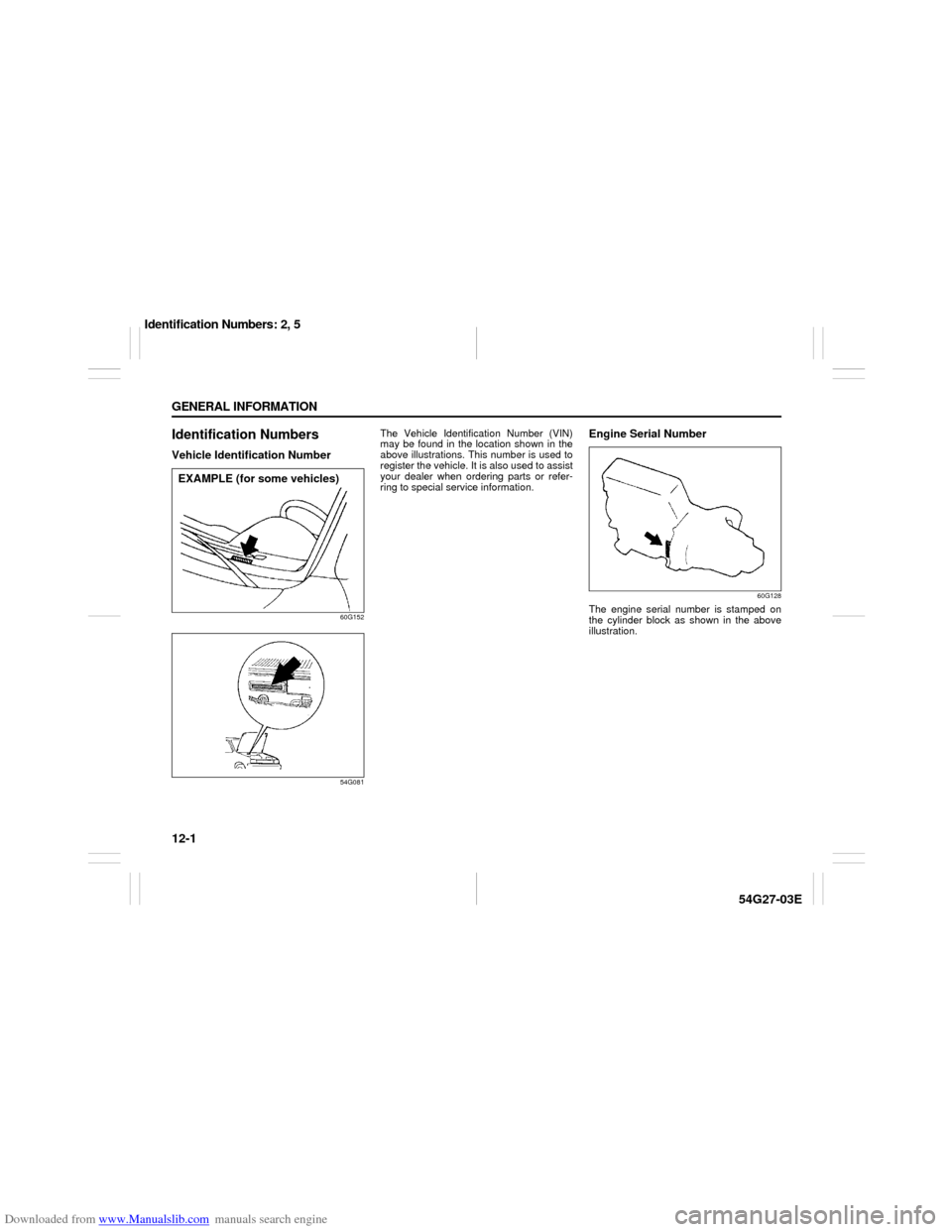
Identification NumbersVehicle Identification Number
60G152
54G081
The Vehicle Identification Number (VIN)
may be found in the location shown in the
above illustrations. This number is used to
register the vehicle. It is also used to assist
your dealer when ordering parts or refer-
ring to special service information.
Engine Serial Number
60G128
The engine serial number is stamped on
the cylinder block as shown in the above
illustration.
EXAMPLE (for some vehicles)
Identification Numbers: 2, 5
Page 215 of 232
Downloaded from www.Manualslib.com manuals search engine 12-2 GENERAL INFORMATION
54G27-03E
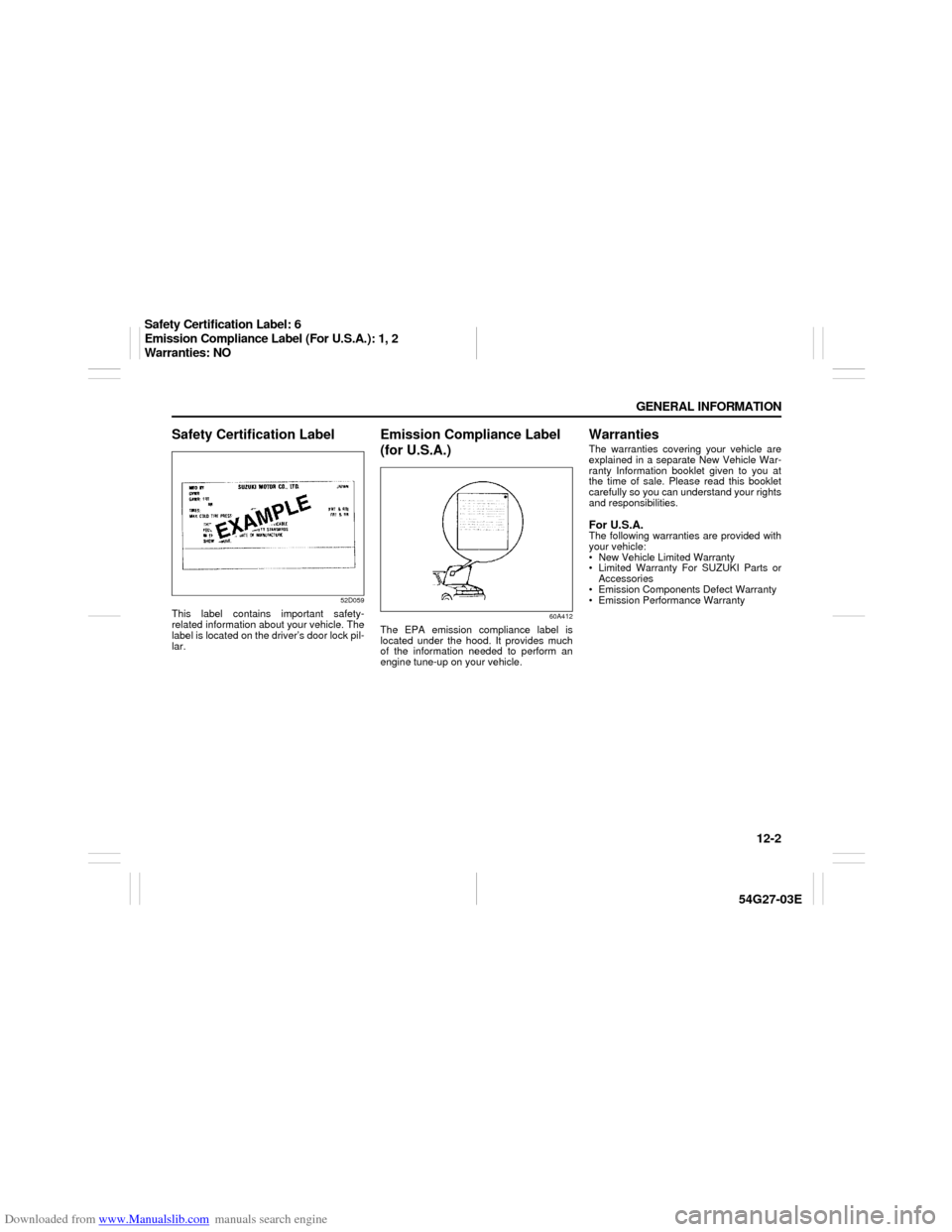
Safety Certification Label
52D059
This label contains important safety-
related information about your vehicle. The
label is located on the driver’s door lock pil-
lar.
Emission Compliance Label
(for U.S.A.)
60A412
The EPA emission compliance label is
located under the hood. It provides much
of the information needed to perform an
engine tune-up on your vehicle.
WarrantiesThe warranties covering your vehicle are
explained in a separate New Vehicle War-
ranty Information booklet given to you at
the time of sale. Please read this booklet
carefully so you can understand your rights
and responsibilities.For U.S.A.The following warranties are provided with
your vehicle:
New Vehicle Limited Warranty
Limited Warranty For SUZUKI Parts or
Accessories
Emission Components Defect Warranty
Emission Performance Warranty
Safety Certification Label: 6
Emission Compliance Label (For U.S.A.): 1, 2
Warranties: NO