air SUZUKI CELERIO 2019 Owners Manual
[x] Cancel search | Manufacturer: SUZUKI, Model Year: 2019, Model line: CELERIO, Model: SUZUKI CELERIO 2019Pages: 201, PDF Size: 5.82 MB
Page 17 of 201
0-5
76MH1-74E
WARRANTY POLICY
Maruti Suzuki India Limited (hereinafter called “Maruti Suzuki”), warrants that each new Maruti Suzuki vehicle distributed in Indiaby Maruti Suzuki and sold by an authorised Maruti Suzuki dealerwill be free, under normal use and service, from any defects inmaterial and workmanship at the time of manufacture SUBJECTTO THE FOLLOWING TERMS AND CONDITIONS:
(1) Qualification:To qualify for this warranty:(a) The Maruti Suzuki vehicle must be delivered by MarutiSuzuki authorised dealer and set-up, serviced by MarutiSuzuki authorised dealer / service station.(b) The warranty registration card in respect of each vehiclemust be completed by the dealer at the time of delivery ofthe vehicle and dealer should retain the same.
(2) Term:The term of the warranty shall be twenty-four (24) months or40,000 kilometers (whichever occurs first) from the date ofdelivery to the first owner.
(3) Maruti Suzuki Warranty Obligation:If any defect(s) should be found in a Maruti Suzuki vehicle withinthe term stipulated above, Maruti Suzuki’s only obligation is torepair or replace at its sole discretion any part shown to be defec-tive, with a new part or the equivalent at no cost to the owner forparts or labour, when Maruti Suzuki acknowledges that such adefect is attributable to faulty material or workmanship at the timeof manufacture. The owner is responsible for any repair or replace-ments which are not covered by this warranty.
(4) Limitation:This warranty shall not apply to:1) Normal maintenance service required other than the threefree services, including without limitation, oil and fluidchanges, headlight aiming, fastener retightening, wheel bal-ancing, wheel alignment and tyre rotation, cleaning of injec-tors, adjustments of carburettor, ignition timing, clutch andvalve clearance.
2) The replacement of normal wear parts including without lim-itation, bulbs, tyres and tubes, spark plugs, belts, hoses, fil-ters, wiper blades, brushes, contact points, fuses, clutch disc,brake shoes, brake pads, cable and all rubber parts (exceptoil seal and glass run).
3) Any vehicle which has been used for competition or racing.
4) Any repairs or replacement required as a result of accidentsor collision.
5) Any defects caused by misuse, negligence, abnormal use orinsufficient care.
6) Any vehicle which has been modified or altered, includingwithout limitation, the installation of performance accesso- ries.
7) Any vehicle on which parts or accessories not approved byMaruti Suzuki have been used.
8) Any vehicle which has not been operated in accordance withthe operating instructions in the Maruti Suzuki Owner’s Man-ual.
9) Any vehicle which has not received, during the warranty term,the service inspections prescribed in the Maruti SuzukiOwner’s Manual.
10) Any vehicle which has been assembled, disassembled,adjusted or repaired by other than an Maruti Suzuki autho-rised dealer/service station.
6
Page 19 of 201
0-7
76MH1-74E
EMISSION WARRANTY POLICY
Maruti Suzuki offers the Emission Warranty on all Maruti Suzuki vehicles (apart from the Regular Warranty and will run parallel tothe regular product warranty) only in four metropolitan cities (NewDelhi, Kolkata, Mumbai and Chennai) with effect from July 1st,2001.
Te r m s :The Emission Warranty will be applicable for 80,000 kms or 3years (Whichever comes earlier) from the date of delivery to thefirst owner. The remaining warranty terms will be valid in case ofany change in ownership provided the production of all valid docu-ments.
Conditions:1. Under Emission Waranty, Warranty claims will be admitted fora prima facie examination, in case vehicle fails to meet theEmission Standard as specified in sub rule (2) of rule no. 115of Central Motor Vehicles Rules (CMVR), 1989.
2. The warranty claims will only be accepted after examinationcarried out by Maruti Suzuki or it’s dealer which leads to firmconclusions that thea) Original settings have not been tempered in any case.b) Part (as given in Annexure - A) has a manufacturing defect.c) Vehicle is unable to meet the Emission Standards (as givenin 1.), inspite of the vehicle having been maintained andused in accordance with the instructions as specified inOwner’s Manual and Service Booklet and the used fuel anddifferent oils (Engine oil, Transmission oil, Brake oil etc.) arealso as per specification.
3. The method of examination for deciding the warranty of theparts will be at the sole discretion of Maruti Suzuki and it’sdealer and results of the examination will be final and binding.If after examination, the warrantable condition is not estab-lished, Maruti Suzuki and it’s dealer has the right to charge all,or part of the cost of such examination.
4. Under Emission Warranty, the parts (as given in Annexure - A)will be changed free of cost, but the consumables will becharged as per actual.
5. If the part covered under Emission Warranty or the associatedparts, are not independently replaceable, on account of thesebeing integral parts of a complete assembly, Maruti Suzuki andit’s dealer will have the sole discretion to replace either theentire assembly or by using some of the parts of the systemthrough suitable repairs or modifications.
6. Any consequential repairs or replacement of parts which maybe found necessary to establish compliance of Emission War-ranty, will not be considered under warranty, unless the same isunder product warranty. The consumable will be charged asper actual under such repair or replacement.
7. Maruti Suzuki will not be responsible for the cost of transporta-tion of the vehicle to the nearest Maruti Suzuki dealer work-shop or any loss due to non-availability of the vehicle duringthe period of lodging of a warranty claim and examination and/or repair by Maruti Suzuki dealer.
8. Maruti Suzuki will not be responsible for any penalty that maybe charged by statutory authorities on account of failure tocomply with the EMISSION STANDARDS.
9. Emission Waranty will not be affected on the change of owner,provided all the documents are available.
8
Page 21 of 201
1-1
FUEL RECOMMENDATION
76MH1-74E
10
Fuel Recommendation
Petrol EngineYou must use unleaded petrol with an octane number (RON) of 91 or higher.
Petrol/Ethanol blends Blends of unleaded petrol and ethanol (grain alcohol), also known as gasohol, arecommercially available in some areas. Blends of this type may be used in your vehicle if they are no more than 10% etha-nol. Make sure this petrol-ethanol blend has octane ratings no lower than those recommended for petrol.
Petrol/Methanol blends Blends of unleaded petrol and methanol(wood alcohol) are also commercially avail- able in some areas. DO NOT USE fuels containing more than 5% methanol underany circumstances. Fuel system damage or vehicle performance problems resulting from the use of such fuels are not theresponsibility of MARUTI SUZUKI and may not be covered under the New Vehicle Warranty.Fuels containing 5% or less methanol may be suitable for use in your vehicle if they contain cosolvents and corrosion inhibi-tors.
NOTE: If you are not satisfied with the driveability or fuel economy of your vehicle when youare using a petrol/alcohol blend, you should switch back to unleaded petrol con- taining no alcohol.
Diesel EngineThe diesel fuel should be with CetaneNumber (CN) higher than 51 and sulfur content less than 350 ppm (parts per mil- lion). MARUTI SUZUKI recommends touse the diesel fuel conformable to EN590. Do not use marine diesel fuel, heating oils and so forth.NOTICE
The fuel tank has an air space toallow for fuel expansion in hotweather. If you continue to add fuel after the filler nozzle has automati- cally shut off or an initial blowbackoccurs, the air chamber will become full. Exposure to heat when fully fuelled in this manner will result inleakage due to fuel expansion. To prevent such fuel leakage, stop filling after the filler nozzle has automati-cally shut off, or when using an alter- native non-automatic system, initial vent blowback occurs.
NOTICE
Be careful not to spill fuel containingalcohol while refueling. If fuel is spilled on the vehicle body, wipe it up immediately. Fuels containing alco-hol can cause paint damage, which is not covered under the New Vehicle Limited Warranty.
NOTICE
The fuel tank has an air space toallow for fuel expansion in hotweather. If you continue to add fuel after the filler nozzle has automati- cally shut off or an initial blow backoccurs, the air chamber will become full. Exposure to heat when fully fuelled in this manner will result inleakage due to fuel expansion. To prevent such fuel leakage, stop filling after the filler nozzle has automati-cally shut off, or when using an alter- native non-automatic system, initial vent blowback occurs.
NOTICE
Be careful not to spill fuel containingalcohol while refueling. If fuel is spilled on the vehicle body, wipe it up immediately. Fuels containing alco-hol can cause paint damage, which is not covered under the New Vehicle Limited Warranty.
76MH1-74E
Page 22 of 201
76MH1-74E
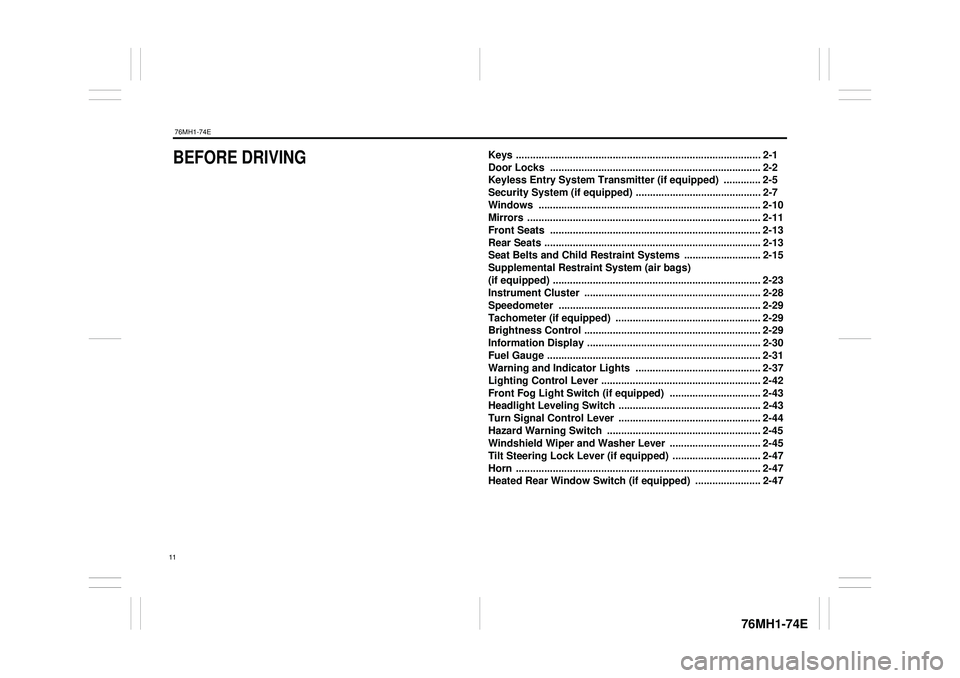
BEFORE DRIVINGKeys ...................................................................................... 2-1
Door Locks .......................................................................... 2-2
Keyless Entry System Transmitte r (if equipped) ............. 2-5
Security System (if equipped) ............................................ 2-7
Windows .............................................................................. 2-10
Mirrors .................................................................................. 2-11
Front Seats .......................................................................... 2-13
Rear Seats ............................................................................ 2-13
Seat Belts and Child Restraint Systems ........................... 2-15
Supplemental Restraint System (air bags)
(if equipped) ......................................................................... 2-23
Instrument Cluster .............................................................. 2-28
Speedometer ....................................................................... 2-29
Tachometer (if equipped) ................................................... 2-29
Brightness Control .............................................................. 2-29
Information Display ............................................................. 2-30
Fuel Gauge ........................................................................... 2-31
Warning and Indicator Lights ............................................ 2-37
Lighting Control Lever ........................................................ 2-42
Front Fog Light Switch (if equipped) ................................ 2-43
Headlight Leveling Switch .................................................. 2-43
Turn Signal Control Lever .................................................. 2-44
Hazard Warning Switch ...................................................... 2-45
Windshield Wiper and Washer L ever ................................ 2-45
Tilt Steering Lock Lever (if equipped) ............................... 2-47
Horn ...................................................................................... 2-47
Heated Rear Window Switch (if equipped) ....................... 2-47
11
76MH1-74E
Page 23 of 201
2-1
BEFORE DRIVING
76MH1-74E
76MH1-74E
Keys
51KM024
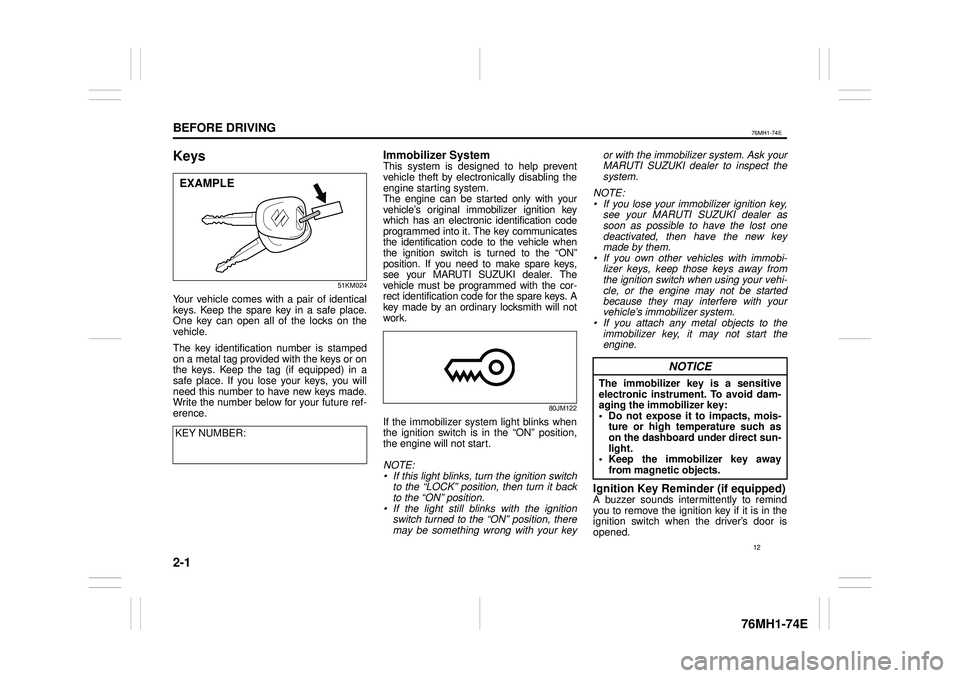
Your vehicle comes with a pair of identical keys. Keep the spare key in a safe place.One key can open all of the locks on the vehicle.
The key identification number is stamped on a metal tag provided with the keys or on the keys. Keep the tag (if equipped) in asafe place. If you lose your keys, you will need this number to have new keys made. Write the number below for your future ref-erence.
Immobilizer SystemThis system is designed to help preventvehicle theft by electronically disabling the engine starting system. The engine can be started only with yourvehicle’s original immobilizer ignition key which has an electronic identification code programmed into it. The key communicatesthe identification code to the vehicle when the ignition switch is turned to the “ON” position. If you need to make spare keys,see your MARUTI SUZUKI dealer. The vehicle must be programmed with the cor- rect identification code for the spare keys. Akey made by an ordinary locksmith will not work.
80JM122
If the immobilizer system light blinks when the ignition switch is in the “ON” position, the engine will not start.
NOTE: • If this light blinks, turn the ignition switchto the “LOCK” position, then turn it back to the “ON” position.• If the light still blinks with the ignitionswitch turned to the “ON” position, theremay be something wrong with your key
or with the immobilizer system. Ask your MARUTI SUZUKI dealer to inspect the system.
NOTE:• If you lose your immobilizer ignition key,see your MARUTI SUZUKI dealer as soon as possible to have the lost onedeactivated, then have the new key made by them.• If you own other vehicles with immobi-lizer keys, keep those keys away fromthe ignition switch when using your vehi- cle, or the engine may not be started because they may interfere with yourvehicle’s immobilizer system.• If you attach any metal objects to theimmobilizer key, it may not start theengine.
Ignition Key Reminder (if equipped)A buzzer sounds intermittently to remindyou to remove the ignition key if it is in the ignition switch when the driver’s door is opened.
KEY NUMBER:
EXAMPLE
NOTICE
The immobilizer key is a sensitiveelectronic instrument. To avoid dam- aging the immobilizer key: • Do not expose it to impacts, mois-ture or high temperature such as on the dashboard under direct sun- light.• Keep the immobilizer key awayfrom magnetic objects.
12
Page 33 of 201
2-11
BEFORE DRIVING
76MH1-74E
76MH1-74E
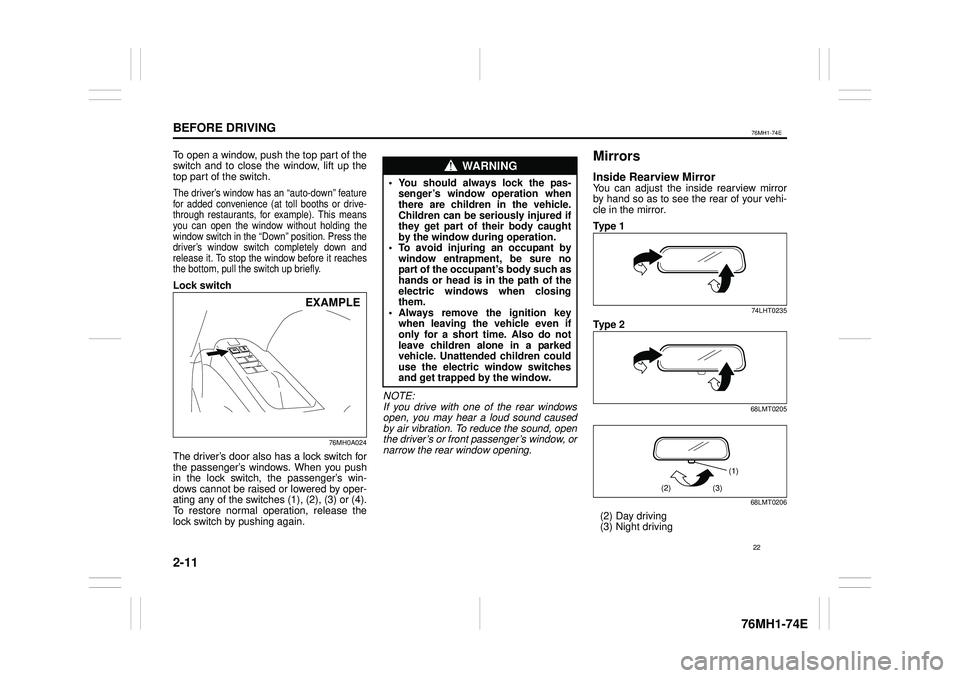
To open a window, push the top part of the switch and to close the window, lift up the top part of the switch.
The driver’s window has an “auto-down” featurefor added convenience (at toll booths or drive-through restaurants, for example). This means you can open the window without holding the window switch in the “Down” position. Press thedriver’s window switch completely down and release it. To stop the window before it reaches the bottom, pull the switch up briefly.
Lock switch
76MH0A024
The driver’s door also has a lock switch forthe passenger’s windows. When you pushin the lock switch, the passenger’s win- dows cannot be raised or lowered by oper- ating any of the switches (1), (2), (3) or (4).To restore normal operation, release the lock switch by pushing again.
NOTE:If you drive with one of the rear windows open, you may hear a loud sound causedby air vibration. To reduce the sound, open the driver’s or front passenger’s window, or narrow the rear window opening.
Mirrors
Inside Rearview MirrorYou can adjust the inside rearview mirrorby hand so as to see the rear of your vehi-cle in the mirror.
Ty p e 1
74LHT0235
Ty p e 2
68LMT0205
68LMT0206
(2) Day driving (3) Night driving
EXAMPLE
WA R N I N G
• You should always lock the pas-senger’s window operation whenthere are children in the vehicle. Children can be seriously injured if they get part of their body caughtby the window during operation.• To avoid injuring an occupant bywindow entrapment, be sure nopart of the occupant’s body such as hands or head is in the path of the electric windows when closingthem.• Always remove the ignition keywhen leaving the vehicle even ifonly for a short time. Also do not leave children alone in a parked vehicle. Unattended children coulduse the electric window switches and get trapped by the window.
(1)
(2)(3)
22
Page 37 of 201
2-15
BEFORE DRIVING
76MH1-74E
76MH1-74E
Seat Belts and Child Restraint
Systems
65D231S
65D606 65D201
WA R N I N G
Wear Your Seat Belts at All Times.
WA R N I N G
An air bag supplements, or adds to, the frontal crash protection offered by seat belts. The driver and all pas-sengers must be properly restrained by wearing seat belts at all times, whether or not an air bag is mountedat their seating position, to minimizethe risk of severe injury or death inthe event of a crash.
WA R N I N G
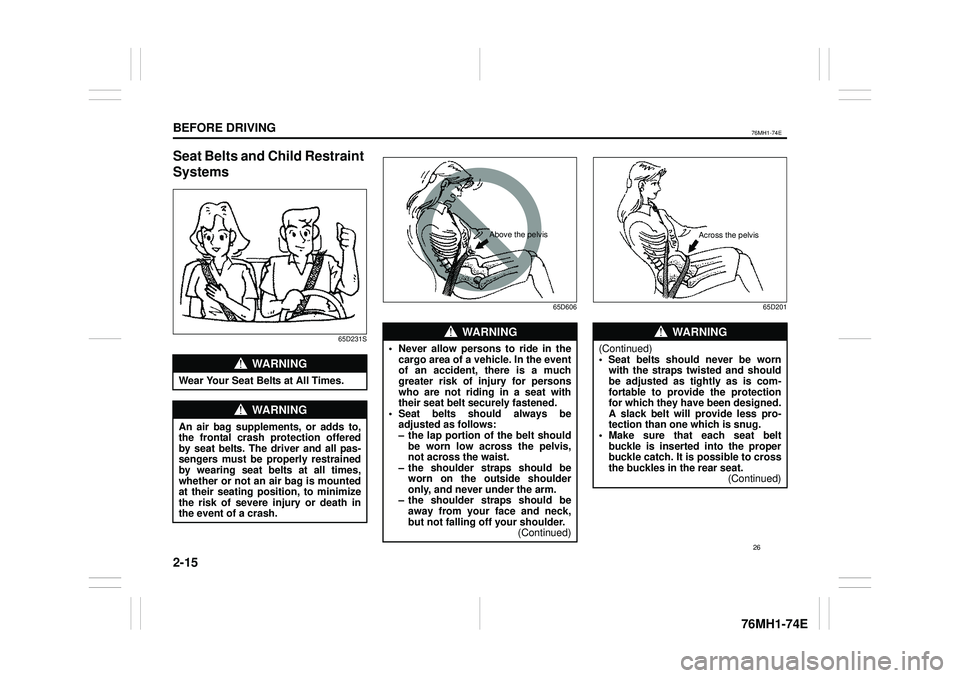
• Never allow persons to ride in thecargo area of a vehicle. In the eventof an accident, there is a much greater risk of injury for persons who are not riding in a seat withtheir seat belt securely fastened.• Seat belts should always beadjusted as follows:– the lap portion of the belt shouldbe worn low across the pelvis,not across the waist.– the shoulder straps should beworn on the outside shoulderonly, and never under the arm.– the shoulder straps should beaway from your face and neck,but not falling off your shoulder.(Continued)
Above the pelvis
WA R N I N G
(Continued)• Seat belts should never be wornwith the straps twisted and should be adjusted as tightly as is com- fortable to provide the protectionfor which they have been designed. A slack belt will provide less pro- tection than one which is snug.• Make sure that each seat beltbuckle is inserted into the properbuckle catch. It is possible to crossthe buckles in the rear seat.(Continued)
Across the pelvis
26
Page 42 of 201
2-20
BEFORE DRIVING
76MH1-74E
76MH1-74E
Child restraint
79J222
Booster seat
79J223
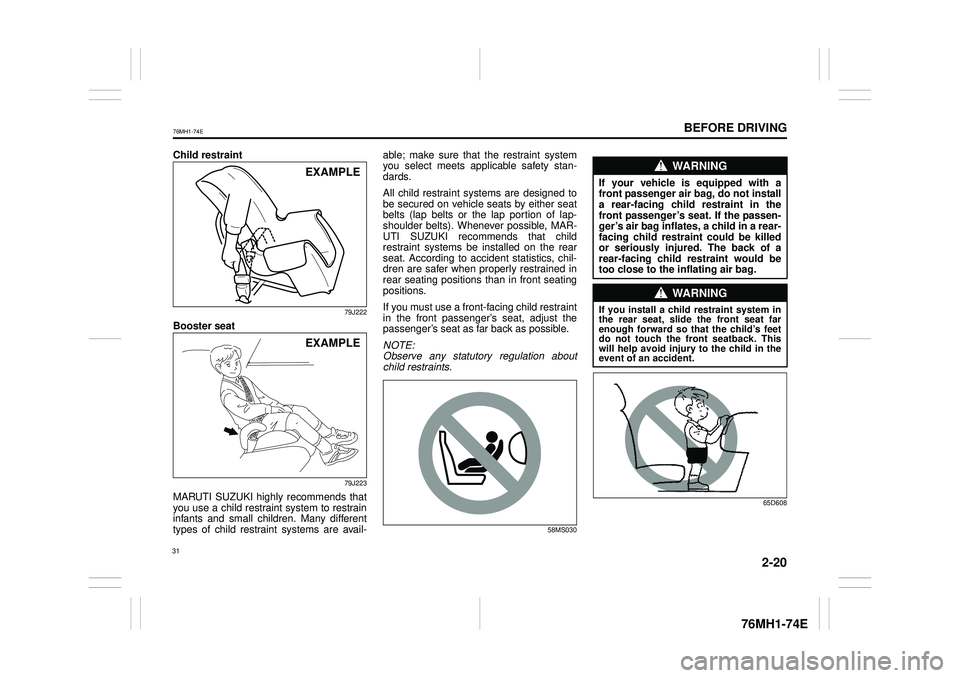
MARUTI SUZUKI highly recommends that you use a child restraint system to restrain infants and small children. Many differenttypes of child restraint systems are avail-
able; make sure that the restraint systemyou select meets applicable safety stan-dards.
All child restraint systems are designed tobe secured on vehicle seats by either seat belts (lap belts or the lap portion of lap- shoulder belts). Whenever possible, MAR- UTI SUZUKI recommends that childrestraint systems be installed on the rear seat. According to accident statistics, chil- dren are safer when properly restrained inrear seating positions than in front seating positions.
If you must use a front-facing child restraint in the front passenger’s seat, adjust the passenger’s seat as far back as possible.
NOTE: Observe any statutory regulation aboutchild restraints.
58MS030
65D608
EXAMPLE
EXAMPLE
WA R N I N G
If your vehicle is equipped with afront passenger air bag, do not installa rear-facing child restraint in the front passenger’s seat. If the passen- ger’s air bag inflates, a child in a rear-facing child restraint could be killed or seriously injured. The back of a rear-facing child restraint would betoo close to the inflating air bag.
WA R N I N G
If you install a child restraint system in the rear seat, slide the front seat farenough forward so that the child’s feet do not touch the front seatback. This will help avoid injury to the child in theevent of an accident.
31
Page 45 of 201
2-23
BEFORE DRIVING
76MH1-74E
76MH1-74E
Supplemental Restraint
System (air bags)
(if equipped)
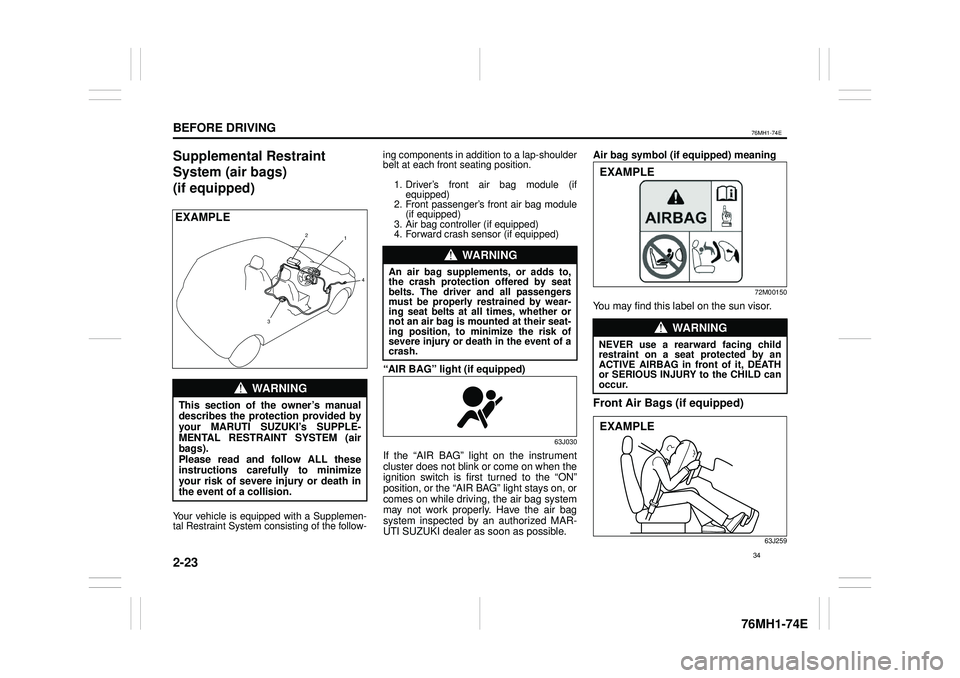
Your vehicle is equipped with a Supplemen- tal Restraint System consisting of the follow-
ing components in addition to a lap-shoulderbelt at each front seating position.
1. Driver’s front air bag module (ifequipped)2. Front passenger’s front air bag module(if equipped)3. Air bag controller (if equipped)4. Forward crash sensor (if equipped)
Page 46 of 201
2-24
BEFORE DRIVING
76MH1-74E
76MH1-74E
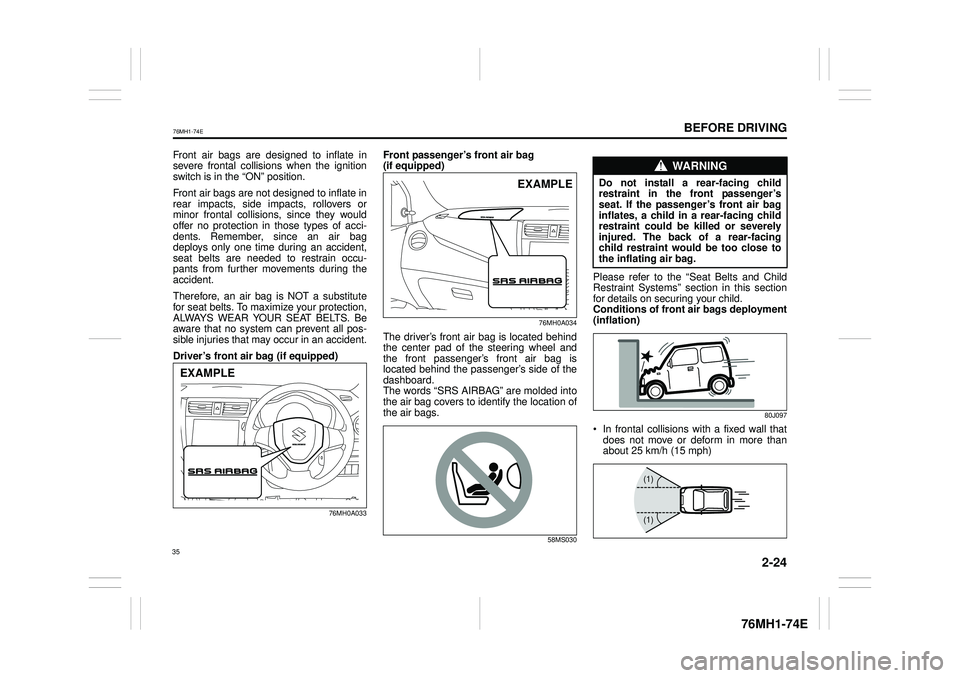
Front air bags are designed to inflate in severe frontal collisions when the ignition switch is in the “ON” position.
Front air bags are not designed to inflate in rear impacts, side impacts, rollovers orminor frontal collisions, since they would offer no protection in those types of acci- dents. Remember, since an air bagdeploys only one time during an accident, seat belts are needed to restrain occu- pants from further movements during theaccident.
Therefore, an air bag is NOT a substitute for seat belts. To maximize your protection, ALWAYS WEAR YOUR SEAT BELTS. Be aware that no system can prevent all pos-sible injuries that may occur in an accident.
Driver