Power SUZUKI GRAND VITARA 2001 2.G Workshop Manual
[x] Cancel search | Manufacturer: SUZUKI, Model Year: 2001, Model line: GRAND VITARA, Model: SUZUKI GRAND VITARA 2001 2.GPages: 656, PDF Size: 14.31 MB
Page 265 of 656
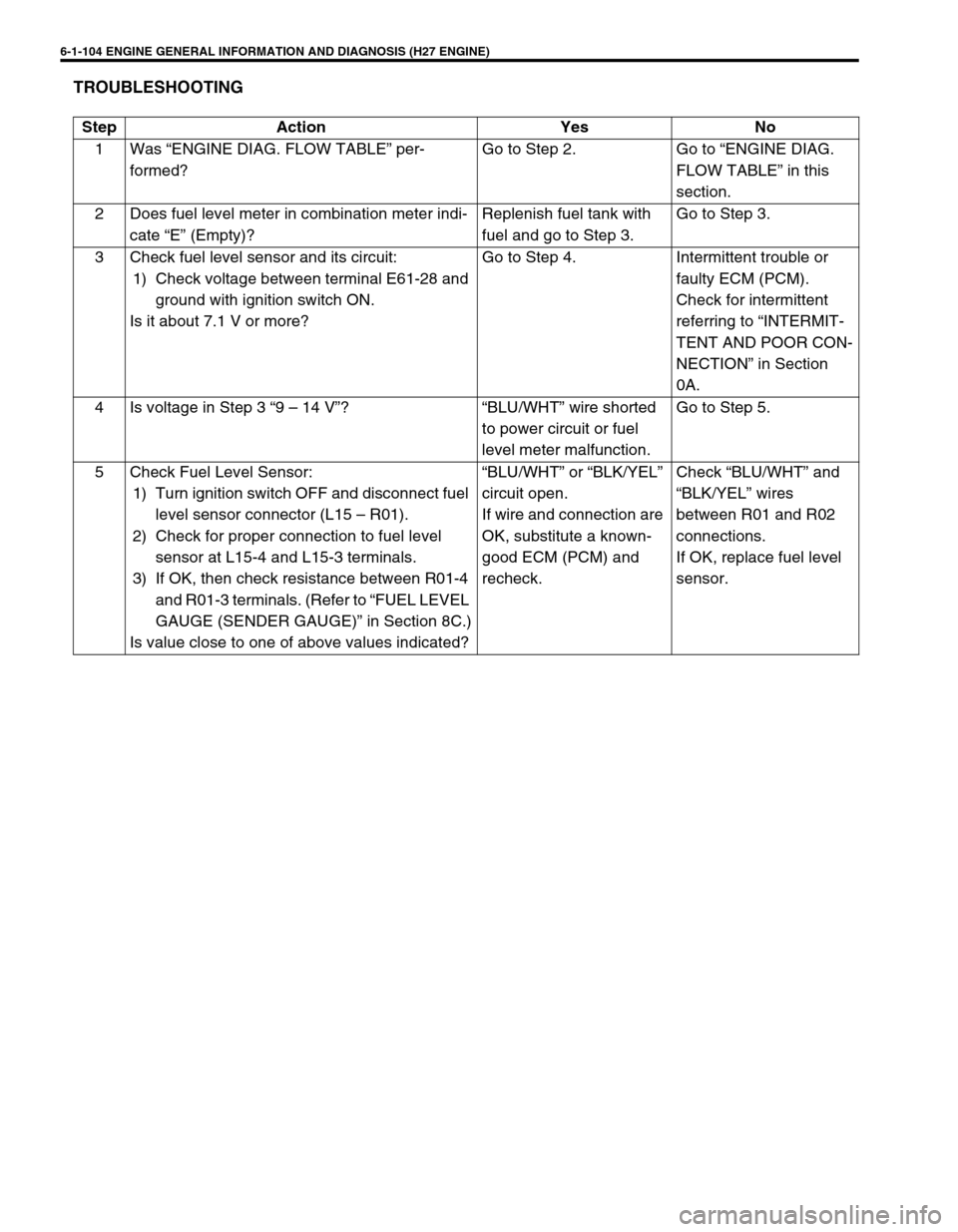
6-1-104 ENGINE GENERAL INFORMATION AND DIAGNOSIS (H27 ENGINE)
TROUBLESHOOTING
Step Action Yes No
1Was “ENGINE DIAG. FLOW TABLE” per-
formed?Go to Step 2. Go to “ENGINE DIAG.
FLOW TABLE” in this
section.
2 Does fuel level meter in combination meter indi-
cate “E” (Empty)?Replenish fuel tank with
fuel and go to Step 3.Go to Step 3.
3 Check fuel level sensor and its circuit:
1) Check voltage between terminal E61-28 and
ground with ignition switch ON.
Is it about 7.1 V or more?Go to Step 4. Intermittent trouble or
faulty ECM (PCM).
Check for intermittent
referring to “INTERMIT-
TENT AND POOR CON-
NECTION” in Section
0A.
4 Is voltage in Step 3 “9 – 14 V”?“BLU/WHT” wire shorted
to power circuit or fuel
level meter malfunction.Go to Step 5.
5 Check Fuel Level Sensor:
1) Turn ignition switch OFF and disconnect fuel
level sensor connector (L15 – R01).
2) Check for proper connection to fuel level
sensor at L15-4 and L15-3 terminals.
3) If OK, then check resistance between R01-4
and R01-3 terminals. (Refer to “FUEL LEVEL
GAUGE (SENDER GAUGE)” in Section 8C.)
Is value close to one of above values indicated?“BLU/WHT” or “BLK/YEL”
circuit open.
If wire and connection are
OK, substitute a known-
good ECM (PCM) and
recheck.Check “BLU/WHT” and
“BLK/YEL” wires
between R01 and R02
connections.
If OK, replace fuel level
sensor.
Page 267 of 656
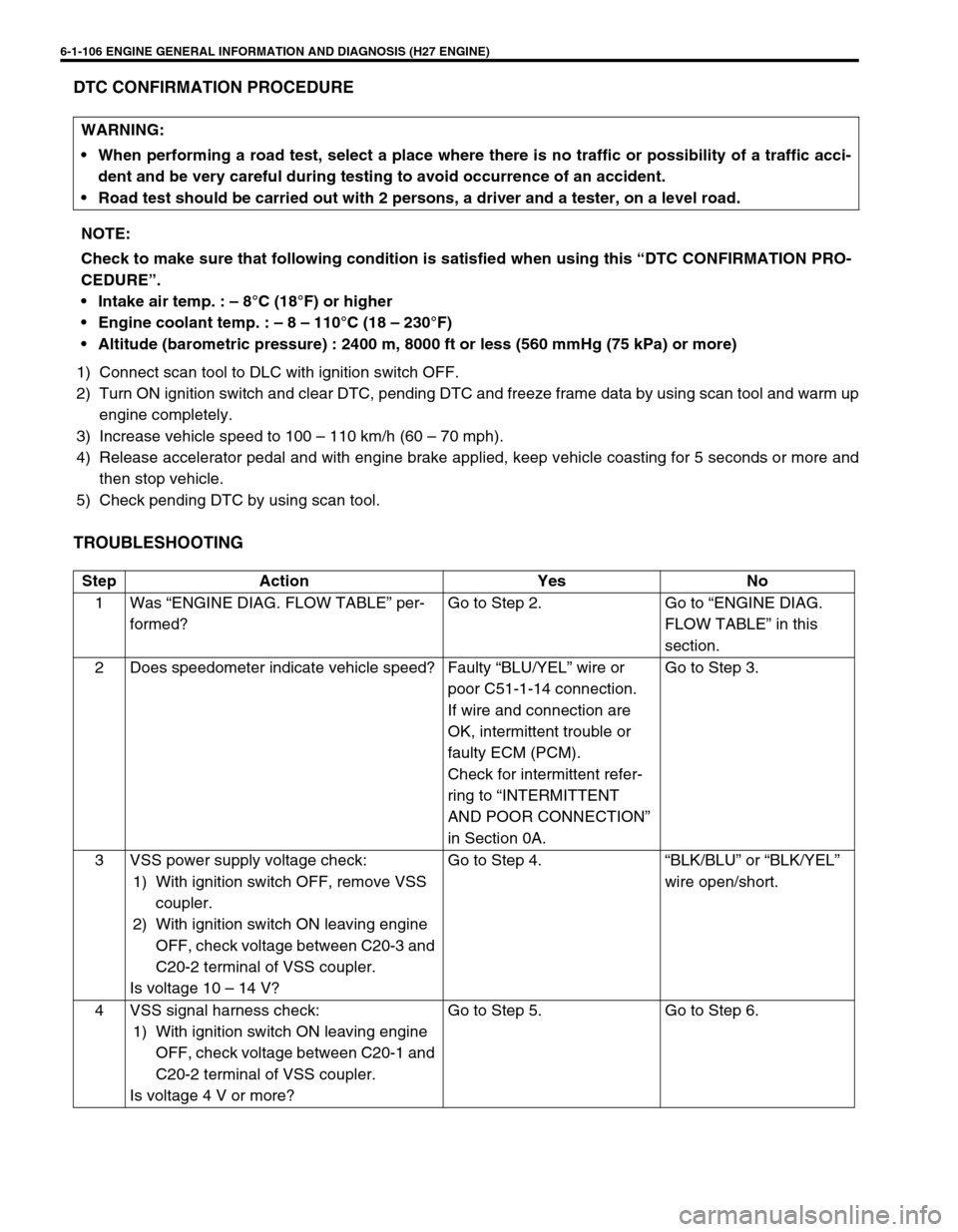
6-1-106 ENGINE GENERAL INFORMATION AND DIAGNOSIS (H27 ENGINE)
DTC CONFIRMATION PROCEDURE
1) Connect scan tool to DLC with ignition switch OFF.
2) Turn ON ignition switch and clear DTC, pending DTC and freeze frame data by using scan tool and warm up
engine completely.
3) Increase vehicle speed to 100 – 110 km/h (60 – 70 mph).
4) Release accelerator pedal and with engine brake applied, keep vehicle coasting for 5 seconds or more and
then stop vehicle.
5) Check pending DTC by using scan tool.
TROUBLESHOOTING
WARNING:
When performing a road test, select a place where there is no traffic or possibility of a traffic acci-
dent and be very careful during testing to avoid occurrence of an accident.
Road test should be carried out with 2 persons, a driver and a tester, on a level road.
NOTE:
Check to make sure that following condition is satisfied when using this “DTC CONFIRMATION PRO-
CEDURE”.
Intake air temp. : – 8°C (18°F) or higher
Engine coolant temp. : – 8 – 110°C (18 – 230°F)
Altitude (barometric pressure) : 2400 m, 8000 ft or less (560 mmHg (75 kPa) or more)
Step Action Yes No
1Was “ENGINE DIAG. FLOW TABLE” per-
formed?Go to Step 2. Go to “ENGINE DIAG.
FLOW TABLE” in this
section.
2 Does speedometer indicate vehicle speed? Faulty “BLU/YEL” wire or
poor C51-1-14 connection.
If wire and connection are
OK, intermittent trouble or
faulty ECM (PCM).
Check for intermittent refer-
ring to “INTERMITTENT
AND POOR CONNECTION”
in Section 0A.Go to Step 3.
3 VSS power supply voltage check:
1) With ignition switch OFF, remove VSS
coupler.
2) With ignition switch ON leaving engine
OFF, check voltage between C20-3 and
C20-2 terminal of VSS coupler.
Is voltage 10 – 14 V?Go to Step 4.“BLK/BLU” or “BLK/YEL”
wire open/short.
4 VSS signal harness check:
1) With ignition switch ON leaving engine
OFF, check voltage between C20-1 and
C20-2 terminal of VSS coupler.
Is voltage 4 V or more?Go to Step 5. Go to Step 6.
Page 270 of 656
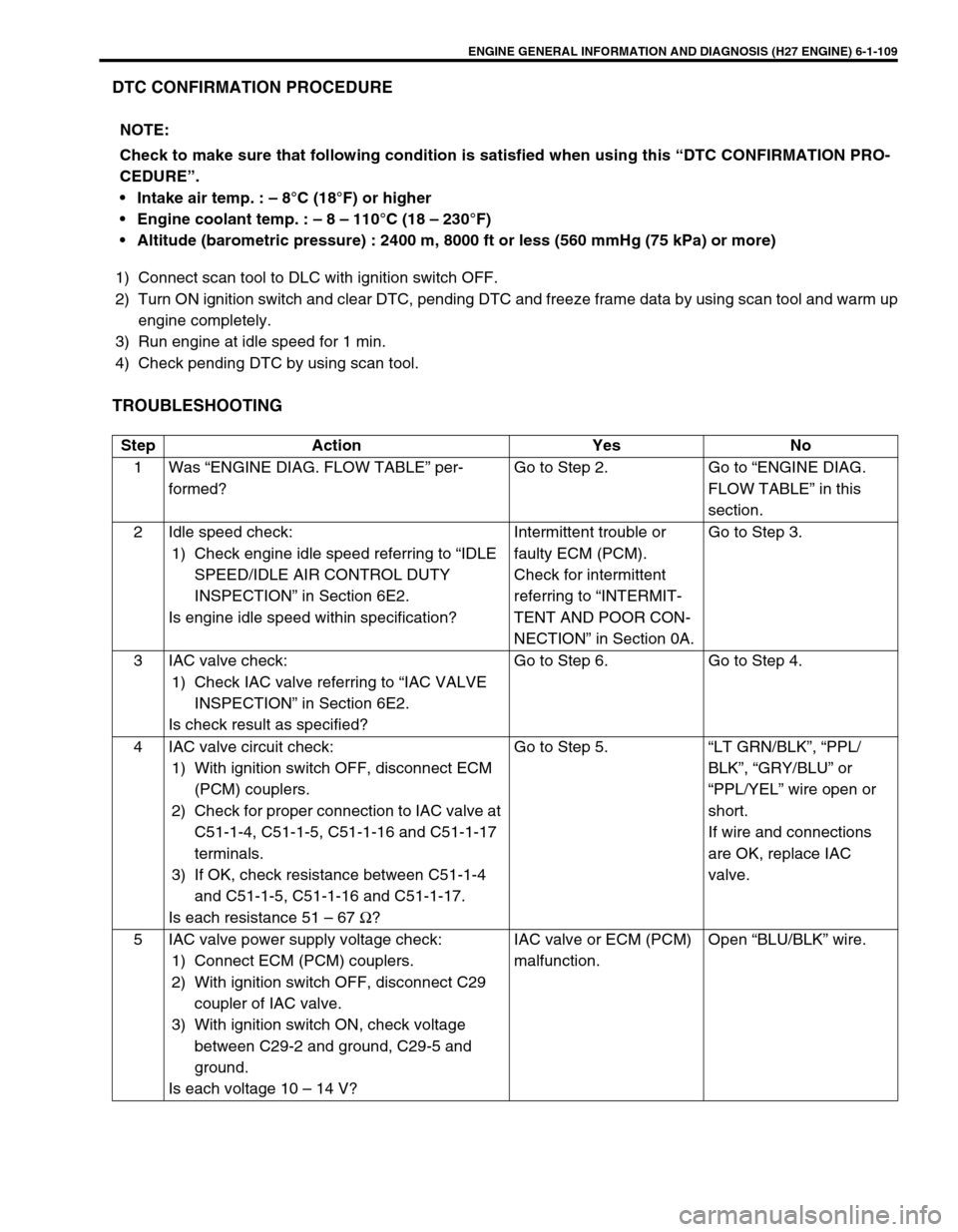
ENGINE GENERAL INFORMATION AND DIAGNOSIS (H27 ENGINE) 6-1-109
DTC CONFIRMATION PROCEDURE
1) Connect scan tool to DLC with ignition switch OFF.
2) Turn ON ignition switch and clear DTC, pending DTC and freeze frame data by using scan tool and warm up
engine completely.
3) Run engine at idle speed for 1 min.
4) Check pending DTC by using scan tool.
TROUBLESHOOTING
NOTE:
Check to make sure that following condition is satisfied when using this “DTC CONFIRMATION PRO-
CEDURE”.
Intake air temp. : – 8°C (18°F) or higher
Engine coolant temp. : – 8 – 110°C (18 – 230°F)
Altitude (barometric pressure) : 2400 m, 8000 ft or less (560 mmHg (75 kPa) or more)
Step Action Yes No
1Was “ENGINE DIAG. FLOW TABLE” per-
formed?Go to Step 2. Go to “ENGINE DIAG.
FLOW TABLE” in this
section.
2 Idle speed check:
1) Check engine idle speed referring to “IDLE
SPEED/IDLE AIR CONTROL DUTY
INSPECTION” in Section 6E2.
Is engine idle speed within specification?Intermittent trouble or
faulty ECM (PCM).
Check for intermittent
referring to “INTERMIT-
TENT AND POOR CON-
NECTION” in Section 0A.Go to Step 3.
3 IAC valve check:
1) Check IAC valve referring to “IAC VALVE
INSPECTION” in Section 6E2.
Is check result as specified?Go to Step 6. Go to Step 4.
4 IAC valve circuit check:
1) With ignition switch OFF, disconnect ECM
(PCM) couplers.
2) Check for proper connection to IAC valve at
C51-1-4, C51-1-5, C51-1-16 and C51-1-17
terminals.
3) If OK, check resistance between C51-1-4
and C51-1-5, C51-1-16 and C51-1-17.
Is each resistance 51 – 67 Ω?Go to Step 5.“LT GRN/BLK”, “PPL/
BLK”, “GRY/BLU” or
“PPL/YEL” wire open or
short.
If wire and connections
are OK, replace IAC
valve.
5 IAC valve power supply voltage check:
1) Connect ECM (PCM) couplers.
2) With ignition switch OFF, disconnect C29
coupler of IAC valve.
3) With ignition switch ON, check voltage
between C29-2 and ground, C29-5 and
ground.
Is each voltage 10 – 14 V?IAC valve or ECM (PCM)
malfunction.Open “BLU/BLK” wire.
Page 276 of 656
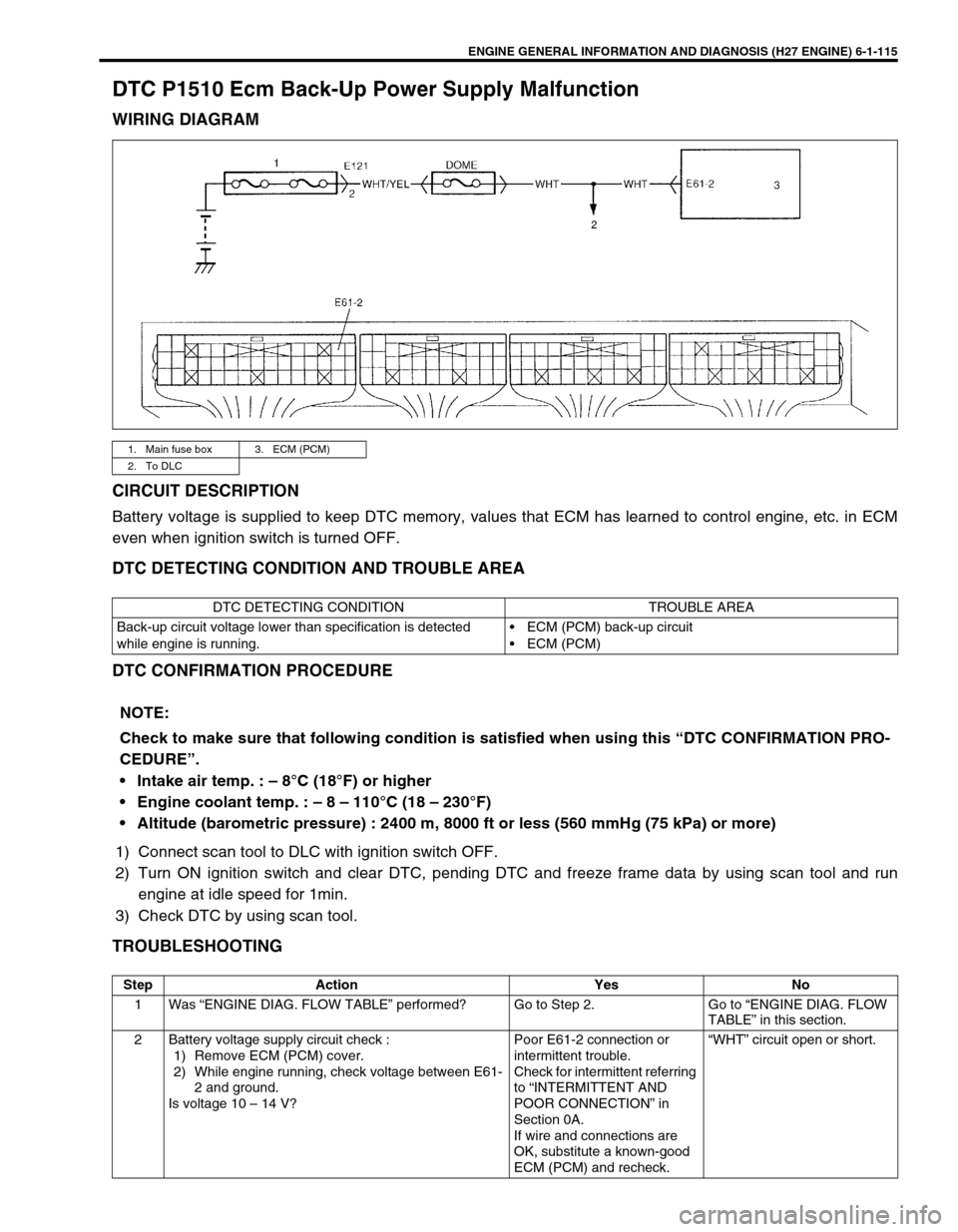
ENGINE GENERAL INFORMATION AND DIAGNOSIS (H27 ENGINE) 6-1-115
DTC P1510 Ecm Back-Up Power Supply Malfunction
WIRING DIAGRAM
CIRCUIT DESCRIPTION
Battery voltage is supplied to keep DTC memory, values that ECM has learned to control engine, etc. in ECM
even when ignition switch is turned OFF.
DTC DETECTING CONDITION AND TROUBLE AREA
DTC CONFIRMATION PROCEDURE
1) Connect scan tool to DLC with ignition switch OFF.
2) Turn ON ignition switch and clear DTC, pending DTC and freeze frame data by using scan tool and run
engine at idle speed for 1min.
3) Check DTC by using scan tool.
TROUBLESHOOTING
1. Main fuse box 3. ECM (PCM)
2. To DLC
DTC DETECTING CONDITION TROUBLE AREA
Back-up circuit voltage lower than specification is detected
while engine is running.•ECM (PCM) back-up circuit
•ECM (PCM)
NOTE:
Check to make sure that following condition is satisfied when using this “DTC CONFIRMATION PRO-
CEDURE”.
Intake air temp. : – 8°C (18°F) or higher
Engine coolant temp. : – 8 – 110°C (18 – 230°F)
Altitude (barometric pressure) : 2400 m, 8000 ft or less (560 mmHg (75 kPa) or more)
Step Action Yes No
1Was “ENGINE DIAG. FLOW TABLE” performed? Go to Step 2. Go to “ENGINE DIAG. FLOW
TABLE” in this section.
2 Battery voltage supply circuit check :
1) Remove ECM (PCM) cover.
2) While engine running, check voltage between E61-
2 and ground.
Is voltage 10 – 14 V?Poor E61-2 connection or
intermittent trouble.
Check for intermittent referring
to “INTERMITTENT AND
POOR CONNECTION” in
Section 0A.
If wire and connections are
OK, substitute a known-good
ECM (PCM) and recheck.“WHT” circuit open or short.
Page 279 of 656
6-1-118 ENGINE GENERAL INFORMATION AND DIAGNOSIS (H27 ENGINE)
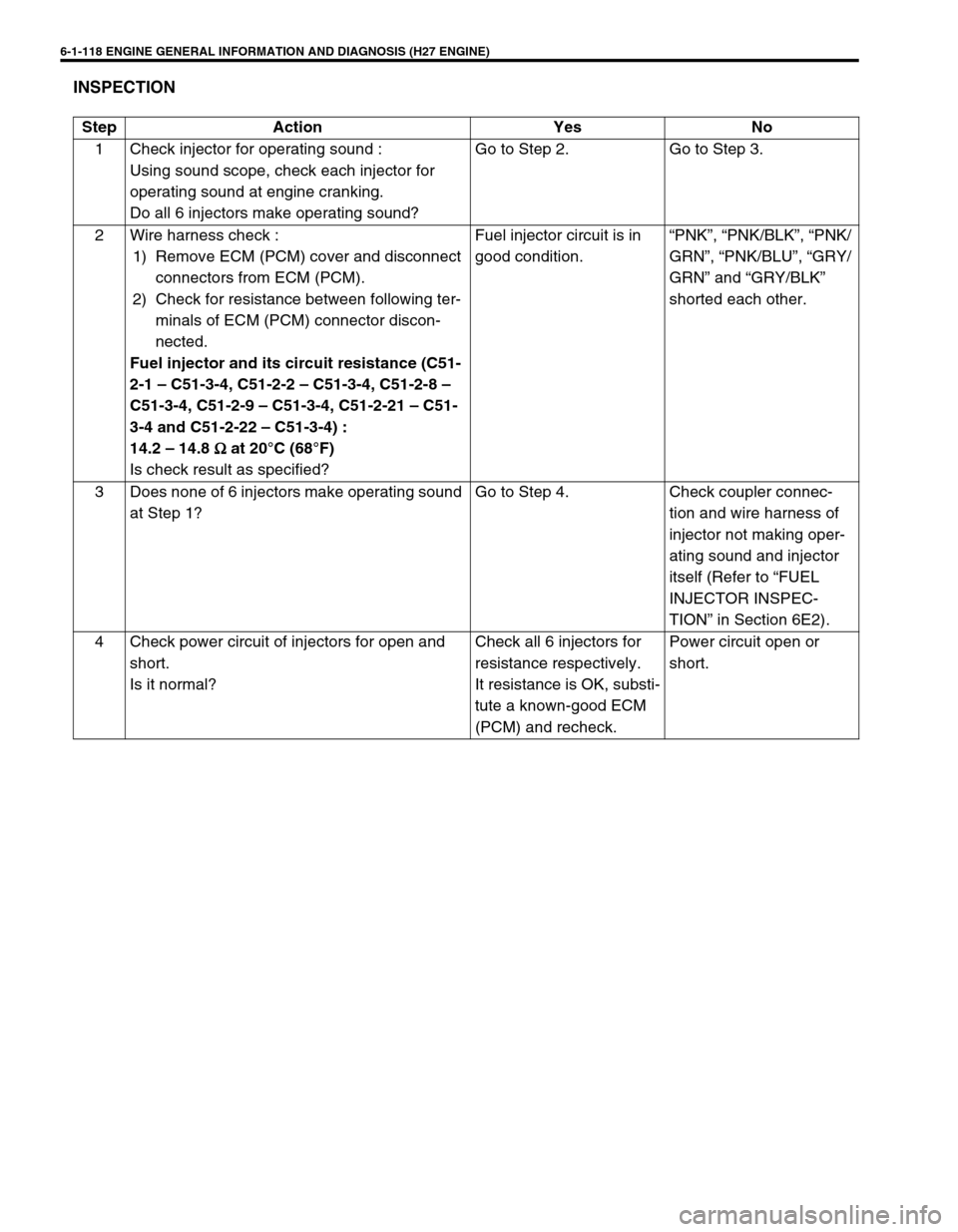
INSPECTION
Step Action Yes No
1 Check injector for operating sound :
Using sound scope, check each injector for
operating sound at engine cranking.
Do all 6 injectors make operating sound?Go to Step 2. Go to Step 3.
2 Wire harness check :
1) Remove ECM (PCM) cover and disconnect
connectors from ECM (PCM).
2) Check for resistance between following ter-
minals of ECM (PCM) connector discon-
nected.
Fuel injector and its circuit resistance (C51-
2-1 – C51-3-4, C51-2-2 – C51-3-4, C51-2-8 –
C51-3-4, C51-2-9 – C51-3-4, C51-2-21 – C51-
3-4 and C51-2-22 – C51-3-4) :
14.2 – 14.8
Ω
ΩΩ Ω at 20°C (68°F)
Is check result as specified?Fuel injector circuit is in
good condition.“PNK”, “PNK/BLK”, “PNK/
GRN”, “PNK/BLU”, “GRY/
GRN” and “GRY/BLK”
shorted each other.
3 Does none of 6 injectors make operating sound
at Step 1?Go to Step 4. Check coupler connec-
tion and wire harness of
injector not making oper-
ating sound and injector
itself (Refer to “FUEL
INJECTOR INSPEC-
TION” in Section 6E2).
4 Check power circuit of injectors for open and
short.
Is it normal?Check all 6 injectors for
resistance respectively.
It resistance is OK, substi-
tute a known-good ECM
(PCM) and recheck.Power circuit open or
short.
Page 283 of 656
6-1-122 ENGINE GENERAL INFORMATION AND DIAGNOSIS (H27 ENGINE)
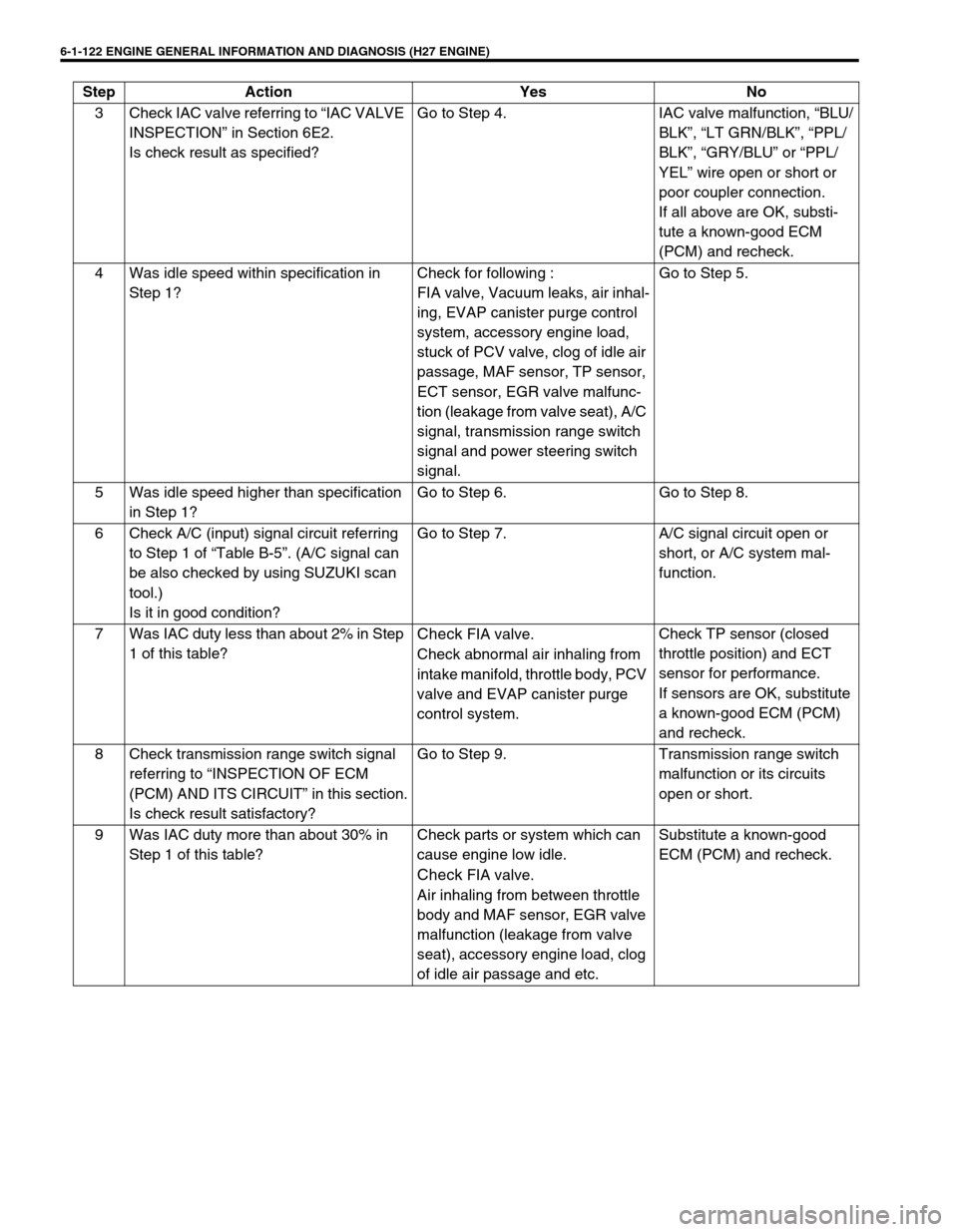
3 Check IAC valve referring to “IAC VALVE
INSPECTION” in Section 6E2.
Is check result as specified?Go to Step 4. IAC valve malfunction, “BLU/
BLK”, “LT GRN/BLK”, “PPL/
BLK”, “GRY/BLU” or “PPL/
YEL” wire open or short or
poor coupler connection.
If all above are OK, substi-
tute a known-good ECM
(PCM) and recheck.
4 Was idle speed within specification in
Step 1?Check for following :
FIA valve, Vacuum leaks, air inhal-
ing, EVAP canister purge control
system, accessory engine load,
stuck of PCV valve, clog of idle air
passage, MAF sensor, TP sensor,
ECT sensor, EGR valve malfunc-
tion (leakage from valve seat), A/C
signal, transmission range switch
signal and power steering switch
signal.Go to Step 5.
5 Was idle speed higher than specification
in Step 1?Go to Step 6. Go to Step 8.
6 Check A/C (input) signal circuit referring
to Step 1 of “Table B-5”. (A/C signal can
be also checked by using SUZUKI scan
tool.)
Is it in good condition?Go to Step 7. A/C signal circuit open or
short, or A/C system mal-
function.
7 Was IAC duty less than about 2% in Step
1 of this table?
Check FIA valve.
Check abnormal air inhaling from
intake manifold, throttle body, PCV
valve and EVAP canister purge
control system.Check TP sensor (closed
throttle position) and ECT
sensor for performance.
If sensors are OK, substitute
a known-good ECM (PCM)
and recheck.
8 Check transmission range switch signal
referring to “INSPECTION OF ECM
(PCM) AND ITS CIRCUIT” in this section.
Is check result satisfactory?Go to Step 9. Transmission range switch
malfunction or its circuits
open or short.
9 Was IAC duty more than about 30% in
Step 1 of this table?Check parts or system which can
cause engine low idle.
Check FIA valve.
Air inhaling from between throttle
body and MAF sensor, EGR valve
malfunction (leakage from valve
seat), accessory engine load, clog
of idle air passage and etc.Substitute a known-good
ECM (PCM) and recheck. Step Action Yes No
Page 286 of 656
ENGINE GENERAL INFORMATION AND DIAGNOSIS (H27 ENGINE) 6-1-125
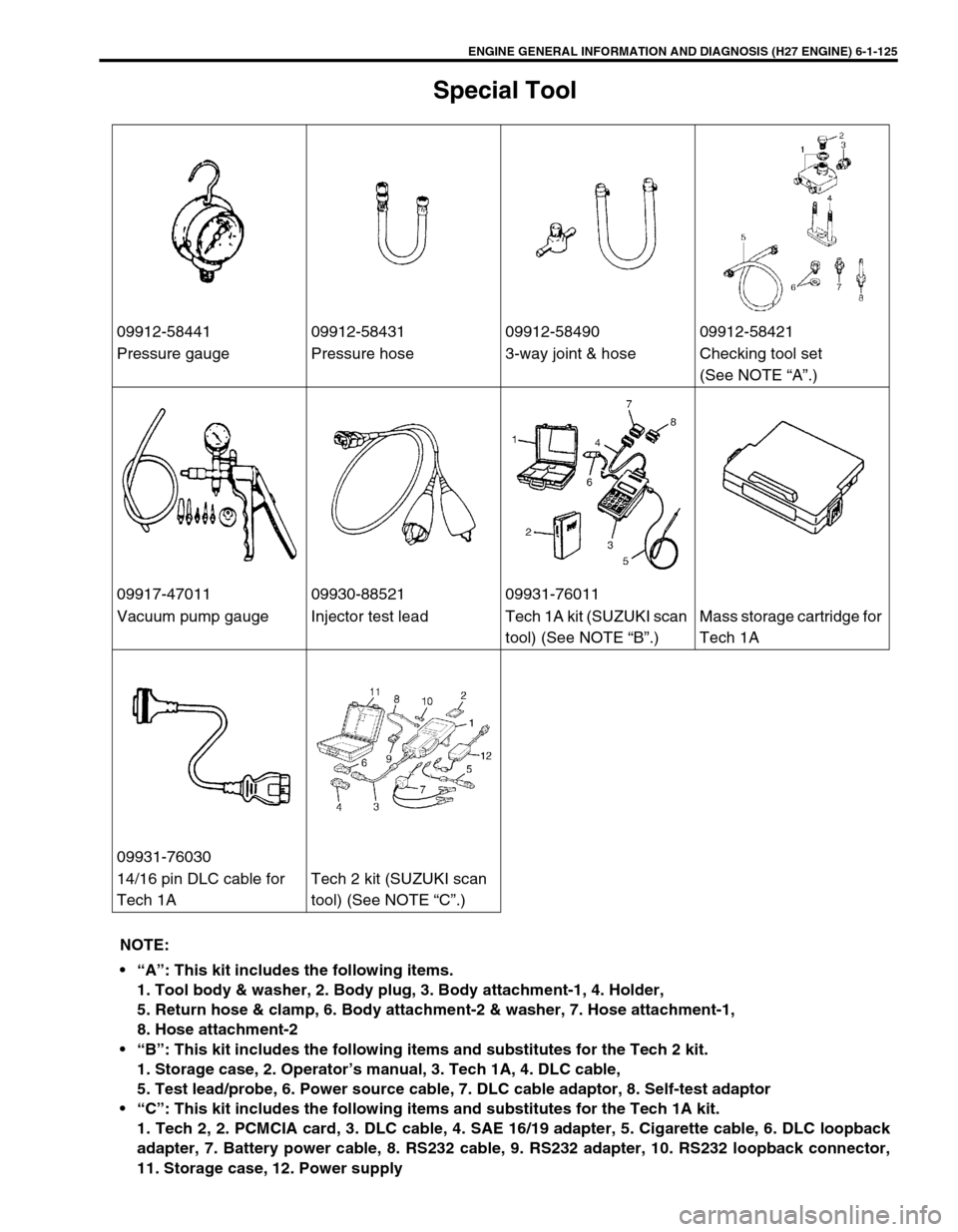
Special Tool
09912-58441 09912-58431 09912-58490 09912-58421
Pressure gauge Pressure hose 3-way joint & hose Checking tool set
(See NOTE “A”.)
09917-47011 09930-88521 09931-76011
Vacuum pump gauge Injector test lead Tech 1A kit (SUZUKI scan
tool) (See NOTE “B”.)Mass storage cartridge for
Tech 1A
09931-76030
14/16 pin DLC cable for
Tech 1ATech 2 kit (SUZUKI scan
tool) (See NOTE “C”.)
NOTE:
“A”: This kit includes the following items.
1. Tool body & washer, 2. Body plug, 3. Body attachment-1, 4. Holder,
5. Return hose & clamp, 6. Body attachment-2 & washer, 7. Hose attachment-1,
8. Hose attachment-2
“B”: This kit includes the following items and substitutes for the Tech 2 kit.
1. Storage case, 2. Operator’s manual, 3. Tech 1A, 4. DLC cable,
5. Test lead/probe, 6. Power source cable, 7. DLC cable adaptor, 8. Self-test adaptor
“C”: This kit includes the following items and substitutes for the Tech 1A kit.
1. Tech 2, 2. PCMCIA card, 3. DLC cable, 4. SAE 16/19 adapter, 5. Cigarette cable, 6. DLC loopback
adapter, 7. Battery power cable, 8. RS232 cable, 9. RS232 adapter, 10. RS232 loopback connector,
11. Storage case, 12. Power supply
Page 299 of 656
6A2-12 ENGINE MECHANICAL (H27 ENGINE)
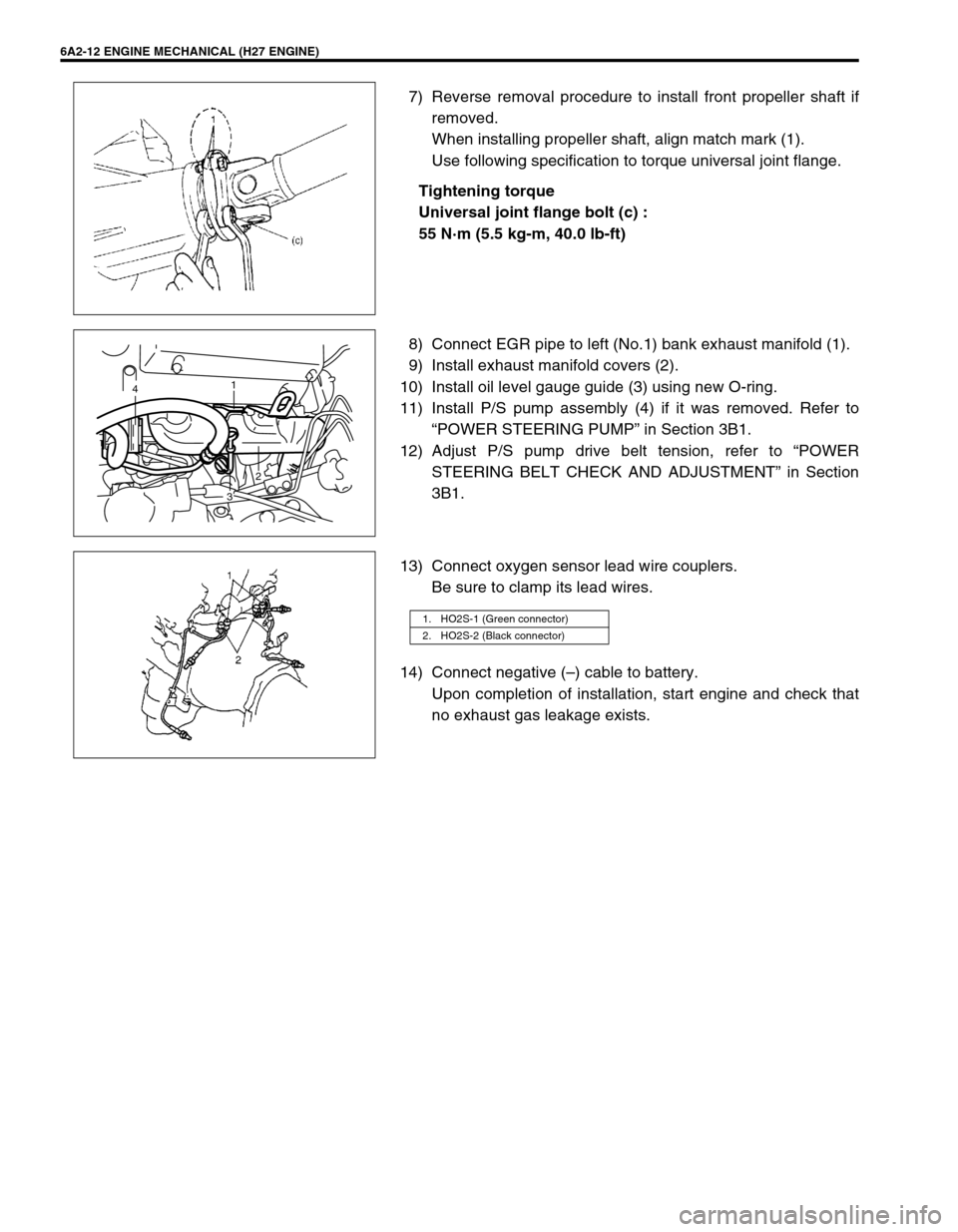
7) Reverse removal procedure to install front propeller shaft if
removed.
When installing propeller shaft, align match mark (1).
Use following specification to torque universal joint flange.
Tightening torque
Universal joint flange bolt (c) :
55 N·m (5.5 kg-m, 40.0 lb-ft)
8) Connect EGR pipe to left (No.1) bank exhaust manifold (1).
9) Install exhaust manifold covers (2).
10) Install oil level gauge guide (3) using new O-ring.
11) Install P/S pump assembly (4) if it was removed. Refer to
“POWER STEERING PUMP” in Section 3B1.
12) Adjust P/S pump drive belt tension, refer to “POWER
STEERING BELT CHECK AND ADJUSTMENT” in Section
3B1.
13) Connect oxygen sensor lead wire couplers.
Be sure to clamp its lead wires.
14) Connect negative (–) cable to battery.
Upon completion of installation, start engine and check that
no exhaust gas leakage exists.
1
4
32
1. HO2S-1 (Green connector)
2. HO2S-2 (Black connector)
Page 307 of 656
6A2-20 ENGINE MECHANICAL (H27 ENGINE)
12) Install oil pan and oil pump strainer.
Refer to “OIL PAN AND OIL PUMP STRAINER” in this sec-
tion.
13) Install cylinder head cover.
Refer to “CYLINDER HEAD COVER” in this section.
14) Install exhaust manifold.
Refer to “EXHAUST MANIFOLD” in this section.
15) Install radiator outlet pipe, radiator, cooling fan and water
hose.
Refer to “COOLING WATER PIPES OR HOSES”, “RADIA-
TOR” and “COOLING FAN AND FAN CLUTCH” in Section
6B.
16) Install throttle body and intake manifold.
Refer to “THROTTLE BODY AND INTAKE MANIFOLD” in
this section.
17) Adjust water pump drive belt tension.
Refer to “COOLING FAN BELT TENSION CHECK AND
ADJUSTMENT” in Section 6B.
18) Adjust power steering pump drive belt tension.
Refer to “POWER STEERING PUMP DRIVE BELT” in Sec-
tion 3B1.
19) Adjust accelerator cable play and A/T throttle cable play.
Refer to “ACCELERATOR CABLE ADJUSTMENT” and “A/T
THROTTLE CABLE ADJUSTMENT (A/T VEHICLE)” in Sec-
tion 6E2.
20) Check to ensure that all removed parts are back in place.
Reinstall any necessary parts which have not been rein-
stalled.
21) Refill engine with engine oil, referring to “ENGINE OIL
CHANGE” in Section 0B.
22) Refill cooling system referring to “COOLING SYSTEM
FLUSH AND REFILL” in Section 6B.
23) Refill front differential housing with gear oil if drained, refer-
ring to “MAINTENANCE SERVICE” in Section 7E.
24) Connect negative cable at battery.
25) Check ignition timing and adjust as necessary, referring to
“IGNITION TIMING CHECK AND ADJUSTMENT” in Section
6F2.
26) Verify that there is no fuel leakage, water leakage, oil leak-
age and exhaust gas leakage at each connection.
27) Check wheel alignment, referring to “STEERING ANGLE” in
Section 3A.
Page 314 of 656
ENGINE MECHANICAL (H27 ENGINE) 6A2-27
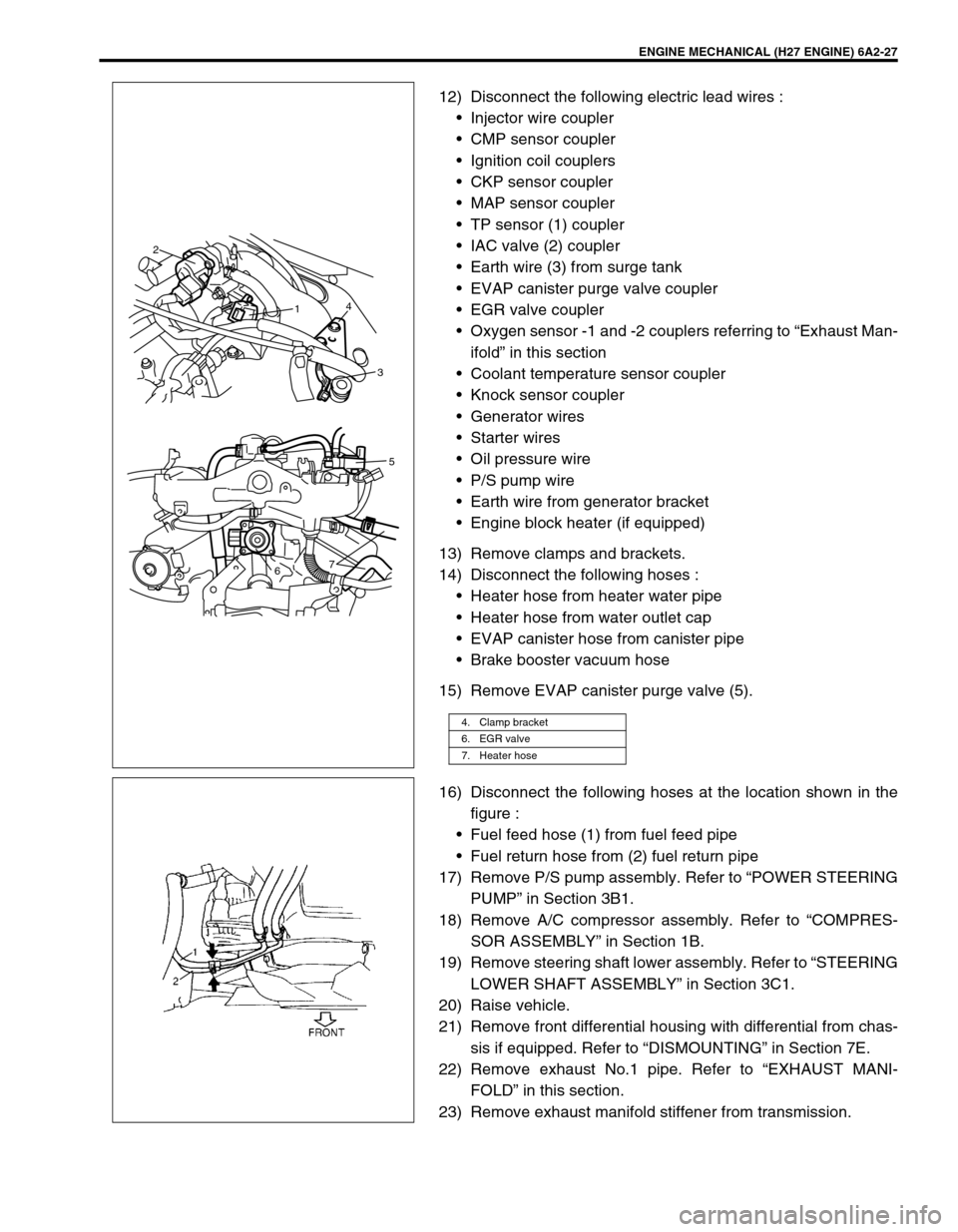
12) Disconnect the following electric lead wires :
•Injector wire coupler
•CMP sensor coupler
•Ignition coil couplers
•CKP sensor coupler
•MAP sensor coupler
•TP sensor (1) coupler
•IAC valve (2) coupler
•Earth wire (3) from surge tank
•EVAP canister purge valve coupler
•EGR valve coupler
•Oxygen sensor -1 and -2 couplers referring to “Exhaust Man-
ifold” in this section
•Coolant temperature sensor coupler
•Knock sensor coupler
•Generator wires
•Starter wires
•Oil pressure wire
•P/S pump wire
•Earth wire from generator bracket
•Engine block heater (if equipped)
13) Remove clamps and brackets.
14) Disconnect the following hoses :
•Heater hose from heater water pipe
•Heater hose from water outlet cap
•EVAP canister hose from canister pipe
•Brake booster vacuum hose
15) Remove EVAP canister purge valve (5).
16) Disconnect the following hoses at the location shown in the
figure :
•Fuel feed hose (1) from fuel feed pipe
•Fuel return hose from (2) fuel return pipe
17) Remove P/S pump assembly. Refer to “POWER STEERING
PUMP” in Section 3B1.
18) Remove A/C compressor assembly. Refer to “COMPRES-
SOR ASSEMBLY” in Section 1B.
19) Remove steering shaft lower assembly. Refer to “STEERING
LOWER SHAFT ASSEMBLY” in Section 3C1.
20) Raise vehicle.
21) Remove front differential housing with differential from chas-
sis if equipped. Refer to “DISMOUNTING” in Section 7E.
22) Remove exhaust No.1 pipe. Refer to “EXHAUST MANI-
FOLD” in this section.
23) Remove exhaust manifold stiffener from transmission.
4. Clamp bracket
6. EGR valve
7. Heater hose
2
14
3
75
6