Power SUZUKI GRAND VITARA 2001 2.G Manual PDF
[x] Cancel search | Manufacturer: SUZUKI, Model Year: 2001, Model line: GRAND VITARA, Model: SUZUKI GRAND VITARA 2001 2.GPages: 656, PDF Size: 14.31 MB
Page 410 of 656
AUTOMATIC TRANSMISSION (4 A/T) 7B1-1
7B1
SECTION 7B1
AUTOMATIC TRANSMISSION (4 A/T)
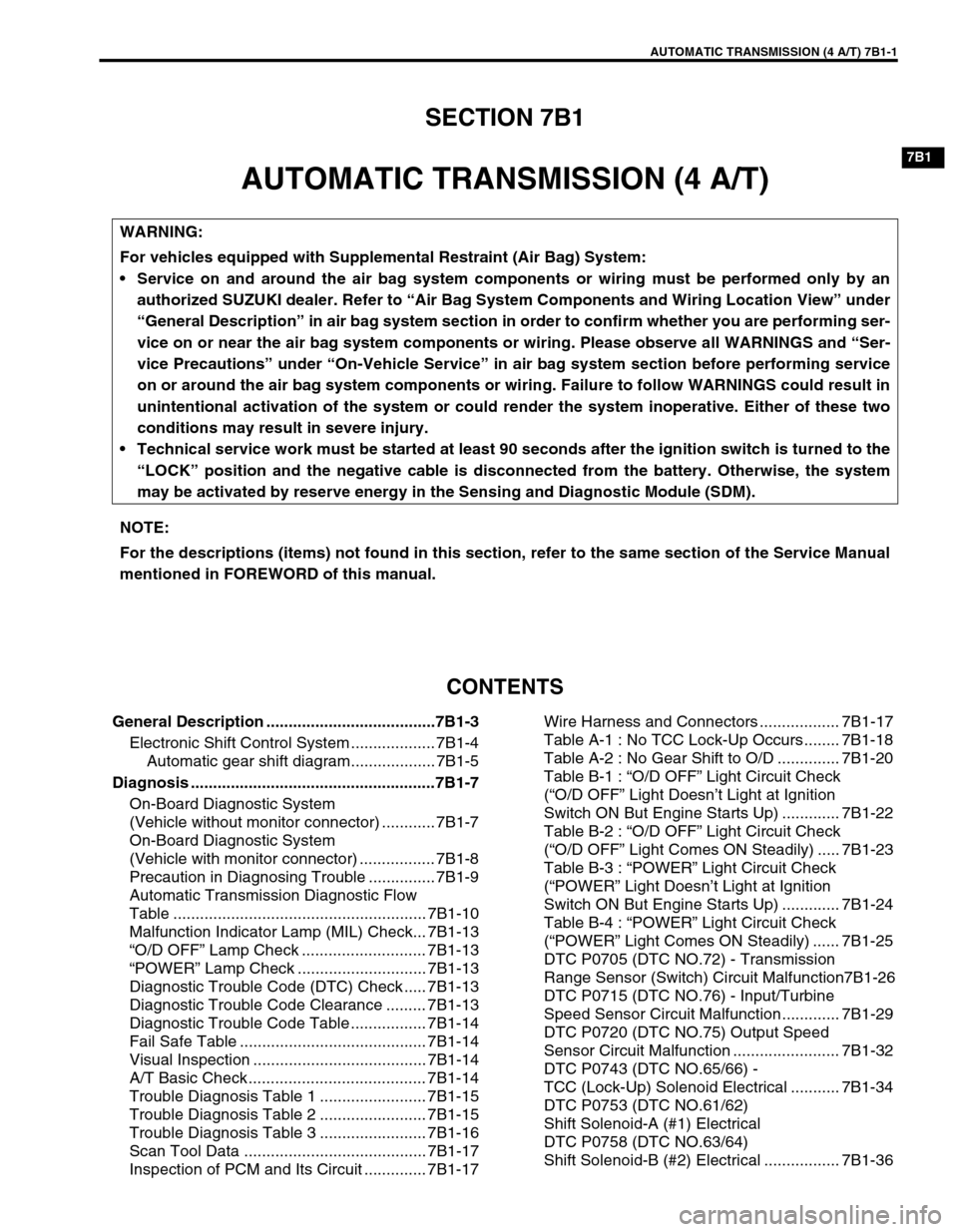
CONTENTS
General Description ......................................7B1-3
Electronic Shift Control System ................... 7B1-4
Automatic gear shift diagram................... 7B1-5
Diagnosis .......................................................7B1-7
On-Board Diagnostic System
(Vehicle without monitor connector) ............ 7B1-7
On-Board Diagnostic System
(Vehicle with monitor connector) ................. 7B1-8
Precaution in Diagnosing Trouble ............... 7B1-9
Automatic Transmission Diagnostic Flow
Table ......................................................... 7B1-10
Malfunction Indicator Lamp (MIL) Check... 7B1-13
“O/D OFF” Lamp Check ............................ 7B1-13
“POWER” Lamp Check ............................. 7B1-13
Diagnostic Trouble Code (DTC) Check ..... 7B1-13
Diagnostic Trouble Code Clearance ......... 7B1-13
Diagnostic Trouble Code Table ................. 7B1-14
Fail Safe Table .......................................... 7B1-14
Visual Inspection ....................................... 7B1-14
A/T Basic Check ........................................ 7B1-14
Trouble Diagnosis Table 1 ........................ 7B1-15
Trouble Diagnosis Table 2 ........................ 7B1-15
Trouble Diagnosis Table 3 ........................ 7B1-16
Scan Tool Data ......................................... 7B1-17
Inspection of PCM and Its Circuit .............. 7B1-17Wire Harness and Connectors .................. 7B1-17
Table A-1 : No TCC Lock-Up Occurs ........ 7B1-18
Table A-2 : No Gear Shift to O/D .............. 7B1-20
Table B-1 : “O/D OFF” Light Circuit Check
(“O/D OFF” Light Doesn’t Light at Ignition
Switch ON But Engine Starts Up) ............. 7B1-22
Table B-2 : “O/D OFF” Light Circuit Check
(“O/D OFF” Light Comes ON Steadily) ..... 7B1-23
Table B-3 : “POWER” Light Circuit Check
(“POWER” Light Doesn’t Light at Ignition
Switch ON But Engine Starts Up) ............. 7B1-24
Table B-4 : “POWER” Light Circuit Check
(“POWER” Light Comes ON Steadily) ...... 7B1-25
DTC P0705 (DTC NO.72) - Transmission
Range Sensor (Switch) Circuit Malfunction7B1-26
DTC P0715 (DTC NO.76) - Input/Turbine
Speed Sensor Circuit Malfunction............. 7B1-29
DTC P0720 (DTC NO.75) Output Speed
Sensor Circuit Malfunction ........................ 7B1-32
DTC P0743 (DTC NO.65/66) -
TCC (Lock-Up) Solenoid Electrical ........... 7B1-34
DTC P0753 (DTC NO.61/62)
Shift Solenoid-A (#1) Electrical
DTC P0758 (DTC NO.63/64)
Shift Solenoid-B (#2) Electrical ................. 7B1-36 WARNING:
For vehicles equipped with Supplemental Restraint (Air Bag) System:
Service on and around the air bag system components or wiring must be performed only by an
authorized SUZUKI dealer. Refer to “Air Bag System Components and Wiring Location View” under
“General Description” in air bag system section in order to confirm whether you are performing ser-
vice on or near the air bag system components or wiring. Please observe all WARNINGS and “Ser-
vice Precautions” under “On-Vehicle Service” in air bag system section before performing service
on or around the air bag system components or wiring. Failure to follow WARNINGS could result in
unintentional activation of the system or could render the system inoperative. Either of these two
conditions may result in severe injury.
Technical service work must be started at least 90 seconds after the ignition switch is turned to the
“LOCK” position and the negative cable is disconnected from the battery. Otherwise, the system
may be activated by reserve energy in the Sensing and Diagnostic Module (SDM).
NOTE:
For the descriptions (items) not found in this section, refer to the same section of the Service Manual
mentioned in FOREWORD of this manual.
Page 412 of 656
AUTOMATIC TRANSMISSION (4 A/T) 7B1-3
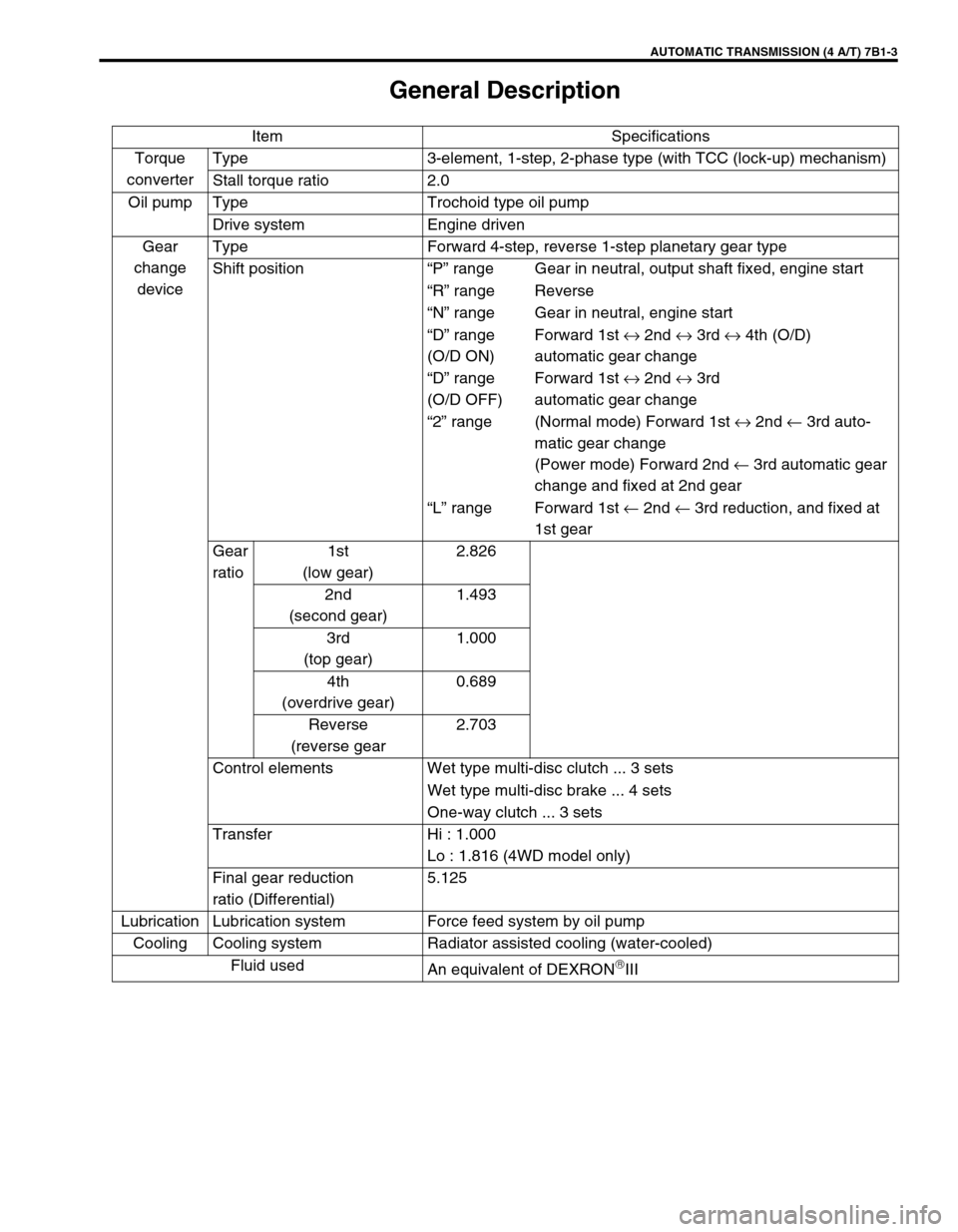
General Description
Item Specifications
Torque
converterType 3-element, 1-step, 2-phase type (with TCC (lock-up) mechanism)
Stall torque ratio 2.0
Oil pump Type Trochoid type oil pump
Drive system Engine driven
Gear
change
deviceType Forward 4-step, reverse 1-step planetary gear type
Shift position“P” range Gear in neutral, output shaft fixed, engine start
“R” range Reverse
“N” range Gear in neutral, engine start
“D” range
(O/D ON)Forward 1st ↔ 2nd ↔ 3rd ↔ 4th (O/D)
automatic gear change
“D” range
(O/D OFF)Forward 1st ↔ 2nd ↔ 3rd
automatic gear change
“2” range (Normal mode) Forward 1st ↔ 2nd ← 3rd auto-
matic gear change
(Power mode) Forward 2nd ← 3rd automatic gear
change and fixed at 2nd gear
“L” range Forward 1st ← 2nd ← 3rd reduction, and fixed at
1st gear
Gear
ratio1st
(low gear)2.826
2nd
(second gear)1.493
3rd
(top gear)1.000
4th
(overdrive gear)0.689
Reverse
(reverse gear2.703
Control elements Wet type multi-disc clutch ... 3 sets
Wet type multi-disc brake ... 4 sets
One-way clutch ... 3 sets
Transfer Hi : 1.000
Lo : 1.816 (4WD model only)
Final gear reduction
ratio (Differential)5.125
Lubrication Lubrication system Force feed system by oil pump
Cooling Cooling system Radiator assisted cooling (water-cooled)
Fluid used
An equivalent of DEXRON
III
Page 413 of 656
7B1-4 AUTOMATIC TRANSMISSION (4 A/T)
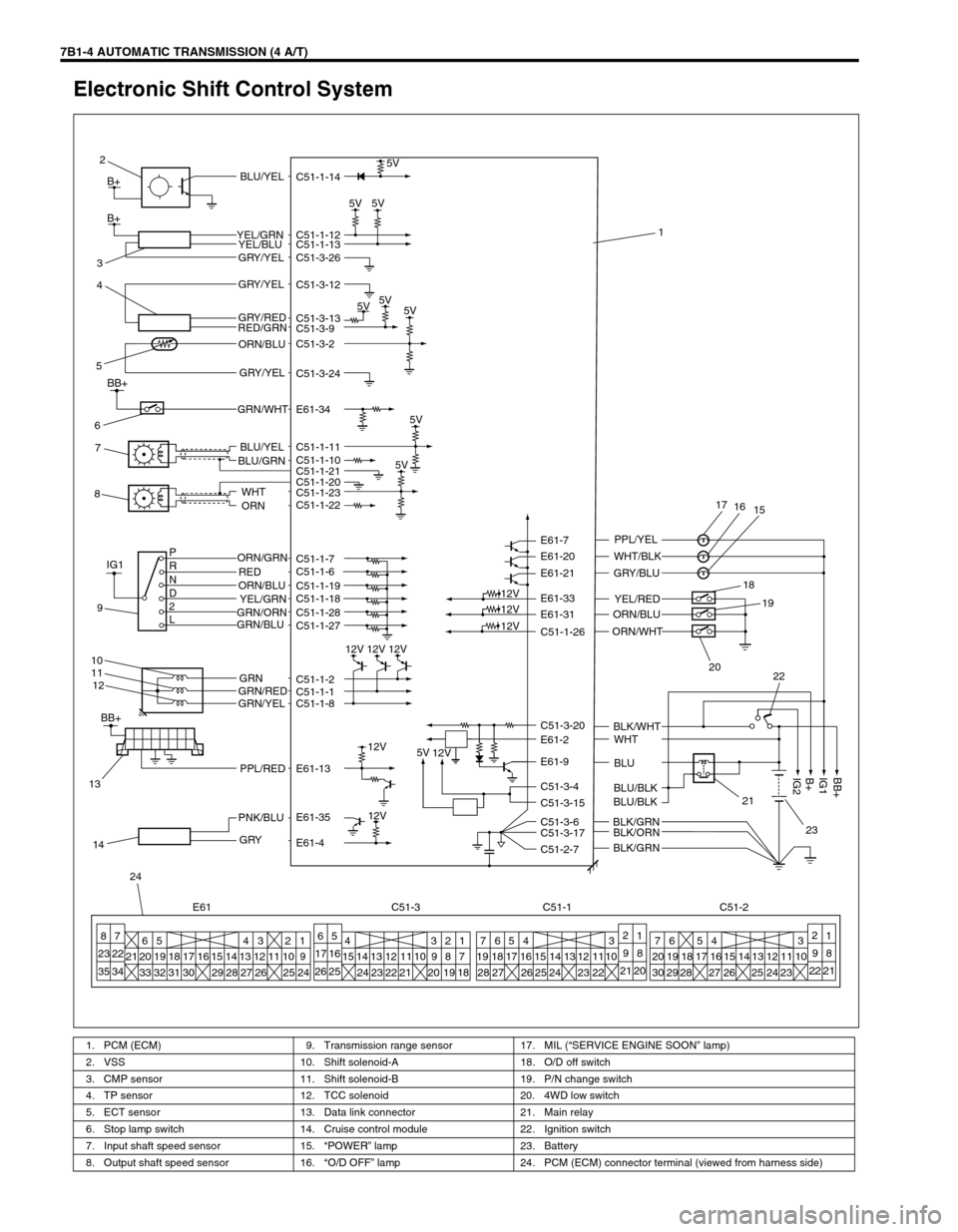
Electronic Shift Control System
1. PCM (ECM) 9. Transmission range sensor 17. MIL (“SERVICE ENGINE SOON” lamp)
2. VSS 10. Shift solenoid-A 18. O/D off switch
3. CMP sensor 11. Shift solenoid-B 19. P/N change switch
4. TP sensor 12. TCC solenoid 20. 4WD low switch
5. ECT sensor 13. Data link connector 21. Main relay
6. Stop lamp switch 14. Cruise control module 22. Ignition switch
7. Input shaft speed sensor 15.“POWER” lamp 23. Battery
8. Output shaft speed sensor 16.“O/D OFF” lamp 24. PCM (ECM) connector terminal (viewed from harness side)
5V
5V5V
5V5V
5V
5V 5V C51-1-14
C51-1-12
C51-1-13
C51-3-26
C51-3-12
C51-3-13
C51-3-9
C51-3-2
C51-3-24
C51-1-11
C51-1-10
C51-1-20 C51-1-21
C51-1-23
C51-1-22
C51-1-7
C51-1-6
C51-1-19
C51-1-18
C51-1-28
C51-1-27
C51-1-2
C51-1-1
C51-1-8
E61-13
E61-35
E61-4C51-1-26 E61-31 E61-33 E61-21 E61-20 E61-7
C51-3-20
E61-2
E61-9
C51-3-4
C51-3-15
C51-3-6
C51-3-17
C51-2-7
12V
12V 12V 12V
12V
12V
12V
12V
5V
12V
BLU/YEL
YEL/GRN
YEL/BLU
GRY/YEL
GRY/YEL
GRY/RED
RED/GRN
ORN/BLU
GRY/YEL
BLU/YEL
BLU/GRN
WHT
ORN
ORN/GRN
RED P
R
N
D
2
LORN/BLU
YEL/GRN
GRN/ORN
GRN/BLU
GRN
GRN/RED
GRN/YEL
PPL/RED
PNK/BLU
GRY
PPL/YEL
WHT/BLK
GRY/BLU
YEL/RED
ORN/BLU
WHT
BLU
BLU/BLK
BLU/BLK
BLK/GRN
BLK/ORN
BLK/GRNBLK/WHT ORN/WHT
8
7
23 22
35 346
20 21
335
19
3218
3117
3016 15
2914
284
13
273
12
26112
10
256
5
17 16
26 252
1
98
21 202
1
98
22 21 1
9
247
20
306
19
2918
27 17
2816 15
2614
25 5
13 4
12
24113
10
23 7
19
28654 3
18
2717 16
2615 14
2513
2412
2311
2210 4
15 14
2413
2312
2211 10 9 8 7
213
202
191
18
24
E61 C51-3 C51-1 C51-2 14
13
B+
B+
17
16
15
18
19
20
22
21
23
BB+
IG1
B+
IG2
1 2
3
4
5
7 6
8
IG1
9
10
11
12
BB+
E61-34 GRN/WHT
BB+
Page 414 of 656
AUTOMATIC TRANSMISSION (4 A/T) 7B1-5
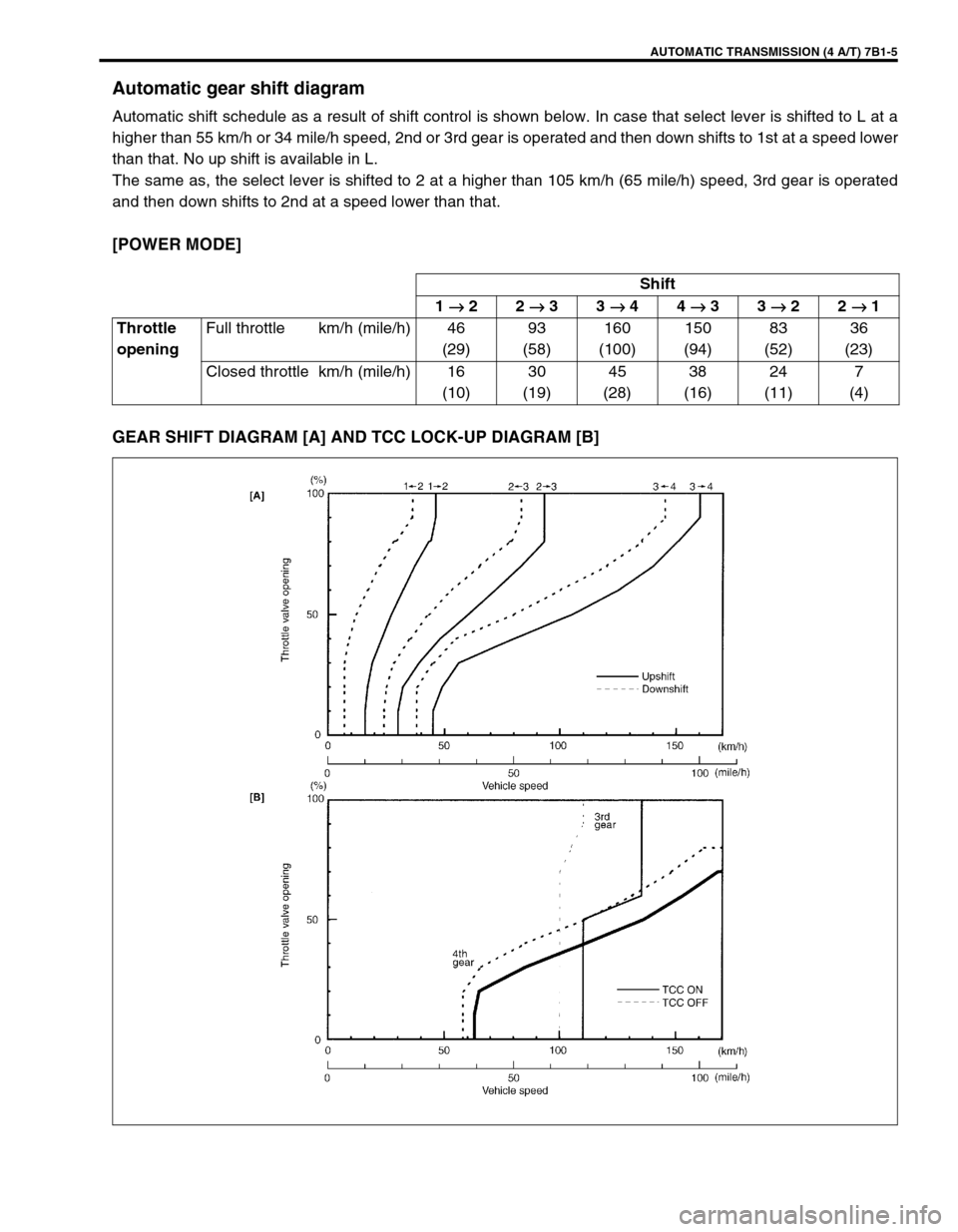
Automatic gear shift diagram
Automatic shift schedule as a result of shift control is shown below. In case that select lever is shifted to L at a
higher than 55 km/h or 34 mile/h speed, 2nd or 3rd gear is operated and then down shifts to 1st at a speed lower
than that. No up shift is available in L.
The same as, the select lever is shifted to 2 at a higher than 105 km/h (65 mile/h) speed, 3rd gear is operated
and then down shifts to 2nd at a speed lower than that.
[POWER MODE]
GEAR SHIFT DIAGRAM [A] AND TCC LOCK-UP DIAGRAM [B]
Shift
1 →
→→ → 22 →
→→ → 33 →
→→ → 44 →
→→ → 33 →
→→ → 22 →
→→ → 1
Throttle
openingFull throttle km/h (mile/h) 46
(29)93
(58)160
(100)150
(94)83
(52)36
(23)
Closed throttle km/h (mile/h) 16
(10)30
(19)45
(28)38
(16)24
(11)7
(4)
Page 417 of 656
7B1-8 AUTOMATIC TRANSMISSION (4 A/T)
On-Board Diagnostic System (Vehicle with
monitor connector)
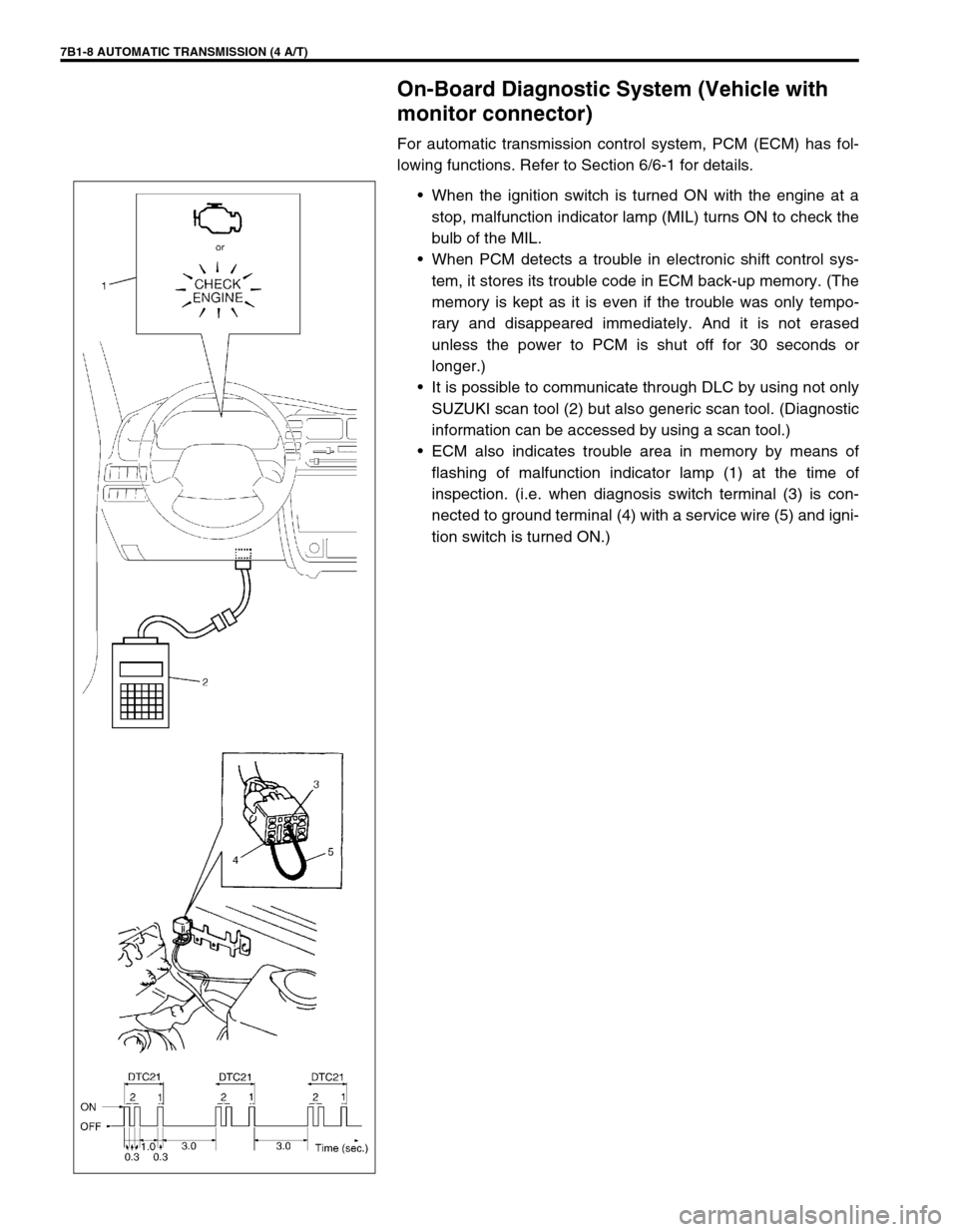
For automatic transmission control system, PCM (ECM) has fol-
lowing functions. Refer to Section 6/6-1 for details.
•When the ignition switch is turned ON with the engine at a
stop, malfunction indicator lamp (MIL) turns ON to check the
bulb of the MIL.
•When PCM detects a trouble in electronic shift control sys-
tem, it stores its trouble code in ECM back-up memory. (The
memory is kept as it is even if the trouble was only tempo-
rary and disappeared immediately. And it is not erased
unless the power to PCM is shut off for 30 seconds or
longer.)
•It is possible to communicate through DLC by using not only
SUZUKI scan tool (2) but also generic scan tool. (Diagnostic
information can be accessed by using a scan tool.)
•ECM also indicates trouble area in memory by means of
flashing of malfunction indicator lamp (1) at the time of
inspection. (i.e. when diagnosis switch terminal (3) is con-
nected to ground terminal (4) with a service wire (5) and igni-
tion switch is turned ON.)
Page 418 of 656
AUTOMATIC TRANSMISSION (4 A/T) 7B1-9
Precaution in Diagnosing Trouble
•Don’t disconnect couplers from PCM (ECM), battery cable
from battery, PCM ground wire harness from engine or main
fuse before checking the diagnosis information (DTC, freeze
frame data, etc.) stored in PCM memory. Such disconnec-
tion will clear memorized information in PCM memory.
•Using SUZUKI scan tool or also generic scan tool for vehicle
without monitor connector, the diagnostic information stored
in PCM memory can be checked and cleared as well. Before
its use, be sure to read Operator’s (Instruction) Manual sup-
plied with it carefully to have good understanding of its func-
tions and usage.
•Priorities for diagnosing troubles
If two or more diagnostic trouble codes (DTCs) are stored,
proceed to the flow table of the DTC which was detected
earliest in the order and follow the instruction in that table.
If no instructions are given, troubleshoot diagnostic trouble
codes according to the following priorities.
–Diagnostic trouble codes (DTCs) other than DTC P0171/
P0172/P0174/P0175 (Fuel system too lean/too rich), DTC
P0300/P0301/P0302/P0303/P0304/P0305/P0306 (Misfire
detected) and DTC P0400 (EGR flow malfunction)
–DTC P0171/P0172/P0174/P0175 (Fuel system too lean/too
rich) and DTC P0400 (EGR flow malfunction)
–DTC P0300/P0301/P0302/P0303/P0304/P0305/P0306
(Misfire detected)
•Be sure to read “PRECAUTIONS FOR ELECTRICAL CIR-
CUIT SERVICE” in Section 0A before inspection and
observe what is written there.
•PCM replacement
When substituting a known-good PCM, check for following
conditions.
Neglecting this check may result in damage to a good PCM.
–All relays and actuators have resistance of specified value.
–MAF sensor, MDP sensor, TP sensor and fuel tank pres-
sure sensor are in good condition. Also, the power circuit of
these sensors is not shorted to the ground.
Page 422 of 656
AUTOMATIC TRANSMISSION (4 A/T) 7B1-13
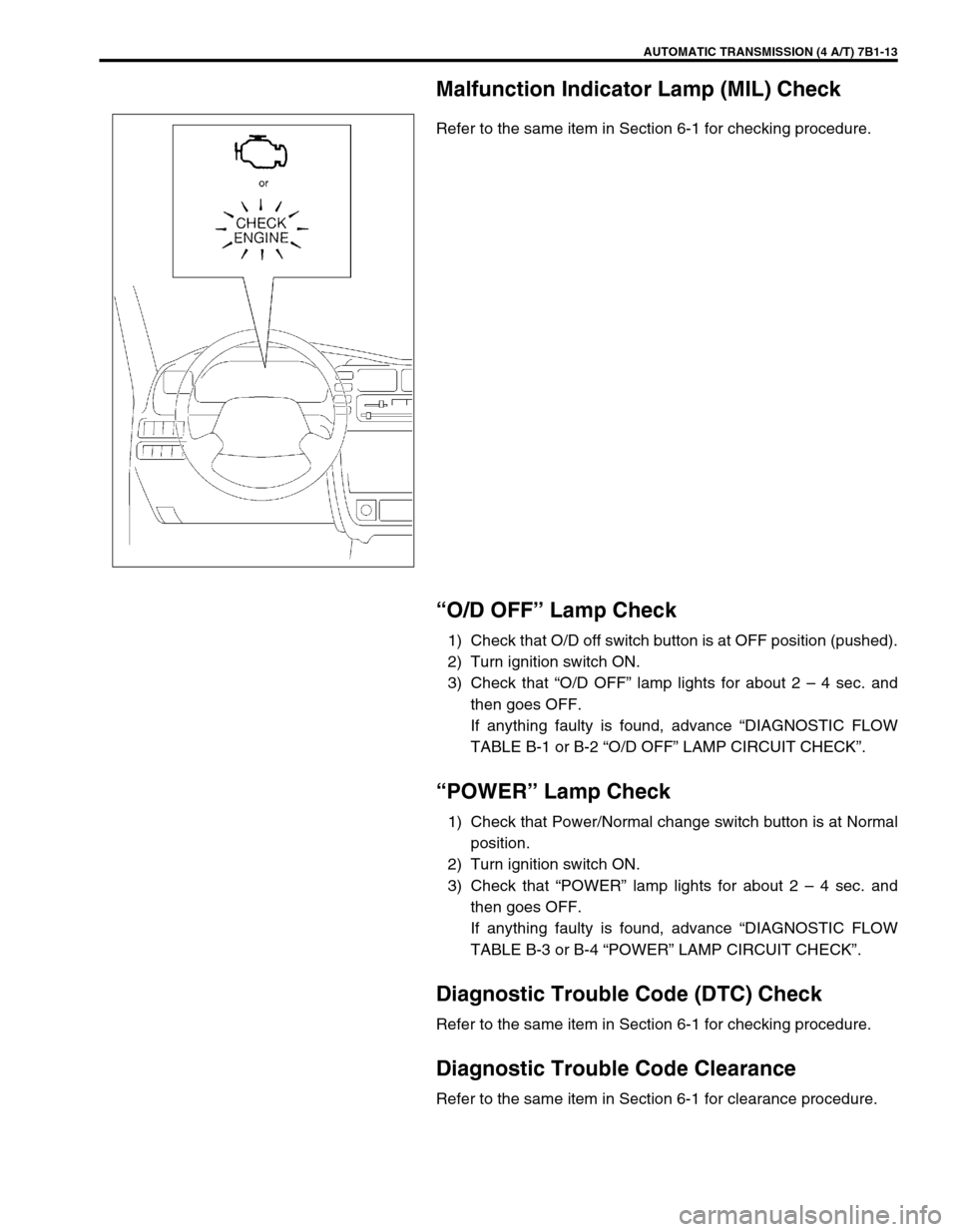
Malfunction Indicator Lamp (MIL) Check
Refer to the same item in Section 6-1 for checking procedure.
“O/D OFF” Lamp Check
1) Check that O/D off switch button is at OFF position (pushed).
2) Turn ignition switch ON.
3) Check that “O/D OFF” lamp lights for about 2 – 4 sec. and
then goes OFF.
If anything faulty is found, advance “DIAGNOSTIC FLOW
TABLE B-1 or B-2 “O/D OFF” LAMP CIRCUIT CHECK”.
“POWER” Lamp Check
1) Check that Power/Normal change switch button is at Normal
position.
2) Turn ignition switch ON.
3) Check that “POWER” lamp lights for about 2 – 4 sec. and
then goes OFF.
If anything faulty is found, advance “DIAGNOSTIC FLOW
TABLE B-3 or B-4 “POWER” LAMP CIRCUIT CHECK”.
Diagnostic Trouble Code (DTC) Check
Refer to the same item in Section 6-1 for checking procedure.
Diagnostic Trouble Code Clearance
Refer to the same item in Section 6-1 for clearance procedure.
Page 423 of 656
7B1-14 AUTOMATIC TRANSMISSION (4 A/T)
Diagnostic Trouble Code Table
Refer to the same item in Section 6-1.
Fail Safe Table
Refer to the same item in Section 6-1.
Visual Inspection
Visually check following parts and systems.
A/T Basic Check
This inspection is important for troubleshooting when PCM (ECM) has detected no DTC and no abnormality has
been noted in visual inspection. Follow flow table carefully.INSPECTION ITEM REFERRING SECTION
•A/T fluid - - - - - level, leakage, color SECTION 0B
•A/T fluid hoses - - - - - disconnection, looseness, deterioration SECTION 7B1
•Throttle (accelerator) cable - - - - - play, installation SECTION 6E2
•A/T throttle cable - - - - - play, installation SECTION 7B1
•A/T select cable - - - - - installation, operation SECTION 7B1
•Engine oil - - - - - level, leakage SECTION 0B
•Engine coolant - - - - - level, leakage SECTION 0B
•Battery - - - - - fluid level, corrosion of terminal
•Connectors of electric wire harness - - - - - disconnection, friction Section 6-1 or 7B1
•Fuses - - - - - burning SECTION 8
•Parts - - - - - installation, damage
•bolt - - - - - looseness
•Other parts that can be checked visually
•Also check following items at engine start, if possible.
–“O/D OFF” lamp - - - - - Operation SECTION 7B1
–“POWER” lamp - - - - - Operation SECTION 7B1
–Malfunction indicator lamp (“SERVICE ENGINE SOON” lamp) - -
- - - OperationSection 6-1
–Charge warning lamp - - - - - Operation SECTION 6H
–Engine oil pressure warning lamp - - - - - Operation SECTION 8C (SECTION 6A2 for pres-
sure check)
–Engine coolant temp. meter - - - - - Operation
–Other parts that can be checked visually
Step Action Yes No
1Was “AUTOMATIC TRANSMISSION DIAGNOSTIC
FLOW TABLE” performed?Go to Step 2. Go to “AUTOMATIC
TRANSMISSION DIAG-
NOSTIC FLOW TABLE”.
2Perform “MANUAL ROAD TEST” in this section.
Is it OK?Go to Step 3. Go to Step 4.
3Proceed to “TROUBLE DIAGNOSIS TABLE 1” in this
section.
Is trouble identified?Repair or replace
defective parts.Go to Step 5.
Page 429 of 656
7B1-20 AUTOMATIC TRANSMISSION (4 A/T)
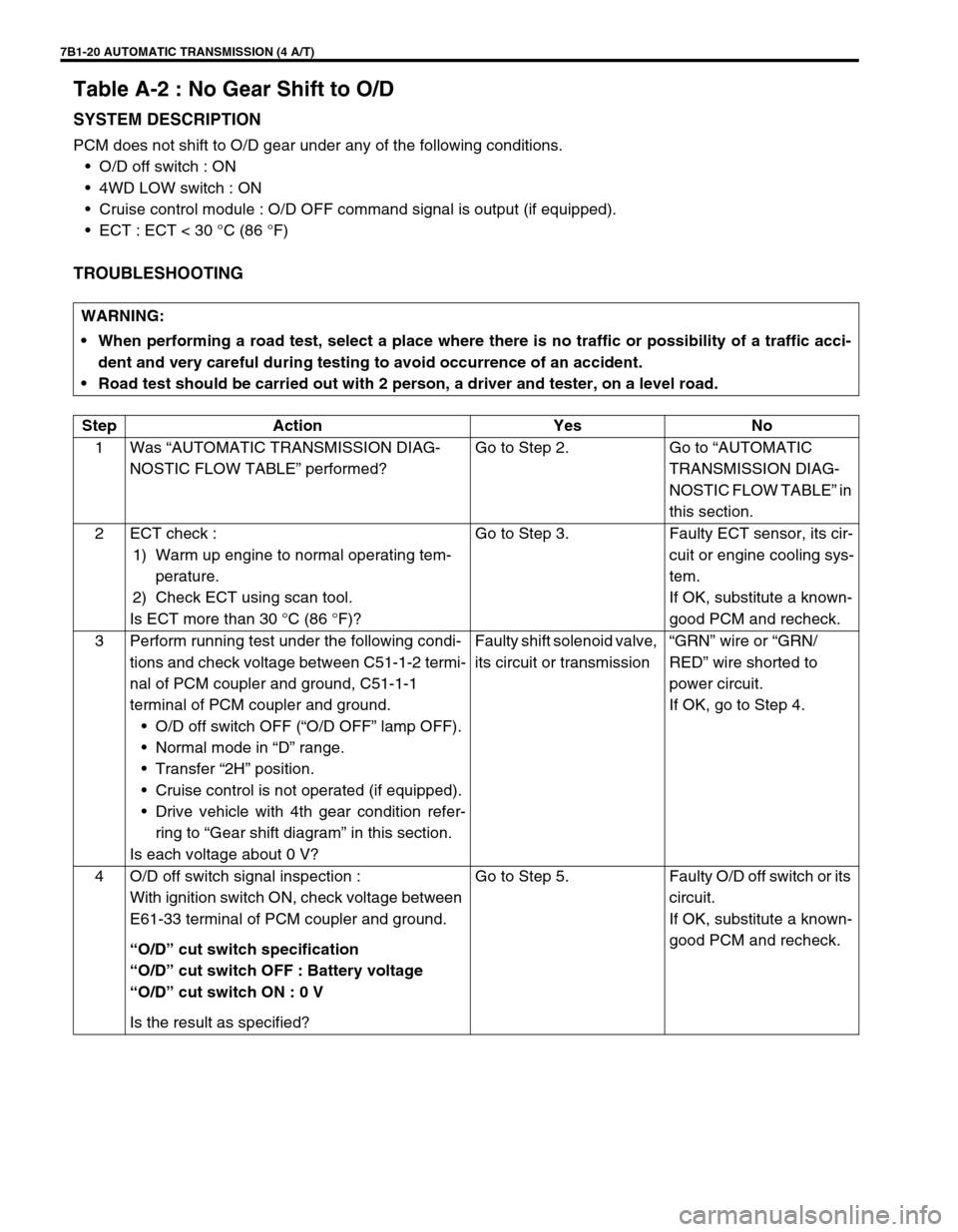
Table A-2 : No Gear Shift to O/D
SYSTEM DESCRIPTION
PCM does not shift to O/D gear under any of the following conditions.
•O/D off switch : ON
•4WD LOW switch : ON
•Cruise control module : O/D OFF command signal is output (if equipped).
•ECT : ECT < 30 °C (86 °F)
TROUBLESHOOTING
WARNING:
When performing a road test, select a place where there is no traffic or possibility of a traffic acci-
dent and very careful during testing to avoid occurrence of an accident.
Road test should be carried out with 2 person, a driver and tester, on a level road.
Step Action Yes No
1Was “AUTOMATIC TRANSMISSION DIAG-
NOSTIC FLOW TABLE” performed?Go to Step 2. Go to “AUTOMATIC
TRANSMISSION DIAG-
NOSTIC FLOW TABLE” in
this section.
2 ECT check :
1) Warm up engine to normal operating tem-
perature.
2) Check ECT using scan tool.
Is ECT more than 30 °C (86 °F)?Go to Step 3. Faulty ECT sensor, its cir-
cuit or engine cooling sys-
tem.
If OK, substitute a known-
good PCM and recheck.
3 Perform running test under the following condi-
tions and check voltage between C51-1-2 termi-
nal of PCM coupler and ground, C51-1-1
terminal of PCM coupler and ground.
•O/D off switch OFF (“O/D OFF” lamp OFF).
•Normal mode in “D” range.
•Transfer “2H” position.
•Cruise control is not operated (if equipped).
•Drive vehicle with 4th gear condition refer-
ring to “Gear shift diagram” in this section.
Is each voltage about 0 V?Faulty shift solenoid valve,
its circuit or transmission“GRN” wire or “GRN/
RED” wire shorted to
power circuit.
If OK, go to Step 4.
4 O/D off switch signal inspection :
With ignition switch ON, check voltage between
E61-33 terminal of PCM coupler and ground.
“O/D” cut switch specification
“O/D” cut switch OFF : Battery voltage
“O/D” cut switch ON : 0 V
Is the result as specified?Go to Step 5. Faulty O/D off switch or its
circuit.
If OK, substitute a known-
good PCM and recheck.
Page 433 of 656
7B1-24 AUTOMATIC TRANSMISSION (4 A/T)
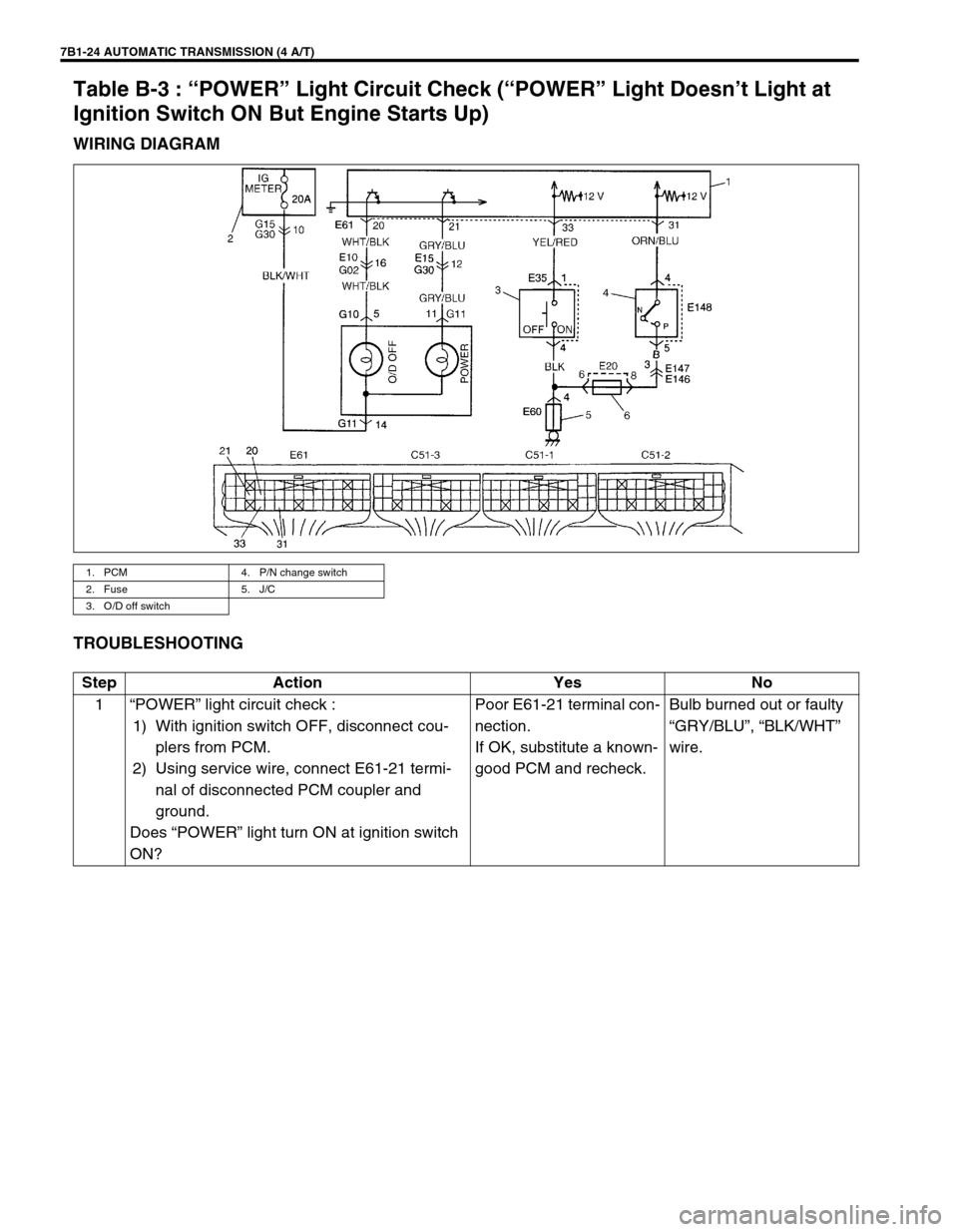
Table B-3 : “POWER” Light Circuit Check (“POWER” Light Doesn’t Light at
Ignition Switch ON But Engine Starts Up)
WIRING DIAGRAM
TROUBLESHOOTING
1. PCM 4. P/N change switch
2. Fuse 5. J/C
3. O/D off switch
Step Action Yes No
1“POWER” light circuit check :
1) With ignition switch OFF, disconnect cou-
plers from PCM.
2) Using service wire, connect E61-21 termi-
nal of disconnected PCM coupler and
ground.
Does “POWER” light turn ON at ignition switch
ON?Poor E61-21 terminal con-
nection.
If OK, substitute a known-
good PCM and recheck.Bulb burned out or faulty
“GRY/BLU”, “BLK/WHT”
wire.