2d high SUZUKI GRAND VITARA 2016 Owner's Manual
[x] Cancel search | Manufacturer: SUZUKI, Model Year: 2016, Model line: GRAND VITARA, Model: SUZUKI GRAND VITARA 2016Pages: 482, PDF Size: 21 MB
Page 127 of 482
2-105
BEFORE DRIVING
54P00-01E
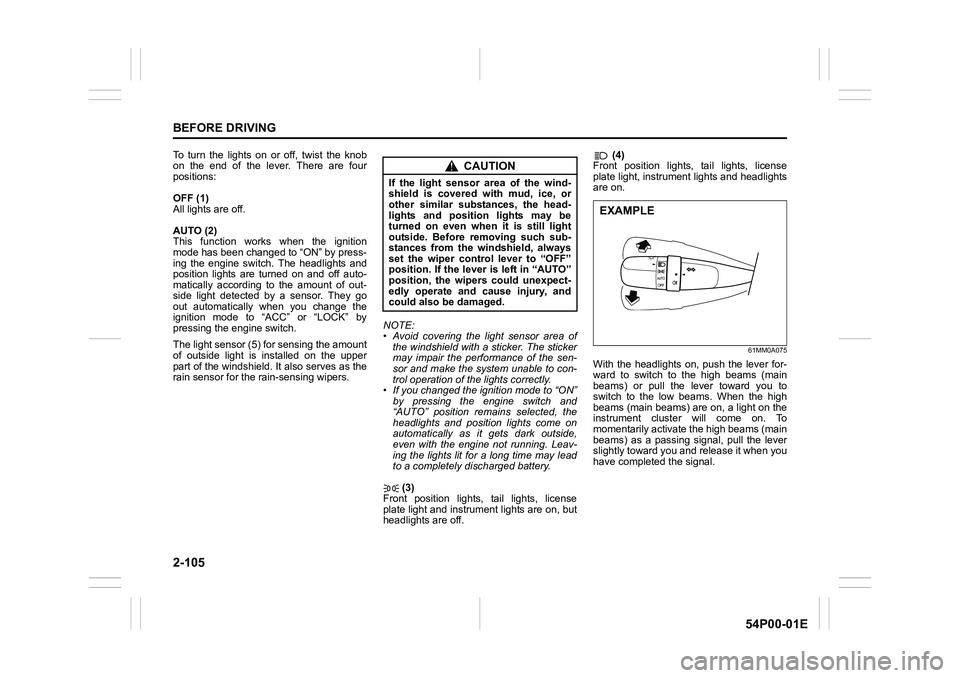
To turn the lights on or off, twist the knob
on the end of the lever. There are four
positions:
OFF (1)
All lights are off.
AUTO (2)
This function works when the ignition
mode has been changed to “ON” by press-
ing the engine switch. The headlights and
position lights are turned on and off auto-
matically according to the amount of out-
side light detected by a sensor. They go
out automatically when you change the
ignition mode to “ACC” or “LOCK” by
pressing the engine switch.
The light sensor (5) for sensing the amount
of outside light is installed on the upper
part of the windshield. It also serves as the
rain sensor for the rain-sensing wipers.NOTE:
• Avoid covering the light sensor area of
the windshield with a sticker. The sticker
may impair the performance of the sen-
sor and make the system unable to con-
trol operation of the lights correctly.
• If you changed the ignition mode to “ON”
by pressing the engine switch and
“AUTO” position remains selected, the
headlights and position lights come on
automatically as it gets dark outside,
even with the engine not running. Leav-
ing the lights lit for a long time may lead
to a completely discharged battery.
(3)
Front position lights, tail lights, license
plate light and instrument lights are on, but
headlights are off. (4)
Front position lights, tail lights, license
plate light, instrument lights and headlights
are on.
61MM0A075
With the headlights on, push the lever for-
ward to switch to the high beams (main
beams) or pull the lever toward you to
switch to the low beams. When the high
beams (main beams) are on, a light on the
instrument cluster will come on. To
momentarily activate the high beams (main
beams) as a passing signal, pull the lever
slightly toward you and release it when you
have completed the signal.
CAUTION
If the light sensor area of the wind-
shield is covered with mud, ice, or
other similar substances, the head-
lights and position lights may be
turned on even when it is still light
outside. Before removing such sub-
stances from the windshield, always
set the wiper control lever to “OFF”
position. If the lever is left in “AUTO”
position, the wipers could unexpect-
edly operate and cause injury, and
could also be damaged.
EXAMPLE
Page 132 of 482
2-110
BEFORE DRIVING
54P00-01E
Hazard warning switch
54P000242
Push in the hazard warning switch to acti-
vate the hazard warning lights. All turn sig-
nal lights and both turn signal indicators
will flash simultaneously. To turn off the
lights, push the switch again.
Use the hazard warning lights to warn
other drivers of possible risk of traffic haz-
ard when you park your vehicle in case of
emergency.
Windshield wiper and washer
lever
65D611
Wiper and washer operation
When the ignition switch is in “ON” position
or the ignition mode is “ON”, you can use
the wiper/washer lever or switch (if
equipped).
Windshield wipers
61MM0A079
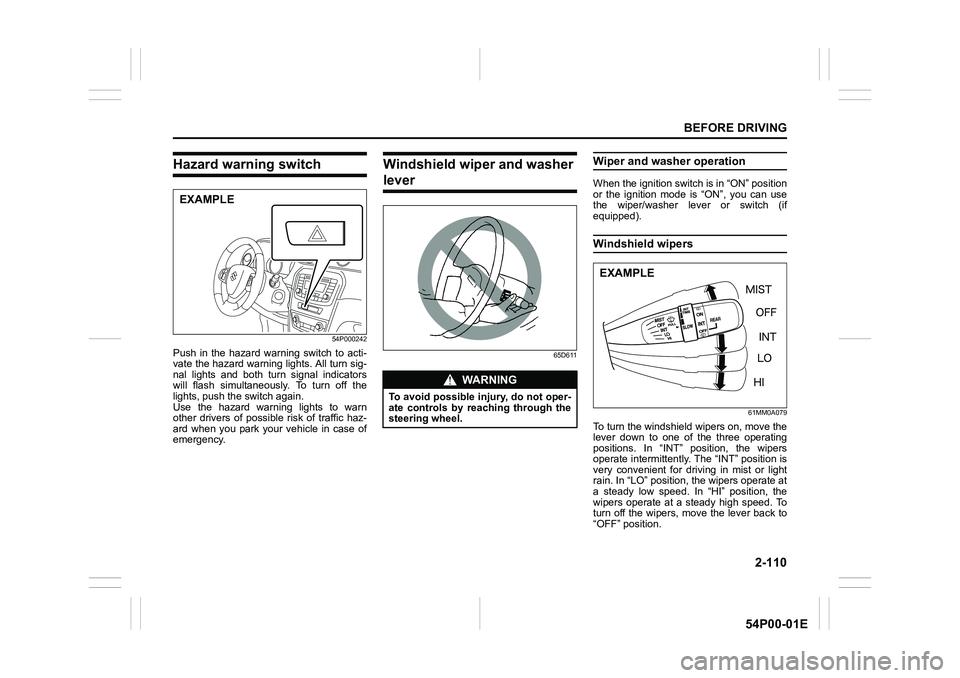
To turn the windshield wipers on, move the
lever down to one of the three operating
positions. In “INT” position, the wipers
operate intermittently. The “INT” position is
very convenient for driving in mist or light
rain. In “LO” position, the wipers operate at
a steady low speed. In “HI” position, the
wipers operate at a steady high speed. To
turn off the wipers, move the lever back to
“OFF” position.
EXAMPLE
WA R N I N G
To avoid possible injury, do not oper-
ate controls by reaching through the
steering wheel.
EXAMPLE
Page 133 of 482
2-111
BEFORE DRIVING
54P00-01E
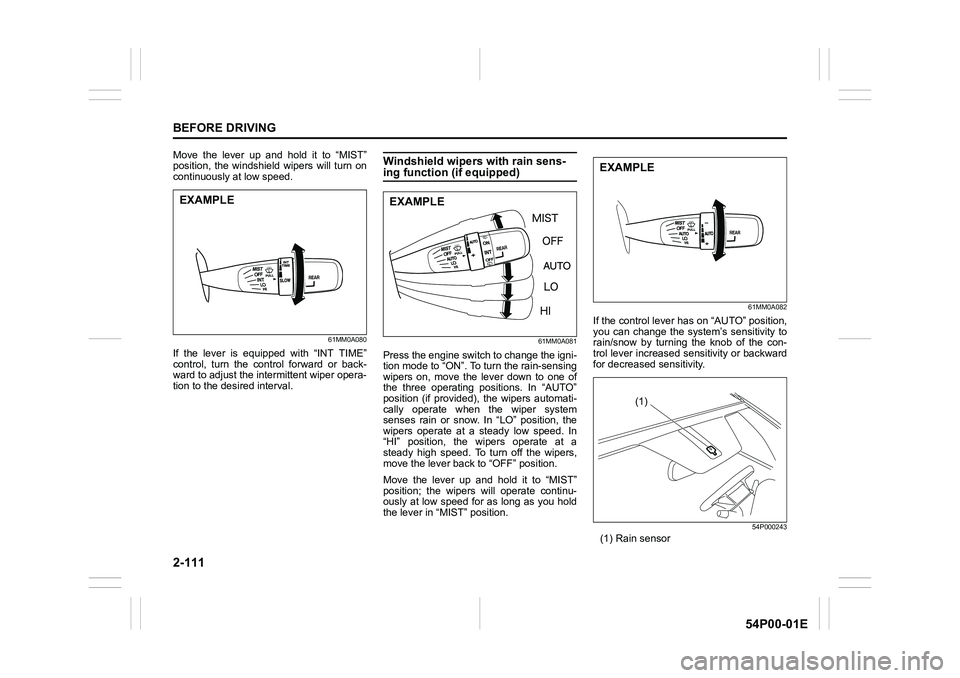
Move the lever up and hold it to “MIST”
position, the windshield wipers will turn on
continuously at low speed.
61MM0A080
If the lever is equipped with “INT TIME”
control, turn the control forward or back-
ward to adjust the intermittent wiper opera-
tion to the desired interval.
Windshield wipers with rain sens-ing function (if equipped)
61MM0A081
Press the engine switch to change the igni-
tion mode to “ON”. To turn the rain-sensing
wipers on, move the lever down to one of
the three operating positions. In “AUTO”
position (if provided), the wipers automati-
cally operate when the wiper system
senses rain or snow. In “LO” position, the
wipers operate at a steady low speed. In
“HI” position, the wipers operate at a
steady high speed. To turn off the wipers,
move the lever back to “OFF” position.
Move the lever up and hold it to “MIST”
position; the wipers will operate continu-
ously at low speed for as long as you hold
the lever in “MIST” position.
61MM0A082
If the control lever has on “AUTO” position,
you can change the system’s sensitivity to
rain/snow by turning the knob of the con-
trol lever increased sensitivity or backward
for decreased sensitivity.
54P000243
(1) Rain sensor
EXAMPLEEXAMPLE
EXAMPLE
(1)
Page 134 of 482
2-112
BEFORE DRIVING
54P00-01E
NOTE:
• Under the following conditions, the rain
sensor may not be able to sense rain or
snow correctly, and thus the rain-sensing
wiper function may not work or may work
incorrectly. (Use a position other than
“AUTO” under these conditions.)
– Rain or snow does not hit the rain sen-
sor area of the windshield, or the snow
is not of a type that is able to be
detected by the sensor.
– The rain sensor area is covered with
mud, ice or other similar substance.
You should remove any foreign sub-
stance.– There were already raindrops on the
windshield before starting rain-sensing
wiper operation. You should remove
the raindrops by operating the wipers
under manual control.
– The rain sensor is hotter than 80°C
(176°F) in the sun or lower than –10°C
(14°F) in freezing weather. (The wip-
ers do not operate under this condi-
tion.)
– The windshield is coated with a water-
repellent substance, which causes
raindrops to run down quickly. This will
give a clearer view and the wipers
may seem to operate too frequently. In
this case, decrease the system’s sen-
sitivity.
– The sensor area is covered with a
sticker.
– The wiper blades are damaged. You
should replace them.
• The following conditions may indicate
problems with the rain-sensing wiper
system. If your system exhibits any of
the following conditions, have it
inspected by an authorized SUZUKI
dealer.
– Rainfall/snowfall rate varies but the
wiping interval remains constant.
– Rain/snow is falling but the wipers do
not operate.Reprogramming the rain-sensing wiper
function
“AUTO” position operation of the rain-
sensing wiper function can be customized
to your preference by reprogramming its
setting as follows. Please contact an
authorized SUZUKI dealer for this customi-
zation.
Full-automatic wiping (factory setting)
The system automatically selects the most
appropriate of the following wiping modes:
no wiping, intermittent wiping, low-speed
wiping or high-speed wiping.
Semi-automatic wiping
The system automatically selects the most
appropriate of the following wiping modes:
intermittent wiping, low-speed wiping or
high-speed wiping. (The wipers do not stop
automatically.)
Intermittent wiping
The wipers operate only in the intermittent
wiping mode. The wiping interval can be
changed with the knob on the control lever.
CAUTION
• Observe the following instructions
when the wiper lever is set to
“AUTO” position with the engine
switch in “ON” mode. Otherwise,
the wipers could unexpectedly
operate and cause injury, and could
also be damaged.
– Do not touch or wipe the rain
sensor area of the windshield
with a cloth.
– Do not hit the windshield or rain
sensor.
• Set the wiper control lever to “OFF”
position before washing the vehicle
in an automatic car wash or clean-
ing the windshield.
Page 141 of 482
3-1
OPERATING YOUR VEHICLE
54P00-01E
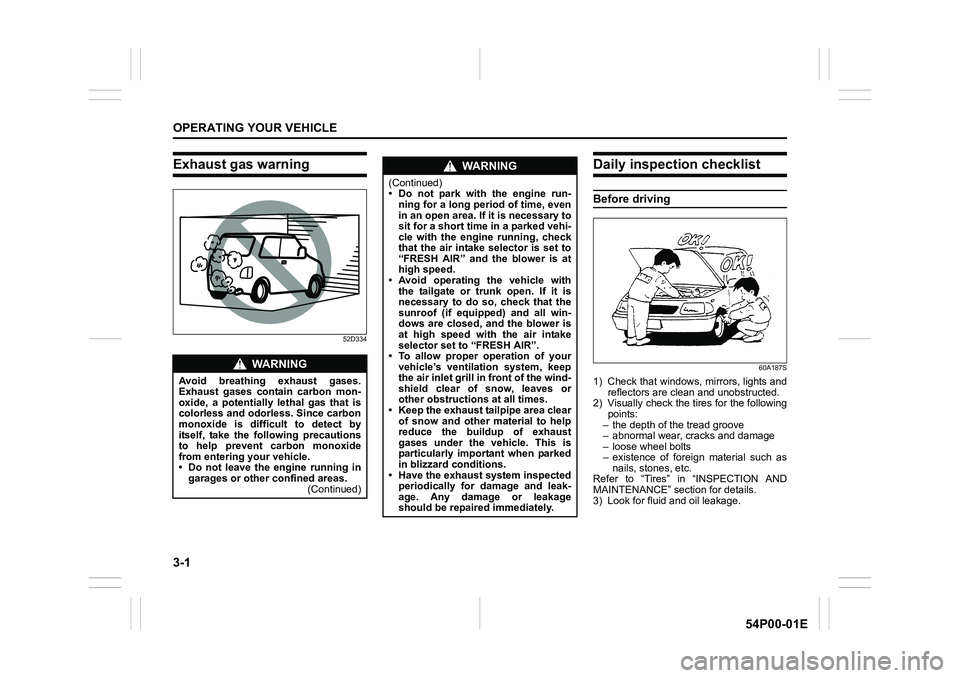
Exhaust gas warning
52D334
Daily inspection checklist
Before driving
60A187S
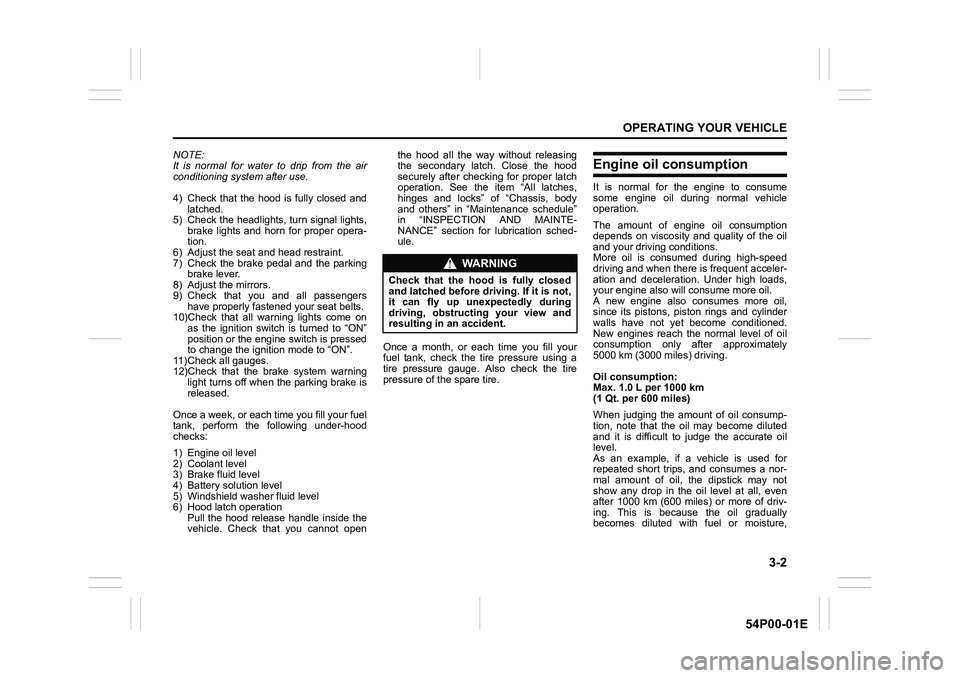
1) Check that windows, mirrors, lights and
reflectors are clean and unobstructed.
2) Visually check the tires for the following
points:
– the depth of the tread groove
– abnormal wear, cracks and damage
– loose wheel bolts
– existence of foreign material such as
nails, stones, etc.
Refer to “Tires” in “INSPECTION AND
MAINTENANCE” section for details.
3) Look for fluid and oil leakage.
WA R N I N G
Avoid breathing exhaust gases.
Exhaust gases contain carbon mon-
oxide, a potentially lethal gas that is
colorless and odorless. Since carbon
monoxide is difficult to detect by
itself, take the following precautions
to help prevent carbon monoxide
from entering your vehicle.
• Do not leave the engine running in
garages or other confined areas.
(Continued)
WA R N I N G
(Continued)
• Do not park with the engine run-
ning for a long period of time, even
in an open area. If it is necessary to
sit for a short time in a parked vehi-
cle with the engine running, check
that the air intake selector is set to
“FRESH AIR” and the blower is at
high speed.
• Avoid operating the vehicle with
the tailgate or trunk open. If it is
necessary to do so, check that the
sunroof (if equipped) and all win-
dows are closed, and the blower is
at high speed with the air intake
selector set to “FRESH AIR”.
• To allow proper operation of your
vehicle’s ventilation system, keep
the air inlet grill in front of the wind-
shield clear of snow, leaves or
other obstructions at all times.
• Keep the exhaust tailpipe area clear
of snow and other material to help
reduce the buildup of exhaust
gases under the vehicle. This is
particularly important when parked
in blizzard conditions.
• Have the exhaust system inspected
periodically for damage and leak-
age. Any damage or leakage
should be repaired immediately.
Page 142 of 482
3-2
OPERATING YOUR VEHICLE
54P00-01E
NOTE:
It is normal for water to drip from the air
conditioning system after use.
4) Check that the hood is fully closed and
latched.
5) Check the headlights, turn signal lights,
brake lights and horn for proper opera-
tion.
6) Adjust the seat and head restraint.
7) Check the brake pedal and the parking
brake lever.
8) Adjust the mirrors.
9) Check that you and all passengers
have properly fastened your seat belts.
10)Check that all warning lights come on
as the ignition switch is turned to “ON”
position or the engine switch is pressed
to change the ignition mode to “ON”.
11)Check all gauges.
12)Check that the brake system warning
light turns off when the parking brake is
released.
Once a week, or each time you fill your fuel
tank, perform the following under-hood
checks:
1) Engine oil level
2) Coolant level
3) Brake fluid level
4) Battery solution level
5) Windshield washer fluid level
6) Hood latch operation
Pull the hood release handle inside the
vehicle. Check that you cannot openthe hood all the way without releasing
the secondary latch. Close the hood
securely after checking for proper latch
operation. See the item “All latches,
hinges and locks” of “Chassis, body
and others” in “Maintenance schedule”
in “INSPECTION AND MAINTE-
NANCE” section for lubrication sched-
ule.
Once a month, or each time you fill your
fuel tank, check the tire pressure using a
tire pressure gauge. Also check the tire
pressure of the spare tire.Engine oil consumption
It is normal for the engine to consume
some engine oil during normal vehicle
operation.
The amount of engine oil consumption
depends on viscosity and quality of the oil
and your driving conditions.
More oil is consumed during high-speed
driving and when there is frequent acceler-
ation and deceleration. Under high loads,
your engine also will consume more oil.
A new engine also consumes more oil,
since its pistons, piston rings and cylinder
walls have not yet become conditioned.
New engines reach the normal level of oil
consumption only after approximately
5000 km (3000 miles) driving.
Oil consumption:
Max. 1.0 L per 1000 km
(1 Qt. per 600 miles)
When judging the amount of oil consump-
tion, note that the oil may become diluted
and it is difficult to judge the accurate oil
level.
As an example, if a vehicle is used for
repeated short trips, and consumes a nor-
mal amount of oil, the dipstick may not
show any drop in the oil level at all, even
after 1000 km (600 miles) or more of driv-
ing. This is because the oil gradually
becomes diluted with fuel or moisture,
WA R N I N G
Check that the hood is fully closed
and latched before driving. If it is not,
it can fly up unexpectedly during
driving, obstructing your view and
resulting in an accident.
Page 143 of 482
3-3
OPERATING YOUR VEHICLE
54P00-01E
making it appear that the oil level has not
changed.
You should also be aware that the diluting
ingredients evaporate out when the vehicle
is subsequently driven at high speeds,
such as on an expressway, making it
appear that oil is excessively consumed
after high-speed driving.Ignition switch
(vehicle without keyless push
start system)
65D61160B041
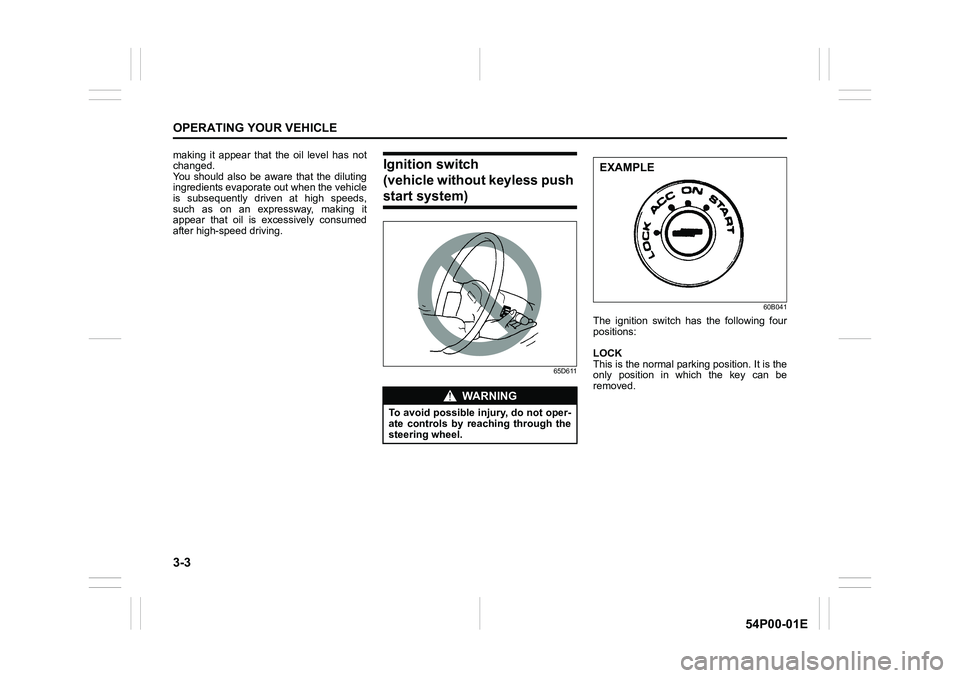
The ignition switch has the following four
positions:
LOCK
This is the normal parking position. It is the
only position in which the key can be
removed.
WA R N I N G
To avoid possible injury, do not oper-
ate controls by reaching through the
steering wheel.
EXAMPLE
Page 153 of 482
3-13
OPERATING YOUR VEHICLE
54P00-01E
Starting a cold and warm engine
(For gasoline engine model)
With your foot taken off the accelerator
pedal, crank the engine by turning the igni-
tion key to “START”. Release the key when
the engine starts.
If the engine does not start after 12 sec-
onds of cranking, wait about 15 seconds,
and then press down the accelerator pedal
to 1/3 full of capacity and try cranking the
engine again. Release the key and accel-
erator pedal when the engine starts.
If the engine still does not start, try holding
the accelerator pedal all the way to the
floor while cranking. This should clear the
engine if it is flooded.(For diesel engine model)
Cold engine
Turn the ignition switch to “ON” position
and wait until the glow plug indicator goes
out if it comes on. Crank the engine by
turning the ignition key to “START”.
Release the key when the engine starts.
Warm engine
Crank the engine by turning the ignition
key to “START”. Release the key when the
engine starts.
Caution when stopping the engine with
turbocharger
When stopping the engine after climbing or
high speed driving, let the engine idle for
about one minute or more (if it is not pro-
hibited) to cool down the turbocharger and
engine oil. This is to prevent the engine oil
from over-deteriorating. Deteriorated
engine oil will damage the bearings of the
turbocharger.
WA R N I N G
Check that the parking brake is set
fully and the transaxle is in Neutral
before attempting to start the engine.
NOTICE
• Stop turning the starter immedi-
ately after the engine has started or
the starter system can be damaged.
• Do not crank the engine for more
than 12 seconds at a time. If the
engine does not start on the first
try, wait about 15 seconds before
trying again.
NOTICE
• Stop turning the starter immedi-
ately after the engine has started or
the starter system can be damaged.
• Do not crank the engine for more
than 30 seconds at a time. If the
engine does not start on the first
try, wait about 15 seconds before
trying again.
Page 156 of 482
3-16
OPERATING YOUR VEHICLE
54P00-01E
(For diesel engine model)
Cold engine
Depress the clutch and brake pedals fully
and press the engine switch to crank the
engine. If the glow plug indicator light
comes on, the engine will start automati-
cally after the glow plug indicator light goes
off up to 10 seconds afterward.
Warm engine
Crank the engine by pressing the engine
switch to change the ignition mode to
“START”.
Caution when stopping the engine with
turbocharger
When stopping the engine after climbing or
high speed driving, let the engine idle for
about one minute or more (if it is not pro-
hibited) to cool down the turbocharger and
engine oil. This is to prevent the engine oil
from over-deteriorating. Deteriorated
engine oil will damage the bearings of the
turbocharger.Restarting diesel engine after fuel-
empty stop
If the engine stops and the low fuel warn-
ing light and the malfunction indicator light
come on, use the following procedure:
1) Fill the fuel tank.
2) Press the engine switch to change the
ignition mode to “ON” for 5-10 seconds
to feed fuel.
3) Perform the above engine starting pro-
cedure to start the engine.
If the malfunction indicator light still comes
on after the engine started, there may be
some problem with the engine. Ask your
SUZUKI dealer to have the engine
inspected.
If the master warning indicator light
blinks and the engine cannot be started
Your keyless push start system remote
controller may not be sensed as being
within the interior workable area. Try again
after checking that you have the remote
controller with you. If the engine still can-
not be started, the battery of the remote
controller may be discharged. To start the
engine, use the following method:
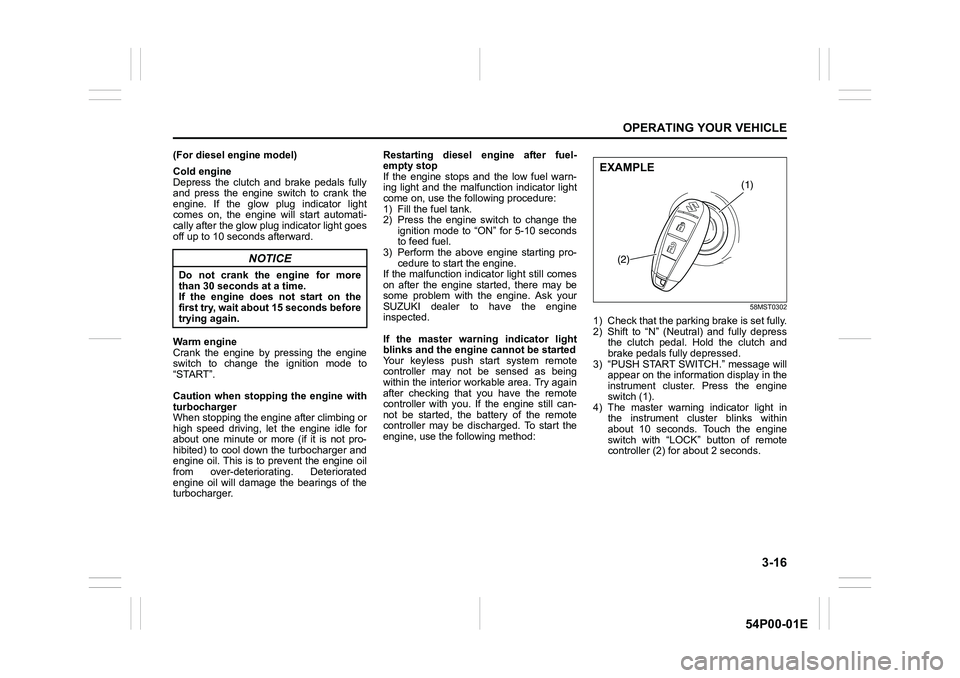
58MST0302
1) Check that the parking brake is set fully.
2) Shift to “N” (Neutral) and fully depress
the clutch pedal. Hold the clutch and
brake pedals fully depressed.
3) “PUSH START SWITCH.” message will
appear on the information display in the
instrument cluster. Press the engine
switch (1).
4) The master warning indicator light in
the instrument cluster blinks within
about 10 seconds. Touch the engine
switch with “LOCK” button of remote
controller (2) for about 2 seconds.
NOTICE
Do not crank the engine for more
than 30 seconds at a time.
If the engine does not start on the
first try, wait about 15 seconds before
trying again.
(1)
(2)
EXAMPLE
Page 158 of 482
3-18
OPERATING YOUR VEHICLE
54P00-01E
Diesel particulate filter (DPF®) (For diesel engine model)
The DPF® filters off the soot particles in
the exhaust gas, so the DPF® could get
clogged depending on the driving condi-
tion. The DPF
® is cleaned by the regener-
ating function that combusts the soot
particles in the DPF
® by raising the
exhaust gas temperature during driving or
idling.
When a certain amount of soot particles is
accumulated in the DPF
®, the DPF® will
regenerate automatically to avoid clogging
the filter. When the DPF
® regenerates
during idling, the engine revolutions will
increase by about 100 rpm and the radia-
tor fan will operate. Therefore, you may
hear a little louder engine sounds (includ-
ing the fan sounds) and/or the exhaust gas
temperature could be higher due to com-
bustion of the soot particles.
NOTE:
When you drive or idle your vehicle, white
smoke may be emitted depending on the
grade of fuel used.This is due to automatic regeneration of
particle filter. It does not affect the way the
vehicle runs.
DPF
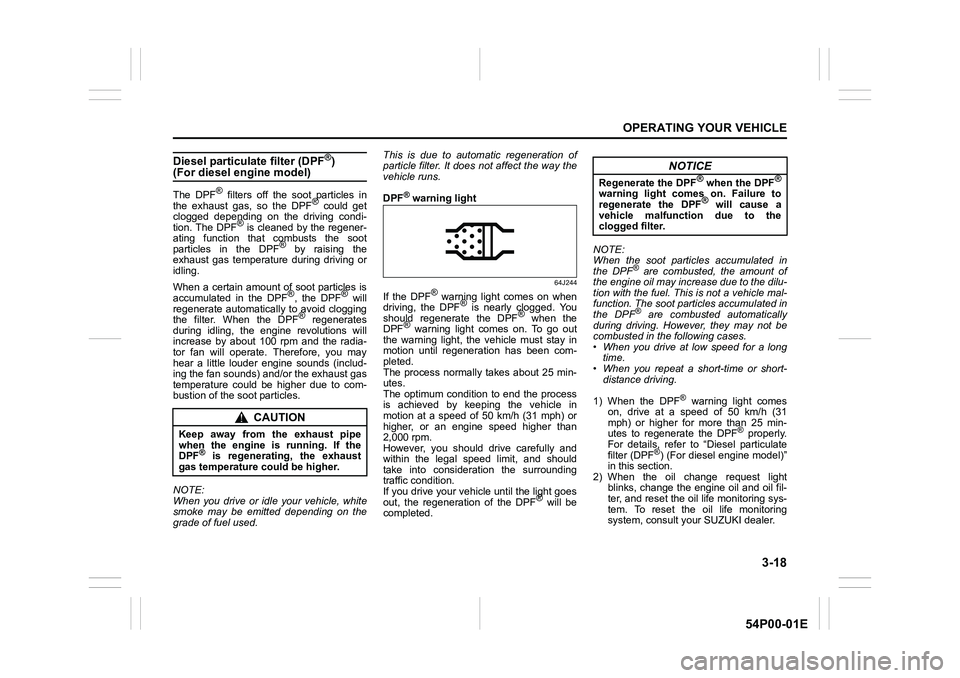
® warning light
64J244
If the DPF® warning light comes on when
driving, the DPF® is nearly clogged. You
should regenerate the DPF® when the
DPF® warning light comes on. To go out
the warning light, the vehicle must stay in
motion until regeneration has been com-
pleted.
The process normally takes about 25 min-
utes.
The optimum condition to end the process
is achieved by keeping the vehicle in
motion at a speed of 50 km/h (31 mph) or
higher, or an engine speed higher than
2,000 rpm.
However, you should drive carefully and
within the legal speed limit, and should
take into consideration the surrounding
traffic condition.
If you drive your vehicle until the light goes
out, the regeneration of the DPF
® will be
completed.NOTE:
When the soot particles accumulated in
the DPF
® are combusted, the amount of
the engine oil may increase due to the dilu-
tion with the fuel. This is not a vehicle mal-
function. The soot particles accumulated in
the DPF
® are combusted automatically
during driving. However, they may not be
combusted in the following cases.
• When you drive at low speed for a long
time.
• When you repeat a short-time or short-
distance driving.
1) When the DPF
® warning light comes
on, drive at a speed of 50 km/h (31
mph) or higher for more than 25 min-
utes to regenerate the DPF
® properly.
For details, refer to “Diesel particulate
filter (DPF
®) (For diesel engine model)”
in this section.
2) When the oil change request light
blinks, change the engine oil and oil fil-
ter, and reset the oil life monitoring sys-
tem. To reset the oil life monitoring
system, consult your SUZUKI dealer.
CAUTION
Keep away from the exhaust pipe
when the engine is running. If the
DPF
® is regenerating, the exhaust
gas temperature could be higher.
NOTICE
Regenerate the DPF® when the DPF®
warning light comes on. Failure to
regenerate the DPF® will cause a
vehicle malfunction due to the
clogged filter.