2d high SUZUKI GRAND VITARA 2016 Workshop Manual
[x] Cancel search | Manufacturer: SUZUKI, Model Year: 2016, Model line: GRAND VITARA, Model: SUZUKI GRAND VITARA 2016Pages: 482, PDF Size: 21 MB
Page 227 of 482
3-87
OPERATING YOUR VEHICLE
54P00-01E
61MM0A199
NOTE:
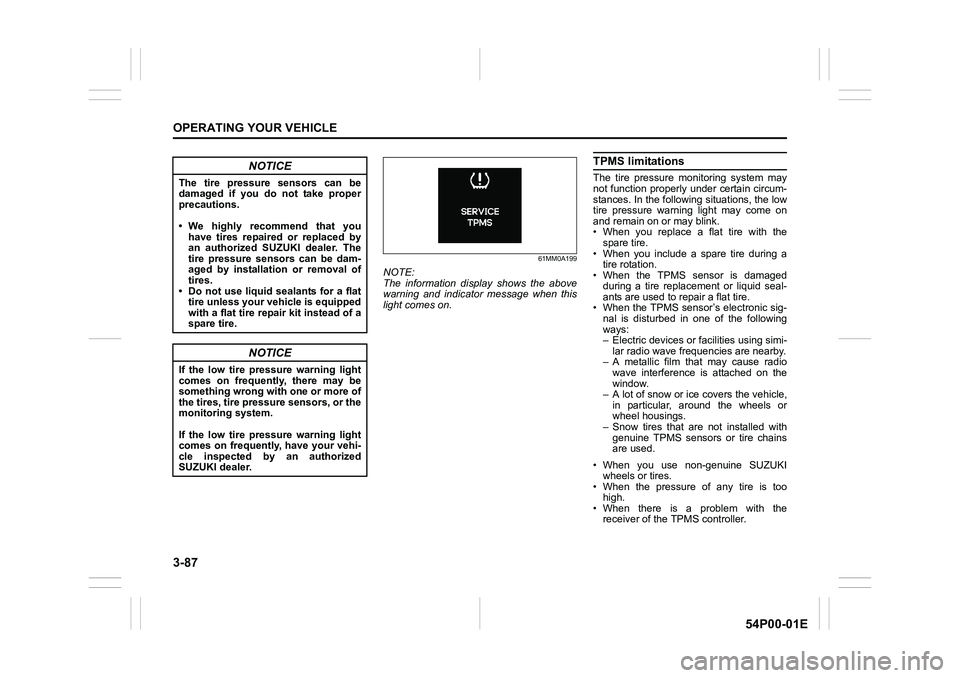
The information display shows the above
warning and indicator message when this
light comes on.
TPMS limitations
The tire pressure monitoring system may
not function properly under certain circum-
stances. In the following situations, the low
tire pressure warning light may come on
and remain on or may blink.
• When you replace a flat tire with the
spare tire.
• When you include a spare tire during a
tire rotation.
• When the TPMS sensor is damaged
during a tire replacement or liquid seal-
ants are used to repair a flat tire.
• When the TPMS sensor’s electronic sig-
nal is disturbed in one of the following
ways:
– Electric devices or facilities using simi-
lar radio wave frequencies are nearby.
– A metallic film that may cause radio
wave interference is attached on the
window.
– A lot of snow or ice covers the vehicle,
in particular, around the wheels or
wheel housings.
– Snow tires that are not installed with
genuine TPMS sensors or tire chains
are used.
• When you use non-genuine SUZUKI
wheels or tires.
• When the pressure of any tire is too
high.
• When there is a problem with the
receiver of the TPMS controller.NOTICE
The tire pressure sensors can be
damaged if you do not take proper
precautions.
• We highly recommend that you
have tires repaired or replaced by
an authorized SUZUKI dealer. The
tire pressure sensors can be dam-
aged by installation or removal of
tires.
• Do not use liquid sealants for a flat
tire unless your vehicle is equipped
with a flat tire repair kit instead of a
spare tire.
NOTICE
If the low tire pressure warning light
comes on frequently, there may be
something wrong with one or more of
the tires, tire pressure sensors, or the
monitoring system.
If the low tire pressure warning light
comes on frequently, have your vehi-
cle inspected by an authorized
SUZUKI dealer.
Page 234 of 482
DRIVING TIPS
4
54P00-01E
60G409
DRIVING TIPS
Running-in ........................................................................... 4-1
Catalytic converter .............................................................. 4-1
Improving fuel economy ..................................................... 4-2
Highway driving .................................................................. 4-3
Driving on hills .................................................................... 4-3
Driving on slippery roads ................................................... 4-4
Page 235 of 482
4-1
DRIVING TIPS
54P00-01E
52D078S
Running-inCatalytic converter
80G106
The purpose of the catalytic converter is to
minimize the amount of harmful pollutants
in your vehicle’s exhaust. Use of leaded
fuel in vehicles equipped with catalytic
converters is prohibited, because lead
deactivates the pollutant-reducing compo-
nents of the catalyst system.
The converter is designed to last the life of
the vehicle under normal usage and when
unleaded fuel is used. No special mainte-
nance is required on the converter. How-
ever, it is very important to keep the engine
properly tuned. Engine misfiring, which can
result from an improperly tuned engine,
may cause overheating of the catalytic
converter. This may result in permanent
WA R N I N G
• Fasten your seat belts at all times.
Even though air bags are equipped
at the front seating positions, the
driver and all passengers should
be properly restrained at all times,
using the seat belts provided. Refer
to “Seat belts and child restraint
systems” section for instructions
on proper use of the seat belts.
• Never drive under the influence of
alcohol or other drugs. Alcohol and
drugs can seriously impair your
ability to drive safely, greatly
increasing the risk of injury to
yourself and others. You should
also avoid driving when you are
tired, sick, irritated or under stress.
NOTICE
The future performance and reliabil-
ity of the engine depends on the care
and restraint exercised during its
early life. It is especially important to
observe the following precautions
during the first 960 km (600 miles) of
vehicle operation.
• After starting, do not race the
engine. Warm it up gradually.
• Avoid prolonged vehicle operation
at a constant speed. Moving parts
will break in better if you vary your
speed.
• Start off from a stop slowly. Avoid
full throttle starts.
• Avoid hard braking, especially
during the first 320 km (200 miles)
of driving.
• Do not drive slowly with the trans-
axle in a high gear.
• Drive the vehicle at moderate
engine speeds.
• Do not tow a trailer during the first
960 km (600 miles) of vehicle oper-
ation.
Page 237 of 482
4-3
DRIVING TIPS
54P00-01E
Keep the air cleaner clean
60A183S
If the air cleaner is clogged with dust, there
will be greater intake resistance, resulting
in decreased power output and increased
fuel consumption.
Keep weight to a minimum
The heavier the load is, the more fuel the
vehicle consumes. Unload any unneces-
sary luggage or cargo.
Keep tire pressures correct
Under-inflation of the tires can waste fuel
due to increased running resistance of the
tires. Keep your tires inflated to the correct
pressure shown on the label on the driver’s
side door or the driver’s door lock pillar.
Highway driving
When driving at highway speeds, pay
attention to the following:
• Stopping distance progressively
increases with vehicle speed. Apply the
brakes far enough ahead of the stopping
point to allow for the extra stopping dis-
tance.
• On rainy days, hydroplaning can occur.
Hydroplaning is the loss of direct contact
between the road surface and the vehi-
cle’s tires due to a water film forming
between them. Steering or braking the
vehicle during hydroplaning can be very
difficult, and loss of control can occur.
Keep speed down when the road sur-
face is wet.
• At high speeds, the vehicle may be
affected by side winds. Therefore,
reduce speed and be prepared for unex-
pected buffeting, which can occur at the
exits of tunnels, when passing by a cut
of a hill, or when being overtaken by
large vehicles, etc.
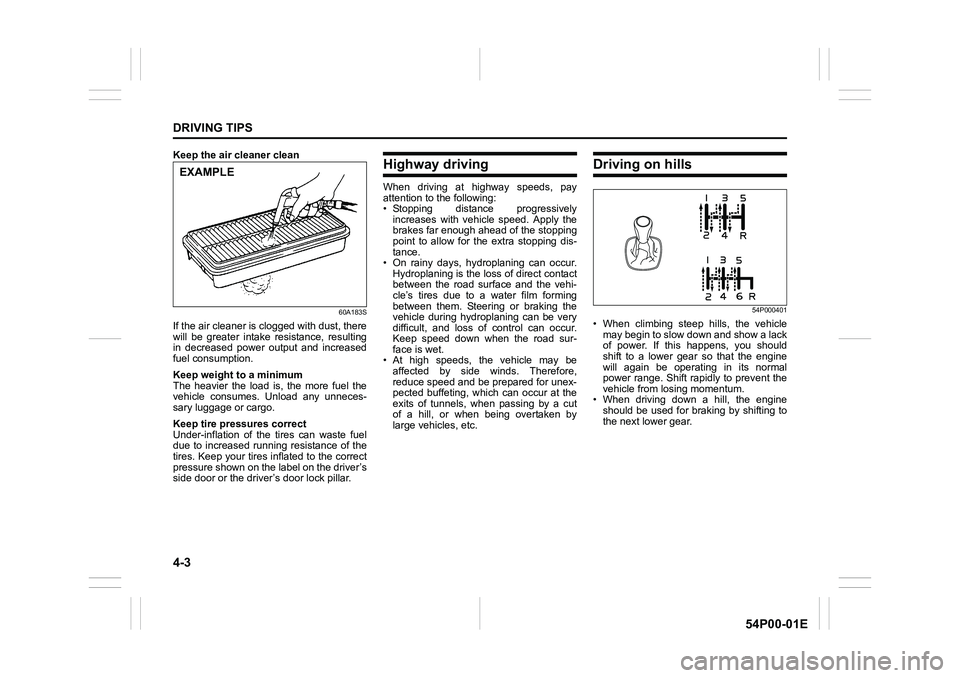
Driving on hills
54P000401
• When climbing steep hills, the vehicle
may begin to slow down and show a lack
of power. If this happens, you should
shift to a lower gear so that the engine
will again be operating in its normal
power range. Shift rapidly to prevent the
vehicle from losing momentum.
• When driving down a hill, the engine
should be used for braking by shifting to
the next lower gear.
EXAMPLE
Page 258 of 482
5-16
OTHER CONTROLS AND EQUIPMENT
54P00-01E
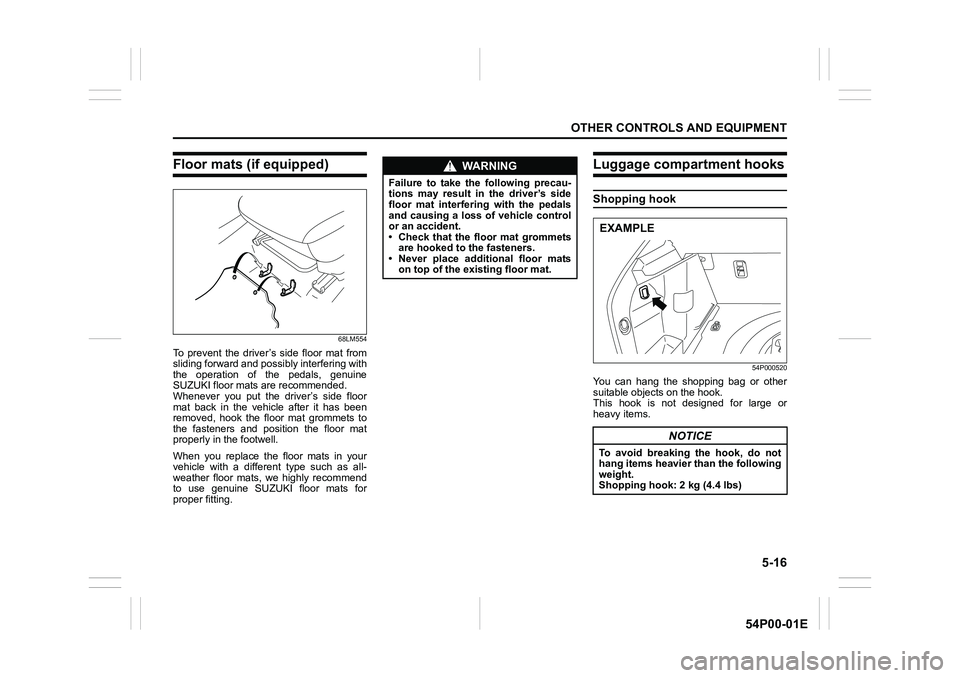
Floor mats (if equipped)
68LM554
To prevent the driver’s side floor mat from
sliding forward and possibly interfering with
the operation of the pedals, genuine
SUZUKI floor mats are recommended.
Whenever you put the driver’s side floor
mat back in the vehicle after it has been
removed, hook the floor mat grommets to
the fasteners and position the floor mat
properly in the footwell.
When you replace the floor mats in your
vehicle with a different type such as all-
weather floor mats, we highly recommend
to use genuine SUZUKI floor mats for
proper fitting.
Luggage compartment hooks
Shopping hook
54P000520
You can hang the shopping bag or other
suitable objects on the hook.
This hook is not designed for large or
heavy items.
WA R N I N G
Failure to take the following precau-
tions may result in the driver’s side
floor mat interfering with the pedals
and causing a loss of vehicle control
or an accident.
• Check that the floor mat grommets
are hooked to the fasteners.
• Never place additional floor mats
on top of the existing floor mat.
NOTICE
To avoid breaking the hook, do not
hang items heavier than the following
weight.
Shopping hook: 2 kg (4.4 lbs)
EXAMPLE
Page 259 of 482
5-17
OTHER CONTROLS AND EQUIPMENT
54P00-01E
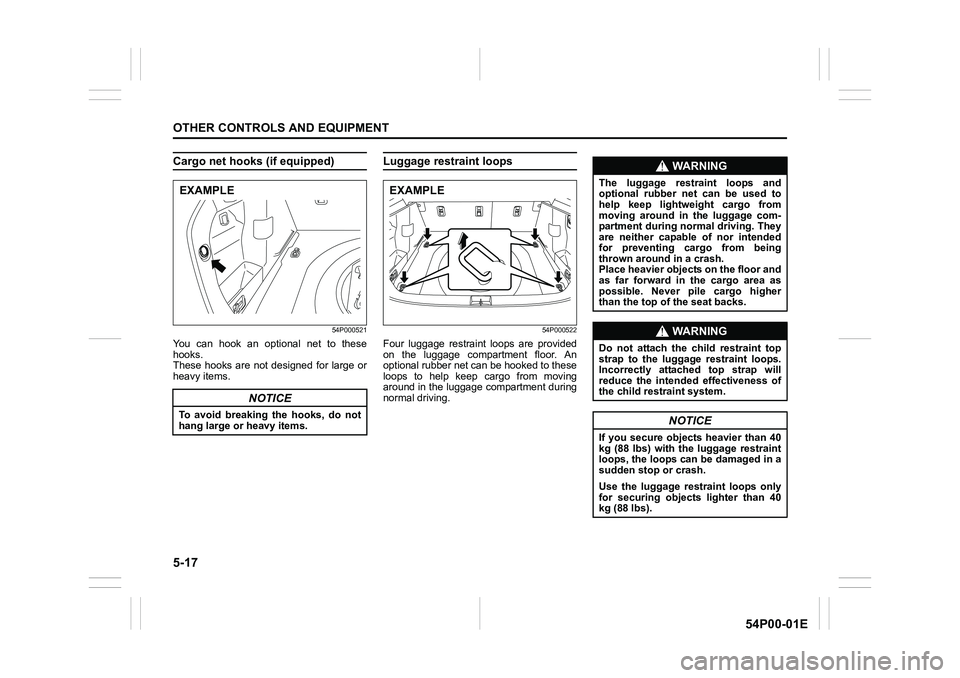
Cargo net hooks (if equipped)
54P000521
You can hook an optional net to these
hooks.
These hooks are not designed for large or
heavy items.
Luggage restraint loops
54P000522
Four luggage restraint loops are provided
on the luggage compartment floor. An
optional rubber net can be hooked to these
loops to help keep cargo from moving
around in the luggage compartment during
normal driving.
NOTICE
To avoid breaking the hooks, do not
hang large or heavy items.
EXAMPLEEXAMPLE
WA R N I N G
The luggage restraint loops and
optional rubber net can be used to
help keep lightweight cargo from
moving around in the luggage com-
partment during normal driving. They
are neither capable of nor intended
for preventing cargo from being
thrown around in a crash.
Place heavier objects on the floor and
as far forward in the cargo area as
possible. Never pile cargo higher
than the top of the seat backs.
WA R N I N G
Do not attach the child restraint top
strap to the luggage restraint loops.
Incorrectly attached top strap will
reduce the intended effectiveness of
the child restraint system.
NOTICE
If you secure objects heavier than 40
kg (88 lbs) with the luggage restraint
loops, the loops can be damaged in a
sudden stop or crash.
Use the luggage restraint loops only
for securing objects lighter than 40
kg (88 lbs).
Page 261 of 482
5-19
OTHER CONTROLS AND EQUIPMENT
54P00-01E
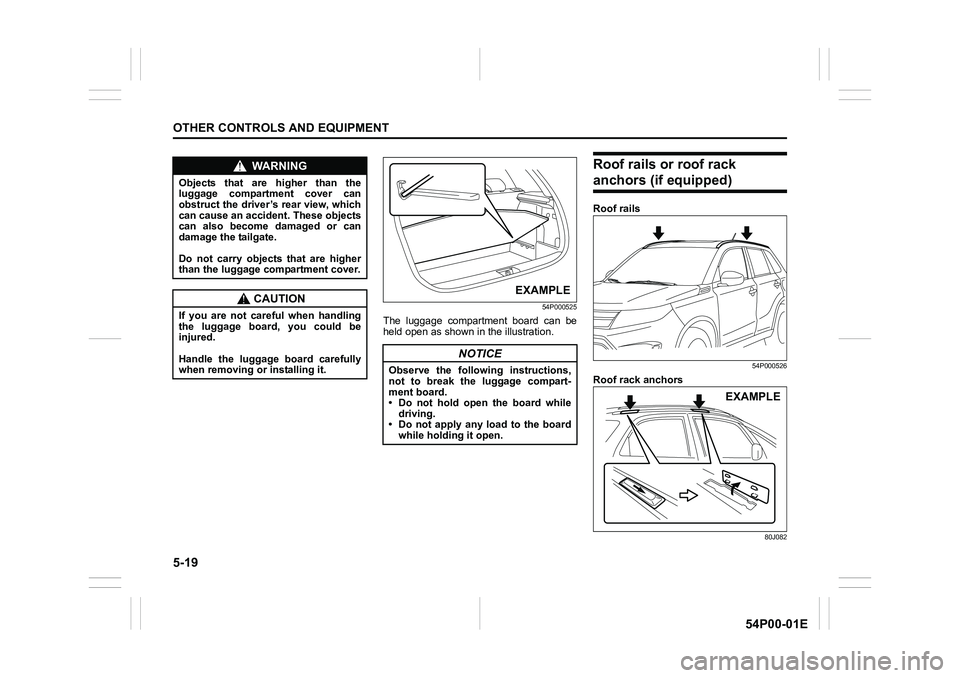
54P000525
The luggage compartment board can be
held open as shown in the illustration.
Roof rails or roof rack
anchors (if equipped)
Roof rails
54P000526
Roof rack anchors
80J082
WA R N I N G
Objects that are higher than the
luggage compartment cover can
obstruct the driver’s rear view, which
can cause an accident. These objects
can also become damaged or can
damage the tailgate.
Do not carry objects that are higher
than the luggage compartment cover.
CAUTION
If you are not careful when handling
the luggage board, you could be
injured.
Handle the luggage board carefully
when removing or installing it.
NOTICE
Observe the following instructions,
not to break the luggage compart-
ment board.
• Do not hold open the board while
driving.
• Do not apply any load to the board
while holding it open.
EXAMPLE
EXAMPLE
Page 268 of 482
5-26
OTHER CONTROLS AND EQUIPMENT
54P00-01E
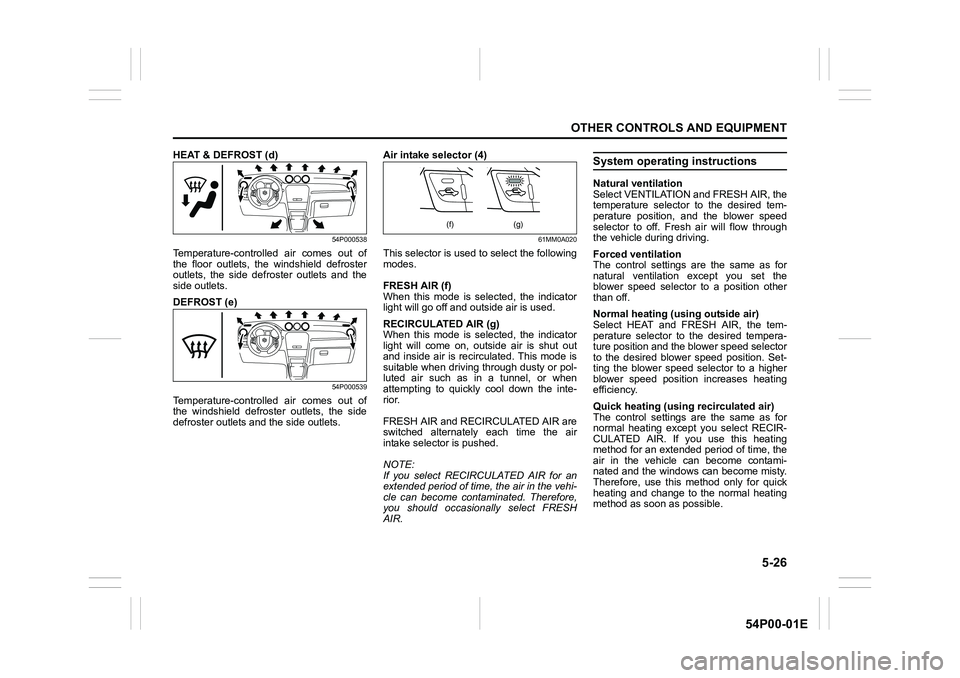
HEAT & DEFROST (d)
54P000538
Temperature-controlled air comes out of
the floor outlets, the windshield defroster
outlets, the side defroster outlets and the
side outlets.
DEFROST (e)
54P000539
Temperature-controlled air comes out of
the windshield defroster outlets, the side
defroster outlets and the side outlets.Air intake selector (4)
61MM0A020
This selector is used to select the following
modes.
FRESH AIR (f)
When this mode is selected, the indicator
light will go off and outside air is used.
RECIRCULATED AIR (g)
When this mode is selected, the indicator
light will come on, outside air is shut out
and inside air is recirculated. This mode is
suitable when driving through dusty or pol-
luted air such as in a tunnel, or when
attempting to quickly cool down the inte-
rior.
FRESH AIR and RECIRCULATED AIR are
switched alternately each time the air
intake selector is pushed.
NOTE:
If you select RECIRCULATED AIR for an
extended period of time, the air in the vehi-
cle can become contaminated. Therefore,
you should occasionally select FRESH
AIR.
System operating instructions
Natural ventilation
Select VENTILATION and FRESH AIR, the
temperature selector to the desired tem-
perature position, and the blower speed
selector to off. Fresh air will flow through
the vehicle during driving.
Forced ventilation
The control settings are the same as for
natural ventilation except you set the
blower speed selector to a position other
than off.
Normal heating (using outside air)
Select HEAT and FRESH AIR, the tem-
perature selector to the desired tempera-
ture position and the blower speed selector
to the desired blower speed position. Set-
ting the blower speed selector to a higher
blower speed position increases heating
efficiency.
Quick heating (using recirculated air)
The control settings are the same as for
normal heating except you select RECIR-
CULATED AIR. If you use this heating
method for an extended period of time, the
air in the vehicle can become contami-
nated and the windows can become misty.
Therefore, use this method only for quick
heating and change to the normal heating
method as soon as possible.
(f) (g)
Page 269 of 482
5-27
OTHER CONTROLS AND EQUIPMENT
54P00-01E
Head cooled/Feet warmed heating
Select BI-LEVEL and FRESH AIR, the
temperature selector to the desired tem-
perature position, and the blower speed
selector to the desired blower speed posi-
tion. Unless the temperature selector is in
the fully cold position or fully hot position,
the air that comes out of the center and
side outlets will be cooler than the air that
comes out of the floor outlets.
Defrosting/Feet warmed heating
Select HEAT & DEFROST and FRESH
AIR, the temperature selector to the
desired temperature position, and the
blower speed selector to high. When the
windshield has become clear, set the
blower speed selector to the desired
blower speed position.
Defrosting
Select DEFROST and FRESH AIR, the
temperature selector to the desired tem-
perature position (higher temperature pro-
vides more efficient defrosting), and the
blower speed selector to high. When the
windshield has become clear, set the
blower speed selector to the desired
blower speed position.
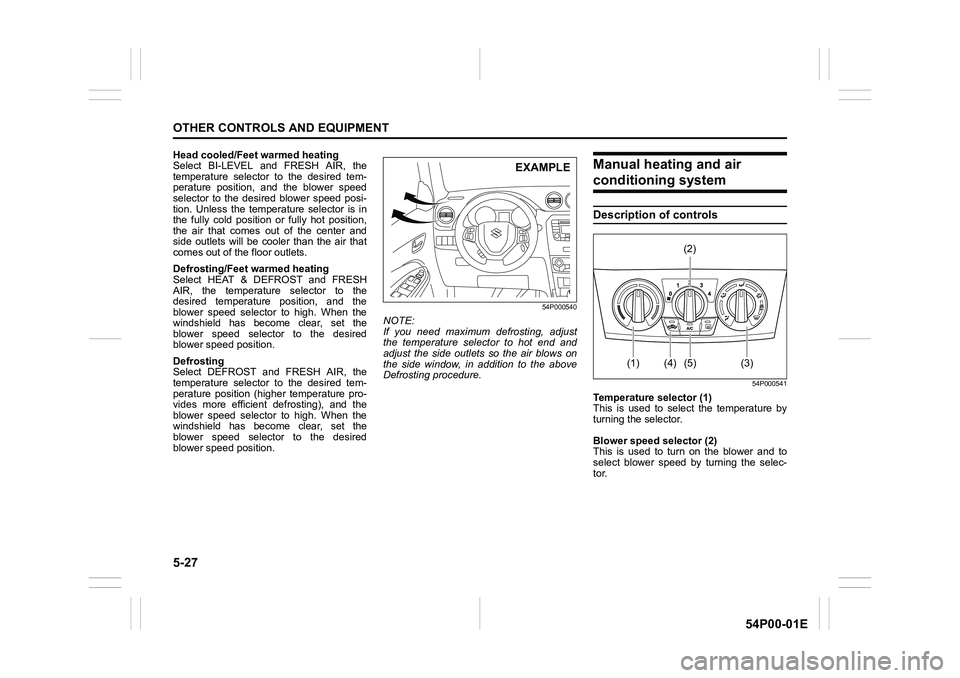
54P000540
NOTE:
If you need maximum defrosting, adjust
the temperature selector to hot end and
adjust the side outlets so the air blows on
the side window, in addition to the above
Defrosting procedure.
Manual heating and air
conditioning system
Description of controls
54P000541
Temperature selector (1)
This is used to select the temperature by
turning the selector.
Blower speed selector (2)
This is used to turn on the blower and to
select blower speed by turning the selec-
tor.
EXAMPLE
(2)
(1) (4) (5) (3)
Page 271 of 482
5-29
OTHER CONTROLS AND EQUIPMENT
54P00-01E
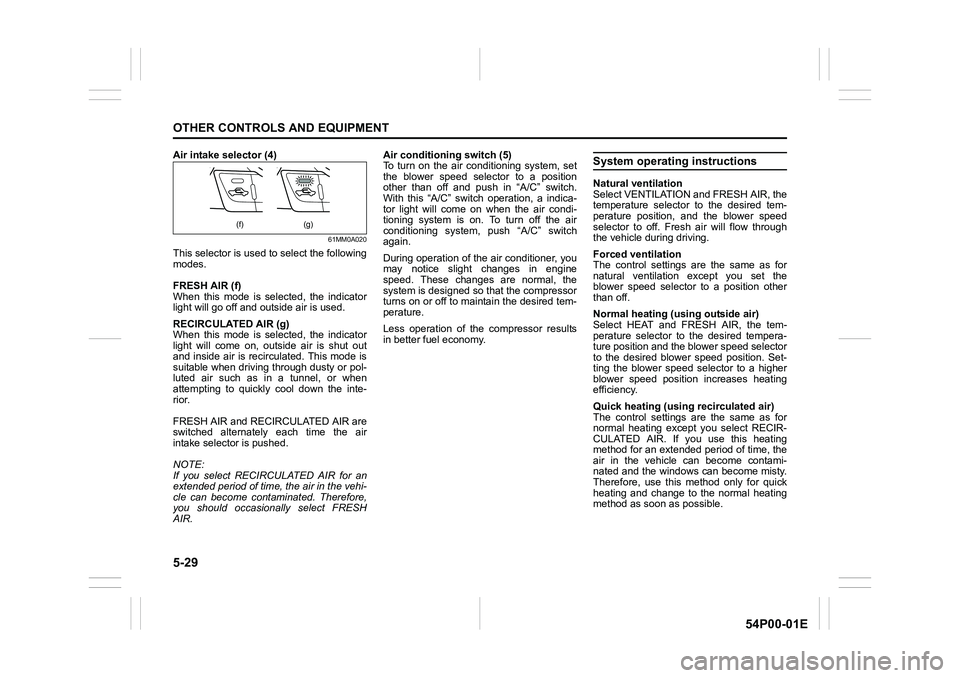
Air intake selector (4)
61MM0A020
This selector is used to select the following
modes.
FRESH AIR (f)
When this mode is selected, the indicator
light will go off and outside air is used.
RECIRCULATED AIR (g)
When this mode is selected, the indicator
light will come on, outside air is shut out
and inside air is recirculated. This mode is
suitable when driving through dusty or pol-
luted air such as in a tunnel, or when
attempting to quickly cool down the inte-
rior.
FRESH AIR and RECIRCULATED AIR are
switched alternately each time the air
intake selector is pushed.
NOTE:
If you select RECIRCULATED AIR for an
extended period of time, the air in the vehi-
cle can become contaminated. Therefore,
you should occasionally select FRESH
AIR.Air conditioning switch (5)
To turn on the air conditioning system, set
the blower speed selector to a position
other than off and push in “A/C” switch.
With this “A/C” switch operation, a indica-
tor light will come on when the air condi-
tioning system is on. To turn off the air
conditioning system, push “A/C” switch
again.
During operation of the air conditioner, you
may notice slight changes in engine
speed. These changes are normal, the
system is designed so that the compressor
turns on or off to maintain the desired tem-
perature.
Less operation of the compressor results
in better fuel economy.
System operating instructions
Natural ventilation
Select VENTILATION and FRESH AIR, the
temperature selector to the desired tem-
perature position, and the blower speed
selector to off. Fresh air will flow through
the vehicle during driving.
Forced ventilation
The control settings are the same as for
natural ventilation except you set the
blower speed selector to a position other
than off.
Normal heating (using outside air)
Select HEAT and FRESH AIR, the tem-
perature selector to the desired tempera-
ture position and the blower speed selector
to the desired blower speed position. Set-
ting the blower speed selector to a higher
blower speed position increases heating
efficiency.
Quick heating (using recirculated air)
The control settings are the same as for
normal heating except you select RECIR-
CULATED AIR. If you use this heating
method for an extended period of time, the
air in the vehicle can become contami-
nated and the windows can become misty.
Therefore, use this method only for quick
heating and change to the normal heating
method as soon as possible.
(f) (g)