warning SUZUKI IGNIS 2017 Manual Online
[x] Cancel search | Manufacturer: SUZUKI, Model Year: 2017, Model line: IGNIS, Model: SUZUKI IGNIS 2017Pages: 505, PDF Size: 8.36 MB
Page 242 of 505
3-89OPERATING YOUR VEHICLE
75RM4-01E
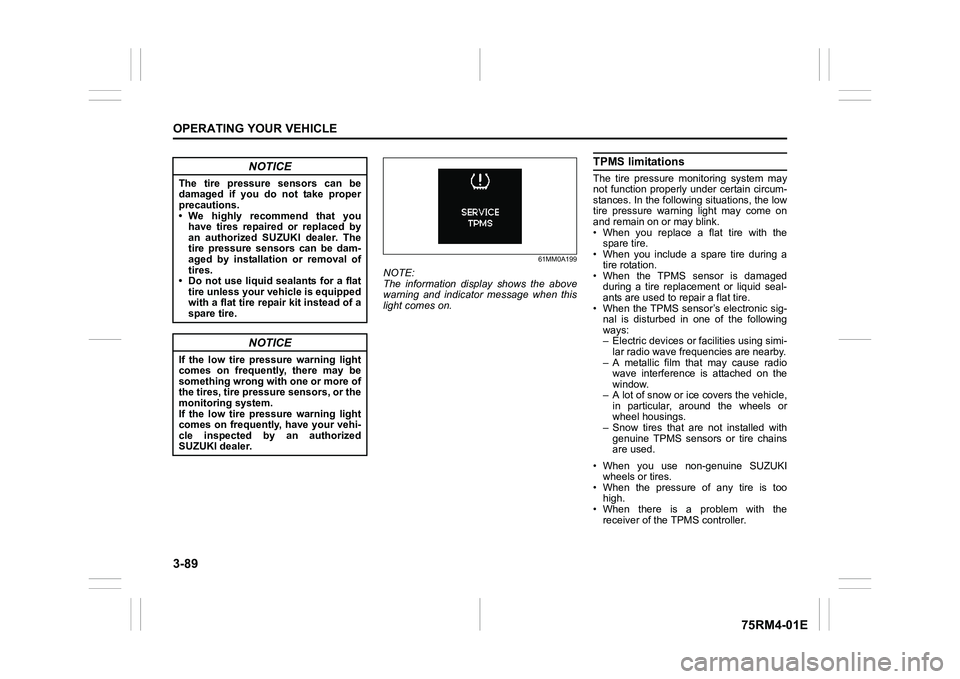
61MM0A199
NOTE:
The information display shows the above
warning and indicator message when this
light comes on.
TPMS limitationsThe tire pressure monitoring system may
not function properly under certain circum-
stances. In the following situations, the low
tire pressure warning light may come on
and remain on or may blink.
• When you replace a flat tire with thespare tire.
• When you include a spare tire during a
tire rotation.
• When the TPMS sensor is damaged during a tire replacement or liquid seal-
ants are used to r epair a flat tire.
• When the TPMS sensor’s electronic sig- nal is disturbed in one of the following
ways:
– Electric devices or fa cilities using simi-
lar radio wave frequencies are nearby.
– A metallic film that may cause radio wave interference is attached on the
window.
– A lot of snow or ice covers the vehicle, in particular, around the wheels or
wheel housings.
– Snow tires that are not installed with genuine TPMS sensors or tire chains
are used.
• When you use non-genuine SUZUKI wheels or tires.
• When the pressure of any tire is too high.
• When there is a problem with the
receiver of the TPMS controller.
NOTICE
The tire pressure sensors can be
damaged if you do not take proper
precautions.
• We highly recommend that youhave tires repaired or replaced by
an authorized SUZUKI dealer. The
tire pressure sensors can be dam-
aged by installation or removal of
tires.
• Do not use liquid sealants for a flat tire unless your vehicle is equipped
with a flat tire repair kit instead of a
spare tire.
NOTICE
If the low tire pressure warning light
comes on frequently, there may be
something wrong with one or more of
the tires, tire pressure sensors, or the
monitoring system.
If the low tire pressure warning light
comes on frequently, have your vehi-
cle inspected by an authorized
SUZUKI dealer.
Page 244 of 505
3-91OPERATING YOUR VEHICLE
75RM4-01E
75RM332
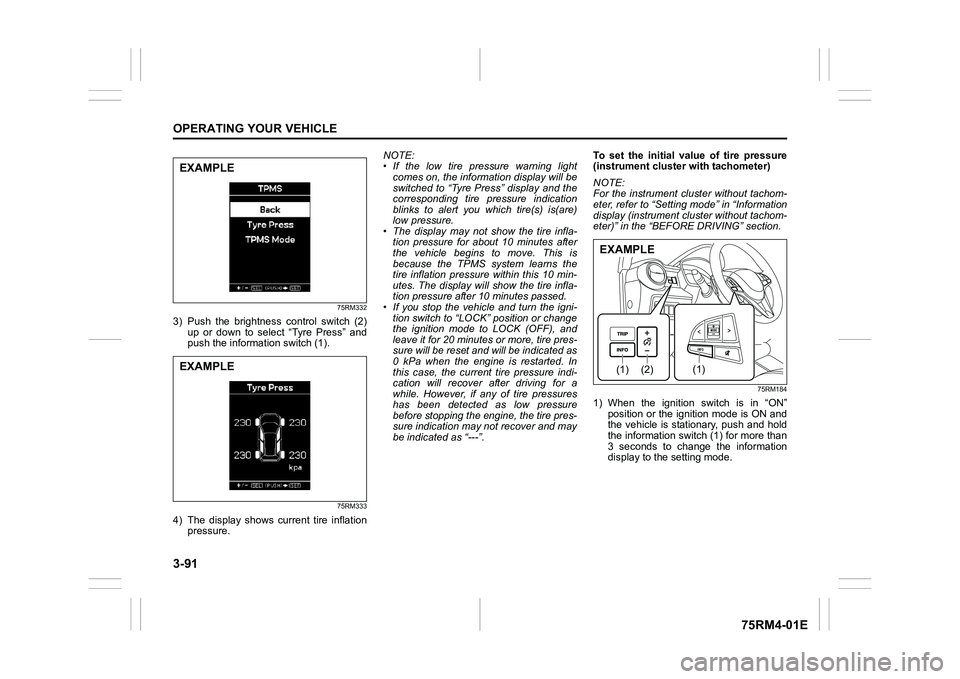
3) Push the brightness control switch (2)
up or down to select “Tyre Press” and
push the information switch (1).
75RM333
4) The display shows current tire inflation pressure. NOTE:
• If the low tire pressure warning light
comes on, the information display will be
switched to “Tyre Press” display and the
corresponding tire pressure indication
blinks to alert you which tire(s) is(are)
low pressure.
• The display may not show the tire infla- tion pressure for about 10 minutes after
the vehicle begins to move. This is
because the TPMS system learns the
tire inflation pressure within this 10 min-
utes. The display will show the tire infla-
tion pressure after 10 minutes passed.
• If you stop the vehicle and turn the igni-
tion switch to “LOCK” position or change
the ignition mode to LOCK (OFF), and
leave it for 20 minutes or more, tire pres-
sure will be reset and will be indicated as
0 kPa when the engine is restarted. In
this case, the current tire pressure indi-
cation will recover after driving for a
while. However, if any of tire pressures
has been detected as low pressure
before stopping the engine, the tire pres-
sure indication may not recover and may
be indicated as “---”. To set the initial value of tire pressure
(instrument
cluster with tachometer)
NOTE:
For the instrument cl uster without tachom-
eter, refer to “Setting mode” in “Information
display (instrument cluster without tachom-
eter)” in the “BEFORE DRIVING” section.
75RM184
1) When the ignition switch is in “ON” position or the ignition mode is ON and
the vehicle is stationary, push and hold
the information switch (1) for more than
3 seconds to change the information
display to the setting mode.
EXAMPLEEXAMPLE
(2)
(1)
(1)
EXAMPLE
Page 345 of 505
6-4
VEHICLE LOADING AND TOWING
75RM4-01E
Additional trailer towing warnings
WA R N I N G
Connect trailer lights and hook up
safety chains every time you tow.
NOTICE
Because towing a trailer puts addi-
tional stress on your vehicle, more
frequent maintenance will be
required than under normal driving
conditions. Follow the schedule in
“Maintenance recommended under
severe driving conditions”.
WA R N I N G
Your vehicle should be handled in a
different way when towing a trailer.
For the safety of yourself and others,
observe the following precautions:
• Practice turning, stopping, andreversing before you begin towing
a trailer in traffi c. Do not tow a
trailer in traffic until you are confi-
dent that you can handle the vehi-
cle and trailer safely.
• Never exceed towing speed limits
or 80 km/h (50 mph), whichever is
lower.
• Never drive at a speed that causes shaking or swaying of the trailer. If
you notice even the slightest sign
of shaking or sw aying, slow down.
• When roads are wet, slippery or rough, drive at a slower speed than
you would on dry or smooth roads.
Failure to slow down when road
conditions are bad can result in
loss of control.
• Always have someone guide you when reversing.
(Continued)
WA R N I N G
(Continued)
• Allow adequate stopping distance.Stopping distance is increased
when you tow a trailer. For each 16
km/h (10 mph) of speed, allow at
least one vehicle and trailer length
between you and the vehicle
ahead. Allow a greater stopping
distance if roads are wet or slip-
pery.
• If the trailer has over-run brakes,
apply the brakes gradually to avoid
snatching caused by the trailer
wheels locking.
• Slow down before corners and maintain a steady speed while cor-
nering. Deceleration or accelera-
tion while cornering can result in
loss of control. Remember that a
larger than normal turning radius is
needed because the trailer wheels
will be closer than vehicle wheels
to the inside of the turn.
• Avoid sudden acceleration and stopping of the vehicle. Do not
make quick maneuvers unless they
are necessary.
• Slow down in cross winds and be
prepared for gusts of wind from
large passing vehicles. (Continued)
Page 350 of 505
7-1INSPECTION AND MAINTENANCE
75RM4-01E
60B128S
WA R N I N G
Take extreme care when working on
your vehicle to prevent accidental
injury. Carefully observe the follow-
ing precautions:
• To prevent damage or unintendedactivation of the air bag system or
seat belt pretensioner system, check
that the lead-acid battery is discon-
nected and the ignition switch has
been in “LOCK” position or the igni-
tion mode has been LOCK (OFF) for
at least 90 seconds before perform-
ing any electrical service work on
your SUZUKI vehicle. Do not touch
air bag system components, seat
belt pretensioner system compo-
nents or wires.
The wires are wrapped with yellow
tape or yellow tubing, and the cou-
plers are yellow for easy identifica-
tion.
• Do not leave the engine running in garages or other confined areas. (Continued)
WA R N I N G
(Continued)
• When the engine is running, keep
hands, clothing, tools, and other
objects away from the fan and drive
belt. Even though the fan may not
be moving, it can automatically
turn on without warning.
• When it is necessary to perform
service work with the engine run-
ning, check that the parking brake
is set fully and the transaxle is in
Neutral (for manual transaxle or
Auto Gear Shift vehicles) or Park
(for CVT vehicles).
• Do not touch ignition wires or other ignition system parts when starting
the engine or when the engine is
running, or you could receive an
electric shock.
•Be careful not to touch a hot engine, exhaust manifold and
pipes, muffler, radiator and water
hoses.
• Do not allow smoking, sparks, or flames around fuel or the battery.
Flammable fumes are present.
• Do not get under your vehicle if it is supported only with the portable
jack provided in your vehicle.
• Be careful not to cause accidental short circuits between the positive
and negative battery terminals. (Continued)
WA R N I N G
(Continued)
• Keep used oil, coolant, and other
fluids away from children and pets.
Dispose of used fluids properly;
never pour them on the ground,
into sewers, etc.
Page 385 of 505

7-36
INSPECTION AND MAINTENANCE
75RM4-01E
Clutch pedalCable control clutch
54G274
Clutch pedal play “d”:
10 – 15 mm (0.4 – 0.6 in.)
Measure the clutch pedal play by moving
the clutch pedal with your hand and mea-
suring the distance it moves until you feel
slight resistance. The play in the clutch
pedal should be between the specified val-
ues. If the play is more or less than the
above, or clutch dragging is felt with the
pedal fully depressed, have the clutch
inspected by your SUZUKI dealer.
BrakesBrake fluid
75RM095
Check the brake fluid level by looking at
the reservoir in the engine compartment.
Check that the fluid level is between “MAX”
and “MIN” lines.
EXAMPLE
NOTICE
If your brake fluid level is near the
“MIN” line, there is a possibility of
brake pad and/or shoe wear and brake
fluid leakage.
Consult with your authorized SUZUKI
dealer regarding this possibility
before filling the reservoir.
WA R N I N G
Failure to follow the guidelines below
can result in personal injury or seri-
ous damage to the brake system.
• If the brake fluid in the reservoir drops below a certain level, the
brake warning light on the instru-
ment cluster will come on (the
engine must be running with the
parking brake fully disengaged).
Should the light come on, immedi-
ately ask your SUZUKI dealer to
inspect the brake system.
• A rapid fluid loss indicates leakage
in the brake system which should
be inspected by your SUZUKI
dealer immediately.
• Do not use any fluid other than SAE J1703 or DOT3 brake fluid. Do not
use reclaimed fluid or fluid that has
been stored in old or open contain-
ers. It is essential that foreign parti-
cles and other liquids are kept out
of the brake fluid reservoir.
CAUTION
Brake fluid can harm your eyes and
damage painted surfaces. Be careful
when refilling the reservoir.
Page 388 of 505
7-39INSPECTION AND MAINTENANCE
75RM4-01E
Tires
80JS025
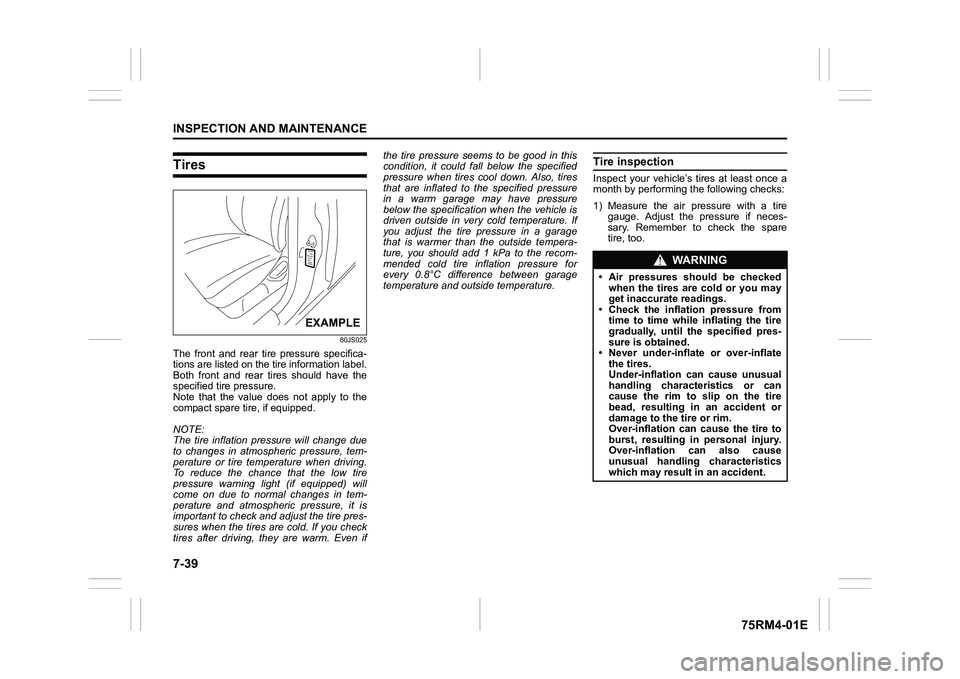
The front and rear tire pressure specifica-
tions are listed on the tire information label.
Both front and rear tires should have the
specified tire pressure.
Note that the value does not apply to the
compact spare tire, if equipped.
NOTE:
The tire inflation pressure will change due
to changes in atmospheric pressure, tem-
perature or tire temperature when driving.
To reduce the chance that the low tire
pressure warning light (if equipped) will
come on due to normal changes in tem-
perature and atmospheric pressure, it is
important to check and adjust the tire pres-
sures when the tires are cold. If you check
tires after driving, they are warm. Even ifthe tire pressure seems to be good in this
condition, it could fall below the specified
pressure when tires co
ol down. Also, tires
that are inflated to the specified pressure
in a warm garage may have pressure
below the specification when the vehicle is
driven outside in very cold temperature. If
you adjust the tire pressure in a garage
that is warmer than the outside tempera-
ture, you should add 1 kPa to the recom-
mended cold tire inflation pressure for
every 0.8°C difference between garage
temperature and outside temperature.
Tire inspectionInspect your vehicle’s tires at least once a
month by performing the following checks:
1) Measure the air pressure with a tire gauge. Adjust the pressure if neces-
sary. Remember to check the spare
tire, too.
EXAMPLE
WA R N I N G
• Air pressures should be checkedwhen the tires are cold or you may
get inaccurate readings.
• Check the inflation pressure from time to time while inflating the tire
gradually, until the specified pres-
sure is obtained.
• Never under-inflate or over-inflate the tires.
Under-inflation can cause unusual
handling characteristics or can
cause the rim to slip on the tire
bead, resulting in an accident or
damage to the tire or rim.
Over-inflation can cause the tire to
burst, resulting in personal injury.
Over-inflation c an also cause
unusual handling characteristics
which may result in an accident.
Page 411 of 505
8-2
EMERGENCY SERVICE
75RM4-01E
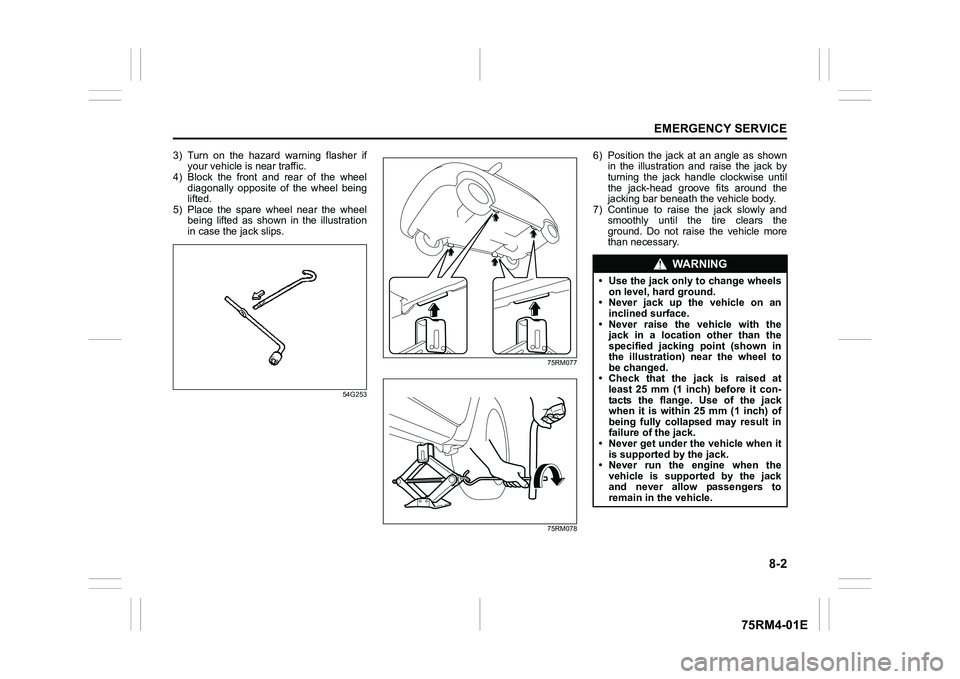
3) Turn on the hazard warning flasher ifyour vehicle is near traffic.
4) Block the front and rear of the wheel
diagonally opposite of the wheel being
lifted.
5) Place the spare wheel near the wheel
being lifted as shown in the illustration
in case the jack slips.
54G253 75RM077
75RM078
6) Position the jack at an angle as shown
in the illustration and raise the jack by
turning the jack handle clockwise until
the jack-head groove fits around the
jacking bar beneath the vehicle body.
7) Continue to raise the jack slowly and
smoothly until the tire clears the
ground. Do not raise the vehicle more
than necessary.
WA R N I N G
• Use the jack only to change wheelson level, hard ground.
• Never jack up the vehicle on an inclined surface.
• Never raise the vehicle with the jack in a location other than the
specified jacking point (shown in
the illustration) near the wheel to
be changed.
• Check that the jack is raised at
least 25 mm (1 inch) before it con-
tacts the flange. Use of the jack
when it is within 25 mm (1 inch) of
being fully collapsed may result in
failure of the jack.
• Never get under the vehicle when it
is supported by the jack.
• Never run the engine when the vehicle is supported by the jack
and never allow passengers to
remain in the vehicle.
Page 416 of 505
8-7EMERGENCY SERVICE
75RM4-01E
Emergency repair1) Place the vehicle on level, hard ground.
Set the parking brake firmly and shift
into “R” (Reverse) if your vehicle has a
manual transaxle/Auto Gear Shift, or
shift into “P” (Park) if your vehicle has a
CVT.
Turn on the hazard warning flasher if
your vehicle is near traffic.
Block the front and rear of the wheel
diagonally opposite of the wheel being
repaired.
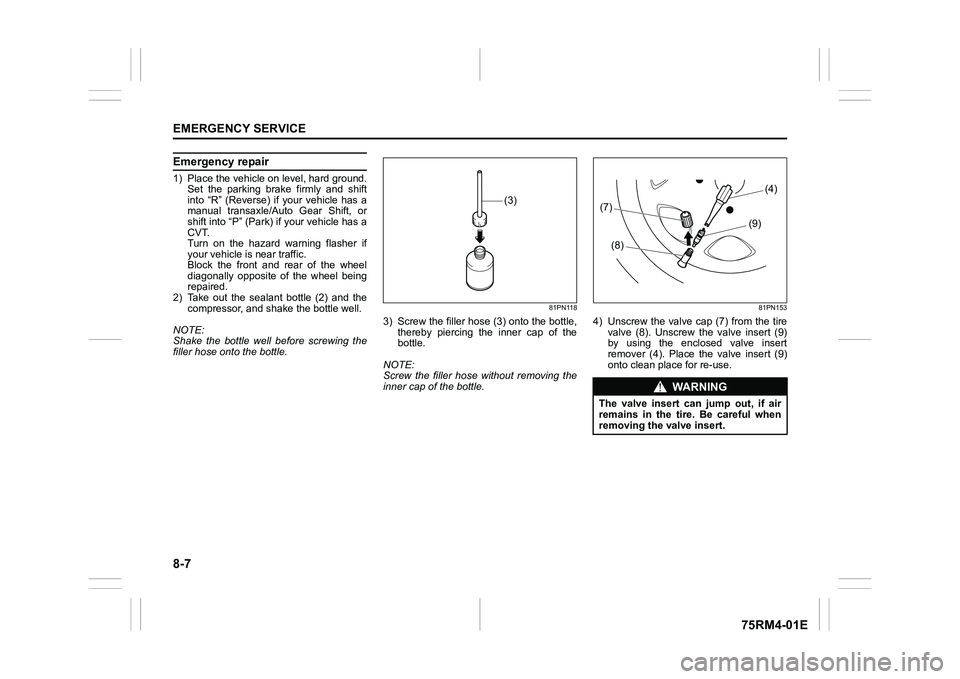
2) Take out the sealant bottle (2) and the compressor, and shake the bottle well.
NOTE:
Shake the bottle well before screwing the
filler hose onto the bottle.
81PN118
3) Screw the filler hose (3) onto the bottle, thereby piercing the inner cap of the
bottle.
NOTE:
Screw the filler hose without removing the
inner cap of the bottle.
81PN153
4) Unscrew the valve cap (7) from the tire valve (8). Unscrew the valve insert (9)
by using the enclosed valve insert
remover (4). Place the valve insert (9)
onto clean place for re-use.
(3)
WA R N I N G
The valve insert can jump out, if air
remains in the tire. Be careful when
removing the valve insert.(7)
(8) (9)(4)
Page 418 of 505
8-9EMERGENCY SERVICE
75RM4-01E
81PN249
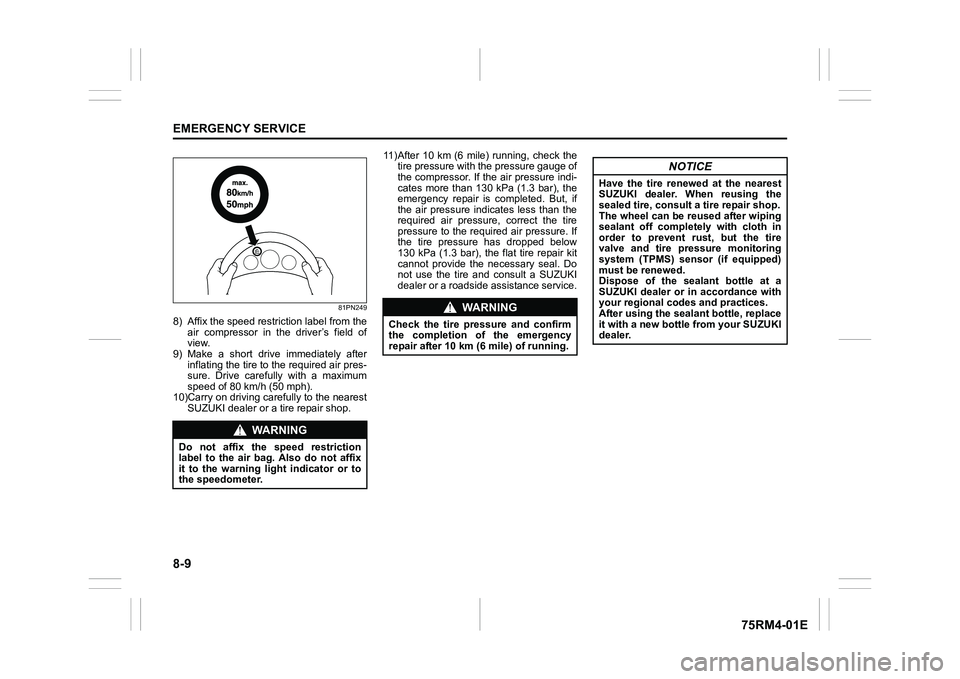
8) Affix the speed restriction label from theair compressor in the driver’s field of
view.
9) Make a short drive immediately after inflating the tire to the required air pres-
sure. Drive carefully with a maximum
speed of 80 km/h (50 mph).
10)Carry on driving carefully to the nearest
SUZUKI dealer or a tire repair shop. 11)After 10 km (6 mile) running, check the
tire pressure with the pressure gauge of
the compressor. If the air pressure indi-
cates more than 130 kPa (1.3 bar), the
emergency repair is completed. But, if
the air pressure indicates less than the
required air pressure, correct the tire
pressure to the required air pressure. If
the tire pressure has dropped below
130 kPa (1.3 bar), the flat tire repair kit
cannot provide the necessary seal. Do
not use the tire and consult a SUZUKI
dealer or a roadside assistance service.
WA R N I N G
Do not affix the speed restriction
label to the air bag. Also do not affix
it to the warning light indicator or to
the speedometer.
WA R N I N G
Check the tire pressure and confirm
the completion o f the emergency
repair after 10 km (6 mile) of running.
NOTICE
Have the tire renewed at the nearest
SUZUKI dealer. When reusing the
sealed tire, consult a tire repair shop.
The wheel can be reused after wiping
sealant off completely with cloth in
order to prevent rust, but the tire
valve and tire pressure monitoring
system (TPMS) sensor (if equipped)
must be renewed.
Dispose of the sealant bottle at a
SUZUKI dealer or in accordance with
your regional codes and practices.
After using the seal ant bottle, replace
it with a new bottle from your SUZUKI
dealer.
Page 422 of 505
8-13EMERGENCY SERVICE
75RM4-01E
Engine trouble: Starter does not operate1) Try turning the ignition switch to“START” position or try pressing the
engine switch to change the ignition
mode to START with the headlights
turned on to determine the lead-acid
battery condition. If the headlights go
excessively dim or go off, it usually
means that either the lead-acid battery
is flat or the battery terminal contact is
poor. Recharge the lead-acid battery or
correct battery terminal contact as nec-
essary.
2) If the headlights remain bright, check the fuses. If the reas on for failure of the
starter is not obvious, there may be a
major electrical problem. Have the vehi-
cle inspected by your authorized
SUZUKI dealer.
Engine trouble: Flooded engine(Vehicle without keyless push start sys-
tem)
If the engine is flooded with gasoline, it
may be hard to start. If this happens, press
the accelerator pedal all the way to the
floor and hold it there while cranking the
engine.
• Do not operate the starter motor for more than 12 seconds.
(Vehicle with keyless push start system)
If the engine is flooded with gasoline, it
may be hard to start. If this happens, press
the accelerator pedal all the way to the
floor and hold it there while cranking the
engine.
• Do not operate the starter motor for more than 12 seconds.
NOTE:
If the engine refuses to start, the starter
motor automatically stops after a certain
period of time. After the starter motor has
automatically stopped or if there is any-
thing abnormal in the engine starting sys-
tem, the starter motor runs only while the
engine switch is held pressed.
Engine trouble: OverheatingThe engine could overheat temporarily
under severe driving conditions. If the high
engine coolant temperature warning light
comes on as overheating during driving:
1) Turn off the air conditioner, if equipped.
2) Take the vehicle to a safe place and park.
3) Let the engine run at the normal idle speed for a few minutes until the high
engine coolant temperature warning
light goes off.
WA R N I N G
If you see or hear escaping steam,
stop the vehicle in a safe place and
immediately turn off the engine to
cool it. Do not open the hood when
steam is present. When the steam
can no longer be seen or heard, open
the hood to see if the coolant is still
boiling. If it is, you must wait until it
stops boiling before you proceed.