Speed SUZUKI IGNIS 2022 Owner's Guide
[x] Cancel search | Manufacturer: SUZUKI, Model Year: 2022, Model line: IGNIS, Model: SUZUKI IGNIS 2022Pages: 505, PDF Size: 8.36 MB
Page 181 of 505

3-28
OPERATING YOUR VEHICLE
75RM4-01E
Downhill
1) Depress the brake pedal and shift thegearshift lever to the “D” position. Make
sure that the gear is in 1st by checking
the gear position indicator.
2) Release the brake pedal and depress
the accelerator pedal slowly. Even if the
accelerator pedal is not depressed, the
clutch will be engaged when the vehicle
speed increases.
Using engine braking:
When driving on a downhill slope, down-
shifting is recommended. So you can use
engine braking.
By placing the gearshift lever in the “M”
position, the Manual (M) mode is selected,
and you can shift to a lower gear manually.
For details of downshift operation, refer to
“Upshift and downshift” in the “Manual (M)
mode”. Manual (M) mode
The gears are not shifted automatically. To
shift the transaxle, the driver must operate
the gearshift lever to
the “+” or “–” direc-
tion. As for conventional manual transaxle
vehicles, releasing the accelerator pedal a
little may help the transaxle to shift
smoothly.
Upshift and downshift:
Upshifting
75RM258
Pull the gearshift lever to the “+” direction
and release it. Every time the lever is oper-
ated, the transaxle is upshifting 1 step in
the order of 1st 2nd 3rd 4th 5th
gear. Downshifting
75RM259
Push the gearshift lever to the “–” direction
and release it. Every time the lever is oper-
ated, the transaxle is downshifted in the
order 5th
4th 3rd 2nd 1st gear.
The gear position is displayed on the gear
position indicator. The gear position indica-
tor shows the transaxle gear position.
Before starting off, always check the gear
position indicator to make sure that the
transaxle is engaged in 1st or reverse,
then depress the accelerator pedal.
NOTE:
• To downshift smoothly, the engine runs fast in some cases. This is done inten-
tionally by the system and is not mal-
function.
• When driving down a hill, downshift and use the engine braking appropriately. If
necessary, continuous downshifting is
Page 182 of 505
3-29OPERATING YOUR VEHICLE
75RM4-01E
possible. However, if downshifting more
than 3 steps, gear shifting will take more
time.
• When the gear is shifting, a noise can be heard in some case. This is not malfunc-
tion. Starting off:
1) Start the engine as instructed in “Start-
ing the engine” in this section.
2) With your foot on the brake pedal, shift the gearshift lever to the “M” position.
When the gearshift lever is shifted to
the “M” position, the gear will be shifted
to 1st. Before starting off, always make
sure that the intended gear is engaged
by checking the gear position indicator,
then depress the accelerator pedal.
NOTE:
• If 1st gear cannot be engaged even though the gearshift lever has been
shifted from the “N” to the “M” position,
the system will re-try shifting automati-
cally. This will take some time, noise
may be heard from the gears, and shift-
ing gear shock may occur. However,
they do not indicate malfunction.
• The “N” indicator will flush, the depress brake pedal indicator will come on and a
warning buzzer (long pulse sound) will
sound if any of the following cases
occur;
– If you shift the gearshift lever from the “N” to the “M” position without
depressing the brake pedal
– If the system is unable to re-try shifting
You should depress the brake pedal and
shift the gearshift lever to “N” position,
then shift to “M” position again a few
seconds later.
WA R N I N G
• Be careful when accelerating, upshifting, downshifting or braking
on a slippery surface. Sudden
acceleration or engine braking
could cause the vehicle to spin or
skid.
• To drive down a long or steep hill,
reduce your speed and downshift.
Remember, if you ride the brakes
excessively, they may overheat and
fail.
• While driving the vehicle, do not shift the gearshift lever to “N” posi-
tion. The engine brake may not
work and you may get involved in
an unexpected accident. If you
return the gearshift lever from “N”
to “M” because of unintended shift-
ing, the gear position will be shifted
according to the current vehicle
speed.
• Do not apply the parking brake
while driving. Otherwise, it could
cause a skid and you may get
involved in an unexpected acci-
dent.
NOTICE
• If the gearshift lever cannot shiftinto any position, or the gear is
changed to “N” position automati-
cally when the vehicle speed
becomes less than 10 km/h (6
mph), there may be a systematic
malfunction. In this case, ask your
SUZUKI dealer to inspect the Auto
Gear Shift system as soon as pos-
sible.
• The manual (M) mode does not
upshift even if the engine speed
reaches the rev-limit.
• The system will not allow shifting up or down to a gear that would
cause engine over-revving or
under-revving.
• If frequently driving at low speed using a high gear position, the life
cycle of the clutch may be reduced.
• Frequent downshif ting (more than
3 positions consecutively) causes
the reduction of transaxle life.
Page 183 of 505
3-30
OPERATING YOUR VEHICLE
75RM4-01E
3) Release the parking brake and brakepedal. Depress the accelerator pedal
slowly for smooth starting. Starting off on an uphill/downhill slope:
Uphill
1) Apply the parking brake firmly so that
the vehicle does no t roll backwards.
2) Shift the gearshift lever to the “M” posi-
tion while depressing the brake pedal.
Make sure that the ge ar position indica-
tor in the instrumental cluster displays
1st gear.
3) Release the brake pedal and depress the accelerator pedal gradually, and
when the vehicle starts to move,
release the parking brake and depress
the accelerator pedal to start off.
Downhill
1) Depress the brake pedal and shift the gearshift lever to the “M” position.
Check the gear position indicator to
make sure that the gear is in 1st.
2) Release the brake pedal and depress the accelerator pedal slowly. Even
though the accelerator pedal is not
depressed, the clutch will be engaged
when the vehicle speed increases. Backing up
After the vehicle has stopped completely,
depress the brake pedal and shift the gear-
shift lever to the “R” position. Depress the
accelerator pedal slowly as when starting
off in 1st gear. Before backing up, make
sure that reverse gear is selected by
checking the gear position indicator.
NOTE:
• If reverse gear cannot be engaged even
though the gearshift lever has been
shifted from the “N” to the “R” position,
the system will re-try shifting automati-
cally. This will take some time, noise
may be heard from the gears, and shift-
ing gear shock may occur. However,
they do not indicate malfunction.
• The “N” indicator will flush, the depress brake pedal indicator will come on and a
warning buzzer (long pulse sound) will
sound if any of the following cases
occur;
– If you shift the gearshift lever from the “N” to the “R” position without depress-
ing the brake pedal
– If the system is unable to re-try shifting
You should depress the brake pedal and
shift the gearshift lever to “N” position,
then shift to “R” position again a few sec-
onds later.
WA R N I N G
Always keep your foot on the brake
pedal while stopped with the engine
running. These operations prevent
the vehicle from starting due to unin-
tended activation of the creeping
function.
NOTICE
Do not operate the system as
described below. The life cycle of the
clutch may be reduced.
• Using the accelerator pedal to hold the vehicle on an uphill slope oper-
ation with the gearshift lever in the
“M” or “D” position. If you perform
this operation for a certain period
of time, a warning buzzer will
sound.
• Shifting the gearshift lever to the
“M”, “D” or “R” po sition while rac-
ing the engine.
• Driving at low speed using a high
gear.
• Stopping on a slope using the creeping function. If you perform
this operation for a certain period
of time, a warning buzzer will
sound.
NOTICE
On an uphill slope, never hold the
vehicle at a stop using only the accel-
erator pedal or creeping function. If
you perform this operation for a cer-
tain period of time, a warning buzzer
will sound, and in some cases the
engine will stall. This can also cause
excessive damage to the clutch.
Page 184 of 505
3-31OPERATING YOUR VEHICLE
75RM4-01E
• The system will not allow shifting to the“R” position if the vehicle speed is over
about 3 km/h (2 mph). If the gearshift
lever is operated under this condition,
the “N” indicator in the instrument cluster
will blink. However, when the vehicle
speed drops below about 3 km/h (2
mph), the gear will be shifted to reverse.
Make sure that the vehicle has stopped
completely before shifting to the “R”
position. Stopping
The vehicle can be stopped by depressing
the brake pedal regardless of the gear
position. This is because the clutch is auto-
matically disengaged to prevent the engine
from stopping.
• If the gearshift lever is in the “D” position,
the gear will be downshifted to 1st when
the vehicle stops.
• If the gearshift lever is in the “M” posi- tion, the gear will be downshifted to 1st
when the vehicle stops.
NOTICE
On a downhill slope, never hold the
vehicle at a stop using only the accel-
erator pedal or the creeping function.
If you perform this operation for a
certain period of time, a warning
buzzer will sound, and in some cases
the engine will stall. This can also
cause excessive damage to the
clutch.
WA R N I N G
• When stopping, for example, at a
traffic light, be sure to depress the
brake pedal firmly. For your safety,
apply the parking brake, too, when
stopping on a hill.
• When racing the engine, make sure that the gear is in the “N” position
by checking the gear position indi-
cator. If the accelerator is operated
with the gear in any other position,
the vehicle may move resulting in
an unexpected accident.
• Do not leave your vehicle unat-
tended while the engine is running. (Continued)
WA R N I N G
(Continued)
• When leaving the vehicle, stop the
engine and park the vehicle with a
gear engaged. If you need to leave
the vehicle with the engine running,
apply the parking brakes firmly,
and shift the gearshift lever to the
“N” position. Otherwise, the vehi-
cle may move unexpectedly and
may cause an accident.
NOTICE
• On a slope, never hold the vehicleat a stop using only the accelerator
pedal or the creeping function. If
you perform this operation for a
certain period of time, a warning
buzzer will sound, and in some
cases the engine will stall. This can
also cause excessive damage to
the clutch.
• If the gearshift lever is operated
more than necessary, the system
may not allow operation of the
gearshift lever for a certain period
of time, and the gear may not be
shifted appropriately. Therefore, do
not operate the gearshift lever if not
necessary.
Page 186 of 505
3-33OPERATING YOUR VEHICLE
75RM4-01E
“N” indicator blinking
When the gear indicator lamp blinks “N”,
you should depress the brake pedal and
shift the gearshift lever to “N” position.
“1st” indicator blinking
When the gear indicator lamp blinks “1st”,
you should depress the brake pedal and
shift the gearshift lever to “N” position, then
shift to “D” or “M” position again a few sec-
onds later.
“R” indicator blinking
When the gear indicator lamp blinks “R”,
you should depress the brake pedal and
shift the gearshift lever to “N” position, then
shift to “R” position again a few seconds
later.
Gearshift indicator (if equipped)
75RM327
In the following cases, the gearshift indica-
tor is indicated on the information display
when the ignition switch is in “ON” position
or the ignition mode is ON.
• For manual transaxle vehicle, when thegearshift lever is in a position other than
“N” (Neutral).
• For Auto Gear Shift vehicle, when using the manual mode.
• For vehicles equipped with the cruise control, when the syst em is not in use.
The electronic control system monitors
driving condition (such as vehicle speed
and/or engine revolution), and it shows
which gear position is optimal for your driv-
ing with the indicati on on the display. Manual transaxle vehicle
If UP/DOWN arrow is indicated on the dis-
play while driving, we recommend you to
shift up or down the gear until the arrow
disappears. It is the optimal gear position
for a driving condition that reduces the
over revolution and stress to the engine,
and improves fuel consumption.
Auto Gear Shift vehicle (when using the
manual mode)
If UP arrow is indicated on the display while
driving, we recommend you to shift up the
gear until the arrow disappears. It is the opti-
mal gear position for a driving condition that
reduces the over revolut
ion and stress to the
engine, and improves fuel consumption.For details on how to use the transaxle,
refer to “Using transa xle” in this section.
EXAMPLE
WA R N I N G
The gearshift indicator is designed to
indicate optimal gear position for
your driving, however, a driver will
not be relieved from the duty of care
of driving operation or gear change
with this indicator.
To drive safe, do not gaze the gear-
shift indicator, pay attention to your
driving situation and shift up or down
if necessary.
Page 187 of 505

3-34
OPERATING YOUR VEHICLE
75RM4-01E
NOTE:
• For manual transaxle vehicle, the gear-shift indicator is not indicated when the
gear position is in “N” (Neutral).
• For manual transaxle vehicle, if you depress the clutch pedal while UP/
DOWN arrow is indicated, the indication
will disappear.
• For Auto Gear Shif t vehicle, if you
release your foot from the accelerator
pedal while UP arrow is indicated, the
indication will display the currently
selected gear position.
• The indication of gearshift indicator tim- ing may differ depending on the vehicle
condition and/or driv ing situation even in
the same vehicle speed and engine rev-
olution.
• If any of the electrical systems such as the dual camera brake support or the
ESP
® (if equipped) is working, the gear-
shift indicator will disappear temporarily. Example of the gearshift indicator
Manual transaxle
Auto Gear Shift (when using the manual mode)
Indication Description
Lower gear position is selected for the vehicle speed and/
or engine revolution. Changing to a higher gear position is
recommended.
Higher gear position is sele cted for the vehicle speed
and/or engine revolution. Chan ging to a lower gear posi-
tion is recommended.
Indication Description Lower gear position is selected for the vehicle speed and/
or engine revolution. Changing to a higher gear position is
recommended.
• In this case, shifting up 5th or upper gear position isrecommended.
Page 189 of 505
3-36
OPERATING YOUR VEHICLE
75RM4-01E
Automatically stopping/restarting of the engineManual transaxle vehicles
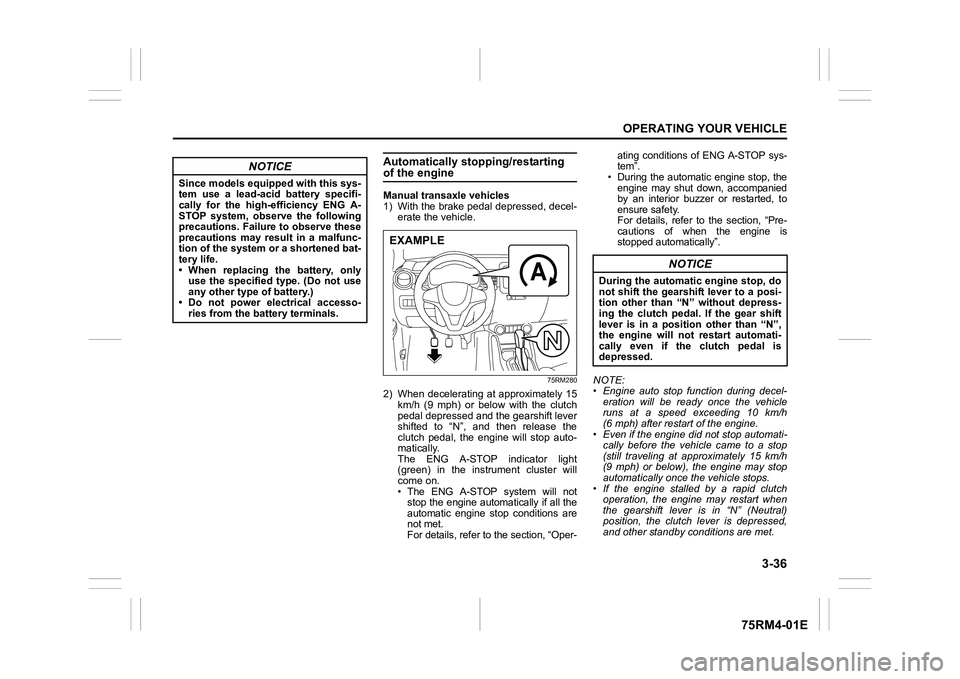
1) With the brake pedal depressed, decel-erate the vehicle.
75RM280
2) When decelerating at approximately 15km/h (9 mph) or below with the clutch
pedal depressed and the gearshift lever
shifted to “N”, and then release the
clutch pedal, the engine will stop auto-
matically.
The ENG A-STOP indicator light
(green) in the instrument cluster will
come on.
• The ENG A-STOP system will notstop the engine automatically if all the
automatic engine stop conditions are
not met.
For details, refer to the section, “Oper- ating conditions of ENG A-STOP sys-
tem”.
• During the automatic engine stop, the
engine may shut down, accompanied
by an interior buzzer or restarted, to
ensure safety.
For details, refer to the section, “Pre-
cautions of when the engine is
stopped automatically”.
NOTE:
• Engine auto stop function during decel- eration will be ready once the vehicle
runs at a speed exceeding 10 km/h
(6 mph) after restart of the engine.
• Even if the engine di d not stop automati-
cally before the vehicle came to a stop
(still traveling at approximately 15 km/h
(9 mph) or below), the engine may stop
automatically once the vehicle stops.
• If the engine stalled by a rapid clutch operation, the engine may restart when
the gearshift lever is in “N” (Neutral)
position, the clutch lever is depressed,
and other standby conditions are met.
NOTICE
Since models equipped with this sys-
tem use a lead-acid battery specifi-
cally for the high-efficiency ENG A-
STOP system, observe the following
precautions. Failure to observe these
precautions may result in a malfunc-
tion of the system or a shortened bat-
tery life.
• When replacing the battery, onlyuse the specified type. (Do not use
any other type of battery.)
• Do not power electrical accesso- ries from the battery terminals.
EXAMPLE
NOTICE
During the automatic engine stop, do
not shift the gearshift lever to a posi-
tion other than “N” without depress-
ing the clutch pedal. If the gear shift
lever is in a position other than “N”,
the engine will not restart automati-
cally even if the clutch pedal is
depressed.
Page 190 of 505
3-37OPERATING YOUR VEHICLE
75RM4-01E
• The audio and other electrical compo-nent can be used during the automatic
engine stop, but the air conditioner will
switch to the fan mode.
• If the vehicle is equipped with the auto- matic heating and air conditioning sys-
tem, the fan speed will be limited during
the automatic engine stop (only in the
auto control mode) to keep the cabin air-
conditioned for a longer time.
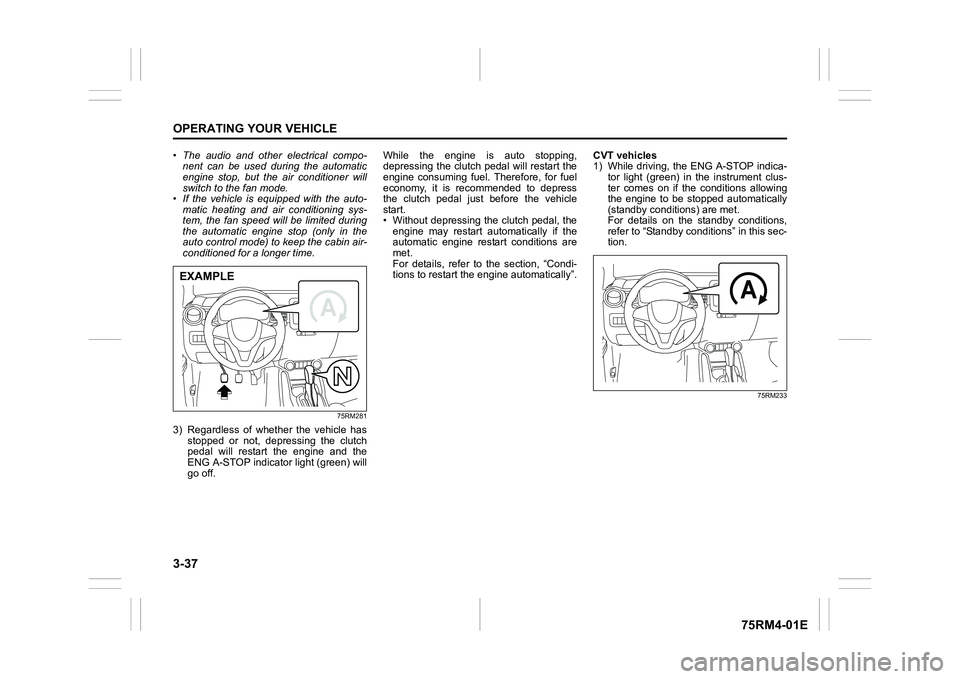
75RM281
3) Regardless of whether the vehicle has
stopped or not, depressing the clutch
pedal will restart the engine and the
ENG A-STOP indicator light (green) will
go off. While the engine is auto stopping,
depressing the clutch pedal will restart the
engine consuming fuel. Therefore, for fuel
economy, it is recommended to depress
the clutch pedal just before the vehicle
start.
• Without depressing the clutch pedal, the
engine may restart automatically if the
automatic engine restart conditions are
met.
For details, refer to the section, “Condi-
tions to restart the engine automatically”. CVT vehicles
1) While driving, the ENG A-STOP indica-
tor light (green) in the instrument clus-
ter comes on if the conditions allowing
the engine to be stopped automatically
(standby conditions) are met.
For details on the standby conditions,
refer to “Standby conditions” in this sec-
tion.
75RM233
EXAMPLE
Page 195 of 505
3-42
OPERATING YOUR VEHICLE
75RM4-01E
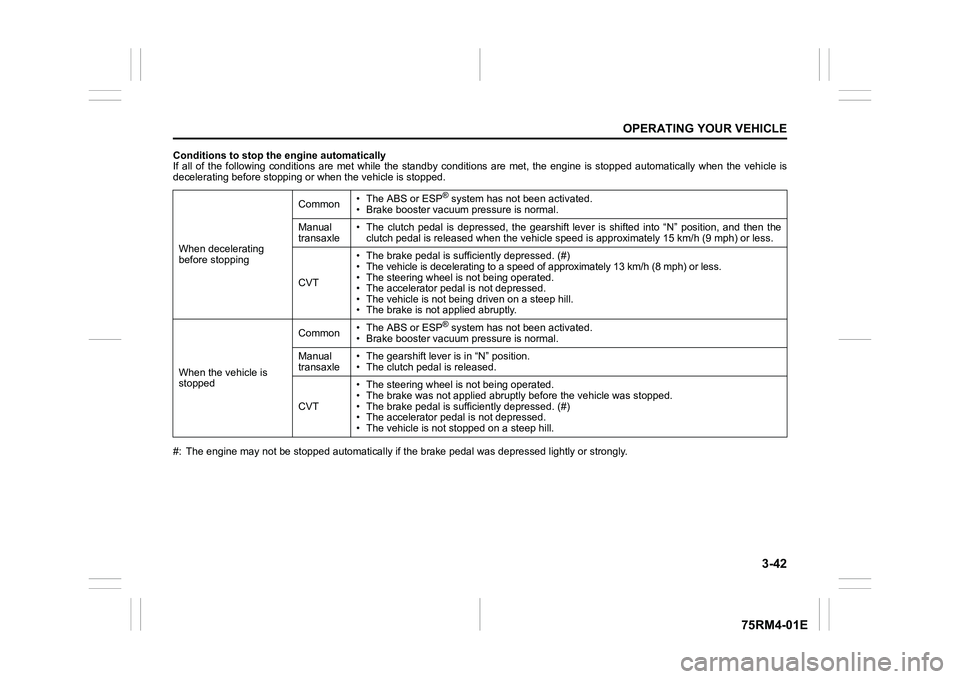
Conditions to stop the engine automatically
If all of the following conditions are met while the standby conditions are met, the engine is stopped automatically when the vehicle is
decelerating before stopping or when the vehicle is stopped.
#: The engine may not be stopped automatically if the brake peda l was depressed lightly or strongly.
When decelerating
before stopping
Common
• The ABS or ESP
® system has not been activated.
• Brake booster vacuum pressure is normal.
Manual
transaxle • The clutch pedal is depressed, the gearshift lever is shifted
into “N” position, and then the
clutch pedal is released when the vehicle speed is approximately 15 km/h (9 mph) or less.
CVT • The brake pedal is sufficiently depressed. (#)
• The vehicle is decelerating to a speed of approximately 13 km/
h (8 mph) or less.
• The steering wheel is not being operated.
• The accelerator pedal is not depressed.
• The vehicle is not being driven on a steep hill.
• The brake is not applied abruptly.
When the vehicle is
stopped Common
• The ABS or ESP® system has not been activated.
• Brake booster vacuum pressure is normal.
Manual
transaxle • The gearshift lever is in “N” position.
• The clutch pedal is released.
CVT • The steering wheel is not being operated.
• The brake was not app
lied abruptly before the vehicle was stop ped.
• The brake pedal is sufficiently depressed. (#)
• The accelerator pedal is not depressed.
• The vehicle is not s topped on a steep hill.
Page 196 of 505
3-43OPERATING YOUR VEHICLE
75RM4-01E
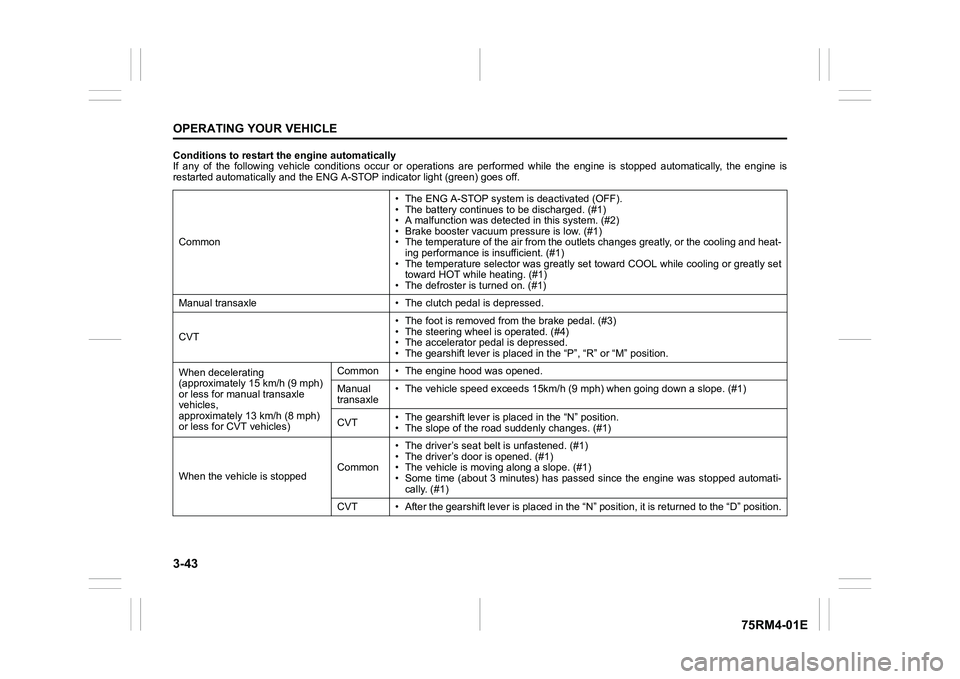
Conditions to restart the engine automatically
If any of the following vehicle conditions occur or operations are performed while the engine is stopped automatically, the en gine is
restarted automatically and the ENG A-STOP i ndicator light (green) goes off.
Common • The ENG A-STOP system is deactivated (OFF).
• The battery continues to be discharged. (#1)
• A malfunction was detect
ed in this system. (#2)
• Brake booster vacuum pressure is low. (#1)
• The temperature of the air from the outlets changes greatly, o r the cooling and heat-
ing performance is insufficient. (#1)
• The temperature selector was greatly set toward COOL while coo ling or greatly set
toward HOT while heating. (#1)
• The defroster is turned on. (#1)
Manual transaxle • The cl utch pedal is depressed.
CVT • The foot is removed from the brake pedal. (#3)
• The steering wheel is operated. (#4)
• The accelerator pedal is depressed.
• The gearshift lever is placed
in the “P”, “R” or “M” position.
When decelerating
(approximately 15 km/h (9 mph)
or less for manual transaxle
vehicles,
approximately 13 km/h (8 mph)
or less for CVT vehicles) Common • The engine hood was opened.
Manual
transaxle
• The vehicle speed exceeds 15km/
h (9 mph) when going down a slope. (#1)
CVT • The gearshift lever is placed in the “N” position.
• The slope of the road
suddenly changes. (#1)
When the vehicle is stopped Common• The driver’s seat
belt is unfastened. (#1)
• The driver’s door is opened. (#1)
• The vehicle is movi ng along a slope. (#1)
• Some time (about 3 minutes) has passed since the engine was st opped automati-
cally. (#1)
CVT • After the gearshift lever is placed in the “N” position, it is returned to the “D” position.