gear SUZUKI JIMNY 2019 User Guide
[x] Cancel search | Manufacturer: SUZUKI, Model Year: 2019, Model line: JIMNY, Model: SUZUKI JIMNY 2019Pages: 421, PDF Size: 6.35 MB
Page 148 of 421
BEFORE DRIVING
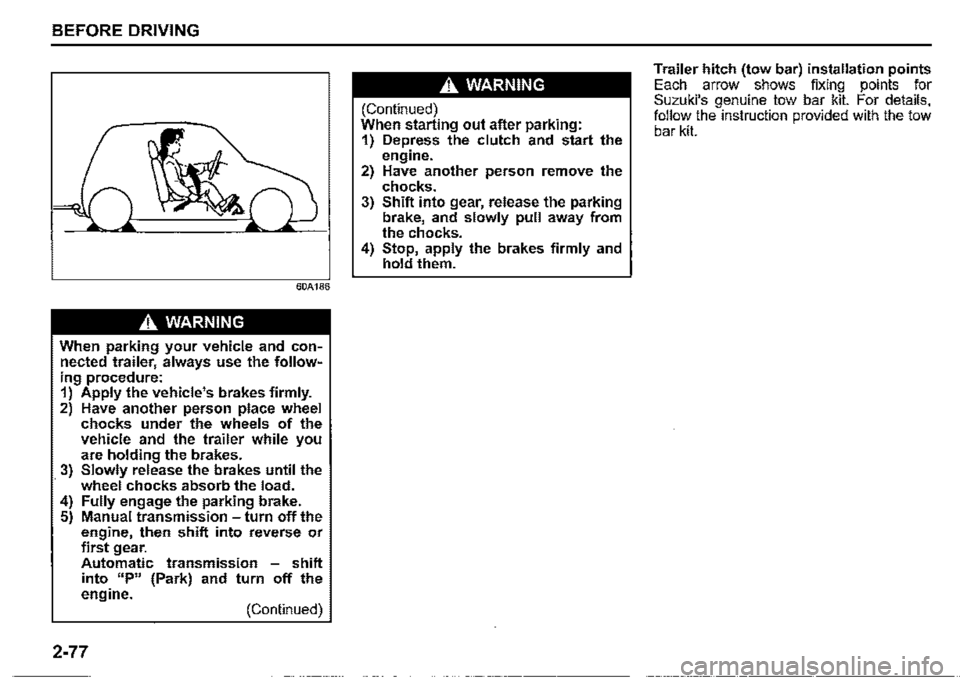
60A186
A WARNING
When parking your vehicle and connected trailer, always use the following procedure: 1) Apply the vehicle's brakes firmly. 2) Have another person place wheel chocks under the wheels of the vehicle and the trailer while you are holding the brakes. 3) Slowly release the brakes until the · wheel chocks absorb the load.
4) Fully engage the parking brake. 5) Manual transmission -turn off the engine, then shift into reverse or first gear. Automatic transmission -shift into "P" (Park) and turn off the engine. (Continued)
2-77
A WARNING
(Continued) When starting out after parking: 1) Depress the clutch and start the engine. 2) Have another person remove the chocks. 3) Shift into gear, release the parking brake, and slowly pull away from the chocks. 4) Stop, apply the brakes firmly and hold them.
Trailer hitch (tow bar) installation points Each arrow shows fixing points for Suzuki's genuine tow bar kit. For details, follow the instruction provided with the tow bar kit.
Page 151 of 421
OPERATING YOUR VEHICLE
OPERATING YOUR VEHICLE
Daily inspection checklist .................................................. 3-1
Engine oil consumption ..................................................... 3-2
Ignition switch ..................................................................... 3-2 -
Parking brake lever ............................................................. 3-5
Pedal ..................................................................................... 3-6
Starting engine .................................................................... 3-7
Using transmission ............................................................. 3-8
Gearshift indicator (if equipped) ........................................ 3-13
Transfer lever ...................................................................... 3-16
Cruise control (if equipped) ............................................... 3-22
Speed limiter (if equipped) ................................................. 3-25
SUZUKI SAFETY SUPPORT (if equipped) ......................... 3-27
Emergency stop signal (ESS) (if equipped) ...................... 3-52
Braking ................................................................................. 3-53
Electronic stability program (ESP®) .................................. 3-55
Tyre pressure monitoring system
(TPMS) (if equipped) ........................................................... 3-63
Page 154 of 421
OPERATING YOUR VEHICLE
68PH00310
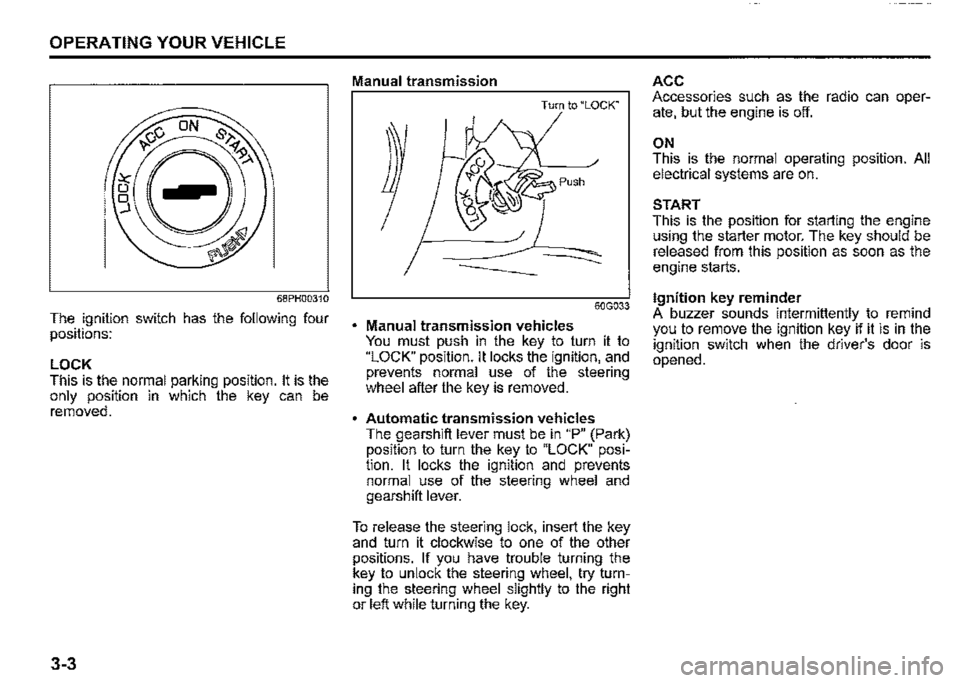
The ignition switch has the following four positions:
LOCK This is the normal parking position. It is the only position in which the key can be removed.
3-3
Manual transmission
Turn to "LOCK"
60G033
Manual transmission vehicles You must push in the key to turn it to "LOCK" position. It locks the ignition, and prevents normal use of the steering wheel after the key is removed.
Automatic transmission vehicles The gearshift lever must be in "P" (Park) position to turn the key to "LOCK" position. It locks the ignition and prevents normal use of the steering wheel and gearshift lever.
To release the steering lock, insert the key and turn it clockwise to one of the other positions. If you have trouble turning the key to unlock the steering wheel, try turning the steering wheel slightly to the right or left while turning the key.
ACC Accessories such as the radio can operate, but the engine is off.
ON This is the normal operating position. All electrical systems are on.
START This is the position for starting the engine using the starter motor. The key should be released from this position as soon as the engine starts.
Ignition key reminder A buzzer sounds intermittently to remind you to remove the ignition key if it is in the ignition switch when the driver's door is opened.
Page 156 of 421
OPERATING YOUR VEHICLE
Parking brake lever
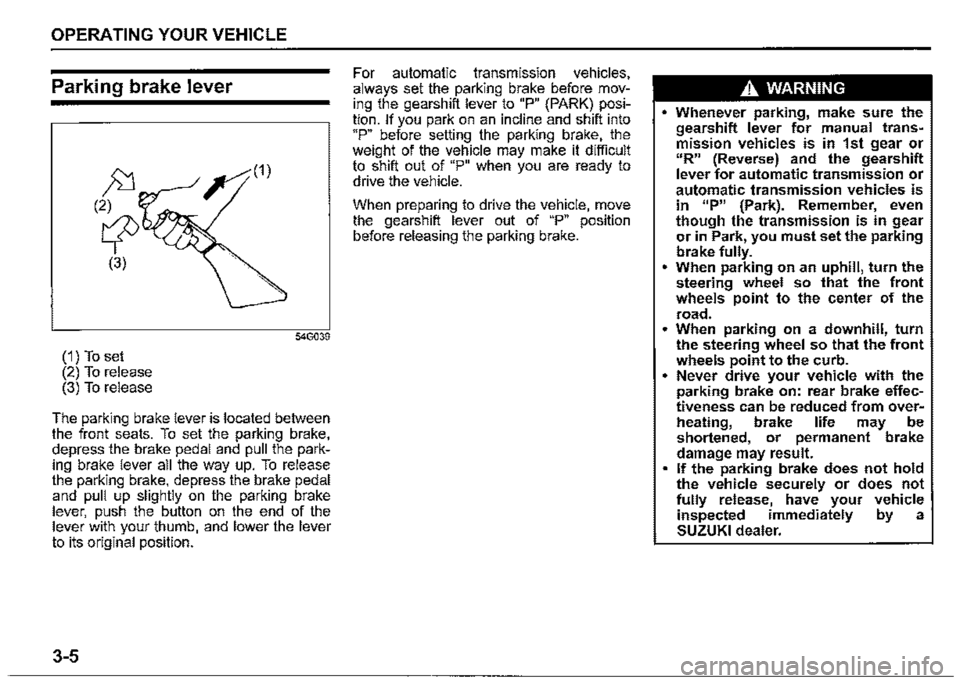
(1) To set (2) To release (3) To release
The parking brake lever is located between the front seats. To set the parking brake, depress the brake pedal and pull the parking brake lever all the way up. To release the parking brake, depress the brake pedal and pull up slightly on the parking brake lever, push the button on the end of the lever with your thumb, and lower the lever to its original position.
3-5
For automatic transmission vehicles, always set the parking brake before moving the gearshift lever to "P" (PARK) position. If you park on an incline and shift into "P" before setting the parking brake, the weight of the vehicle may make it difficult to shift out of "P" when you are ready to drive the vehicle.
When preparing to drive the vehicle, move the gearshift lever out of "P" position before releasing the parking brake.
A WARNING
• Whenever parking, make sure the gearshift lever for manual transmission vehicles is in 1st gear or "R" (Reverse) and the gearshift lever for automatic transmission or automatic transmission vehicles is in 11P" {Park). Remember, even though the transmission is in gear or in Park, you must set the parking brake fully. • When parking on an uphill, turn the steering wheel so that the front wheels point to the center of the
road. • When parking on a downhill, turn the steering wheel so that the front wheels point to the curb. • Never drive your vehicle with the parking brake on: rear brake effectiveness can be reduced from overM heating, brake life may be shortened, or permanent brake damage may result. • If the parking brake does not hold the vehicle securely or does not fully release, have your vehicle inspected immediately by a SUZUKI dealer.
Page 157 of 421

A WARNING
Always set the parking brake fully before leaving your vehicle or it may move, causing injury or damage. When parking, make sure the gearshift lever for manual transmission vehicles is in 1st gear or "R" (Reverse) and the gearshift lever for automatic transmission vehicles is in "P" (Park). Remember, even though the transmission is in gear or in Park, you must set the parking brake fully.
A WARNING
When parking the vehicle in extremely cold weather, the following procedure should be used: 1) Set the parking brake. 2) Manual transmission -turn off the engine, then shift into reverse or first gear. Automatic transmission -shift into "P" (Park) and turn off the engine. 3) Get out of the vehicle and put chocks under the wheels. 4) Release the parking brake. When you return to your vehicle, first set the parking brake, and then remove the wheel chocks.
A WARNING
Do not leave cigarette lighters, spray cans, soft drink cans or plastic arti~ cles (such as glasses, CD case, etc.) in sun-heated vehicle. The temperature inside the vehicle may cause as follows: Gas may leak from a cigarette lighter or spray can and may lead to a fire. The glasses, plastic cards or CD cases, etc. may deform or crack. Soft drink cans may fracture.
Parking brake reminder buzzer
A buzzer sounds intermittently to remind you to release the parking brake if you start the vehicle without fully releasing the parking brake. Check that the parking brake is fully released and the brake system warning light turns off.
OPERATING YOUR VEHICLE
Pedal
Manual transmission
80J2121
Automatic transmission
80J2122
3-6
Page 158 of 421
OPERATING YOUR VEHICLE
Clutch pedal (1)
A clutch pedal is used to disengage the driving force to the wheels when starting the engine, stopping, or shifting the gearshift lever. Depressing the pedal disengages the clutch.
A WARNING
Do not drive with your foot resting on the clutch pedal. It could result in excessive clutch wear, clutch damage, or unexpected loss of engine braking.
Brake pedal (2)
Your vehicle is equipped with either front and rear disc brakes or front disc brakes and rear drum brakes. Depressing a brake pedal applies both sets of brakes.
You may hear occasional brake squeal when you apply the brakes. This is a normal condition caused by environmental factors such as temperature, humidity or dust, etc.
A WARNING
If brake squeal is excessive and occurs each time the brakes are applied, you should have the brakes checked by a SUZUKI dealer.
3-7
A WARNING
Do not apply brakes continuously or rest your foot on the brake pedal. This will result in overheating of the brakes which could cause unpredictable braking action, longer stopping distances, or permanent brake dam
age.
Accelerator pedal (3)
An accelerator pedal controls the speed of the engine. Depressing the accelerator pedal increases power output and speed.
Starting engine
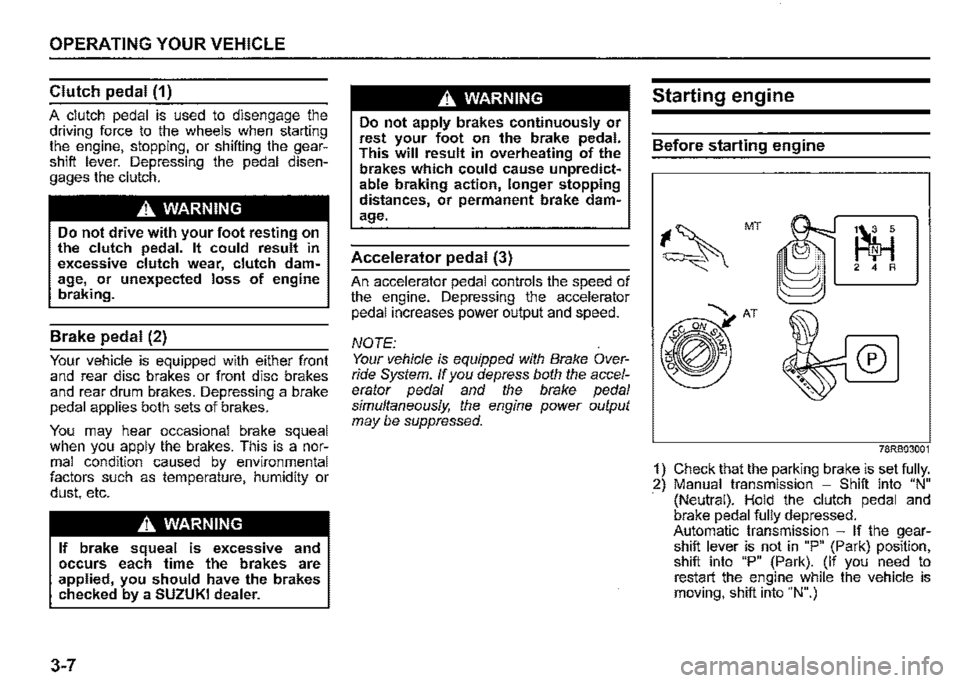
Before starting engine
~ 2 4 R
AT
NOTE: Your vehicle is equipped with Brake Over-fl..l""'"-i ® ride System. If you depress both the accelerator pedal and the brake pedal simultaneously, the engine power output may be suppressed.
78RB03001
1) Check that the parking brake is set fully. 2) Manual transmission -Shift into "N" (Neutral). Hold the clutch pedal and brake pedal fully depressed. Automatic transmission -If the gearshift lever is not in "P" (Park) position, shift into "P" (Park). (If you need to restart the engine while the vehicle is moving, shift into "N".)
Page 159 of 421

NOTE: Automatic transmission vehicles have a starter interlock device which is designed to keep the starter from operating if the transmission is in any of the drive positions.
A WARNING
Check that the parking brake is set fully and the transmission is in Neutral (or Park for vehicles with an automatic transmission) before attempting to start the engine.
Starting a cold and warm engine
With your foot taken off the accelerator pedal, crank the engine by turning the ignition key to "START". Release the key when the engine starts.
NOTICE
• Stop turning the starter immediately after the engine has started or the starter system can be damaged. For protection of a lead-acid battery and a starter motor, do not use the starter motor by turning the key to "START" for more than 12 seconds at a time. If the engine dose not start, turn the key to 11LOCK" position and wait for more than 30 seconds before trying again. If the engine does not start after several attempts, consult a SUZUKI dealer or a qualified workshop.
If the engine does not start after 12 seconds of cranking, wait about 30 seconds, and then press down the accelerator pedal to 1/3 of its stroke and try cranking the engine again. Release the key and accelerator pedal when the engine starts.
If the engine still does not start, depress the accelerator pedal all the way to the fioor while cranking.
OPERATING YOUR VEHICLE
Using transmission
A WARNING
Do not hang any items on the gearshift lever and do not use the gearshift lever as a handrest. Otherwise, it could prevent proper operation of the gearshift lever and cause its malfunction, resulting in an accident.
Manual transmission
3 5
1-$=1
2 4 R
78RB03002
3-8
Page 160 of 421
OPERATING YOUR VEHICLE
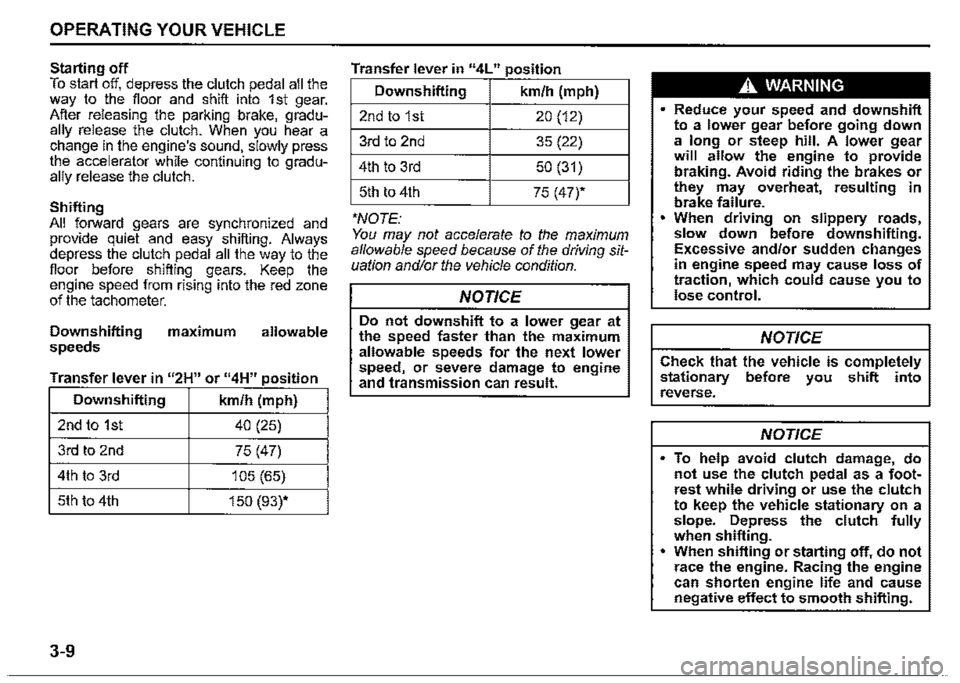
Starting off To start off, depress the clutch pedal all the way to the floor and shift into 1 st gear. After releasing the parking brake, gradually release the clutch. When you hear a change in the engine's sound, slowly press the accelerator while continuing to gradually release the clutch.
Shifting All forward gears are synchronized and provide quiet and easy shifting. Always depress the clutch pedal all the way to the floor before shifting gears. Keep the engine speed from rising into the red zone of the tachometer.
Downshifting maximum allowable speeds
Transfer lever in "2H" or "4H" position
Downshifting km/h (mph)
2nd to 1st 40 (25)
3rd to 2nd 75 (47)
4th to 3rd 105 (65)
5th to 4th 150 (93)*
3-9
Transfer lever in "4L" position
Downshifting km/h (mph)
2ndto1st 20 (12)
3rd to 2nd 35 (22)
4th to 3rd 50 (31)
5th to 4th 75 (47)*
*NOTE: You may not accelerate to the maximum allowable speed because of the driving situation and/or the vehicle condition.
NOTICE
Do not downshift to a lower gear at the speed faster than the maximum allowable speeds for the next lower speed) or severe damage to engine and transmission can result.
A WARNING
• Reduce your speed and downshift to a lower gear before going down a long or steep hill. A lower gear will allow the engine to provide braking. Avoid riding the brakes or they may overheat, resulting in brake failure. When driving on slippery roads, slow down before downshifting. Excessive and/or sudden changes in engine speed may cause loss of traction, which could cause you to lose control.
NOTICE
Check that the vehicle is completely stationary before you shift into reverse.
NOTICE
To help avoid clutch damage, do not use the clutch pedal as a footrest while driving or use the clutch to keep the vehicle stationary on a slope. Depress the clutch fully when shifting. • When shifting or starting off, do not race the engine. Racing the engine can shorten engine life and cause negative effect to smooth shifting.
Page 161 of 421
Automatic transmission
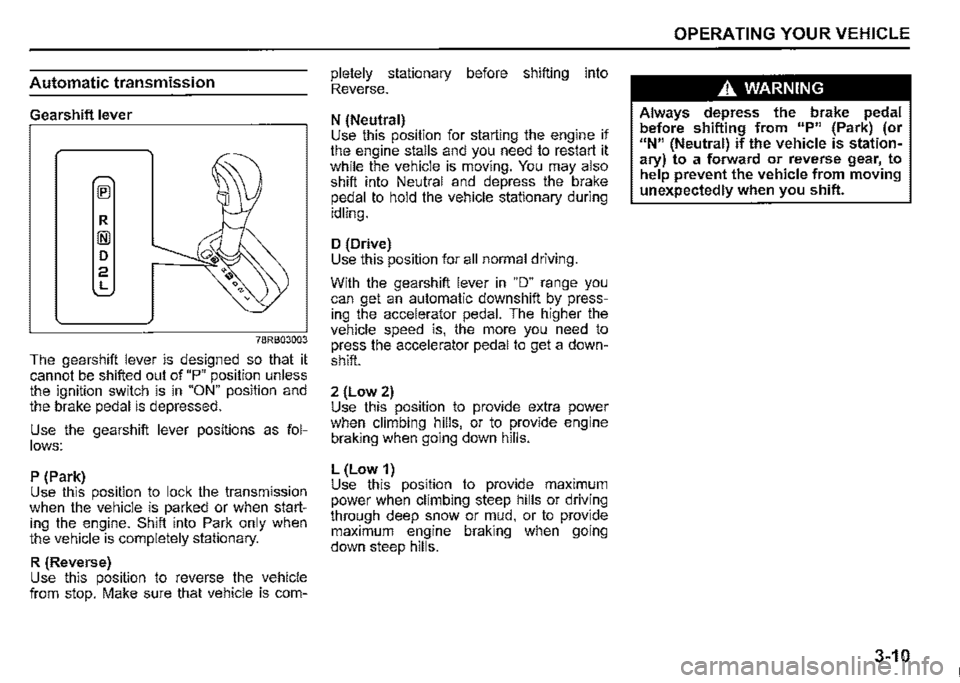
Gearshift lever
[eJ
R
[fj)
D
2 L
78RB03003
The gearshift lever is designed so that it cannot be shifted out of "P" position unless the ignition switch is in "ON" position and the brake pedal is depressed.
Use the gearshift lever positions as follows:
P (Park) Use this position to lock the transmission when the vehicle is parked or when starting the engine. Shift into Park only when the vehicle is completely stationary.
R (Reverse) Use this position to reverse the vehicle from stop. Make sure that vehicle is corn-
pletely stationary before shifting into Reverse.
N (Neutral) Use this position for starting the engine if the engine stalls and you need to restart it while the vehicle is moving. You may also shift into Neutral and depress the brake pedal to hold the vehicle stationary during
idling.
D (Drive) Use this position for all normal driving.
With the gearshift lever in "D" range you ?an get an automatic downshift by pressing the accelerator pedal. The higher the vehicle speed is, the more you need to press the accelerator pedal to get a downshift.
2 (Low2) Use this position to provide extra power when climbing hills, or to provide engine braking when going down hills.
L (Low 1) Use this position to provide maximum power when climbing steep hills or driving through deep snow or mud, or to provide maximum engine braking when going down steep hills.
OPERATING YOUR VEHICLE
A, WARNING
Always depress the brake pedal before shifting from "P" (Park) (or "N" (Neutral) if the vehicle is stationary) to a forward or reverse gear, to help prevent the vehicle from moving unexpectedly when you shift.
3-10
Page 162 of 421
OPERATING YOUR VEHICLE
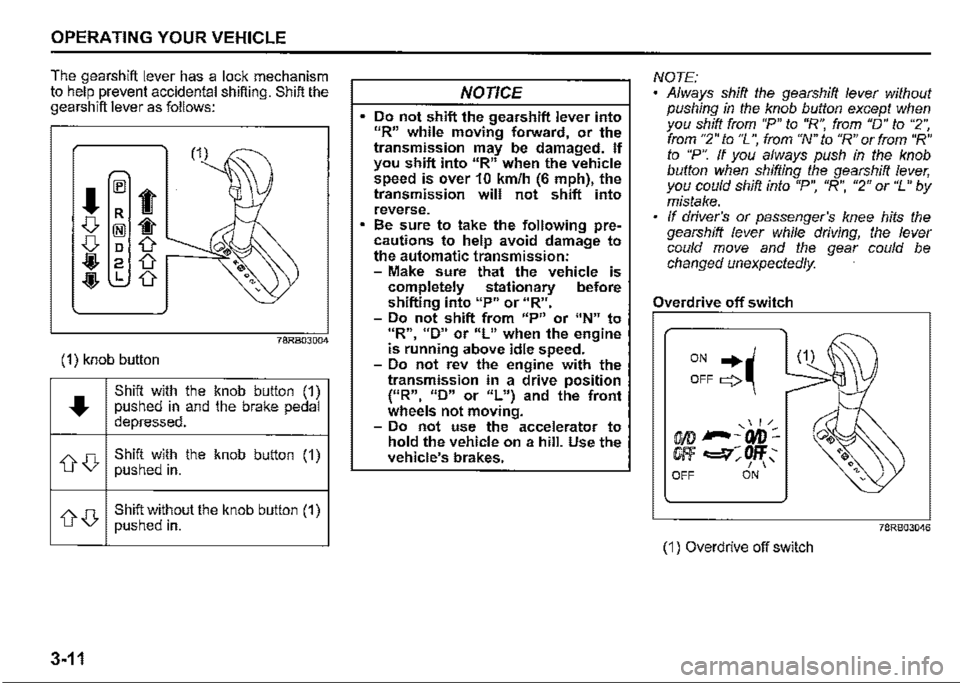
The gearshift lever has a lock mechanism to help prevent accidental shifting. Shift the gearshift lever as follows:
•
®
t R D IN) it
D D D-,@, 2 D-
,@, L D-
78RB03004
( 1 ) knob button
Shift with the knob button (1)
•
pushed in and the brake pedal depressed.
-OD Shift with the knob button (1) pushed in.
D-D Shift without the knob button (1) pushed in.
3-11
NOTICE
• Do not shift the gearshifl lever into 11R" while moving forward, or the transmission may be damaged. If you shift into "R" when the vehicle speed is over 10 km/h (6 mph),_the transmission will not shift mto reverse. Be sure to take the following precautions to help avoid damage to the automatic transmission: -Make sure that the vehicle is completely stationary before shifting into 11P" or "R". -Do not shift from up" or "N" to "R" "D" or "L11 when the engine is r~nning above idle speed. -Do not rev the engine with the transmission in a drive position {uR", 11D" or 11~") and the front wheels not movmg. -Do not use the accelerator to hold the vehicle on a hill. Use the vehicle's brakes.
NOTE: • Always shift the gearshift lever without pushing in the knob button except when ou shift from "P" to "R", from "D" to "2", rrom "2" to "L ", from "N" to "R''. or from "R" to "P". If you always push m the knob button when shifting the gearsh1ft lever. Id h.ft · t "P" "R" "2" or "L" by youcou s1 mo , , mistake. If driver's or passenger's knee hits the gearshift lever while driving, the lever could move and the gear could be changed unexpectedly.
Overdrive off switch
ON ...
OFF c;>~
' / < .. 00---00-@ff ~-ow-,, I \" OFF ON
(1) Overdrive off switch
78RB03046