ESP SUZUKI MARUTI 2005 1.G User Guide
[x] Cancel search | Manufacturer: SUZUKI, Model Year: 2005, Model line: MARUTI, Model: SUZUKI MARUTI 2005 1.GPages: 136, PDF Size: 2.93 MB
Page 67 of 136
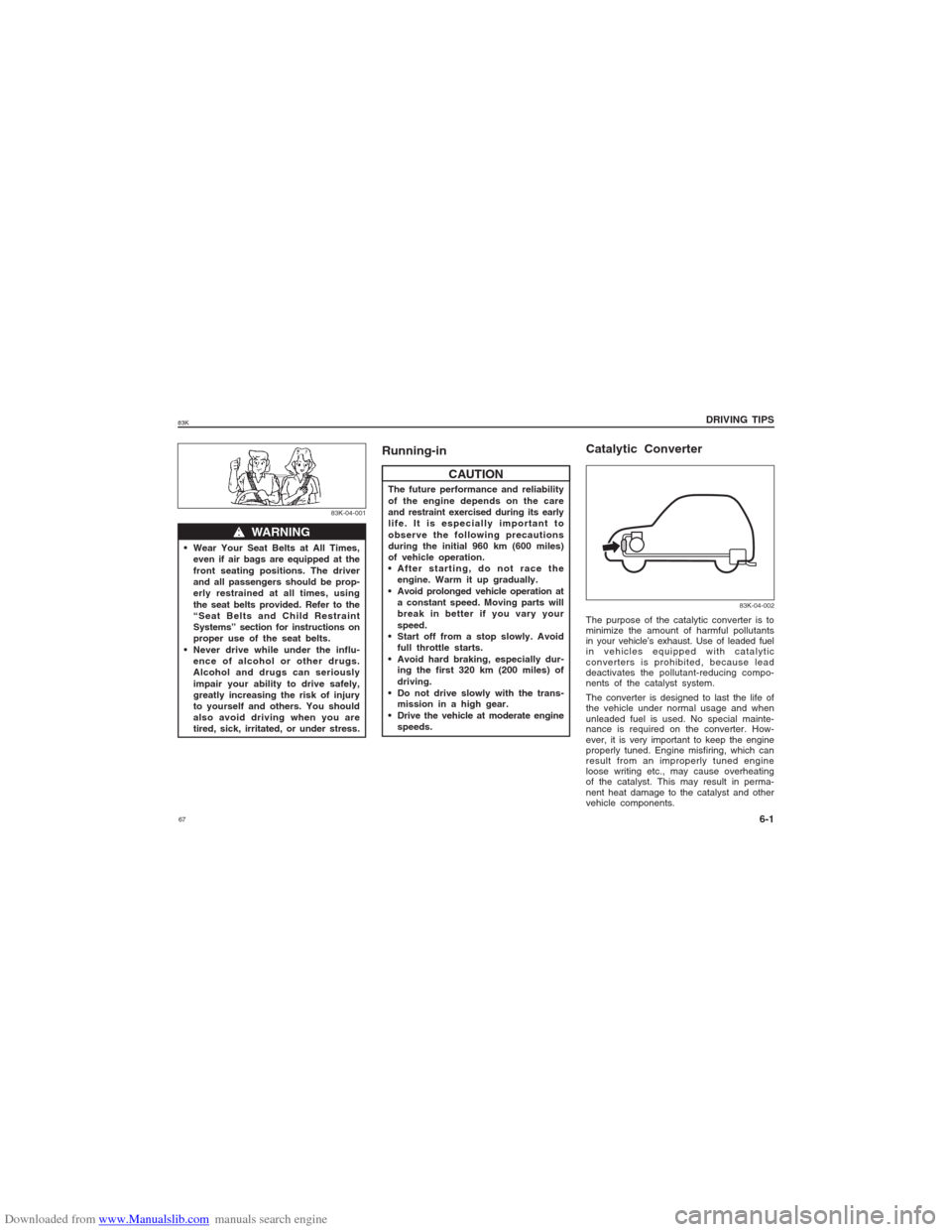
Downloaded from www.Manualslib.com manuals search engine 6783K Wear Your Seat Belts at All Times,
even if air bags are equipped at the
front seating positions. The driver
and all passengers should be prop-
erly restrained at all times, using
the seat belts provided. Refer to the
“Seat Belts and Child Restraint
Systems” section for instructions on
proper use of the seat belts.
Never drive while under the influ-
ence of alcohol or other drugs.
Alcohol and drugs can seriously
impair your ability to drive safely,
greatly increasing the risk of injury
to yourself and others. You should
also avoid driving when you are
tired, sick, irritated, or under stress.The future performance and reliability
of the engine depends on the care
and restraint exercised during its early
life. It is especially important to
observe the following precautions
during the initial 960 km (600 miles)
of vehicle operation.
After starting, do not race the
engine. Warm it up gradually.
Avoid prolonged vehicle operation at
a constant speed. Moving parts will
break in better if you vary your
speed.
Start off from a stop slowly. Avoid
full throttle starts.
Avoid hard braking, especially dur-
ing the first 320 km (200 miles) of
driving.
Do not drive slowly with the trans-
mission in a high gear.
Drive the vehicle at moderate engine
speeds.
83K-04-001
w ww w
w WARNING
Running-in
CAUTION
Catalytic ConverterThe purpose of the catalytic converter is to
minimize the amount of harmful pollutants
in your vehicle’s exhaust. Use of leaded fuel
in vehicles equipped with catalytic
converters is prohibited, because lead
deactivates the pollutant-reducing compo-
nents of the catalyst system.
The converter is designed to last the life of
the vehicle under normal usage and when
unleaded fuel is used. No special mainte-
nance is required on the converter. How-
ever, it is very important to keep the engine
properly tuned. Engine misfiring, which can
result from an improperly tuned engine
loose writing etc., may cause overheating
of the catalyst. This may result in perma-
nent heat damage to the catalyst and other
vehicle components.
83K-04-002
DRIVING TIPS
6-1
Page 69 of 136
Downloaded from www.Manualslib.com manuals search engine 6983K
DRIVING TIPS
6-3
(Diesel engine)
No cleaning is required. Replace as per
periodic maintenance schedule.
Keep weight to a minimum
The heavier the load, the more fuel the
vehicle consumes. Take out any luggage or
cargo when it is not necessary.
Keep tyre pressures correct
Underinflation of the tyres can waste fuel
due to increased running resistance of the
tyres. Keep your tyres inflated to the cor-
rect pressure shown on the label on the
driver’s side door pillar.Highway DrivingWhen driving at high speeds, pay attention
to the following:
Stopping distance progressively increa-
ses with vehicle speed. Apply the brakes
far enough ahead of the stopping point
to allow for the extra stopping distance.
On rainy days, “Aquaplaning” can occur.
“Aquaplaning” is the loss of direct con-
tact between the road surface and the
vehicle’s tyres due to a water film form-
ing between them. Steering or braking
the vehicle while “Aquaplaning” can be
very difficult, and loss of control can
occur. Keep speed down when the road
surface is wet.
At high speeds, the vehicle may be
affected by side winds. Therefore, reducespeed and be prepared for unexpected
buffeting, which can occur at the exits
of tunnels, when passing by a cut of a
hill, or when being overtaken by large
vehicles, etc.
Driving on Hills
w ww w
w WARNING
Try not to hold the brake pedal down
too long or too often while going
down a steep or long hill. This could
cause the brakes to overheat, result-
ing in reduced braking efficiency.
Failure to take this precaution could
result in loss of vehicle control.
CAUTION
When descending a down hill, NEVER
turn the ignition key to the “OFF”
position. Emission control system
damage may result.Driving on Slippery Roads
83K-04-006
83K-04-005
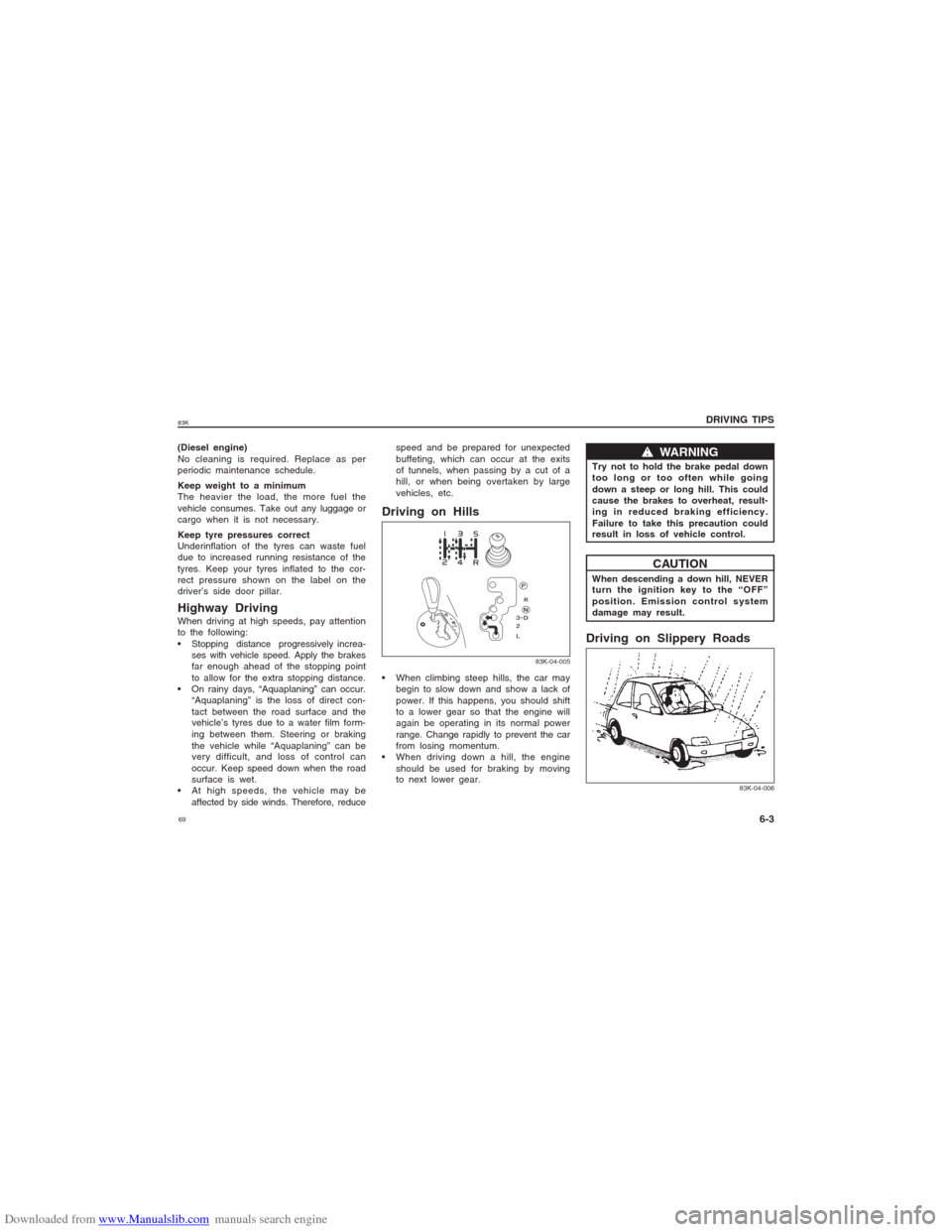
When climbing steep hills, the car may
begin to slow down and show a lack of
power. If this happens, you should shift
to a lower gear so that the engine will
again be operating in its normal power
range. Change rapidly to prevent the car
from losing momentum.
When driving down a hill, the engine
should be used for braking by moving
to next lower gear.
Page 72 of 136
Downloaded from www.Manualslib.com manuals search engine 7283K
DRIVING TIPS
6-6
83K-04-010
4. Before entering a corner, decelerate to
a safe speed. Don’t apply brakes during
cornering, or a cornering skid may occur.
5. When overtaking other vehicles, watch
out for the oncoming vehicle and
carefully confirm the safety.
6. Don’t attempt zigzag driving which will
hinder your control over the vehicle and
cause an accident.
Braking
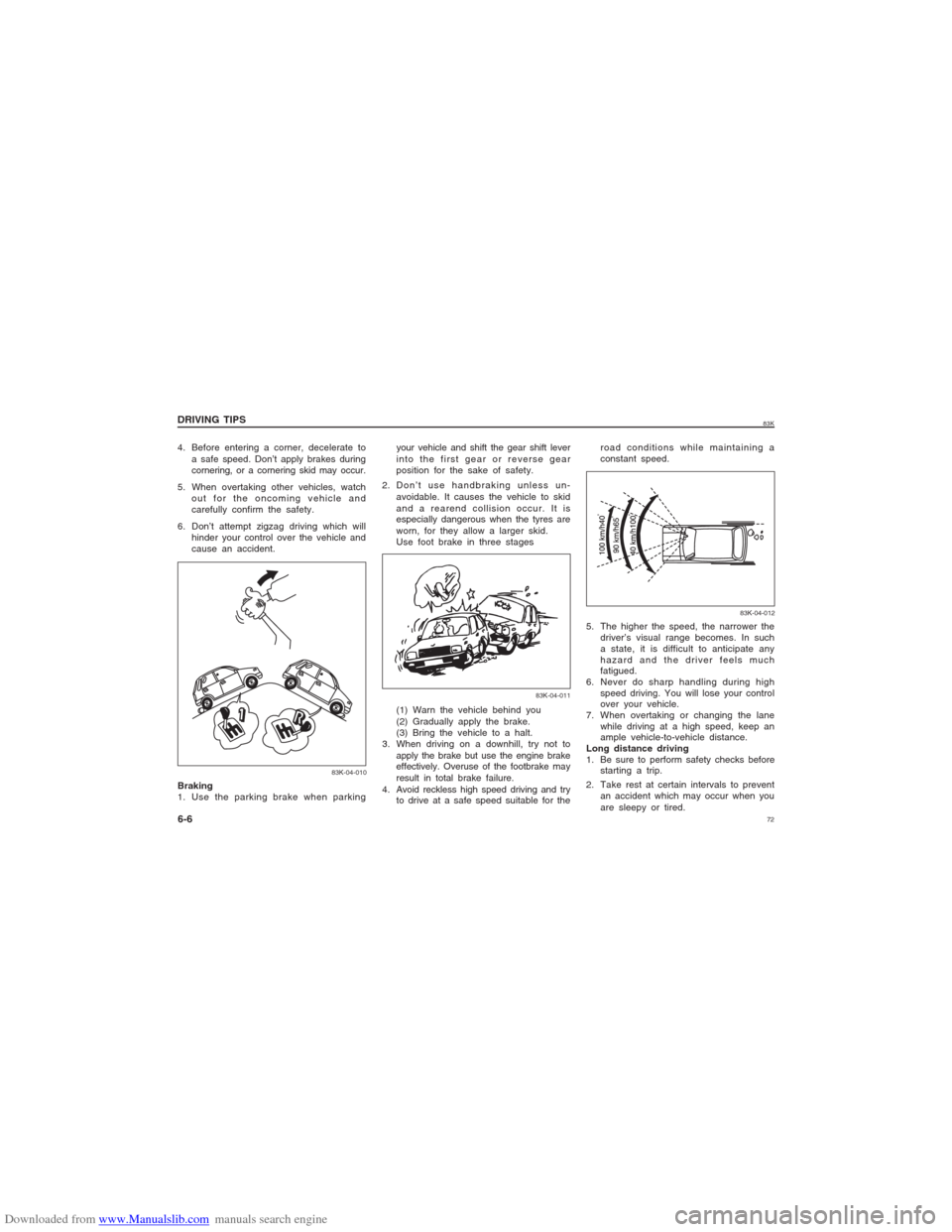
1. Use the parking brake when parking(1) Warn the vehicle behind you
(2) Gradually apply the brake.
(3) Bring the vehicle to a halt.
3. When driving on a downhill, try not to
apply the brake but use the engine brake
effectively. Overuse of the footbrake may
result in total brake failure.
4. Avoid reckless high speed driving and try
to drive at a safe speed suitable for theroad conditions while maintaining a
constant speed.
83K-04-012
83K-04-011
your vehicle and shift the gear shift lever
into the first gear or reverse gear
position for the sake of safety.
2. Don’t use handbraking unless un-
avoidable. It causes the vehicle to skid
and a rearend collision occur. It is
especially dangerous when the tyres are
worn, for they allow a larger skid.
Use foot brake in three stages
5. The higher the speed, the narrower the
driver’s visual range becomes. In such
a state, it is difficult to anticipate any
hazard and the driver feels much
fatigued.
6. Never do sharp handling during high
speed driving. You will lose your control
over your vehicle.
7. When overtaking or changing the lane
while driving at a high speed, keep an
ample vehicle-to-vehicle distance.
Long distance driving
1. Be sure to perform safety checks before
starting a trip.
2. Take rest at certain intervals to prevent
an accident which may occur when you
are sleepy or tired.
Page 87 of 136
Downloaded from www.Manualslib.com manuals search engine 8783KVEHICLE LOADING AND TOWING
VEHICLE LOADING AND TOWING
Vehicle LoadingYour vehicle was designed for specific weight
capacities. The weight capacities of your
vehicle are indicated by the Gross Vehicle
Weight Rating (GVWR) and the Gross Axle
Weight Rating (GAWR, front and rear). The
GVWR and GAWR (front and rear) are listed
in the “SPECIFICATIONS” section.
GVWR – Maximum permissible overall weight
of the fully loaded vehicle (including all the
occupants, accessories and cargo plus the
trailer nose weight if towing a trailer).
GAWR – (Front and Rear) Maximum per-
missible weight on an individual axle.
Actual weight of the loaded vehicle and actual
loads at the front and rear axles can only be
determined by weighing the vehicle. Compare
these weights to the GVWR and GAWR (front
and rear). If the gross vehicle weight or the
load on either axle exceeds these ratings, you
must remove enough weight to bring the load
down to the rated capacity.
w ww w
w WARNING
Always distribute cargo evenly. To
avoid personal injury or damage to your
vehicle, always secure cargo to prevent
it from shifting if the vehicle moves
suddenly. Place heavier objects on the
floor and as far forward in the cargo
area as possible. Never pile cargo
higher than the top of the seat backs.
w ww w
w WARNING
Never overload your vehicle. The gross
vehicle weight (sum of the weights of
the vehicle, all the occupants,
accessories, cargo plus trailer nose
V VV V
V
w ww w
w WARNING
V VV V
Vweight if towing a trailer) must never
exceed the Gross Vehicle Weight
Rating (GVWR). In addition, never
distribute a load so that the weight on
either the front or rear axle exceeds
the Gross Axle Weight Rating (GAWR).Trailer TowingYour MARUTI SUZUKI was originally
designed to carry people and a normal
amount of cargo, not to tow a trailer. MARUTI
SUZUKI does not recommend you use your
vehicle to tow a trailer if there is not any local
regulation about towing capacity permitted (for
example, registered or statutory towing
capacity). Towing a trailer can adversely affect
handling, durability, and fuel economy.When you tow your vehicle, follow the
instructions below to avoid accidents
and damage to your vehicle. In addition,
be sure to observe government and
local requirements regarding vehicle
lighting and trailer hitches or tow bars.
w ww w
w WARNING
Towing Your VehicleYour vehicle may be towed behind another
Vehicle (such as a motorhome), provided
you use the proper towing method specified
for your vehicle. The towing method you
must use depends on the specifications of
your vehicle: whether it is a manual
transmission vehicle or an automatic
transmission vehicle.
Use the towing instruction table to select the
proper towing method for your vehicle, and
carefully follow the corresponding
instructions. Be sure to use proper towing
equipment designed for recreational towing
and make sure that towing speed does not
exceed 90 km/h.
w ww w
w WARNING
A safety chain should always be used
when you tow your vehicle.
8-1
Page 90 of 136
Downloaded from www.Manualslib.com manuals search engine 9083K
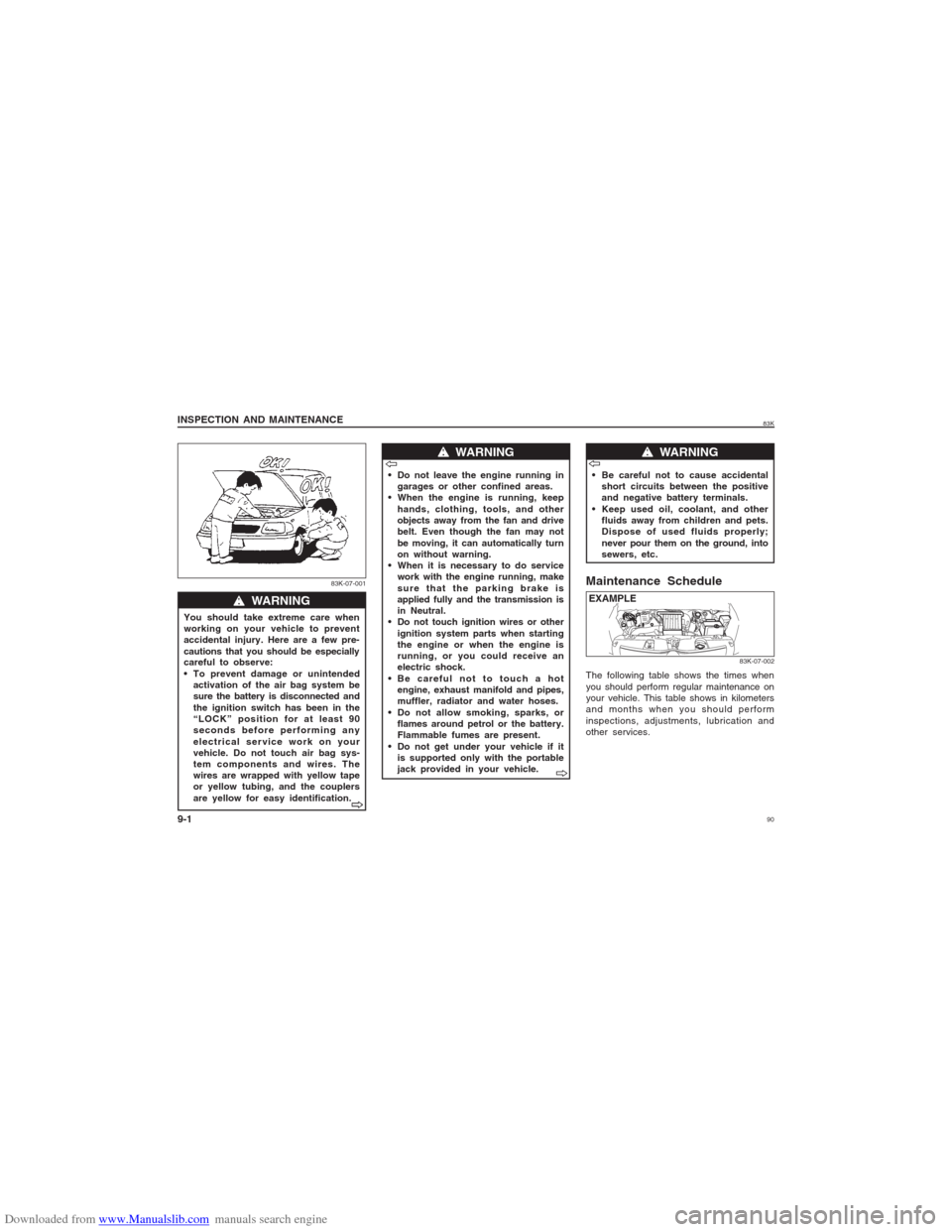
You should take extreme care when
working on your vehicle to prevent
accidental injury. Here are a few pre-
cautions that you should be especially
careful to observe:
To prevent damage or unintended
activation of the air bag system be
sure the battery is disconnected and
the ignition switch has been in the
“LOCK” position for at least 90
seconds before performing any
electrical service work on your
vehicle. Do not touch air bag sys-
tem components and wires. The
wires are wrapped with yellow tape
or yellow tubing, and the couplers
are yellow for easy identification.
w ww w
w WARNING
83K-07-001
w ww w
w WARNING
w ww w
w WARNING
INSPECTION AND MAINTENANCE
9-1
V VV V
V
Do not leave the engine running in
garages or other confined areas.
When the engine is running, keep
hands, clothing, tools, and other
objects away from the fan and drive
belt. Even though the fan may not
be moving, it can automatically turn
on without warning.
When it is necessary to do service
work with the engine running, make
sure that the parking brake is
applied fully and the transmission is
in Neutral.
Do not touch ignition wires or other
ignition system parts when starting
the engine or when the engine is
running, or you could receive an
electric shock.
Be careful not to touch a hot
engine, exhaust manifold and pipes,
muffler, radiator and water hoses.
Do not allow smoking, sparks, or
flames around petrol or the battery.
Flammable fumes are present.
Do not get under your vehicle if it
is supported only with the portable
jack provided in your vehicle.V VV V
V
V VV V
V
Be careful not to cause accidental
short circuits between the positive
and negative battery terminals.
Keep used oil, coolant, and other
fluids away from children and pets.
Dispose of used fluids properly;
never pour them on the ground, into
sewers, etc.V VV V
V
83K-07-002
Maintenance ScheduleThe following table shows the times when
you should perform regular maintenance on
your vehicle. This table shows in kilometers
and months when you should perform
inspections, adjustments, lubrication and
other services.EXAMPLE
Page 91 of 136
Downloaded from www.Manualslib.com manuals search engine 9183K
INSPECTION AND MAINTENANCE
9-2
w ww w
w WARNING
MARUTI SUZUKI recommends that
maintenance on your MARUTI SUZUKI
vehicle should be performed by
MARUTI SUZUKI authorised Dealer/
Service Station.
CAUTION
Whenever it becomes necessary to
replace parts on your vehicle, it is
recommended that you use MARUTI
GENUINE PARTS (MGP) only.Periodic Maintenance Sched-
ule
“A” : Adjust
“C” : Clean
“R” : Replace or Change
“I” : Inspect, correct or replace if
necessary
“L” : Lubricate
“T” : Tighten to Specified Torque
“O” : Rotate
NOTE:
This table includes services as scheduled
up to 80,000 km mileage. Beyond 80,000
km, carry out the same services at the
same intervals respectively.
Page 113 of 136
Downloaded from www.Manualslib.com manuals search engine 11383K
INSPECTION AND MAINTENANCE
9-24
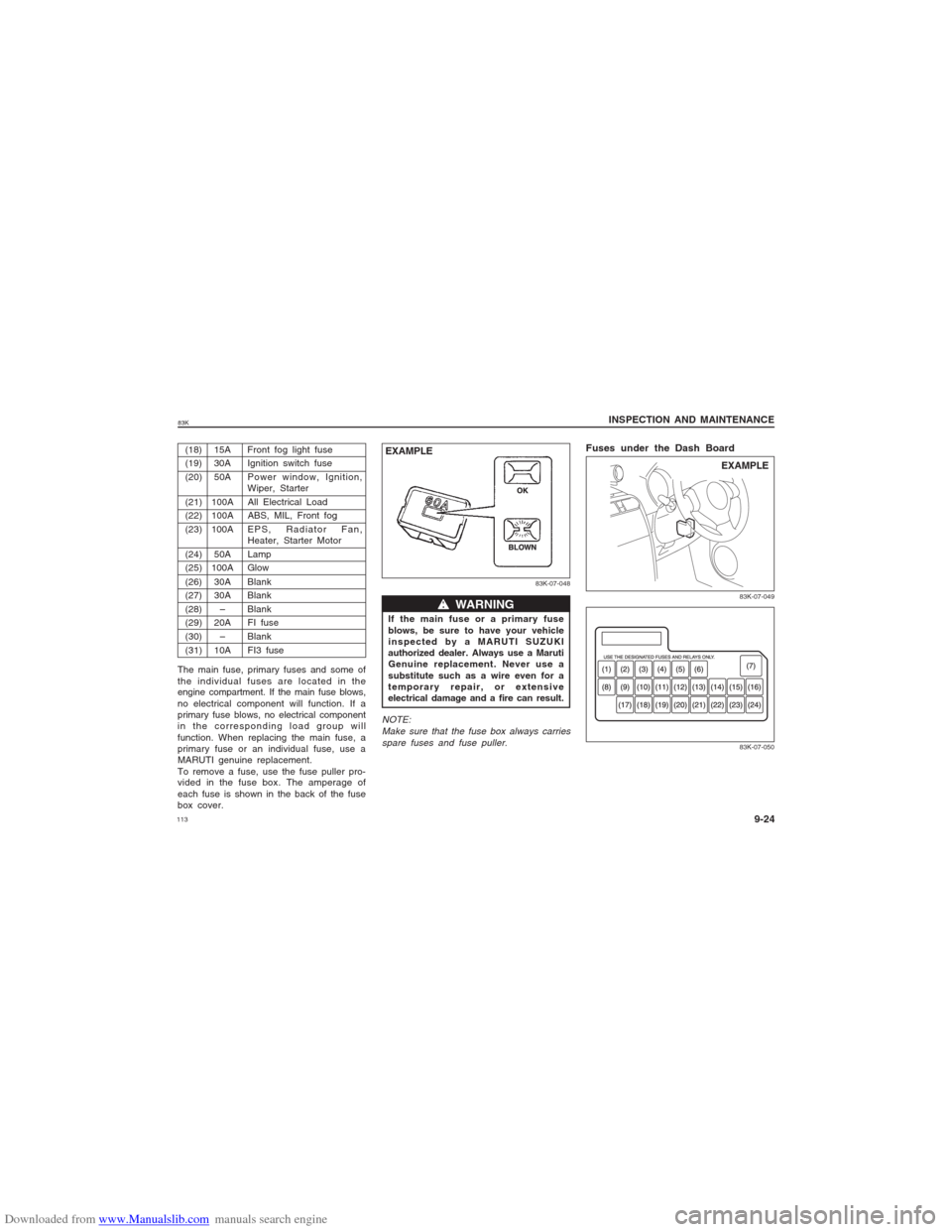
(18) 15A Front fog light fuse
(19) 30A Ignition switch fuse
(20) 50APower window, Ignition,
Wiper, Starter
(21)100A All Electrical Load
(22)100A ABS, MIL, Front fog
(23)100AEPS, Radiator Fan,
Heater, Starter Motor
(24) 50ALamp
(25)100A Glow
(26) 30A Blank
(27) 30A Blank
(28) – Blank
(29) 20A FI fuse
(30) – Blank
(31) 10A FI3 fuseThe main fuse, primary fuses and some of
the individual fuses are located in the
engine compartment. If the main fuse blows,
no electrical component will function. If a
primary fuse blows, no electrical component
in the corresponding load group will
function. When replacing the main fuse, a
primary fuse or an individual fuse, use a
MARUTI genuine replacement.
To remove a fuse, use the fuse puller pro-
vided in the fuse box. The amperage of
each fuse is shown in the back of the fuse
box cover.
w ww w
w WARNING
If the main fuse or a primary fuse
blows, be sure to have your vehicle
inspected by a MARUTI SUZUKI
authorized dealer. Always use a Maruti
Genuine replacement. Never use a
substitute such as a wire even for a
temporary repair, or extensive
electrical damage and a fire can result.NOTE:
Make sure that the fuse box always carries
spare fuses and fuse puller.EXAMPLEFuses under the Dash Board
83K-07-04983K-07-050
EXAMPLE
83K-07-048
Page 114 of 136
Downloaded from www.Manualslib.com manuals search engine 11483K
INSPECTION AND MAINTENANCE
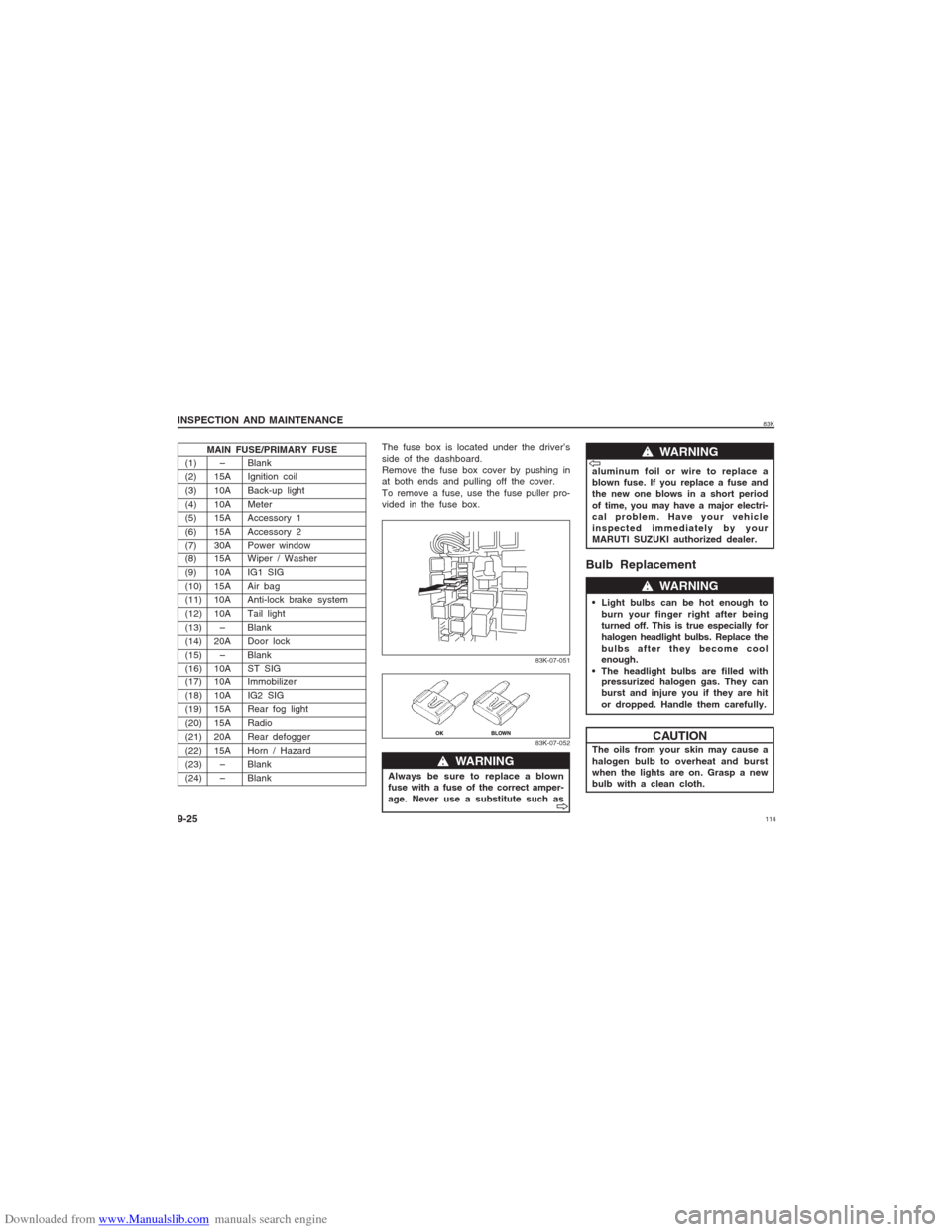
9-25(1) – Blank
(2) 15A Ignition coil
(3) 10A Back-up light
(4) 10A Meter
(5) 15A Accessory 1
(6) 15A Accessory 2
(7) 30A Power window
(8) 15A Wiper / Washer
(9) 10A IG1 SIG
(10) 15A Air bag
(11) 10A Anti-lock brake system
(12) 10ATail light
(13) – Blank
(14) 20A Door lock
(15) – Blank
(16) 10A ST SIG
(17) 10A Immobilizer
(18) 10A IG2 SIG
(19) 15A Rear fog light
(20) 15ARadio
(21) 20A Rear defogger
(22) 15A Horn / Hazard
(23) – Blank
(24) – BlankMAIN FUSE/PRIMARY FUSE
83K-07-051
The fuse box is located under the driver’s
side of the dashboard.
Remove the fuse box cover by pushing in
at both ends and pulling off the cover.
To remove a fuse, use the fuse puller pro-
vided in the fuse box.
83K-07-052
w ww w
w WARNING
Always be sure to replace a blown
fuse with a fuse of the correct amper-
age. Never use a substitute such as
V VV V
V
w ww w
w WARNING
aluminum foil or wire to replace a
blown fuse. If you replace a fuse and
the new one blows in a short period
of time, you may have a major electri-
cal problem. Have your vehicle
inspected immediately by your
MARUTI SUZUKI authorized dealer.V VV V
V
Bulb Replacement Light bulbs can be hot enough to
burn your finger right after being
turned off. This is true especially for
halogen headlight bulbs. Replace the
bulbs after they become cool
enough.
The headlight bulbs are filled with
pressurized halogen gas. They can
burst and injure you if they are hit
or dropped. Handle them carefully.
w ww w
w WARNING
The oils from your skin may cause a
halogen bulb to overheat and burst
when the lights are on. Grasp a new
bulb with a clean cloth.
CAUTION
Page 123 of 136
Downloaded from www.Manualslib.com manuals search engine 12383K
EMERGENCY SERVICE
10-2
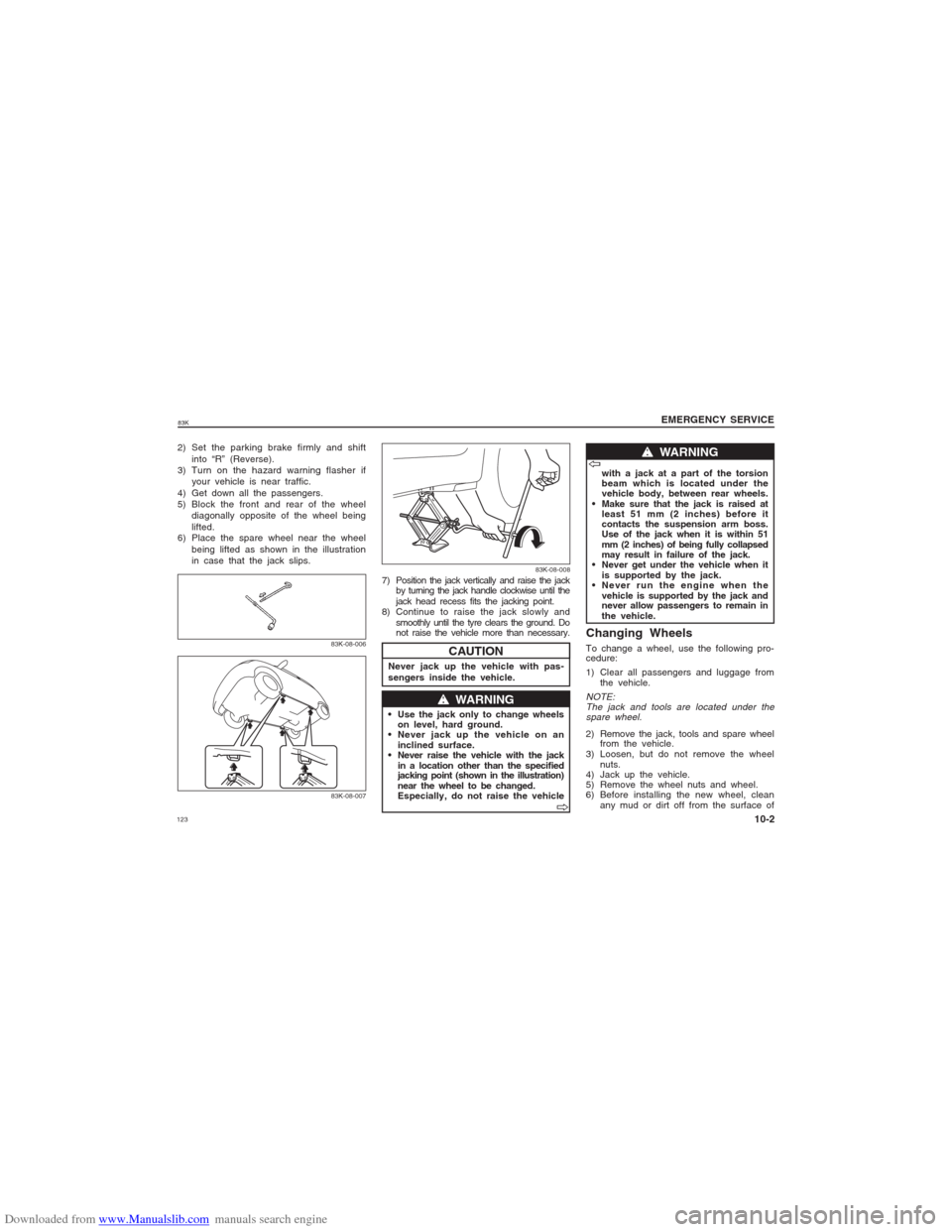
2) Set the parking brake firmly and shift
into “R” (Reverse).
3) Turn on the hazard warning flasher if
your vehicle is near traffic.
4) Get down all the passengers.
5) Block the front and rear of the wheel
diagonally opposite of the wheel being
lifted.
6) Place the spare wheel near the wheel
being lifted as shown in the illustration
in case that the jack slips.
83K-08-00683K-08-007
CAUTION
Never jack up the vehicle with pas-
sengers inside the vehicle. 7) Position the jack vertically and raise the jack
by turning the jack handle clockwise until the
jack head recess fits the jacking point.
8) Continue to raise the jack slowly and
smoothly until the tyre clears the ground. Do
not raise the vehicle more than necessary.
w ww w
w WARNING
Use the jack only to change wheels
on level, hard ground.
Never jack up the vehicle on an
inclined surface.
Never raise the vehicle with the jack
in a location other than the specified
jacking point (shown in the illustration)
near the wheel to be changed.
Especially, do not raise the vehiclewith a jack at a part of the torsion
beam which is located under the
vehicle body, between rear wheels.
Make sure that the jack is raised at
least 51 mm (2 inches) before it
contacts the suspension arm boss.
Use of the jack when it is within 51
mm (2 inches) of being fully collapsed
may result in failure of the jack.
Never get under the vehicle when it
is supported by the jack.
Never run the engine when the
vehicle is supported by the jack and
never allow passengers to remain in
the vehicle.
V VV V
V
w ww w
w WARNING
V VV V
V
Changing WheelsTo change a wheel, use the following pro-
cedure:
1) Clear all passengers and luggage from
the vehicle.NOTE:
The jack and tools are located under the
spare wheel.2) Remove the jack, tools and spare wheel
from the vehicle.
3) Loosen, but do not remove the wheel
nuts.
4) Jack up the vehicle.
5) Remove the wheel nuts and wheel.
6) Before installing the new wheel, clean
any mud or dirt off from the surface of
83K-08-008