transmission SUZUKI MARUTI 2005 1.G Owners Manual
[x] Cancel search | Manufacturer: SUZUKI, Model Year: 2005, Model line: MARUTI, Model: SUZUKI MARUTI 2005 1.GPages: 136, PDF Size: 2.93 MB
Page 8 of 136
Downloaded from www.Manualslib.com manuals search engine 883K
Maruti Suzuki offers the Emission Warranty on all Maruti Suzuki vehicles (apart from the Regular warranty and will run parallel
to the regular product warranty) only in four metropolitan cities (New Delhi, Kolkata, Mumbai and Chennai) with effect from
July 1st, 2001.
Terms:
The Emission Warranty will be applicable for 80,000 kms or 3 years (Which ever comes earlier) from the date of delivery to
the first owner. The remaining warranty terms will be valid in case of any change in ownership provided the production of all
valid document.
Conditions:1. Under Emission Warranty, Warranty claims will be admitted for a prima facie examination, in case vehicle fails to meet to the
Emission Standard as specified in sub rule (2) of rule no. 115 of Central Motor Vehicles Rules (CMVR), 1989.
2. The warranty claims will only be accepted after examination carried out by Maruti Suzuki or it's dealer which leads to firm conclusions
that the
a) Original settings have not been tempered in any case.
b) Part (as given in Annexure-A) has a manufacturing defect.
c) Vehicle is unable to meet the Emission Standards (as given in 1.), inspite of the vehicle having been maintained and used
in accordance with the instructions as specified in Owner's Manual and Service Booklet and the used fuel and different oils
(Engine oil, Transmission oil, Brake oil etc.) are also as per specification.
3. The method of examination for deciding the warranty of the parts will be at the sole discretion of Maruti Suzuki and it's dealer
and results of the examination will be final and binding. If after examination, the warrantable condition is not established, Maruti
Suzuki and it's dealer has the right to charge all, or part of the cost of such examination.
4. Under Emission Warranty, the parts (as given in Annexure-A) will be changed free of cost, but the consumables will be charged
as per actual.
5. If the part covered under Emission Warranty or the associated parts, are not independently replaceable, on account of these being
integral parts a complete assembly, Maruti Suzuki and it's dealer will have the sole discretion to replace entire assembly or by
using some of the parts of the system through suitable repair or modifications.EMISSION WARRANTY
2-3EMISSION WARRANTY
Page 9 of 136
Downloaded from www.Manualslib.com manuals search engine 983K6. Any consequential repairs or replacement of parts which may be found necessary to establish compliance of Emission Warranty,
will not be considered under warranty, unless the same is under product warranty. The consumable will be charged as per actual
under such repair or replacement.
7. Maruti Suzuki will not be responsible for the cost of transportation of the vehicle to the nearest Maruti Suzuki dealer workshop
or any loss due to non-availability of the vehicle during the period of lodging of a warranty claim and examination and/or repair
by Maruti Suzuki dealer.
8. Maruti Suzuki will not be responsible for any penalty that may be charged by statutory authorities on account of failure to comply
with the EMISSION STANDARDS.
9. Emission Warranty will not be affected on the change of owner, provided all the documents are available.
10. All maintenance actions (as specified in the Owner's Manual and Service Booklet) need to be followed and recorded in the manual
for emission warranty.
11. The customer needs to produce the PUC (Pollution Under Control) certificate valid for the period preceding the test during which
the failure is discovered. The receipts (for the maintenance of the vehicle as per specification in Owner's Manual and Service
Booklet from the date of original purchase of the vehicle) will also be required.Condition Under which the Emission Warranty is not APPLICABLE
1. In the absence of valid PUC certificate.
2. Vehicle not serviced from Maruti Suzuki authorised workshop as per the schedule specified in the Owner's Manual.
3. Vehicle subjected to abnormal use (accident, motor race, rallies or for the purpose of establishing the records etc.)
4. Use of non MGP (Maruti Genuine Part).
5. Vehicle tempered in an unauthorised manner.
6. Tampering with odometer so that the actual kilometer reading can not be read.
7. Use of adulterated fuel and/or unspecified oils (Engine oil, Transmission oil and Brake oil etc.)
EMISSION WARRANTY
2-4
Page 23 of 136
Downloaded from www.Manualslib.com manuals search engine 2383K
BEFORE DRIVING
4-11
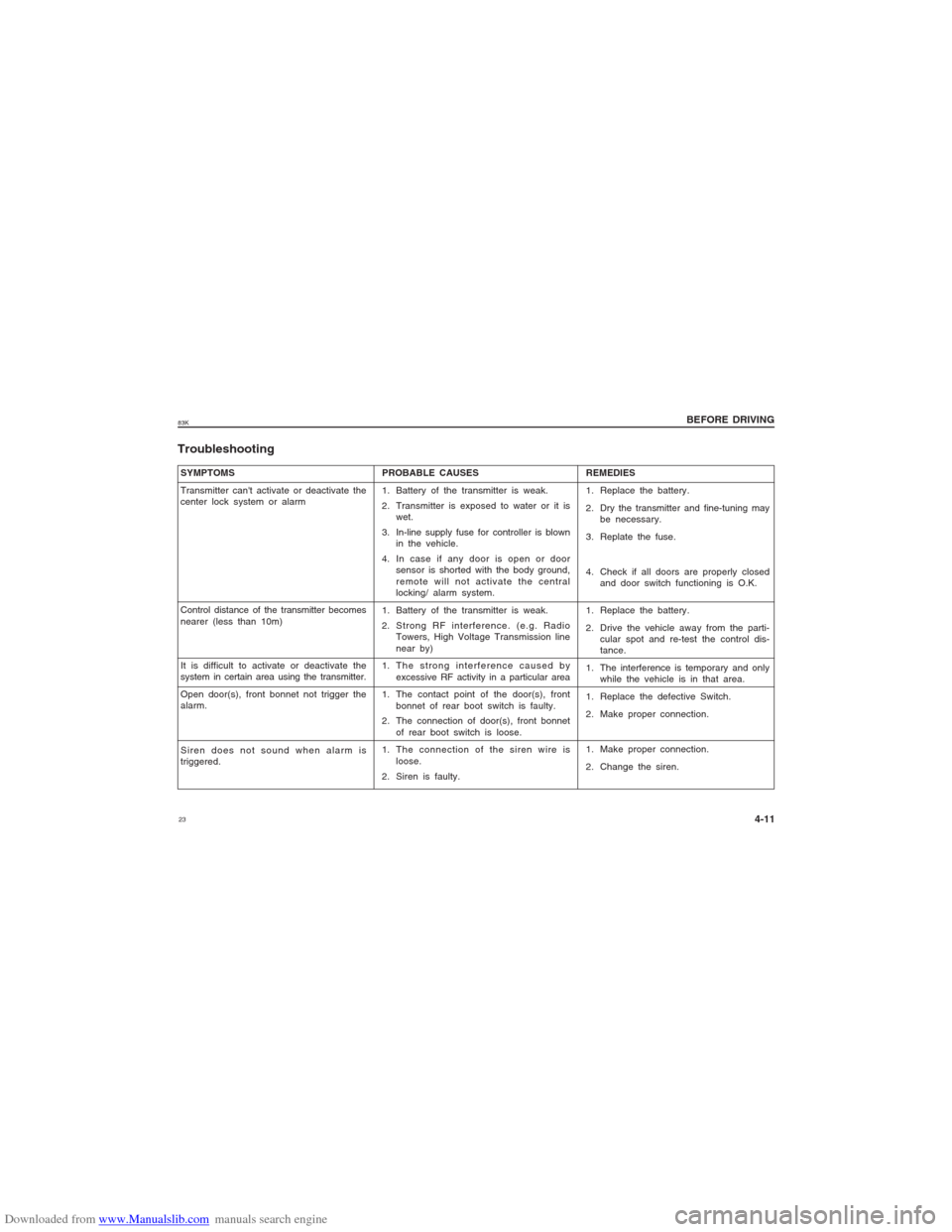
SYMPTOMS
Transmitter can't activate or deactivate the
center lock system or alarm
Control distance of the transmitter becomes
nearer (less than 10m)
It is difficult to activate or deactivate the
system in certain area using the transmitter.
Open door(s), front bonnet not trigger the
alarm.
Siren does not sound when alarm is
triggered.Troubleshooting
PROBABLE CAUSES
1. Battery of the transmitter is weak.
2. Transmitter is exposed to water or it is
wet.
3. In-line supply fuse for controller is blown
in the vehicle.
4. In case if any door is open or door
sensor is shorted with the body ground,
remote will not activate the central
locking/ alarm system.
1. Battery of the transmitter is weak.
2. Strong RF interference. (e.g. Radio
Towers, High Voltage Transmission line
near by)
1. The strong interference caused by
excessive RF activity in a particular area
1. The contact point of the door(s), front
bonnet of rear boot switch is faulty.
2. The connection of door(s), front bonnet
of rear boot switch is loose.
1. The connection of the siren wire is
loose.
2. Siren is faulty.REMEDIES
1. Replace the battery.
2. Dry the transmitter and fine-tuning may
be necessary.
3. Replate the fuse.
4. Check if all doors are properly closed
and door switch functioning is O.K.
1. Replace the battery.
2. Drive the vehicle away from the parti-
cular spot and re-test the control dis-
tance.
1. The interference is temporary and only
while the vehicle is in that area.
1. Replace the defective Switch.
2. Make proper connection.
1. Make proper connection.
2. Change the siren.
Page 45 of 136
Downloaded from www.Manualslib.com manuals search engine 4583K
BEFORE DRIVING
4-33
will flash along with all of the turn signal
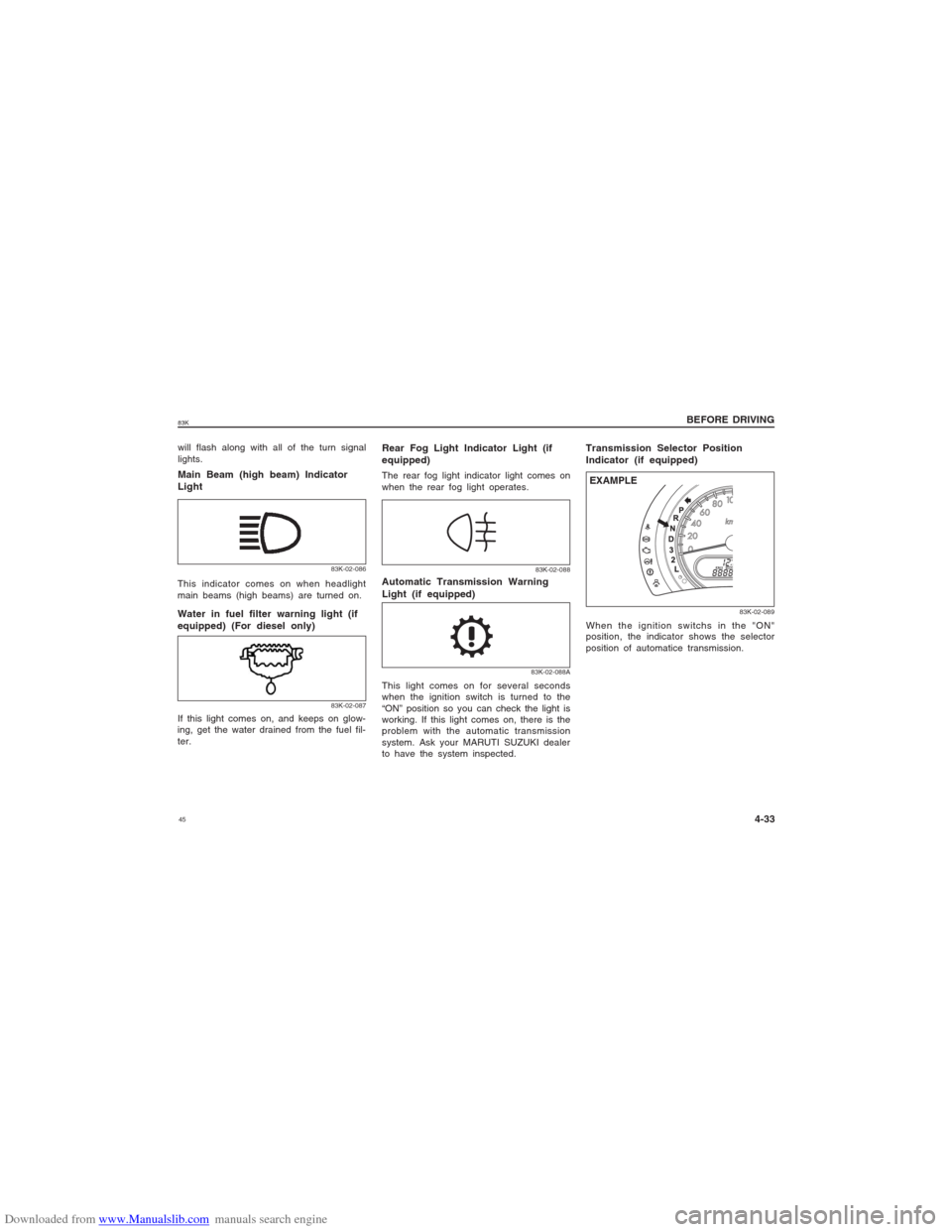
lights.Main Beam (high beam) Indicator
Light
83K-02-086
This indicator comes on when headlight
main beams (high beams) are turned on.
83K-02-087
Water in fuel filter warning light (if
equipped) (For diesel only)If this light comes on, and keeps on glow-
ing, get the water drained from the fuel fil-
ter.
83K-02-08883K-02-088A
Automatic Transmission Warning
Light (if equipped)This light comes on for several seconds
when the ignition switch is turned to the
“ON” position so you can check the light is
working. If this light comes on, there is the
problem with the automatic transmission
system. Ask your MARUTI SUZUKI dealer
to have the system inspected.
Transmission Selector Position
Indicator (if equipped)
83K-02-089
EXAMPLEWhen the ignition switchs in the "ON"
position, the indicator shows the selector
position of automatice transmission.
Rear Fog Light Indicator Light (if
equipped)The rear fog light indicator light comes on
when the rear fog light operates.
Page 55 of 136
Downloaded from www.Manualslib.com manuals search engine 5583KOPERATING YOUR VEHICLE
Exhaust Gas Warning........................................................................................................ 5-1
Daily Inspection Checklist................................................................................................ 5-1
Engine Oil Consumption................................................................................................... 5-2
Ignition Switch .................................................................................................................... 5-2
Parking Brake Lever.......................................................................................................... 5-4
Pedal..................................................................................................................................... 5-4
Starting the Engine............................................................................................................5-5
Using the Transmission.................................................................................................... 5-6
Braking .................................................................................................................................. 5-9
OPERATING YOUR VEHICLE
Page 59 of 136
Downloaded from www.Manualslib.com manuals search engine 5983K
OPERATING YOUR VEHICLE
5-4
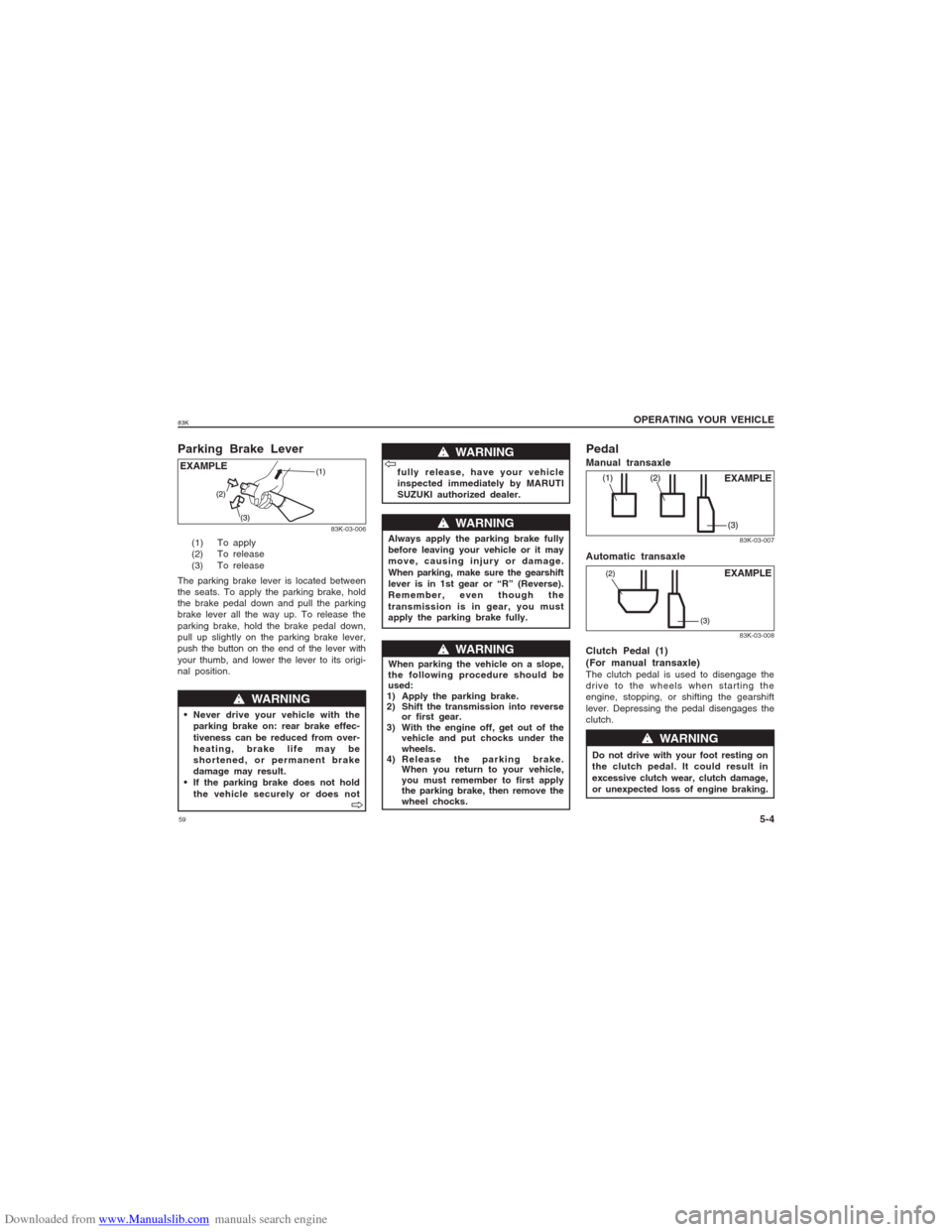
Parking Brake Lever
83K-03-006
w ww w
w WARNING
Never drive your vehicle with the
parking brake on: rear brake effec-
tiveness can be reduced from over-
heating, brake life may be
shortened, or permanent brake
damage may result.
If the parking brake does not hold
the vehicle securely or does not (1) To apply
(2) To release
(3) To release
The parking brake lever is located between
the seats. To apply the parking brake, hold
the brake pedal down and pull the parking
brake lever all the way up. To release the
parking brake, hold the brake pedal down,
pull up slightly on the parking brake lever,
push the button on the end of the lever with
your thumb, and lower the lever to its origi-
nal position.
V VV V
V
w ww w
w WARNING
V VV V
V
w ww w
w WARNING
Always apply the parking brake fully
before leaving your vehicle or it may
move, causing injury or damage.
When parking, make sure the gearshift
lever is in 1st gear or “R” (Reverse).
Remember, even though the
transmission is in gear, you must
apply the parking brake fully.fully release, have your vehicle
inspected immediately by MARUTI
SUZUKI authorized dealer.
w ww w
w WARNING
When parking the vehicle on a slope,
the following procedure should be
used:
1) Apply the parking brake.
2) Shift the transmission into reverse
or first gear.
3) With the engine off, get out of the
vehicle and put chocks under the
wheels.
4) Release the parking brake.
When you return to your vehicle,
you must remember to first apply
the parking brake, then remove the
wheel chocks.
EXAMPLE
PedalManual transaxle
83K-03-007
EXAMPLE
Automatic transaxle
83K-03-008
EXAMPLE
Clutch Pedal (1)
(For manual transaxle)The clutch pedal is used to disengage the
drive to the wheels when starting the
engine, stopping, or shifting the gearshift
lever. Depressing the pedal disengages the
clutch.
w ww w
w WARNING
Do not drive with your foot resting on
the clutch pedal. It could result in
excessive clutch wear, clutch damage,
or unexpected loss of engine braking.
Page 61 of 136
Downloaded from www.Manualslib.com manuals search engine 6183K
OPERATING YOUR VEHICLE
5-6
CAUTION
Stop turning the starter immediately
after the engine has started or the
starter system can be damaged.
Do not crank the engine for more
than 15 seconds at a time. If the
engine doesn’t start on the first try,
wait about 15 seconds before trying
again.
Warm engine
Crank the engine by turning the ignition key
to “START”. Release the key when the
engine starts.
CAUTION
When stopping the engine with tur-
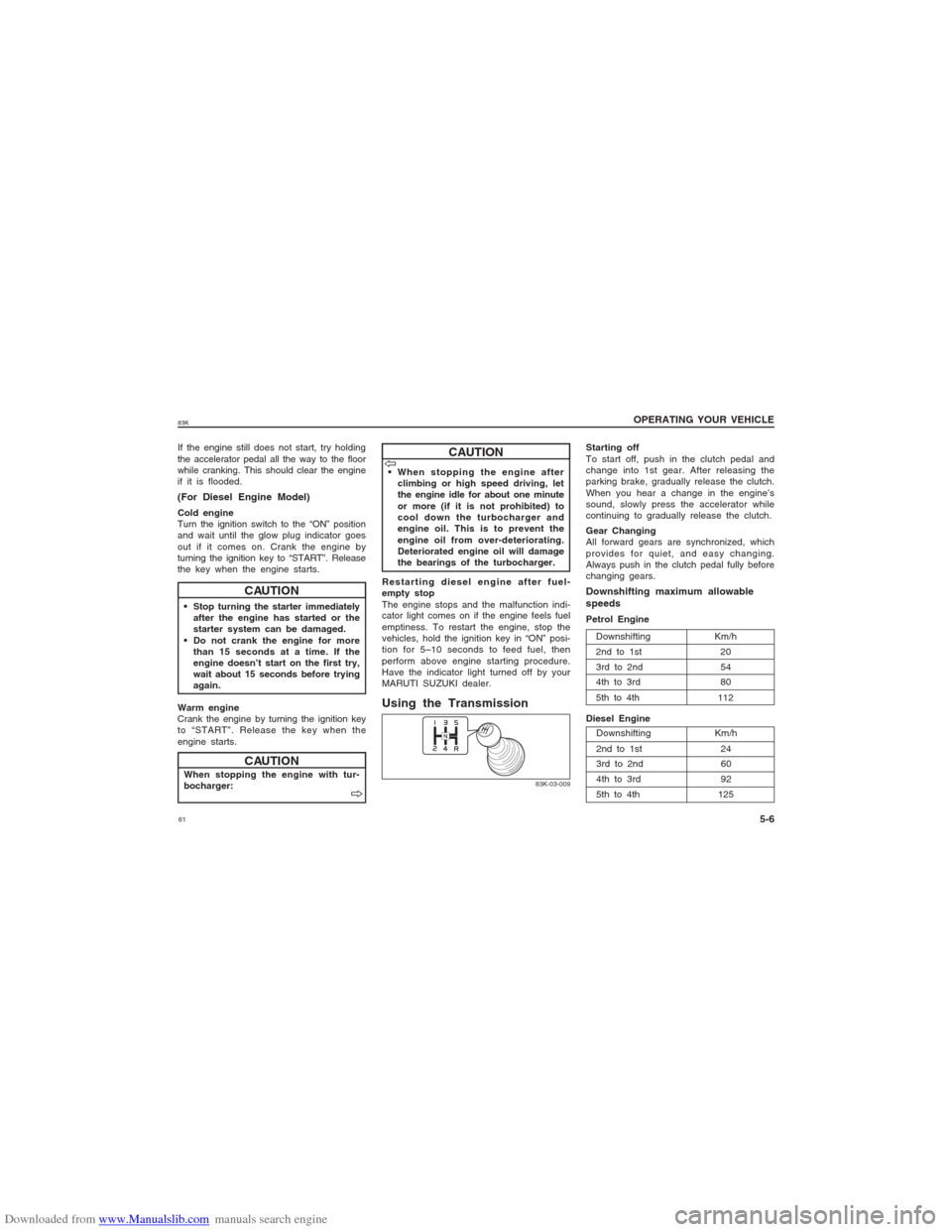
bocharger:Downshifting Km/h
2nd to 1st 20
3rd to 2nd 54
4th to 3rd 80
5th to 4th 112
83K-03-009
Using the Transmission
Starting off
To start off, push in the clutch pedal and
change into 1st gear. After releasing the
parking brake, gradually release the clutch.
When you hear a change in the engine’s
sound, slowly press the accelerator while
continuing to gradually release the clutch.
Gear Changing
All forward gears are synchronized, which
provides for quiet, and easy changing.
Always push in the clutch pedal fully before
changing gears.Downshifting maximum allowable
speedsPetrol Engine
Downshifting Km/h
2nd to 1st 24
3rd to 2nd 60
4th to 3rd 92
5th to 4th 125
If the engine still does not start, try holding
the accelerator pedal all the way to the floor
while cranking. This should clear the engine
if it is flooded.(For Diesel Engine Model)Cold engine
Turn the ignition switch to the “ON” position
and wait until the glow plug indicator goes
out if it comes on. Crank the engine by
turning the ignition key to “START”. Release
the key when the engine starts. When stopping the engine after
climbing or high speed driving, let
the engine idle for about one minute
or more (if it is not prohibited) to
cool down the turbocharger and
engine oil. This is to prevent the
engine oil from over-deteriorating.
Deteriorated engine oil will damage
the bearings of the turbocharger.
Restarting diesel engine after fuel-
empty stop
The engine stops and the malfunction indi-
cator light comes on if the engine feels fuel
emptiness. To restart the engine, stop the
vehicles, hold the ignition key in “ON” posi-
tion for 5–10 seconds to feed fuel, then
perform above engine starting procedure.
Have the indicator light turned off by your
MARUTI SUZUKI dealer.
Diesel Engine
V VV V
V
CAUTION
V VV V
V
Page 70 of 136
Downloaded from www.Manualslib.com manuals search engine 7083K
DRIVING TIPS
6-4
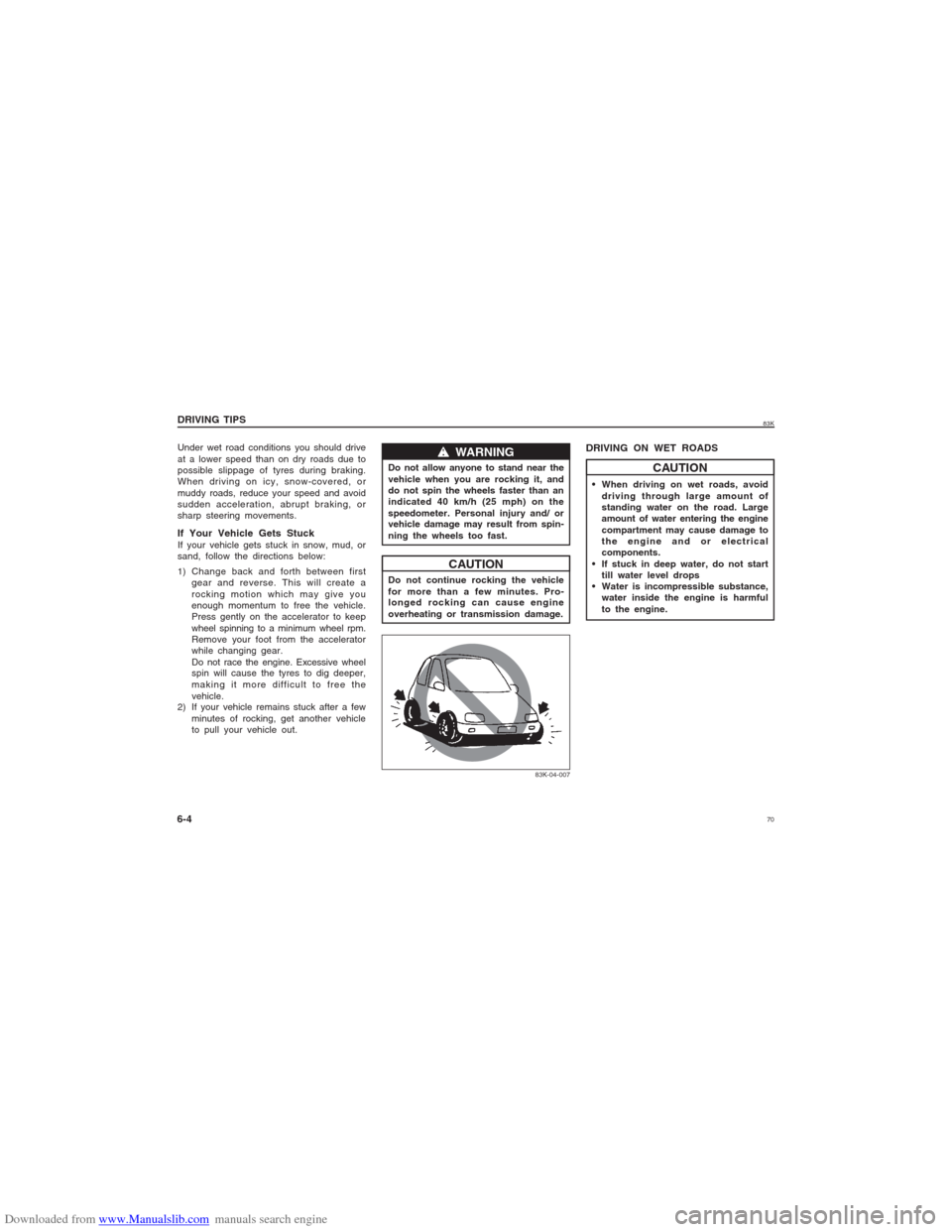
w ww w
w WARNING
Do not allow anyone to stand near the
vehicle when you are rocking it, and
do not spin the wheels faster than an
indicated 40 km/h (25 mph) on the
speedometer. Personal injury and/ or
vehicle damage may result from spin-
ning the wheels too fast.
CAUTION
83K-04-007
Do not continue rocking the vehicle
for more than a few minutes. Pro-
longed rocking can cause engine
overheating or transmission damage.
Under wet road conditions you should drive
at a lower speed than on dry roads due to
possible slippage of tyres during braking.
When driving on icy, snow-covered, or
muddy roads, reduce your speed and avoid
sudden acceleration, abrupt braking, or
sharp steering movements.If Your Vehicle Gets StuckIf your vehicle gets stuck in snow, mud, or
sand, follow the directions below:
1) Change back and forth between first
gear and reverse. This will create a
rocking motion which may give you
enough momentum to free the vehicle.
Press gently on the accelerator to keep
wheel spinning to a minimum wheel rpm.
Remove your foot from the accelerator
while changing gear.
Do not race the engine. Excessive wheel
spin will cause the tyres to dig deeper,
making it more difficult to free the
vehicle.
2) If your vehicle remains stuck after a few
minutes of rocking, get another vehicle
to pull your vehicle out.
CAUTION
When driving on wet roads, avoid
driving through large amount of
standing water on the road. Large
amount of water entering the engine
compartment may cause damage to
the engine and or electrical
components.
If stuck in deep water, do not start
till water level drops
Water is incompressible substance,
water inside the engine is harmful
to the engine.DRIVING ON WET ROADS
Page 87 of 136
Downloaded from www.Manualslib.com manuals search engine 8783KVEHICLE LOADING AND TOWING
VEHICLE LOADING AND TOWING
Vehicle LoadingYour vehicle was designed for specific weight
capacities. The weight capacities of your
vehicle are indicated by the Gross Vehicle
Weight Rating (GVWR) and the Gross Axle
Weight Rating (GAWR, front and rear). The
GVWR and GAWR (front and rear) are listed
in the “SPECIFICATIONS” section.
GVWR – Maximum permissible overall weight
of the fully loaded vehicle (including all the
occupants, accessories and cargo plus the
trailer nose weight if towing a trailer).
GAWR – (Front and Rear) Maximum per-
missible weight on an individual axle.
Actual weight of the loaded vehicle and actual
loads at the front and rear axles can only be
determined by weighing the vehicle. Compare
these weights to the GVWR and GAWR (front
and rear). If the gross vehicle weight or the
load on either axle exceeds these ratings, you
must remove enough weight to bring the load
down to the rated capacity.
w ww w
w WARNING
Always distribute cargo evenly. To
avoid personal injury or damage to your
vehicle, always secure cargo to prevent
it from shifting if the vehicle moves
suddenly. Place heavier objects on the
floor and as far forward in the cargo
area as possible. Never pile cargo
higher than the top of the seat backs.
w ww w
w WARNING
Never overload your vehicle. The gross
vehicle weight (sum of the weights of
the vehicle, all the occupants,
accessories, cargo plus trailer nose
V VV V
V
w ww w
w WARNING
V VV V
Vweight if towing a trailer) must never
exceed the Gross Vehicle Weight
Rating (GVWR). In addition, never
distribute a load so that the weight on
either the front or rear axle exceeds
the Gross Axle Weight Rating (GAWR).Trailer TowingYour MARUTI SUZUKI was originally
designed to carry people and a normal
amount of cargo, not to tow a trailer. MARUTI
SUZUKI does not recommend you use your
vehicle to tow a trailer if there is not any local
regulation about towing capacity permitted (for
example, registered or statutory towing
capacity). Towing a trailer can adversely affect
handling, durability, and fuel economy.When you tow your vehicle, follow the
instructions below to avoid accidents
and damage to your vehicle. In addition,
be sure to observe government and
local requirements regarding vehicle
lighting and trailer hitches or tow bars.
w ww w
w WARNING
Towing Your VehicleYour vehicle may be towed behind another
Vehicle (such as a motorhome), provided
you use the proper towing method specified
for your vehicle. The towing method you
must use depends on the specifications of
your vehicle: whether it is a manual
transmission vehicle or an automatic
transmission vehicle.
Use the towing instruction table to select the
proper towing method for your vehicle, and
carefully follow the corresponding
instructions. Be sure to use proper towing
equipment designed for recreational towing
and make sure that towing speed does not
exceed 90 km/h.
w ww w
w WARNING
A safety chain should always be used
when you tow your vehicle.
8-1
Page 90 of 136
Downloaded from www.Manualslib.com manuals search engine 9083K
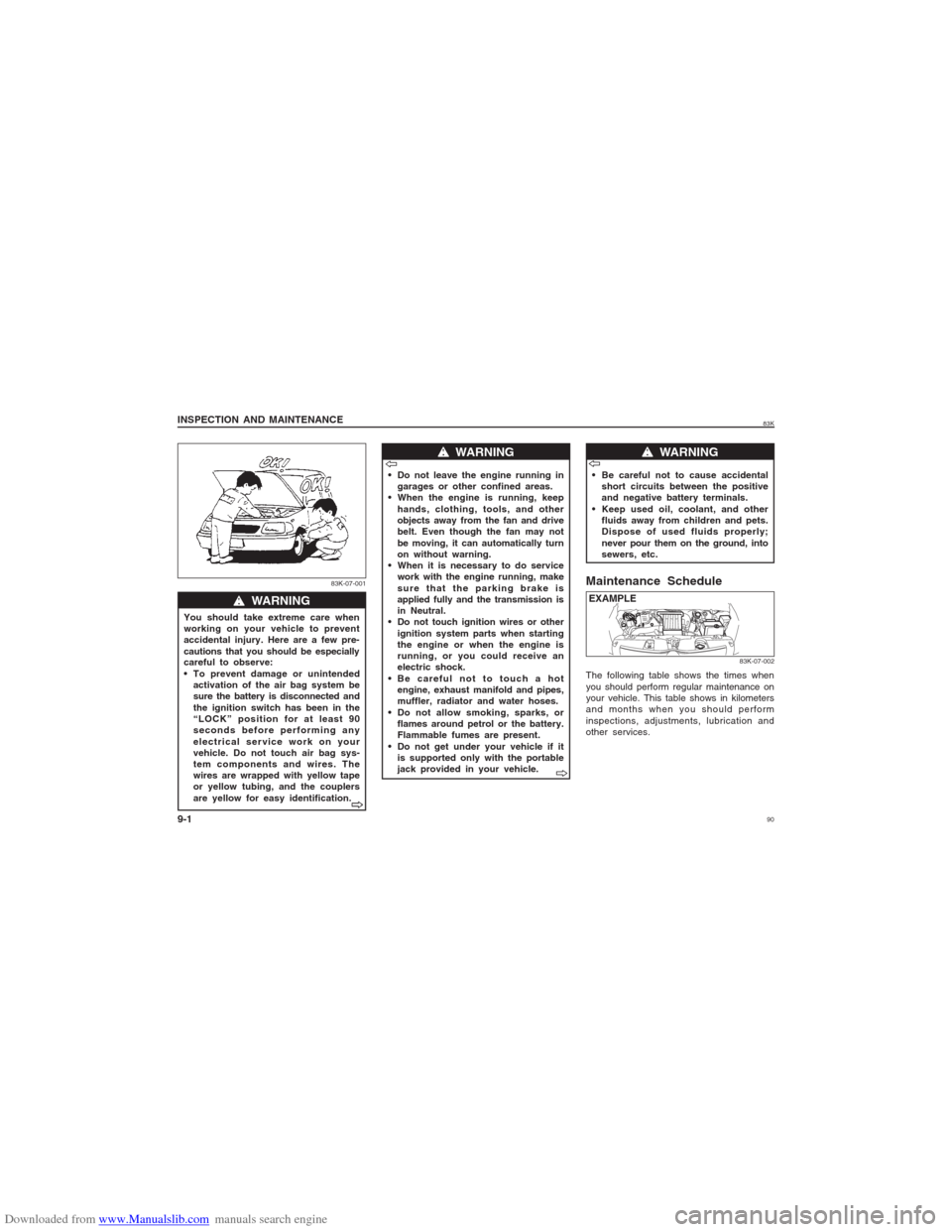
You should take extreme care when
working on your vehicle to prevent
accidental injury. Here are a few pre-
cautions that you should be especially
careful to observe:
To prevent damage or unintended
activation of the air bag system be
sure the battery is disconnected and
the ignition switch has been in the
“LOCK” position for at least 90
seconds before performing any
electrical service work on your
vehicle. Do not touch air bag sys-
tem components and wires. The
wires are wrapped with yellow tape
or yellow tubing, and the couplers
are yellow for easy identification.
w ww w
w WARNING
83K-07-001
w ww w
w WARNING
w ww w
w WARNING
INSPECTION AND MAINTENANCE
9-1
V VV V
V
Do not leave the engine running in
garages or other confined areas.
When the engine is running, keep
hands, clothing, tools, and other
objects away from the fan and drive
belt. Even though the fan may not
be moving, it can automatically turn
on without warning.
When it is necessary to do service
work with the engine running, make
sure that the parking brake is
applied fully and the transmission is
in Neutral.
Do not touch ignition wires or other
ignition system parts when starting
the engine or when the engine is
running, or you could receive an
electric shock.
Be careful not to touch a hot
engine, exhaust manifold and pipes,
muffler, radiator and water hoses.
Do not allow smoking, sparks, or
flames around petrol or the battery.
Flammable fumes are present.
Do not get under your vehicle if it
is supported only with the portable
jack provided in your vehicle.V VV V
V
V VV V
V
Be careful not to cause accidental
short circuits between the positive
and negative battery terminals.
Keep used oil, coolant, and other
fluids away from children and pets.
Dispose of used fluids properly;
never pour them on the ground, into
sewers, etc.V VV V
V
83K-07-002
Maintenance ScheduleThe following table shows the times when
you should perform regular maintenance on
your vehicle. This table shows in kilometers
and months when you should perform
inspections, adjustments, lubrication and
other services.EXAMPLE