MAIN SUZUKI SX4 2006 1.G Service Workshop Manual
[x] Cancel search | Manufacturer: SUZUKI, Model Year: 2006, Model line: SX4, Model: SUZUKI SX4 2006 1.GPages: 1556, PDF Size: 37.31 MB
Page 898 of 1556
Downloaded from www.Manualslib.com manuals search engine 6C-18 Power Assisted Steering System:
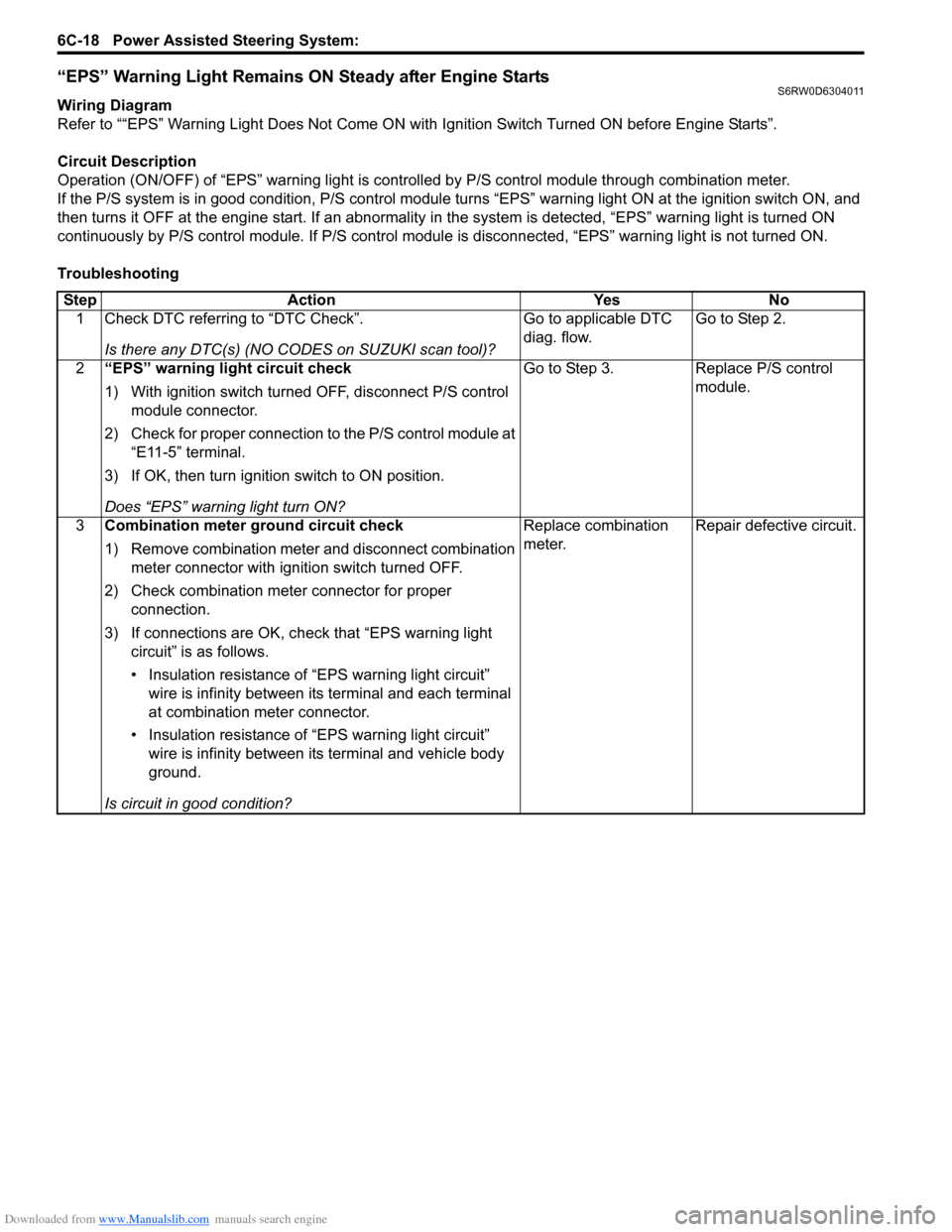
“EPS” Warning Light Remains ON Steady after Engine StartsS6RW0D6304011
Wiring Diagram
Refer to ““EPS” Warning Light Does Not Come ON with Ignition Switch Turned ON before Engine Starts”.
Circuit Description
Operation (ON/OFF) of “EPS” warning light is controlled by P/S control module through combination meter.
If the P/S system is in good condition, P/S control module turns “EPS” warning light ON at the ignition switch ON, and
then turns it OFF at the engine start. If an abnormality in the system is detected, “EPS” warning light is turned ON
continuously by P/S control module. If P/S control module is disconnected, “EPS” warning light is not turned ON.
Troubleshooting
Step Action Yes No
1 Check DTC referring to “DTC Check”.
Is there any DTC(s) (NO CODES on SUZUKI scan tool)?Go to applicable DTC
diag. flow.Go to Step 2.
2“EPS” warning light circuit check
1) With ignition switch turned OFF, disconnect P/S control
module connector.
2) Check for proper connection to the P/S control module at
“E11-5” terminal.
3) If OK, then turn ignition switch to ON position.
Does “EPS” warning light turn ON?Go to Step 3. Replace P/S control
module.
3Combination meter ground circuit check
1) Remove combination meter and disconnect combination
meter connector with ignition switch turned OFF.
2) Check combination meter connector for proper
connection.
3) If connections are OK, check that “EPS warning light
circuit” is as follows.
• Insulation resistance of “EPS warning light circuit”
wire is infinity between its terminal and each terminal
at combination meter connector.
• Insulation resistance of “EPS warning light circuit”
wire is infinity between its terminal and vehicle body
ground.
Is circuit in good condition?Replace combination
meter.Repair defective circuit.
Page 899 of 1556
Downloaded from www.Manualslib.com manuals search engine Power Assisted Steering System: 6C-19
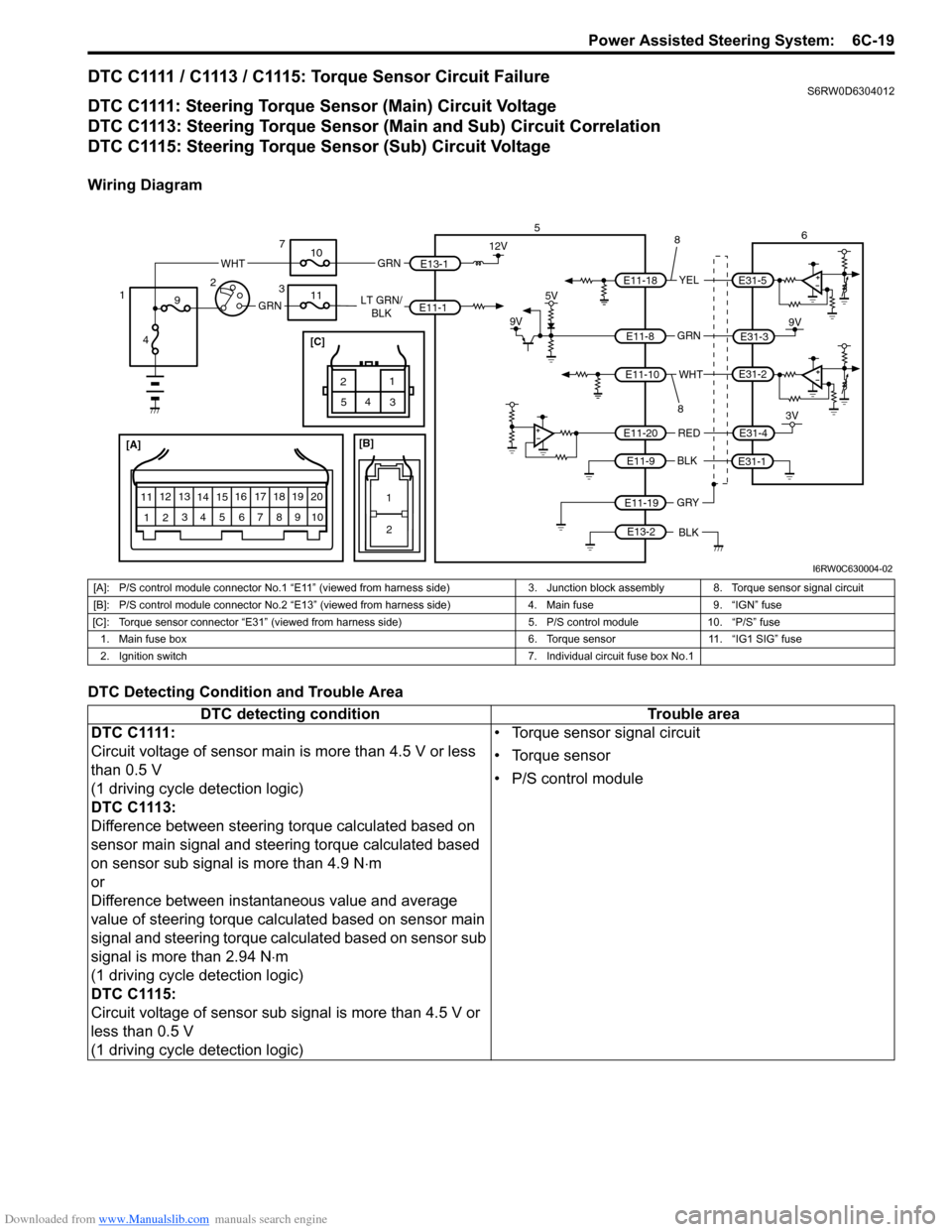
DTC C1111 / C1113 / C1115: Torque Sensor Circuit FailureS6RW0D6304012
DTC C1111: Steering Torque Sensor (Main) Circuit Voltage
DTC C1113: Steering Torque Sensor (Main and Sub) Circuit Correlation
DTC C1115: Steering Torque Sensor (Sub) Circuit Voltage
Wiring Diagram
DTC Detecting Condition and Trouble Area
[A]
123
453 21
4
5
67
8
9 11
10 12 13
141516
17 18 1920
1
2
[B]
[C]
LT GRN/
BLK
WHT GRN
BLK
E11-1
E11-10E11-8
E11-9
E11-19
E13-1 GRN
GRY
GRN
WHT
5
6
37
10
11
9
4 12
12V
E13-2BLK
9V
REDE11-20
5VYELE11-18E31-5
E31-2
E31-39V
E31-43V
E31-1
8
8
I6RW0C630004-02
[A]: P/S control module connector No.1 “E11” (viewed from harness side) 3. Junction block assembly 8. Torque sensor signal circuit
[B]: P/S control module connector No.2 “E13” (viewed from harness side) 4. Main fuse 9. “IGN” fuse
[C]: Torque sensor connector “E31” (viewed from harness side) 5. P/S control module 10. “P/S” fuse
1. Main fuse box 6. Torque sensor 11. “IG1 SIG” fuse
2. Ignition switch 7. Individual circuit fuse box No.1
DTC detecting condition Trouble area
DTC C1111:
Circuit voltage of sensor main is more than 4.5 V or less
than 0.5 V
(1 driving cycle detection logic)
DTC C1113:
Difference between steering torque calculated based on
sensor main signal and steering torque calculated based
on sensor sub signal is more than 4.9 N⋅m
or
Difference between instantaneous value and average
value of steering torque calculated based on sensor main
signal and steering torque calculated based on sensor sub
signal is more than 2.94 N⋅m
(1 driving cycle detection logic)
DTC C1115:
Circuit voltage of sensor sub signal is more than 4.5 V or
less than 0.5 V
(1 driving cycle detection logic)• Torque sensor signal circuit
• Torque sensor
• P/S control module
Page 901 of 1556
Downloaded from www.Manualslib.com manuals search engine Power Assisted Steering System: 6C-21
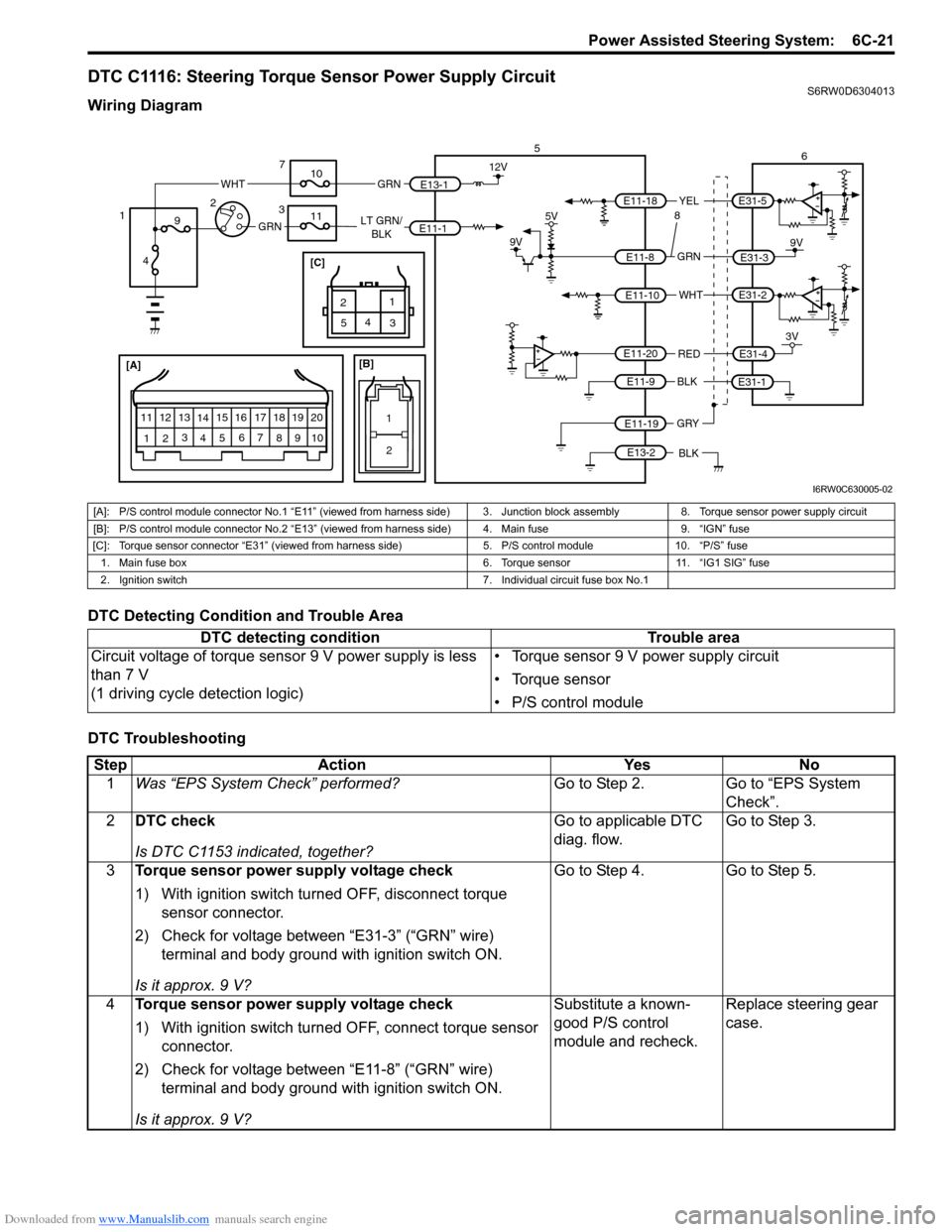
DTC C1116: Steering Torque Sensor Power Supply CircuitS6RW0D6304013
Wiring Diagram
DTC Detecting Condition and Trouble Area
DTC Troubleshooting
[A]
123
453 21
4
5
67
8
9 11
10 12 13
141516
17 18 1920
1
2
[B]
[C]
LT GRN/
BLK
WHT GRN
BLK
E11-1
E11-10E11-8
E11-9
E11-19
E13-1 GRN
GRY
GRN
WHT
5
6
37
10
11
9
4 12
12V
E13-2BLK
9V
REDE11-20
5VYELE11-18E31-5
E31-2
E31-39V
E31-43V
E31-1
8
I6RW0C630005-02
[A]: P/S control module connector No.1 “E11” (viewed from harness side) 3. Junction block assembly 8. Torque sensor power supply circuit
[B]: P/S control module connector No.2 “E13” (viewed from harness side) 4. Main fuse 9. “IGN” fuse
[C]: Torque sensor connector “E31” (viewed from harness side) 5. P/S control module 10. “P/S” fuse
1. Main fuse box 6. Torque sensor 11. “IG1 SIG” fuse
2. Ignition switch 7. Individual circuit fuse box No.1
DTC detecting condition Trouble area
Circuit voltage of torque sensor 9 V power supply is less
than 7 V
(1 driving cycle detection logic)• Torque sensor 9 V power supply circuit
• Torque sensor
• P/S control module
Step Action Yes No
1Was “EPS System Check” performed?Go to Step 2. Go to “EPS System
Check”.
2DTC check
Is DTC C1153 indicated, together?Go to applicable DTC
diag. flow.Go to Step 3.
3Torque sensor power supply voltage check
1) With ignition switch turned OFF, disconnect torque
sensor connector.
2) Check for voltage between “E31-3” (“GRN” wire)
terminal and body ground with ignition switch ON.
Is it approx. 9 V?Go to Step 4. Go to Step 5.
4Torque sensor power supply voltage check
1) With ignition switch turned OFF, connect torque sensor
connector.
2) Check for voltage between “E11-8” (“GRN” wire)
terminal and body ground with ignition switch ON.
Is it approx. 9 V?Substitute a known-
good P/S control
module and recheck.Replace steering gear
case.
Page 902 of 1556
Downloaded from www.Manualslib.com manuals search engine 6C-22 Power Assisted Steering System:
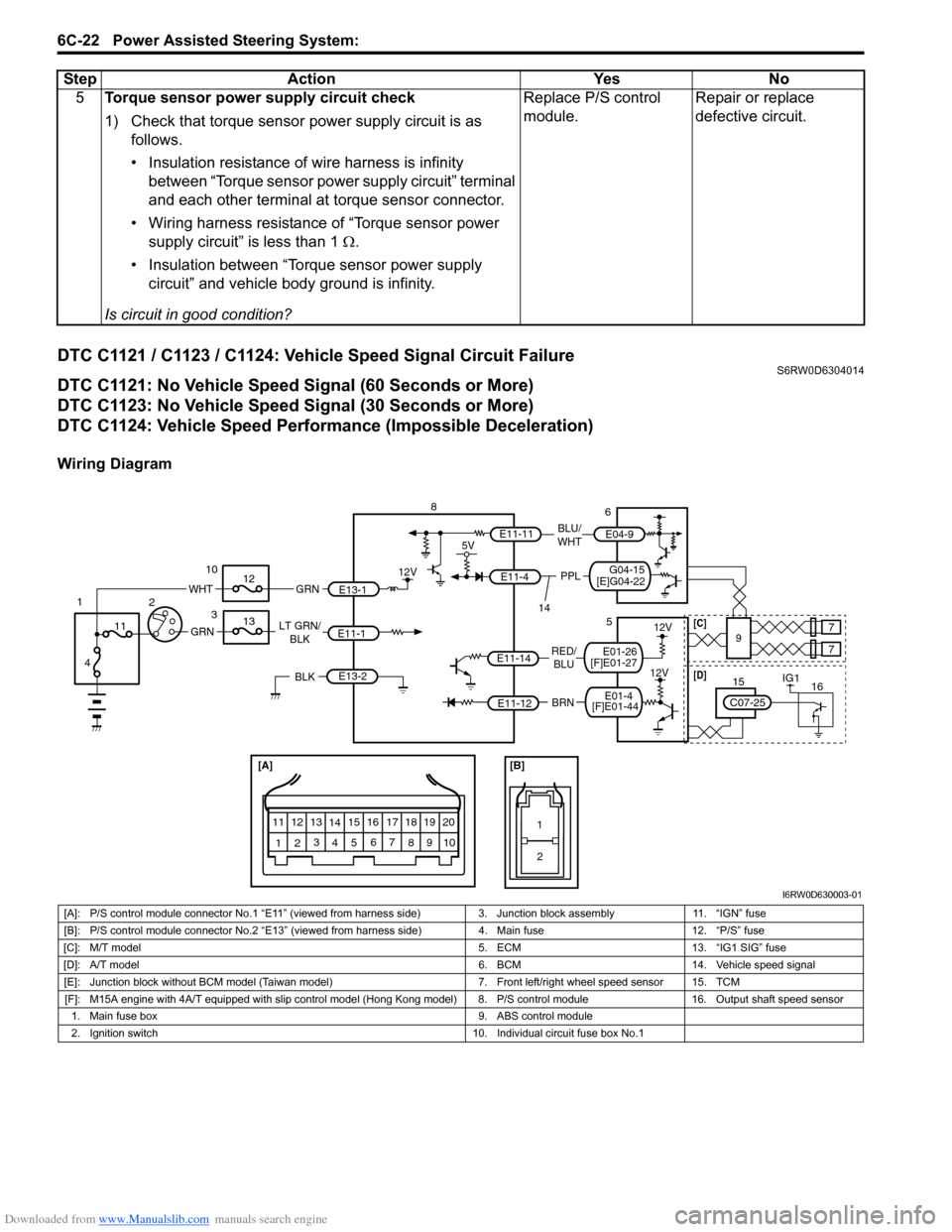
DTC C1121 / C1123 / C1124: Vehicle Speed Signal Circuit FailureS6RW0D6304014
DTC C1121: No Vehicle Speed Signal (60 Seconds or More)
DTC C1123: No Vehicle Speed Signal (30 Seconds or More)
DTC C1124: Vehicle Speed Performance (Impossible Deceleration)
Wiring Diagram5Torque sensor power supply circuit check
1) Check that torque sensor power supply circuit is as
follows.
• Insulation resistance of wire harness is infinity
between “Torque sensor power supply circuit” terminal
and each other terminal at torque sensor connector.
• Wiring harness resistance of “Torque sensor power
supply circuit” is less than 1 Ω.
• Insulation between “Torque sensor power supply
circuit” and vehicle body ground is infinity.
Is circuit in good condition?Replace P/S control
module.Repair or replace
defective circuit. Step Action Yes No
[A]
123
4567
8
9 11
10 12 13
141516
17 18 1920
1
2
[B]
BRN RED/
BLU LT GRN/
BLK
E11-1
E11-14
E11-12
E13-1 GRN
GRN
WHT
8
3 10
12
13
11
4 1
2
12V
E13-2BLK
12V
12V
9 5
77
E11-11
G04-15
[E]G04-22
5V
PPL
E11-4
BLU/
WHTE04-9
6
14
IG11615
C07-25
[D][C]
[F]E01-44E01-4
[F]E01-27E01-26
I6RW0D630003-01
[A]: P/S control module connector No.1 “E11” (viewed from harness side) 3. Junction block assembly 11. “IGN” fuse
[B]: P/S control module connector No.2 “E13” (viewed from harness side) 4. Main fuse 12. “P/S” fuse
[C]: M/T model 5. ECM 13. “IG1 SIG” fuse
[D]: A/T model 6. BCM 14. Vehicle speed signal
[E]: Junction block without BCM model (Taiwan model) 7. Front left/right wheel speed sensor 15. TCM
[F]: M15A engine with 4A/T equipped with slip control model (Hong Kong model) 8. P/S control module 16. Output shaft speed sensor
1. Main fuse box 9. ABS control module
2. Ignition switch 10. Individual circuit fuse box No.1
Page 904 of 1556
Downloaded from www.Manualslib.com manuals search engine 6C-24 Power Assisted Steering System:
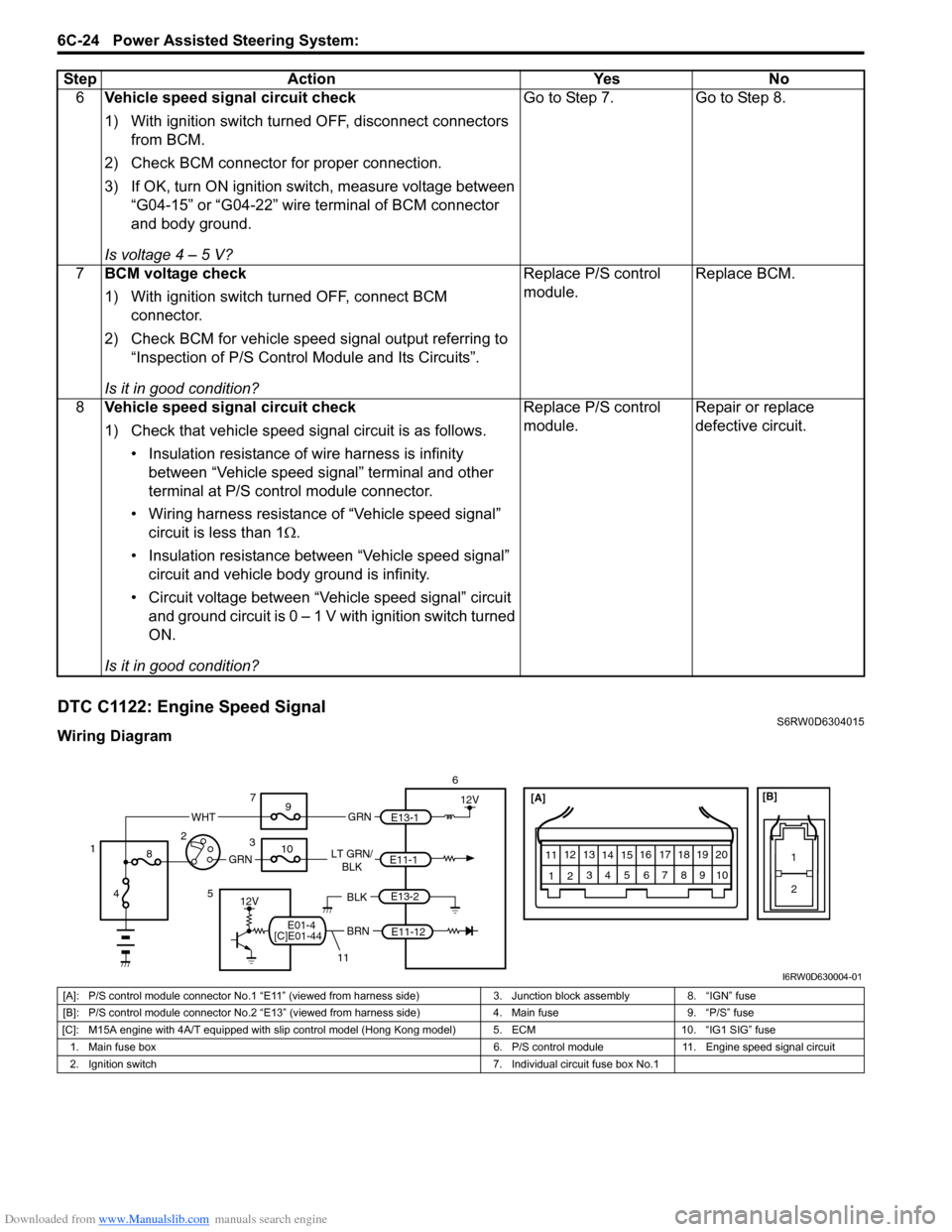
DTC C1122: Engine Speed SignalS6RW0D6304015
Wiring Diagram6Vehicle speed signal circuit check
1) With ignition switch turned OFF, disconnect connectors
from BCM.
2) Check BCM connector for proper connection.
3) If OK, turn ON ignition switch, measure voltage between
“G04-15” or “G04-22” wire terminal of BCM connector
and body ground.
Is voltage 4 – 5 V?Go to Step 7. Go to Step 8.
7BCM voltage check
1) With ignition switch turned OFF, connect BCM
connector.
2) Check BCM for vehicle speed signal output referring to
“Inspection of P/S Control Module and Its Circuits”.
Is it in good condition?Replace P/S control
module.Replace BCM.
8Vehicle speed signal circuit check
1) Check that vehicle speed signal circuit is as follows.
• Insulation resistance of wire harness is infinity
between “Vehicle speed signal” terminal and other
terminal at P/S control module connector.
• Wiring harness resistance of “Vehicle speed signal”
circuit is less than 1Ω.
• Insulation resistance between “Vehicle speed signal”
circuit and vehicle body ground is infinity.
• Circuit voltage between “Vehicle speed signal” circuit
and ground circuit is 0 – 1 V with ignition switch turned
ON.
Is it in good condition?Replace P/S control
module.Repair or replace
defective circuit. Step Action Yes No
[A]
123
4567
8
9 11
10 12 13
141516
17 18 1920
1
2
[B]
BRN LT GRN/
BLK
E11-1
E11-12
E13-1 GRN
GRN
WHT
6
37
9
10
8
4 12
12V
E13-2BLK12V5
11
[C]E01-44E01-4
I6RW0D630004-01
[A]: P/S control module connector No.1 “E11” (viewed from harness side) 3. Junction block assembly 8. “IGN” fuse
[B]: P/S control module connector No.2 “E13” (viewed from harness side) 4. Main fuse 9. “P/S” fuse
[C]: M15A engine with 4A/T equipped with slip control model (Hong Kong model) 5. ECM 10. “IG1 SIG” fuse
1. Main fuse box 6. P/S control module 11. Engine speed signal circuit
2. Ignition switch 7. Individual circuit fuse box No.1
Page 906 of 1556
Downloaded from www.Manualslib.com manuals search engine 6C-26 Power Assisted Steering System:
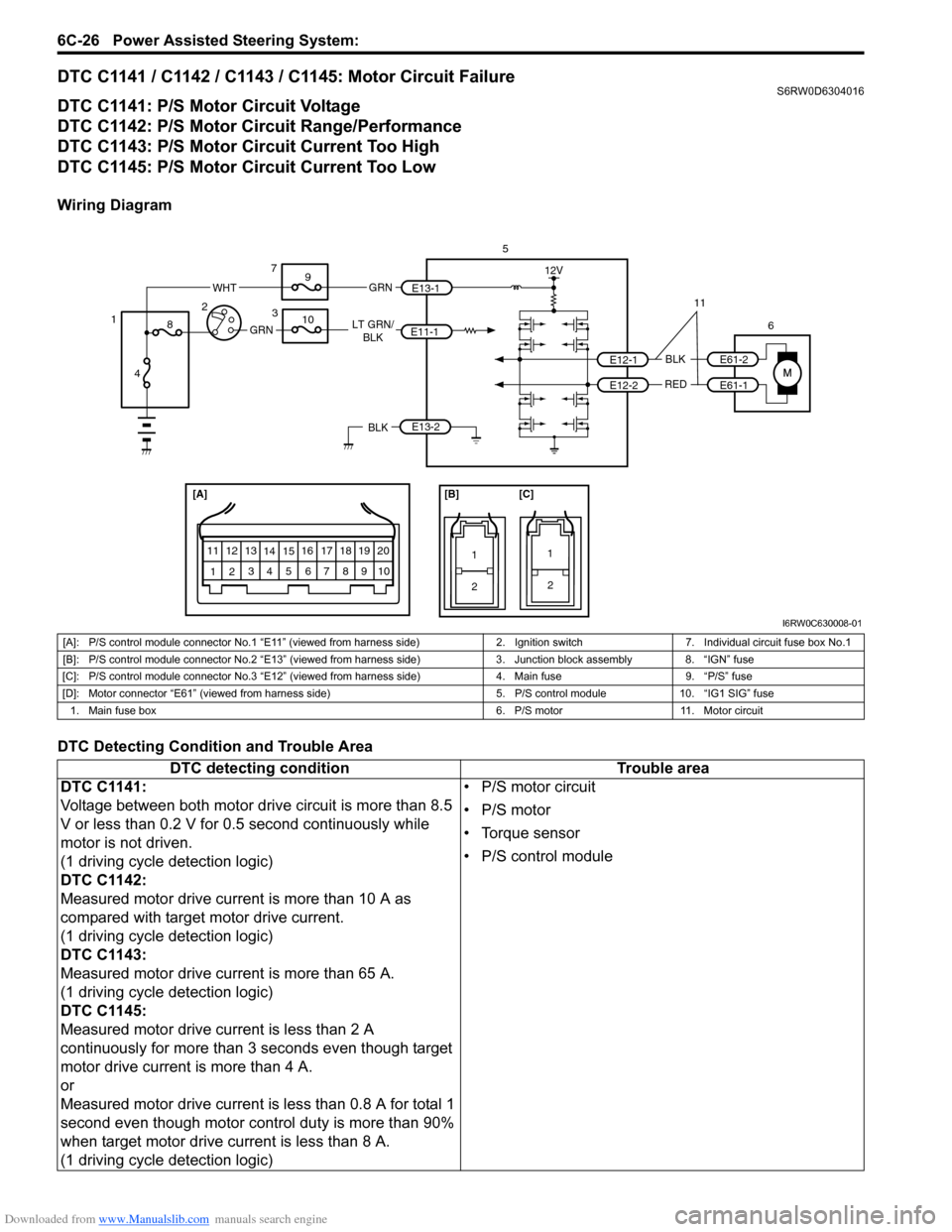
DTC C1141 / C1142 / C1143 / C1145: Motor Circuit FailureS6RW0D6304016
DTC C1141: P/S Motor Circuit Voltage
DTC C1142: P/S Motor Circuit Range/Performance
DTC C1143: P/S Motor Circuit Current Too High
DTC C1145: P/S Motor Circuit Current Too Low
Wiring Diagram
DTC Detecting Condition and Trouble Area
[A]
123
4567
8
9 11
10 12 13
141516
17 18 1920
1
2
[B]
1
2
[C]
LT GRN/
BLK
BLK
RED
E11-1
E12-1
E12-2 E13-1 GRNGRN
WHT
5
6 3 7
9
10
8
4 12
12V
E13-2BLK
E61-2
E61-1
11
I6RW0C630008-01
[A]: P/S control module connector No.1 “E11” (viewed from harness side) 2. Ignition switch 7. Individual circuit fuse box No.1
[B]: P/S control module connector No.2 “E13” (viewed from harness side) 3. Junction block assembly 8. “IGN” fuse
[C]: P/S control module connector No.3 “E12” (viewed from harness side) 4. Main fuse 9. “P/S” fuse
[D]: Motor connector “E61” (viewed from harness side) 5. P/S control module 10. “IG1 SIG” fuse
1. Main fuse box 6. P/S motor 11. Motor circuit
DTC detecting condition Trouble area
DTC C1141:
Voltage between both motor drive circuit is more than 8.5
V or less than 0.2 V for 0.5 second continuously while
motor is not driven.
(1 driving cycle detection logic)
DTC C1142:
Measured motor drive current is more than 10 A as
compared with target motor drive current.
(1 driving cycle detection logic)
DTC C1143:
Measured motor drive current is more than 65 A.
(1 driving cycle detection logic)
DTC C1145:
Measured motor drive current is less than 2 A
continuously for more than 3 seconds even though target
motor drive current is more than 4 A.
or
Measured motor drive current is less than 0.8 A for total 1
second even though motor control duty is more than 90%
when target motor drive current is less than 8 A.
(1 driving cycle detection logic)• P/S motor circuit
• P/S motor
• Torque sensor
• P/S control module
Page 907 of 1556
Downloaded from www.Manualslib.com manuals search engine Power Assisted Steering System: 6C-27
DTC Troubleshooting
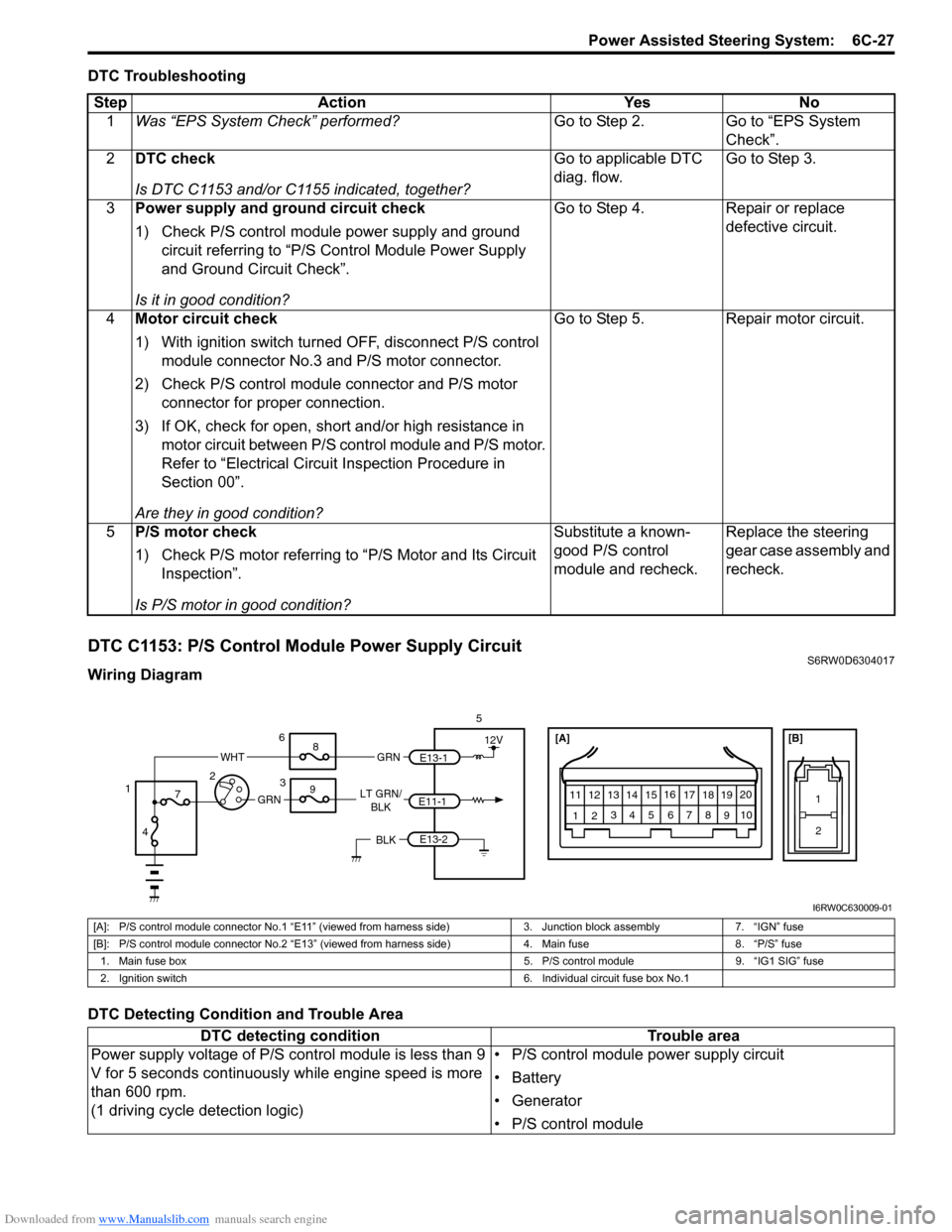
DTC C1153: P/S Control Module Power Supply CircuitS6RW0D6304017
Wiring Diagram
DTC Detecting Condition and Trouble AreaStep Action Yes No
1Was “EPS System Check” performed?Go to Step 2. Go to “EPS System
Check”.
2DTC check
Is DTC C1153 and/or C1155 indicated, together?Go to applicable DTC
diag. flow.Go to Step 3.
3Power supply and ground circuit check
1) Check P/S control module power supply and ground
circuit referring to “P/S Control Module Power Supply
and Ground Circuit Check”.
Is it in good condition?Go to Step 4. Repair or replace
defective circuit.
4Motor circuit check
1) With ignition switch turned OFF, disconnect P/S control
module connector No.3 and P/S motor connector.
2) Check P/S control module connector and P/S motor
connector for proper connection.
3) If OK, check for open, short and/or high resistance in
motor circuit between P/S control module and P/S motor.
Refer to “Electrical Circuit Inspection Procedure in
Section 00”.
Are they in good condition?Go to Step 5. Repair motor circuit.
5P/S motor check
1) Check P/S motor referring to “P/S Motor and Its Circuit
Inspection”.
Is P/S motor in good condition?Substitute a known-
good P/S control
module and recheck.Replace the steering
gear case assembly and
recheck.
[A]
123
4567
8
9 11
10 12 13
141516
17 18 1920
1
2
[B]
LT GRN/
BLKE11-1E13-1 GRNGRN
WHT
5
3 6
8
9
7
4 12
12V
E13-2BLK
I6RW0C630009-01
[A]: P/S control module connector No.1 “E11” (viewed from harness side) 3. Junction block assembly 7. “IGN” fuse
[B]: P/S control module connector No.2 “E13” (viewed from harness side) 4. Main fuse 8. “P/S” fuse
1. Main fuse box 5. P/S control module 9. “IG1 SIG” fuse
2. Ignition switch 6. Individual circuit fuse box No.1
DTC detecting condition Trouble area
Power supply voltage of P/S control module is less than 9
V for 5 seconds continuously while engine speed is more
than 600 rpm.
(1 driving cycle detection logic)• P/S control module power supply circuit
• Battery
• Generator
• P/S control module
Page 911 of 1556
Downloaded from www.Manualslib.com manuals search engine Power Assisted Steering System: 6C-31
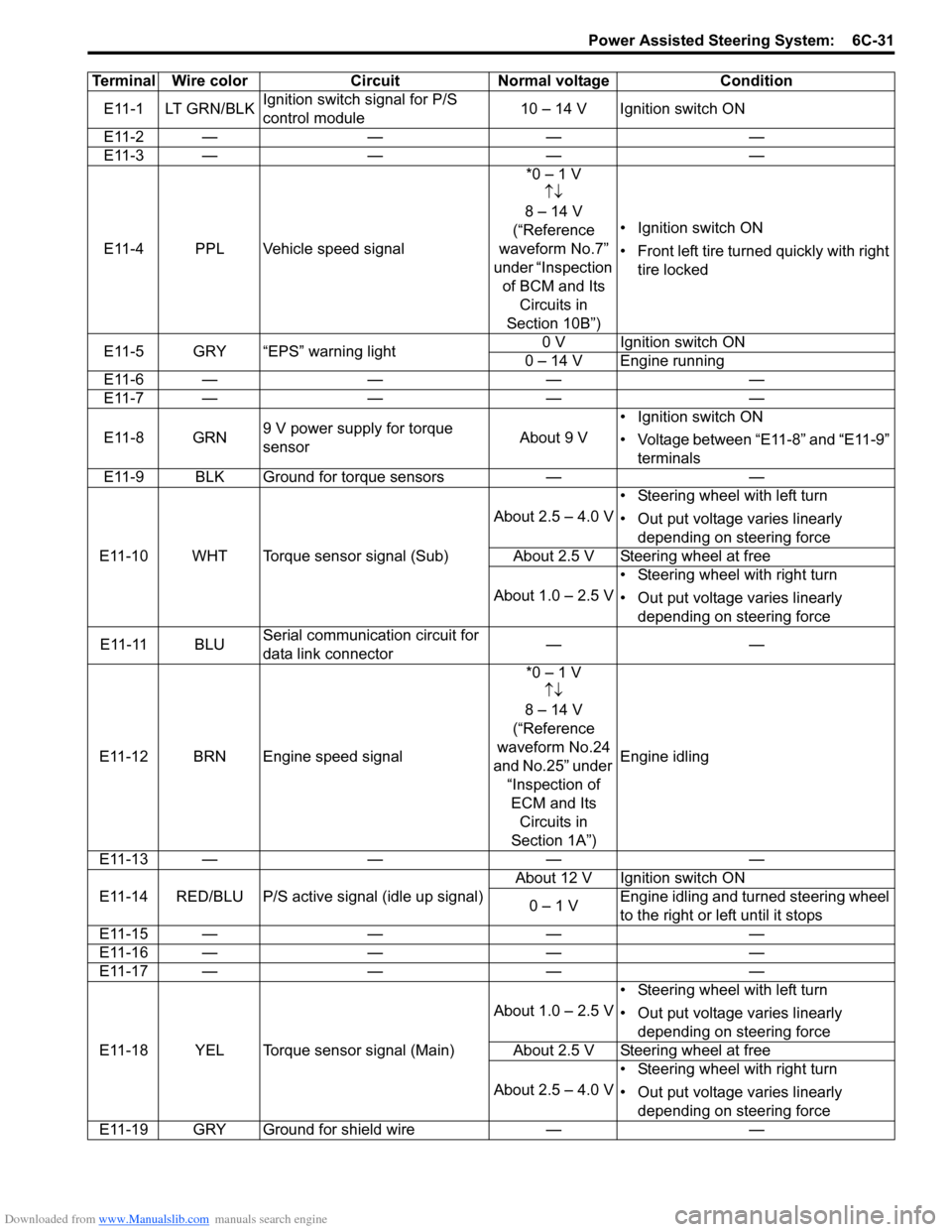
Terminal Wire color Circuit Normal voltage Condition
E11-1 LT GRN/BLKIgnition switch signal for P/S
control module10 – 14 V Ignition switch ON
E11-2 — — — —
E11-3 — — — —
E11-4 PPL Vehicle speed signal*0 – 1 V
↑↓
8 – 14 V
(“Reference
waveform No.7”
under “Inspection
of BCM and Its
Circuits in
Section 10B”)• Ignition switch ON
• Front left tire turned quickly with right
tire locked
E11-5 GRY “EPS” warning light0 V Ignition switch ON
0 – 14 V Engine running
E11-6 — — — —
E11-7 — — — —
E11-8 GRN9 V power supply for torque
sensorAbout 9 V• Ignition switch ON
• Voltage between “E11-8” and “E11-9”
terminals
E11-9 BLK Ground for torque sensors — —
E11-10 WHT Torque sensor signal (Sub)About 2.5 – 4.0 V• Steering wheel with left turn
• Out put voltage varies linearly
depending on steering force
About 2.5 V Steering wheel at free
About 1.0 – 2.5 V• Steering wheel with right turn
• Out put voltage varies linearly
depending on steering force
E11-11 BLUSerial communication circuit for
data link connector——
E11-12 BRN Engine speed signal*0 – 1 V
↑↓
8 – 14 V
(“Reference
waveform No.24
and No.25” under
“Inspection of
ECM and Its
Circuits in
Section 1A”)Engine idling
E11-13 — — — —
E11-14 RED/BLU P/S active signal (idle up signal)About 12 V Ignition switch ON
0 – 1 VEngine idling and turned steering wheel
to the right or left until it stops
E11-15 — — — —
E11-16 — — — —
E11-17 — — — —
E11-18 YEL Torque sensor signal (Main)About 1.0 – 2.5 V• Steering wheel with left turn
• Out put voltage varies linearly
depending on steering force
About 2.5 V Steering wheel at free
About 2.5 – 4.0 V• Steering wheel with right turn
• Out put voltage varies linearly
depending on steering force
E11-19 GRY Ground for shield wire — —
Page 912 of 1556
Downloaded from www.Manualslib.com manuals search engine 6C-32 Power Assisted Steering System:
NOTE
*: The voltage of this circuit may not be checked by voltmeter. If so, use oscilloscope.
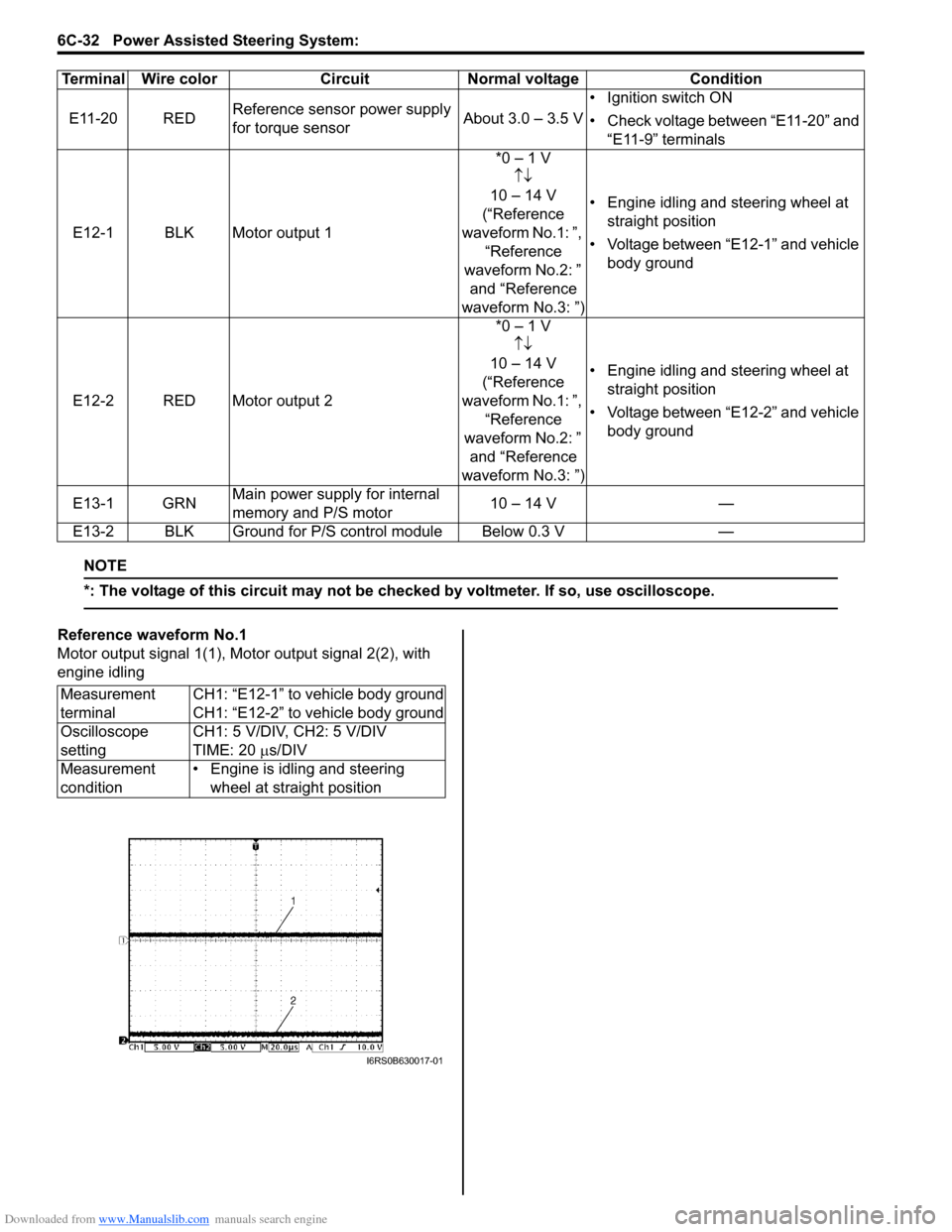
Reference waveform No.1
Motor output signal 1(1), Motor output signal 2(2), with
engine idlingE11-20 REDReference sensor power supply
for torque sensorAbout 3.0 – 3.5 V• Ignition switch ON
• Check voltage between “E11-20” and
“E11-9” terminals
E12-1 BLK Motor output 1*0 – 1 V
↑↓
10 – 14 V
(“Reference
waveform No.1: ”,
“Reference
waveform No.2: ”
and “Reference
waveform No.3: ”)• Engine idling and steering wheel at
straight position
• Voltage between “E12-1” and vehicle
body ground
E12-2 RED Motor output 2*0 – 1 V
↑↓
10 – 14 V
(“Reference
waveform No.1: ”,
“Reference
waveform No.2: ”
and “Reference
waveform No.3: ”)• Engine idling and steering wheel at
straight position
• Voltage between “E12-2” and vehicle
body ground
E13-1 GRNMain power supply for internal
memory and P/S motor10 – 14 V —
E13-2 BLK Ground for P/S control module Below 0.3 V — Terminal Wire color Circuit Normal voltage Condition
Measurement
terminalCH1: “E12-1” to vehicle body ground
CH1: “E12-2” to vehicle body ground
Oscilloscope
settingCH1: 5 V/DIV, CH2: 5 V/DIV
TIME: 20 µs/DIV
Measurement
condition• Engine is idling and steering
wheel at straight position
I6RS0B630017-01
Page 921 of 1556
Downloaded from www.Manualslib.com manuals search engine Power Assisted Steering System: 6C-41
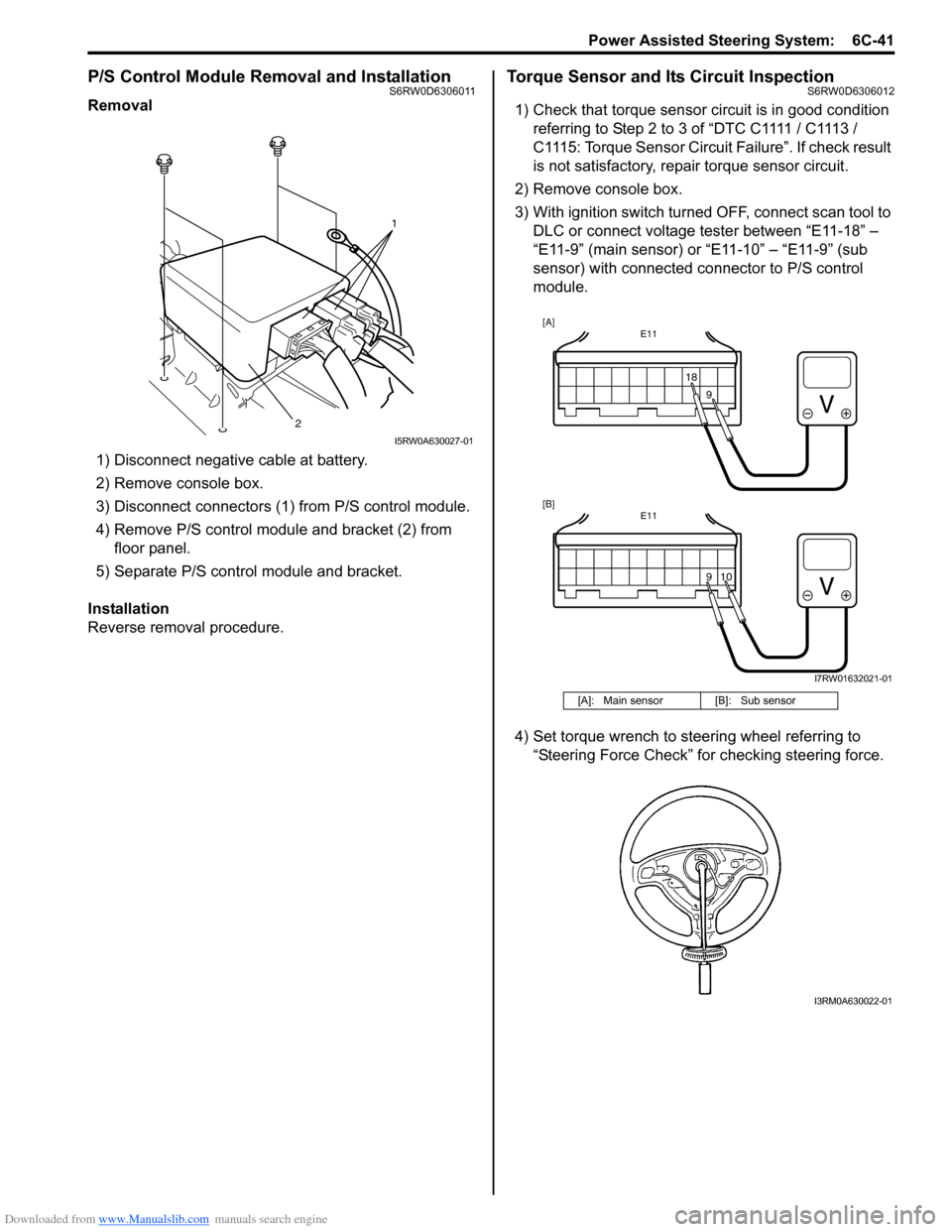
P/S Control Module Removal and InstallationS6RW0D6306011
Removal
1) Disconnect negative cable at battery.
2) Remove console box.
3) Disconnect connectors (1) from P/S control module.
4) Remove P/S control module and bracket (2) from
floor panel.
5) Separate P/S control module and bracket.
Installation
Reverse removal procedure.
Torque Sensor and Its Circuit InspectionS6RW0D6306012
1) Check that torque sensor circuit is in good condition
referring to Step 2 to 3 of “DTC C1111 / C1113 /
C1115: Torque Sensor Circuit Failure”. If check result
is not satisfactory, repair torque sensor circuit.
2) Remove console box.
3) With ignition switch turned OFF, connect scan tool to
DLC or connect voltage tester between “E11-18” –
“E11-9” (main sensor) or “E11-10” – “E11-9” (sub
sensor) with connected connector to P/S control
module.
4) Set torque wrench to steering wheel referring to
“Steering Force Check” for checking steering force.
1
2
I5RW0A630027-01
[A]: Main sensor [B]: Sub sensor
E11
1818
E11
10
[A]
[B]
9 9
I7RW01632021-01
I3RM0A630022-01