300 SUZUKI SX4 2006 1.G Service User Guide
[x] Cancel search | Manufacturer: SUZUKI, Model Year: 2006, Model line: SX4, Model: SUZUKI SX4 2006 1.GPages: 1556, PDF Size: 37.31 MB
Page 160 of 1556
Downloaded from www.Manualslib.com manuals search engine 1A-110 Engine General Information and Diagnosis:
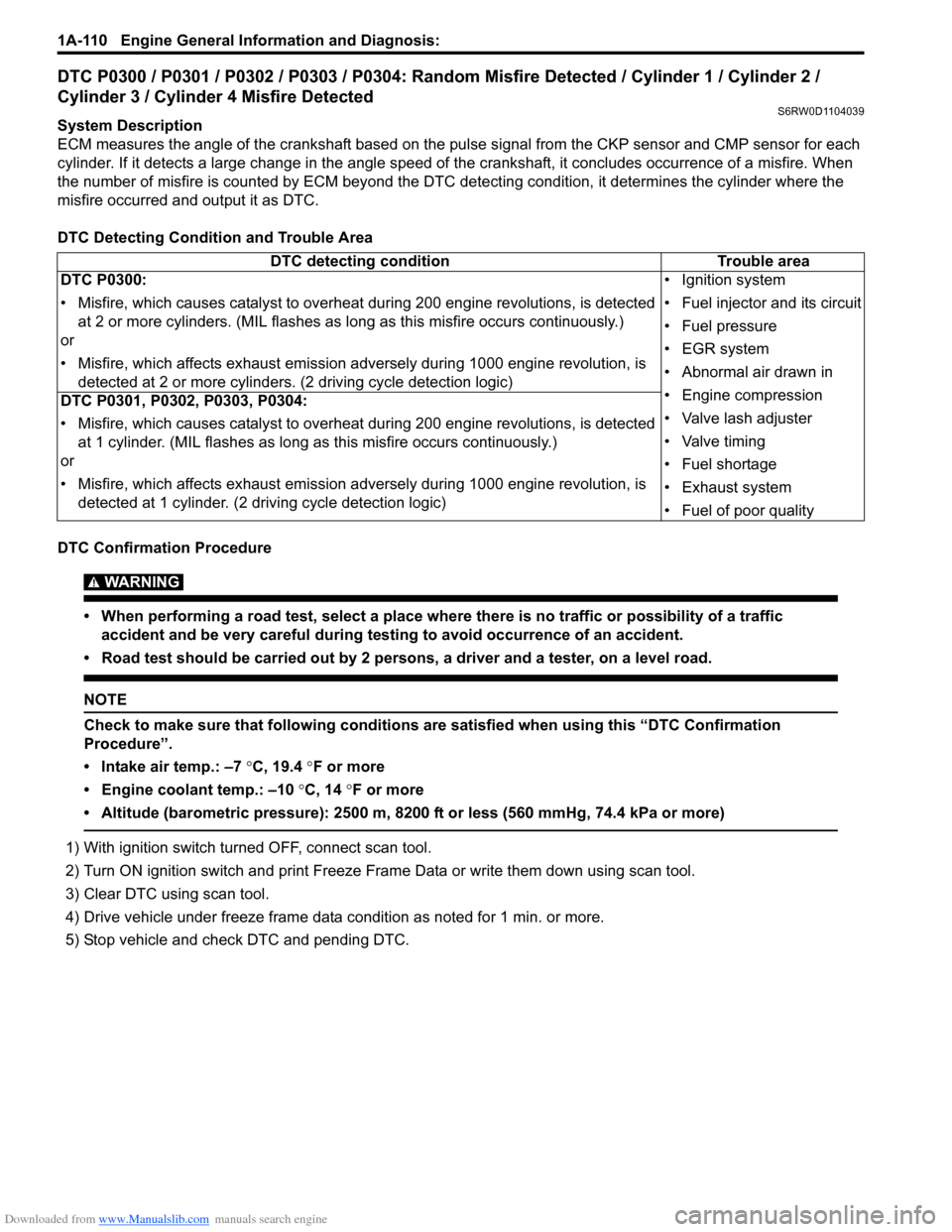
DTC P0300 / P0301 / P0302 / P0303 / P0304: Random Misfire Detected / Cylinder 1 / Cylinder 2 /
Cylinder 3 / Cylinder 4 Misfire Detected
S6RW0D1104039
System Description
ECM measures the angle of the crankshaft based on the pulse signal from the CKP sensor and CMP sensor for each
cylinder. If it detects a large change in the angle speed of the crankshaft, it concludes occurrence of a misfire. When
the number of misfire is counted by ECM beyond the DTC detecting condition, it determines the cylinder where the
misfire occurred and output it as DTC.
DTC Detecting Condition and Trouble Area
DTC Confirmation Procedure
WARNING!
• When performing a road test, select a place where there is no traffic or possibility of a traffic
accident and be very careful during testing to avoid occurrence of an accident.
• Road test should be carried out by 2 persons, a driver and a tester, on a level road.
NOTE
Check to make sure that following conditions are satisfied when using this “DTC Confirmation
Procedure”.
• Intake air temp.: –7 °C, 19.4 °F or more
• Engine coolant temp.: –10 °C, 14 °F or more
• Altitude (barometric pressure): 2500 m, 8200 ft or less (560 mmHg, 74.4 kPa or more)
1) With ignition switch turned OFF, connect scan tool.
2) Turn ON ignition switch and print Freeze Frame Data or write them down using scan tool.
3) Clear DTC using scan tool.
4) Drive vehicle under freeze frame data condition as noted for 1 min. or more.
5) Stop vehicle and check DTC and pending DTC.DTC detecting condition Trouble area
DTC P0300:
• Misfire, which causes catalyst to overheat during 200 engine revolutions, is detected
at 2 or more cylinders. (MIL flashes as long as this misfire occurs continuously.)
or
• Misfire, which affects exhaust emission adversely during 1000 engine revolution, is
detected at 2 or more cylinders. (2 driving cycle detection logic)• Ignition system
• Fuel injector and its circuit
• Fuel pressure
• EGR system
• Abnormal air drawn in
• Engine compression
• Valve lash adjuster
• Valve timing
• Fuel shortage
• Exhaust system
• Fuel of poor quality DTC P0301, P0302, P0303, P0304:
• Misfire, which causes catalyst to overheat during 200 engine revolutions, is detected
at 1 cylinder. (MIL flashes as long as this misfire occurs continuously.)
or
• Misfire, which affects exhaust emission adversely during 1000 engine revolution, is
detected at 1 cylinder. (2 driving cycle detection logic)
Page 170 of 1556
Downloaded from www.Manualslib.com manuals search engine 1A-120 Engine General Information and Diagnosis:
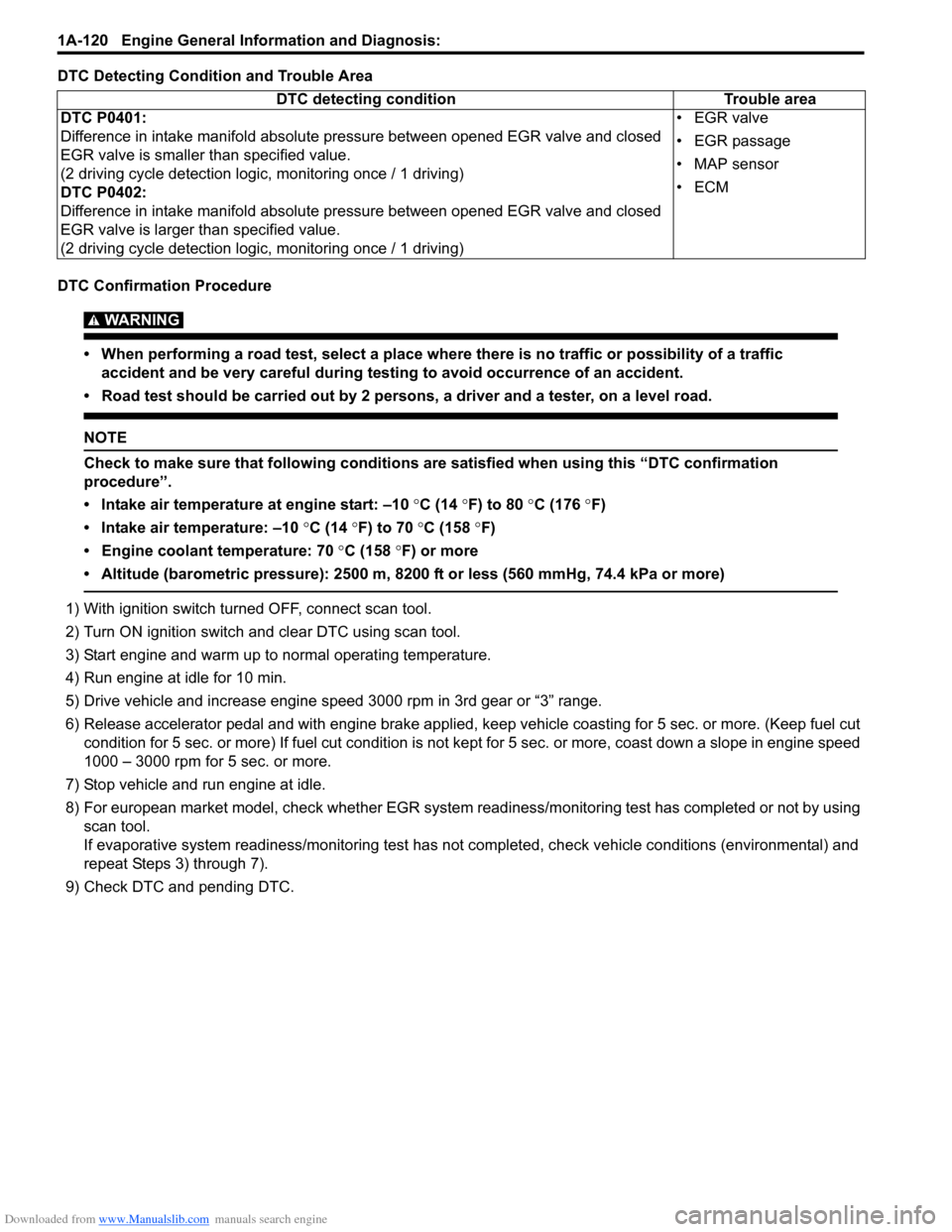
DTC Detecting Condition and Trouble Area
DTC Confirmation Procedure
WARNING!
• When performing a road test, select a place where there is no traffic or possibility of a traffic
accident and be very careful during testing to avoid occurrence of an accident.
• Road test should be carried out by 2 persons, a driver and a tester, on a level road.
NOTE
Check to make sure that following conditions are satisfied when using this “DTC confirmation
procedure”.
• Intake air temperature at engine start: –10 °C (14 °F) to 80 °C (176 °F)
• Intake air temperature: –10 °C (14 °F) to 70 °C (158 °F)
• Engine coolant temperature: 70 °C (158 °F) or more
• Altitude (barometric pressure): 2500 m, 8200 ft or less (560 mmHg, 74.4 kPa or more)
1) With ignition switch turned OFF, connect scan tool.
2) Turn ON ignition switch and clear DTC using scan tool.
3) Start engine and warm up to normal operating temperature.
4) Run engine at idle for 10 min.
5) Drive vehicle and increase engine speed 3000 rpm in 3rd gear or “3” range.
6) Release accelerator pedal and with engine brake applied, keep vehicle coasting for 5 sec. or more. (Keep fuel cut
condition for 5 sec. or more) If fuel cut condition is not kept for 5 sec. or more, coast down a slope in engine speed
1000 – 3000 rpm for 5 sec. or more.
7) Stop vehicle and run engine at idle.
8) For european market model, check whether EGR system readiness/monitoring test has completed or not by using
scan tool.
If evaporative system readiness/monitoring test has not completed, check vehicle conditions (environmental) and
repeat Steps 3) through 7).
9) Check DTC and pending DTC.DTC detecting condition Trouble area
DTC P0401:
Difference in intake manifold absolute pressure between opened EGR valve and closed
EGR valve is smaller than specified value.
(2 driving cycle detection logic, monitoring once / 1 driving)
DTC P0402:
Difference in intake manifold absolute pressure between opened EGR valve and closed
EGR valve is larger than specified value.
(2 driving cycle detection logic, monitoring once / 1 driving)• EGR valve
• EGR passage
• MAP sensor
•ECM
Page 228 of 1556
Downloaded from www.Manualslib.com manuals search engine 1A-178 Engine General Information and Diagnosis:
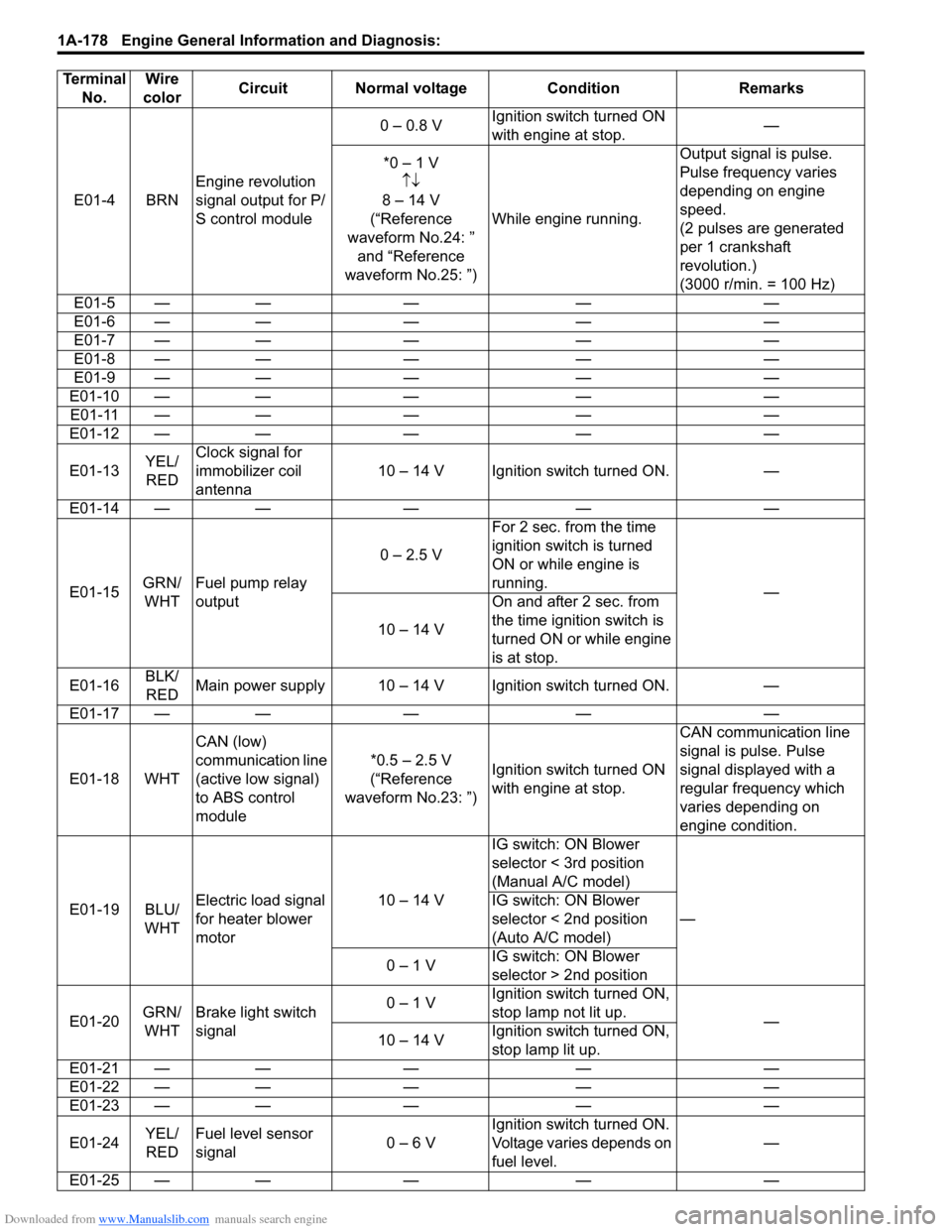
E01-4 BRNEngine revolution
signal output for P/
S control module0 – 0.8 VIgnition switch turned ON
with engine at stop.—
*0 – 1 V
↑↓
8 – 14 V
(“Reference
waveform No.24: ”
and “Reference
waveform No.25: ”)While engine running.Output signal is pulse.
Pulse frequency varies
depending on engine
speed.
(2 pulses are generated
per 1 crankshaft
revolution.)
(3000 r/min. = 100 Hz)
E01-5 — — — — —
E01-6 — — — — —
E01-7 — — — — —
E01-8 — — — — —
E01-9 — — — — —
E01-10 — — — — —
E01-11 — — — — —
E01-12 — — — — —
E01-13YEL/
REDClock signal for
immobilizer coil
antenna10 – 14 V Ignition switch turned ON. —
E01-14 — — — — —
E01-15GRN/
WHTFuel pump relay
output0 – 2.5 VFor 2 sec. from the time
ignition switch is turned
ON or while engine is
running.
—
10 – 14 VOn and after 2 sec. from
the time ignition switch is
turned ON or while engine
is at stop.
E01-16BLK/
REDMain power supply 10 – 14 V Ignition switch turned ON. —
E01-17 — — — — —
E01-18 WHTCAN (low)
communication line
(active low signal)
to ABS control
module*0.5 – 2.5 V
(“Reference
waveform No.23: ”)Ignition switch turned ON
with engine at stop.CAN communication line
signal is pulse. Pulse
signal displayed with a
regular frequency which
varies depending on
engine condition.
E01-19 BLU/
WHTElectric load signal
for heater blower
motor10 – 14 VIG switch: ON Blower
selector < 3rd position
(Manual A/C model)
— IG switch: ON Blower
selector < 2nd position
(Auto A/C model)
0 – 1 VIG switch: ON Blower
selector > 2nd position
E01-20GRN/
WHTBrake light switch
signal0 – 1 VIgnition switch turned ON,
stop lamp not lit up.
—
10 – 14 VIgnition switch turned ON,
stop lamp lit up.
E01-21 — — — — —
E01-22 — — — — —
E01-23 — — — — —
E01-24YEL/
REDFuel level sensor
signal0 – 6 VIgnition switch turned ON.
Voltage varies depends on
fuel level.—
E01-25 — — — — — Terminal
No.Wire
colorCircuit Normal voltage Condition Remarks
Page 269 of 1556
Downloaded from www.Manualslib.com manuals search engine Engine Electrical Devices: 1C-1
Engine
Engine Electrical Devices
Repair Instructions
Engine Control Module (ECM) Removal and
Installation
S6RW0D1306001
CAUTION!
As ECM consists of precision parts, be
careful not to expose it to excessive shock.
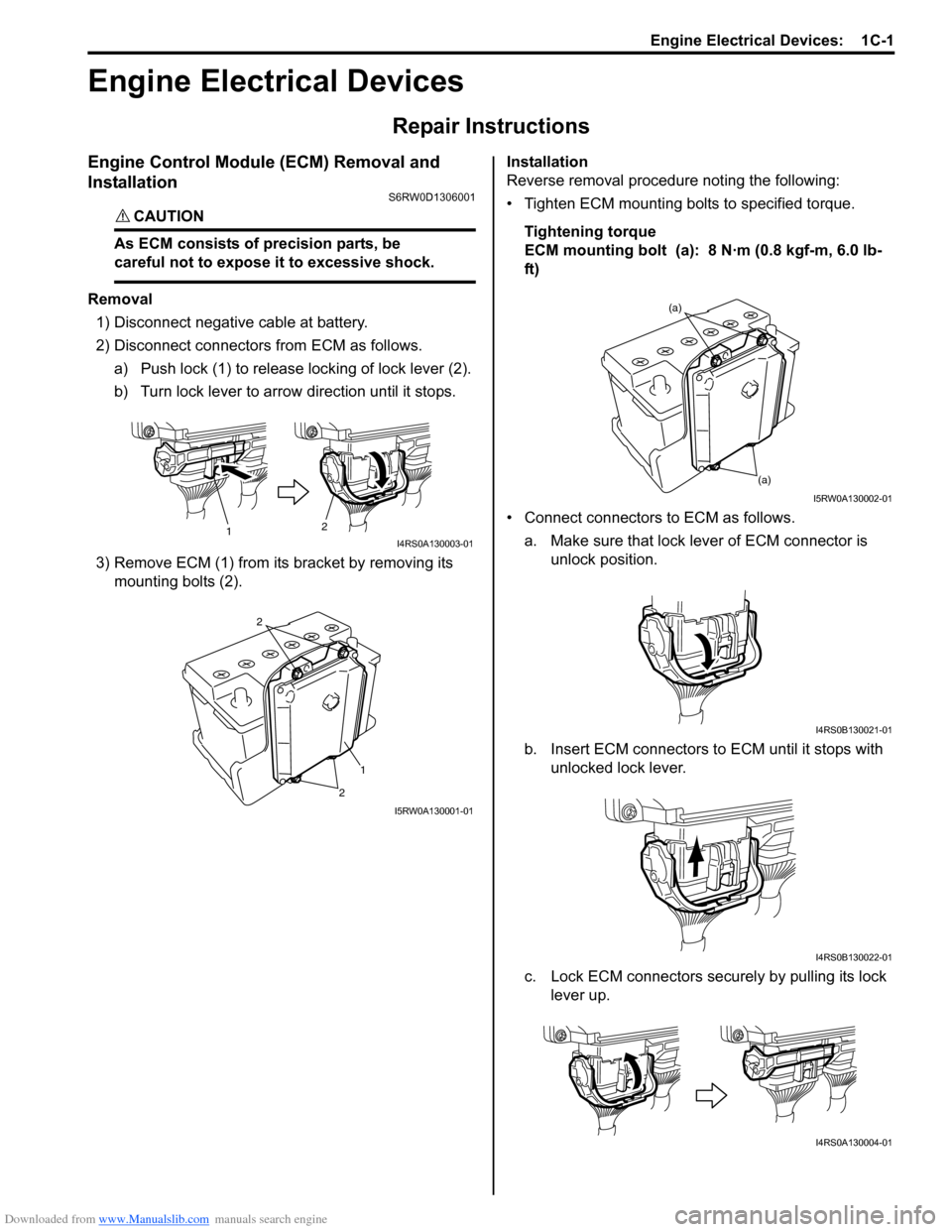
Removal
1) Disconnect negative cable at battery.
2) Disconnect connectors from ECM as follows.
a) Push lock (1) to release locking of lock lever (2).
b) Turn lock lever to arrow direction until it stops.
3) Remove ECM (1) from its bracket by removing its
mounting bolts (2).Installation
Reverse removal procedure noting the following:
• Tighten ECM mounting bolts to specified torque.
Tightening torque
ECM mounting bolt (a): 8 N·m (0.8 kgf-m, 6.0 lb-
ft)
• Connect connectors to ECM as follows.
a. Make sure that lock lever of ECM connector is
unlock position.
b. Insert ECM connectors to ECM until it stops with
unlocked lock lever.
c. Lock ECM connectors securely by pulling its lock
lever up.
12I4RS0A130003-01
1
2 2
I5RW0A130001-01
(a) (a)
I5RW0A130002-01
I4RS0B130021-01
I4RS0B130022-01
I4RS0A130004-01
Page 270 of 1556
Downloaded from www.Manualslib.com manuals search engine 1C-2 Engine Electrical Devices:
Manifold Absolute Pressure (MAP) Sensor
Inspection (If Equipped)
S6RW0D1306002
1) Remove air cleaner assembly.
2) Disconnect connector from MAP sensor.
3) Remove MAP sensor.
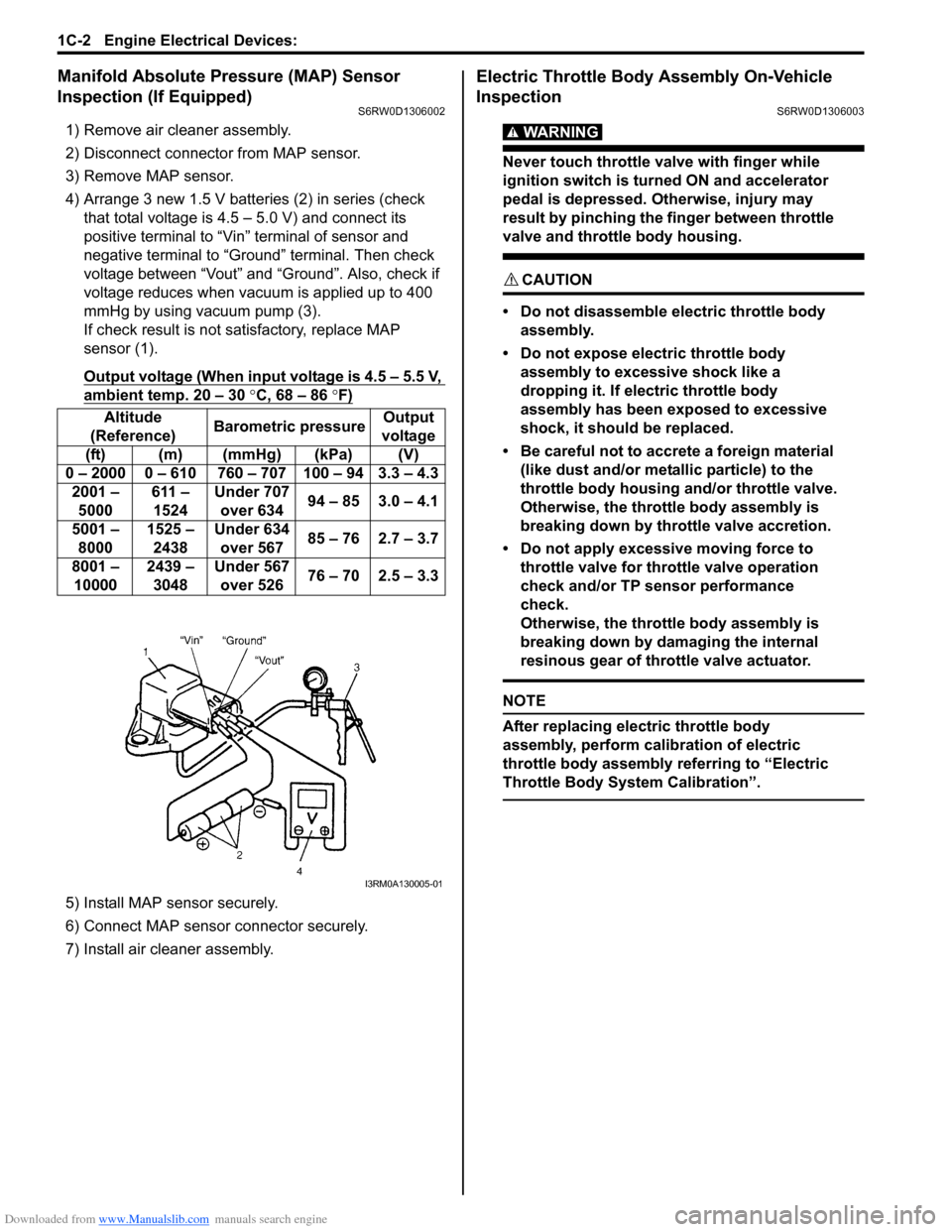
4) Arrange 3 new 1.5 V batteries (2) in series (check
that total voltage is 4.5 – 5.0 V) and connect its
positive terminal to “Vin” terminal of sensor and
negative terminal to “Ground” terminal. Then check
voltage between “Vout” and “Ground”. Also, check if
voltage reduces when vacuum is applied up to 400
mmHg by using vacuum pump (3).
If check result is not satisfactory, replace MAP
sensor (1).
Output voltage (When input voltage is 4.5 – 5.5 V,
ambient temp. 20 – 30 °C, 68 – 86 °F)
5) Install MAP sensor securely.
6) Connect MAP sensor connector securely.
7) Install air cleaner assembly.
Electric Throttle Body Assembly On-Vehicle
Inspection
S6RW0D1306003
WARNING!
Never touch throttle valve with finger while
ignition switch is turned ON and accelerator
pedal is depressed. Otherwise, injury may
result by pinching the finger between throttle
valve and throttle body housing.
CAUTION!
• Do not disassemble electric throttle body
assembly.
• Do not expose electric throttle body
assembly to excessive shock like a
dropping it. If electric throttle body
assembly has been exposed to excessive
shock, it should be replaced.
• Be careful not to accrete a foreign material
(like dust and/or metallic particle) to the
throttle body housing and/or throttle valve.
Otherwise, the throttle body assembly is
breaking down by throttle valve accretion.
• Do not apply excessive moving force to
throttle valve for throttle valve operation
check and/or TP sensor performance
check.
Otherwise, the throttle body assembly is
breaking down by damaging the internal
resinous gear of throttle valve actuator.
NOTE
After replacing electric throttle body
assembly, perform calibration of electric
throttle body assembly referring to “Electric
Throttle Body System Calibration”.
Altitude
(Reference)Barometric pressureOutput
voltage
(ft) (m) (mmHg) (kPa) (V)
0 – 2000 0 – 610 760 – 707 100 – 94 3.3 – 4.3
2001 –
5000611 –
1524Under 707
over 63494 – 85 3.0 – 4.1
5001 –
80001525 –
2438Under 634
over 56785 – 76 2.7 – 3.7
8001 –
100002439 –
3048Under 567
over 52676 – 70 2.5 – 3.3
I3RM0A130005-01
Page 271 of 1556
Downloaded from www.Manualslib.com manuals search engine Engine Electrical Devices: 1C-3
Throttle Valve Visual Check
1) Remove air cleaner outlet hose.
2) Check that there isn’t any foreign matter caught
between throttle valve and throttle body housing. If
there is, take it out after removing throttle body
referring to “Electric Throttle Body Assembly
Removal and Installation in Section 1D” and clean
inside of throttle body thoroughly.
Throttle Valve Operation Check
1) Remove air cleaner outlet hose.
2) Turn OFF ignition switch.
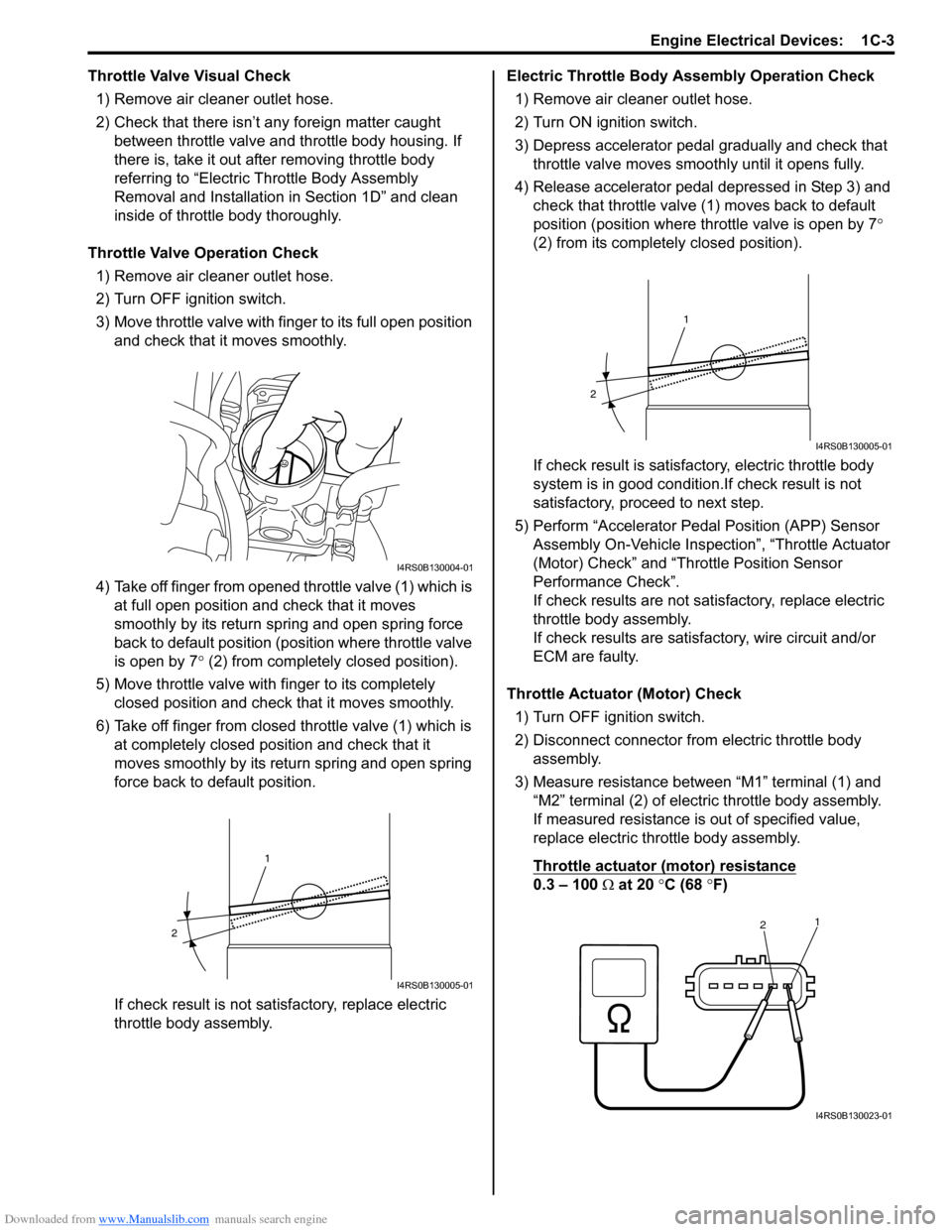
3) Move throttle valve with finger to its full open position
and check that it moves smoothly.
4) Take off finger from opened throttle valve (1) which is
at full open position and check that it moves
smoothly by its return spring and open spring force
back to default position (position where throttle valve
is open by 7° (2) from completely closed position).
5) Move throttle valve with finger to its completely
closed position and check that it moves smoothly.
6) Take off finger from closed throttle valve (1) which is
at completely closed position and check that it
moves smoothly by its return spring and open spring
force back to default position.
If check result is not satisfactory, replace electric
throttle body assembly.Electric Throttle Body Assembly Operation Check
1) Remove air cleaner outlet hose.
2) Turn ON ignition switch.
3) Depress accelerator pedal gradually and check that
throttle valve moves smoothly until it opens fully.
4) Release accelerator pedal depressed in Step 3) and
check that throttle valve (1) moves back to default
position (position where throttle valve is open by 7°
(2) from its completely closed position).
If check result is satisfactory, electric throttle body
system is in good condition.If check result is not
satisfactory, proceed to next step.
5) Perform “Accelerator Pedal Position (APP) Sensor
Assembly On-Vehicle Inspection”, “Throttle Actuator
(Motor) Check” and “Throttle Position Sensor
Performance Check”.
If check results are not satisfactory, replace electric
throttle body assembly.
If check results are satisfactory, wire circuit and/or
ECM are faulty.
Throttle Actuator (Motor) Check
1) Turn OFF ignition switch.
2) Disconnect connector from electric throttle body
assembly.
3) Measure resistance between “M1” terminal (1) and
“M2” terminal (2) of electric throttle body assembly.
If measured resistance is out of specified value,
replace electric throttle body assembly.
Throttle actuator (motor) resistance
0.3 – 100 Ω at 20 °C (68 °F)
I4RS0B130004-01
1
2
I4RS0B130005-01
1
2
I4RS0B130005-01
21
I4RS0B130023-01
Page 272 of 1556
Downloaded from www.Manualslib.com manuals search engine 1C-4 Engine Electrical Devices:
Throttle Position Sensor Performance Check
1) Remove air cleaner outlet hose.
2) Turn OFF ignition switch.
3) Disconnect connector from electric throttle body
assembly.
4) Check throttle position sensor (main and sub) output
voltage as following steps.
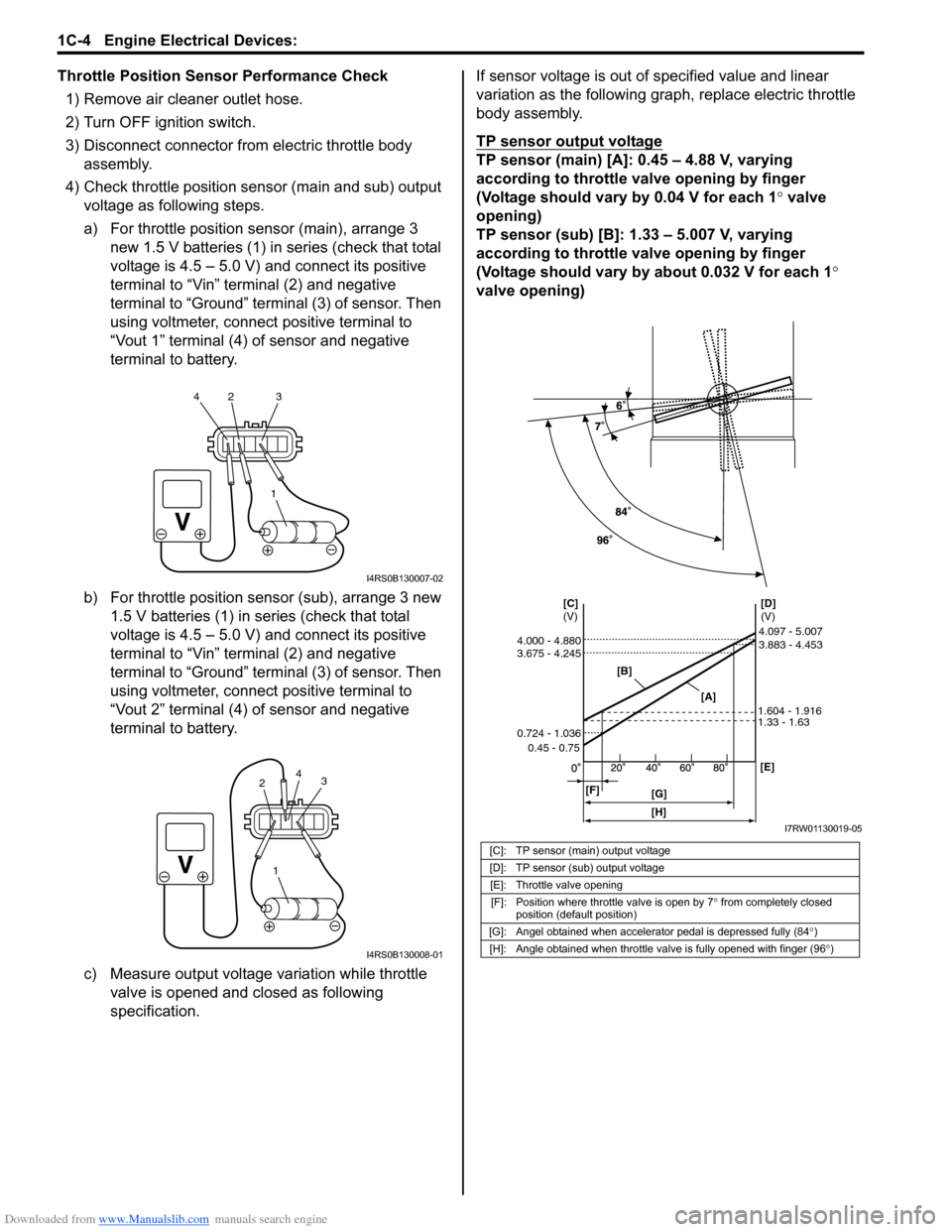
a) For throttle position sensor (main), arrange 3
new 1.5 V batteries (1) in series (check that total
voltage is 4.5 – 5.0 V) and connect its positive
terminal to “Vin” terminal (2) and negative
terminal to “Ground” terminal (3) of sensor. Then
using voltmeter, connect positive terminal to
“Vout 1” terminal (4) of sensor and negative
terminal to battery.
b) For throttle position sensor (sub), arrange 3 new
1.5 V batteries (1) in series (check that total
voltage is 4.5 – 5.0 V) and connect its positive
terminal to “Vin” terminal (2) and negative
terminal to “Ground” terminal (3) of sensor. Then
using voltmeter, connect positive terminal to
“Vout 2” terminal (4) of sensor and negative
terminal to battery.
c) Measure output voltage variation while throttle
valve is opened and closed as following
specification.If sensor voltage is out of specified value and linear
variation as the following graph, replace electric throttle
body assembly.
TP sensor output voltage
TP sensor (main) [A]: 0.45 – 4.88 V, varying
according to throttle valve opening by finger
(Voltage should vary by 0.04 V for each 1° valve
opening)
TP sensor (sub) [B]: 1.33 – 5.007 V, varying
according to throttle valve opening by finger
(Voltage should vary by about 0.032 V for each 1°
valve opening)
1 42 3
I4RS0B130007-02
1
3
24
I4RS0B130008-01
[C]: TP sensor (main) output voltage
[D]: TP sensor (sub) output voltage
[E]: Throttle valve opening
[F]: Position where throttle valve is open by 7° from completely closed
position (default position)
[G]: Angel obtained when accelerator pedal is depressed fully (84°)
[H]: Angle obtained when throttle valve is fully opened with finger (96°)
[B]
[A][D]
(V) [C]
(V)
[F]
[G][E] 0.45 - 0.75 0.724 - 1.036 3.675 - 4.245 4.000 - 4.880
1.33 - 1.63 1.604 - 1.9163.883 - 4.453 4.097 - 5.007
[H]
I7RW01130019-05
Page 273 of 1556
Downloaded from www.Manualslib.com manuals search engine Engine Electrical Devices: 1C-5
Electric Throttle Body System CalibrationS6RW0D1306004
NOTE
If the service described under the
“Precautions of Electric Throttle Body
System Calibration in Section 1A” is
performed, calibrate electric throttle body
system as follows.
1) If electric throttle body assembly and/or accelerator
pedal position (APP) sensor assembly are replaced,
perform following steps.
a) Disconnect negative cable at battery for 20
seconds or more for the purpose of clearing
calibration data of closed throttle position from
memory in ECM.
b) Connect negative cable to battery.
2) Keep ignition switch at ON position for 5 seconds or
more without running engine.
Accelerator Pedal Position (APP) Sensor
Assembly On-Vehicle Inspection
S6RW0D1306005
1) Check that APP sensor assembly has been mounted
to vehicle body properly (no pinched floor carpet,
etc.).
If mounting is not properly, reinstall APP sensor
assembly properly referring to “Accelerator Pedal
Position (APP) Sensor Assembly Removal and
Installation”.
2) Connect scan tool to DLC with ignition switch turned
OFF.
3) Turn ON ignition switch and select “Data List” mode
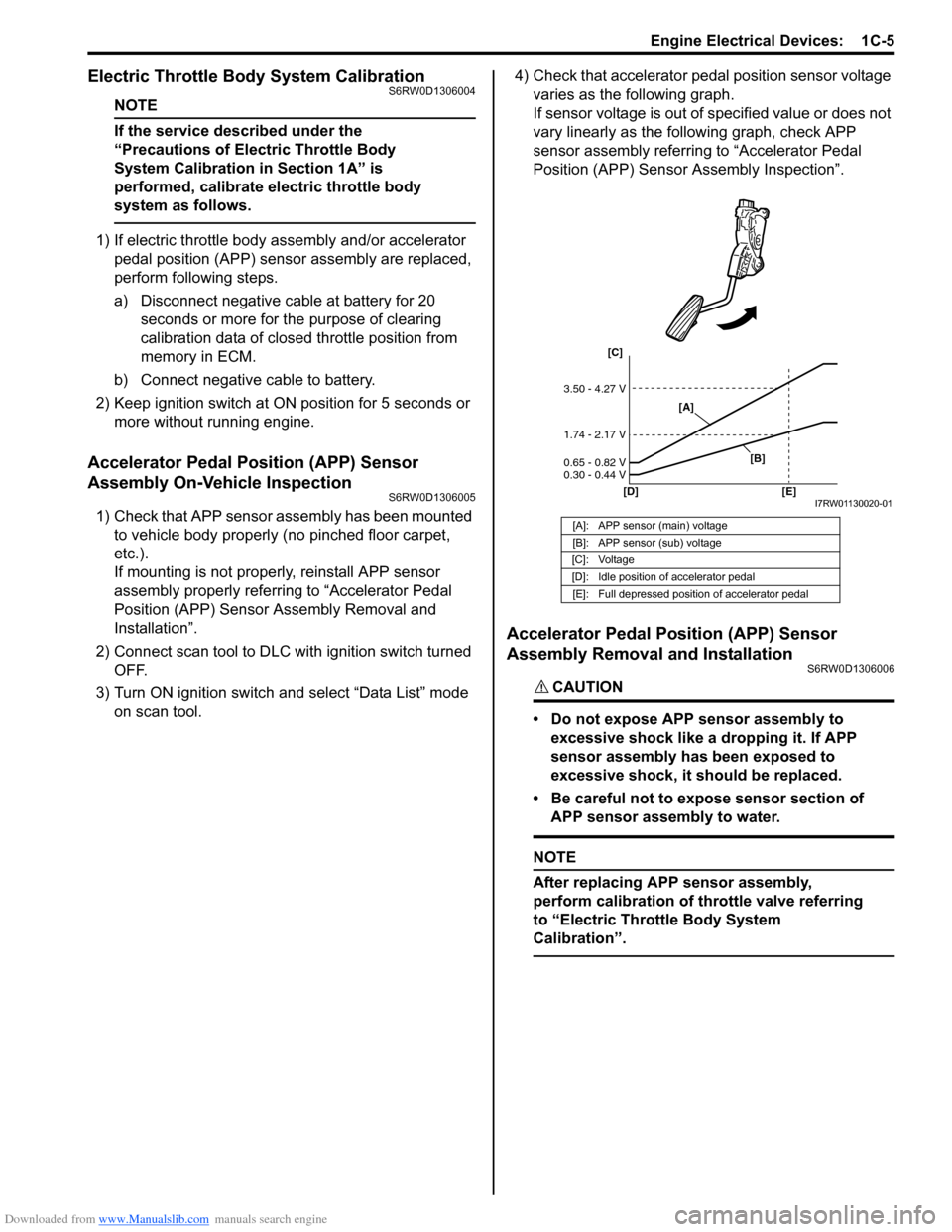
on scan tool.4) Check that accelerator pedal position sensor voltage
varies as the following graph.
If sensor voltage is out of specified value or does not
vary linearly as the following graph, check APP
sensor assembly referring to “Accelerator Pedal
Position (APP) Sensor Assembly Inspection”.
Accelerator Pedal Position (APP) Sensor
Assembly Removal and Installation
S6RW0D1306006
CAUTION!
• Do not expose APP sensor assembly to
excessive shock like a dropping it. If APP
sensor assembly has been exposed to
excessive shock, it should be replaced.
• Be careful not to expose sensor section of
APP sensor assembly to water.
NOTE
After replacing APP sensor assembly,
perform calibration of throttle valve referring
to “Electric Throttle Body System
Calibration”.
[A]: APP sensor (main) voltage
[B]: APP sensor (sub) voltage
[C]: Voltage
[D]: Idle position of accelerator pedal
[E]: Full depressed position of accelerator pedal
[C]
[D] [E]
3.50 - 4.27 V
1.74 - 2.17 V
0.65 - 0.82 V
0.30 - 0.44 V
[A]
[B]
I7RW01130020-01
Page 274 of 1556
Downloaded from www.Manualslib.com manuals search engine 1C-6 Engine Electrical Devices:
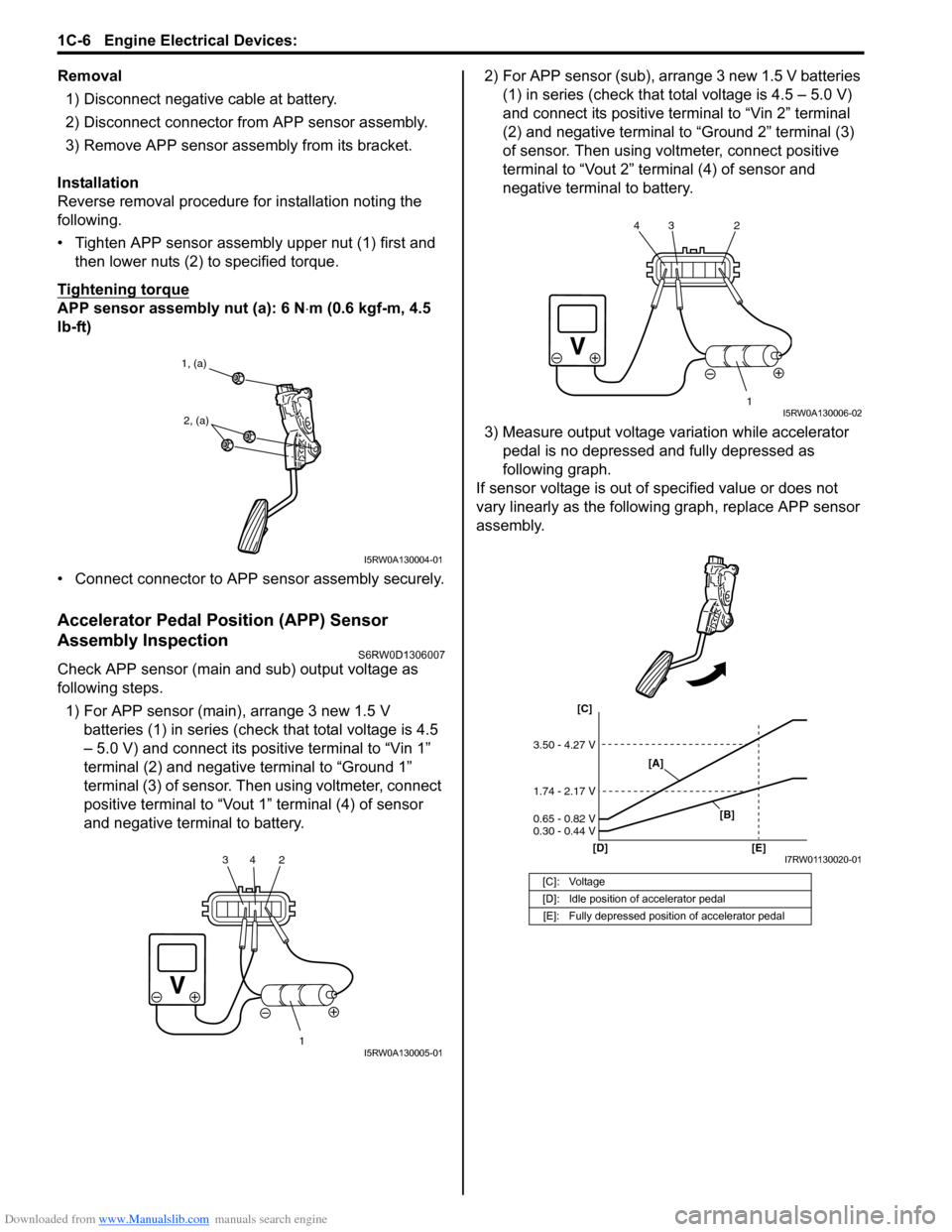
Removal
1) Disconnect negative cable at battery.
2) Disconnect connector from APP sensor assembly.
3) Remove APP sensor assembly from its bracket.
Installation
Reverse removal procedure for installation noting the
following.
• Tighten APP sensor assembly upper nut (1) first and
then lower nuts (2) to specified torque.
Tightening torque
APP sensor assembly nut (a): 6 N⋅m (0.6 kgf-m, 4.5
lb-ft)
• Connect connector to APP sensor assembly securely.
Accelerator Pedal Position (APP) Sensor
Assembly Inspection
S6RW0D1306007
Check APP sensor (main and sub) output voltage as
following steps.
1) For APP sensor (main), arrange 3 new 1.5 V
batteries (1) in series (check that total voltage is 4.5
– 5.0 V) and connect its positive terminal to “Vin 1”
terminal (2) and negative terminal to “Ground 1”
terminal (3) of sensor. Then using voltmeter, connect
positive terminal to “Vout 1” terminal (4) of sensor
and negative terminal to battery.2) For APP sensor (sub), arrange 3 new 1.5 V batteries
(1) in series (check that total voltage is 4.5 – 5.0 V)
and connect its positive terminal to “Vin 2” terminal
(2) and negative terminal to “Ground 2” terminal (3)
of sensor. Then using voltmeter, connect positive
terminal to “Vout 2” terminal (4) of sensor and
negative terminal to battery.
3) Measure output voltage variation while accelerator
pedal is no depressed and fully depressed as
following graph.
If sensor voltage is out of specified value or does not
vary linearly as the following graph, replace APP sensor
assembly.
1, (a)
2, (a)
I5RW0A130004-01
1 2 34I5RW0A130005-01
[C]: Voltage
[D]: Idle position of accelerator pedal
[E]: Fully depressed position of accelerator pedal
1 2 3 4I5RW0A130006-02
[C]
[D] [E]
3.50 - 4.27 V
1.74 - 2.17 V
0.65 - 0.82 V
0.30 - 0.44 V
[A]
[B]
I7RW01130020-01
Page 275 of 1556
Downloaded from www.Manualslib.com manuals search engine Engine Electrical Devices: 1C-7
Engine Coolant Temperature (ECT) Sensor
Removal and Installation
S6RW0D1306008
Removal
1) Disconnect negative cable at battery.
2) Drain coolant referring to “Cooling System Draining
in Section 1F”.
WARNING!
To avoid danger of being burned, do not
remove radiator cap while engine and
radiator are still hot.
Scalding fluid and steam can be blown out
under pressure if cap is taken off too soon.
3) Remove air intake pipe.
4) Disconnect connector from ECT sensor (1).
5) Remove ECT sensor from water outlet.
Installation
Reverse removal procedure noting the following.
• Clean mating surfaces of ECT sensor and water
outlet.
• Check O-ring for damage and replace, if necessary.
• Tighten ECT sensor (1) to specified torque.
Tightening torque
ECT sensor (a): 15 N·m (1.5 kgf-m, 11.0 lb-ft)
• Connect connector to ECT sensor securely.
• Refill coolant referring to “Cooling System Flush and
Refill in Section 1F”.
Engine Coolant Temperature (ECT) Sensor
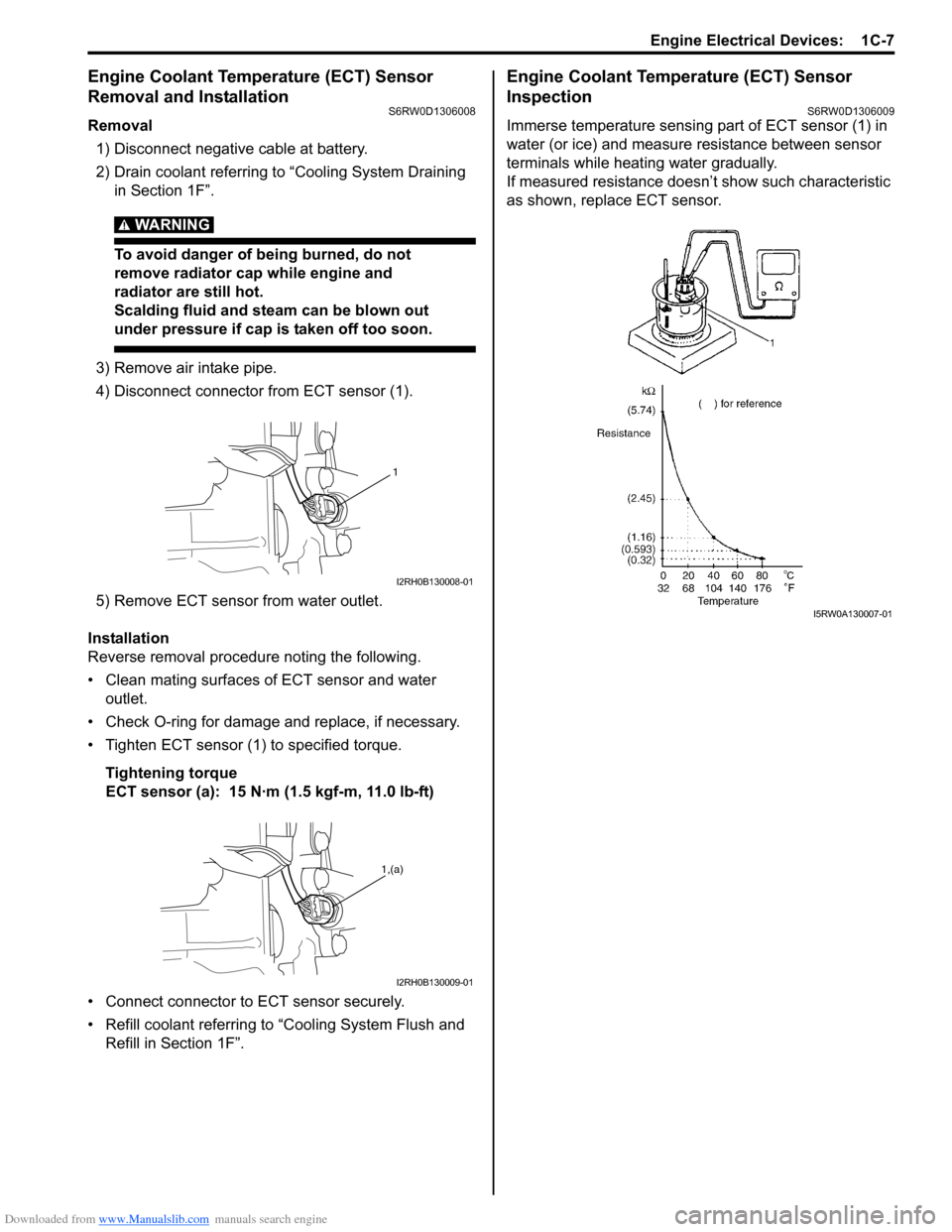
Inspection
S6RW0D1306009
Immerse temperature sensing part of ECT sensor (1) in
water (or ice) and measure resistance between sensor
terminals while heating water gradually.
If measured resistance doesn’t show such characteristic
as shown, replace ECT sensor.
1
I2RH0B130008-01
1,(a)
I2RH0B130009-01
I5RW0A130007-01