Can SUZUKI SX4 2006 1.G Service Workshop Manual
[x] Cancel search | Manufacturer: SUZUKI, Model Year: 2006, Model line: SX4, Model: SUZUKI SX4 2006 1.GPages: 1556, PDF Size: 37.31 MB
Page 555 of 1556
Downloaded from www.Manualslib.com manuals search engine Transfer: 3C-8
Reduction Driven Gear Assembly Disassembly
and Reassembly
S6RW0D3306007
Disassembly
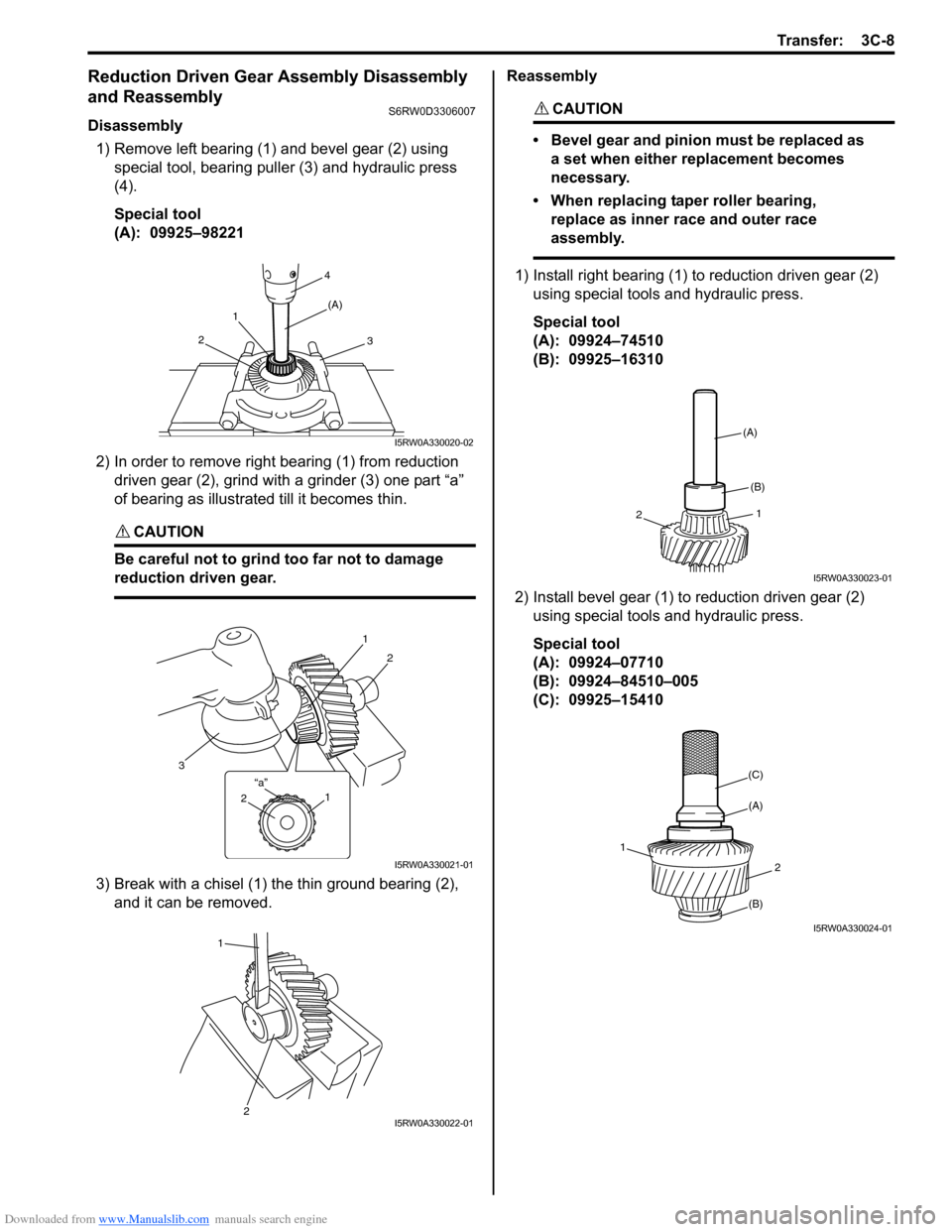
1) Remove left bearing (1) and bevel gear (2) using
special tool, bearing puller (3) and hydraulic press
(4).
Special tool
(A): 09925–98221
2) In order to remove right bearing (1) from reduction
driven gear (2), grind with a grinder (3) one part “a”
of bearing as illustrated till it becomes thin.
CAUTION!
Be careful not to grind too far not to damage
reduction driven gear.
3) Break with a chisel (1) the thin ground bearing (2),
and it can be removed.Reassembly
CAUTION!
• Bevel gear and pinion must be replaced as
a set when either replacement becomes
necessary.
• When replacing taper roller bearing,
replace as inner race and outer race
assembly.
1) Install right bearing (1) to reduction driven gear (2)
using special tools and hydraulic press.
Special tool
(A): 09924–74510
(B): 09925–16310
2) Install bevel gear (1) to reduction driven gear (2)
using special tools and hydraulic press.
Special tool
(A): 09924–07710
(B): 09924–84510–005
(C): 09925–154104
(A)1
23
I5RW0A330020-02
1
2
3
1
2“a”
I5RW0A330021-01
1
2I5RW0A330022-01
(A)
(B)
1
2
I5RW0A330023-01
(C)
(A)
2
1
(B)
I5RW0A330024-01
Page 566 of 1556
Downloaded from www.Manualslib.com manuals search engine 3D-1 Propeller Shafts:
Driveline / Axle
Propeller Shafts
Precautions
Propeller Shaft CautionS6RW0D3400001
CAUTION!
• All propeller shaft fasteners are an important attaching part in that it could affect the performance of
vital parts and systems, and/or could result in major repair expense. They must be replaced with one
of the same part number or with an equivalent part if replacement becomes necessary. Do not use a
replacement part of lesser quality or substitute design. Torque values must be used as specified
during reassembly to assure proper retention of this part.
• Never attempt to heat, quench or straighten any propeller shaft part. Replace it with a new part, or
damage to the part may result.
General Description
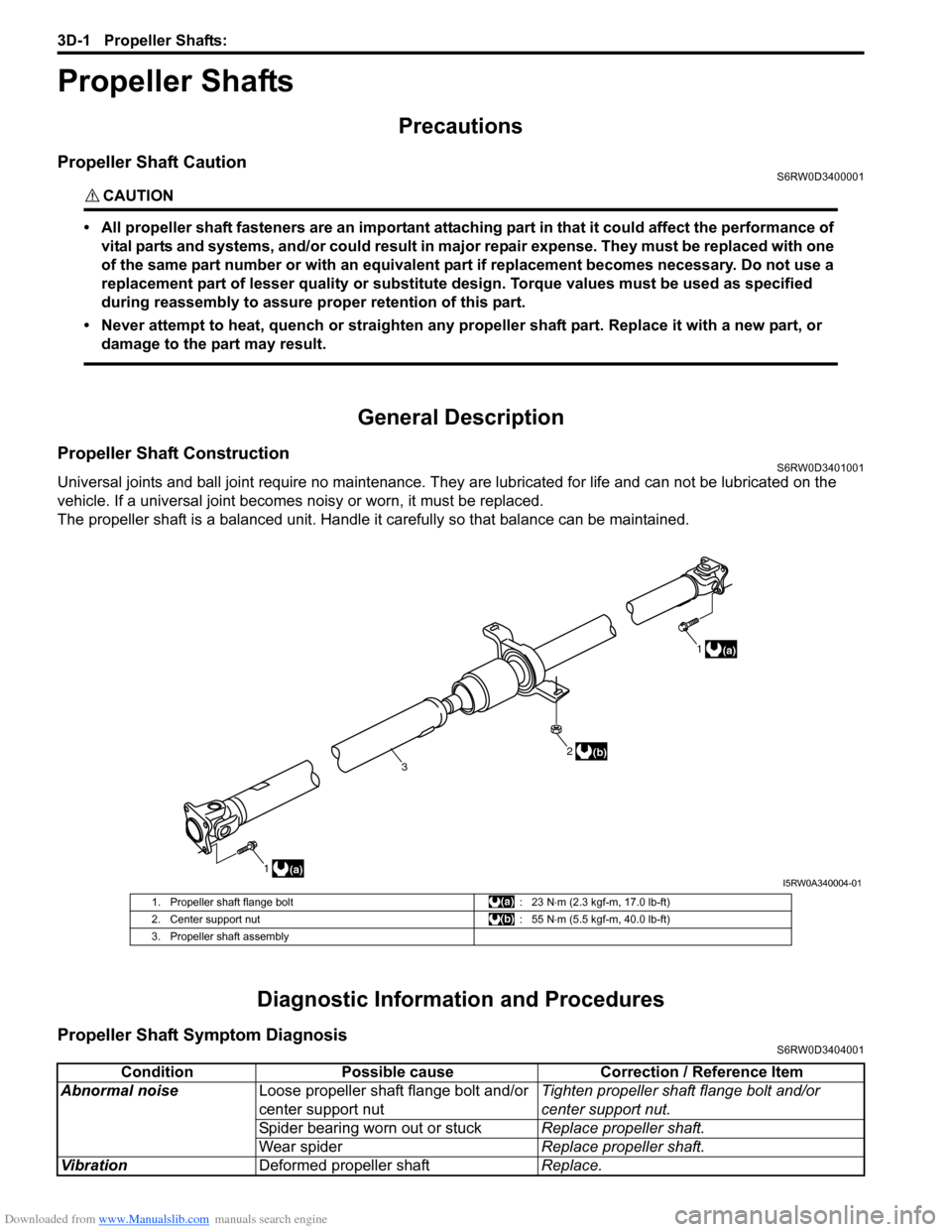
Propeller Shaft ConstructionS6RW0D3401001
Universal joints and ball joint require no maintenance. They are lubricated for life and can not be lubricated on the
vehicle. If a universal joint becomes noisy or worn, it must be replaced.
The propeller shaft is a balanced unit. Handle it carefully so that balance can be maintained.
Diagnostic Information and Procedures
Propeller Shaft Symptom DiagnosisS6RW0D3404001
1(a)1
(a)
2
3(b)
I5RW0A340004-01
1. Propeller shaft flange bolt : 23 N⋅m (2.3 kgf-m, 17.0 lb-ft)
2. Center support nut : 55 N⋅m (5.5 kgf-m, 40.0 lb-ft)
3. Propeller shaft assembly
Condition Possible cause Correction / Reference Item
Abnormal noiseLoose propeller shaft flange bolt and/or
center support nutTighten propeller shaft flange bolt and/or
center support nut.
Spider bearing worn out or stuckReplace propeller shaft.
Wear spiderReplace propeller shaft.
VibrationDeformed propeller shaftReplace.
Page 567 of 1556

Downloaded from www.Manualslib.com manuals search engine Propeller Shafts: 3D-2
Repair Instructions
Propeller Shaft Joint CheckS6RW0D3406001
If universal joints and ball joint are suspected of
producing chattering or rattling noise, inspect them for
wear. For universal joint, check to see if cross spider
rattles in yokes are worn down and replace defective
propeller shaft assembly with new one.
Noise coming from universal joint and ball joint can be
easily distinguished from other noises because rhythm
of chattering or rattling is in step with cruising speed.
Noise is pronounced particularly on standing start or in
coasting condition (when braking effect of engine is
showing in the drive line).
Propeller Shaft Assembly Removal and
Installation
S6RW0D3406002
Removal
1) Hoist vehicle.
2) Before removing propeller shaft assembly, give
match marks (2) on joint flange and propeller shaft
as shown.
3) Separate propeller shaft assembly (1) from transfer
output flange and rear differential flange.4) Remove propeller shaft by removing center support
nuts (1).
CAUTION!
Use care not to drop it. Otherwise, vibration
may occur during driving.
Installation
Reverse removal procedure to install propeller shaft,
noting the following point.
• When installing propeller shaft, align the match marks
(2). Otherwise, vibration may occur during driving.
• Use the following specification to torque each bolt and
nut.
Tightening torque
Propeller shaft bolt: 23 N·m (2.3 kgf-m, 17.0 lb-ft)
Center support nut: 55 N·m (5.5 kgf-m, 40.0 lb-ft)
Propeller Shaft InspectionS6RW0D3406003
1) Check propeller shaft joints for wear, play and
damage. If any defect is found, replace.
2) Check propeller shaft center support for biting of
foreign matter, crack, abnormal noise and damage. If
any defect is found, replace.
I5JB0A340003-01
2
2
1
1
I5RW0A340002-01
1I5RW0A340003-01
Page 570 of 1556
Downloaded from www.Manualslib.com manuals search engine 4-ii Table of Contents
Specifications .......................................................4D-4
Tightening Torque Specifications ........................4D-4
ABS ............................................................4E-1
Precautions........................................................... 4E-1
Precautions in Diagnosing Troubles ................... 4E-1
Precautions in On-Vehicle Service...................... 4E-1
General Description ............................................. 4E-2
ABS Description .................................................. 4E-2
ABS Hydraulic Unit / Control Module
Assembly Description ....................................... 4E-3
CAN Communication System Description........... 4E-3
Schematic and Routing Diagram ........................ 4E-4
ABS Schematic ................................................... 4E-4
ABS Wiring Circuit Diagram ................................ 4E-5
Component Location ........................................... 4E-8
ABS Components Location ................................. 4E-8
Diagnostic Information and Procedures ............ 4E-8
ABS Check .......................................................... 4E-8
ABS Warning Light Check................................. 4E-10
EBD Warning Light (Brake Warning Light)
Check .............................................................. 4E-10
DTC Check........................................................ 4E-11
DTC Table ......................................................... 4E-11
DTC Clearance ................................................. 4E-11
Scan Tool Data ................................................. 4E-12
ABS Warning Light Does Not Come ON at
Ignition Switch ON .......................................... 4E-13
ABS Warning Light Comes ON Steady ............. 4E-15
EBD Warning Light (Brake Warning Light)
Comes ON Steady .......................................... 4E-16
Serial Data Link Circuit Check .......................... 4E-17
DTC C1013: Control Module Mismatch ............ 4E-20
DTC C1015: G Sensor Circuit (4WD Model)..... 4E-21
DTC 1016: Brake Light Switch .......................... 4E-22
DTC C1021 / C1022 / C1025 / C1026 / C1031
/ C1032 / C1035 / C1036: Wheel Speed
Sensor Circuit / Sensor or Encoder ................ 4E-23
DTC C1033: Wheel Speed Sensor Deviation ... 4E-25
DTC C1041 / C1042 / C1045 / C1046 / C1051
/ C1052 / C1055 / C1056: Inlet / Outlet
Solenoid .......................................................... 4E-26DTC C1057: Power Supply Voltage Too High
/ Too Low ........................................................ 4E-27
DTC C1061: Pump Motor Circuit ...................... 4E-28
DTC C1063: Solenoid Valve Power Supply
Driver Circuit ................................................... 4E-29
DTC C1071: Control Module Internal Defect .... 4E-30
ABS Hydraulic Unit / Control Module
Assembly Power and Ground Circuit Check ... 4E-30
Repair Instructions ............................................ 4E-31
ABS Hydraulic Unit Operation Check................ 4E-31
ABS Hydraulic Unit / Control Module
Assembly Components ................................... 4E-32
ABS Hydraulic Unit / Control Module
Assembly On-Vehicle Inspection .................... 4E-33
ABS Hydraulic Unit / Control Module
Assembly Removal and Installation ................ 4E-33
Front and Rear Wheel Speed Sensor On-
Vehicle Inspection ........................................... 4E-34
Front Wheel Speed Sensor Removal and
Installation ....................................................... 4E-35
Front and Rear Wheel Speed Sensor
Inspection ........................................................ 4E-36
Rear Wheel Speed Sensor Removal and
Installation (4WD Model) ................................. 4E-36
Rear Wheel Speed Sensor Removal and
Installation (2WD Model) ................................. 4E-36
Front Wheel Speed Sensor Encoder On-
Vehicle Inspection ........................................... 4E-37
Front Wheel Speed Sensor Encoder Removal
and Installation ................................................ 4E-37
Rear Wheel Speed Sensor Encoder On-
Vehicle Inspection ........................................... 4E-37
Rear Wheel Speed Sensor Encoder Removal
and Installation ................................................ 4E-37
G Sensor Removal and Installation (4WD
Model) ............................................................. 4E-38
G Sensor Inspection (4WD Model) ................... 4E-38
Specifications ..................................................... 4E-39
Tightening Torque Specifications ...................... 4E-39
Special Tools and Equipment ........................... 4E-39
Special Tool ...................................................... 4E-39
Page 571 of 1556
Downloaded from www.Manualslib.com manuals search engine Precautions: 4-1
Brakes
Precautions
Precautions
Precautions for BrakesS6RW0D4000001
Suspension Caution
Refer to “Suspension Caution in Section 00”.
Wheels and Tires Caution
Refer to “Wheels and Tires Caution in Section 00”.
Brake Caution
Refer to “Brake Caution in Section 00”.
General Precautions
Refer to “General Precautions in Section 00”.
Vehicle Lifting Points
Refer to “Vehicle Lifting Points in Section 0A”.
Fastener Caution
Refer to “Fastener Caution in Section 00”.
Fastener Information
Refer to “Fasteners Information in Section 0A”.
Precaution on CAN Troubleshooting
Refer to “Precaution on CAN Troubleshooting in Section 1A”.
Page 597 of 1556
Downloaded from www.Manualslib.com manuals search engine Rear Brakes: 4C-2
Rear Brake Drum Removal and InstallationS6RW0D4306002
Removal
1) Hoist vehicle and remove rear wheel.
2) Release parking brake lever.
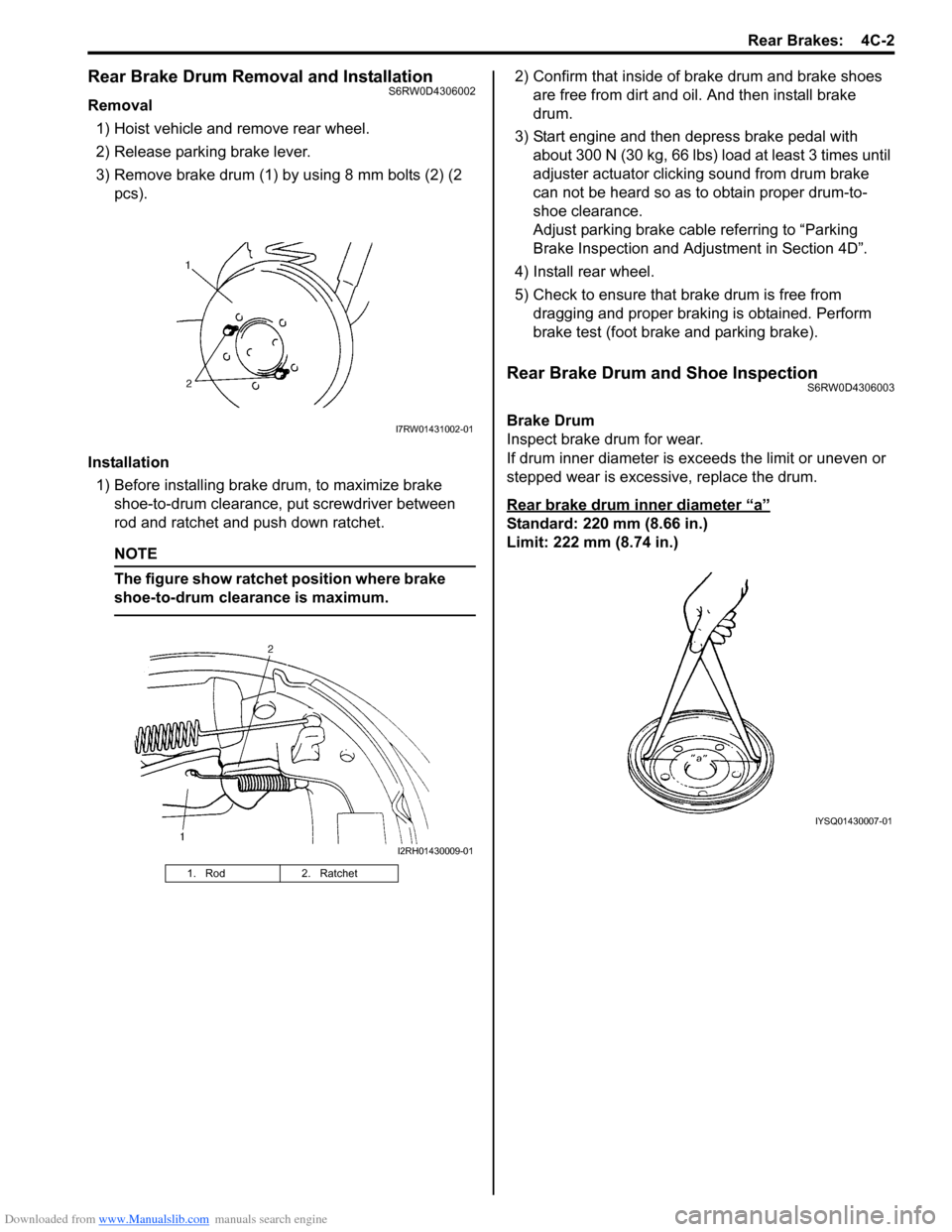
3) Remove brake drum (1) by using 8 mm bolts (2) (2
pcs).
Installation
1) Before installing brake drum, to maximize brake
shoe-to-drum clearance, put screwdriver between
rod and ratchet and push down ratchet.
NOTE
The figure show ratchet position where brake
shoe-to-drum clearance is maximum.
2) Confirm that inside of brake drum and brake shoes
are free from dirt and oil. And then install brake
drum.
3) Start engine and then depress brake pedal with
about 300 N (30 kg, 66 lbs) load at least 3 times until
adjuster actuator clicking sound from drum brake
can not be heard so as to obtain proper drum-to-
shoe clearance.
Adjust parking brake cable referring to “Parking
Brake Inspection and Adjustment in Section 4D”.
4) Install rear wheel.
5) Check to ensure that brake drum is free from
dragging and proper braking is obtained. Perform
brake test (foot brake and parking brake).
Rear Brake Drum and Shoe InspectionS6RW0D4306003
Brake Drum
Inspect brake drum for wear.
If drum inner diameter is exceeds the limit or uneven or
stepped wear is excessive, replace the drum.
Rear brake drum inner diameter
“a”
Standard: 220 mm (8.66 in.)
Limit: 222 mm (8.74 in.)
1. Rod 2. Ratchet
I7RW01431002-01
I2RH01430009-01
IYSQ01430007-01
Page 598 of 1556
Downloaded from www.Manualslib.com manuals search engine 4C-3 Rear Brakes:
Cracked, Scored or Grooved Drum
A cracked drum is unsafe for further service and must be
replaced. Do not attempt to weld a cracked drum.
Smooth up any slight scores. Heavy or extensive scoring
will cause excessive brake lining wear and it will
probably be necessary to resurface drum braking
surface.
If brake linings are slightly worn and drum is grooved,
drum should be polished with fine emery cloth in the
direction of drum depth but not circumferentially along
drum inner.
NOTE
When drum is removed, visually inspect
wheel cylinder for brake fluid leakage.
Correct leaky point, if any.
Brake Shoe
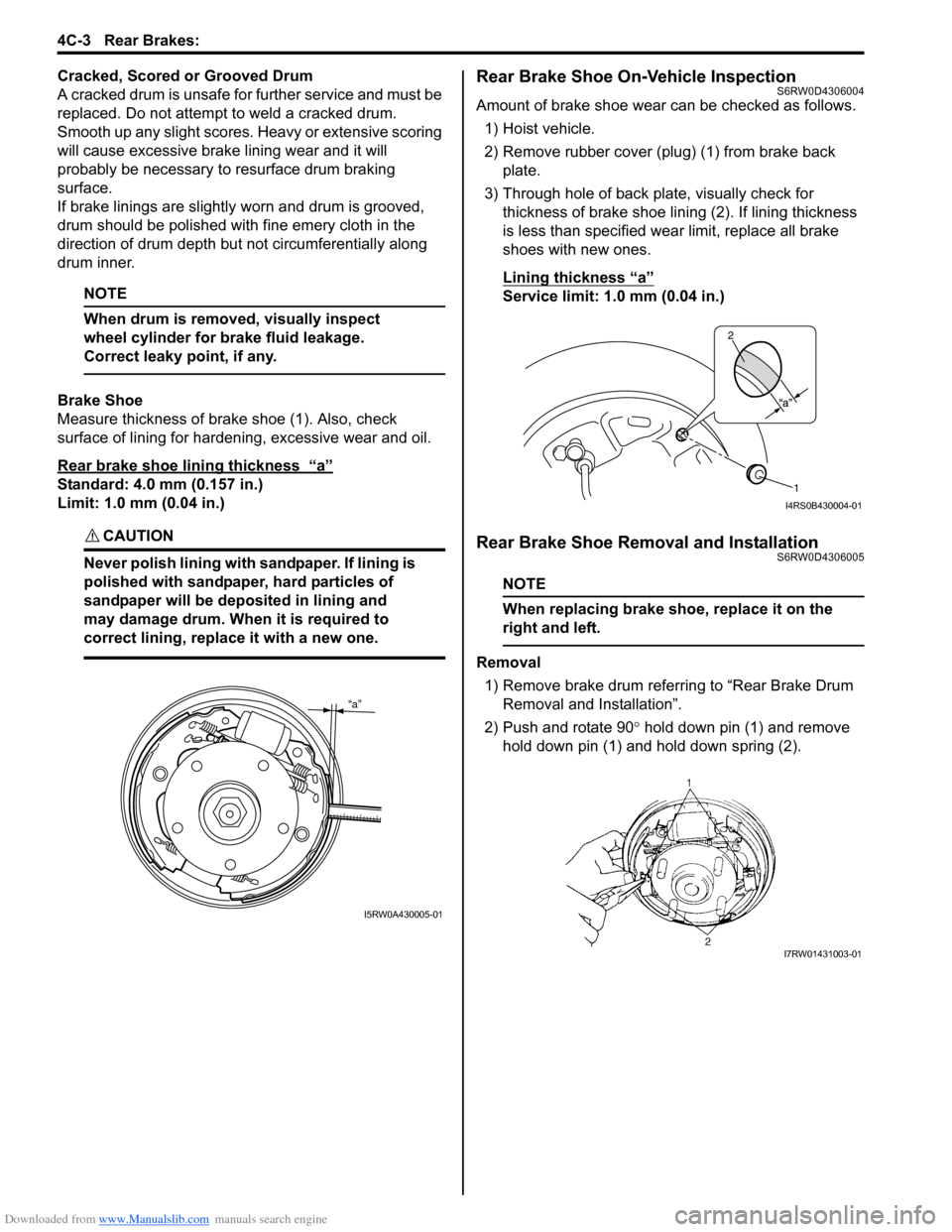
Measure thickness of brake shoe (1). Also, check
surface of lining for hardening, excessive wear and oil.
Rear brake shoe lining thickness
“a”
Standard: 4.0 mm (0.157 in.)
Limit: 1.0 mm (0.04 in.)
CAUTION!
Never polish lining with sandpaper. If lining is
polished with sandpaper, hard particles of
sandpaper will be deposited in lining and
may damage drum. When it is required to
correct lining, replace it with a new one.
Rear Brake Shoe On-Vehicle InspectionS6RW0D4306004
Amount of brake shoe wear can be checked as follows.
1) Hoist vehicle.
2) Remove rubber cover (plug) (1) from brake back
plate.
3) Through hole of back plate, visually check for
thickness of brake shoe lining (2). If lining thickness
is less than specified wear limit, replace all brake
shoes with new ones.
Lining thickness “a”
Service limit: 1.0 mm (0.04 in.)
Rear Brake Shoe Removal and InstallationS6RW0D4306005
NOTE
When replacing brake shoe, replace it on the
right and left.
Removal
1) Remove brake drum referring to “Rear Brake Drum
Removal and Installation”.
2) Push and rotate 90° hold down pin (1) and remove
hold down pin (1) and hold down spring (2).
“a”
I5RW0A430005-01
2
1
I4RS0B430004-01
I7RW01431003-01
Page 600 of 1556
Downloaded from www.Manualslib.com manuals search engine 4C-5 Rear Brakes:
Installation
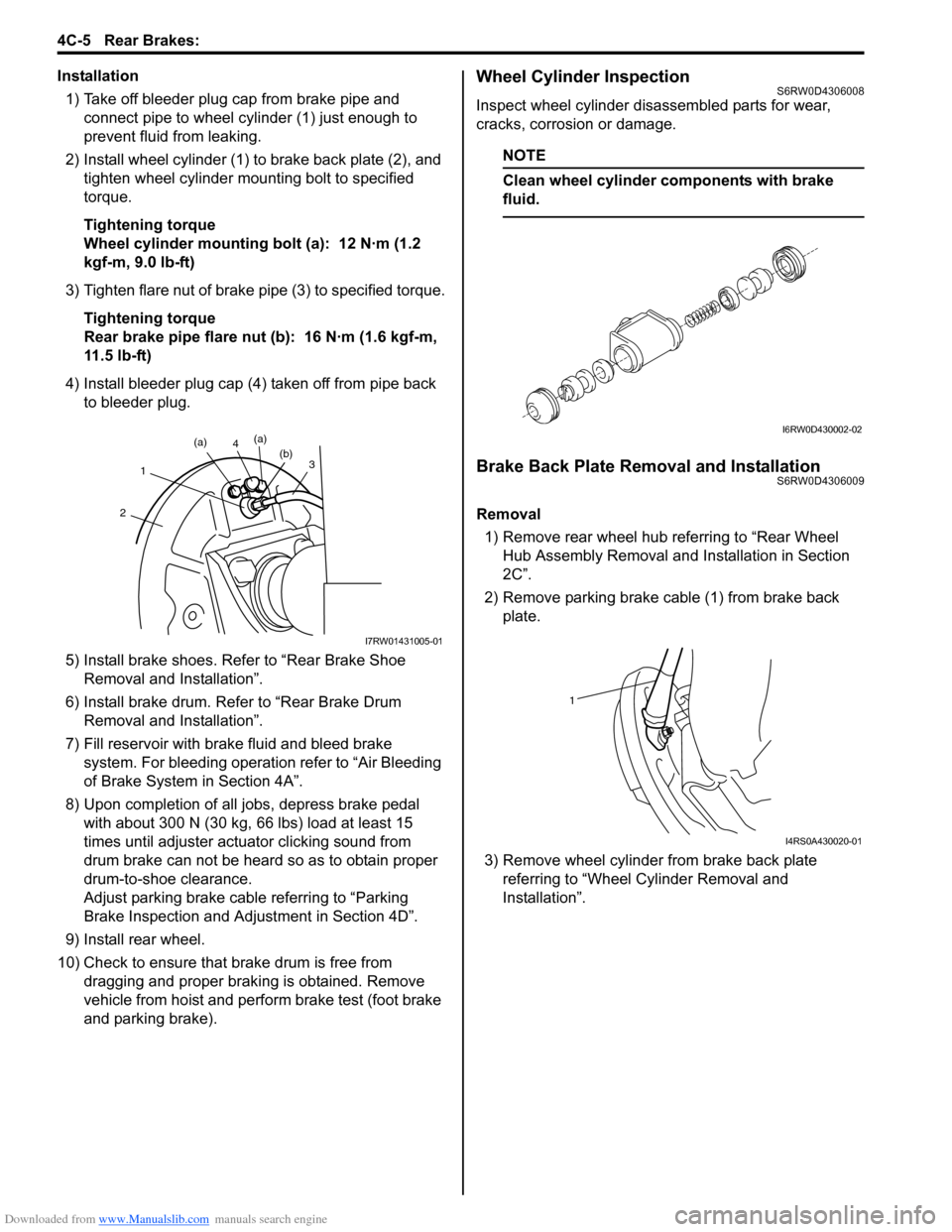
1) Take off bleeder plug cap from brake pipe and
connect pipe to wheel cylinder (1) just enough to
prevent fluid from leaking.
2) Install wheel cylinder (1) to brake back plate (2), and
tighten wheel cylinder mounting bolt to specified
torque.
Tightening torque
Wheel cylinder mounting bolt (a): 12 N·m (1.2
kgf-m, 9.0 lb-ft)
3) Tighten flare nut of brake pipe (3) to specified torque.
Tightening torque
Rear brake pipe flare nut (b): 16 N·m (1.6 kgf-m,
11.5 lb-ft)
4) Install bleeder plug cap (4) taken off from pipe back
to bleeder plug.
5) Install brake shoes. Refer to “Rear Brake Shoe
Removal and Installation”.
6) Install brake drum. Refer to “Rear Brake Drum
Removal and Installation”.
7) Fill reservoir with brake fluid and bleed brake
system. For bleeding operation refer to “Air Bleeding
of Brake System in Section 4A”.
8) Upon completion of all jobs, depress brake pedal
with about 300 N (30 kg, 66 lbs) load at least 15
times until adjuster actuator clicking sound from
drum brake can not be heard so as to obtain proper
drum-to-shoe clearance.
Adjust parking brake cable referring to “Parking
Brake Inspection and Adjustment in Section 4D”.
9) Install rear wheel.
10) Check to ensure that brake drum is free from
dragging and proper braking is obtained. Remove
vehicle from hoist and perform brake test (foot brake
and parking brake).Wheel Cylinder InspectionS6RW0D4306008
Inspect wheel cylinder disassembled parts for wear,
cracks, corrosion or damage.
NOTE
Clean wheel cylinder components with brake
fluid.
Brake Back Plate Removal and InstallationS6RW0D4306009
Removal
1) Remove rear wheel hub referring to “Rear Wheel
Hub Assembly Removal and Installation in Section
2C”.
2) Remove parking brake cable (1) from brake back
plate.
3) Remove wheel cylinder from brake back plate
referring to “Wheel Cylinder Removal and
Installation”.
(b)3
4(a)
(a)
1
2
I7RW01431005-01
I6RW0D430002-02
1
I4RS0A430020-01
Page 606 of 1556
Downloaded from www.Manualslib.com manuals search engine 4E-1 ABS:
Brakes
ABS
Precautions
Precautions in Diagnosing TroublesS6RW0D4500001
To ensure that the trouble diagnosis is done accurately
and smoothly, observe the following and follow “ABS
Check”.
• Diagnostic information stored in ABS control module
memory can be cleared as well as checked by using
SUZUKI scan tool. Before using scan tool, read its
Operator's (Instruction) Manual carefully to have good
understanding as to what functions are available and
how to use it.
• If the vehicle was operated in any of the following
ways, ABS warning light may light momentarily but
this does not indicate anything abnormal in ABS.
– The vehicle was driven with parking brake pulled.
– The vehicle was driven with brake dragging.
– The vehicle was stuck in mud, sand, etc.
– Wheel spin occurred while driving.
– Wheel(s) was rotated while the vehicle was jacked
up.
• Be sure to read “Precautions for Electrical Circuit
Service in Section 00” and “Precaution for CAN
Communication System in Section 00” before
inspection and observe what is written there.
• Be sure to use the trouble diagnosis procedure as
described in “ABS Check”. Failure to follow it may
result in incorrect diagnosis. (Some other diagnosis
trouble code may be stored by mistake in the memory
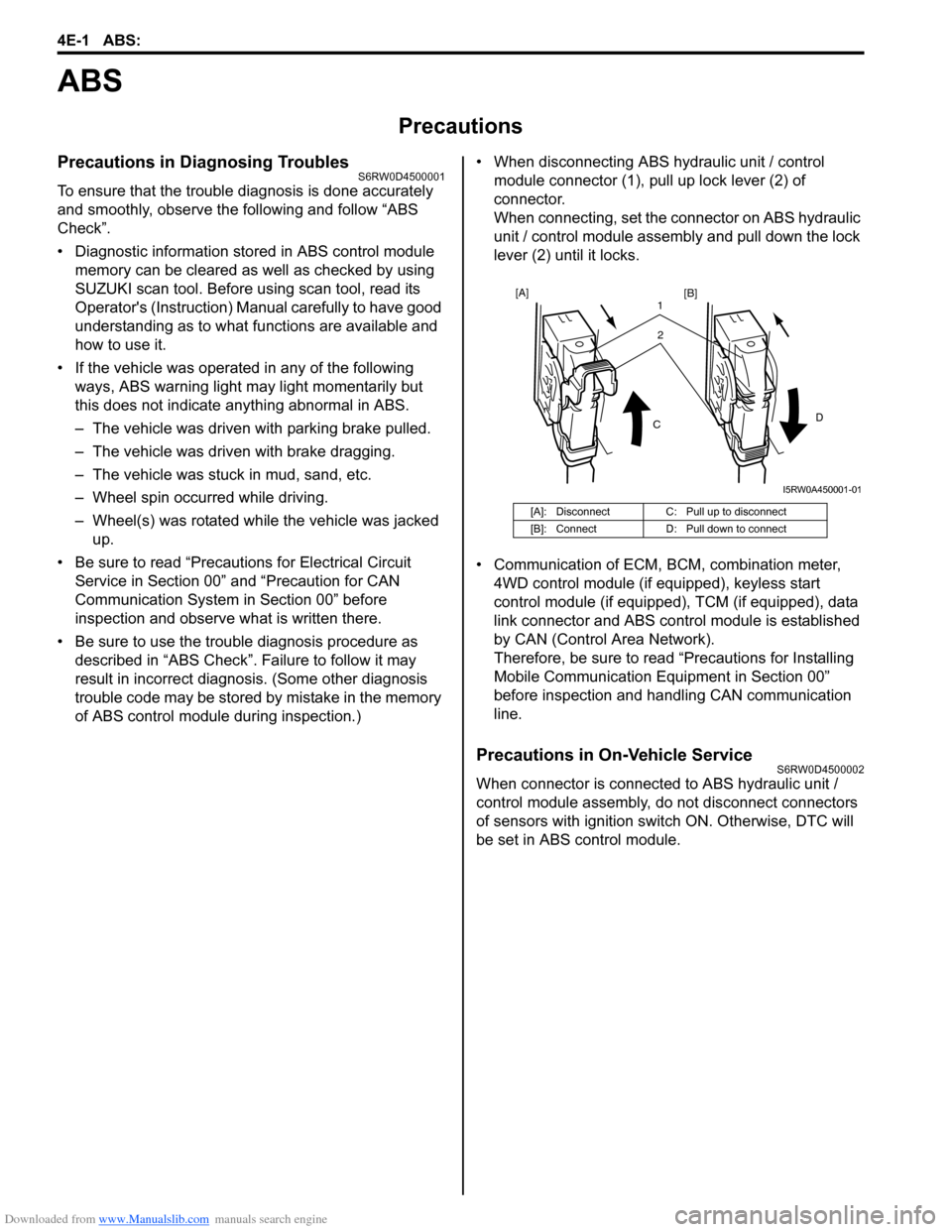
of ABS control module during inspection.)• When disconnecting ABS hydraulic unit / control
module connector (1), pull up lock lever (2) of
connector.
When connecting, set the connector on ABS hydraulic
unit / control module assembly and pull down the lock
lever (2) until it locks.
• Communication of ECM, BCM, combination meter,
4WD control module (if equipped), keyless start
control module (if equipped), TCM (if equipped), data
link connector and ABS control module is established
by CAN (Control Area Network).
Therefore, be sure to read “Precautions for Installing
Mobile Communication Equipment in Section 00”
before inspection and handling CAN communication
line.
Precautions in On-Vehicle ServiceS6RW0D4500002
When connector is connected to ABS hydraulic unit /
control module assembly, do not disconnect connectors
of sensors with ignition switch ON. Otherwise, DTC will
be set in ABS control module.
[A]: Disconnect C: Pull up to disconnect
[B]: Connect D: Pull down to connect
2 1
CD
[A]
[B]
I5RW0A450001-01
Page 608 of 1556
Downloaded from www.Manualslib.com manuals search engine 4E-3 ABS:
ABS Hydraulic Unit / Control Module Assembly
Description
S6RW0D4501002
ABS control module is a component of ABS hydraulic
unit / control module assembly and has the following
functions.
Self-Diagnosis Function
ABS control module diagnoses conditions of the system
component parts (whether or not there is any
abnormality) all the time and indicates the results
(warning of abnormality occurrence and DTC) through
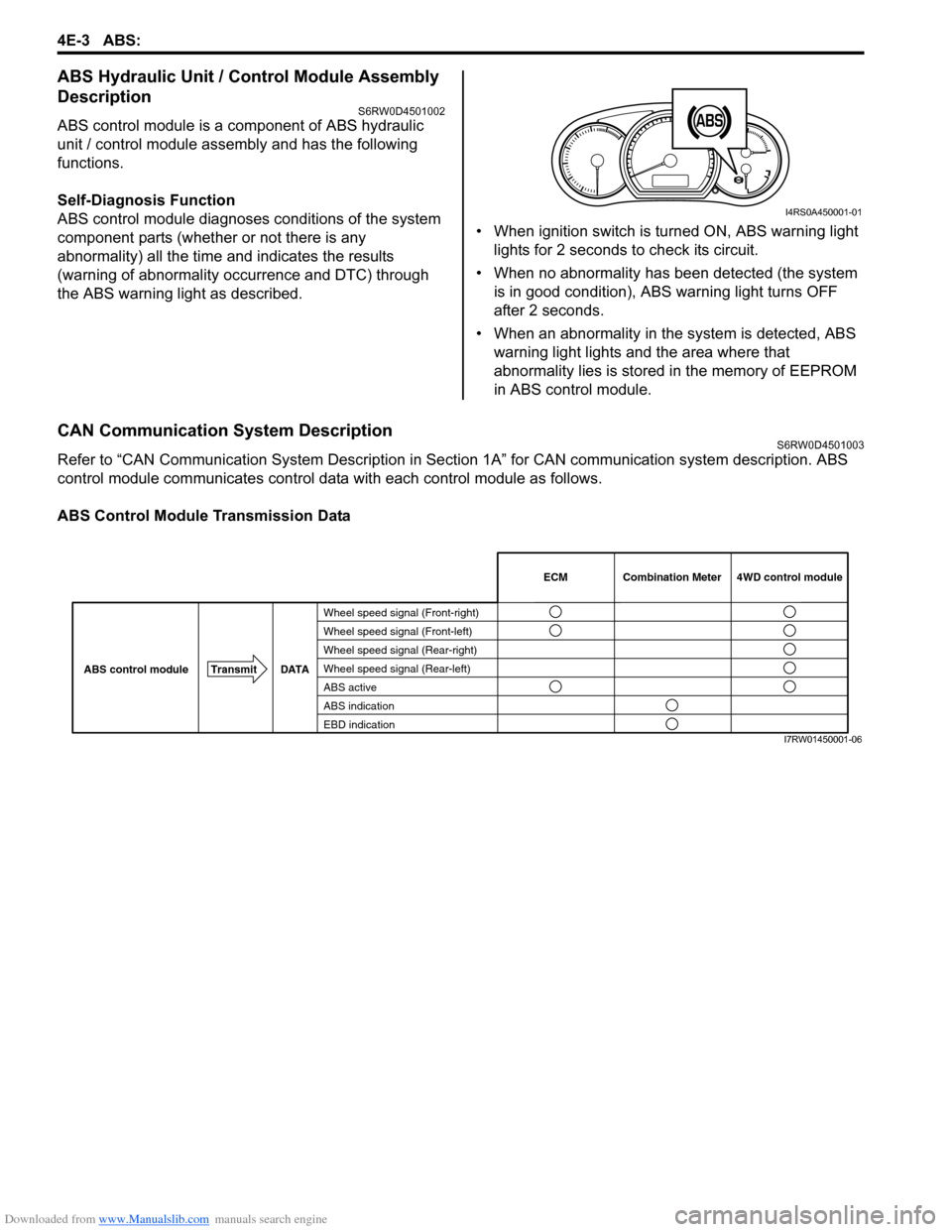
the ABS warning light as described.• When ignition switch is turned ON, ABS warning light
lights for 2 seconds to check its circuit.
• When no abnormality has been detected (the system
is in good condition), ABS warning light turns OFF
after 2 seconds.
• When an abnormality in the system is detected, ABS
warning light lights and the area where that
abnormality lies is stored in the memory of EEPROM
in ABS control module.
CAN Communication System DescriptionS6RW0D4501003
Refer to “CAN Communication System Description in Section 1A” for CAN communication system description. ABS
control module communicates control data with each control module as follows.
ABS Control Module Transmission Data
1
I4RS0A450001-01
Wheel speed signal (Front-right)
Wheel speed signal (Front-left)
Wheel speed signal (Rear-right)
Wheel speed signal (Rear-left)
ABS active
ABS indication
EBD indicationCombination Meter
TransmitDATA
ABS control module ECM 4WD control module
I7RW01450001-06