ECU SUZUKI XL7 2007 2.G Owner's Guide
[x] Cancel search | Manufacturer: SUZUKI, Model Year: 2007, Model line: XL7, Model: SUZUKI XL7 2007 2.GPages: 274, PDF Size: 6.12 MB
Page 177 of 274
4-19 DRIVING YOUR VEHICLE
78J00-03E
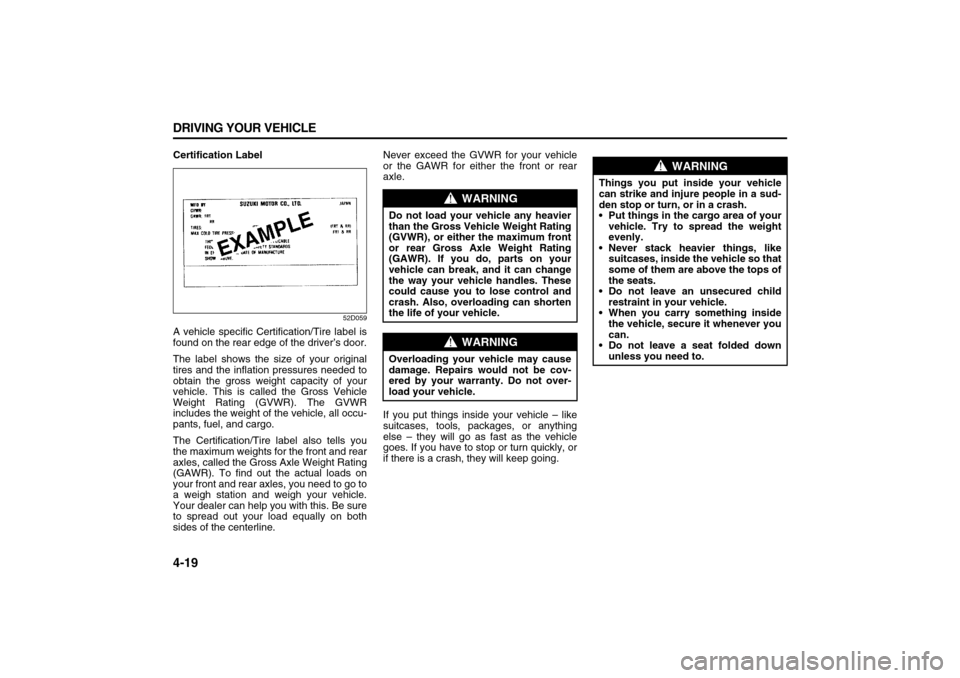
Certification Label
52D059
A vehicle specific Certification/Tire label is
found on the rear edge of the driver’s door.
The label shows the size of your original
tires and the inflation pressures needed to
obtain the gross weight capacity of your
vehicle. This is called the Gross Vehicle
Weight Rating (GVWR). The GVWR
includes the weight of the vehicle, all occu-
pants, fuel, and cargo.
The Certification/Tire label also tells you
the maximum weights for the front and rear
axles, called the Gross Axle Weight Rating
(GAWR). To find out the actual loads on
your front and rear axles, you need to go to
a weigh station and weigh your vehicle.
Your dealer can help you with this. Be sure
to spread out your load equally on both
sides of the centerline.Never exceed the GVWR for your vehicle
or the GAWR for either the front or rear
axle.
If you put things inside your vehicle – like
suitcases, tools, packages, or anything
else – they will go as fast as the vehicle
goes. If you have to stop or turn quickly, or
if there is a crash, they will keep going.
WARNING
Do not load your vehicle any heavier
than the Gross Vehicle Weight Rating
(GVWR), or either the maximum front
or rear Gross Axle Weight Rating
(GAWR). If you do, parts on your
vehicle can break, and it can change
the way your vehicle handles. These
could cause you to lose control and
crash. Also, overloading can shorten
the life of your vehicle.
WARNING
Overloading your vehicle may cause
damage. Repairs would not be cov-
ered by your warranty. Do not over-
load your vehicle.
WARNING
Things you put inside your vehicle
can strike and injure people in a sud-
den stop or turn, or in a crash.
Put things in the cargo area of your
vehicle. Try to spread the weight
evenly.
Never stack heavier things, like
suitcases, inside the vehicle so that
some of them are above the tops of
the seats.
Do not leave an unsecured child
restraint in your vehicle.
When you carry something inside
the vehicle, secure it whenever you
can.
Do not leave a seat folded down
unless you need to.
Page 182 of 274

4-24 DRIVING YOUR VEHICLE
78J00-03E
your rig. Acquaint yourself with the feel of
handling and braking with the added
weight of the trailer. And always keep in
mind that the vehicle you are driving is now
a good deal longer and not nearly as
responsive as your vehicle is by itself.
Before you start, check all trailer hitch
parts and attachments, safety chains, elec-
trical connector, lamps, tires and mirror
adjustment. If the trailer has electric
brakes, start your vehicle and trailer mov-
ing and then apply the trailer brake control-
ler by hand to be sure the brakes are
working. This lets you check your electrical
connection at the same time.
During your trip, check occasionally to be
sure that the load is secure, and that the
lamps and any trailer brakes are still work-
ing.
Following Distance
Stay at least twice as far behind the vehicle
ahead as you would when driving your
vehicle without a trailer. This can help you
avoid situations that require heavy braking
and sudden turns.
Passing
You will need more passing distance up
ahead when you are towing a trailer. And,
because you are a good deal longer, you
will need to go much farther beyond the
passed vehicle before you can return to
your lane.Backing Up
Hold the bottom of the steering wheel with
one hand. Then, to move the trailer to the
left, just move that hand to the left. To
move the trailer to the right, move your
hand to the right. Always back up slowly
and, if possible, have someone guide you.
Making Turns
When you are turning with a trailer, make
wider turns than normal. Do this so your
trailer will not strike soft shoulders, curbs,
road signs, trees or other objects. Avoid
jerky or sudden maneuvers. Signal well in
advance.
Turn Signals When Towing a Trailer
When you tow a trailer, your vehicle has to
have extra wiring.
The arrows on your instrument panel will
flash whenever you signal a turn or lane
change. Properly hooked up, the trailer
lamps will also flash, telling other drivers
you are about to turn, change lanes or
stop.When towing a trailer, the arrows on your
instrument panel will flash for turns even if
the bulbs on the trailer are burned out.
Thus, you may think drivers behind you are
seeing your signal when they are not. It’s
important to check occasionally to be sure
the trailer bulbs are still working.
Driving On Grades
Reduce speed and shift to a lower gear
before you start down a long or steep
downgrade. If you do not shift down, you
might have to use your brakes so much
that they would get hot and no longer work
well.
Parking on Hills
But if you ever have to park your rig on a
hill, do the following:
1) Apply your regular brakes, but do not
shift into PARK (P) yet.
2) Have someone place chocks under the
trailer wheels.
3) When the wheel chocks are in place,
release the regular brakes until the
chocks absorb the load.
CAUTION
Making very sharp turns while traile-
ring could cause the trailer to come
in contact with the vehicle. Your vehi-
cle could be damaged. Avoid making
very sharp turns while trailering.
WARNING
You really should not park your vehi-
cle, with a trailer attached, on a hill. If
something goes wrong, your rig
could start to move. People can be
injured, and both your vehicle and
the trailer can be damaged.
Page 208 of 274
5-24 SERVICE AND APPEARANCE CARE
78J00-03E
1802297
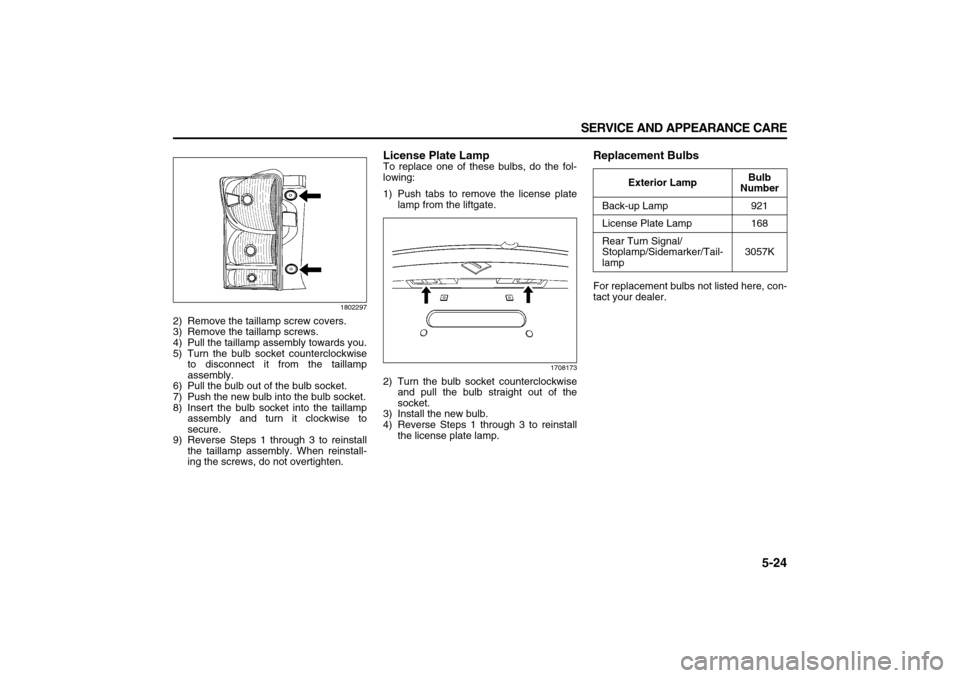
2) Remove the taillamp screw covers.
3) Remove the taillamp screws.
4) Pull the taillamp assembly towards you.
5) Turn the bulb socket counterclockwise
to disconnect it from the taillamp
assembly.
6) Pull the bulb out of the bulb socket.
7) Push the new bulb into the bulb socket.
8) Insert the bulb socket into the taillamp
assembly and turn it clockwise to
secure.
9) Reverse Steps 1 through 3 to reinstall
the taillamp assembly. When reinstall-
ing the screws, do not overtighten.
License Plate LampTo replace one of these bulbs, do the fol-
lowing:
1) Push tabs to remove the license plate
lamp from the liftgate.
1708173
2) Turn the bulb socket counterclockwise
and pull the bulb straight out of the
socket.
3) Install the new bulb.
4) Reverse Steps 1 through 3 to reinstall
the license plate lamp.
Replacement BulbsFor replacement bulbs not listed here, con-
tact your dealer.
Exterior LampBulb
Number
Back-up Lamp 921
License Plate Lamp 168
Rear Turn Signal/
Stoplamp/Sidemarker/Tail-
lamp3057K
Page 209 of 274
5-25 SERVICE AND APPEARANCE CARE
78J00-03E
Windshield Wiper Blade
ReplacementWindshield wiper blades should be
inspected for wear or cracking. Refer to
“Scheduled Maintenance” in “Mainte-
nance Schedule” in the “Maintenance
Schedule” section for more information.
Replacement blades come in different
types and are removed in different ways.
For proper type and length, refer to “Nor-
mal Maintenance Replacement Parts” in
“Maintenance Schedule” in the “Mainte-
nance Schedule” section.
Here’s how to replace the windshield wiper
blades:
1) Make sure the front wipers are turned
off.
2) Pull the windshield wiper arm away
from the windshield.
811525
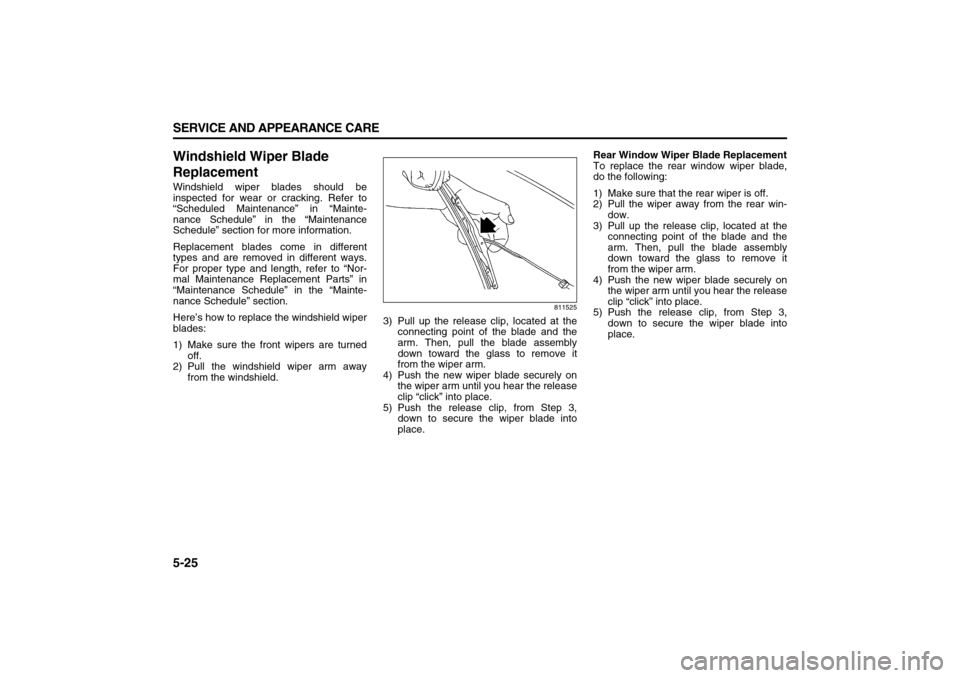
3) Pull up the release clip, located at the
connecting point of the blade and the
arm. Then, pull the blade assembly
down toward the glass to remove it
from the wiper arm.
4) Push the new wiper blade securely on
the wiper arm until you hear the release
clip “click” into place.
5) Push the release clip, from Step 3,
down to secure the wiper blade into
place.Rear Window Wiper Blade Replacement
To replace the rear window wiper blade,
do the following:
1) Make sure that the rear wiper is off.
2) Pull the wiper away from the rear win-
dow.
3) Pull up the release clip, located at the
connecting point of the blade and the
arm. Then, pull the blade assembly
down toward the glass to remove it
from the wiper arm.
4) Push the new wiper blade securely on
the wiper arm until you hear the release
clip “click” into place.
5) Push the release clip, from Step 3,
down to secure the wiper blade into
place.
Page 229 of 274
5-45 SERVICE AND APPEARANCE CARE
78J00-03E
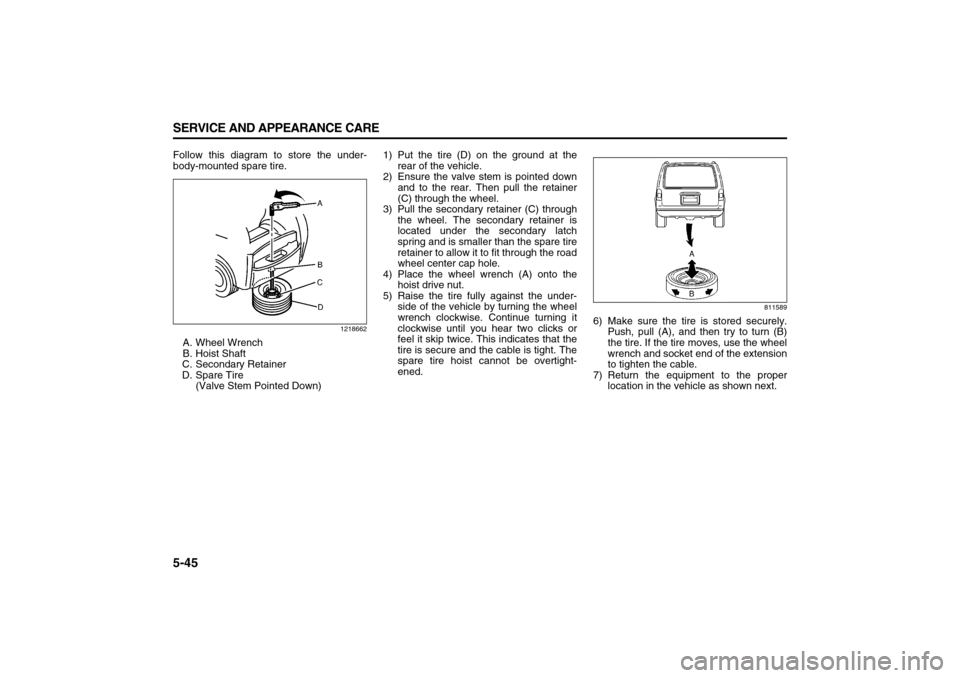
Follow this diagram to store the under-
body-mounted spare tire.
1218662
A. Wheel Wrench
B. Hoist Shaft
C. Secondary Retainer
D. Spare Tire
(Valve Stem Pointed Down)1) Put the tire (D) on the ground at the
rear of the vehicle.
2) Ensure the valve stem is pointed down
and to the rear. Then pull the retainer
(C) through the wheel.
3) Pull the secondary retainer (C) through
the wheel. The secondary retainer is
located under the secondary latch
spring and is smaller than the spare tire
retainer to allow it to fit through the road
wheel center cap hole.
4) Place the wheel wrench (A) onto the
hoist drive nut.
5) Raise the tire fully against the under-
side of the vehicle by turning the wheel
wrench clockwise. Continue turning it
clockwise until you hear two clicks or
feel it skip twice. This indicates that the
tire is secure and the cable is tight. The
spare tire hoist cannot be overtight-
ened.
811589
6) Make sure the tire is stored securely.
Push, pull (A), and then try to turn (B)
the tire. If the tire moves, use the wheel
wrench and socket end of the extension
to tighten the cable.
7) Return the equipment to the proper
location in the vehicle as shown next.
Page 230 of 274
5-46 SERVICE AND APPEARANCE CARE
78J00-03E
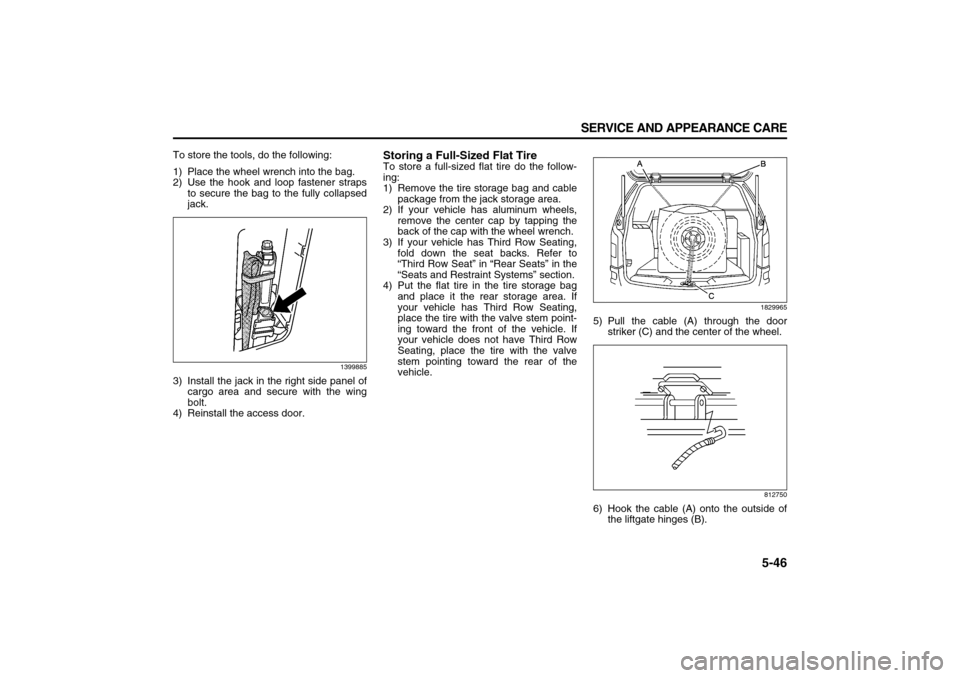
To store the tools, do the following:
1) Place the wheel wrench into the bag.
2) Use the hook and loop fastener straps
to secure the bag to the fully collapsed
jack.
1399885
3) Install the jack in the right side panel of
cargo area and secure with the wing
bolt.
4) Reinstall the access door.
Storing a Full-Sized Flat TireTo store a full-sized flat tire do the follow-
ing:
1) Remove the tire storage bag and cable
package from the jack storage area.
2) If your vehicle has aluminum wheels,
remove the center cap by tapping the
back of the cap with the wheel wrench.
3) If your vehicle has Third Row Seating,
fold down the seat backs. Refer to
“Third Row Seat” in “Rear Seats” in the
“Seats and Restraint Systems” section.
4) Put the flat tire in the tire storage bag
and place it the rear storage area. If
your vehicle has Third Row Seating,
place the tire with the valve stem point-
ing toward the front of the vehicle. If
your vehicle does not have Third Row
Seating, place the tire with the valve
stem pointing toward the rear of the
vehicle.
1829965
5) Pull the cable (A) through the door
striker (C) and the center of the wheel.
812750
6) Hook the cable (A) onto the outside of
the liftgate hinges (B).
Page 231 of 274
5-47 SERVICE AND APPEARANCE CARE
78J00-03E
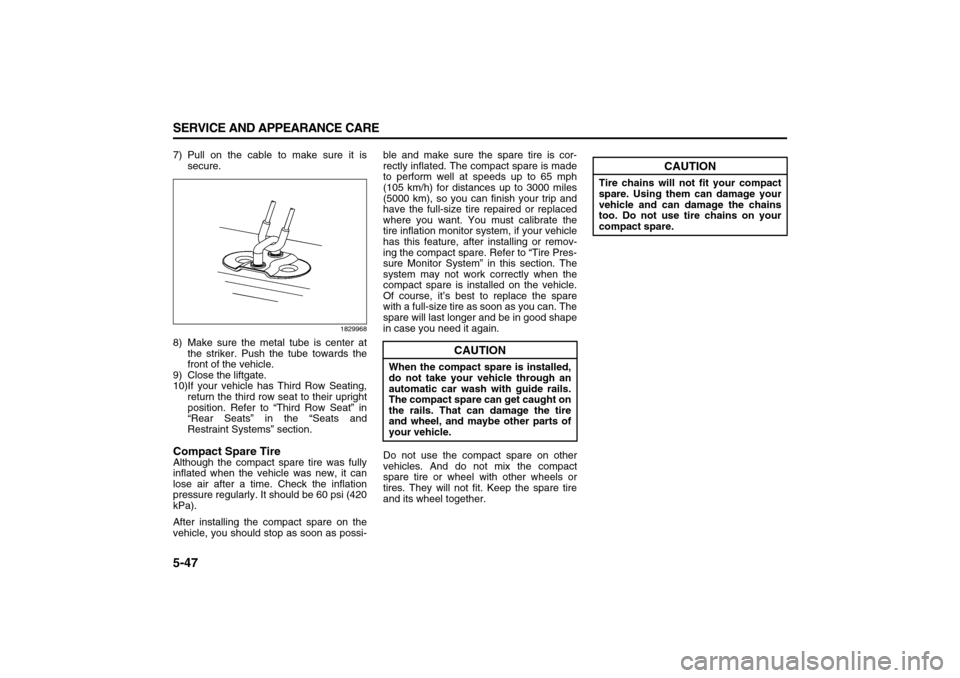
7) Pull on the cable to make sure it is
secure.
1829968
8) Make sure the metal tube is center at
the striker. Push the tube towards the
front of the vehicle.
9) Close the liftgate.
10)If your vehicle has Third Row Seating,
return the third row seat to their upright
position. Refer to “Third Row Seat” in
“Rear Seats” in the “Seats and
Restraint Systems” section.Compact Spare TireAlthough the compact spare tire was fully
inflated when the vehicle was new, it can
lose air after a time. Check the inflation
pressure regularly. It should be 60 psi (420
kPa).
After installing the compact spare on the
vehicle, you should stop as soon as possi-ble and make sure the spare tire is cor-
rectly inflated. The compact spare is made
to perform well at speeds up to 65 mph
(105 km/h) for distances up to 3000 miles
(5000 km), so you can finish your trip and
have the full-size tire repaired or replaced
where you want. You must calibrate the
tire inflation monitor system, if your vehicle
has this feature, after installing or remov-
ing the compact spare. Refer to “Tire Pres-
sure Monitor System” in this section. The
system may not work correctly when the
compact spare is installed on the vehicle.
Of course, it’s best to replace the spare
with a full-size tire as soon as you can. The
spare will last longer and be in good shape
in case you need it again.
Do not use the compact spare on other
vehicles. And do not mix the compact
spare tire or wheel with other wheels or
tires. They will not fit. Keep the spare tire
and its wheel together.
CAUTION
When the compact spare is installed,
do not take your vehicle through an
automatic car wash with guide rails.
The compact spare can get caught on
the rails. That can damage the tire
and wheel, and maybe other parts of
your vehicle.
CAUTION
Tire chains will not fit your compact
spare. Using them can damage your
vehicle and can damage the chains
too. Do not use tire chains on your
compact spare.
Page 256 of 274

6-14 MAINTENANCE SCHEDULE
78J00-03E
At Each Fuel FillIt is important to perform these underhood
checks at each fuel fill.
Engine Oil Level Check
Check the engine oil level and add the
proper oil if necessary. Refer to “Engine
Oil” in “Checking Things Under the Hood”
in the “Service and Appearance Care” sec-
tion for further details.
Engine Coolant Level Check
Check the engine coolant level and add
DEX-COOL
® coolant mixture if necessary.
Refer to “Engine Coolant” in “Checking
Things Under the Hood” in the “Service
and Appearance Care” section for further
details.
Windshield Washer Fluid Level Check
Check the windshield washer fluid level in
the windshield washer fluid reservoir and
add the proper fluid if necessary.
At Least Once a MonthTire Inflation Check
Visually inspect your vehicle’s tires and
make sure they are inflated to the correct
pressures. Do not forget to check the
spare tire. Open the driver’s door to find
the Tire Information Placard which lists the
recommended tire inflation pressures.
Check to make sure the spare tire is stored
securely. Refer to “Changing a Flat Tire” in
“Tires” in the “Service and Appearance
Care” section.
Tire Wear Inspection
Tire rotation may be required for high mile-
age highway drivers prior to the Engine Oil
Life System service notification. Check the
tires for wear and, if necessary, rotate the
tires. Refer to “Tire Inspection and Rota-
tion” in “Tires” in the “Service and Appear-
ance Care” section.
At Least Once a YearStarter Switch Check
1) Before you start, be sure you have
enough room around the vehicle.
2) Firmly apply both the parking brake and
the regular brake. Refer to “Parking
Brake” in “Starting and Operating Your
Vehicle” in the “Features and Controls”
section.
Do not use the accelerator pedal, and
be ready to turn off the engine immedi-
ately if it starts.
3) Try to start the engine in each gear.
The vehicle should start only in PARK
(P) or NEUTRAL (N). If the vehicle
starts in any other position, contact
your dealer for service.
CAUTION
It is important to check the engine oil
regularly and keep it at the proper
level. Failure to keep the engine oil at
the proper level can cause damage to
the engine not covered by your war-
ranty.
WARNING
When you are doing this inspection,
the vehicle could move suddenly. If
the vehicle moves, you or others
could be injured.
Page 271 of 274

8-4 INDEX
78J00-03E N
National Highway Traffic Safety Administration
(NHTSA)
................................................................................7-3
Navigation/Radio System
...................................................3-67
New Vehicle Break-In
..........................................................2-12
Normal Maintenance Replacement Parts
..........................6-17
OOff-Road Recovery
..............................................................4-7
Oil Pressure Light ................................................................3-23
Older Children
......................................................................1-18
On-Board Vehicle Computers and Event Data
Recorders
.............................................................................7-2
Other Warning Devices
.......................................................3-3
Outlet Adjustment
...............................................................3-13
Outside Convex Mirrors
......................................................2-21
Outside Power Mirrors ........................................................2-21
Owner Checks and Services
..............................................6-13
PParking Brake
......................................................................2-17
Parking Over Things That Burn
.........................................2-18
Passenger Airbag Status Indicator ....................................3-17
Passenger Compartment Air Filter ....................................3-14
Passenger Folding Seatback
..............................................1-5
Passenger Safety Belt Reminder Light
.............................3-16
Passenger Sensing System
................................................1-39
Passing
.................................................................................4-7
PASS-Key® III+
....................................................................2-10
Power Door Locks ...............................................................2-5
Power Seat
...........................................................................1-1
Power Steering Fluid
...........................................................5-16
Power Windows
...................................................................2-8Power Windows and Other Power Options
...................... 5-53
Programmable Automatic Door Locks
............................. 2-6
QQuestions and Answers About Safety Belts
.................... 1-10
RRadio Reception
.................................................................. 3-74
Radio with CD (Base)
.......................................................... 3-41
Radio with CD (MP3) ........................................................... 3-44
Radio with CD and DVD (MP3)
........................................... 3-49
Rear Air Conditioning and Heating System
..................... 3-13
Rear Air Conditioning and Heating System and
Electronic Climate Controls
............................................... 3-14
Rear Door Security Locks
.................................................. 2-6
Rear Seat Entertainment System
...................................... 3-67
Rear Seat Passengers
........................................................ 1-15
Rear Seats
........................................................................... 1-6
Rear Window Wiper/Washer
.............................................. 3-5
Recommended Fluids and Lubricants
.............................. 6-16
Recreational Vehicle Towing
............................................. 4-20
Reduced Engine Power Light ............................................ 3-24
Remote Keyless Entry (RKE) System
............................... 2-1
Remote Keyless Entry (RKE) System Operation
............. 2-2
Remote Vehicle Start
.......................................................... 2-4
Replacement Bulbs
............................................................. 5-24
Replacing Restraint System Parts After a Crash
............. 1-43
Reporting Safety Defects
................................................... 7-3
Restraint System Check ..................................................... 1-42
Retained Accessory Power (RAP)
..................................... 2-13
Right Front Passenger Position
........................................ 1-15
Running the Engine While Parked .................................... 2-19
Page 272 of 274

8-5 INDEX
78J00-03E S
Safety Belt Extender
............................................................1-18
Safety Belt Pretensioners
...................................................1-18
Safety Belt Reminder Light .................................................3-16
Safety Belts
: They Are for Everyone .................................1-9
Safety Certification Label
...................................................7-1
Scheduled Maintenance
......................................................6-2
Scheduled Maintenance except CANADA
.........................6-3
Securing a Child Restraint Designed for the LATCH
System
..................................................................................1-28
Securing a Child Restraint in a Rear Seat Position
..........1-29
Securing a Child Restraint in the Right Front Seat
Position
................................................................................1-31
Securing an Add-on Child Restraint in the Vehicle
..........1-23
Securing the Child Within the Child Restraint
..................1-23
Security Light
.......................................................................3-24
Service
..................................................................................5-1
Service All-Wheel Drive Light
.............................................3-25
Service Parts Identification Label
......................................5-53
Service Vehicle Soon Light
................................................3-26
Servicing Your Airbag-Equipped Vehicle
..........................1-42
Sheet Metal Damage
............................................................5-51
Shifting Into Park (P) ...........................................................2-17
Shifting Out of Park (P) .......................................................2-18
Speedometer and Odometer
..............................................3-15
Split Folding the Second Row Seat
...................................1-6
Starting and Operating Your Vehicle .................................2-12
Starting the Engine
..............................................................2-13
Steering
................................................................................4-6
Storage Areas
......................................................................2-21
Storing a Full-Sized Flat Tire
..............................................5-46Sun Visors
........................................................................... 2-9
Sunroof
................................................................................ 2-24
TTachometer
.......................................................................... 3-16
Taillamps, Turn Signal, Stoplamps and Back-up
Lamps
.................................................................................. 5-23
Theft-Deterrent Feature
...................................................... 3-73
Theft-Deterrent Systems .................................................... 2-9
Tilt Wheel
............................................................................. 3-3
Tire Chains .......................................................................... 5-37
Tire Inspection and Rotation
............................................. 5-33
Tire Pressure Light
............................................................. 3-21
Tire Pressure Monitor System
........................................... 5-31
Tire Sidewall Labeling
........................................................ 5-26
Tire Size
............................................................................... 5-27
Tire Terminology and Definitions
...................................... 5-28
Tires
............................................................................5-26
, 5-51
Top Tether Anchor
.............................................................. 1-27
Towing
................................................................................. 4-20
Towing Your Vehicle
........................................................... 4-20
Traction Control System (TCS)
.......................................... 4-5
Traction Control System (TCS) Warning Light
................ 3-20
Transfer Case (Power Transfer Unit)
................................ 5-22
Trip Odometer
..................................................................... 3-15
Turn Signal/Multifunction Lever
........................................ 3-3
UUnderbody Maintenance
.................................................... 5-51
Uniform Tire Quality Grading
............................................. 5-35
Using the Maintenance Schedule
...................................... 6-1
VVehicle Care/Appearance Materials
.................................. 5-52