ECU TESLA MODEL S 2014 (Europe) Owner's Guide
[x] Cancel search | Manufacturer: TESLA, Model Year: 2014, Model line: MODEL S, Model: TESLA MODEL S 2014Pages: 152, PDF Size: 17.5 MB
Page 104 of 152
Tire Care and MaintenanceTire Care and Maintenance
7.6MODEL S OWNERS MANUAL
Using Tire Chains
Tesla has tested and approved Security Chain
Company (SCC) Model Z-563 chains for use on
the rear wheels. These chains must only be
used if your Model S has 245/45R19 rear tires
installed. Do not use chains on 21” tires.
When installing tire chains, follow the
instructions provided by the tire chain
manufacturer. Mount them as tightly as
possible.
When using tire chains:
•Drive slowly—do not exceed 48 km/h.
•Avoid heavily loading Model S (heavy loads
can reduce the clearance between the tires
and the body).
•Remove the tire chains as soon as
conditions allow.
NOTE: Tire chains are prohibited in some
jurisdictions. Check local laws before installing
tire chains.
CAUTION: Using non-recommended tire
chains, or using tire chains on other sized
tires, can damage the suspension, body,
wheels, and/or brake lines. Damage caused by
using non-recommended tire chains is not
covered by the warranty.
CAUTION: Ensure that tire chains cannot
touch suspension components or brake
lines. If you hear the chains making
unusual noises that would indicate contact with
Model S, stop and investigate immediately.
Tire Pressure Monitoring
Each tire should be checked monthly when
cold and inflated to the recommended
pressures that are printed on the Tire and
Loading Information label located on the
driver’s door pillar (see page 7.3). If your
vehicle has tires of a different size than the size
indicated on the vehicle placard or tire inflation
pressure label, determine the proper tire
inflation pressure for those tires.
As an added safety feature, your vehicle has
been equipped with a tire pressure monitoring
system (TPMS) that displays a low tire pressure
telltale (Tire Pressure Warning) on the
instrument panel when one or more of your
tires is significantly under-inflated. Accordingly,
when the Tire Pressure indicator light displays
on the instrument panel alerting you of low tire pressure, stop and check your tires as soon as
possible, and inflate them to the proper
pressure (see page 7.3). Driving on a
significantly under-inflated tire causes the tire
to overheat and can lead to tire failure.
Under-inflation also reduces fuel efficiency and
tire tread life, and may affect the vehicle's
handling and stopping ability.
If Model S detects a fault with the Tire
Pressure Monitoring System (TPMS),
this indicator flashes for one minute
whenever you power on Model S.
NOTE: Installing accessories that are not
approved by Tesla can interfere with the TPMS
system.
WARNING: The TPMS is not a substitute
for proper tire maintenance, including
manually checking tire pressures and regularly
inspecting the condition of tires. It is the
driver's responsibility to maintain correct tire
pressure, even if under-inflation has not
reached the level for the TPMS to trigger the
Tire Pressure Warning on the instrument panel.
TPMS Malfunction
Model S has also been equipped with a TPMS
malfunction indicator to indicate when the
system is not operating properly.
The TPMS malfunction indicator is combined
with the low tire pressure indicator light. When
the system detects a malfunction, the indicator
light flashes for approximately one minute after
Model S powers on, and then remains
continuously lit. This sequence continues upon
subsequent vehicle start-ups as long as the
malfunction exists.
When the TPMS malfunction indicator is on, the
system might not be able to detect or signal
low tire pressure as intended. TPMS
malfunctions can occur for a variety of reasons,
including installing replacement or alternate
tires or wheels on the vehicle that prevent the
TPMS from functioning properly. Always check
the TPMS malfunction indicator light after
replacing one or more tires or wheels on your
vehicle to ensure that the replacement or
alternate tires and wheels allow the TPMS to
continue to function properly.
NOTE: If a tire has been replaced or repaired
using a different tire sealant than the one
available from Tesla, and a low tire pressure is
book.book Page 6 Friday, July 19, 2013 12:53 PM
Page 107 of 152
Temporary Tire Repair
MAINTENANCE7.9
Inflating with Sealant and Air
If you have a Tesla tire repair kit as described on
page 7.8, follow these steps to temporarily
repair a small tire puncture (less than 6 mm).
1.Stop Model S in a safe place away from
traffic and ask passengers to wait in a safe
area.
2.Turn on the hazard warning flashers to alert
other road users.
3.If possible, position the wheel with the
puncture at the bottom.
4.Detach the power supply connector from
the back of the compressor and plug it into
the 12V power socket located on the front
of the center console.
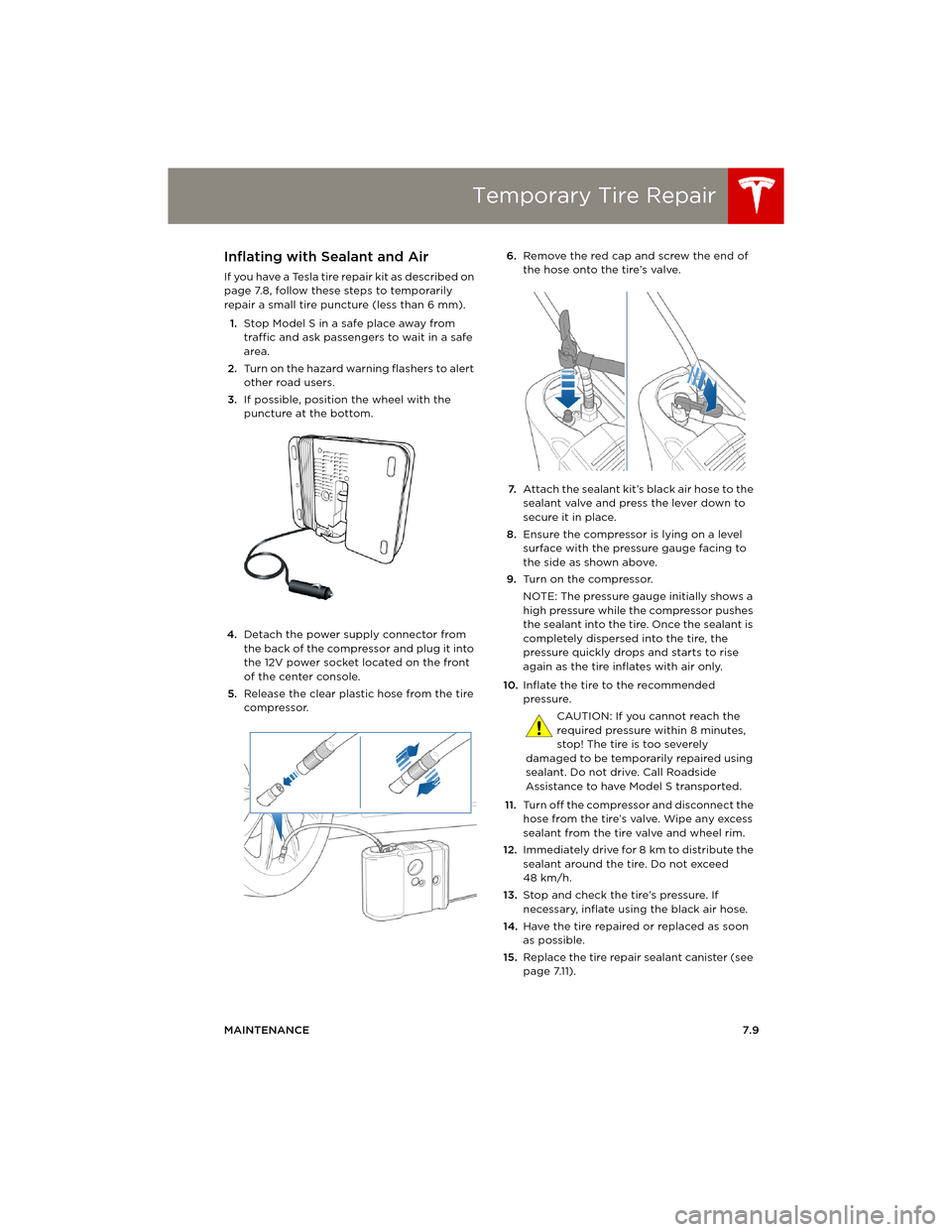
5.Release the clear plastic hose from the tire
compressor.6.Remove the red cap and screw the end of
the hose onto the tire’s valve.
7.Attach the sealant kit’s black air hose to the
sealant valve and press the lever down to
secure it in place.
8.Ensure the compressor is lying on a level
surface with the pressure gauge facing to
the side as shown above.
9.Tu r n o n t h e c o m p r e s s o r.
NOTE: The pressure gauge initially shows a
high pressure while the compressor pushes
the sealant into the tire. Once the sealant is
completely dispersed into the tire, the
pressure quickly drops and starts to rise
again as the tire inflates with air only.
10.Inflate the tire to the recommended
pressure.
CAUTION: If you cannot reach the
required pressure within 8 minutes,
stop! The tire is too severely
damaged to be temporarily repaired using
sealant. Do not drive. Call Roadside
Assistance to have Model S transported.
11.Turn off the compressor and disconnect the
hose from the tire’s valve. Wipe any excess
sealant from the tire valve and wheel rim.
12.Immediately drive for 8 km to distribute the
sealant around the tire. Do not exceed
48 km/h.
13.Stop and check the tire’s pressure. If
necessary, inflate using the black air hose.
14.Have the tire repaired or replaced as soon
as possible.
15.Replace the tire repair sealant canister (see
page 7.11).
book.book Page 9 Friday, July 19, 2013 12:53 PM
Page 108 of 152
Temporary Tire RepairTemporary Tire Repair
7.10MODEL S OWNERS MANUAL
Inflating with Air Only
If you have a Tesla tire repair kit as described in
page 7.8, follow these steps to inflate a tire with
air:
1.Detach the power supply connector from
the rear of the compressor and plug it into
the 12V power socket located in Model S on
the front of center console.
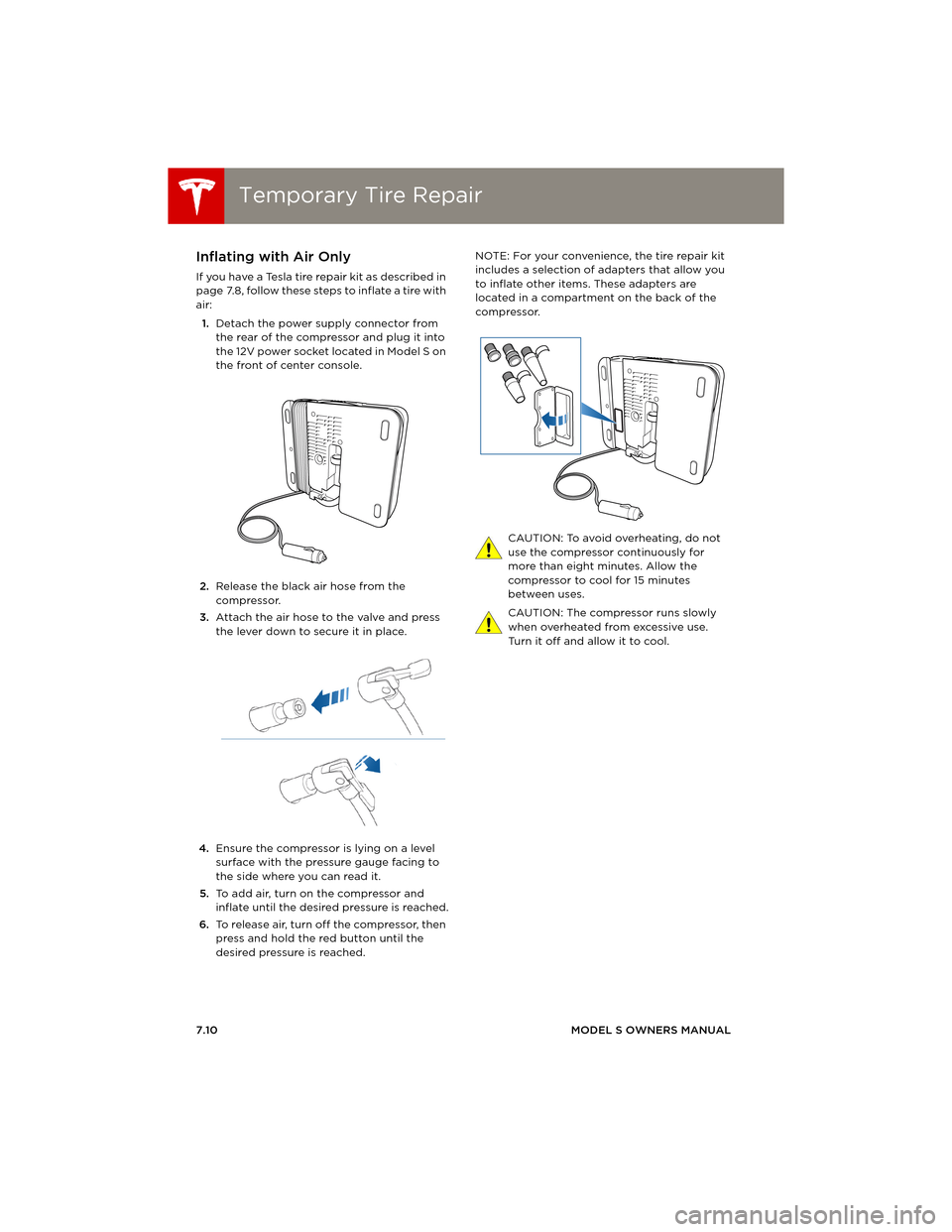
2.Release the black air hose from the
compressor.
3.Attach the air hose to the valve and press
the lever down to secure it in place.
4.Ensure the compressor is lying on a level
surface with the pressure gauge facing to
the side where you can read it.
5.To add air, turn on the compressor and
inflate until the desired pressure is reached.
6.To release air, turn off the compressor, then
press and hold the red button until the
desired pressure is reached.NOTE: For your convenience, the tire repair kit
includes a selection of adapters that allow you
to inflate other items. These adapters are
located in a compartment on the back of the
compressor.
CAUTION: To avoid overheating, do not
use the compressor continuously for
more than eight minutes. Allow the
compressor to cool for 15 minutes
between uses.
CAUTION: The compressor runs slowly
when overheated from excessive use.
Turn it off and allow it to cool.
book.book Page 10 Friday, July 19, 2013 12:53 PM
Page 112 of 152
CleaningCleaning
7.14MODEL S OWNERS MANUAL
Polishing, Touch Up, and Body
Repair
To preserve the cosmetic appearance of the
body, you can occasionally treat the paint
surfaces with an approved polish containing:
•Very mild abrasive to remove surface
contamination without removing or
damaging the paint.
•Filling compounds that fill scratches and
reduce their visibility.
•Wax to provide a protective coating
between the paint and environmental
elements.
Regularly inspect the exterior paint for
damage. Treat minor chips and scratches using
a paint touch up pen (available for purchase
from Tesla). Use the touch-up pen after
washing but before polishing or waxing.
Repair rock chips, fractures or scratches. Body
repairs should be performed only by a Tesla
approved body repair facility. Contact Tesla for
a list of approved facilities.
CAUTION: Do not use cutting pastes,
color restoration compounds, or polishes
containing harsh abrasives. These can
scour the surface and permanently damage the
paint.
CAUTION: Do not use chrome polish or
other abrasive cleaners.
Using a Car Cover
To preserve the cosmetic appearance of the
body when Model S is not being used, use a
genuine Tesla car cover. Car covers can be
purchased from Tesla.
CAUTION: Never use a non-Tesla car
cover when Model S is plugged in. Doing
so can prevent the Battery from being
adequately cooled during charging.
Floor Mats
To e x t e n d t h e l i f e o f y o u r c a r p e t a n d m a k e t h e m
easier to clean, use genuine Tesla floor mats.
Maintain mats by cleaning them regularly and
replacing them if they become excessively
worn.
WARNING: To avoid potential
interference with a foot pedal, ensure
that the driver’s floor mat is securely
fastened, and never place an additional floor
mat on top of it.
maintenance.fm Page 14 Thursday, July 25, 2013 12:49 PM
Page 135 of 152
9.1
ROADSIDE ASSISTANCE
About Roadside Assistance
Contacting Roadside Assistance................ 9.2
Regional Roadside Assistance Numbers. 9.2
Instructions for TransportersUse a Flatbed Only ......................................... 9.3
Disable Self-Leveling (air suspension vehi-
cles only) ............................................................ 9.3
Activate Tow Mode ........................................ 9.3
Connect the Tow Chain ................................ 9.3
Pull Onto the Trailer and Secure
the Wheels...................................................... 9.4
book.book Page 1 Friday, July 19, 2013 12:53 PM
Page 138 of 152
Instructions for TransportersInstructions for Transporters
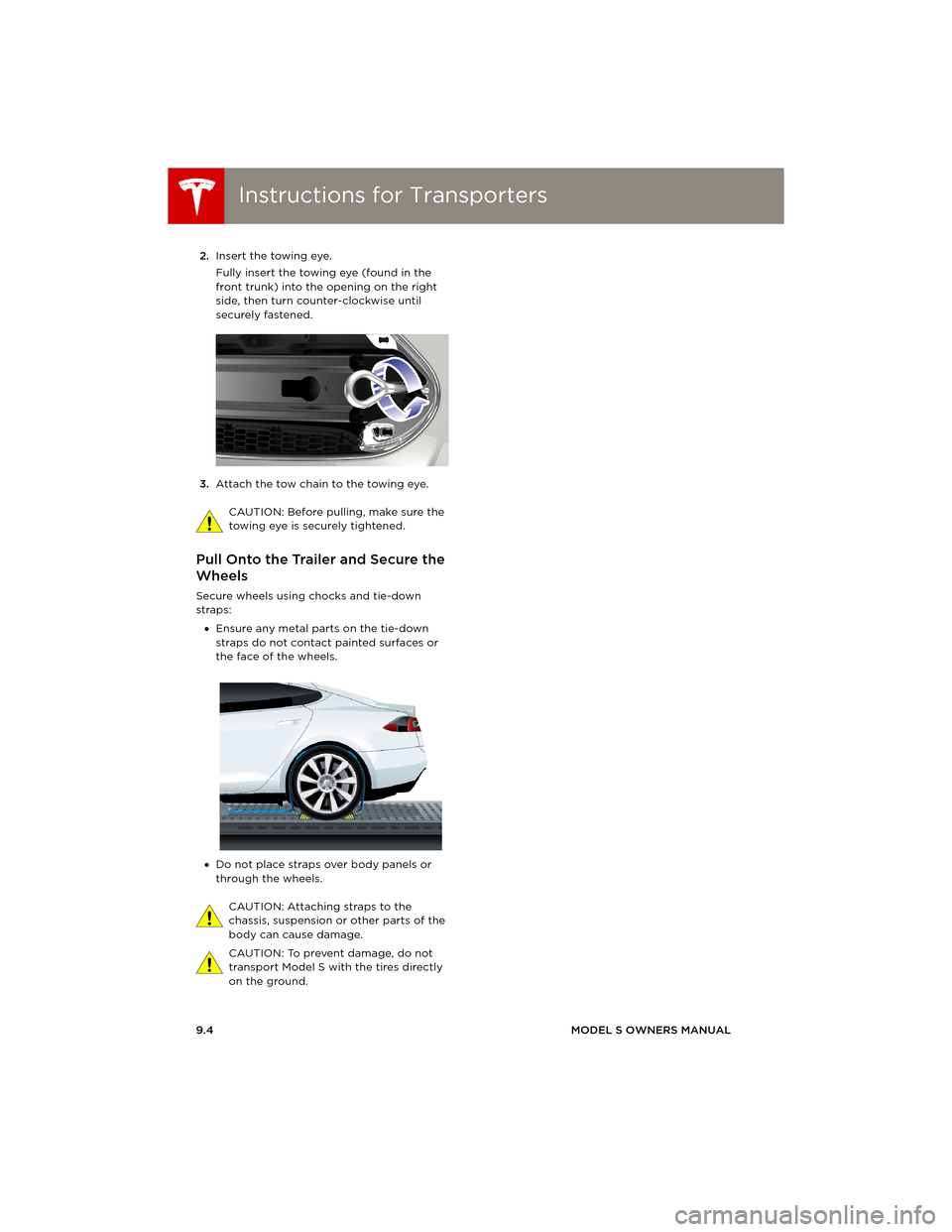
9.4MODEL S OWNERS MANUAL 2.Insert the towing eye.
Fully insert the towing eye (found in the
front trunk) into the opening on the right
side, then turn counter-clockwise until
securely fastened.
3.Attach the tow chain to the towing eye.
CAUTION: Before pulling, make sure the
towing eye is securely tightened.
Pull Onto the Trailer and Secure the
Wheels
Secure wheels using chocks and tie-down
straps:
•Ensure any metal parts on the tie-down
straps do not contact painted surfaces or
the face of the wheels.
•Do not place straps over body panels or
through the wheels.
CAUTION: Attaching straps to the
chassis, suspension or other parts of the
body can cause damage.
CAUTION: To prevent damage, do not
transport Model S with the tires directly
on the ground.
book.book Page 4 Friday, July 19, 2013 12:53 PM
Page 147 of 152
v
INDEX
range
displayed on instrument panel ................... 4-8
driving tips to maximize ............................. 4-19
regenerative braking .................................... 4-21
Rated range ............................................................ 4-8
rear facing child seats
folding
.................................................................3-12
opening ...............................................................3-11
safety information ......................................... 3-14
seating a child ..................................................3-13
usage restrictions ............................................3-11
rear seats
folding
.................................................................. 3-3
raising .................................................................. 3-3
rear view camera ............................................... 4-24
rear window switches, disabling .................... 2-7
regenerative braking ......................................... 4-21
release notes ....................................................... 5-24
remote window opening ................................... 2-7
reverse gear ............................................................ 4-7
roadside assistance ............................................. 9-2
S
safety information
airbags ................................................................3-18
child seats ........................................................ 3-10
rear facing child seats ................................. 3-14
seat belts ............................................................ 3-6
seat belts
cleaning
..............................................................7-13
fastening ............................................................. 3-4
in a collision ....................................................... 3-5
overview ............................................................. 3-4
pre-tensioners ................................................... 3-5
safety instructions ........................................... 3-6
testing .................................................................. 3-5
wearing ................................................................ 3-4
wearing when pregnant ................................ 3-4
seat covers .............................................................. 3-3
seat heaters ............................................................ 5-8
seating capacity .................................................... 8-3
seating position, driver ...................................... 3-2
seats
adjusting
............................................................. 3-2
heaters ................................................................. 5-8
rear facing, folding .........................................3-12
rear facing, opening ........................... 3-11, 3-12
rear facing, safety information ................. 3-14
rear facing, seating a child ..........................3-13
rear facing, usage restrictions ....................3-11
security settings .................................................5-22
service data recording ..................................... 10-2
service intervals .................................................... 7-2
Settings .................................................................... 5-6
shifting gears ......................................................... 4-7
software updates .............................................. 5-24specifications
12V battery
......................................................... 8-7
brakes ...................................................................8-6
dimensions .........................................................8-5
exterior ................................................................8-5
high voltage Battery ....................................... 8-7
motor ....................................................................8-6
steering ................................................................8-6
suspension .......................................................... 8-7
tires .......................................................................8-8
transmission .......................................................8-6
weights ................................................................8-5
wheels ..................................................................8-8
stability control .................................................. 4-22
starting Model S ................................................... 4-6
Statutory Plate ...................................................... 8-4
steering specifications ........................................8-6
steering wheel
adjusting position
............................................4-3
adjusting sensitivity ........................................4-3
controls, left .......................................................4-3
controls, right ................................................... 4-4
sunroof .................................................................... 2-12
suspension
automatic adjustments
................................. 5-11
indicator lights ................................................. 5-11
Jack mode ......................................................... 5-11
manual settings ............................................... 5-11
T
telematics .............................................................. 10-2
telephone
answering a call
............................................... 4-4
Bluetooth, general information ................ 5-17
call menu ........................................................... 5-18
connecting ........................................................ 5-18
displaying call menu ...................................... 4-4
instrument panel menu ............................... 5-18
making a call .................................................... 5-18
receiving a call ................................................ 5-18
steering wheel buttons ................................. 4-4
temperature
Battery (high voltage), limits
..................... 6-4
cabin, controls for ...........................................5-8
cabin, operating tips ..................................... 5-10
outside ................................................................ 4-8
tie-down straps .................................................... 9-4
tilt detection ........................................................ 5-22
Tire Pressure Monitoring System
malfunction
........................................................7-6
overview ..............................................................7-6
replacing a tire sensor ................................... 7-7
tire pressure, checking ....................................... 7-3
tire repair kit ........................................................... 7-8
inflating with air only .................................... 7-10
inflating with sealant ......................................7-9
replacing the sealant canister .................... 7-11
book.book Page v Friday, July 19, 2013 12:53 PM
Page 148 of 152
vi
INDEXINDEX
tires
asymmetric ........................................................ 7-5
balancing ............................................................7-4
chains ................................................................... 7-6
flat spots .............................................................7-4
inspecting .................................................7-4, 7-5
installing new .................................................... 7-5
pressure monitoring ....................................... 7-6
pressures, how to check ............................... 7-3
punctures ............................................................7-4
replacing ............................................................. 7-5
replacing a tire sensor ................................... 7-7
replacing tire sealant ......................................7-11
rotation of ...........................................................7-4
specification ......................................................8-8
tire sealant .......................................................... 7-8
understanding tire markings ..................... 8-10
wear patterns ....................................................7-4
winter ................................................................... 7-5
touch up body ..................................................... 7-14
touchscreen
brightness
........................................................... 5-2
cleaning ............................................................. 7-13
Controls ...............................................................5-4
overview .............................................................. 5-2
Settings ............................................................... 5-6
software updates .......................................... 5-24
tow chain, connecting ........................................ 9-3
Tow mode ............................................................... 9-3
towing
connecting the tow chain
............................. 9-3
Jack mode .......................................................... 9-3
keeping Model S in Neutral ..........................9-3
securing the wheels ....................................... 9-4
towing a trailer ......................................................8-4
towing instructions .............................................. 9-3
TPMS
malfunction
........................................................ 7-6
overview .............................................................. 7-6
replacing a tire sensor ................................... 7-7
traction control .................................................. 4-22
traffic alerts ........................................................... 5-14
trailer hitches .........................................................8-4
transmission specifications ...............................8-6
transporting
connecting the tow chain
............................. 9-3
Jack mode .......................................................... 9-3
keeping Model S in Neutral ..........................9-3
securing the wheels ....................................... 9-4
trip information ................................................... 4-18
trunk, front
closing
................................................................ 2-10
inside emergency release .............................2-11
opening .............................................................. 2-10
opening, no power ..........................................2-11trunk, rear
adjust opening height
....................................2-8
child protection locks .....................................2-5
closing ..................................................................2-8
disabling interior handle ...............................2-5
interior release ................................................. 2-9
opening ................................................................2-8
opening, no power ......................................... 2-9
Ttire and Loading Information label ..............8-3
TuneIn ...................................................................... 5-14
turn signals ............................................................4-14
U
Units & Format ...................................................... 5-6
unlocking
passive
.................................................................2-2
trunk, front ........................................................ 2-10
trunk, rear ...........................................................2-8
using the touchscreen ................................... 2-4
when key does not work ...............................2-5
with key ...............................................................2-2
USB devices
connecting
........................................................ 5-16
playing audio files from ............................... 5-15
USB ports ............................................................... 5-16
V
Vehicle Identification Number (VIN) .............8-2
vehicle loading
determining load limit
................................... 8-4
general information .........................................8-3
information label ..............................................8-3
load calculation examples ........................... 8-4
vent, sunroof ......................................................... 2-12
ventilation ................................................... 5-9, 5-10
VIN (Vehicle Identification Number) .............8-2
volume control ............................................ 4-3, 5-2
W
walk-away locking ................................................2-5
warning flashers ..................................................4-14
warning lights
ABS
.................................................................... 4-20
air suspension ................................................... 5-11
airbag .................................................................. 3-18
Jack mode ......................................................... 5-11
summary of ....................................................... 4-9
tire pressure .......................................................7-3
traction control .............................................. 4-22
washer fluid, topping up .................................. 7-18
washer jets, cleaning ......................................... 7-15
washers ................................................................... 4-15
weight specifications ...........................................8-5
book.book Page vi Friday, July 19, 2013 12:53 PM