range TESLA MODEL S 2014 (Europe) Owner's Guide
[x] Cancel search | Manufacturer: TESLA, Model Year: 2014, Model line: MODEL S, Model: TESLA MODEL S 2014Pages: 152, PDF Size: 17.5 MB
Page 100 of 152
Maintenance ScheduleMaintenance Schedule
7.2MODEL S OWNERS MANUAL
MAINTENANCE
Maintenance ScheduleService Intervals
Regular maintenance is the key to ensuring the
continued reliability and efficiency of your
Model S.
Take Model S to Tesla at the regularly scheduled
maintenance intervals of every 12 months, or
every 20,000 kms, whichever comes first.
Model S must be serviced by Tesla-certified
technicians. Damages or failures caused by
maintenance or repairs performed by non-Tesla
certified technicians are not covered by the
warranty.
Fluid Replacement
Do not change or top up Battery coolant and
brake fluid yourself. Tesla service technicians
replace fluids at the regularly scheduled service
intervals:
•Brake fluid - every 2 years or 40,000 kms,
whichever comes first.
•Battery coolant - every 4 years or
80,000 kms, whichever comes first.
NOTE: Any damage from opening the Battery
coolant reservoir is excluded from the warranty.
Daily and Monthly Checks
In addition to the regularly scheduled
maintenance performed by Tesla, you should
carry out a few simple checks more frequently.
Daily Checks
•Check the Battery’s charge level, displayed
on the instrument panel.
•Check that all exterior lights, horn, turn
signals, and wipers and washers are
working.
•Check the operation of the brakes,
including the parking brake.
•Check the operation of the seat belts
(see page 3.5).
•Look for fluid deposits underneath Model S
that might indicate a leak. It is normal for a
small pool of water to form (caused by the
air conditioning system’s dehumidifying
process).
Monthly Checks
•Check the condition and pressure of each
tire (see page 7.3).
•Check washer fluid level and top up if
necessary (see page 7.18).
•Check that the air conditioning system is
operating (see page 5.9).
CAUTION: Contact Tesla immediately if
you notice any significant or sudden drop
in fluid levels or uneven tire wear.
High Voltage Safety
Your Model S has been designed and built with
safety as a priority. However, be aware of these
precautions to protect yourself from the risk of
injury inherent in all high-voltage systems:
•Read and follow all instructions provided on
the labels that are attached to Model S.
These labels are there for your safety.
•The high voltage system has no
user-serviceable parts. Do not disassemble,
remove or replace high voltage
components, cables or connectors. High
voltage cables are colored orange for easy
identification.
•If an accident occurs, do not touch any high
voltage wiring, connectors, or components
connected to the wiring.
•In the unlikely event that a fire occurs,
immediately contact your local fire
emergency responders.
WARNING: Always disconnect the charge
cable before working underneath
Model S, even if charging is not in progress.
WARNING: Keep your hands and clothing
away from cooling fans. Some fans
operate even when Model S is powered off.
WARNING: Some fluids (battery acid,
Battery coolant, brake fluid, windshield
washer additives, etc.) used in motor vehicles
are poisonous and should not be inhaled,
swallowed, or brought into contact with open
wounds. For your safety, always read and follow
instructions printed on fluid containers.
Dispose of used fluids and other
chemicals at authorized waste disposal
sites. It is illegal to pollute drains, waterways or
soil.
book.book Page 2 Friday, July 19, 2013 12:53 PM
Page 101 of 152
Tire Care and Maintenance
MAINTENANCE7.3
Tire Care and MaintenanceMaintaining Tire Pressures
Keep tires inflated to the pressures shown on
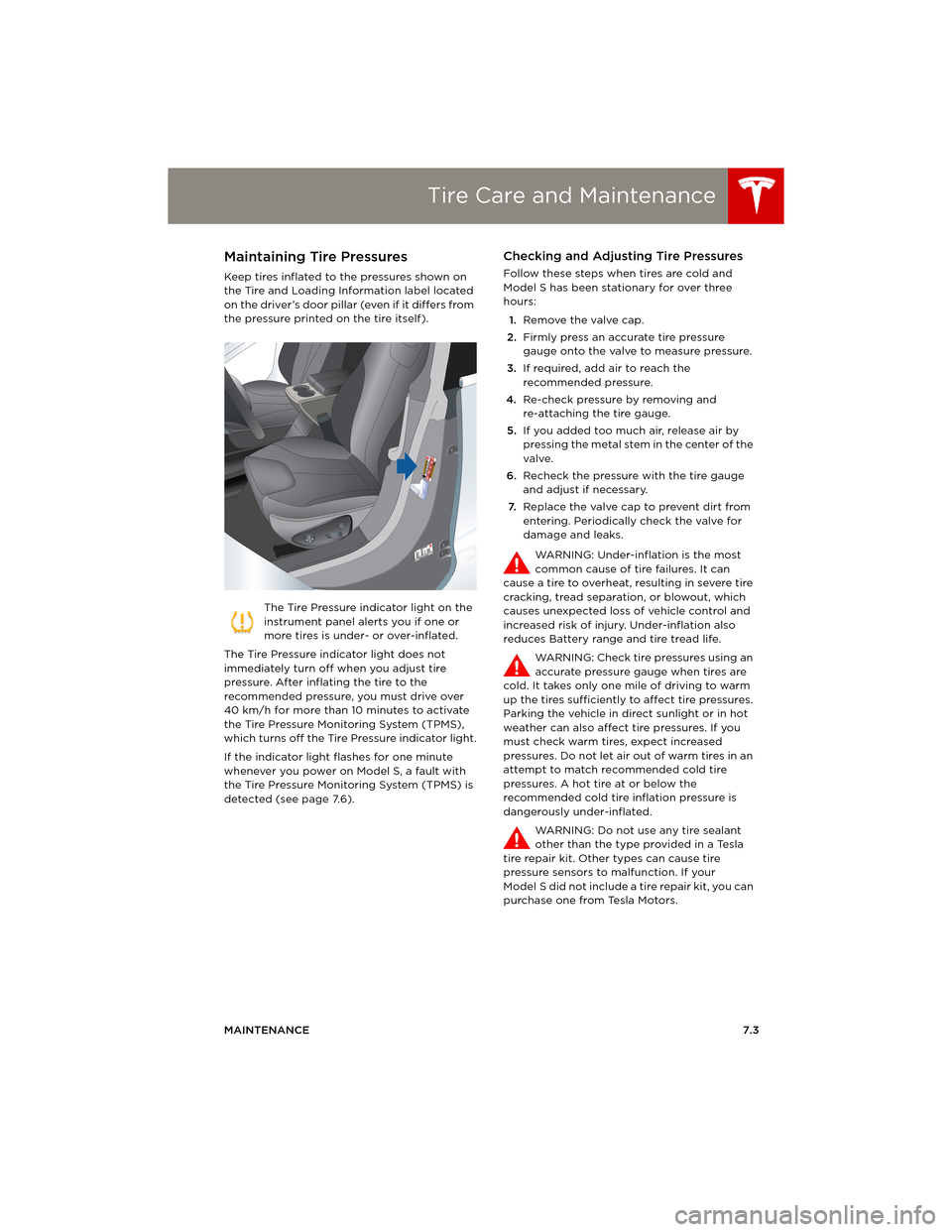
the Tire and Loading Information label located
on the driver’s door pillar (even if it differs from
the pressure printed on the tire itself).
The Tire Pressure indicator light on the
instrument panel alerts you if one or
more tires is under- or over-inflated.
The Tire Pressure indicator light does not
immediately turn off when you adjust tire
pressure. After inflating the tire to the
recommended pressure, you must drive over
40 km/h for more than 10 minutes to activate
the Tire Pressure Monitoring System (TPMS),
which turns off the Tire Pressure indicator light.
If the indicator light flashes for one minute
whenever you power on Model S, a fault with
the Tire Pressure Monitoring System (TPMS) is
detected (see page 7.6).
Checking and Adjusting Tire Pressures
Follow these steps when tires are cold and
Model S has been stationary for over three
hours:
1.Remove the valve cap.
2.Firmly press an accurate tire pressure
gauge onto the valve to measure pressure.
3.If required, add air to reach the
recommended pressure.
4.Re-check pressure by removing and
re-attaching the tire gauge.
5.If you added too much air, release air by
pressing the metal stem in the center of the
valve.
6.Recheck the pressure with the tire gauge
and adjust if necessary.
7.Replace the valve cap to prevent dirt from
entering. Periodically check the valve for
damage and leaks.
WARNING: Under-inflation is the most
common cause of tire failures. It can
cause a tire to overheat, resulting in severe tire
cracking, tread separation, or blowout, which
causes unexpected loss of vehicle control and
increased risk of injury. Under-inflation also
reduces Battery range and tire tread life.
WARNING: Check tire pressures using an
accurate pressure gauge when tires are
cold. It takes only one mile of driving to warm
up the tires sufficiently to affect tire pressures.
Parking the vehicle in direct sunlight or in hot
weather can also affect tire pressures. If you
must check warm tires, expect increased
pressures. Do not let air out of warm tires in an
attempt to match recommended cold tire
pressures. A hot tire at or below the
recommended cold tire inflation pressure is
dangerously under-inflated.
WARNING: Do not use any tire sealant
other than the type provided in a Tesla
tire repair kit. Other types can cause tire
pressure sensors to malfunction. If your
Model S did not include a tire repair kit, you can
purchase one from Tesla Motors.
book.book Page 3 Friday, July 19, 2013 12:53 PM
Page 102 of 152
Tire Care and MaintenanceTire Care and Maintenance
7.4MODEL S OWNERS MANUAL
Inspecting and Maintaining Tires
Regularly inspect the tread and side walls for
any sign of distortion (bulges), cuts or wear.
WARNING: Do not drive Model S if a tire
is damaged, excessively worn, or inflated
to an incorrect pressure. Check tires regularly
for wear, and ensure there are no cuts, bulges or
exposure of the ply/cord structure.
Tire Wear
Model S is originally fitted with tires that have
wear indicators molded into the tread pattern.
When the tread has been worn down to 1.6 mm,
the indicators start to appear at the surface of
the tread pattern, producing the effect of a
continuous band of rubber across the width of
the tire.
Replace a tire as soon as an indicator band
becomes visible or the tread depth reaches the
minimum permitted by law.
Tire Rotation, Balance, and Wheel
Alignment
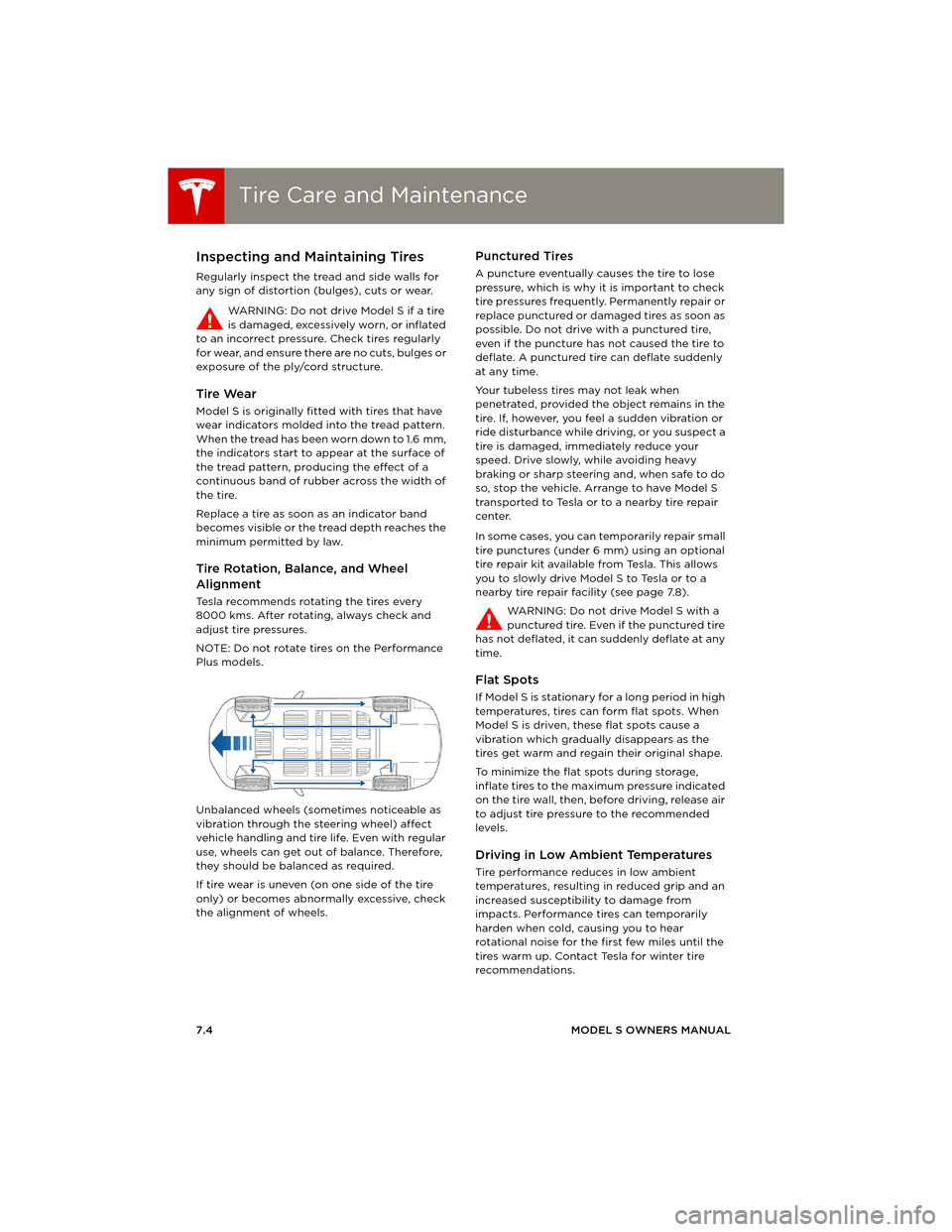
Tesla recommends rotating the tires every
8000 kms. After rotating, always check and
adjust tire pressures.
NOTE: Do not rotate tires on the Performance
Plus models.
Unbalanced wheels (sometimes noticeable as
vibration through the steering wheel) affect
vehicle handling and tire life. Even with regular
use, wheels can get out of balance. Therefore,
they should be balanced as required.
If tire wear is uneven (on one side of the tire
only) or becomes abnormally excessive, check
the alignment of wheels.
Punctured Tires
A puncture eventually causes the tire to lose
pressure, which is why it is important to check
tire pressures frequently. Permanently repair or
replace punctured or damaged tires as soon as
possible. Do not drive with a punctured tire,
even if the puncture has not caused the tire to
deflate. A punctured tire can deflate suddenly
at any time.
Your tubeless tires may not leak when
penetrated, provided the object remains in the
tire. If, however, you feel a sudden vibration or
ride disturbance while driving, or you suspect a
tire is damaged, immediately reduce your
speed. Drive slowly, while avoiding heavy
braking or sharp steering and, when safe to do
so, stop the vehicle. Arrange to have Model S
transported to Tesla or to a nearby tire repair
center.
In some cases, you can temporarily repair small
tire punctures (under 6 mm) using an optional
tire repair kit available from Tesla. This allows
you to slowly drive Model S to Tesla or to a
nearby tire repair facility (see page 7.8).
WARNING: Do not drive Model S with a
punctured tire. Even if the punctured tire
has not deflated, it can suddenly deflate at any
time.
Flat Spots
If Model S is stationary for a long period in high
temperatures, tires can form flat spots. When
Model S is driven, these flat spots cause a
vibration which gradually disappears as the
tires get warm and regain their original shape.
To minimize the flat spots during storage,
inflate tires to the maximum pressure indicated
on the tire wall, then, before driving, release air
to adjust tire pressure to the recommended
levels.
Driving in Low Ambient Temperatures
Tire performance reduces in low ambient
temperatures, resulting in reduced grip and an
increased susceptibility to damage from
impacts. Performance tires can temporarily
harden when cold, causing you to hear
rotational noise for the first few miles until the
tires warm up. Contact Tesla for winter tire
recommendations.
book.book Page 4 Friday, July 19, 2013 12:53 PM
Page 129 of 152
Subsystems
SPECIFICATIONS8.7
Suspension
Battery - 12V
Battery - High Voltage
Front Independent, double wishbone
Air spring or coil spring/telescopic damper
Sway bar
Rear Independent
Multi-link
Air spring or coil spring/telescopic damper
Sway bar (air suspension vehicles only)
For alignment values, see page 8.8.
Ty p e E X I D E U 1 R 3 7 0 X P W
Maintenance free, sealed for life
Rating 35 amp-hr
Cold Cranking Amps (CCA): 320 A
Voltage and Polarity 12V negative (-)
Type Liquid-cooled Lithium ion (Li-ion)
Rating 60 or 85 kWh (at beginning of life)
Voltage and Polarity 366V DC
Negative (-) ground
Temperature Range Do not expose the High Voltage Battery to
ambient temperatures above 60° C or below -30°
C for more than 24 hours at a time.
book.book Page 7 Friday, July 19, 2013 12:53 PM
Page 144 of 152
ii
INDEXINDEX
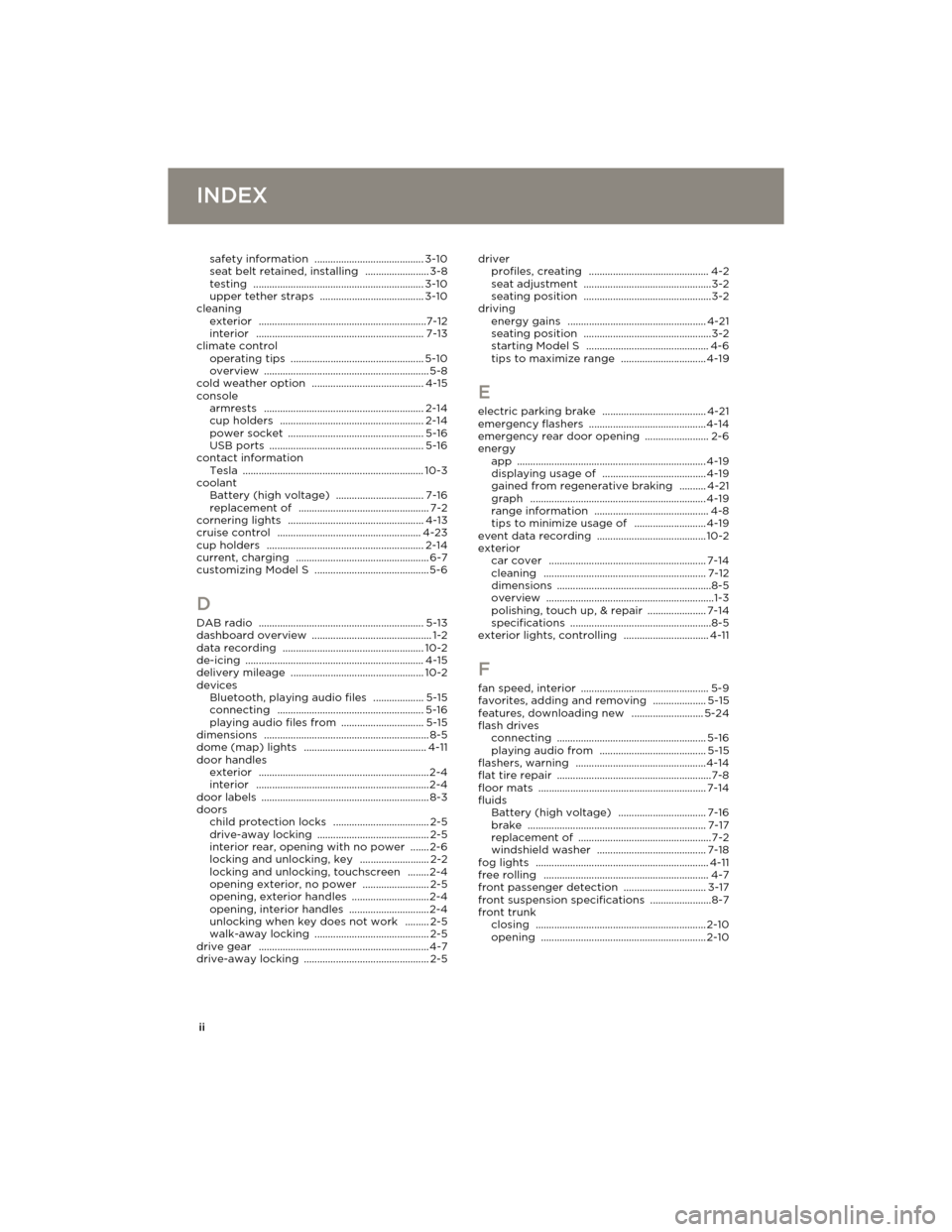
safety information ......................................... 3-10
seat belt retained, installing ........................ 3-8
testing ................................................................ 3-10
upper tether straps ....................................... 3-10
cleaning
exterior
...............................................................7-12
interior ............................................................... 7-13
climate control
operating tips
.................................................. 5-10
overview .............................................................. 5-8
cold weather option .......................................... 4-15
console
armrests
............................................................ 2-14
cup holders ...................................................... 2-14
power socket ................................................... 5-16
USB ports .......................................................... 5-16
contact information
Tesla
.................................................................... 10-3
coolant
Battery (high voltage)
................................. 7-16
replacement of ................................................. 7-2
cornering lights ................................................... 4-13
cruise control ...................................................... 4-23
cup holders ........................................................... 2-14
current, charging .................................................. 6-7
customizing Model S ........................................... 5-6
D
DAB radio .............................................................. 5-13
dashboard overview ............................................. 1-2
data recording ..................................................... 10-2
de-icing ................................................................... 4-15
delivery mileage .................................................. 10-2
devices
Bluetooth, playing audio files
................... 5-15
connecting ....................................................... 5-16
playing audio files from ............................... 5-15
dimensions .............................................................. 8-5
dome (map) lights .............................................. 4-11
door handles
exterior
................................................................2-4
interior .................................................................2-4
door labels ............................................................... 8-3
doors
child protection locks
.................................... 2-5
drive-away locking .......................................... 2-5
interior rear, opening with no power ....... 2-6
locking and unlocking, key .......................... 2-2
locking and unlocking, touchscreen ........2-4
opening exterior, no power ......................... 2-5
opening, exterior handles .............................2-4
opening, interior handles ..............................2-4
unlocking when key does not work ......... 2-5
walk-away locking ........................................... 2-5
drive gear ................................................................4-7
drive-away locking ............................................... 2-5driver
profiles, creating
............................................. 4-2
seat adjustment ................................................3-2
seating position ................................................3-2
driving
energy gains
.................................................... 4-21
seating position ................................................3-2
starting Model S .............................................. 4-6
tips to maximize range ................................ 4-19
E
electric parking brake ....................................... 4-21
emergency flashers ............................................4-14
emergency rear door opening ........................ 2-6
energy
app
....................................................................... 4-19
displaying usage of .......................................4-19
gained from regenerative braking .......... 4-21
graph .................................................................. 4-19
range information ........................................... 4-8
tips to minimize usage of ........................... 4-19
event data recording ......................................... 10-2
exterior
car cover
........................................................... 7-14
cleaning ............................................................. 7-12
dimensions ..........................................................8-5
overview ...............................................................1-3
polishing, touch up, & repair ...................... 7-14
specifications .....................................................8-5
exterior lights, controlling ................................ 4-11
F
fan speed, interior ................................................ 5-9
favorites, adding and removing .................... 5-15
features, downloading new ........................... 5-24
flash drives
connecting
........................................................ 5-16
playing audio from ........................................ 5-15
flashers, warning .................................................4-14
flat tire repair ..........................................................7-8
floor mats ............................................................... 7-14
fluids
Battery (high voltage)
................................. 7-16
brake ................................................................... 7-17
replacement of ..................................................7-2
windshield washer ......................................... 7-18
fog lights ................................................................. 4-11
free rolling .............................................................. 4-7
front passenger detection ............................... 3-17
front suspension specifications .......................8-7
front trunk
closing
................................................................ 2-10
opening .............................................................. 2-10
book.book Page ii Friday, July 19, 2013 12:53 PM
Page 145 of 152
iii
INDEX
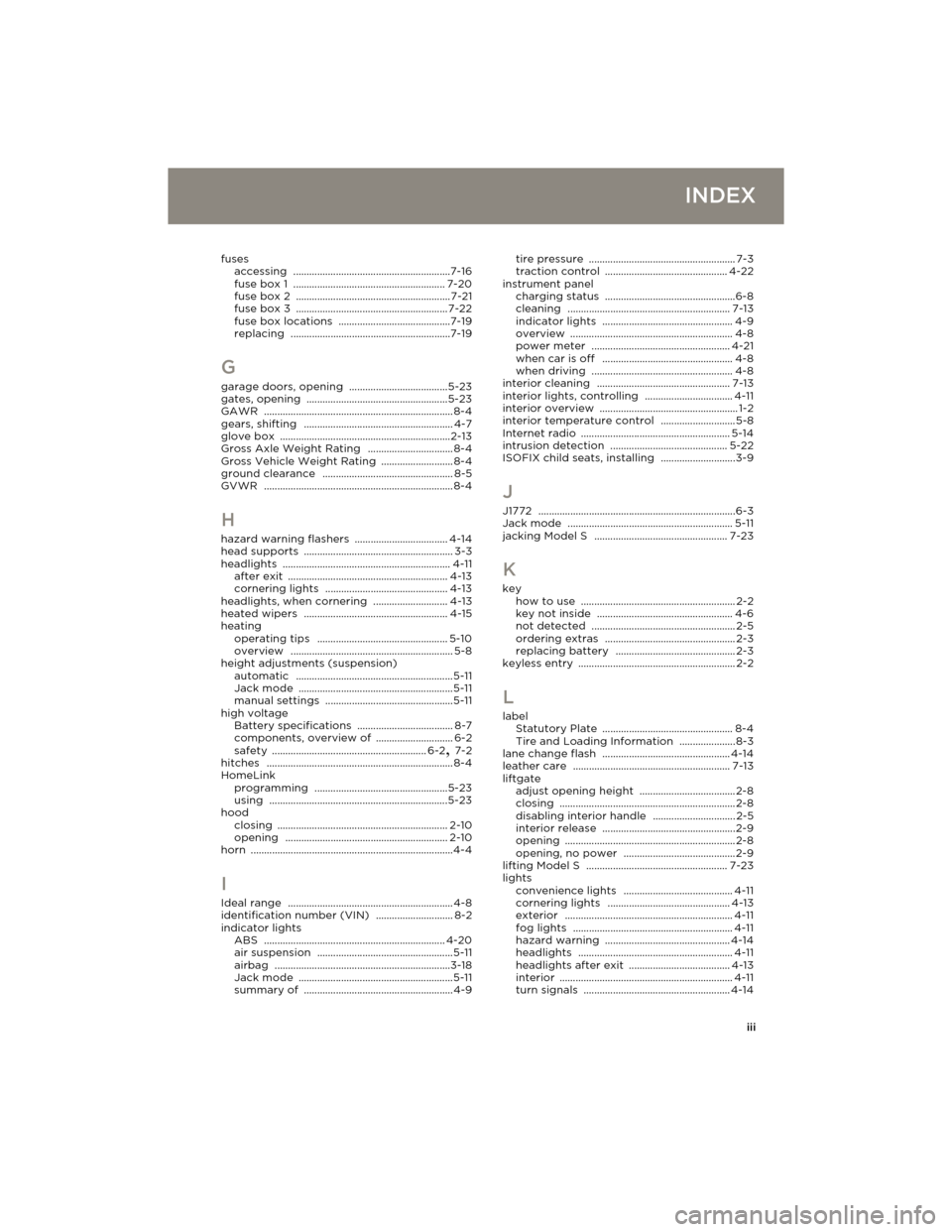
fuses
accessing ...........................................................7-16
fuse box 1 ......................................................... 7-20
fuse box 2 .......................................................... 7-21
fuse box 3 ......................................................... 7-22
fuse box locations ..........................................7-19
replacing ............................................................7-19
G
garage doors, opening .....................................5-23
gates, opening .....................................................5-23
GAWR ....................................................................... 8-4
gears, shifting ........................................................ 4-7
glove box ................................................................2-13
Gross Axle Weight Rating ................................ 8-4
Gross Vehicle Weight Rating ........................... 8-4
ground clearance ................................................. 8-5
GVWR ....................................................................... 8-4
H
hazard warning flashers ................................... 4-14
head supports ........................................................ 3-3
headlights ............................................................... 4-11
after exit ............................................................ 4-13
cornering lights .............................................. 4-13
headlights, when cornering ............................ 4-13
heated wipers ...................................................... 4-15
heating
operating tips
................................................. 5-10
overview ............................................................. 5-8
height adjustments (suspension)
automatic
...........................................................5-11
Jack mode ..........................................................5-11
manual settings ................................................5-11
high voltage
Battery specifications
.................................... 8-7
components, overview of ............................. 6-2
safety .......................................................... 6-2, 7-2
hitches ...................................................................... 8-4
HomeLink
programming
..................................................5-23
using ...................................................................5-23
hood
closing
................................................................ 2-10
opening ............................................................. 2-10
horn ............................................................................4-4
I
Ideal range .............................................................. 4-8
identification number (VIN) ............................. 8-2
indicator lights
ABS
.................................................................... 4-20
air suspension ...................................................5-11
airbag ..................................................................3-18
Jack mode ..........................................................5-11
summary of ........................................................4-9tire pressure
....................................................... 7-3
traction control .............................................. 4-22
instrument panel
charging status
.................................................6-8
cleaning ............................................................. 7-13
indicator lights ................................................. 4-9
overview ............................................................. 4-8
power meter .................................................... 4-21
when car is off ................................................. 4-8
when driving ..................................................... 4-8
interior cleaning .................................................. 7-13
interior lights, controlling ................................. 4-11
interior overview .................................................... 1-2
interior temperature control ............................5-8
Internet radio ........................................................ 5-14
intrusion detection ............................................ 5-22
ISOFIX child seats, installing ............................3-9
J
J1772 ..........................................................................6-3
Jack mode .............................................................. 5-11
jacking Model S .................................................. 7-23
K
key
how to use .......................................................... 2-2
key not inside ................................................... 4-6
not detected ...................................................... 2-5
ordering extras ................................................. 2-3
replacing battery ............................................. 2-3
keyless entry ........................................................... 2-2
L
label
Statutory Plate ................................................. 8-4
Tire and Loading Information .....................8-3
lane change flash ................................................ 4-14
leather care ........................................................... 7-13
liftgate
adjust opening height
.................................... 2-8
closing .................................................................. 2-8
disabling interior handle ............................... 2-5
interior release ..................................................2-9
opening ................................................................ 2-8
opening, no power ..........................................2-9
lifting Model S ..................................................... 7-23
lights
convenience lights
......................................... 4-11
cornering lights .............................................. 4-13
exterior ............................................................... 4-11
fog lights ............................................................ 4-11
hazard warning ............................................... 4-14
headlights .......................................................... 4-11
headlights after exit ...................................... 4-13
interior ................................................................. 4-11
turn signals ....................................................... 4-14
book.book Page iii Friday, July 19, 2013 12:53 PM
Page 147 of 152
v
INDEX
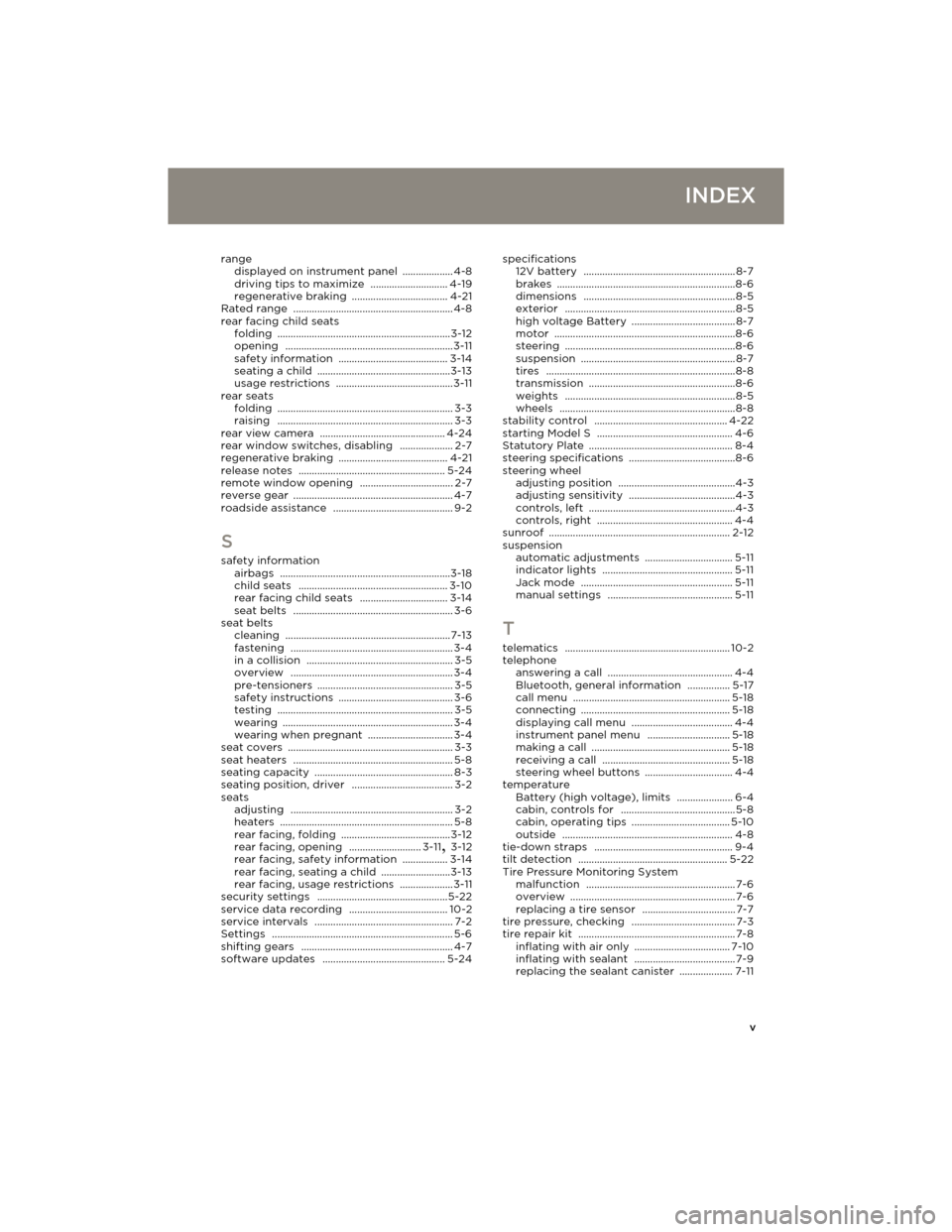
range
displayed on instrument panel ................... 4-8
driving tips to maximize ............................. 4-19
regenerative braking .................................... 4-21
Rated range ............................................................ 4-8
rear facing child seats
folding
.................................................................3-12
opening ...............................................................3-11
safety information ......................................... 3-14
seating a child ..................................................3-13
usage restrictions ............................................3-11
rear seats
folding
.................................................................. 3-3
raising .................................................................. 3-3
rear view camera ............................................... 4-24
rear window switches, disabling .................... 2-7
regenerative braking ......................................... 4-21
release notes ....................................................... 5-24
remote window opening ................................... 2-7
reverse gear ............................................................ 4-7
roadside assistance ............................................. 9-2
S
safety information
airbags ................................................................3-18
child seats ........................................................ 3-10
rear facing child seats ................................. 3-14
seat belts ............................................................ 3-6
seat belts
cleaning
..............................................................7-13
fastening ............................................................. 3-4
in a collision ....................................................... 3-5
overview ............................................................. 3-4
pre-tensioners ................................................... 3-5
safety instructions ........................................... 3-6
testing .................................................................. 3-5
wearing ................................................................ 3-4
wearing when pregnant ................................ 3-4
seat covers .............................................................. 3-3
seat heaters ............................................................ 5-8
seating capacity .................................................... 8-3
seating position, driver ...................................... 3-2
seats
adjusting
............................................................. 3-2
heaters ................................................................. 5-8
rear facing, folding .........................................3-12
rear facing, opening ........................... 3-11, 3-12
rear facing, safety information ................. 3-14
rear facing, seating a child ..........................3-13
rear facing, usage restrictions ....................3-11
security settings .................................................5-22
service data recording ..................................... 10-2
service intervals .................................................... 7-2
Settings .................................................................... 5-6
shifting gears ......................................................... 4-7
software updates .............................................. 5-24specifications
12V battery
......................................................... 8-7
brakes ...................................................................8-6
dimensions .........................................................8-5
exterior ................................................................8-5
high voltage Battery ....................................... 8-7
motor ....................................................................8-6
steering ................................................................8-6
suspension .......................................................... 8-7
tires .......................................................................8-8
transmission .......................................................8-6
weights ................................................................8-5
wheels ..................................................................8-8
stability control .................................................. 4-22
starting Model S ................................................... 4-6
Statutory Plate ...................................................... 8-4
steering specifications ........................................8-6
steering wheel
adjusting position
............................................4-3
adjusting sensitivity ........................................4-3
controls, left .......................................................4-3
controls, right ................................................... 4-4
sunroof .................................................................... 2-12
suspension
automatic adjustments
................................. 5-11
indicator lights ................................................. 5-11
Jack mode ......................................................... 5-11
manual settings ............................................... 5-11
T
telematics .............................................................. 10-2
telephone
answering a call
............................................... 4-4
Bluetooth, general information ................ 5-17
call menu ........................................................... 5-18
connecting ........................................................ 5-18
displaying call menu ...................................... 4-4
instrument panel menu ............................... 5-18
making a call .................................................... 5-18
receiving a call ................................................ 5-18
steering wheel buttons ................................. 4-4
temperature
Battery (high voltage), limits
..................... 6-4
cabin, controls for ...........................................5-8
cabin, operating tips ..................................... 5-10
outside ................................................................ 4-8
tie-down straps .................................................... 9-4
tilt detection ........................................................ 5-22
Tire Pressure Monitoring System
malfunction
........................................................7-6
overview ..............................................................7-6
replacing a tire sensor ................................... 7-7
tire pressure, checking ....................................... 7-3
tire repair kit ........................................................... 7-8
inflating with air only .................................... 7-10
inflating with sealant ......................................7-9
replacing the sealant canister .................... 7-11
book.book Page v Friday, July 19, 2013 12:53 PM