light TOYOTA 4RUNNER 2009 N280 / 5.G Owner's Manual
[x] Cancel search | Manufacturer: TOYOTA, Model Year: 2009, Model line: 4RUNNER, Model: TOYOTA 4RUNNER 2009 N280 / 5.GPages: 520, PDF Size: 10.74 MB
Page 83 of 520
83
1-4. Opening and closing the windows and moon roof
1
Before driving
■
The moon roof can be operated when
The engine switch is in the ON position.
■ Operating the moon roof after turning the engine switch off
The moon roof can be operated for approximately 43 seconds even after the
engine switch is turned off. It cannot, however, be operated once either front
door is opened.
■ Jam protection function
●If an object is detected between the moon roof and the frame while clos-
ing, travel is stopped and the moon roof opens slightly.
● If an object is detected between the moon roof and the frame while tilti\
ng
down, travel is stopped and the moon roof opens fully.
■ Sunshade
The sunshade can be opened and closed manually. However, the sunshade
will open automatically when the moon roof is opened.
■ When the battery is disconnected
The moon roof must be initialized in order to ensure proper operation
Push and hold the switch on the TILT UP side until the moon roof
tilts all the way up and then tilts down a little automatically.
To ensure the initialization is complete, make sure automatic open-
ing and closing functions work properly.
Page 85 of 520
85
1
Before driving
1-5. Refueling
Opening the fuel tank cap
Perform the following steps to open the fuel tank cap.
■Before refueling the vehicle
Turn the engine switch off and ensure that all the doors and win-
dows are closed.
■ Opening the fuel tank cap
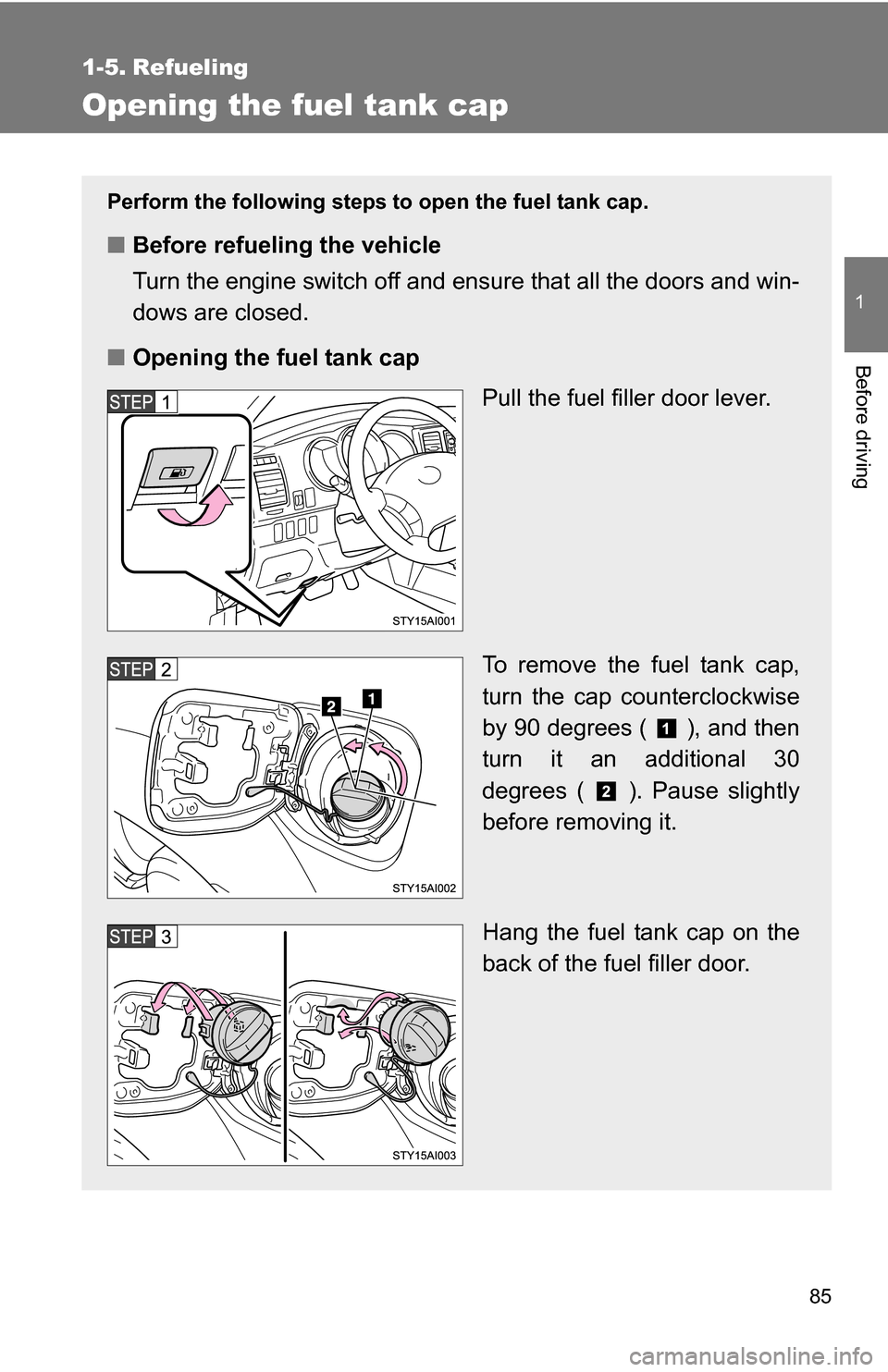
Pull the fuel filler door lever.
To remove the fuel tank cap,
turn the cap counterclockwise
by 90 degrees ( ), and then
turn it an additional 30
degrees ( ). Pause slightly
before removing it.
Hang the fuel tank cap on the
back of the fuel filler door.
Page 90 of 520
90
1-6. Theft deterrent system
Alarm (if equipped)
The system sounds the alarm and flashes lights when forcible entry
is detected.
■ Triggering of the alarm
The alarm is triggered in the following situations.
●A locked door is unlocked or opened in any way other than
using the wireless remote control door lock function or key.
The doors will lock again automatically.
● The hood is opened while t he vehicle is locked.
● The battery is reconnected.
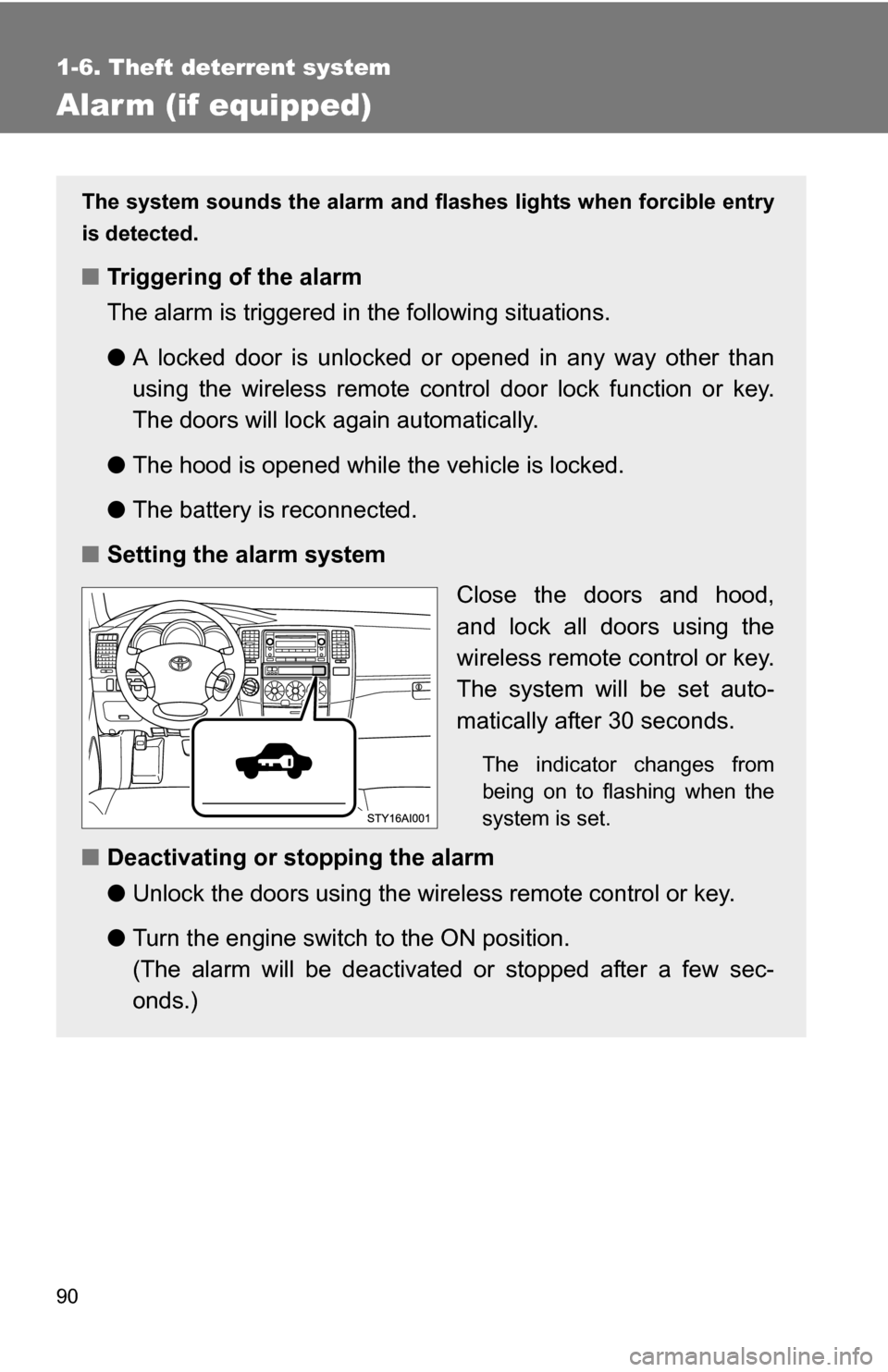
■ Setting the alarm system
Close the doors and hood,
and lock all doors using the
wireless remote control or key.
The system will be set auto-
matically after 30 seconds.
The indicator changes from
being on to flashing when the
system is set.
■Deactivating or stopping the alarm
●Unlock the doors using the wire less remote control or key.
● Turn the engine switch to the ON position.
(The alarm will be deactivated or stopped after a few sec-
onds.)
Page 96 of 520

96 1-7. Safety information
Airbag system componentsYour vehicle is equipped with ADVANCED AIRBAGS designed based
on US motor vehicle safety standards (FMVSS208). The airbag sys-
tem controls airbag deployment po wer for the driver and front pas-
senger. The driver airbag system consists of the driver seat’s position
sensor etc. The front passenger’s airbag system consists of the front
passenger occupant classification sensor etc. Side airbags
AIR BAG ON and AIR BAG
OFF indicator lights
Curtain shield airbags
Front passenger airbag
Side and curtain shield air-
bag sensors
Front airbag sensors
Airbag sensor assembly
Front passenger’s seat belt
buckle switch
Occupant detection system
(ECU and sensors)
Curtain shield airbag sen-
sors
SRS warning light and
RSCA OFF indicator light
RSCA OFF switch
Driver’s seat position sen-
sor
Driver airbag
Driver’s seat belt buckle
switch
Page 97 of 520

97
1-7. Safety information
1
Before driving
The main SRS airbag system components are shown above. The
SRS airbag system is controlled by
the airbag sensor assembly. The
airbag sensor assembly consists of a safing sensor and an airbag
sensor.
In certain types of severe frontal or side impacts, the SRS airbag sys-
tem triggers the airbag inflators. A chemical reaction in the inflators
quickly fills the airbags with non-toxic gas to help rest rain the motion
of the occupants.
■ SRS warning light
This warning light system monitors the airbag sensor assembly, front airbag
sensors, side and curtain shield airbag sensor assemblies, curtain shield air-
bag sensor assemblies, driver’s seat position sensor, driver’s seat belt
buckle switch, front passenger occupant classification system, AIR BAG ON
and AIR BAG OFF indicator lights, front passenger’s seat belt buckle switch,
front seat belt pretensioner assemblies , RSCA OFF indicator light, inflators,
interconnecting wiring and power sources. ( P. 437)
■ If the SRS airbags deploy (inflate)
●Bruising and slight abrasions may result from contact with a deploying
(inflating) SRS airbag.
● A loud noise and white powder will be emitted.
● Parts of the airbag module (steering wheel hub, airbag cover and inflator)
as well as the front seats, and parts of the front and rear pillars and roof
side rail, may be hot for several minutes. The airbag itself may also be
hot.
● The front windshield may crack.
Page 102 of 520

102 1-7. Safety information
CAUTION
■SRS airbag precautions
Observe the following precautions regarding the airbags.
Failure to do so may cause death or serious injury.
●The driver and all passengers in the vehicle must wear their seat belts
properly.
The SRS airbags are supplemental devices to be used with the seat belts.
● The SRS driver airbag deploys with considerable force, and can cause
death or serious injury especially if the driver is very close to the airbag.
The National Highway Traffic Safety Administration (“NHTSA”) advises:
Since the risk zone for the driver’s airbag is the first 2 - 3 in. (50 - 75 mm)
of inflation, placing yourself 10 in. (250 mm) from your driver airbag pro-
vides you with a clear margin of safety. This distance is measured from the
center of the steering wheel to your breastbone. If you now sit less than 10
in. (250 mm) away, you can change your driving position in several ways:
• Move your seat to the rear as far as you can while still reaching the pedals comfortably.
• Slightly recline the back of the seat. Although vehicle designs vary, many drivers can achieve the 10 in.
(250 mm) distance, even with the driver seat all the way forward, sim-
ply by reclining the back of the seat somewhat. If reclining the back of
your seat makes it hard to see the road, raise yourself by using a firm,
non-slippery cushion, or raise the seat if your vehicle has that feature\
.
• If your steering wheel is adjustable, tilt it downward. This points the air- bag toward your chest instead of your head and neck.
The seat should be adjusted as recommended by NHTSA above, while still
maintaining control of the foot pedals and steering wheel, and your view of
the instrument panel controls.
Page 108 of 520

108
1-7. Safety information
Front passenger occupant classification system
Your vehicle is equipped with a front passenger occupant classifica-
tion system. This system detects the conditions of the front passen-
ger seat and activates or deactiv ates the devices for the front
passenger.
SRS warning light
Front passenger’s seat belt reminder light
AIR BAG OFF indicator light
AIR BAG ON indicator light
Page 109 of 520

109
1-7. Safety information
1
Before driving
Conditions and operation of
the front passenger occupant
classification system
■ Adult*
1
■Child*3 or child restraint system*4
Indicator/
warning light AIR BAG ON and AIR BAG OFF indica-
tor lights AIR BAG ON
SRS warning light Off
Front passenger’s seat belt reminder light
Flashing*2
Devices Front passenger airbag
Activated
Side airbag on the front passenger seat
Curtain shield airbag in the front passen- ger side
Front passenger’s seat belt pretensioner
Indicator/
warning light AIR BAG ON and AIR BAG OFF indica-
tor lights AIR BAG
OFF*
5
SRS warning light Off
Front passenger’s seat belt reminder light Flashing*
2
DevicesFront passenger airbag
Deactivated
Side airbag on the front passenger seat
Curtain shield airbag in the front passen- ger side Activated
Front passenger’s seat belt pretensioner
Page 110 of 520

110 1-7. Safety information
■Unoccupied
■ There is a malfunction in the system
*
1:The system judges a person of adult size as an adult. When a smaller adult sits in the front pa ssenger seat, the system may rec-
ognize him/her as a child dependi ng on his/her physique and pos-
ture.
*
2:In the event the front passenger does not wear a seat belt.
*
3:When a larger child who has outgrow n a child restraint system sits
in the front passenger seat, the system may recognize him/her as
an adult depending on his/her physique or posture.
Indicator/
warning light AIR BAG ON and AIR BAG OFF indica-
tor lights Not illumi-
nated
SRS warning light Off
Front passenger’s seat belt reminder
light
Devices Front passenger airbag
Deactivated
Side airbag on the front passenger seat
Curtain shield airbag in the front passen- ger side Activated
Front passenger’s seat belt pretensioner Deactivated
Indicator/
warning light AIR BAG ON and AIR BAG OFF indica-
tor lights AIR BAG
OFF
SRS warning light On
Front passenger’s seat belt reminder light Off
Devices Front passenger airbag
Deactivated
Side airbag on the front passenger seat
Curtain shield airbag in the front passen- ger side Activated
Front passenger’s seat belt pretensioner
Page 111 of 520

111
1-7. Safety information
1
Before driving
*4:Never install a rear-facing child
restraint system on the front pas-
senger seat. A forward-facing child restraint system should only be
installed on the front passenger seat when it is unavoidable.
( P. 113)
*
5:In case the indicator is not illu minated, consult this manual for
installing the child restraint system properly. ( P. 117)
CAUTION
■Front passenger occupant cl assification system precautions
Observe the following precautions regarding front passenger occupant clas-
sification system.
Failure to do so may cause death or serious injury.
● Wear the seat belt properly.
● Make sure the front passenger’s seat belt tab has not been left inserted
into the buckle before someone sits in the front passenger seat.
● Make sure the AIR BAG OFF indicator light is not illuminated when using
the seat belt extender for the front passenger seat. If the AIR BAG OFF
indicator light is illuminated, disconnect the extender tongue from the seat
belt buckle, then reconnect the seat belt. Reconnect the seat belt extender
after making sure the AIR BAG ON indicator light is illuminated. If you use
the seat belt extender while the AIR BA G OFF indicator light is illuminated,
the front passenger airbag may not activate correctly, which could cause
death or serious injury in the event of collision.
● Do not apply a heavy load to the front passenger seat or equipment.
● Do not put weight on the front passenger seat by putting your hands or
feet on the front passenger seat seatback from the rear passenger seat.
● Do not let a rear passenger lift the front passenger seat with their feet or
press on the seatback with their legs.
● Do not put objects under the front passenger seat.