light TOYOTA 86 2017 Owners Manual
[x] Cancel search | Manufacturer: TOYOTA, Model Year: 2017, Model line: 86, Model: TOYOTA 86 2017Pages: 428, PDF Size: 5.25 MB
Page 325 of 428
5
When trouble arises
3255-2. Steps to take in an emergency
WARNING■
Maintenance of the tires
Each tire, including the spare (if provided), should be checked monthly
when cold and inflated to the inflation pressure recommended by the
vehicle manufacturer on the vehicle placard or tire inflation pressure
label (tire and load information label). (If your vehicle has tires of a differ-
ent size than the size indicated on the vehicle placard or tire inflation
pressure label [tire and load information label], you should determine the
proper tire inflation pr essure for those tires.)
As an added safety feature, your vehicle has been equipped with a tire
pressure monitoring system (TPMS-ti re pressure warning system) that
illuminates a low tire pressure telltal e (tire pressure warning light) when
one or more of your tires is sign ificantly under-inflated. Accordingly,
when the low tire pressu re telltale (tire pressure warning light) illumi-
nates, you should stop and check your tires as soon as possible, and
inflate them to the proper pressure. Driving on a significantly under-
inflated tire causes the tire to overheat and can lead to tire failure.
Under-inflation also reduces fuel effi ciency and tire tread life, and may
affect the vehicle's handling and stopping ability.
Please note that the TPMS (tire pressure warning system) is not a sub-
stitute for proper ti re maintenance, an d it is the driver's responsibility to
maintain correct tire pressure, even if under-inflation has not reached the
level to trigger illumination of the TP MS low tire pressure telltale (tire
pressure warning light).
Your vehicle has also been equipped with a TPMS (tire pressure warning
system) malfunction indicator to indi cate when the system is not operat-
ing properly. The TPMS (tire pressure warning system) malfunction indi-
cator is combined with the low tire pressure telltale (tire pressure
warning light). When the system detects a malfunctio n, the telltale will
flash for approximately one minute an d then remain continuously illumi-
nated. This sequence will continue upon subsequent vehicle start-ups as
long as the malfunction exists. When the malfunction indicator is illumi-
nated, the system may not be able to detect or signal low tire pressure
as intended.
Page 329 of 428
5
When trouble arises
3295-2. Steps to take in an emergency
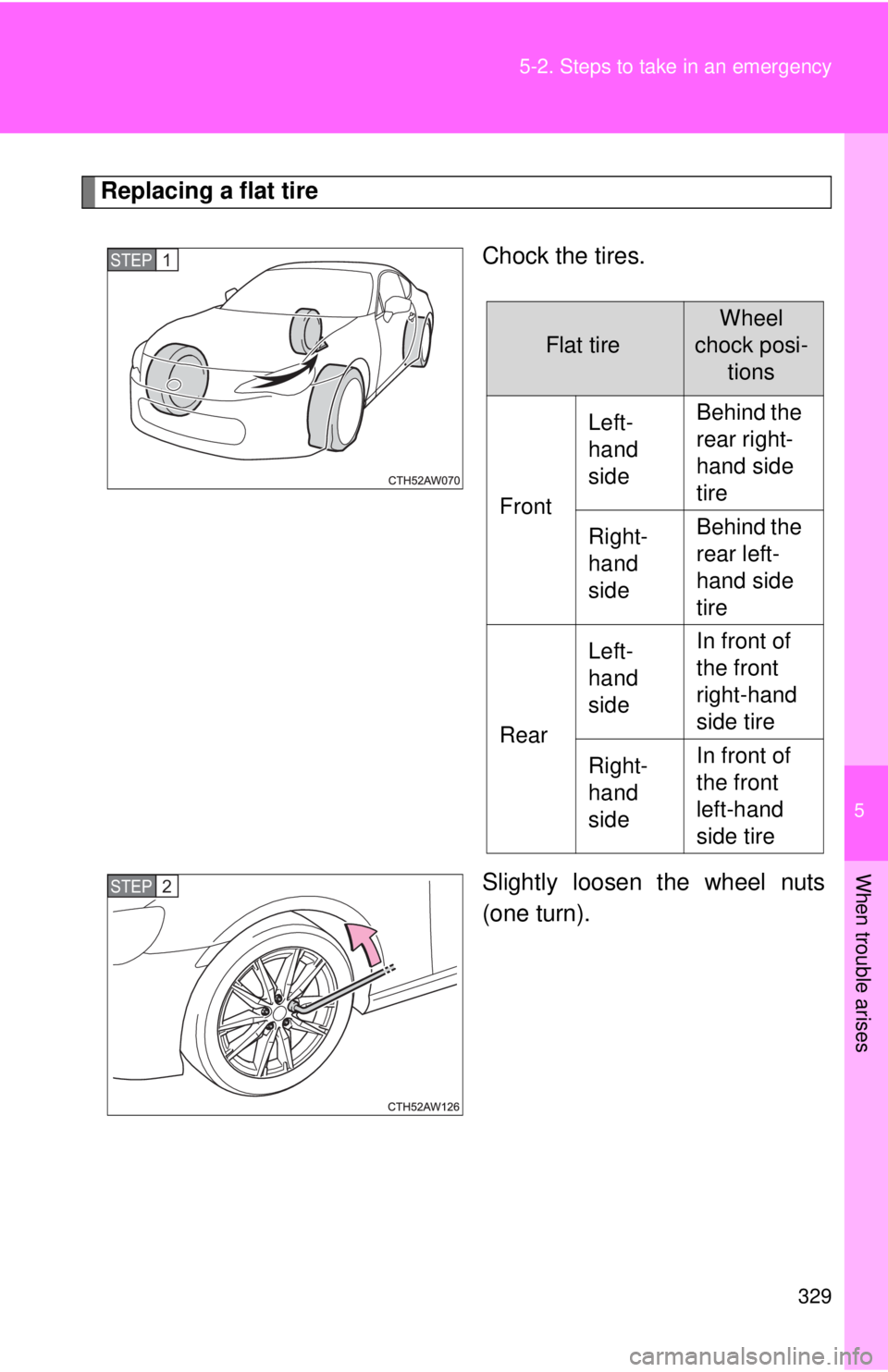
Replacing a flat tire
Chock the tires.
Slightly loosen the wheel nuts
(one turn).STEP 1
Flat tire Wheel
chock posi-
tions
Front Left-
hand
side Behind the
rear right-
hand side
tire
Right-
hand
side Behind the
rear left-
hand side
tire
Rear Left-
hand
side In front of
the front
right-hand
side tire
Right-
hand
side In front of
the front
left-hand
side tireSTEP 2
Page 330 of 428
3305-2. Steps to take in an emergency
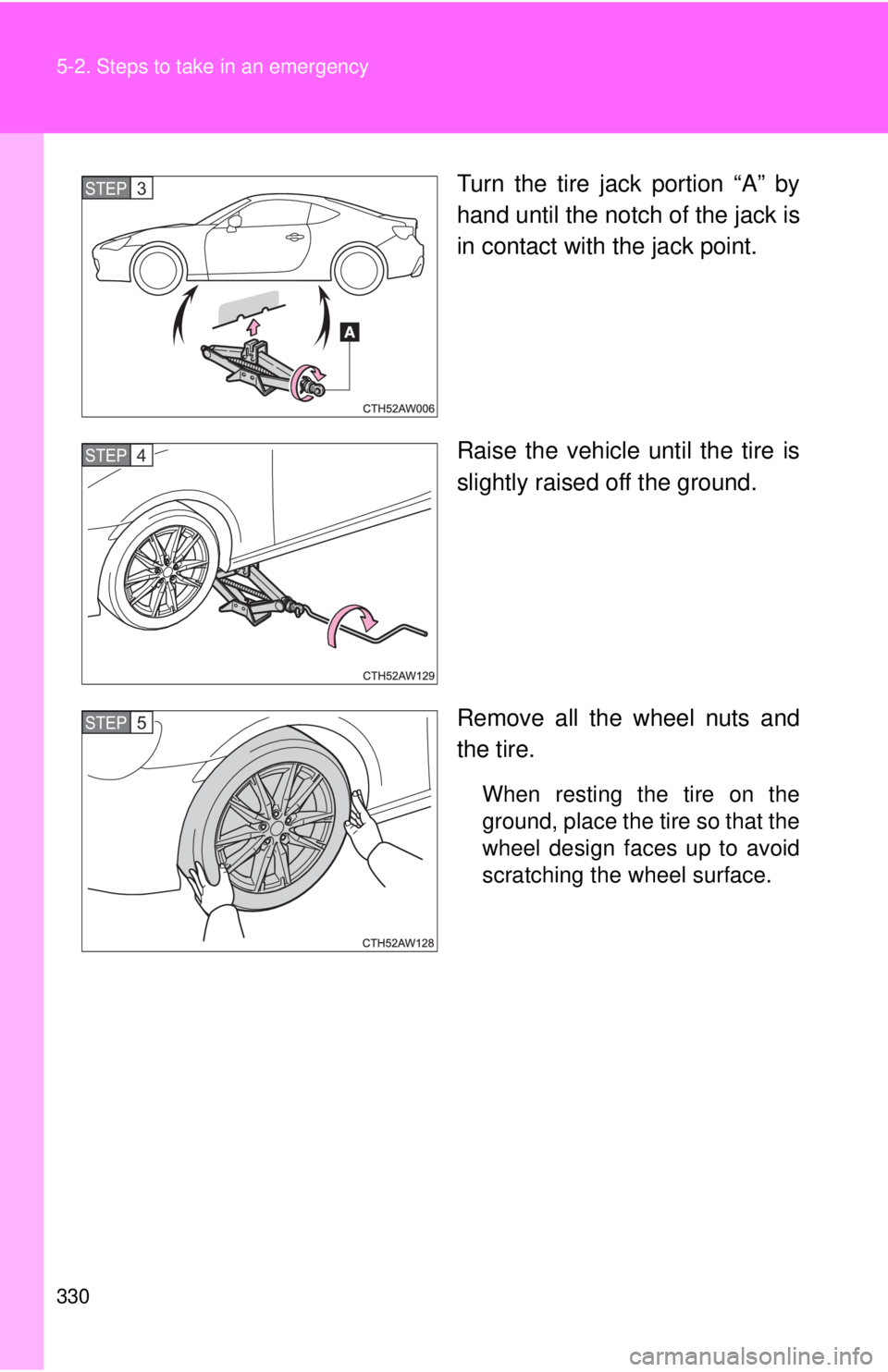
Turn the tire jack portion “A” by
hand until the notch of the jack is
in contact with the jack point.
Raise the vehicle until the tire is
slightly raised off the ground.
Remove all the wheel nuts and
the tire.
When resting the tire on the
ground, place the tire so that the
wheel design faces up to avoid
scratching the wheel surface.STEP 3
STEP 4
STEP 5
Page 332 of 428
3325-2. Steps to take in an emergency
Stow the flat tire, tire jack and all tools.■
The compact spare tire ●
The compact spare tire is identified by the label “TEMPORARY USE
ONLY” on the tire sidewall.
Use the compact spare tire temporarily only in an emergency.●
Make sure to check the tire pressure of the compact spare tire.
( → P. 364)■
When using the compact spare tire
As the compact spare tire is not equipped with the tire pressure warning
valve and transmitter, low inflation pr essure of the spare tire will not be
warned. Also, if you replace the compac t spare tire after the tire pressure
warning light comes on, the light remains on.■
If you have a flat rear tire
Install the compact spare tire on the front of the vehicle. Perform the fol-
lowing steps.
Replace a front tire with the compact spare tire.
Replace the flat rear tire with t he tire removed from the front of
the vehicle.STEP 5
STEP 1
STEP 2
Page 338 of 428
3385-2. Steps to take in an emergency
If the engine will not start If the engine will not start even th ough correct star ting procedures
are being followed ( → P. 142), consider each of the following points.
■ The engine will not start even when the starter motor oper-
ates normally.
One of the following may be the cause of the problem.
● There may not be sufficient fuel in the vehicle’s tank.
Refuel the vehicle.
● The engine may be flooded.
Try to restart the engine once more following correct starting
procedures. ( → P. 142)
● There may be a malfunction in the engine immobilizer system.
( → P. 6 1 )
■ The starter motor turns over slowly, the interior lights and
headlights are dim, or the hor n does not sound or sounds at
a low volume.
One of the following may be the cause of the problem.
● The battery may be discharged. ( → P. 341)
● The battery terminal connec tions may be loose or corroded.
■ The starter motor does not turn over, the interior lights and
headlights do not turn on, or the horn does not sound.
One of the following may be the cause of the problem.
● One or both of the battery terminals may be disconnected.
● The battery may be discharged. ( → P. 341)
Contact your Toyota dealer if the problem cannot be repaired, or if
repair procedures are unknown.
Page 341 of 428
5
When trouble arises
3415-2. Steps to take in an emergency
If the battery is discharged The following procedures may be used to start the engine if the vehi-
cle's battery is discharged.
You can call your Toyota dealer or a qualified repair shop.
If you have a set of jumper (or boo ster) cables and a second vehi-
cle with a 12-volt battery, you c an jump start your vehicle following
the steps below.
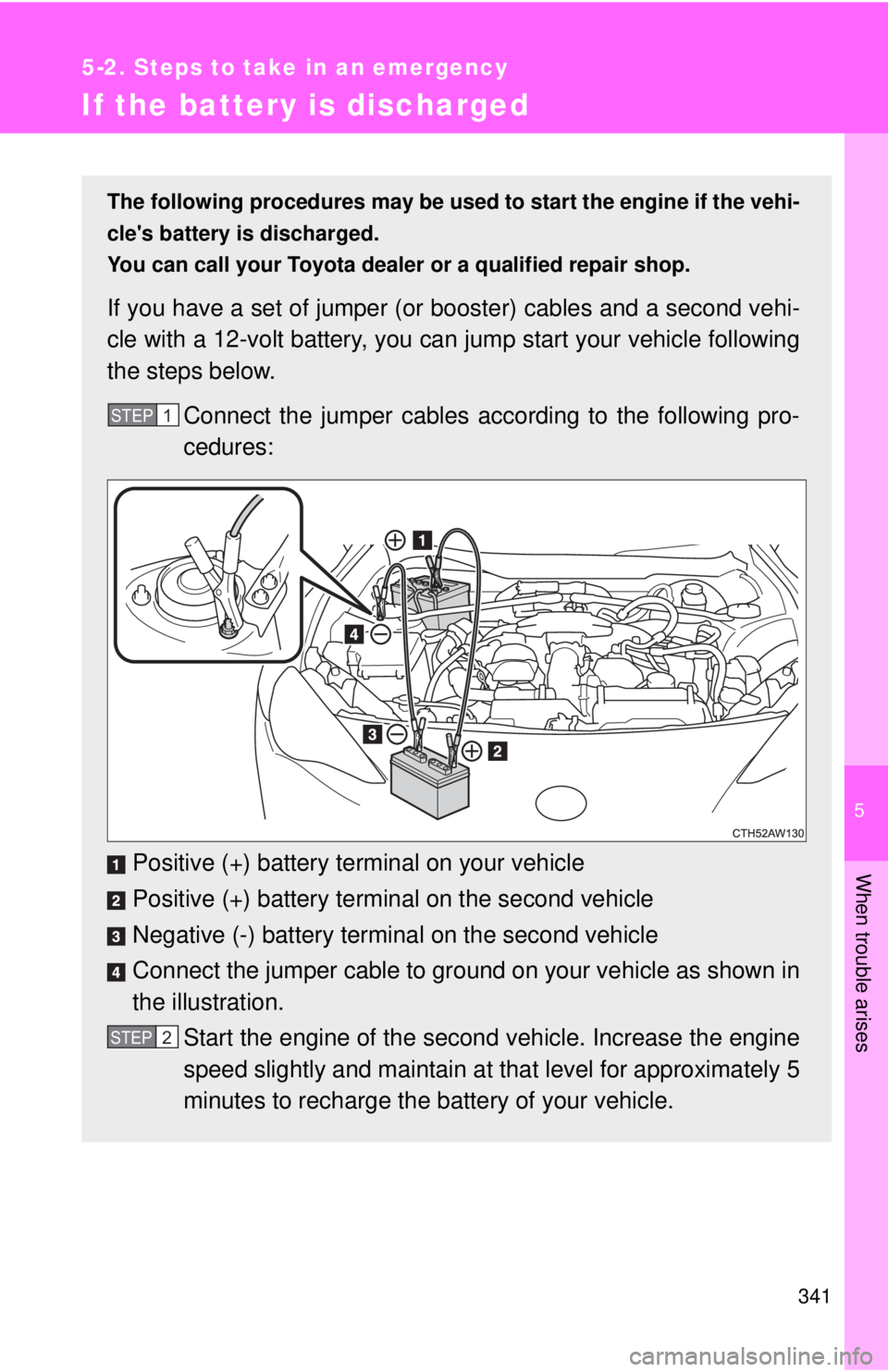
Connect the jumper cables according to the following pro-
cedures:
Positive (+) battery terminal on your vehicle
Positive (+) battery terminal on the second vehicle
Negative (-) battery terminal on the second vehicle
Connect the jumper cable to ground on your vehicle as shown in
the illustration.
Start the engine of the second vehicle. Increase the engine
speed slightly and maintain at that level for approximately 5
minutes to recharge the battery of your vehicle.STEP 1
STEP 2
Page 342 of 428
3425-2. Steps to take in an emergency
■ Starting the engine when the battery is discharged
The engine cannot be started by push-starting.
■ Avoiding a discharged battery
● Turn off the headlights and the air conditioning system while the engine is
off.
● Turn off any unnecessary electrical components when the vehicle is run-
ning at a low speed for an extended period, such as in heavy traffic, etc.
■ Charging the battery
The electricity stored in the battery will discharge gradually even when the
vehicle is not in use, due to natural discharge and the draining effects of cer-
tain electrical appliances. If the vehicle is left for a long time, the battery may
discharge, and the engine may be unable to start. (The battery recharges
automatically during driving.) Maintain the engine speed of the second vehicle and turn
the engine switch to the “ON” position, then start the vehi-
cle's engine.
Once the vehicle’s engine has started, remove the jumper
cables in the exact reverse order in which they were con-
nected.
Once the engine starts, have th e vehicle checked at your Toyota
dealer as soon as possible. STEP 3
STEP 4
Page 343 of 428
5
When trouble arises
3435-2. Steps to take in an emergency
WARNING■ Avoiding battery fires or explosions
Observe the following precautions to prevent accidentally igniting the flam-
mable gas that may be emitted from the battery.
● Make sure the jumper cable is connected to the correct terminal and that it
is not unintentionally in contact with any part other than the intended termi-
nal.
● Do not allow the jumper cables to come into contact with the “+” and “-” ter-
minals.
● Do not allow open flame or use matc hes, cigarette lighters or smoke near
the battery.
■ Battery precautions
The battery contains poisonous and corrosive acidic electrolyte, while
related parts contain lead and lead compounds. Observe the following pre-
cautions when handling the battery.
● When working with the battery, always wear safety glasses and take care
not to allow any battery fluids (acid) to come into contact with skin, clothing
or the vehicle body.
● Do not lean over the battery.
● In the event that battery fluid comes into contact with the skin or eyes,
immediately wash the affected area with water and seek medical attention.
Place a wet sponge or cloth over the affected area until medical attention
can be received.
● Always wash your hands after handling the battery support, terminals, and
other battery-related parts.
● Do not allow children near the battery.
■ To prevent damage to the vehicle
Do not pull- or push-start the vehicle as the three-way catalytic converter
may overheat and become a fire hazard.
Page 365 of 428
3656-1. Specifications
6
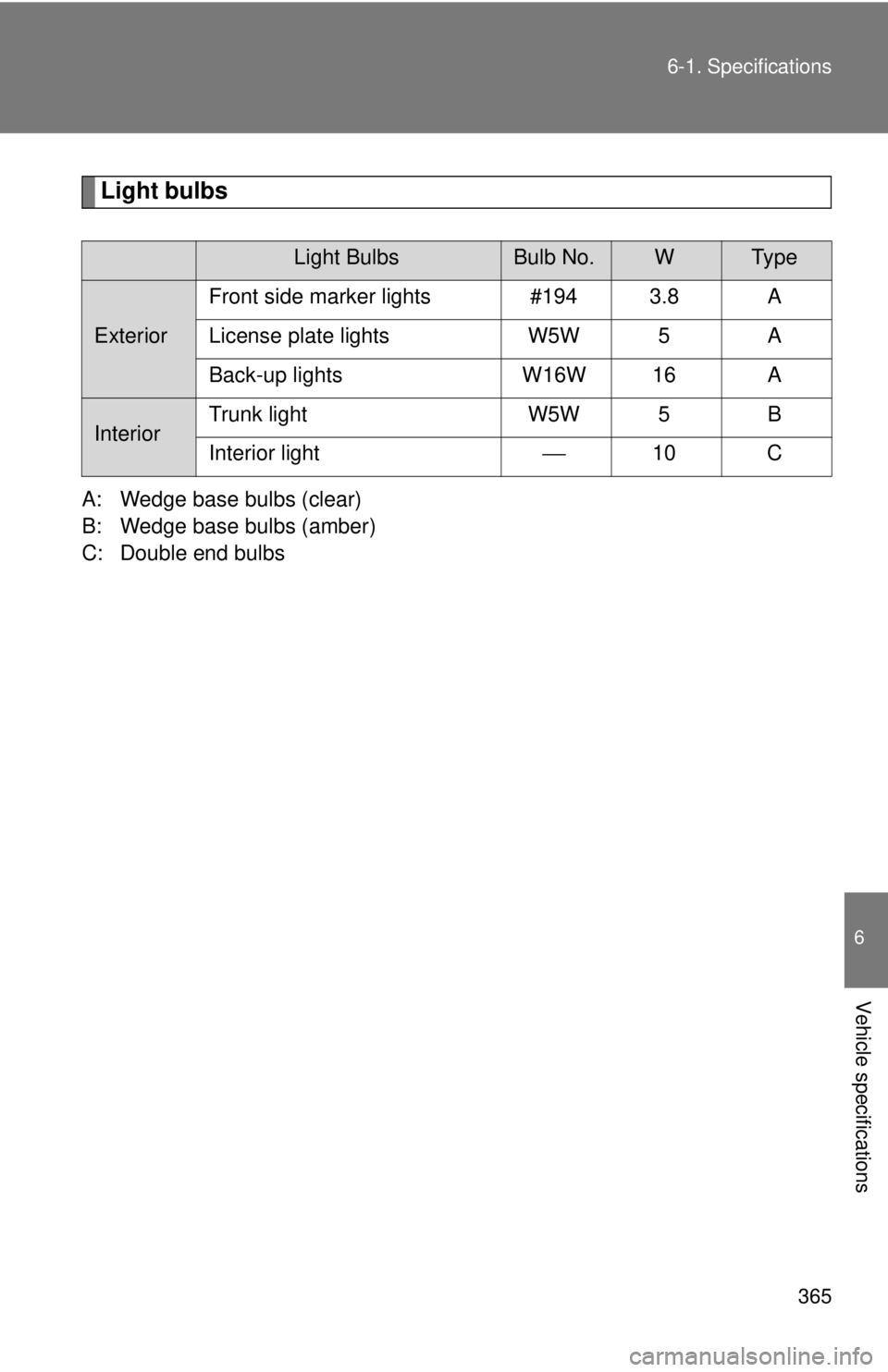
Vehicle specifications Light bulbs
A: Wedge base bulbs (clear)
B: Wedge base bulbs (amber)
C: Double end bulbs Light Bulbs Bulb No. W Ty p e
Exterior Front side marker lights #194 3.8 A
License plate lights W5W 5 A
Back-up lights W16W 16 A
Interior Trunk light W5W 5 B
Interior light ⎯ 10 C
Page 366 of 428
3666-1. Specifications
Fuel information
■ Fuel tank opening for unleaded gasoline
To help prevent incorrect fueling, your Toyota has a fuel tank opening that
only accommodates the special nozzle on unleaded fuel pumps.
■ If your engine knocks
● Consult your Toyota dealer.
● You may occasionally notice light knocking for a short time while acceler-
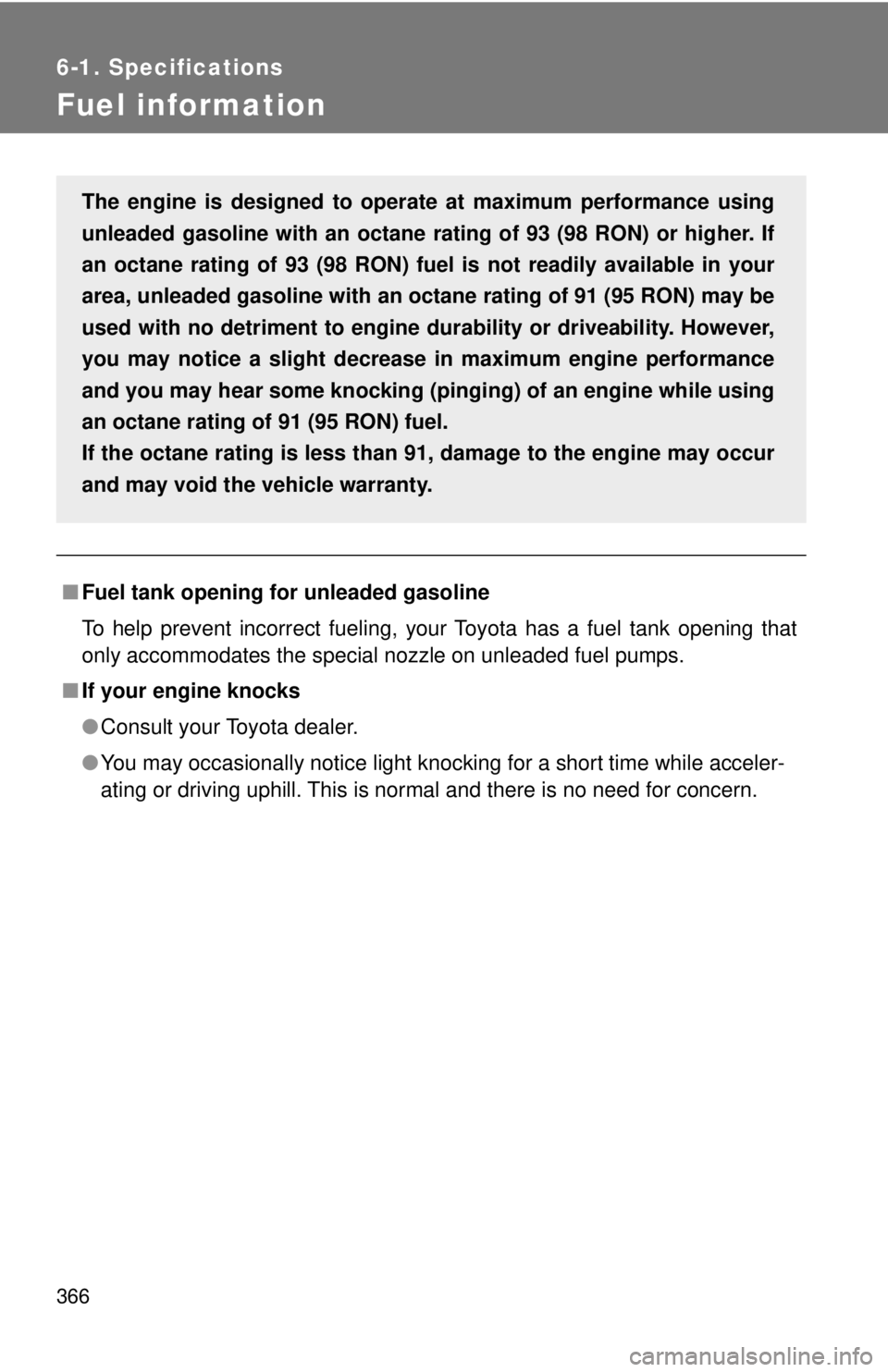
ating or driving uphill. This is normal and there is no need for concern.The engine is designed to operate at maximum performance using
unleaded gasoline with an octane ra ting of 93 (98 RON) or higher. If
an octane rating of 93 (98 RON) fuel is not readily available in your
area, unleaded gasoline with an octane rating of 91 (95 RON) may be
used with no detriment to engine dur ability or driveability. However,
you may notice a slight decrease in maximum engine performance
and you may hear some knocking (pin ging) of an engine while using
an octane rating of 91 (95 RON) fuel.
If the octane rating is less than 91, damage to the engine may occur
and may void the vehicle warranty.