engine TOYOTA 86 2017 Owners Manual
[x] Cancel search | Manufacturer: TOYOTA, Model Year: 2017, Model line: 86, Model: TOYOTA 86 2017Pages: 428, PDF Size: 5.25 MB
Page 321 of 428
5
When trouble arises
3215-2. Steps to take in an emergency
*1
: Driver’s seat belt buzzer:
The driver’s seat belt buzzer sounds to alert the driver that his or her seat
belt is not fastened. Once the engine switch is turned to the “ON” position,
the buzzer sounds for 6 seconds. If the vehicle reaches a speed of 12 mph
(20 km/h), the buzzer sounds once. If the seat belt is still unfastened after 24
seconds, the buzzer will sound intermittently for 10 seconds. Then, if the
seat belt is still unfastened, the buzzer will sound in a different tone for 20
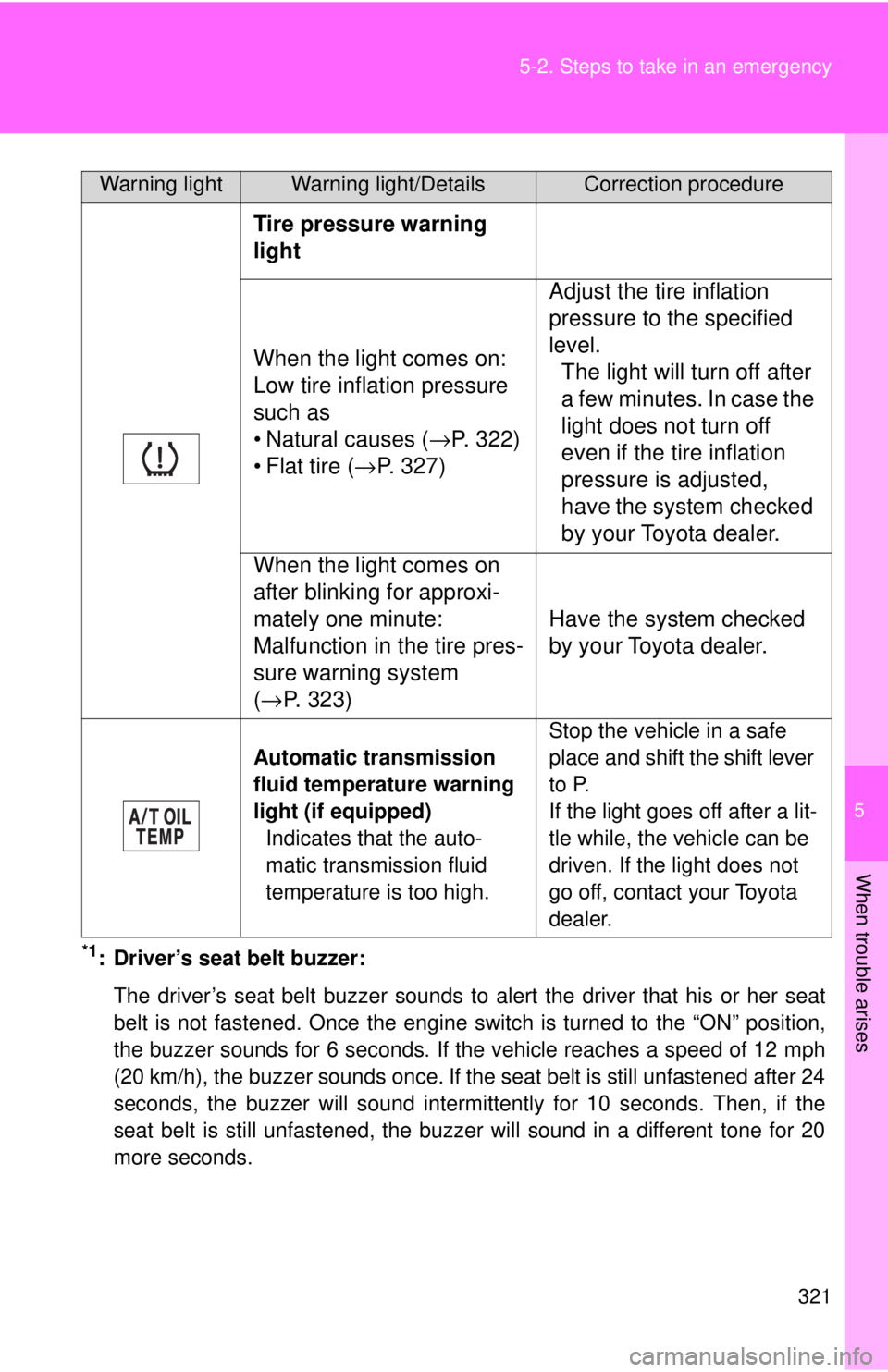
more seconds. Tire pressure warning
light
When the light comes on:
Low tire inflation pressure
such as
• Natural causes ( → P. 322)
• Flat tire ( → P. 327) Adjust the tire inflation
pressure to the specified
level.
The light will turn off after
a few minutes. In case the
light does not turn off
even if the tire inflation
pressure is adjusted,
have the system checked
by your Toyota dealer.
When the light comes on
after blinking for approxi-
mately one minute:
Malfunction in the tire pres-
sure warning system
( → P. 323) Have the system checked
by your Toyota dealer.
Automatic transmission
fluid temperature warning
light (if equipped)
Indicates that the auto-
matic transmission fluid
temperature is too high. Stop the vehicle in a safe
place and shift the shift lever
to P.
If the light goes off after a lit-
tle while, the vehicle can be
driven. If the light does not
go off, contact your Toyota
dealer.Warning light Warning light/Details Correction procedure
Page 323 of 428

5
When trouble arises
3235-2. Steps to take in an emergency
■
If the tire pressure warning system is inoperative
The tire pressure warning system will be disabled in the following condi-
tions:
(When the condition be comes normal, the syst em will work properly.)●
If tires not equipped with tire pressure warning valves and transmit-
ters are used.●
If the ID code on the tire pressure warning valves and transmitters is
not registered in the tire pressure warning computer.●
If the tire inflation pr essure is 55 psi (380 kPa, 3.87 kgf/cm 2
or bar) or
higher.
The tire pressure warning system may be disabled in the following condi-
tions:
(When the condition be comes normal, the syst em will work properly.)●
If electronic devices or facilities us ing similar radio wave frequencies
are nearby.●
If a radio set at similar frequencies is in use in the vehicle.●
If a window tint that affects the radio wave signals is installed.●
If there is a lot of snow or ice on the vehicle, in particular around the
wheels or wheel housings.
●
If non-genuine Toyota wheels are used. (Even if you use Toyota
wheels, the tire pressu re warning system may not work properly with
some types of tires.)
●
If tire chains are used.
●
If a large metallic object which can interfer e with signal reception is
put in the trunk.
■
If the tire pressure warning light frequently comes on after blinking
for approximately one minute
If the tire pressure warning light fr equently comes on after blinking for
approximately one minute when the engine switch is turned to the “ON”
position, have it checked your Toyota dealer.
Page 327 of 428
5
When trouble arises
3275-2. Steps to take in an emergency
If you have a flat tire Your vehicle is equipped with a spare tire. The flat tire can be
replaced with the spare tire.
■ Before jacking up the vehicle
● Stop the vehicle in a safe place on a hard, flat surface.
● Set the parking brake.
● Shift the shift lever to P (vehic les with an automatic transmis-
sion) or R (vehicles with a manual transmission).
● Stop the engine.
● Turn on the emergency flashers. ( → P. 306)
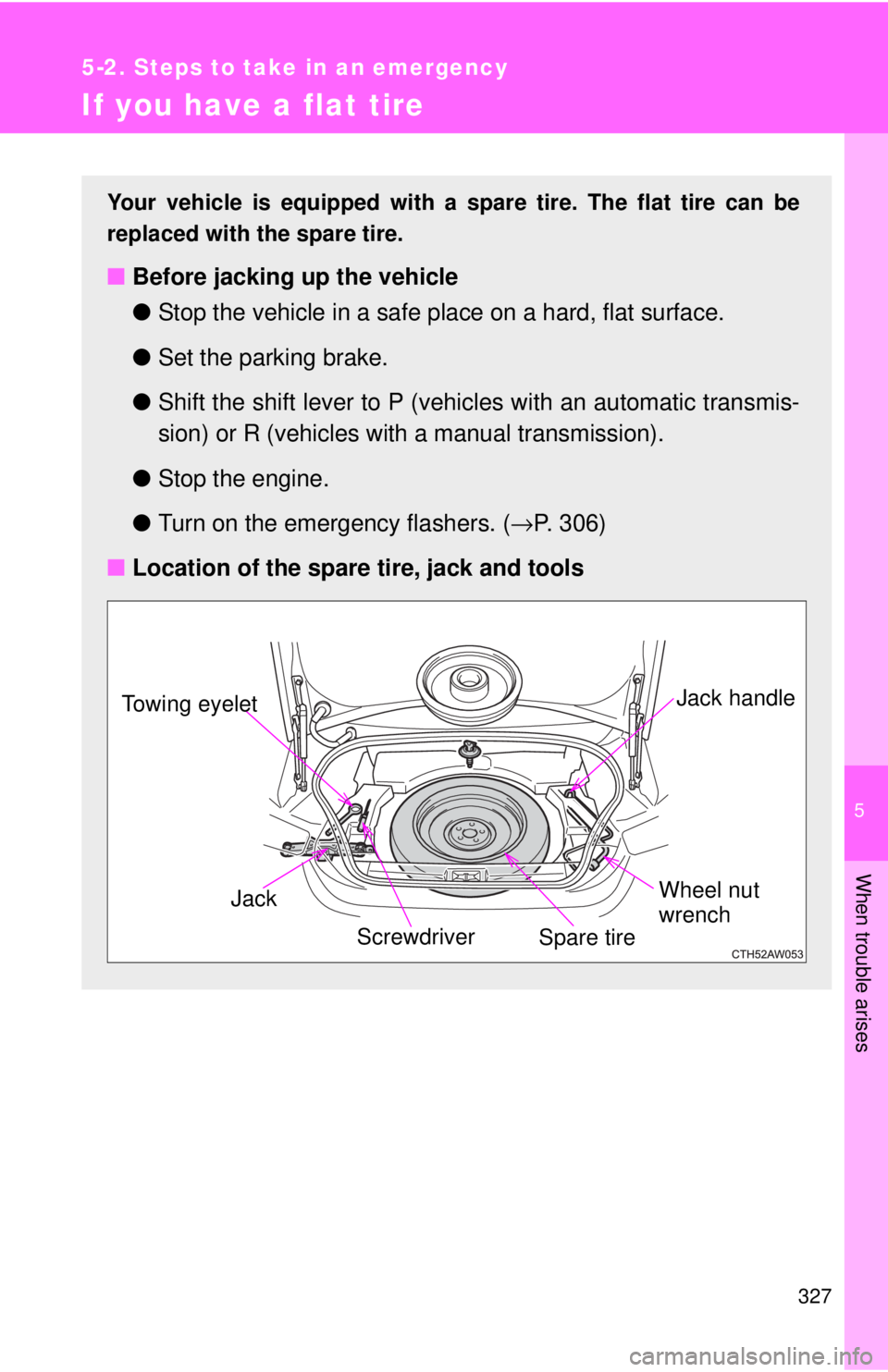
■ Location of the spare tire, jack and tools
Jack Jack handle
Spare tireTowing eyelet
Screwdriver Wheel nut
wrench
Page 334 of 428

3345-2. Steps to take in an emergency
WARNING■
Using the tire jack
Improper use of the tire jack may lead to death or serious injuries due to
the vehicle suddenly falling off the jack. ●
Do not use the tire jack for any purpose other than replacing tires or
installing and removing tire chains.●
Only use the tire jack that comes with this vehicle for replacing a flat
tire.
Do not use it on other vehicles, and do not use other tire jacks for
replacing tires on this vehicle.●
Always check that the tire jack is securely set to the jack point.●
Do not put any part of your body under the vehicle supported by a jack.●
Do not start or run the engine while your vehicle is supported by the
jack.
●
Do not raise the vehicle while someone is in it.
●
When raising the vehicle, do not put an object on or under the jack.
●
Do not raise the vehicle to a hei ght greater than that required to
replace the tire.
●
Use a jack stand if it is necessary to get under the vehicle.
Take particular care when lowering the vehicle to ensure that no one
working on or near the vehicle may be injured.
Page 336 of 428

3365-2. Steps to take in an emergency
WARNING■
When using the compact spare tire ●
Remember that your compact spare tire is specifically designed for
use with your vehicle. Do not use your compact spare tire on another
vehicle.●
Do not use two compact spare tires simultaneously.●
Replace the compact spare tire with a standard tire as soon as possi-
ble.●
Avoid sudden acceleration, abrupt steering, sudden braking and shift-
ing operations that cause sudden engine braking.●
Install the compact spare tire on a front wheel. ■
When storing the compact spare tire
Be careful not to catch fingers or other body parts between the compact
spare tire and the body of the vehicle.
■
Speed limit when using the compact spare tire
Do not drive at speeds in excess of 50 mph (80 km/h) when a compact
spare tire is installed on the vehicle.
The compact spare tire is not designed for drivin g at high speeds. Failing
to observe this precaution may lead to an accident causing death or seri-
ous injury.
■
When the spare tire is attached
The vehicle speed may not be correctly detected, and the following sys-
tems may not operate correctly:
●
ABS & brake assist
●
VSC
●
TRAC
●
EPS
●
Cruise control
●
LSD
Page 338 of 428
3385-2. Steps to take in an emergency
If the engine will not start If the engine will not start even th ough correct star ting procedures
are being followed ( → P. 142), consider each of the following points.
■ The engine will not start even when the starter motor oper-
ates normally.
One of the following may be the cause of the problem.
● There may not be sufficient fuel in the vehicle’s tank.
Refuel the vehicle.
● The engine may be flooded.
Try to restart the engine once more following correct starting
procedures. ( → P. 142)
● There may be a malfunction in the engine immobilizer system.
( → P. 6 1 )
■ The starter motor turns over slowly, the interior lights and
headlights are dim, or the hor n does not sound or sounds at
a low volume.
One of the following may be the cause of the problem.
● The battery may be discharged. ( → P. 341)
● The battery terminal connec tions may be loose or corroded.
■ The starter motor does not turn over, the interior lights and
headlights do not turn on, or the horn does not sound.
One of the following may be the cause of the problem.
● One or both of the battery terminals may be disconnected.
● The battery may be discharged. ( → P. 341)
Contact your Toyota dealer if the problem cannot be repaired, or if
repair procedures are unknown.
Page 339 of 428
5
When trouble arises
3395-2. Steps to take in an emergency
If the shift lever cannot be shifted from P (vehicles with an automatic transmission)If the shift lever cannot be shifted with your foot on the brake, there
may be a problem with the shift lock system (a system to prevent
accidental operation of the shift l ever). Have the vehicle inspected by
your Toyota dealer immediately.
The following steps may be used as an emergency measure to
ensure that the shift lever can be shifted.
Set the parking brake.
Turn the engine switch to the “ACC” position.
Depress the brake pedal.
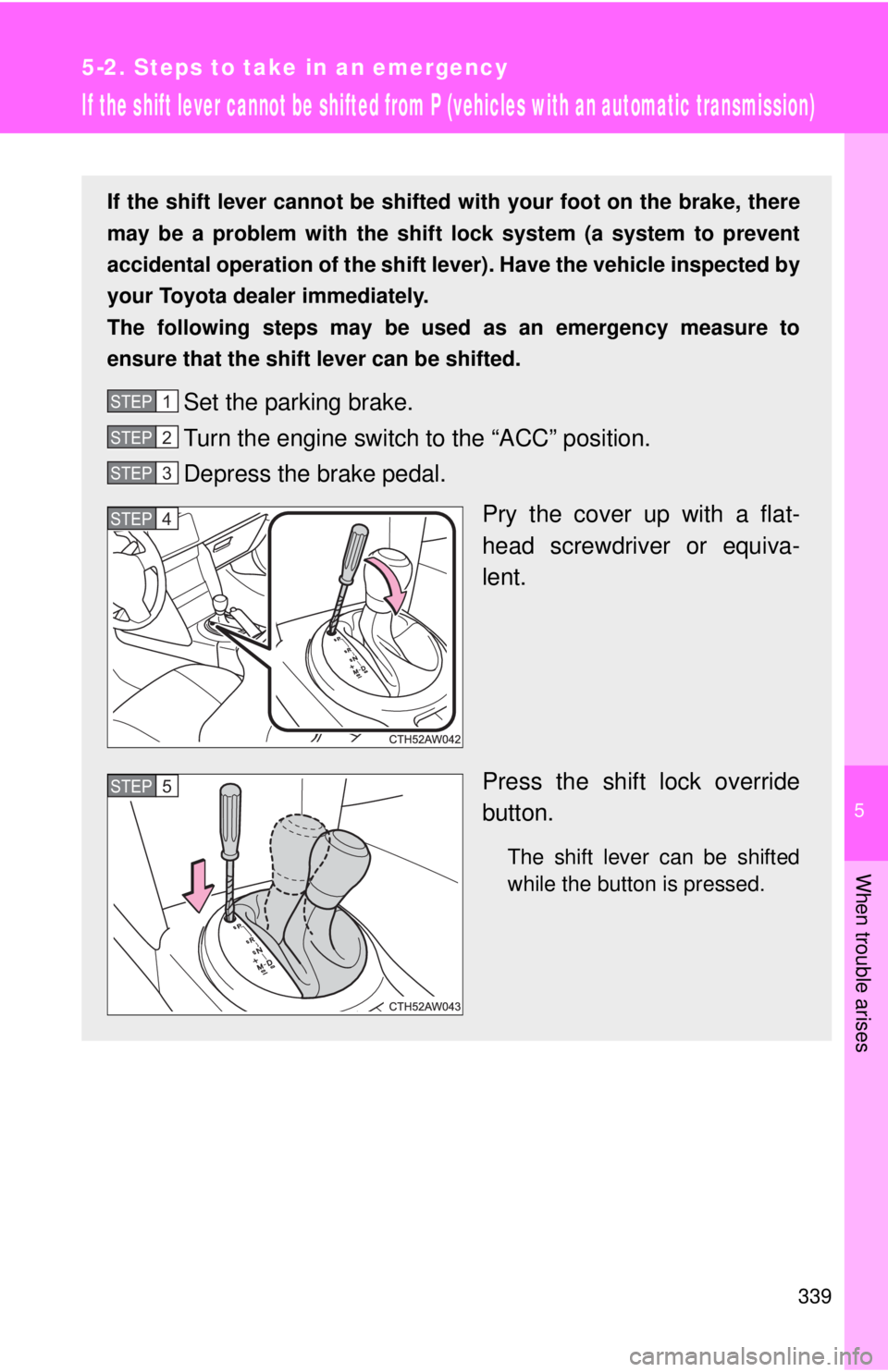
Pry the cover up with a flat-
head screwdriver or equiva-
lent.
Press the shift lock override
button. The shift lever can be shifted
while the button is pressed.STEP 1
STEP 2
STEP 3
STEP 4
STEP 5
Page 341 of 428
5
When trouble arises
3415-2. Steps to take in an emergency
If the battery is discharged The following procedures may be used to start the engine if the vehi-
cle's battery is discharged.
You can call your Toyota dealer or a qualified repair shop.
If you have a set of jumper (or boo ster) cables and a second vehi-
cle with a 12-volt battery, you c an jump start your vehicle following
the steps below.
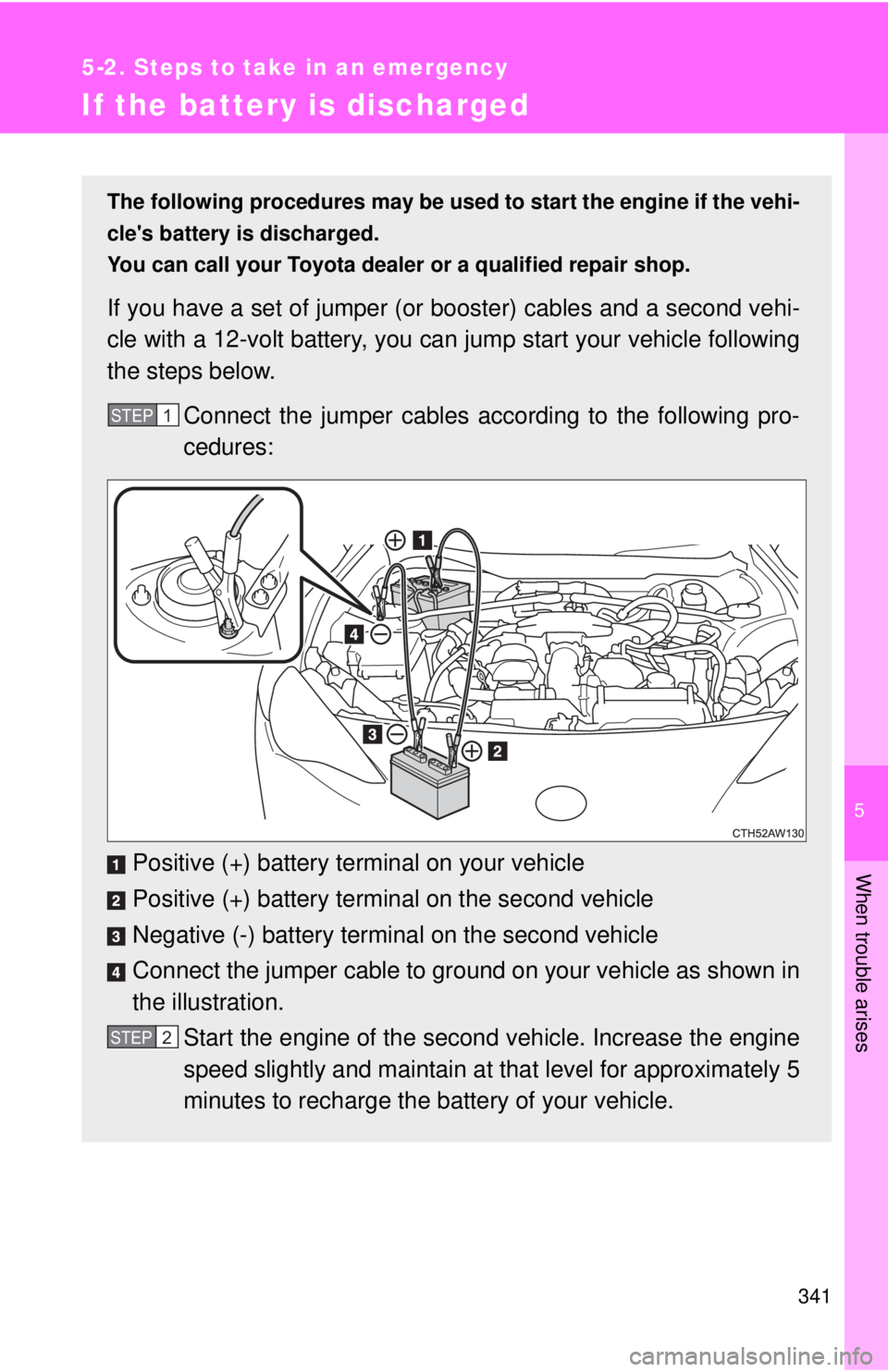
Connect the jumper cables according to the following pro-
cedures:
Positive (+) battery terminal on your vehicle
Positive (+) battery terminal on the second vehicle
Negative (-) battery terminal on the second vehicle
Connect the jumper cable to ground on your vehicle as shown in
the illustration.
Start the engine of the second vehicle. Increase the engine
speed slightly and maintain at that level for approximately 5
minutes to recharge the battery of your vehicle.STEP 1
STEP 2
Page 342 of 428
3425-2. Steps to take in an emergency
■ Starting the engine when the battery is discharged
The engine cannot be started by push-starting.
■ Avoiding a discharged battery
● Turn off the headlights and the air conditioning system while the engine is
off.
● Turn off any unnecessary electrical components when the vehicle is run-
ning at a low speed for an extended period, such as in heavy traffic, etc.
■ Charging the battery
The electricity stored in the battery will discharge gradually even when the
vehicle is not in use, due to natural discharge and the draining effects of cer-
tain electrical appliances. If the vehicle is left for a long time, the battery may
discharge, and the engine may be unable to start. (The battery recharges
automatically during driving.) Maintain the engine speed of the second vehicle and turn
the engine switch to the “ON” position, then start the vehi-
cle's engine.
Once the vehicle’s engine has started, remove the jumper
cables in the exact reverse order in which they were con-
nected.
Once the engine starts, have th e vehicle checked at your Toyota
dealer as soon as possible. STEP 3
STEP 4
Page 345 of 428
5
When trouble arises
3455-2. Steps to take in an emergency
If your vehicle overheats
Correction procedures
Stop the vehicle in a safe plac e and turn off the air condition-
ing system, and then stop the engine.
If you see steam:
Carefully lift the hood after the steam subsides.
If you do not see steam:
Carefully lift the hood.
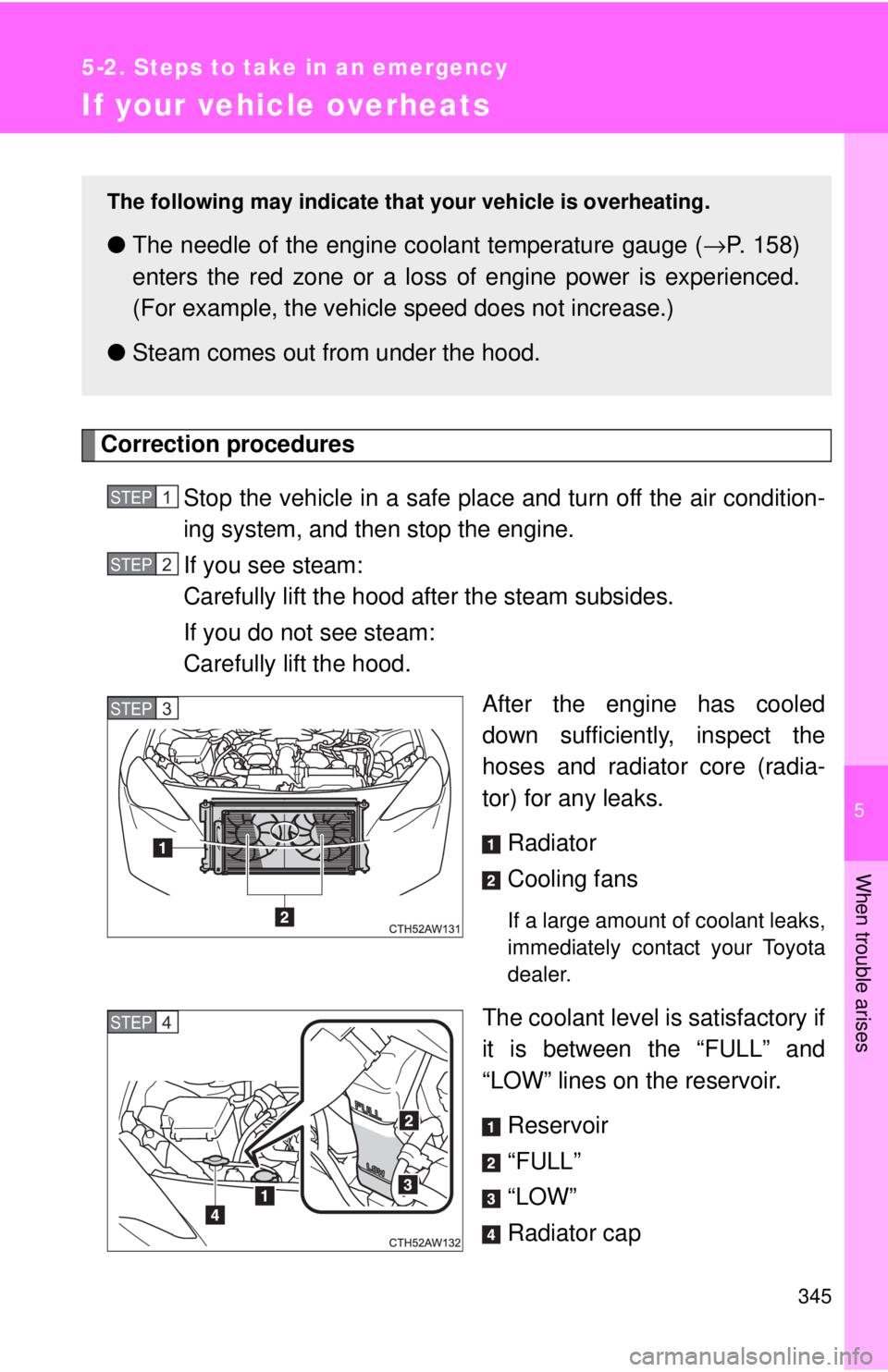
After the engine has cooled
down sufficiently, inspect the
hoses and radiator core (radia-
tor) for any leaks.
Radiator
Cooling fans If a large amount of coolant leaks,
immediately contact your Toyota
dealer.
The coolant level is satisfactory if
it is between the “FULL” and
“LOW” lines on the reservoir.
Reservoir
“FULL”
“LOW”
Radiator capThe following may indicate that your vehicle is overheating.
● The needle of the engine co olant temperature gauge ( → P. 158)
enters the red zone or a loss of engine power is experienced.
(For example, the vehicl e speed does not increase.)
● Steam comes out from under the hood. STEP 1
STEP 2
STEP 3
STEP 4