air condition TOYOTA 86 2017 User Guide
[x] Cancel search | Manufacturer: TOYOTA, Model Year: 2017, Model line: 86, Model: TOYOTA 86 2017Pages: 428, PDF Size: 5.25 MB
Page 105 of 428
1051-7. Safety information
1
Before driving
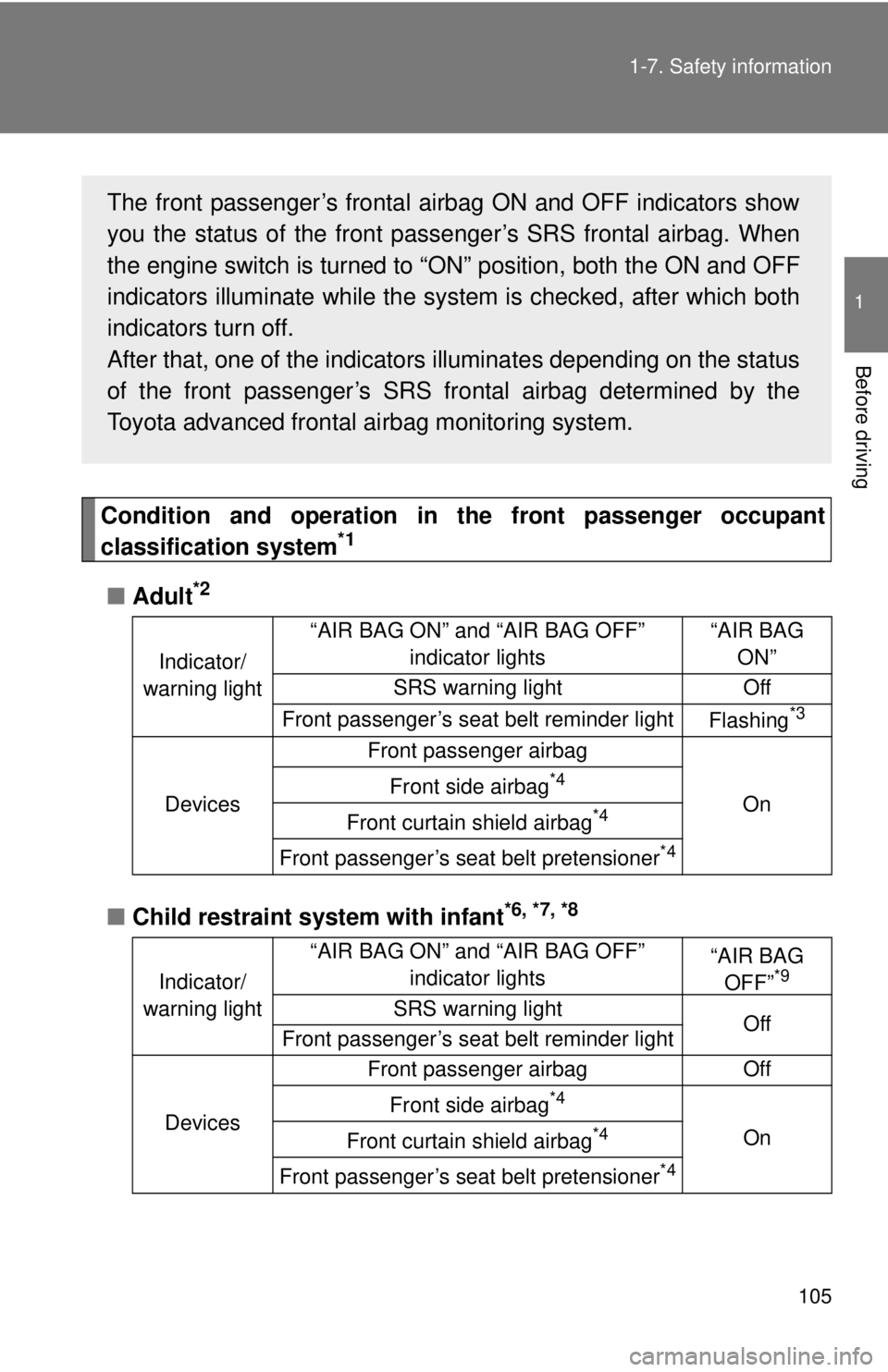
Condition and operation in th e front passenger occupant
classification system *1
■ Adult *2
■ Child restraint system with infant *6, *7, *8Indicator/
warning light “AIR BAG ON” and “AIR BAG OFF”
indicator lights “AIR BAG
ON”
SRS warning light Off
Front passenger’s seat belt reminder light
Flashing *3
Devices Front passenger airbag
OnFront side airbag *4
Front curtain shield airbag *4
Front passenger’s seat belt pretensioner *4
Indicator/
warning light “AIR BAG ON” and “AIR BAG OFF”
indicator lights “AIR BAG
OFF” *9
SRS warning light
Off
Front passenger’s seat belt reminder light
Devices Front passenger airbag Off
Front side airbag *4
On
Front curtain shield airbag *4
Front passenger’s seat belt pretensioner *4The front passenger’s frontal airbag ON and OFF indicators show
you the status of the front pass enger’s SRS frontal airbag. When
the engine switch is turned to “O N” position, both the ON and OFF
indicators illuminate while the system is checked, after which both
indicators turn off.
After that, one of the indicators illuminates depending on the status
of the front passenger’s SRS fr ontal airbag determined by the
Toyota advanced frontal ai rbag monitoring system.
Page 132 of 428
1322-1. Driving procedures
■ After the engine starts
In order to secure a rich exhaust sound when starting the vehicle and envi-
ronmental performance, air intake and exhaust sounds become loud and
vibrations may increase for a little while after the engine starts. This is not a
malfunction.
■ Operating your vehicle in a foreign country
Comply with the relevant vehicle registration laws and confirm the availability
of the correct fuel. ( → P. 357)
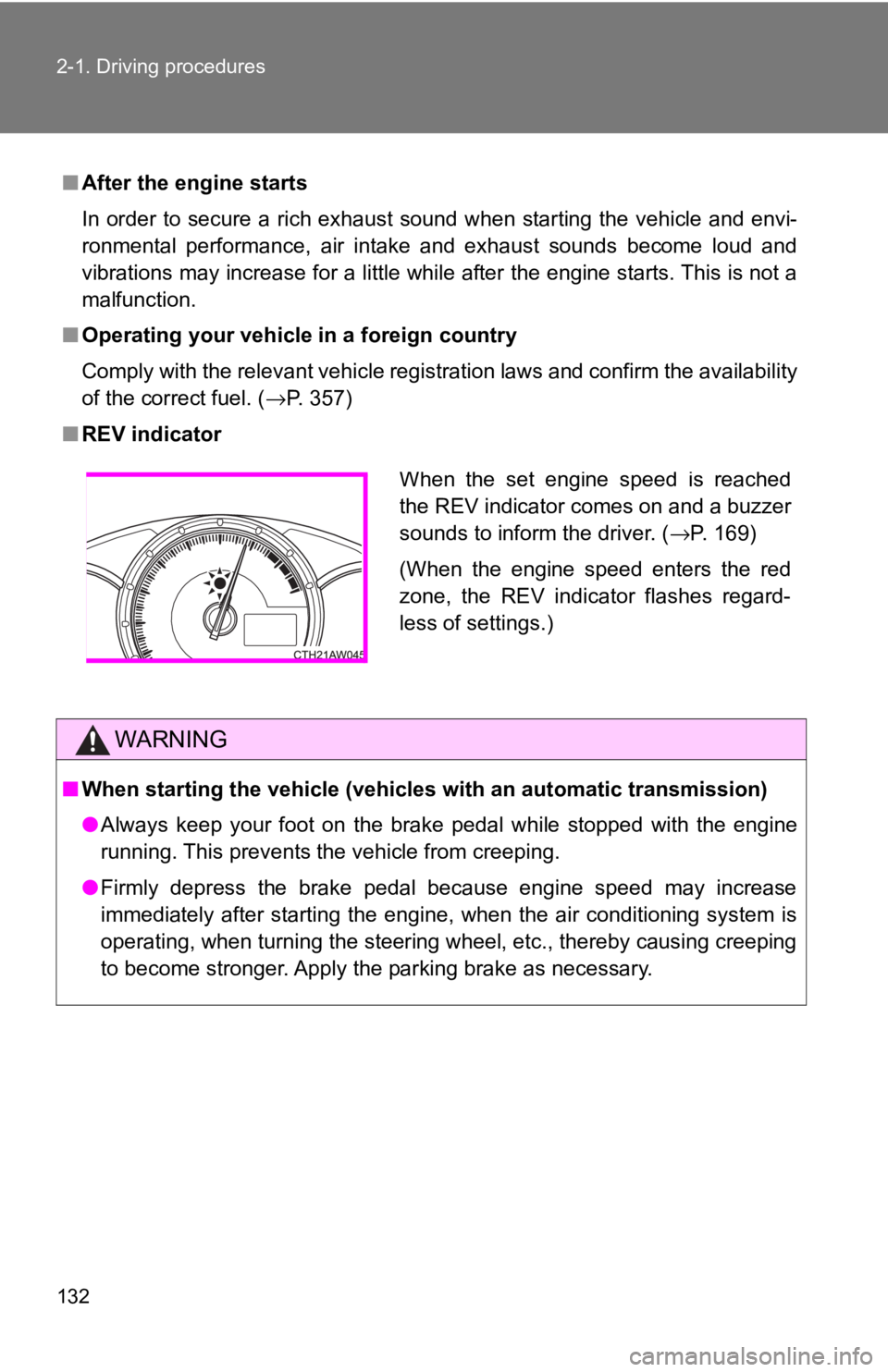
■ REV indicator
WARNING■ When starting the vehicle (vehicles with an automatic transmission)
● Always keep your foot on the brake pedal while stopped with the engine
running. This prevents the vehicle from creeping.
● Firmly depress the brake pedal because engine speed may increase
immediately after starting the engine, when the air conditioning system is
operating, when turning the steering wheel, etc., thereby causing creeping
to become stronger. Apply the parking brake as necessary. When the set engine speed is reached
the REV indicator comes on and a buzzer
sounds to inform the driver. ( → P. 169)
(When the engine speed enters the red
zone, the REV indicator flashes regard-
less of settings.)
Page 200 of 428
2002-5. Driving information
Winter driving tips Carry out the necessary preparations and inspections before driving
the vehicle in winter. Always drive the vehicle in a manner appropri-
ate to the prevailing weather conditions.
■ Pre-winter preparations
● Use fluids that are appropriate to the prevailing outside tem-
peratures.
• Engine oil
• Washer fluid
● Have a service technician inspect the condition of the battery.
● Have the vehicle fitted with four snow tires.
Make sure to install 4 tires that are of the specified size, and that
all 4 tires are the same size, same maker, same brand and tread
pattern.
■ Before driving the vehicle
Perform the following according to the driving conditions.
● Do not try to forcibly open a window or move a wiper that is
frozen. Pour warm water over the frozen area to melt the ice.
Wipe away the water immediately to prevent it from freezing.
● To ensure proper operation of th e climate control system fan,
remove any snow that has accumulated on the air inlet vents
in front of the windshield.
● Check for and remove any excess ice or snow that may have
accumulated on the exterior lights, vehicle's roof, chassis,
around the tires or on the brakes.
● Remove any snow or mud from the bottom of your shoes
before getting in the vehicle.
Page 207 of 428
Interior features
3
2073-1. Using the air
conditioning system
and defogger
Manual air conditioning
system ........................... 208
Rear window and
outside rear view
mirror defoggers ............ 215
3-2. Using the audio system
Using the AUX/USB
port................................. 217
Steering wheel audio
switches ......................... 218
Using the microphone ...... 219 3-3. Using the interior lights
Interior lights list ............... 220
• Interior light ..................... 221
3-4. Using the storage
features
List of storage
features .......................... 222
• Glove box........................ 223
• Bottle holders .................. 224
• Cup holders/
console tray .................... 225
3-5. Other interior features
Sun visors ........................ 227
Vanity mirrors ................... 228
Clock ................................ 229
Power outlets ................... 230
Floor mat .......................... 232
Page 208 of 428
2083-1. Using the air conditioning system and defogger
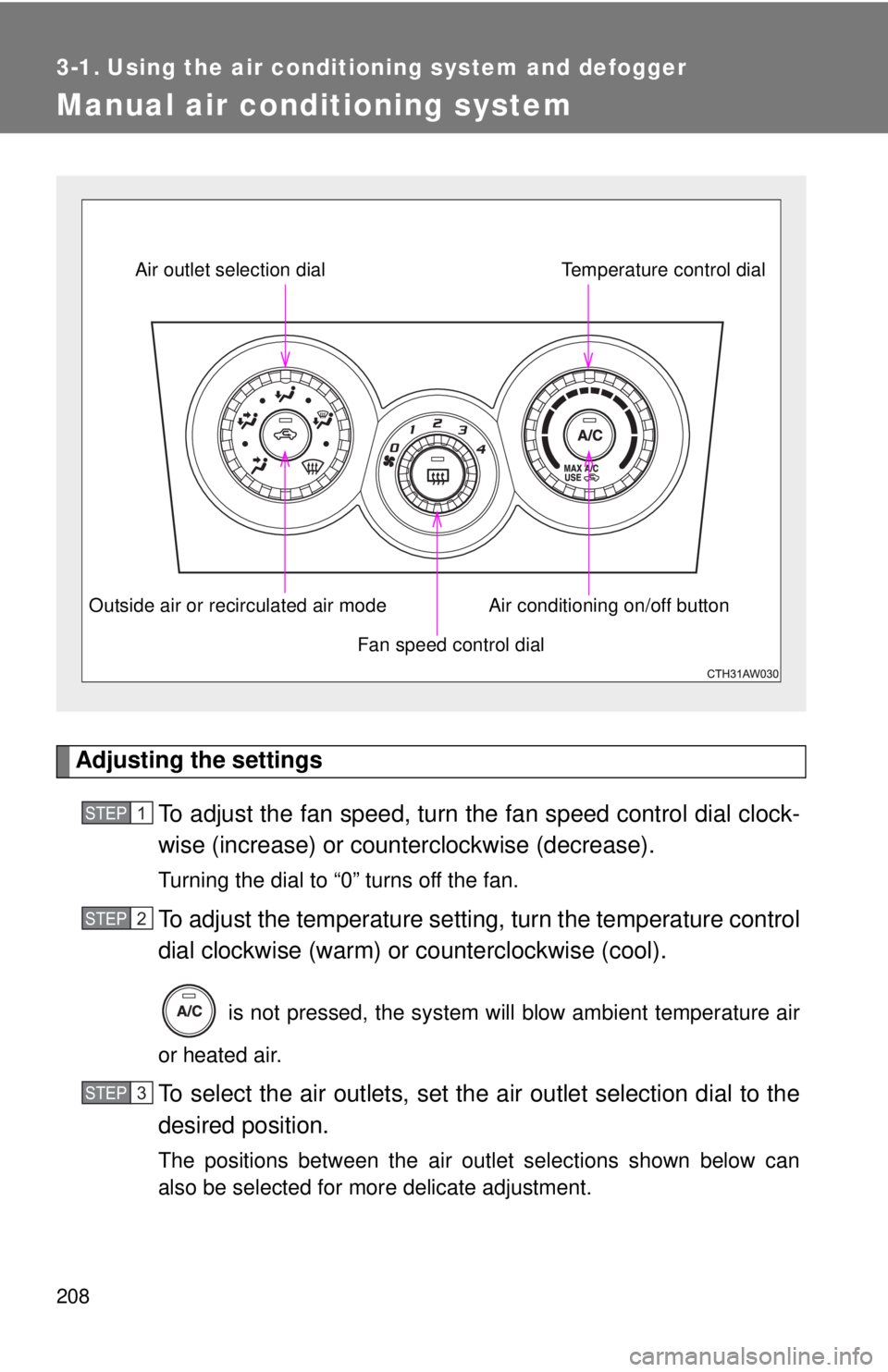
Manual air conditioning system
Adjusting the settings
To adjust the fan speed, turn the fan speed cont rol dial clock-
wise (increase) or count erclockwise (decrease).Turning the dial to “0” turns off the fan.
To adjust the temperature setting, turn the temperature control
dial clockwise (warm) or counterclockwise (cool).
is not pressed, the system will blow ambient temperature air
or heated air.
To select the air outlets, set the air outlet selection dial to the
desired position.
The positions between the air outlet selections shown below can
also be selected for more delicate adjustment. Fan speed control dialAir outlet selection dial
Air conditioning on/off button Temperature control dial
Outside air or recirculated air mode
STEP 1
STEP 2
STEP 3
Page 213 of 428
2133-1. Using the air condit ioning system and defogger
3
Interior features ■ For quick cooling
Turn the temperature control dial to the “MAX A/C” position and select the
recirculated air mode.
■ Fogging up of the windows
● The windows will easily fog up when the humidity in the vehicle is high.
Turning
on will dehumidify the air from the outlets and defog the
windshield effectively.
● If you turn
off, the windows may fog up more easily.
● The windows may fog up if the recirculated air mode is used.
■ Outside/recirculated air mode
When driving on dusty roads such as tunnels or in heavy traffic, set the out-
side/recirculated air mode button to the recirculated air mode. This is effec-
tive in preventing outside air from entering the vehicle interior. During cooling
operation, setting the recirculated air m ode will also cool the vehicle interior
effectively.
■ When the outside temperature falls to nearly 32°F (0°C)
The dehumidification function may not operate even when is
pressed.
■ Ventilation and air conditioning odors
● To let fresh air in, set the air conditioning system to the outside air mode.
● During use, various odors from inside and outside the vehicle may enter
into and accumulate in the air conditioning system. This may then cause
odor to be emitted from the vents.
● To reduce potential odors from occurring:
It is recommended that the air conditioning system be set to outside air
mode prior to turning the vehicle off.
■ Air conditioning filter
→ P. 284
Page 214 of 428

2143-1. Using the air cond itioning system and defogger
WARNING■ To prevent the windshield from fogging up
Do not set the air outlet selection dial to during cool air operation in
extremely humid weather. The difference between the temperature of the
outside air and that of the windshield can cause the outer surface of the
windshield to fog up, blocking your vision.
NOTICE■ To prevent battery discharge
Do not leave the air conditioning system on longer than necessary when the
engine is stopped.
Page 215 of 428
2153-1. Using the air conditioning system and defogger
3
Interior features
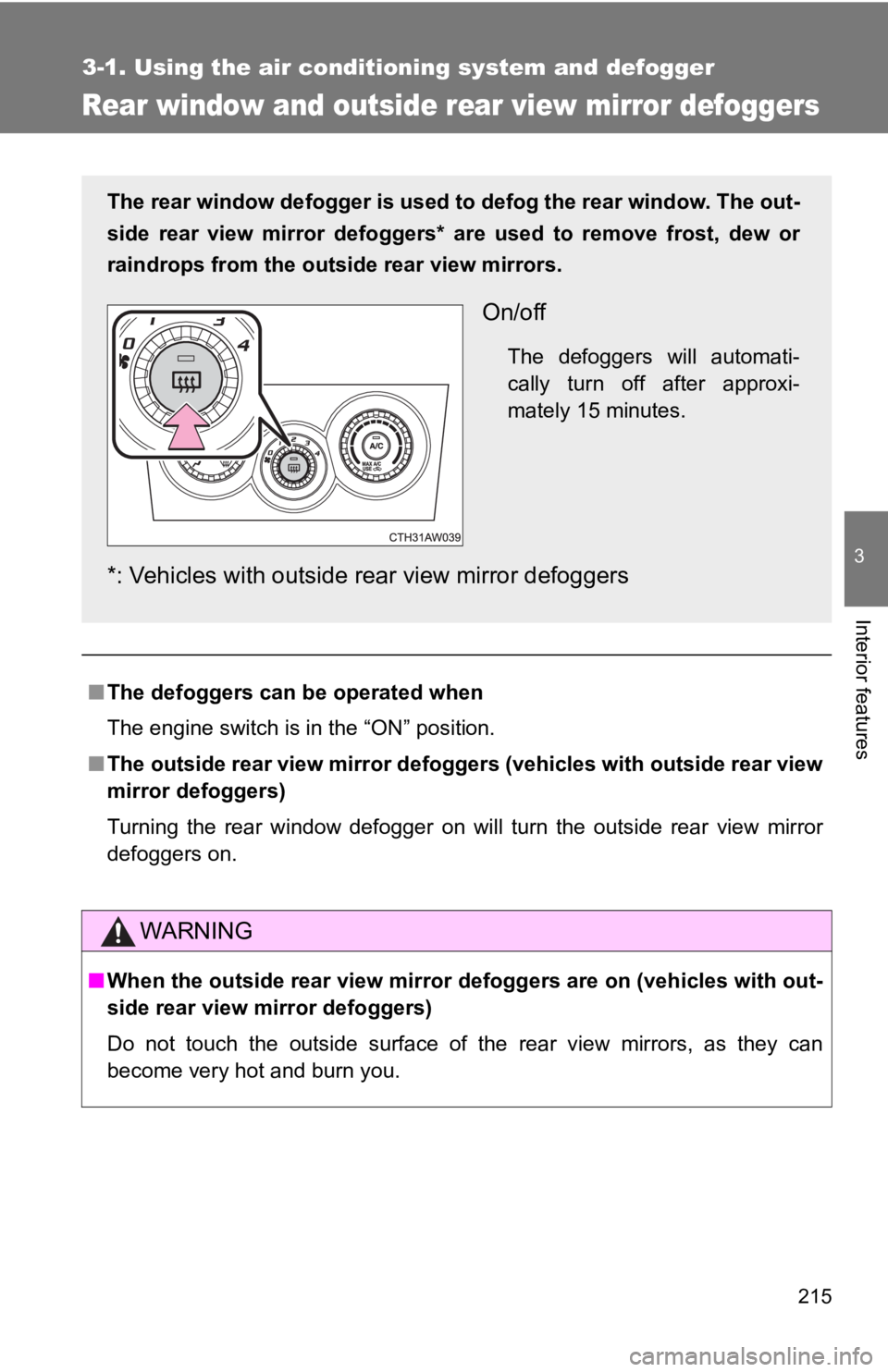
Rear window and outside r ear view mirror defoggers
■ The defoggers can be operated when
The engine switch is in the “ON” position.
■ The outside rear view mi rror defoggers (vehicles with outside rear view
mirror defoggers)
Turning the rear window defogger on will turn the outside rear view mirror
defoggers on.
WARNING
■ When the outside rear view mirror defoggers are on (vehicles with out-
side rear view mirror defoggers)
Do not touch the outside surface of the rear view mirrors, as they can
become very hot and burn you.The rear window defogger is used to defog the rear window. The out-
side rear view mirror defoggers* are used to remove frost, dew or
raindrops from the outs ide rear view mirrors.
On/off The defoggers will automati-
cally turn off after approxi-
mately 15 minutes.
*: Vehicles with outside rear view mirror defoggers
Page 235 of 428
Maintenance and care
4
2354-1. Maintenance and care
Cleaning and protecting
the vehicle exterior......... 236
Cleaning and protecting
the vehicle interior.......... 240
4-2. Maintenance
Maintenance
requirements .................. 244
General maintenance....... 246
Emission inspection and
maintenance (I/M)
programs........................ 249 4-3. Do-it-yourself
maintenance
Do-it-yourself service
precautions .................... 250
Hood ................................ 253
Positioning a floor
jack ................................ 255
Engine compartment ........ 257
Tires ................................. 270
Tire inflation pressure ...... 277
Wheels ............................. 281
Air conditioning filter......... 284
Wireless remote control
key battery ..................... 287
Checking and replacing
fuses .............................. 290
Light bulbs........................ 298
Page 238 of 428

2384-1. Maintenance and care
WARNING■ When washing the vehicle
Do not apply water to the inside of the engine compartment. Doing so may
cause the electrical components etc. to catch fire.
■ Precautions regarding the exhaust pipes
Exhaust gasses cause the exhaust pipes and rear bumper diffusers to
become quite hot.
When washing the vehicle, be careful not to touch the pipes and diffusers
until they have cooled sufficiently, as touching hot exhaust pipes and rear
bumper diffusers can cause burns.
NOTICE■ To prevent paint deterioration and corrosion on the body and compo-
nents (aluminum wheels etc.)
● Wash the vehicle immediately in the following cases:
• After driving near the sea coast
• After driving on salted roads
• If you see coal tar or tree sap on the paint surface
• If you see dead insects, insect droppings or bird droppings on the paint
• After driving in an area contaminated with soot, oily smoke, mine dust,
iron powder or chemical substances
• If the vehicle becomes heavily soiled in dust or mud
• If liquids such as benzene and gasoline are spilled on the paint surface
● If the paint is chipped or scratched, have it repaired immediately.
● To prevent the wheels from corroding, remove any dirt and store in a place
with low humidity when storing the wheels.
■ Protective film for side sill plates
Make sure to remove the protective film. Failure to do so may cause rust,
depending on conditions.