trunk TOYOTA 86 2017 Owner's Manual
[x] Cancel search | Manufacturer: TOYOTA, Model Year: 2017, Model line: 86, Model: TOYOTA 86 2017Pages: 428, PDF Size: 5.25 MB
Page 195 of 428
195 2
When driving 2-5. Driving information
Cargo and luggage
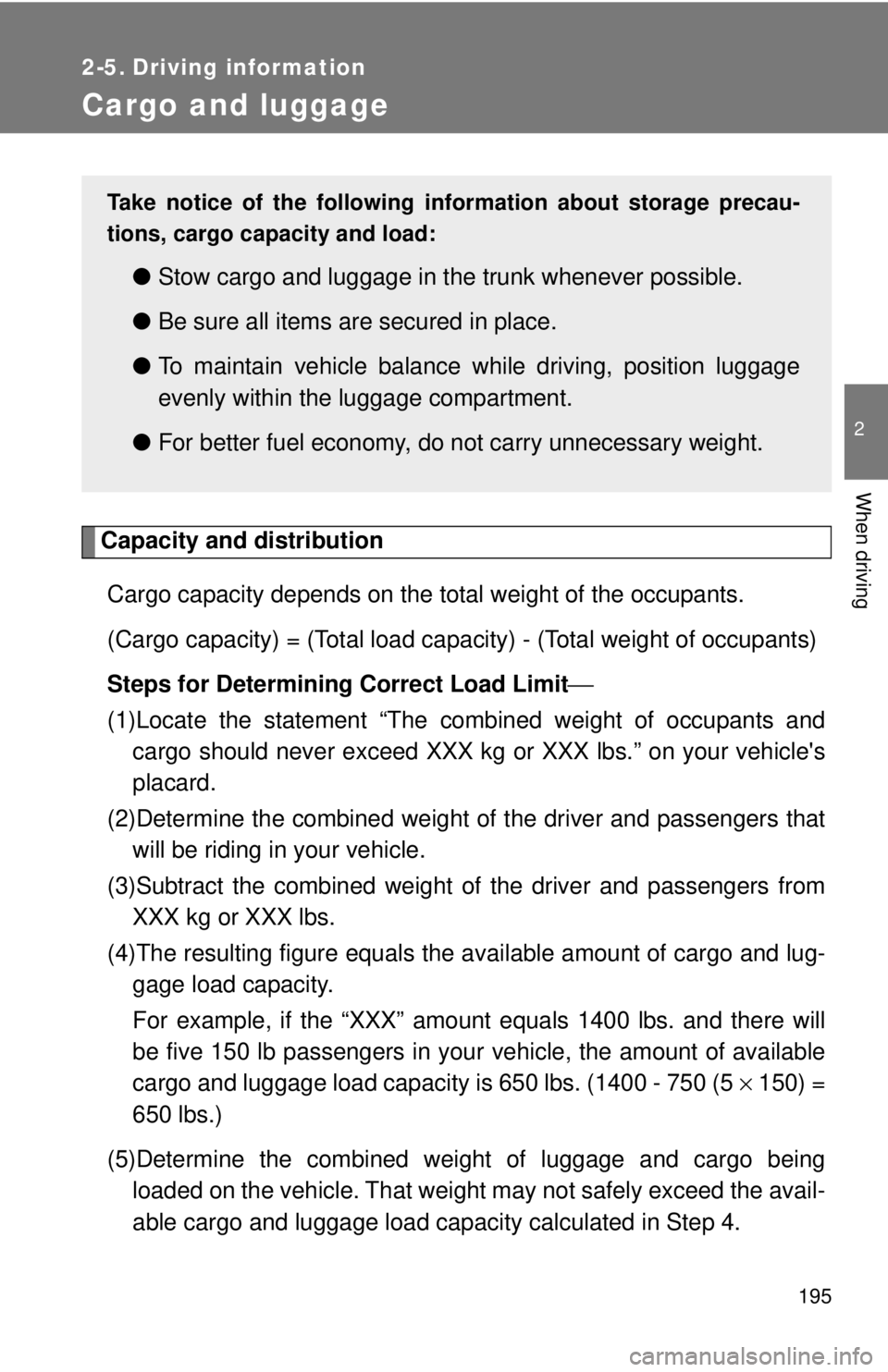
Capacity and distribution
Cargo capacity depends on the to tal weight of the occupants.
(Cargo capacity) = (Total load capa city) - (Total weight of occupants)
Steps for Determining Correct Load Limit ⎯
(1)Locate the statement “The combined wei ght of occupants and
cargo should never exceed XXX kg or XXX lbs.” on your vehicle's
placard.
(2)Determine the combined weight of the driver and passengers that
will be riding in your vehicle.
(3)Subtract the combined weight of the driver and passengers from
XXX kg or XXX lbs.
(4)The resulting figure equals the av ailable amount of cargo and lug-
gage load capacity.
For example, if the “XXX” amount equals 1400 lbs. and there will
be five 150 lb passengers in your vehicle, the amount of available
cargo and luggage load capacity is 650 lbs. (1400 - 750 (5 × 150) =
650 lbs.)
(5)Determine the combined weight of luggage and cargo being
loaded on the vehicle. That weight may not safely exceed the avail-
able cargo and luggage load capacity calculated in Step 4.Take notice of the following information about storage precau-
tions, cargo capacity and load:
● Stow cargo and luggage in t he trunk whenever possible.
● Be sure all items are secured in place.
● To maintain vehicle balance while driving, position luggage
evenly within the luggage compartment.
● For better fuel economy, do no t carry unnecessary weight.
Page 197 of 428

1972-5. Driving information
2
When driving As shown in the example above, if the number of occupants
increases, the cargo and luggage load will be reduced by an amount
that equals the increased weight due to the additional occupants. In
other words, if an increase in the number of occupants causes an
excess of the total load capacity (combined weight of occupants plus
cargo and luggage load), you must reduce the cargo and luggage on
your vehicle.
WARNING■
Things that must not be carried in the trunk
The following things may cause a fire if loaded in the trunk: ●
Receptacles containing gasoline●
Aerosol cans
Page 198 of 428

1982-5. Driving information
WARNING■
Storage precautions
Observe the following precautions.
Failure to do so may result in death or serious injury.●
Stow cargo and luggage in the trunk whenever possible.●
To prevent cargo and luggage from sliding forward during braking, do
not stack anything in the enlarged trunk. Keep cargo and luggage low,
as close to the floor as possible.●
When you fold down the rear seats, long items should not be placed
directly behind the front seats.●
Never allow anyone to ride in the enlarged trunk. It is not designed for
passengers. They should ride in t heir seats with their seat belts prop-
erly fastened. Otherwise, they are much more likely to suffer death or
serious bodily injury, in the event of sudden braking, sudden swerving
or an accident.
●
Do not place cargo or luggage in or on the following locations as the
item may get under the clutch, brake or accelerator pedal and prevent
the pedals from being depressed properly, block the driver’s vision, or
hit the driver or passengers, causing an accident:
• At the feet of the driver
• On the front passenger or rear seats (when stacking items)
• On the package tray
• On the instrument panel
• On the dashboard
●
Secure all items in the occupant compartment, as they may shift and
injure someone during sudden braking, sudden swerving or an acci-
dent.
■
Capacity and distribution
●
Do not exceed the maximum axle weight rating or the total vehicle
weight rating.
●
Even if the total load of occupant's weight and the cargo load is less
than the total load capacity, do not apply the load unevenly. Improper
loading may cause deterioration of steering or braking control which
may cause death or serious injury.
Page 248 of 428
2484-2. Maintenance
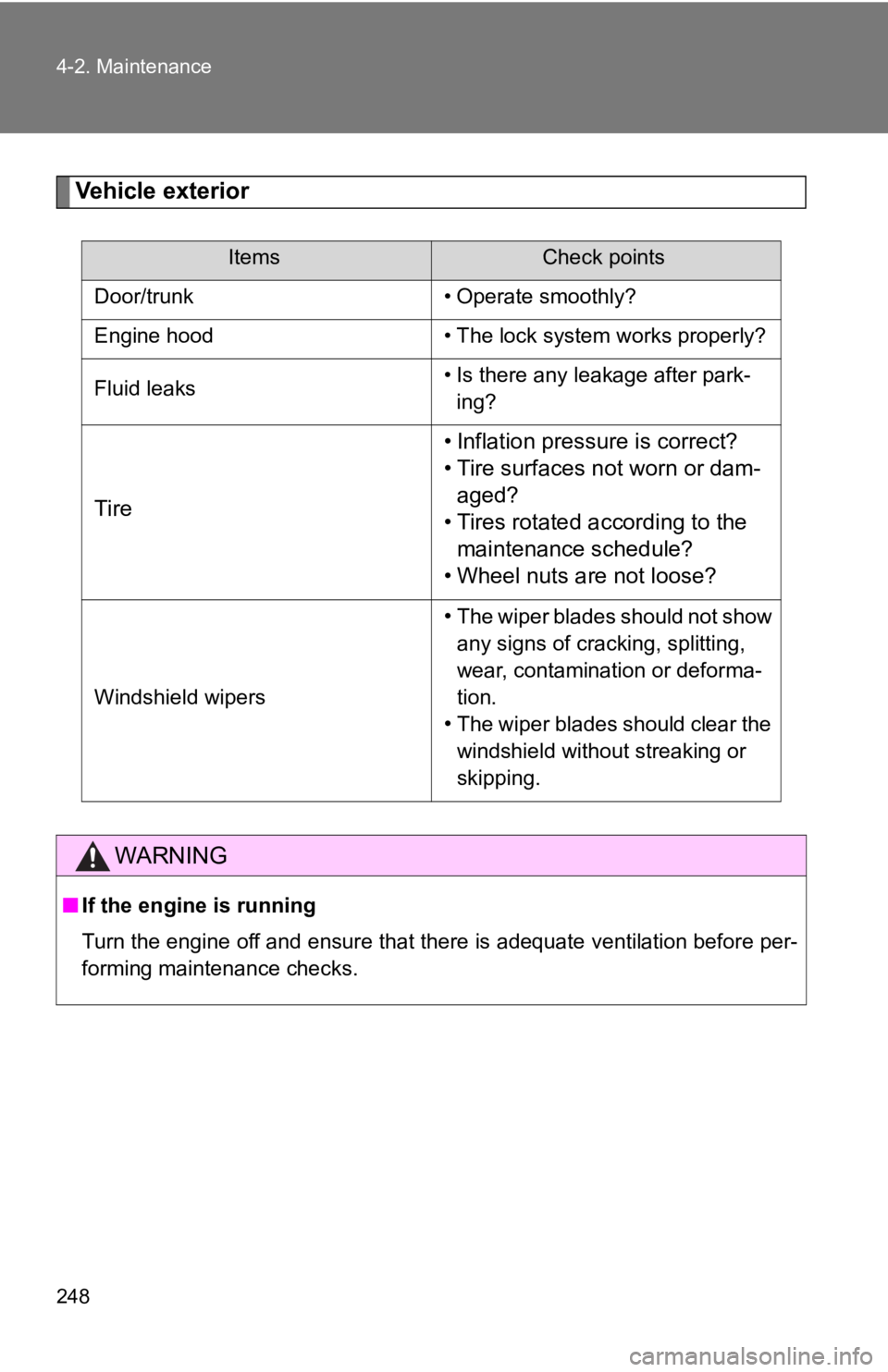
Vehicle exterior Items Check points
Door/trunk • Operate smoothly?
Engine hood • The lock system works properly?
Fluid leaks • Is there any leakage after park-
ing?
Tire • Inflation pressure is correct?
• Tire surfaces not worn or dam-
aged?
• Tires rotated according to the
maintenance schedule?
• Wheel nuts are not loose?
Windshield wipers • The wiper blades should not show
any signs of cracking, splitting,
wear, contamination or deforma-
tion.
• The wiper blades should clear the
windshield without streaking or
skipping.
WARNING■ If the engine is running
Turn the engine off and ensure that there is adequate ventilation before per-
forming maintenance checks.
Page 320 of 428
3205-2. Steps to take in an emergency
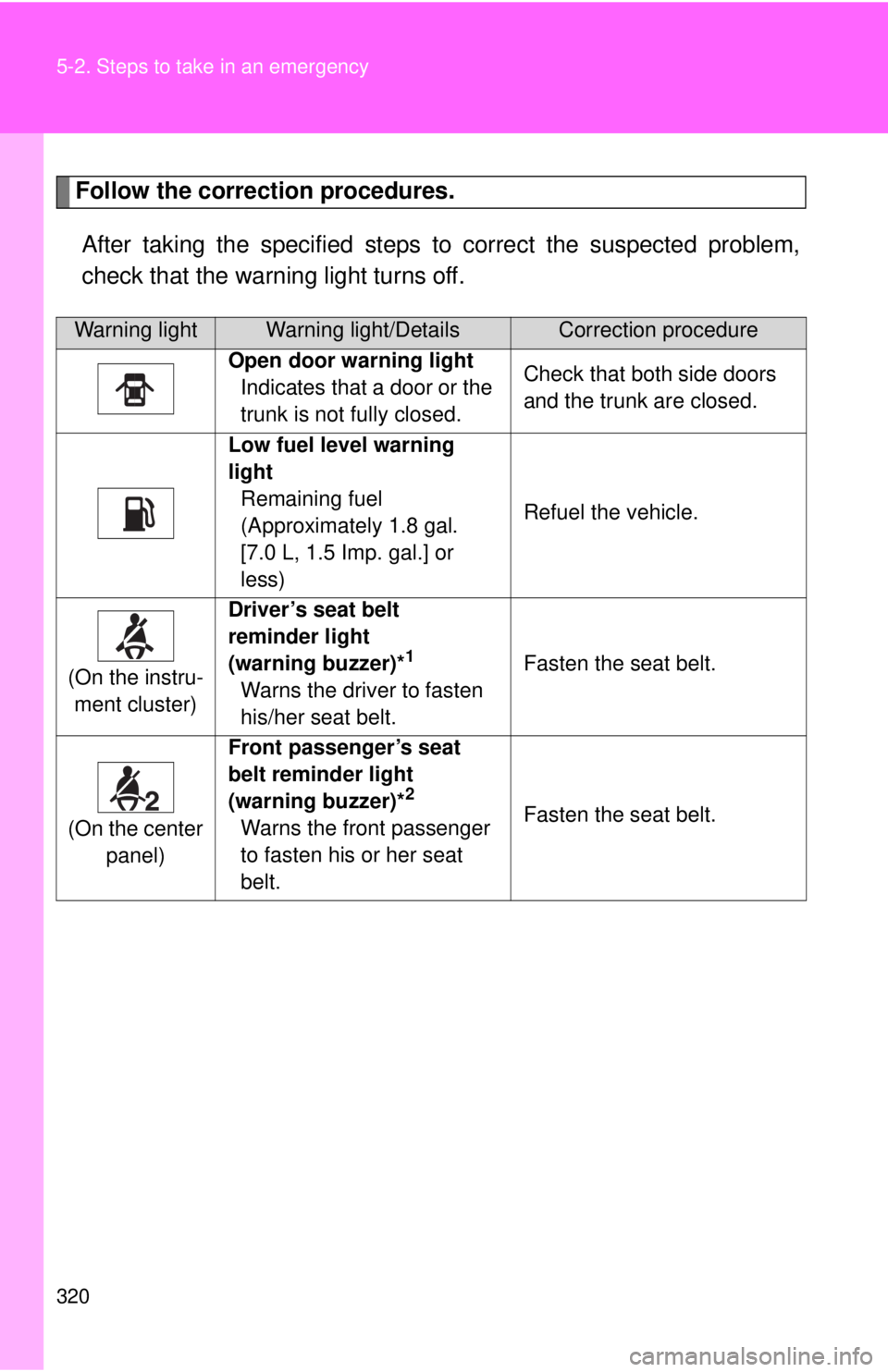
Follow the correction procedures.
After taking the specif ied steps to correct the suspected problem,
check that the warning light turns off. Warning light Warning light/Details Correction procedure
Open door warning light
Indicates that a door or the
trunk is not fully closed. Check that both side doors
and the trunk are closed.
Low fuel level warning
light
Remaining fuel
(Approximately 1.8 gal.
[7.0 L, 1.5 Imp. gal.] or
less) Refuel the vehicle.
(On the instru-
ment cluster) Driver’s seat belt
reminder light
(warning buzzer)* 1
Warns the driver to fasten
his/her seat belt. Fasten the seat belt.
(On the center
panel) Front passenger’s seat
belt reminder light
(warning buzzer)* 2
Warns the front passenger
to fasten his or her seat
belt. Fasten the seat belt.
Page 323 of 428

5
When trouble arises
3235-2. Steps to take in an emergency
■
If the tire pressure warning system is inoperative
The tire pressure warning system will be disabled in the following condi-
tions:
(When the condition be comes normal, the syst em will work properly.)●
If tires not equipped with tire pressure warning valves and transmit-
ters are used.●
If the ID code on the tire pressure warning valves and transmitters is
not registered in the tire pressure warning computer.●
If the tire inflation pr essure is 55 psi (380 kPa, 3.87 kgf/cm 2
or bar) or
higher.
The tire pressure warning system may be disabled in the following condi-
tions:
(When the condition be comes normal, the syst em will work properly.)●
If electronic devices or facilities us ing similar radio wave frequencies
are nearby.●
If a radio set at similar frequencies is in use in the vehicle.●
If a window tint that affects the radio wave signals is installed.●
If there is a lot of snow or ice on the vehicle, in particular around the
wheels or wheel housings.
●
If non-genuine Toyota wheels are used. (Even if you use Toyota
wheels, the tire pressu re warning system may not work properly with
some types of tires.)
●
If tire chains are used.
●
If a large metallic object which can interfer e with signal reception is
put in the trunk.
■
If the tire pressure warning light frequently comes on after blinking
for approximately one minute
If the tire pressure warning light fr equently comes on after blinking for
approximately one minute when the engine switch is turned to the “ON”
position, have it checked your Toyota dealer.
Page 337 of 428

5
When trouble arises
3375-2. Steps to take in an emergency
NOTICE■
Do not drive the vehicle with a flat tire.
Do not continue driving with a flat tire.
Driving even a short distance with a fl at tire can damage the tire and the
wheel beyond repair.■
Be careful when driving over bumps with the compact spare tire
installed on the vehicle.
The vehicle becomes lower when driving with the compact spare tire
compared to when driving with standard tires. Be careful when driving
over uneven road surfaces.■
Driving with tire chains and the compact spare tire
Do not fit tire chains to the compact spare tire.
Tire chains may damage the vehicle body and adversely affect driving
performance.■
When replacing the tires
When removing or fitting the wheels, tires or the tire pressure warning
valve and transmitter, contact your Toyota dealer as the tire pressure
warning valve and transmitter may be damaged if not handled correctly.
■
To avoid damage to the tire pressure warning valves and transmit-
ters
When a tire is repaired with liquid sealants, the tire pressure warning
valve and transmitter may not operate properly. If a liquid sealant is
used, contact your Toyota dealer or other qualified service shop as soon
as possible. Make sure to replace the tire pressure warning valve and
transmitter when replacing the tire. ( → P. 271)
■
Stowing the jack
When stowing the jack in the jack holder, make sure that the part that the
jack handle attaches to is pointing towards the inside of the trunk. Failure
to do so may damage the vehicle body.
Page 365 of 428
3656-1. Specifications
6
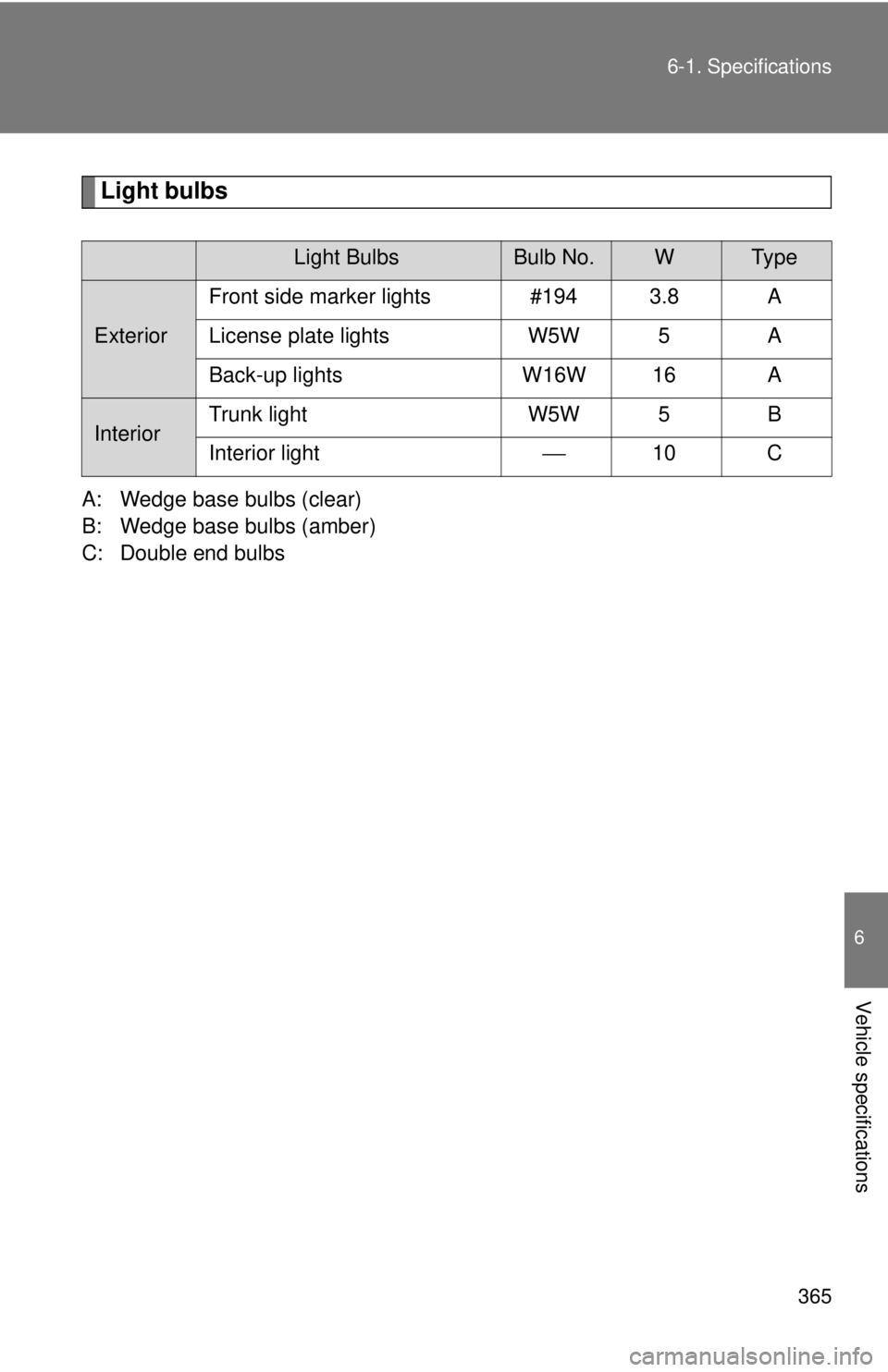
Vehicle specifications Light bulbs
A: Wedge base bulbs (clear)
B: Wedge base bulbs (amber)
C: Double end bulbs Light Bulbs Bulb No. W Ty p e
Exterior Front side marker lights #194 3.8 A
License plate lights W5W 5 A
Back-up lights W16W 16 A
Interior Trunk light W5W 5 B
Interior light ⎯ 10 C
Page 384 of 428

3846-2. Customization
Wireless
remote con-
trol
(
→ P. 24) Door lock buzzer On Off
Trunk unlocking func-
tion On Off
Trunk unlocking opera-
tion Push and hold
(short) Push and hold
(long)
One short push
Two short
pushes
Panic function On Off
Vehicle finder function Off On
Automatic
light control
system
( → P. 172) Light sensor sensitivity ±0% -40% to +40%
Time elapsed before
headlights automati-
cally turn off after doors
are closed 30 seconds 0 second
60 seconds
90 seconds
Illumination
(
→ P. 220) Time elapsed before
lights turn off 15 seconds 7.5 seconds
30 seconds
Operation when the
doors are unlocked On Off
Operation after the
engine switch is turned
off On Off
Interior light illumination On OffItem Function Default setting Customized
setting
Page 417 of 428

417Alphabetical index
Child safety
Airbag precautions ................. 97
Battery precautions ...... 267, 343
Child restraint system ........... 112
How your child should
wear the seat belt................. 44
Installing child restraints ....... 116
Power window lock switch ...... 54
Power window
precautions .......................... 56
Removed key battery
precautions ........................ 288
Seat belt guide ....................... 43
Seat belt precautions.............. 46
Trunk precautions................... 32
Cleaning
Aluminum wheels ................. 237
Exterior ................................. 236
Interior .................................. 240
Seat belts ............................. 241
Clock ........................................ 229
Condenser ............................... 263
Console tray ............................ 225
Coolant
Capacity ............................... 360
Checking .............................. 261
Cooling system
Engine overheating .............. 345
Cruise control .......................... 179 Cup holders ..............................225
Curtain shield airbags ...............66
Customizable features.............383
Daytime running light
system ....................................173
Defogger
Rear window .........................215
Side mirror.............................215
Dimension.................................354
Dinghy towing ..........................205
Display
Multi-information display .......165
Trip information .....................166
Do-it-yourself main tenance.....250
Doors
Door lock ...........................24, 27
Door windows..........................54
Side mirrors .............................51
Driver's seat belt
reminder light.........................320
Driving
Break-in tips ..........................131
Correct posture .......................64
Procedures ............................128
Winter drive tips ....................200D