check engine TOYOTA 86 2017 Owner's Guide
[x] Cancel search | Manufacturer: TOYOTA, Model Year: 2017, Model line: 86, Model: TOYOTA 86 2017Pages: 428, PDF Size: 5.25 MB
Page 261 of 428
2614-3. Do-it-yourself maintenance
4
Maintenance and care
Engine coolant
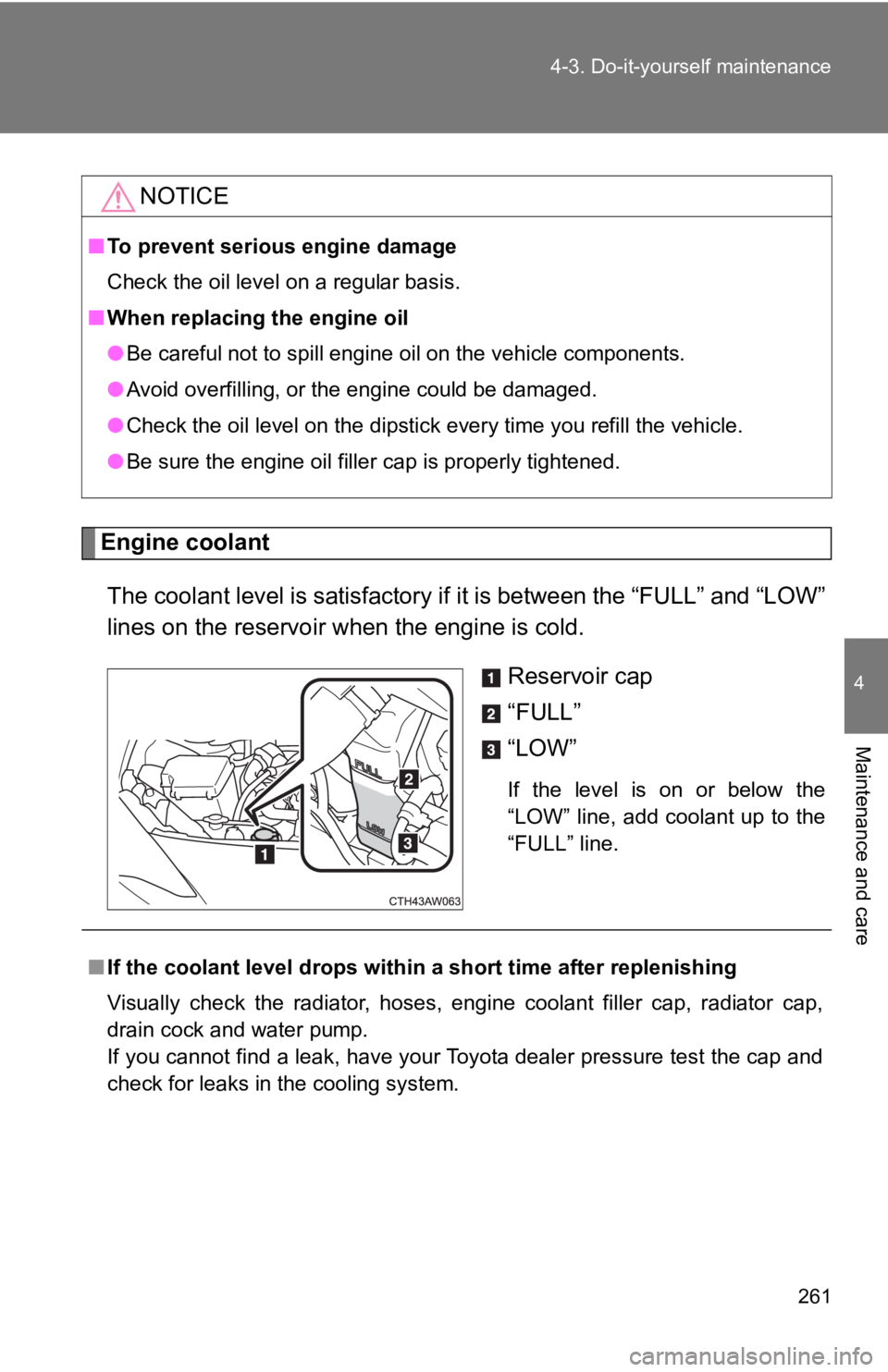
The coolant level is satisfactory if it is between the “FULL” and “LOW”
lines on the reservoir when the engine is cold.
Reservoir cap
“FULL”
“LOW” If the level is on or below the
“LOW” line, add coolant up to the
“FULL” line.NOTICE■ To prevent serious engine damage
Check the oil level on a regular basis.
■ When replacing the engine oil
● Be careful not to spill engine oil on the vehicle components.
● Avoid overfilling, or the engine could be damaged.
● Check the oil level on the dipstick every time you refill the vehicle.
● Be sure the engine oil filler cap is properly tightened.
■ If the coolant level drops within a short time after replenishing
Visually check the radiator, hoses, engine coolant filler cap, radiator cap,
drain cock and water pump.
If you cannot find a leak, have your Toyota dealer pressure test the cap and
check for leaks in the cooling system.
Page 263 of 428
2634-3. Do-it-yourself maintenance
4
Maintenance and care Radiator and condenser
Check the radiator and condenser and clear away any foreign
objects.
If either of the above parts are ex tremely dirty or you are not sure of
their condition, have y our vehicle checked by your Toyota dealer.
Brake fluid
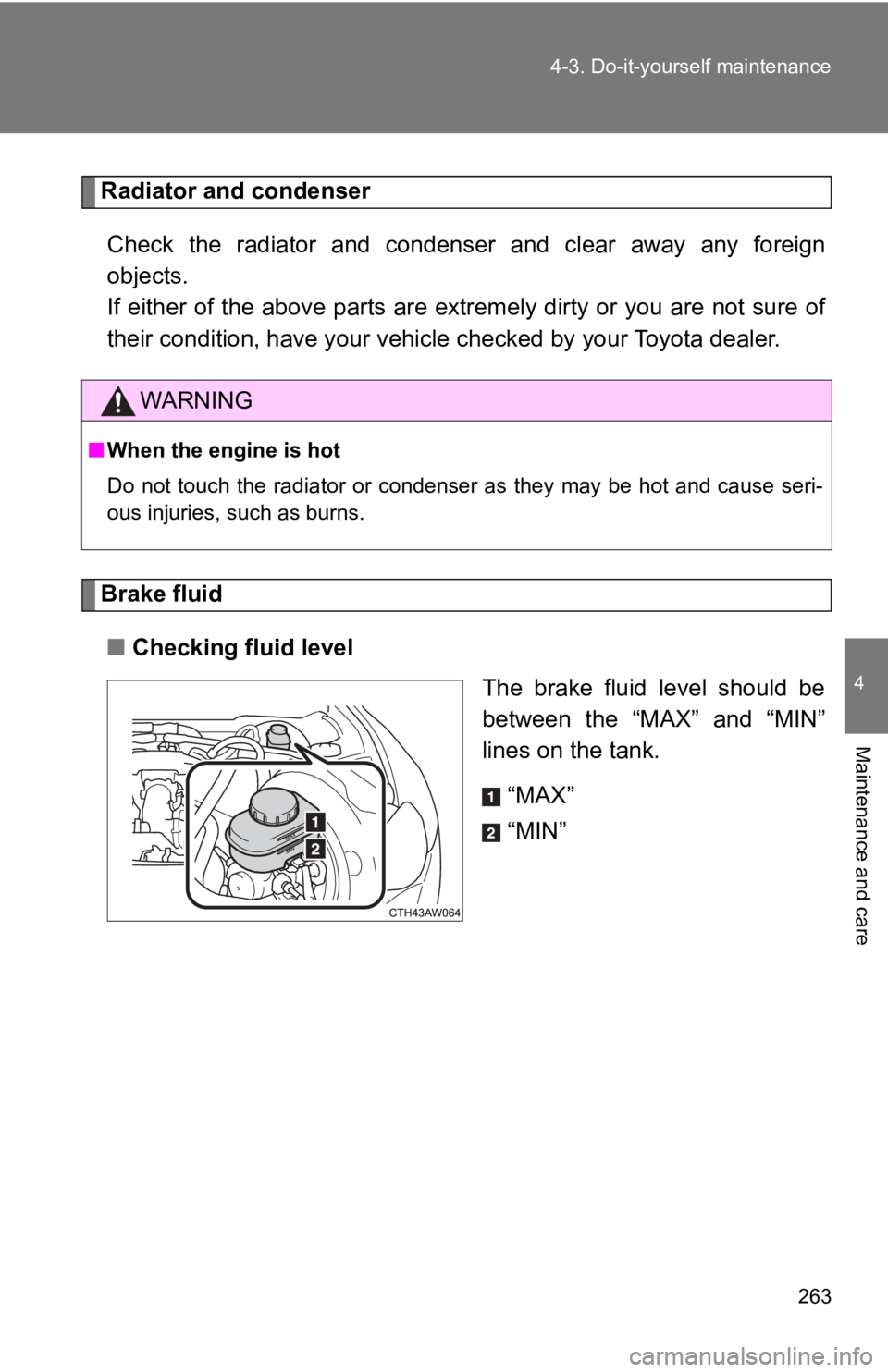
■ Checking fluid level
The brake fluid level should be
between the “MAX” and “MIN”
lines on the tank.
“MAX”
“MIN”WARNING■ When the engine is hot
Do not touch the radiator or condenser as they may be hot and cause seri-
ous injuries, such as burns.
Page 268 of 428
2684-3. Do-it-yourself maintenance
Washer fluid
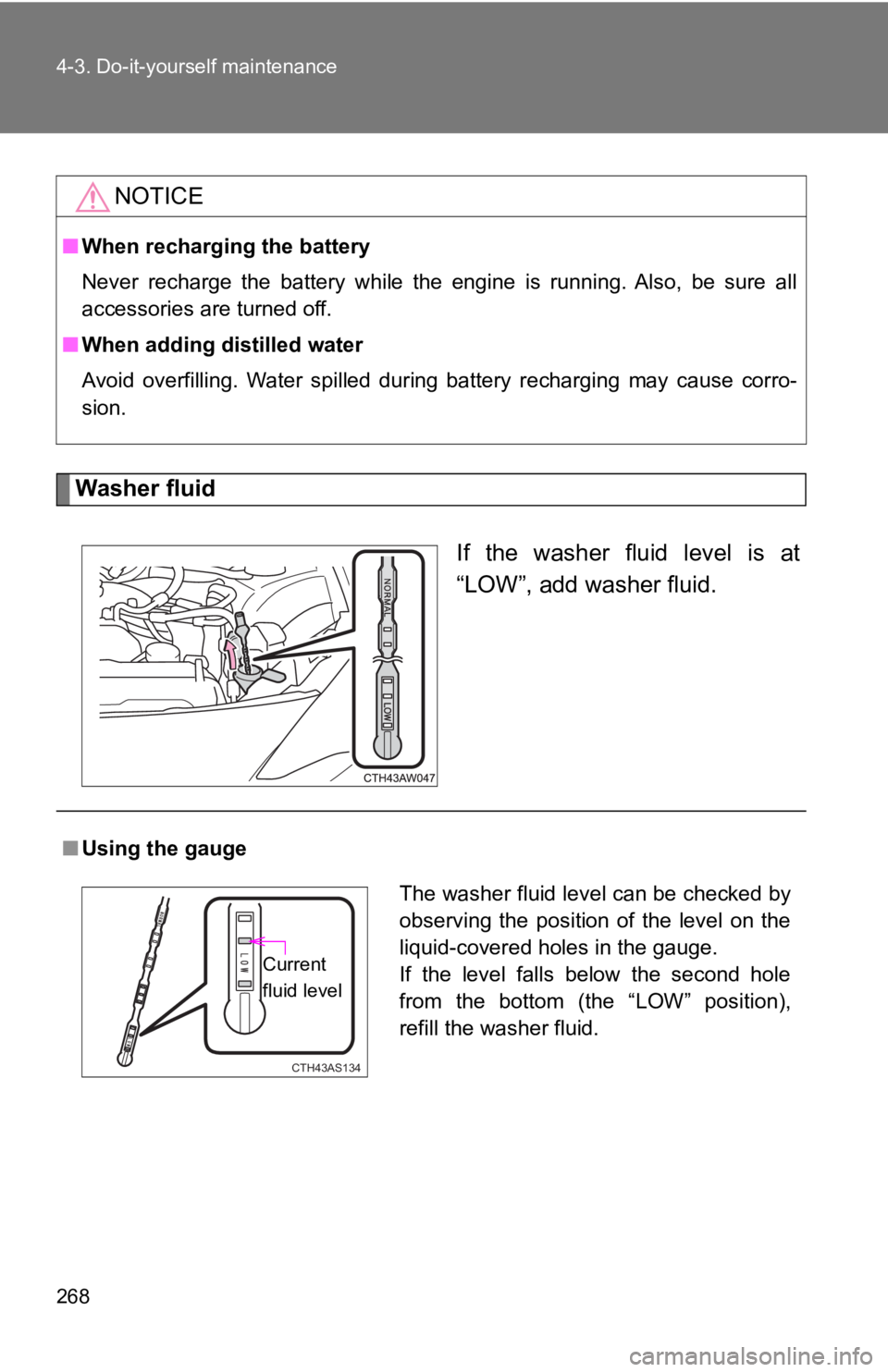
If the washer fluid level is at
“LOW”, add washer fluid.NOTICE■ When recharging the battery
Never recharge the battery while the engine is running. Also, be sure all
accessories are turned off.
■ When adding distilled water
Avoid overfilling. Water spilled during battery recharging may cause corro-
sion.
■ Using the gauge
The washer fluid level can be checked by
observing the position of the level on the
liquid-covered holes in the gauge.
If the level falls below the second hole
from the bottom (the “LOW” position),
refill the washer fluid. CTH43AS134
Current
fluid level
Page 290 of 428
2904-3. Do-it-yourself maintenance
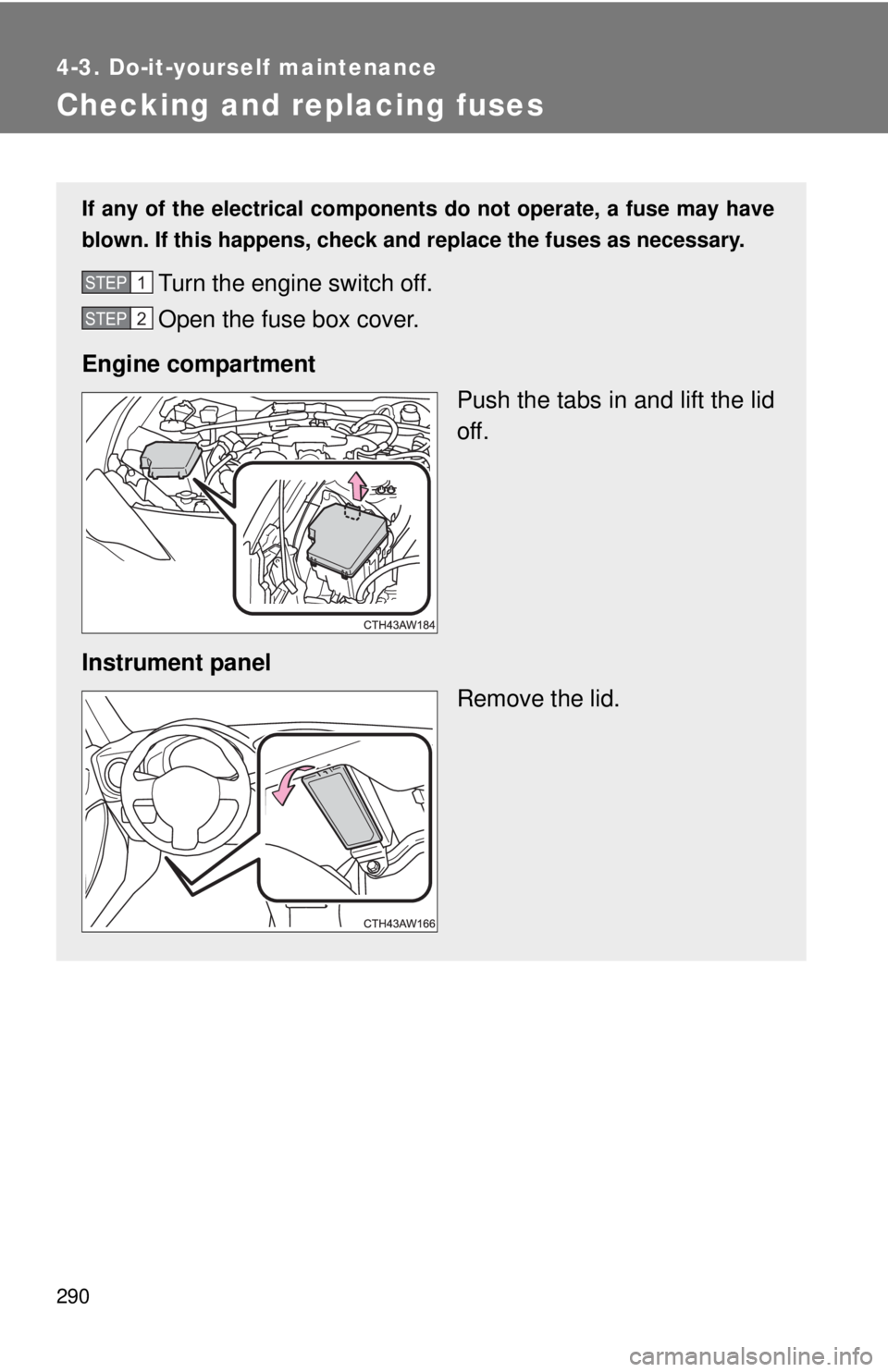
Checking and replacing fuses If any of the electrical components do not operate, a fuse may have
blown. If this happens, check and replace the fuses as necessary.
Turn the engine switch off.
Open the fuse box cover.
Engine compartment
Push the tabs in and lift the lid
off.
Instrument panel
Remove the lid.STEP 1
STEP 2
Page 321 of 428
5
When trouble arises
3215-2. Steps to take in an emergency
*1
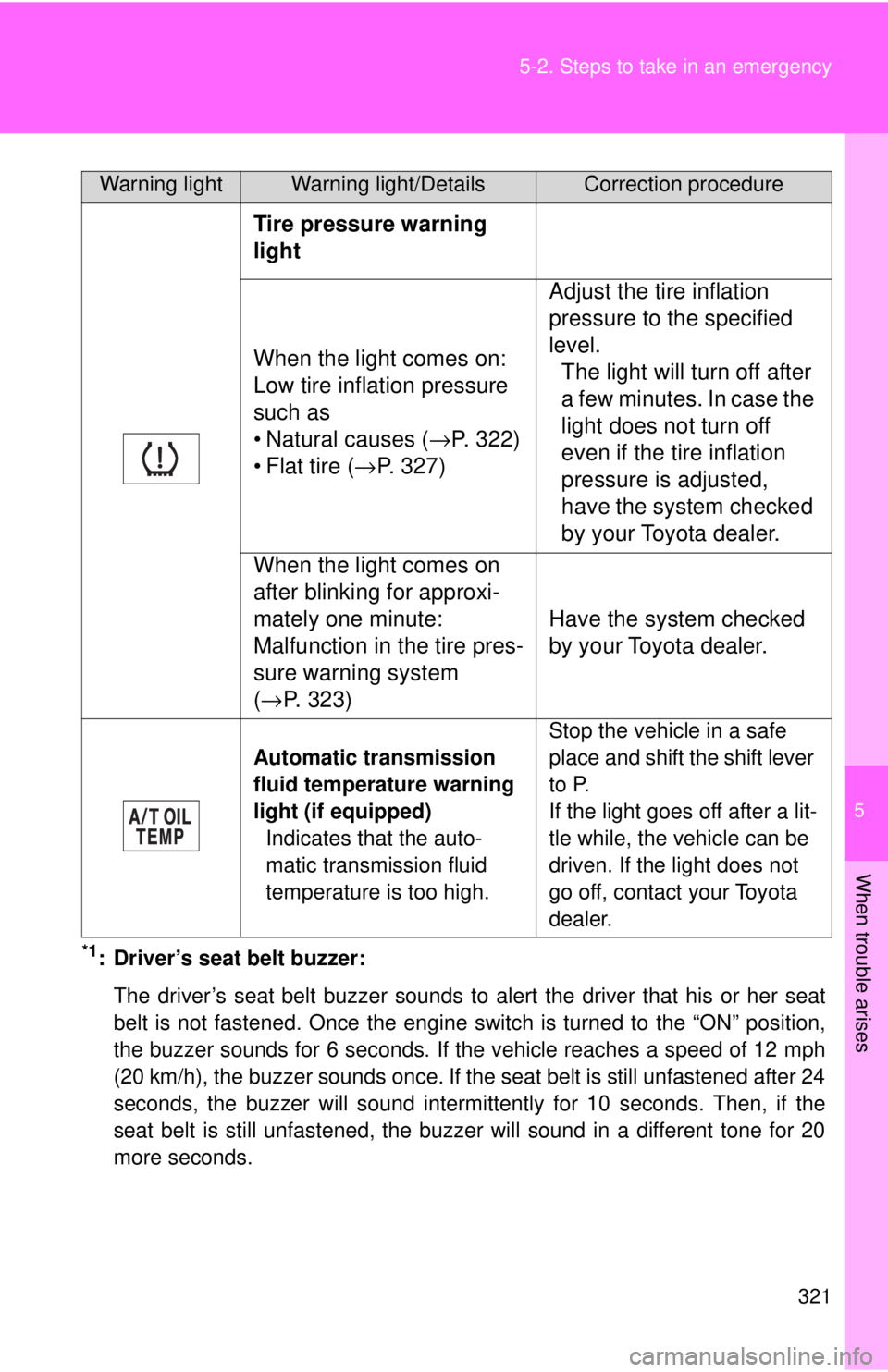
: Driver’s seat belt buzzer:
The driver’s seat belt buzzer sounds to alert the driver that his or her seat
belt is not fastened. Once the engine switch is turned to the “ON” position,
the buzzer sounds for 6 seconds. If the vehicle reaches a speed of 12 mph
(20 km/h), the buzzer sounds once. If the seat belt is still unfastened after 24
seconds, the buzzer will sound intermittently for 10 seconds. Then, if the
seat belt is still unfastened, the buzzer will sound in a different tone for 20
more seconds. Tire pressure warning
light
When the light comes on:
Low tire inflation pressure
such as
• Natural causes ( → P. 322)
• Flat tire ( → P. 327) Adjust the tire inflation
pressure to the specified
level.
The light will turn off after
a few minutes. In case the
light does not turn off
even if the tire inflation
pressure is adjusted,
have the system checked
by your Toyota dealer.
When the light comes on
after blinking for approxi-
mately one minute:
Malfunction in the tire pres-
sure warning system
( → P. 323) Have the system checked
by your Toyota dealer.
Automatic transmission
fluid temperature warning
light (if equipped)
Indicates that the auto-
matic transmission fluid
temperature is too high. Stop the vehicle in a safe
place and shift the shift lever
to P.
If the light goes off after a lit-
tle while, the vehicle can be
driven. If the light does not
go off, contact your Toyota
dealer.Warning light Warning light/Details Correction procedure
Page 323 of 428
5
When trouble arises
3235-2. Steps to take in an emergency
■
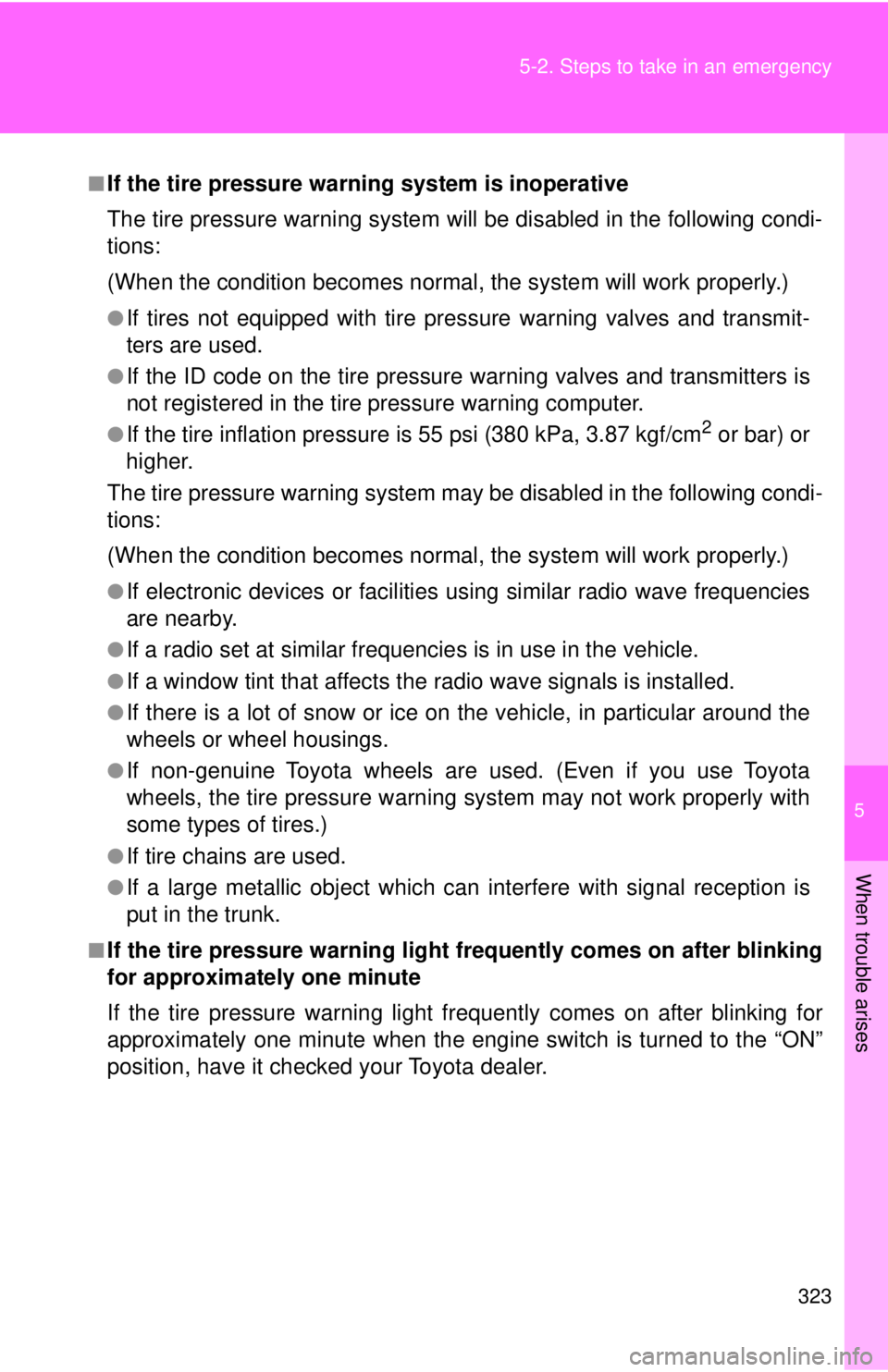
If the tire pressure warning system is inoperative
The tire pressure warning system will be disabled in the following condi-
tions:
(When the condition be comes normal, the syst em will work properly.)●
If tires not equipped with tire pressure warning valves and transmit-
ters are used.●
If the ID code on the tire pressure warning valves and transmitters is
not registered in the tire pressure warning computer.●
If the tire inflation pr essure is 55 psi (380 kPa, 3.87 kgf/cm 2
or bar) or
higher.
The tire pressure warning system may be disabled in the following condi-
tions:
(When the condition be comes normal, the syst em will work properly.)●
If electronic devices or facilities us ing similar radio wave frequencies
are nearby.●
If a radio set at similar frequencies is in use in the vehicle.●
If a window tint that affects the radio wave signals is installed.●
If there is a lot of snow or ice on the vehicle, in particular around the
wheels or wheel housings.
●
If non-genuine Toyota wheels are used. (Even if you use Toyota
wheels, the tire pressu re warning system may not work properly with
some types of tires.)
●
If tire chains are used.
●
If a large metallic object which can interfer e with signal reception is
put in the trunk.
■
If the tire pressure warning light frequently comes on after blinking
for approximately one minute
If the tire pressure warning light fr equently comes on after blinking for
approximately one minute when the engine switch is turned to the “ON”
position, have it checked your Toyota dealer.
Page 334 of 428
3345-2. Steps to take in an emergency
WARNING■
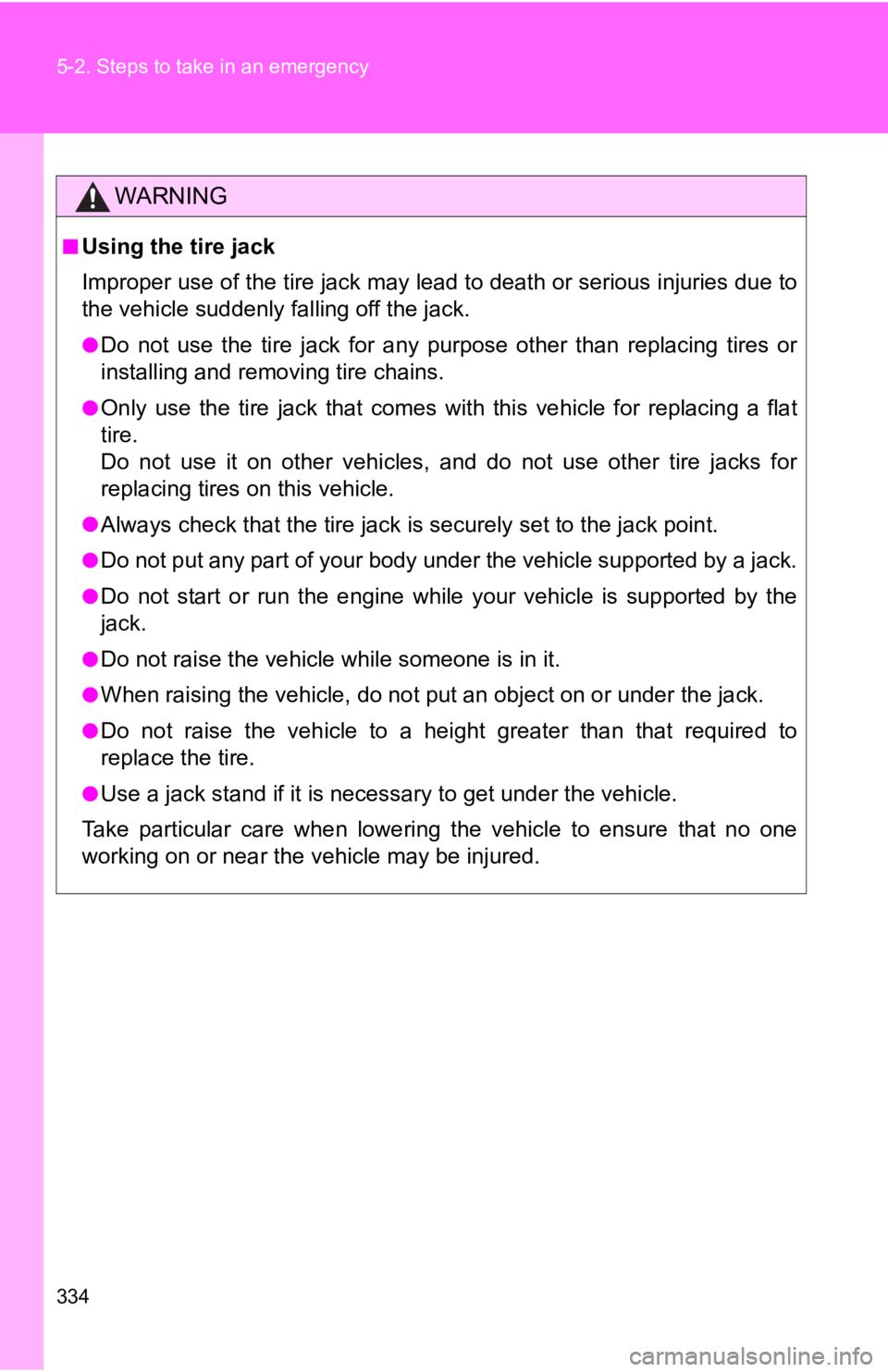
Using the tire jack
Improper use of the tire jack may lead to death or serious injuries due to
the vehicle suddenly falling off the jack. ●
Do not use the tire jack for any purpose other than replacing tires or
installing and removing tire chains.●
Only use the tire jack that comes with this vehicle for replacing a flat
tire.
Do not use it on other vehicles, and do not use other tire jacks for
replacing tires on this vehicle.●
Always check that the tire jack is securely set to the jack point.●
Do not put any part of your body under the vehicle supported by a jack.●
Do not start or run the engine while your vehicle is supported by the
jack.
●
Do not raise the vehicle while someone is in it.
●
When raising the vehicle, do not put an object on or under the jack.
●
Do not raise the vehicle to a hei ght greater than that required to
replace the tire.
●
Use a jack stand if it is necessary to get under the vehicle.
Take particular care when lowering the vehicle to ensure that no one
working on or near the vehicle may be injured.
Page 342 of 428
3425-2. Steps to take in an emergency
■ Starting the engine when the battery is discharged
The engine cannot be started by push-starting.
■ Avoiding a discharged battery
● Turn off the headlights and the air conditioning system while the engine is
off.
● Turn off any unnecessary electrical components when the vehicle is run-
ning at a low speed for an extended period, such as in heavy traffic, etc.
■ Charging the battery
The electricity stored in the battery will discharge gradually even when the
vehicle is not in use, due to natural discharge and the draining effects of cer-
tain electrical appliances. If the vehicle is left for a long time, the battery may
discharge, and the engine may be unable to start. (The battery recharges
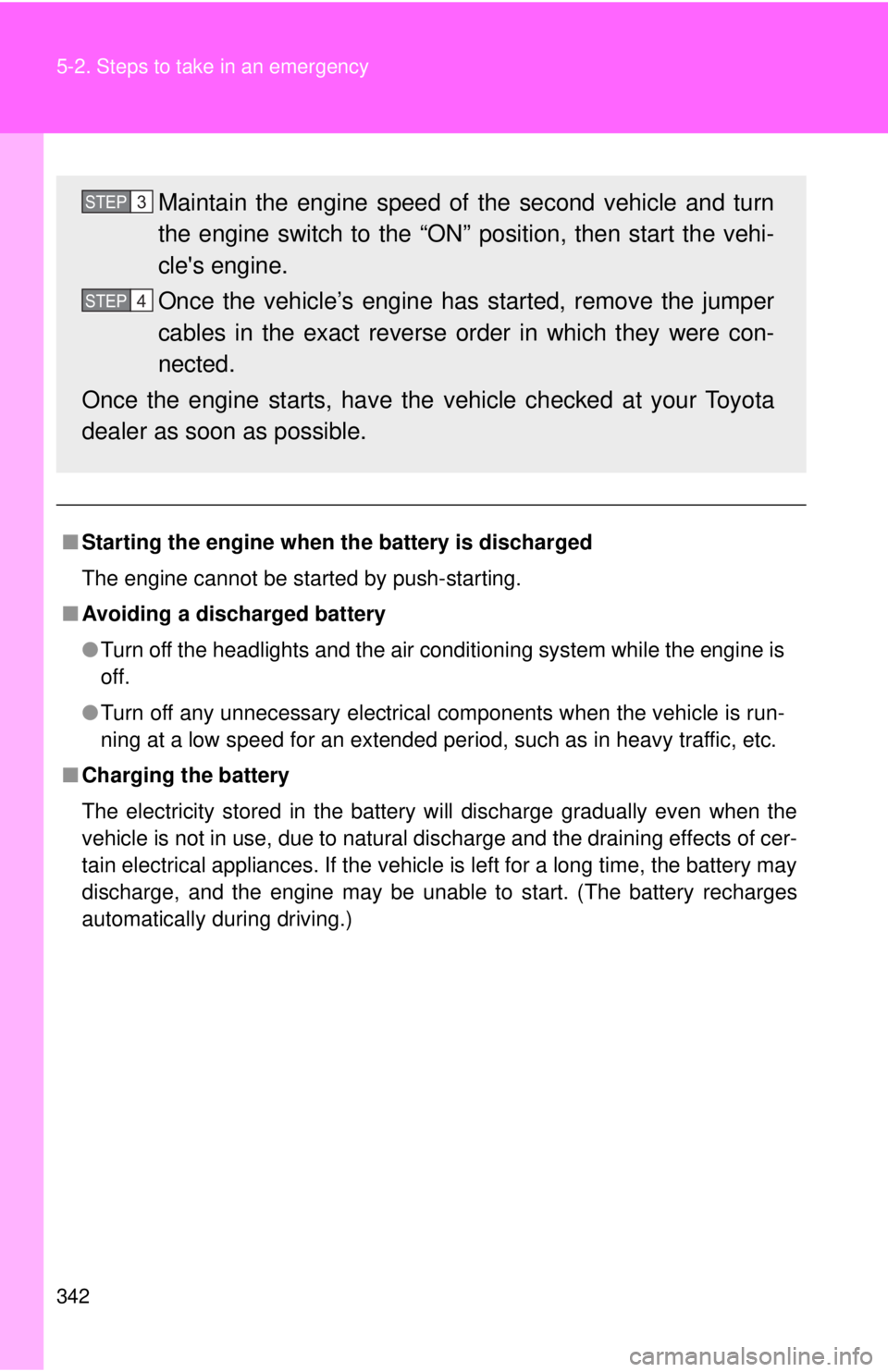
automatically during driving.) Maintain the engine speed of the second vehicle and turn
the engine switch to the “ON” position, then start the vehi-
cle's engine.
Once the vehicle’s engine has started, remove the jumper
cables in the exact reverse order in which they were con-
nected.
Once the engine starts, have th e vehicle checked at your Toyota
dealer as soon as possible. STEP 3
STEP 4
Page 346 of 428
3465-2. Steps to take in an emergency
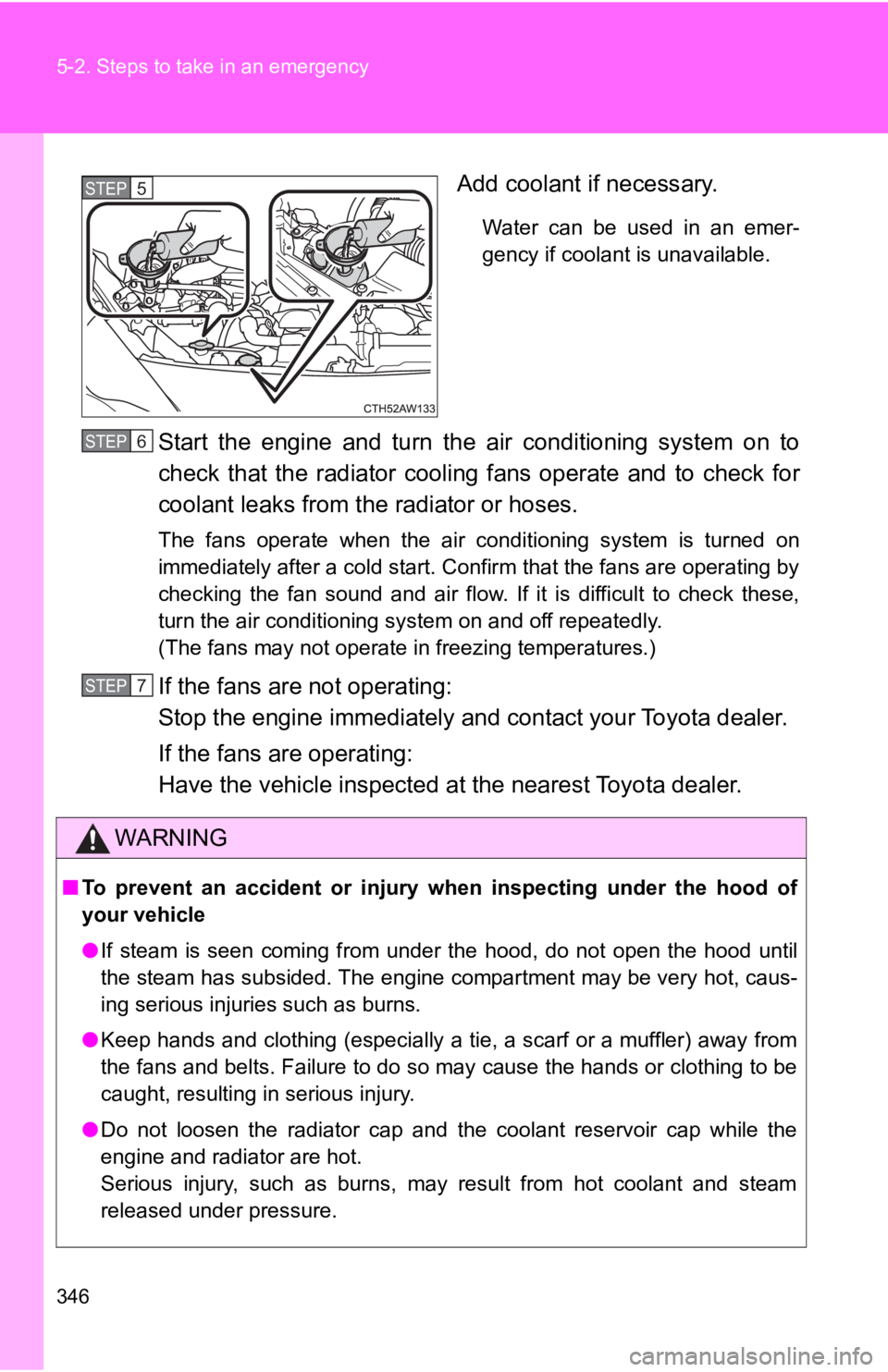
Add coolant if necessary. Water can be used in an emer-
gency if coolant is unavailable.
Start the engine and turn the air conditioning system on to
check that the radiator cooling fans operate and to check for
coolant leaks from the radiator or hoses. The fans operate when the air conditioning system is turned on
immediately after a cold start. Confirm that the fans are operating by
checking the fan sound and air flow. If it is difficult to check these,
turn the air conditioning system on and off repeatedly.
(The fans may not operate in freezing temperatures.)
If the fans are not operating:
Stop the engine immediately and contact your Toyota dealer.
If the fans are operating:
Have the vehicle inspected at the nearest Toyota dealer.STEP 5
WARNING■ To prevent an accident or injury when inspecting under the hood of
your vehicle
● If steam is seen coming from under the hood, do not open the hood until
the steam has subsided. The engine compartment may be very hot, caus-
ing serious injuries such as burns.
● Keep hands and clothing (especially a tie, a scarf or a muffler) away from
the fans and belts. Failure to do so may cause the hands or clothing to be
caught, resulting in serious injury.
● Do not loosen the radiator cap and the coolant reservoir cap while the
engine and radiator are hot.
Serious injury, such as burns, may result from hot coolant and steam
released under pressure. STEP 6
STEP 7
Page 358 of 428
3586-1. Specifications
Lubrication system
* : The engine oil capacity is a reference quantity to be used when changing
the engine oil. Warm up and turn off the engine, wait more than 5 minutes,
and check the oil level on the dipstick.
■ Engine oil selection
“Toyota Genuine Motor Oil” is used in your Toyota vehicle. Use
Toyota approved “Toyota Genuine Motor Oil” or equivalent to satisfy
the following grade and viscosity.
Oil grade: ILSAC GF-5 multigrade engine oil
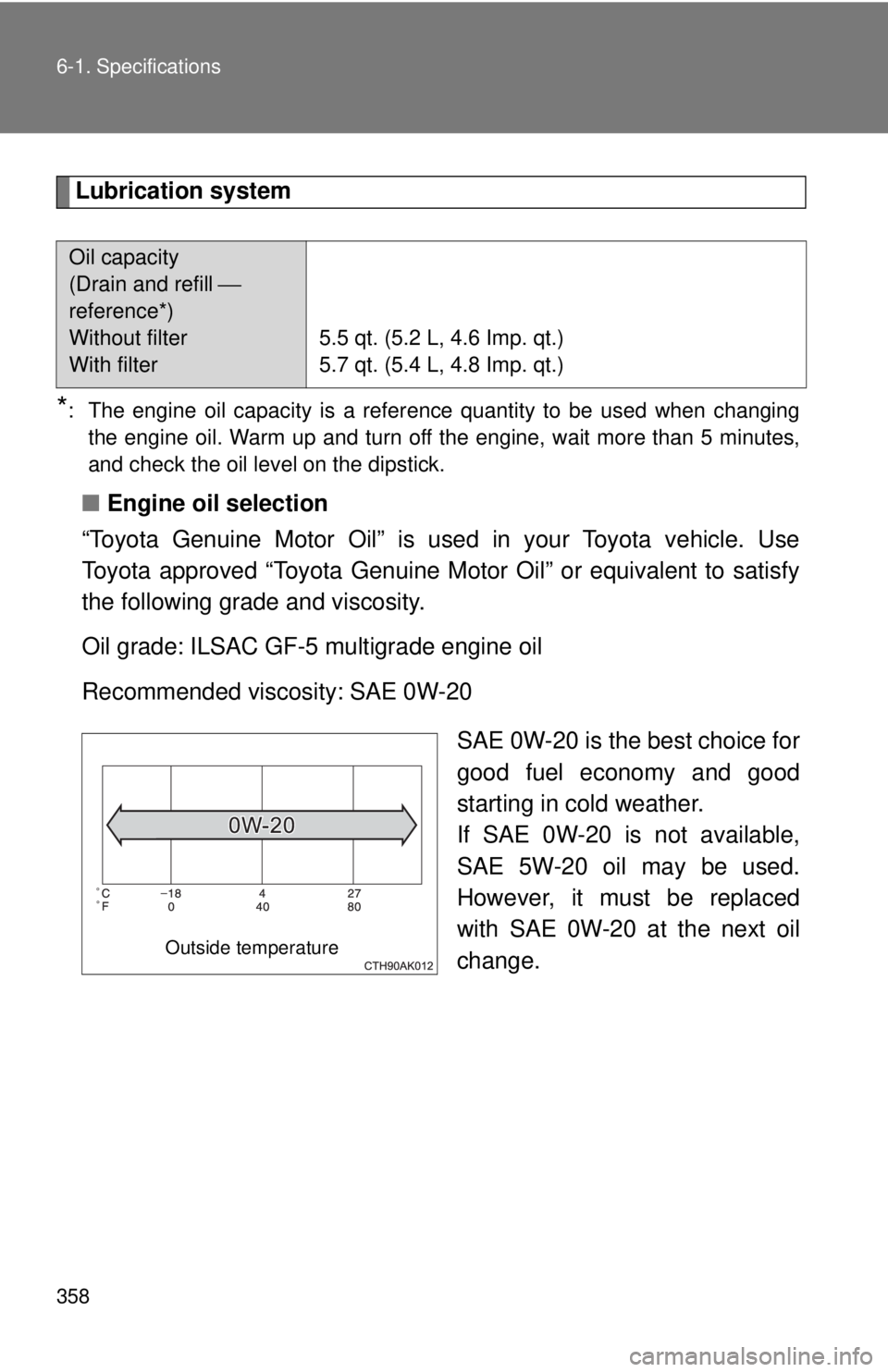
Recommended viscosity: SAE 0W-20
SAE 0W-20 is the best choice for
good fuel economy and good
starting in cold weather.
If SAE 0W-20 is not available,
SAE 5W-20 oil may be used.
However, it must be replaced
with SAE 0W-20 at the next oil
change.Oil capacity
(Drain and refill ⎯
reference*)
Without filter
With filter 5.5 qt. (5.2 L, 4.6 Imp. qt.)
5.7 qt. (5.4 L, 4.8 Imp. qt.)
Outside temperature