child seat TOYOTA 86 2017 Owners Manual
[x] Cancel search | Manufacturer: TOYOTA, Model Year: 2017, Model line: 86, Model: TOYOTA 86 2017Pages: 428, PDF Size: 5.25 MB
Page 2 of 428
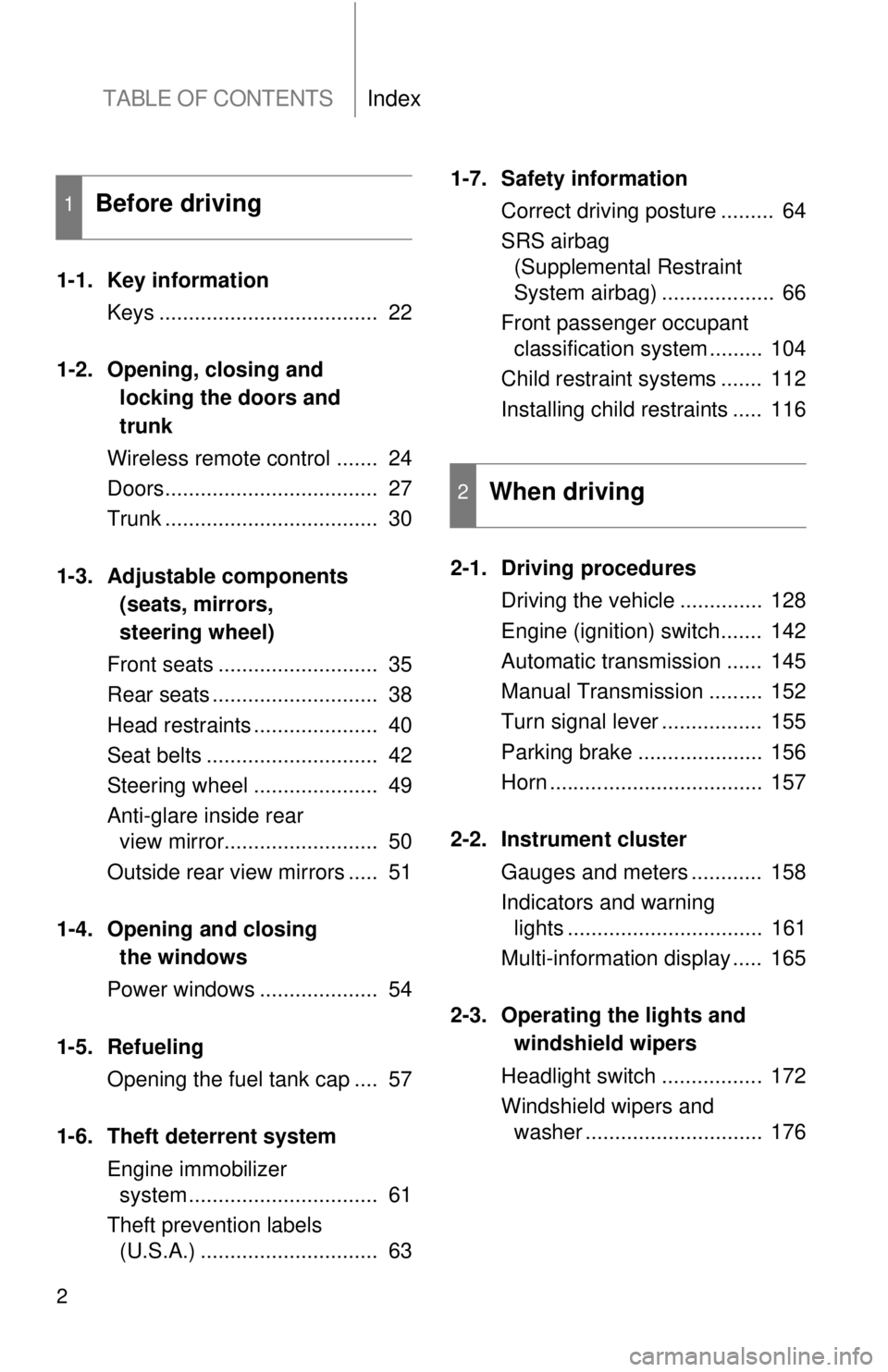
TABLE OF CONTENTS Index
21-1. Key information
Keys ..................................... 22
1-2. Opening, closing and
locking the doors and
trunk
Wireless remote control ....... 24
Doors.................................... 27
Trunk .................................... 30
1-3. Adjustable components
(seats, mirrors,
steering wheel)
Front seats ........................... 35
Rear seats ............................ 38
Head restraints ..................... 40
Seat belts ............................. 42
Steering wheel ..................... 49
Anti-glare inside rear
view mirror.......................... 50
Outside rear view mirrors ..... 51
1-4. Opening and closing
the windows
Power windows .................... 54
1-5. Refueling
Opening the fuel tank cap .... 57
1-6. Theft deterrent system
Engine immobilizer
system ................................ 61
Theft prevention labels
(U.S.A.) .............................. 63 1-7. Safety information
Correct driving posture ......... 64
SRS airbag
(Supplemental Restraint
System airbag) ................... 66
Front passenger occupant
classification system ......... 104
Child restraint systems ....... 112
Installing child restraints ..... 116
2-1. Driving procedures
Driving the vehicle .............. 128
Engine (ignition) switch....... 142
Automatic transmission ...... 145
Manual Transmission ......... 152
Turn signal lever ................. 155
Parking brake ..................... 156
Horn .................................... 157
2-2. Instrument cluster
Gauges and meters ............ 158
Indicators and warning
lights ................................. 161
Multi-information display ..... 165
2-3. Operating the lights and
windshield wipers
Headlight switch ................. 172
Windshield wipers and
washer .............................. 1761
Before driving
2
When driving
Page 8 of 428
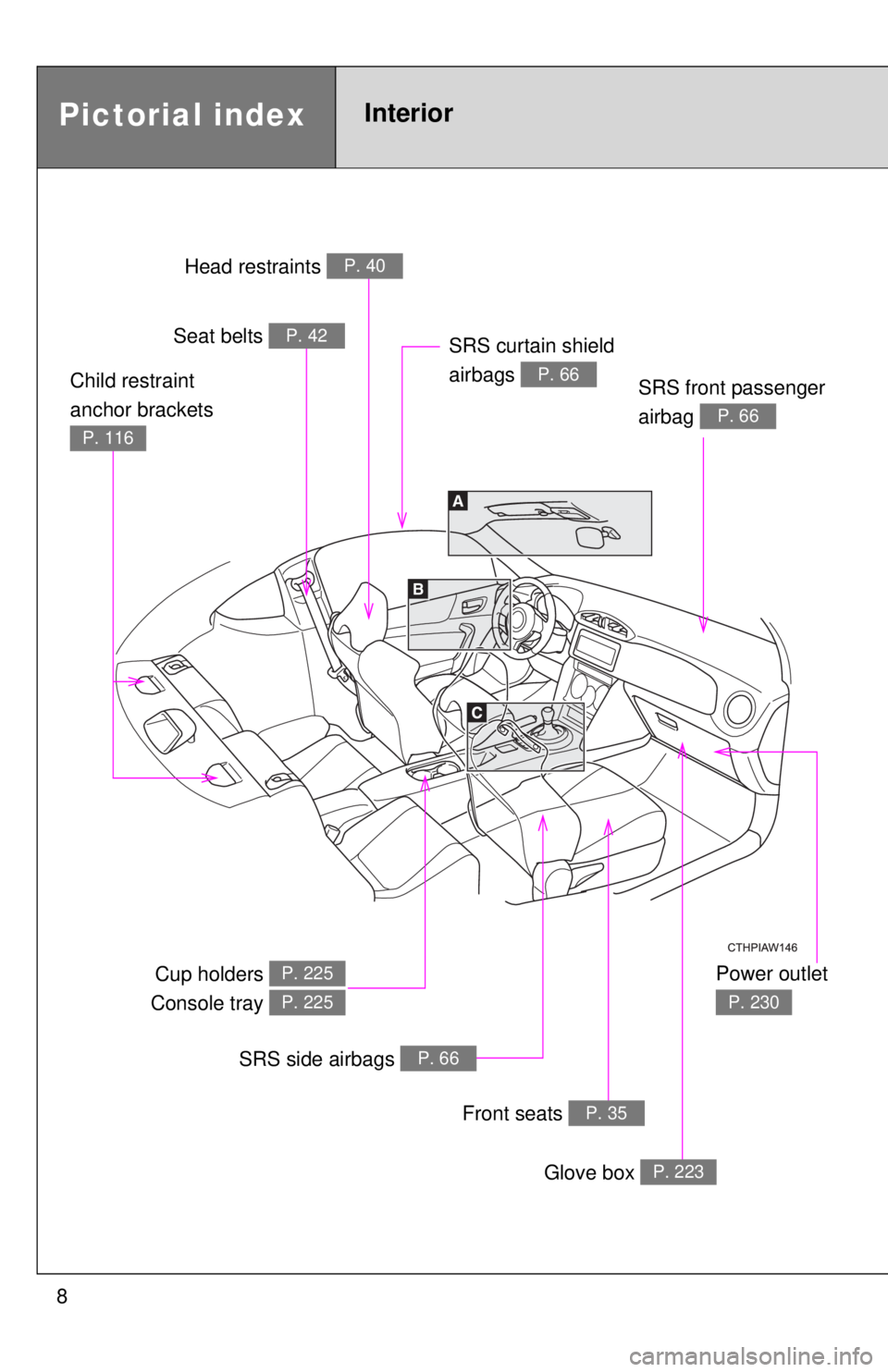
8Pictorial index Interior
Power outlet P. 230Head restraints P. 40
Seat belts P. 42
SRS front passenger
airbag P. 66
Cup holders
Console tray P. 225
P. 225
SRS side airbags P. 66
Front seats P. 35
Glove box P. 223SRS curtain shield
airbags P. 66
Child restraint
anchor brackets P. 116
Page 19 of 428

19Scrapping of your Toyota The SRS airbag and seat belt pretensioner devices in your Toyota contain
explosive chemicals. If the vehicle is scrapped with the airbags and seat belt
pretensioners left as they are, this may cause an accident such as fire. Be
sure to have the systems of the SRS airbag and seat belt pretensioner
removed and disposed of by a qualified service shop or by your Toyota
dealer before you scrap your vehicle.
Perchlorate Material Special handling may apply, See www.dtsc.ca.gov/hazardouswaste/perchlorate.
Your vehicle has components that may contain perchlorate. These
components may include airbag, seat belt pretensioners, and wireless
remote control batteries.
WARNING■ General precautions while driving
Driving under the influence: Never drive your vehicle when under the influ-
ence of alcohol or drugs that have impai red your ability to operate your vehi-
cle. Alcohol and certain drugs delay reaction time, impair judgment and
reduce coordination, which could lead to an accident that could result in
death or serious injury.
Defensive driving: Always drive defensively. Anticipate mistakes that other
drivers or pedestrians might make and be ready to avoid accidents.
Driver distraction: Always give your full attention to driving. Anything that dis-
tracts the driver, such as adjusting controls, talking on a cellular phone or
reading can result in a collision with resulting death or serious injury to you,
your occupants or others.
■ General precaution regarding children’s safety
Never leave children unattended in the vehicle, and never allow children to
have or use the key.
Children may be able to start the vehicle or shift the vehicle into neutral.
There is also a danger that children may injure themselves by playing with
the windows or other features of the vehicle. In addition, heat build-up or
extremely cold temperatures inside the vehicle can be fatal to children.
Page 21 of 428
Before driving
1
211-1. Key information
Keys ................................... 22
1-2. Opening, closing and
locking the doors and
trunk
Wireless remote
control .............................. 24
Doors ................................. 27
Trunk .................................. 30
1-3. Adjustable components
(seats, mirrors,
steering wheel)
Front seats ......................... 35
Rear seats.......................... 38
Head restraints................... 40
Seat belts ........................... 42
Steering wheel ................... 49
Anti-glare inside rear
view mirror ....................... 50
Outside rear view
mirrors.............................. 51 1-4. Opening and closing
the windows
Power windows .................. 54
1-5. Refueling
Opening the fuel tank
cap ................................... 57
1-6. Theft deterrent system
Engine immobilizer
system ............................. 61
Theft prevention labels
(U.S.A.) ............................ 63
1-7. Safety information
Correct driving posture....... 64
SRS airbag
(Supplemental
Restraint System
airbag).............................. 66
Front passenger
occupant classification
system ........................... 104
Child restraint
systems.......................... 112
Installing child
restraints ........................ 116
Page 39 of 428
391-3. Adjustable components (s eats, mirrors, steering wheel)
1
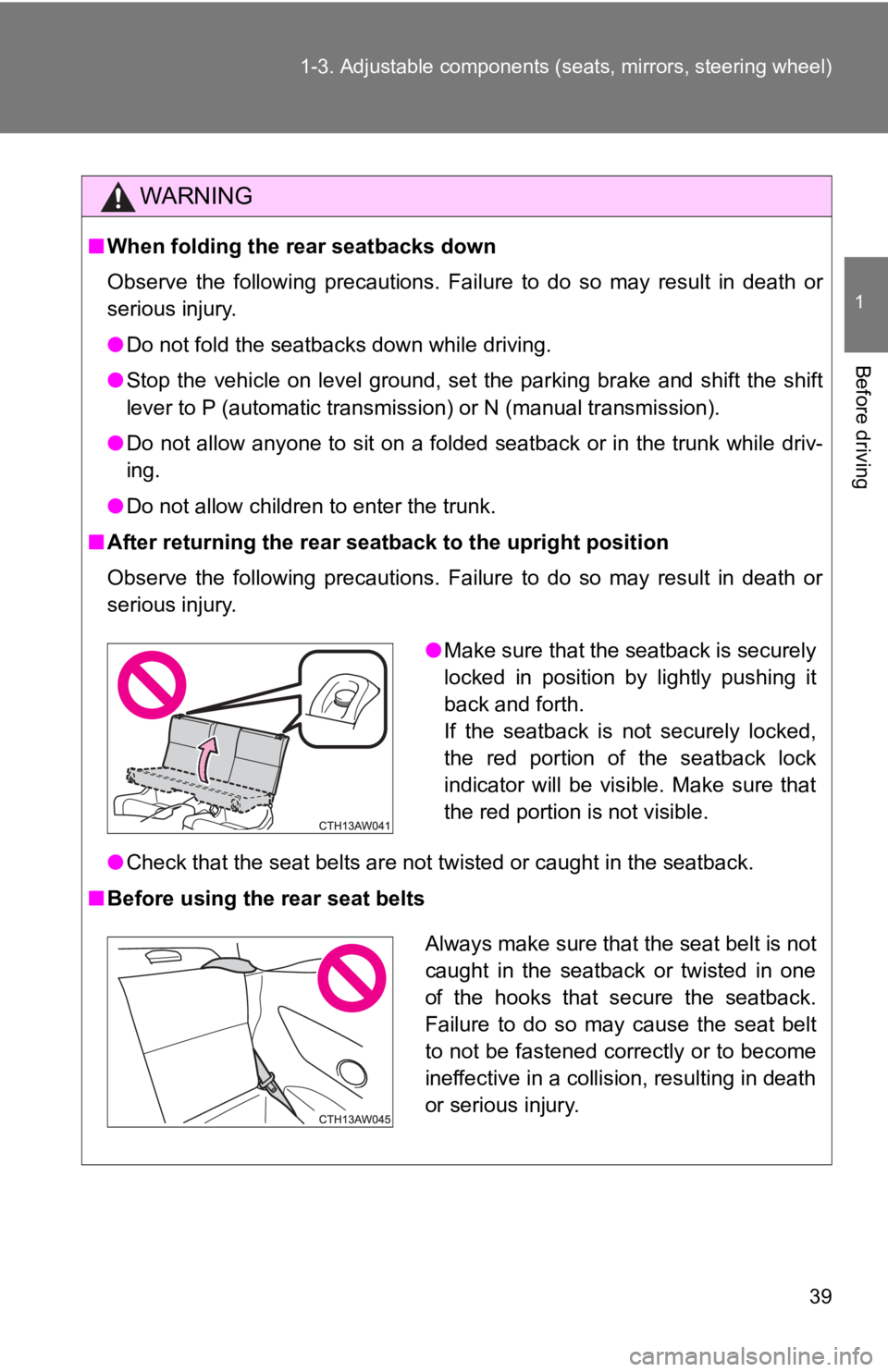
Before driving WARNING■ When folding the rear seatbacks down
Observe the following precautions. Failure to do so may result in death or
serious injury.
● Do not fold the seatbacks down while driving.
● Stop the vehicle on level ground, set the parking brake and shift the shift
lever to P (automatic transmission) or N (manual transmission).
● Do not allow anyone to sit on a folded seatback or in the trunk while driv-
ing.
● Do not allow children to enter the trunk.
■ After returning the rear seatback to the upright position
Observe the following precautions. Failure to do so may result in death or
serious injury.
● Check that the seat belts are not twisted or caught in the seatback.
■ Before using the rear seat belts ● Make sure that the seatback is securely
locked in position by lightly pushing it
back and forth.
If the seatback is not securely locked,
the red portion of the seatback lock
indicator will be visible. Make sure that
the red portion is not visible.
Always make sure that the seat belt is not
caught in the seatback or twisted in one
of the hooks that secure the seatback.
Failure to do so may cause the seat belt
to not be fastened correctly or to become
ineffective in a collision, resulting in death
or serious injury.
Page 44 of 428

441-3. Adjustable components (s eats, mirrors, steering wheel)
■ Emergency locking retractor (ELR)
The retractor will lock the belt during a sudden stop or on impact. It may also
lock if you lean forward too quickly. A slow, easy motion will allow the belt to
extend so that you can move around fully.
■ Automatic locking retractor (ALR)
When a passenger's shoulder belt is completely extended and then
retracted even slightly, the belt is locked in that position and cannot be
extended. This feature is used to hold the child restraint system (CRS) firmly.
To free the belt again, fully retract the belt and then pull the belt out once
more. ( → P. 116)
■ Child seat belt usage
The seat belts of your vehicle are principally designed for persons of adult
size.
● Use a child restraint system appropriate for the child, until the child
becomes large enough to properly w ear the vehicle's seat belt.
( → P. 11 2 )
● When the child becomes large enough to properly wear the vehicle's seat
belt, follow the instructions on P. 42 regarding seat belt usage.
■ Seat belt pretensioners
● Seatbelt pretensioners are not designed to activate in a rear impact or
minor frontal or side impact.
● The following four components operate simultaneously when the vehicle
is involved in a rollover accident.
• Seat belt pretensioner for driver
• Seat belt pretensioner for front passenger
• SRS curtain shield airbag for driver’s seat side
• SRS curtain shield airbag for front passenger’s seat side
Page 46 of 428
461-3. Adjustable components (s eats, mirrors, steering wheel)
WARNINGObserve the following precautions to reduce the risk of injury in the event of
sudden braking, sudden swerving or an accident.
Failure to do so may cause death or serious injury.
■ Wearing a seat belt
● Ensure that all passengers wear a seat belt.
● Always wear a seat belt properly.
● Each seat belt should be used by one person only. Do not use a seat belt
for more than one person at once, including children.
● Toyota recommends that children be seated in the rear seat and always
use a seat belt and/or an appropriate child restraint system.
● To achieve a proper seating position, do not recline the seat more than
necessary. The seat belt is most effective when the occupants are sitting
up straight and well back in the seats.
● Do not wear the shoulder belt under your arm.
● Always wear your seat belt low and snug across your hips.
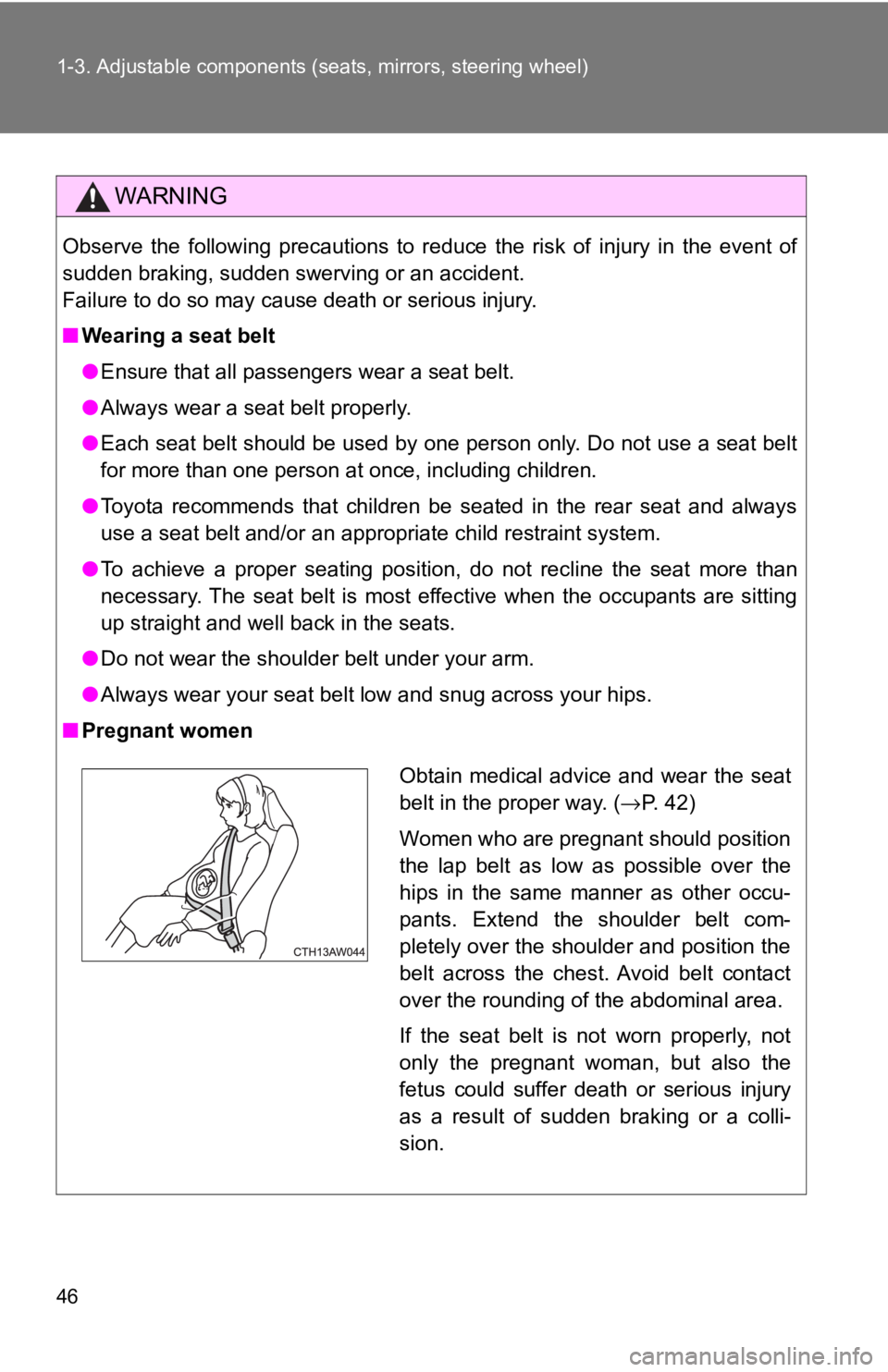
■ Pregnant women
Obtain medical advice and wear the seat
belt in the proper way. ( → P. 42)
Women who are pregnant should position
the lap belt as low as possible over the
hips in the same manner as other occu-
pants. Extend the shoulder belt com-
pletely over the shoulder and position the
belt across the chest. Avoid belt contact
over the rounding of the abdominal area.
If the seat belt is not worn properly, not
only the pregnant woman, but also the
fetus could suffer death or serious injury
as a result of sudden braking or a colli-
sion.
Page 47 of 428
471-3. Adjustable components (s eats, mirrors, steering wheel)
1
Before driving WARNING■ People with a medical condition
Obtain medical advice and wear the seat belt in the proper way.
■ When children are in the vehicle
Do not allow children to play with the seat belt. If the seat belt becomes
twisted around a child’s neck, it may lead to choking or other serious injuries
that could result in death.
If this occurs and the buckle cannot be unfastened, scissors should be used
to cut the belt.
■ Seat belt pretensioners
If the pretensioner has activated, the SRS warning light will come on. In that
case, the seat belt cannot be used again and must be replaced at your
Toyota dealer.
Page 69 of 428
691-7. Safety information
1
Before driving WARNING■ SRS airbag
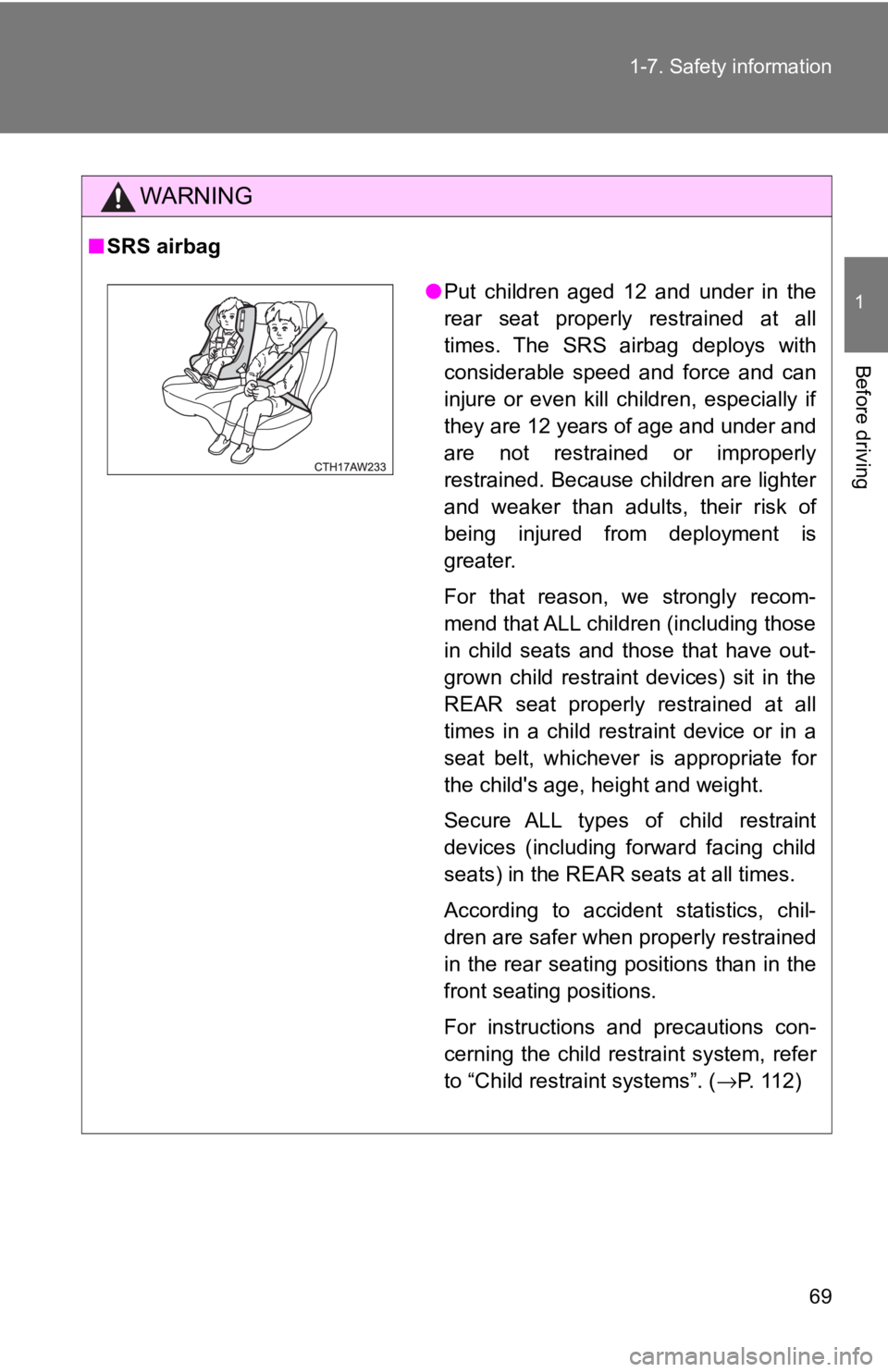
● Put children aged 12 and under in the
rear seat properly restrained at all
times. The SRS airbag deploys with
considerable speed and force and can
injure or even kill children, especially if
they are 12 years of age and under and
are not restrained or improperly
restrained. Because children are lighter
and weaker than adults, their risk of
being injured from deployment is
greater.
For that reason, we strongly recom-
mend that ALL children (including those
in child seats and those that have out-
grown child restraint devices) sit in the
REAR seat properly restrained at all
times in a child restraint device or in a
seat belt, whichever is appropriate for
the child's age, height and weight.
Secure ALL types of child restraint
devices (including forward facing child
seats) in the REAR seats at all times.
According to accident statistics, chil-
dren are safer when properly restrained
in the rear seating positions than in the
front seating positions.
For instructions and precautions con-
cerning the child restraint system, refer
to “Child restraint systems”. ( → P. 112)
Page 70 of 428

701-7. Safety information
WARNING■ SRS airbag
● NEVER INSTALL A REARWARD FACING CHILD SEAT IN THE FRONT
SEAT. DOING SO RISKS SERIOUS INJURY OR DEATH TO THE CHILD
BY PLACING THE CHILD’S HEAD TOO CLOSE TO THE SRS AIRBAG.
● Never allow a child to stand up, or to kneel on the front passenger’s seat,
or never hold a child on your lap or in your arms. The SRS airbag deploys
with considerable force and can injure or even kill the child.
● When the SRS airbag deploys, some smoke will be released. This smoke
could cause breathing problems for people with a history of asthma or
other breathing trouble. If you or your passengers have breathing prob-
lems after SRS airbag deploys, get fresh air promptly.
● A deploying SRS airbag releases hot gas. Occupants could get burned if
they come into direct contact with the hot gas.