radio TOYOTA 86 2017 Owners Manual
[x] Cancel search | Manufacturer: TOYOTA, Model Year: 2017, Model line: 86, Model: TOYOTA 86 2017Pages: 428, PDF Size: 5.25 MB
Page 16 of 428

16 Installation of a mobi le two-way radio systemThe installation of a mobile two-way radio system in your vehicle could affect
electronic systems such as:
● Multiport fuel injection system/sequential multiport fuel injection system
● Cruise control system
● Anti-lock brake system
● SRS airbag system
● Seat belt pretensioner system
Be sure to check with your Toyota dealer for precautionary measures or spe-
cial instructions regarding installation of a mobile two-way radio system.
Page 22 of 428
221-1. Key information
Keys
■ When required to leave the vehicle’s key with a parking attendant
Turn the trunk opener main switch off as circumstances demand. ( → P. 31)
Provide the attendant with the valet key.
■ Key number plate
Keep the plate in a safe place, not in the vehicle. In the event that a key is
lost, a new key can be made at your Toyota dealer using the key number
plate. ( → P. 340)
■ When riding in an aircraft
When bringing a key with wireless remote control function onto an aircraft,
make sure you do not press any buttons on the key while inside the aircraft
cabin. If you are carrying the key in your bag etc., ensure that the buttons
are not likely to be pressed accidentally. Pressing a button may cause the
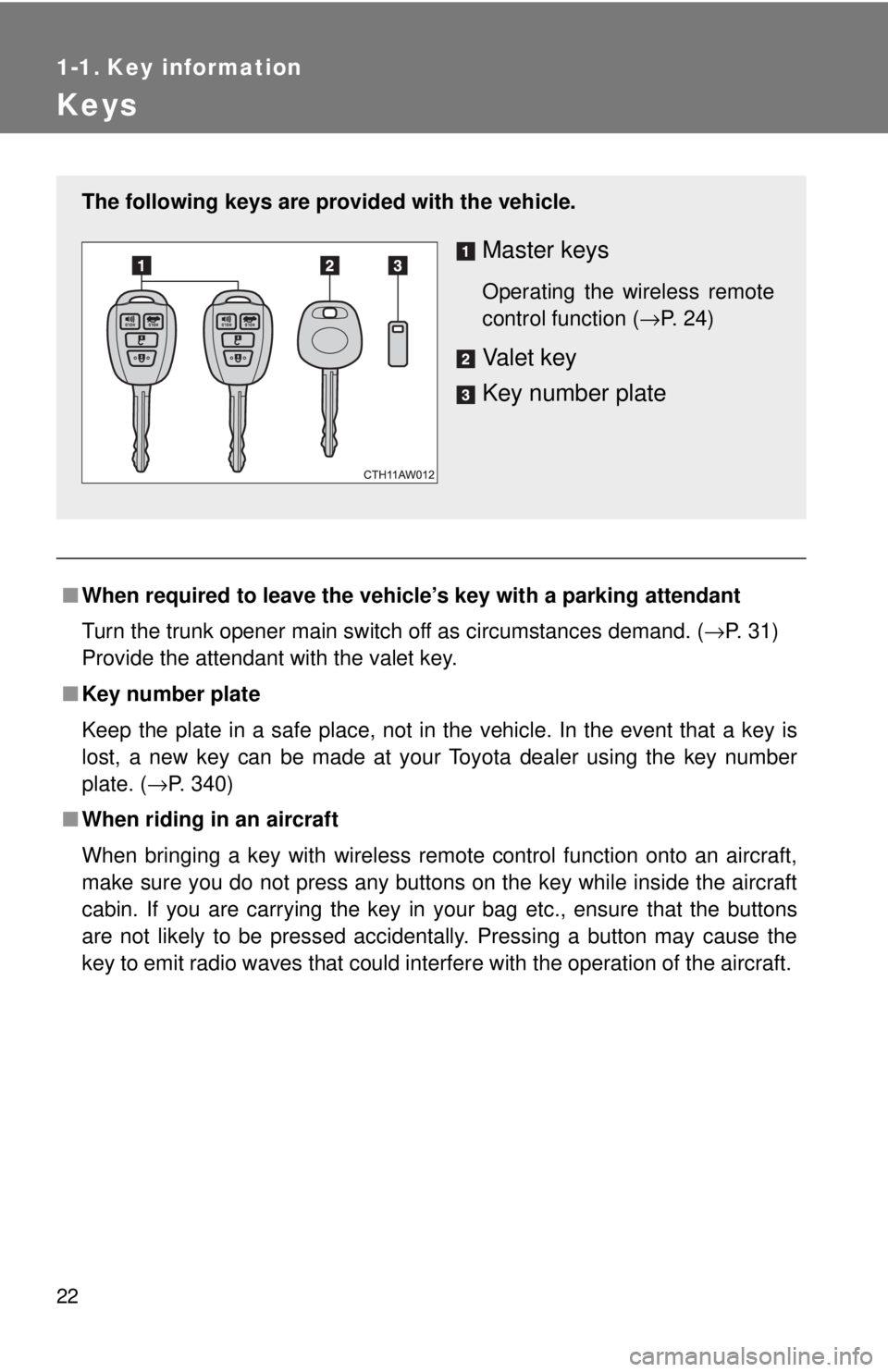
key to emit radio waves that could interfere with the operation of the aircraft. The following keys are provid ed with the vehicle.
Master keys Operating the wireless remote
control function ( → P. 24)
Va l e t k e y
Key number plate
Page 25 of 428
251-2. Opening, closing and locking the doors and trunk
1
Before driving ■ Vehicle finder function
■ Security feature
If a door is not opened within approximately 60 seconds after the vehicle is
unlocked, the security feature automatically locks the vehicle again.
■ Conditions affecting operation
The wireless remote control function may not operate normally in the follow-
ing situations:
● When the wireless key battery is depleted
● Near a TV tower, electric power plant, gas station, radio station, large dis-
play, airport or other facility that generates strong radio waves or electri-
cal noise
● When carrying a portable radio, cellular phone or other wireless commu-
nication devices
● When the wireless key is in contact with, or is covered by a metallic
object
● When other wireless key (that emit radio waves) is being used nearby
● If window tint with a metallic content or metallic objects are attached to
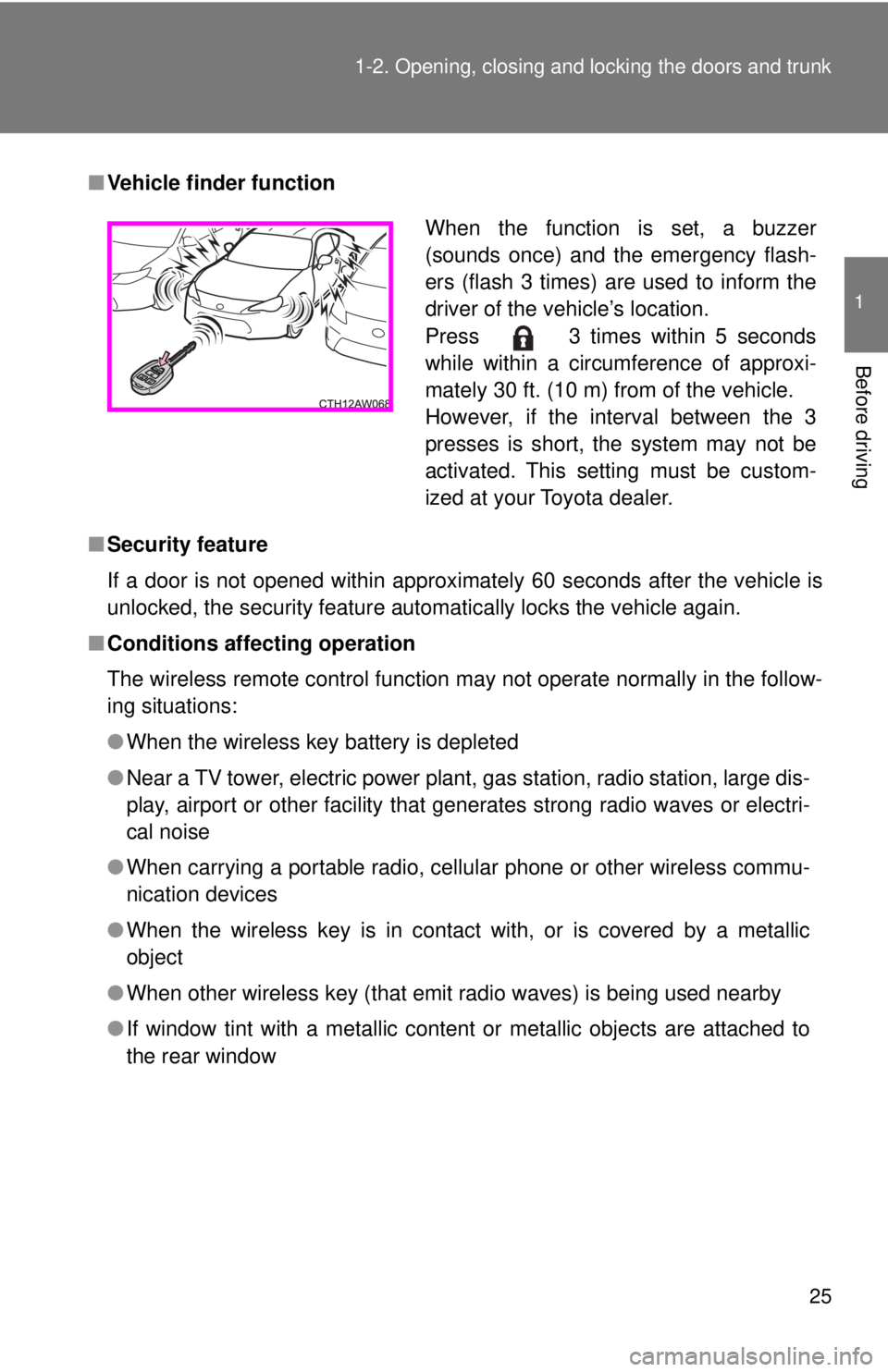
the rear window When the function is set, a buzzer
(sounds once) and the emergency flash-
ers (flash 3 times) are used to inform the
driver of the vehicle’s location.
Press 3 times within 5 seconds
while within a circumference of approxi-
mately 30 ft. (10 m) from of the vehicle.
However, if the interval between the 3
presses is short, the system may not be
activated. This setting must be custom-
ized at your Toyota dealer.
Page 26 of 428

261-2. Opening, closing and locking the doors and trunk
■ Key battery depletion
If the wireless remote control function does not operate, the battery may be
depleted. Replace the battery when necessary. ( → P. 287)
■ When the wireless remote control battery is fully depleted
→ P. 287
■ Customization that can be conf igured at your Toyota dealer
Settings (e.g. wireless remote control system) can be changed.
(Customizable features → P. 383)
■ Certification for wireless remote control
For vehicles sold in the U.S.A.
FCC ID: HYQ23AAC FCC ID: HYQ12BEL
NOTE:
This device complies with part 15 of the FCC Rules. Operation is subject to
the following two conditions: (1) This device may not cause harmful interfer-
ence, and (2) this device must accept any interference received, including
interference that may cause undesired operation.
FCC WARNING:
Changes or modifications not expressly approved by the party responsible
for compliance could void the user's authority to operate the equipment.
For vehicles sold in Canada
NOTE:
This device complies with Industry Canada’s licence-exempt RSSs. Opera-
tion is subject to the following two conditions: (1) This device may not cause
interference; and (2) This device must accept any interference, including
interference that may cause undesired operation of the device.
NOTE:
Le présent appareil est conforme aux CNR d’Industrie Canada applicables
aux appareils radio exempts de licence. L’exploitation est autorisée aux
deux conditions suivantes: (1) l’appareil ne doit pas produire de brouillage;
(2) l’utilisateur de l’appareil doit accept er tout brouillage radioélectrique subi,
même si le brouillage est susceptible d’en compromettre le fonctionnement.
Page 62 of 428

621-6. Theft deterrent system
■ Certification for engi ne immobilizer system
For vehicles sold in the U.S.A.
FCC ID: MOZRI-38BFH
This device complies with part 15 of the FCC Rules. Operation is subject to
the following two conditions: (1) This device may not cause harmful interfer-
ence, and (2) this device must accept any interference received, including
interference that may cause undesired operation.
FCC WARNING
Changes or modifications not expressly approved by the party responsible
for compliance could void the user’s authority to operate the equipment.
For vehicles sold in Canada
NOTE:
This device complies with Industry Canada’s licence-exempt RSSs. Opera-
tion is subject to the following two conditions: (1) This device may not cause
interference, and (2) This device must accept any interference, including
interference that may cause undesired operation of the device.
NOTE:
Le présent appareil est conforme aux CNR d’Industrie Canada applicables
aux appareils radio exempts de licence. L’exploitation est autorisée aux
deux conditions suivantes: (1) l’appareil ne doit pas produire de brouillage;
(2) l’utilisateur de l’appareil doit accepter tout brouillage radioélectrique subi,
même si le brouillage est susceptible d’en compromettre le fonctionnement.
NOTICE
■ To ensure the system operates correctly
Do not modify or remove the system. If modified or removed, the proper
operation of the system cannot be guaranteed.
Page 101 of 428

1011-7. Safety information
1
Before driving WARNING■ SRS airbag precautions
● Do not touch any of the component parts immediately after the SRS air-
bags have deployed (inflated) as they may be hot.
● If breathing becomes difficult after the SRS airbag has deployed, open a
door or window to allow fresh air in, or leave the vehicle if it is safe to do
so. Wash off any residue as soon as possible to prevent skin irritation.
● If the areas where the SRS airbags are stored, such as the steering wheel
pad and front and rear pillar garnishes, are damaged or cracked, have
them replaced by your Toyota dealer.
■ Modification and disposal of SRS airbag system components
Do not dispose of your vehicle or perform any of the following modifications
without consulting your Toyota dealer.
The SRS airbags may malfunction or deploy (inflate) accidentally, causing
death or serious injury.
● Installation, removal, disassembly and repair of the SRS airbags.
● Repairs, modifications, removal or replacement of the steering wheel,
instrument panel, dashboard, seats or seat upholstery, front, side and rear
pillars or roof side rails.
● Repairs or modifications of the front fender, front bumper, or side of the
occupant compartment.
● Installation of a grille guard (bull bars, kangaroo bar, etc.), snow plows,
winches.
● Modifications to the vehicle's suspension system.
● Installation of electronic devices such as mobile two-way radios and CD
players.
● Modifications to your vehicle for a person with a physical disability.
Page 274 of 428

2744-3. Do-it-yourself maintenance
■
Initializing the tire pr essure warning system
Initialize the system with the tire infl ation pressure adjusted to the speci-
fied level.■
Routine tire inflation pressure checks
The tire pressure warning system doe s not replace routine tire inflation
pressure checks. Make sure to check tire inflation pressure as part of
your routine of daily vehicle checks.■
Tire pressure warning system certification
MODEL/FCC IDs:
Transmitter: PAXPMVC010
Receiver: HYQ23AAC
For vehicles sold in the U.S.A.
This device complies with part 15 of the FCC Rules. Operation is subject
to the following two conditions: (1) This device may not cause harmful
interference, and (2) this device must accept any interference received,
including interference that may cause undesired operation.
FCC WARNING:
Changes or modifications not expre ssly approved by the party responsi-
ble for compliance could void the user's authority to operate the equip-
ment.
For vehicles sold in Canada
NOTE:
This device complies with Industry Canada’s licence-exempt RSSs. Opera-
tion is subject to the following two conditions: (1) This device may not cause
interference; and (2) This device must accept any interference, including
interference that may cause undesired operation of the device.
NOTE:
Le présent appareil est conforme aux CNR d’Industrie Canada applicables
aux appareils radio exempts de licence. L’exploitation est autorisée aux
deux conditions suivantes: (1) l’appareil ne doit pas produire de brouillage;
(2) l’utilisateur de l’appareil doit accept er tout brouillage radioélectrique subi,
même si le brouillage est susceptible d’en compromettre le fonctionnement.
Page 296 of 428
2964-3. Do-it-yourself maintenance
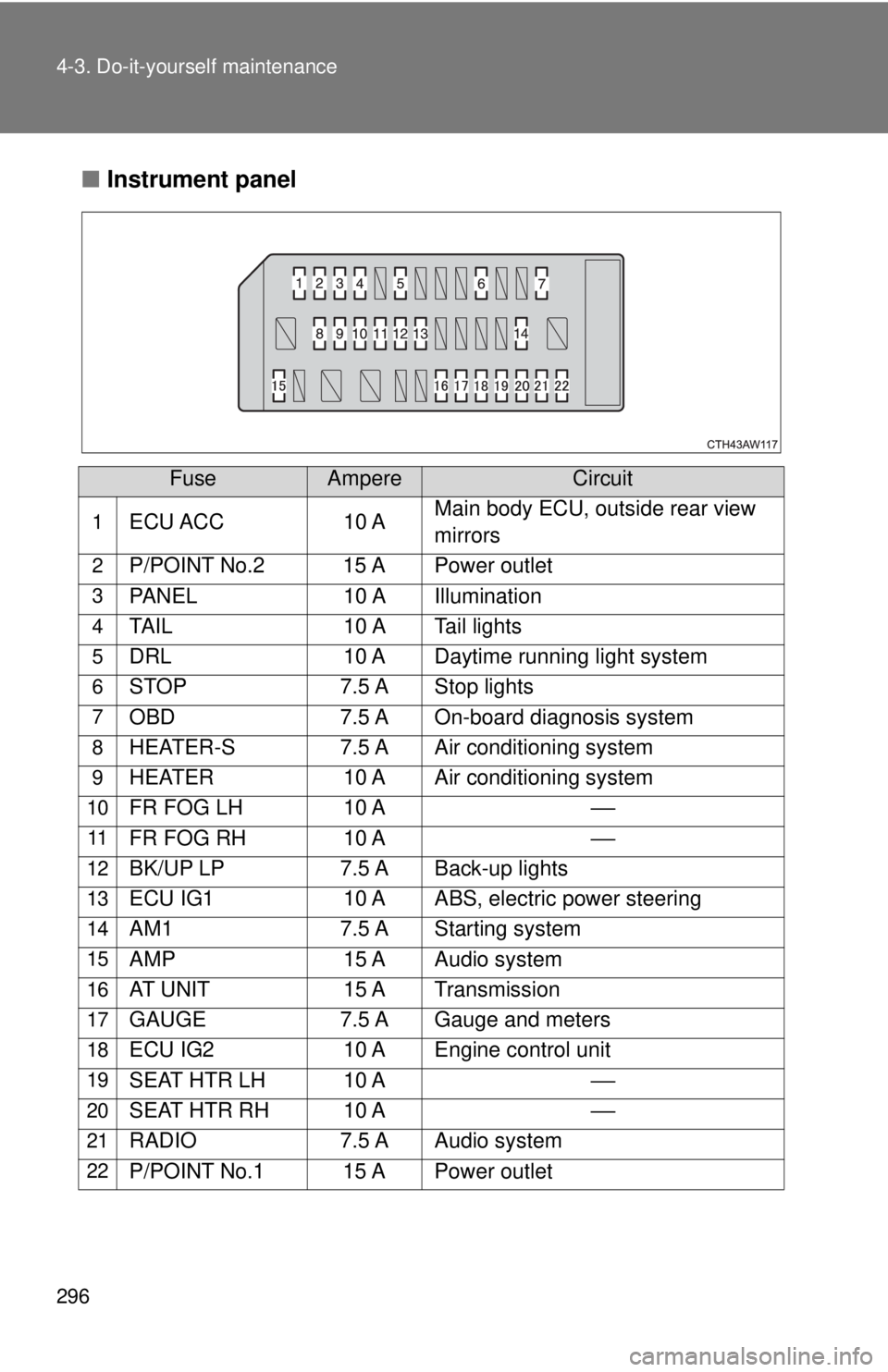
■ Instrument panel
Fuse Ampere Circuit1
ECU ACC 10 A Main body ECU, outside rear view
mirrors2
P/POINT No.2 15 A Power outlet3
PANEL 10 A Illumination4
TAIL 10 A Tail lights5
DRL 10 A Daytime running light system6
STOP 7.5 A Stop lights7
OBD 7.5 A On-board diagnosis system8
HEATER-S 7.5 A Air conditioning system9
HEATER 10 A Air conditioning system
10
FR FOG LH 10 A
⎯11
FR FOG RH 10 A
⎯12
BK/UP LP 7.5 A Back-up lights
13
ECU IG1 10 A ABS, electric power steering
14
AM1 7.5 A Starting system
15
AMP 15 A Audio system
16
AT UNIT 15 A Transmission
17
GAUGE 7.5 A Gauge and meters
18
ECU IG2 10 A Engine control unit
19
SEAT HTR LH 10 A
⎯
20
SEAT HTR RH 10 A
⎯
21
RADIO 7.5 A Audio system
22
P/POINT No.1 15 A Power outlet
Page 323 of 428

5
When trouble arises
3235-2. Steps to take in an emergency
■
If the tire pressure warning system is inoperative
The tire pressure warning system will be disabled in the following condi-
tions:
(When the condition be comes normal, the syst em will work properly.)●
If tires not equipped with tire pressure warning valves and transmit-
ters are used.●
If the ID code on the tire pressure warning valves and transmitters is
not registered in the tire pressure warning computer.●
If the tire inflation pr essure is 55 psi (380 kPa, 3.87 kgf/cm 2
or bar) or
higher.
The tire pressure warning system may be disabled in the following condi-
tions:
(When the condition be comes normal, the syst em will work properly.)●
If electronic devices or facilities us ing similar radio wave frequencies
are nearby.●
If a radio set at similar frequencies is in use in the vehicle.●
If a window tint that affects the radio wave signals is installed.●
If there is a lot of snow or ice on the vehicle, in particular around the
wheels or wheel housings.
●
If non-genuine Toyota wheels are used. (Even if you use Toyota
wheels, the tire pressu re warning system may not work properly with
some types of tires.)
●
If tire chains are used.
●
If a large metallic object which can interfer e with signal reception is
put in the trunk.
■
If the tire pressure warning light frequently comes on after blinking
for approximately one minute
If the tire pressure warning light fr equently comes on after blinking for
approximately one minute when the engine switch is turned to the “ON”
position, have it checked your Toyota dealer.
Page 376 of 428

3766-1. Specifications
Warning: The temperature grades of a tire assume that it is properly
inflated and not overloaded.
Excessive speed, underinflation, or excessive loading, either sepa-
rately or in combinatio n, can cause heat buildup and possible tire fail-
ure.
Glossary of tire terminology
Tire related term Meaning
Cold tire inflation
pressure Tire pressure when the vehicle has been
parked for three hours or more, or has not
been driven more than 1 mile or 1.5 km under
that condition
Maximum inflation
pressure The maximum cold inflated pressure to which a
tire may be inflated, s hown on the sidewall of
the tire
Recommended
inflation pressure Cold tire inflation pressure recommended by a
manufacturer.
Accessory weight The combined weight (in excess of those stan-
dard items which may be replaced) of auto-
matic transmission, power steering, power
brakes, power windows, power seats, radio
and heater, to the extent that these items are
available as factory-installed equipment
(whether installed or not)
Curb weight The weight of a motor vehicle with standard
equipment, including the maximum capacity of
fuel, oil and coolant, and if so equipped, air
conditioning and additional weight optional
engine
Maximum loaded
vehicle weight The sum of:
(a) Curb weight
(b) Accessory weight
(c) Vehicle capacity weight
(d) Production options weight