emergency towing TOYOTA AVALON 2019 Owners Manual (in English)
[x] Cancel search | Manufacturer: TOYOTA, Model Year: 2019, Model line: AVALON, Model: TOYOTA AVALON 2019Pages: 536, PDF Size: 9.43 MB
Page 16 of 536
16Pictorial index
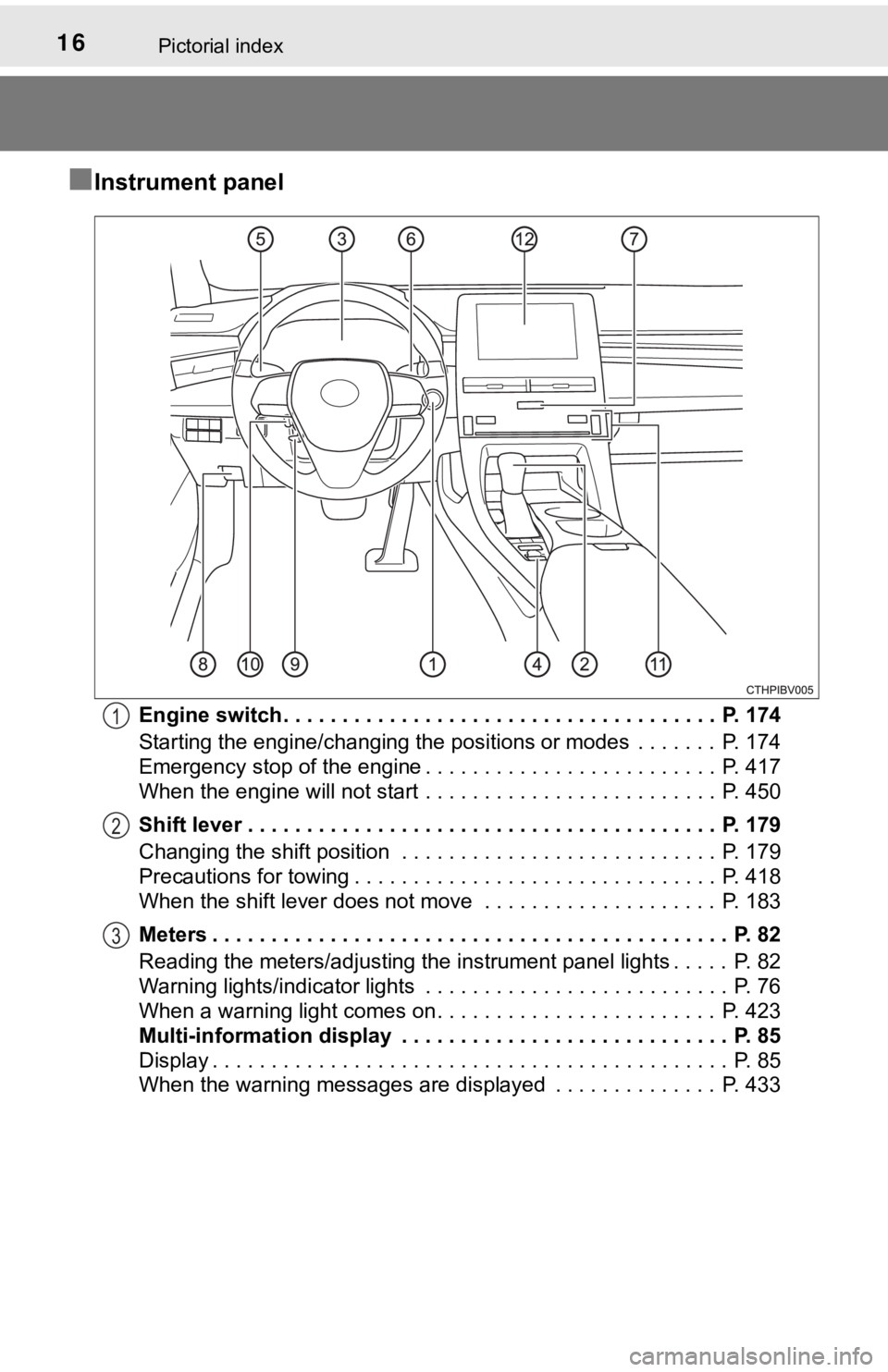
■Instrument panel
Engine switch . . . . . . . . . . . . . . . . . . . . . . . . . . . . . . . . . . . . . P. 174
Starting the engine/changing the positions or modes . . . . . . . P. 174
Emergency stop of the engine . . . . . . . . . . . . . . . . . . . . . . . . . P. 417
When the engine will not start . . . . . . . . . . . . . . . . . . . . . . . . . P. 450
Shift lever . . . . . . . . . . . . . . . . . . . . . . . . . . . . . . . . . . . . . . . . P. 179
Changing the shift position . . . . . . . . . . . . . . . . . . . . . . . . . . . P. 179
Precautions for towing . . . . . . . . . . . . . . . . . . . . . . . . . . . . . . . P. 418
When the shift lever does not move . . . . . . . . . . . . . . . . . . . . P. 183
Meters . . . . . . . . . . . . . . . . . . . . . . . . . . . . . . . . . . . . . . . . . . . . P. 82
Reading the meters/adjusting the instrument panel lights . . . . . P. 82
Warning lights/indicator lights . . . . . . . . . . . . . . . . . . . . . . . . . . P. 76
When a warning light comes on . . . . . . . . . . . . . . . . . . . . . . . . P. 423
Multi-information display . . . . . . . . . . . . . . . . . . . . . . . . . . . . P. 85
Display . . . . . . . . . . . . . . . . . . . . . . . . . . . . . . . . . . . . . . . . . . . . P. 85
When the warning messages are displayed . . . . . . . . . . . . . . P. 4331
2
3
Page 219 of 536

2194-5. Using the driving support systems
4
Driving
WARNING
■When to disable the pre-collision system
In the following situations, disable the system, as it may not operate prop-
erly, possibly leading to an accident resulting in death or ser ious injury:
● When the vehicle is being towed
● When your vehicle is towing another vehicle
● When transporting the vehicle via truck, boat, train or similar means of
transportation
● When the vehicle is raised on a lift with the engine running an d the tires
are allowed to rotate freely
● When inspecting the vehicle using a drum tester such as a chass is dyna-
mometer or speedometer tester, or when using an on vehicle whee l bal-
ancer
● When a strong impact is applied to the front bumper or front gr ille, due to
an accident or other reasons
● If the vehicle cannot be driven in a stable manner, such as when the vehi-
cle has been in an accident or is malfunctioning
● When the vehicle is driven in a sporty manner or off-road
● When the tires are not properly inflated
● When the tires are very worn
● When tires of a size other than specified are installed
● When tire chains are installed
● When a compact spare tire or an emergency tire puncture repair kit is used
● If equipment (snow plow, etc.) that may obstruct the radar sens or or cam-
era sensor is temporarily installed to the vehicle
Page 265 of 536

2654-5. Using the driving support systems
4
Driving
●In some situations, such as the following, the rear camera dete ction function
may operate even though there are no pedestrians in the detection area.
• When a three dimensional object, such as a pole, traffic cone, fence, or parked vehicle, is detected
• When a moving object, such as a car or motorcycle is detected
• When backing up toward moving objects such as flags or puddles , or air-
borne matter, such as smoke, steam, rain, or snow
• When there is a pattern on the road, due to the road being mad e of cob-
blestone or gravel or having tram rails, traces of repair, white lines,
pedestrian crossings or fallen leaves on the surface
• When backing up on a metal cover (grating), such as those used for
drainage ditches
• When backing up toward the roadside or a bump in the road
• When an object is reflected in a puddle or on a wet road surfa ce
• When there are shadows on the road
• When backing up over a bump in the road
• If the vehicle is significantly tilted, such as when carrying a heavy load
• When backing up toward an incline/decline
• If the suspension has been modified or tires of a size other than specified are installed
• If the rear of the vehicle is raised or lowered due to the carried load
• If an electronic component, such as a backlit license plate or rear fog
light, is installed near the rear camera
• If a bumper protector, such as an additional trim strip, is installed to the rear bumper
• If the orientation of the rear camera has been changed due to a collision
or other impact, or removal and installation
• If a towing eyelet is installed to the rear of the vehicle
• When the rear camera is obscured (dirt, snow, ice, etc. are at tached) or
scratched
• When water is flowing over the rear camera lens
• If there is a flashing light in the detection area, such as th e emergency
flashers of another vehicle
■ Situations in which the rear cam era detection function may be difficult to
notice
● If buzzer may be difficult to hear if the surrounding area is noisy, the volume
of the audio system volume is high, the air conditioning system is being
used, etc.
● If the temperature in the cabin is extremely high or low, the a udio system
screen may not operate correctly.
Page 355 of 536
3555-4. Other interior features
5
Interior features
■Automatic Collision Notification
In case of either airbag deployme nt or severe rear-end collision, the
system is designed to automatically call the response center. T he
responding agent receives the v ehicle’s location and attempts to
speak with the vehicl e occupants to assess the level of emergency.
If the occupants are unable to communicate, the agent automati-
cally treats the call as an emergency, contacts the nearest eme r-
gency services provider to descr ibe the situation, and requests that
assistance be sent to the location.
■Stolen Vehicle Location
If your vehicle is stolen, Safety Connect can work with local author-
ities to assist them in locating and recovering the vehicle. Af ter filing
a police report, call the Safety Connect response center at 1-8 55-
405-6500 in the Unites States, 1-877-855-8377 in Puerto Rico or 1-
888-869-6828 in Canada, and follow the prompts for Safety Con-
nect to initiate this service.
In addition to assisting law enforcement with recovery of a sto len
vehicle, Safety-Connect-equipped vehicle location data may, und er
certain circumstances, be shared with third parties to locate y our
vehicle. Further information is a vailable at Toyota.com in the United
States, Toyotapr.com in Puerto Rico and Toyota.ca in Canada.
■Emergency Assistance Button (“SOS”)
In the event of an emergency on t he road, push the “SOS” button to
reach the Safety Connect respons e center. The answering agent
will determine your vehicle’s loca tion, assess the emergency, and
dispatch the necessary assistanc e required.
If you accidentally press the “SOS” button, tell the response-c enter
agent that you are not experiencing an emergency.
■
Enhanced Roadside Assistance
Enhanced Roadside As sistance adds GPS data to the already
included warranty-based Toyota roadside service.
Subscribers can press the “SOS” button to reach a Safety Connec t
response-center agent, who can he lp with a wide range of needs,
such as: towing, flat tire, fuel delivery, etc. For a description of the
Enhanced Roadside Assistance se rvices and their limitations,
please see the Safety Connect Te rms and Conditions, which are
available at Toyota.com in the United States, Toyotapr.com in
Puerto Rico and Toyota.ca in Canada.
Safety Connect services
Page 418 of 536
4187-2. Steps to take in an emergency
The following may indicate a problem with your transmission. Contact
your Toyota dealer or commercial towing service before towing.
● The engine is running but t he vehicle does not move.
● The vehicle makes an abnormal sound.
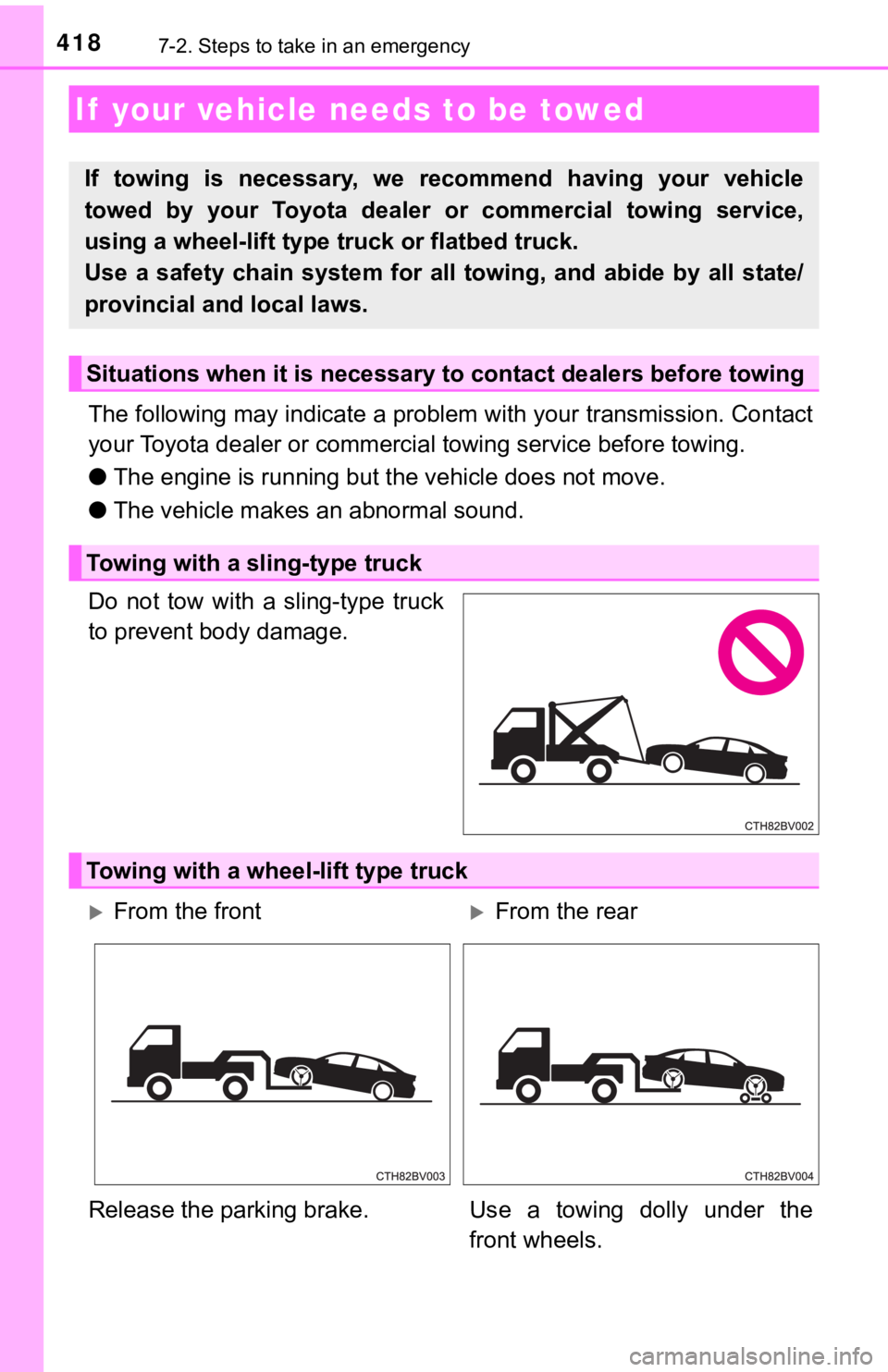
Do not tow with a sling-type truck
to prevent body damage.
If your vehicle needs to be towed
If towing is necessary, we recommend having your vehicle
towed by your Toyota dealer o r commercial towing service,
using a wheel-lift type t ruck or flatbed truck.
Use a safety chain system for all towing, and abide by all stat e/
provincial and local laws.
Situations when it is necessary to contact dealers before towing
Towing with a sling-type truck
Towing with a wheel-lift type truck
From the frontFrom the rear
Release the parking brake. Us e a towing dolly under the
front wheels.
Page 419 of 536
4197-2. Steps to take in an emergency
7
When trouble arises
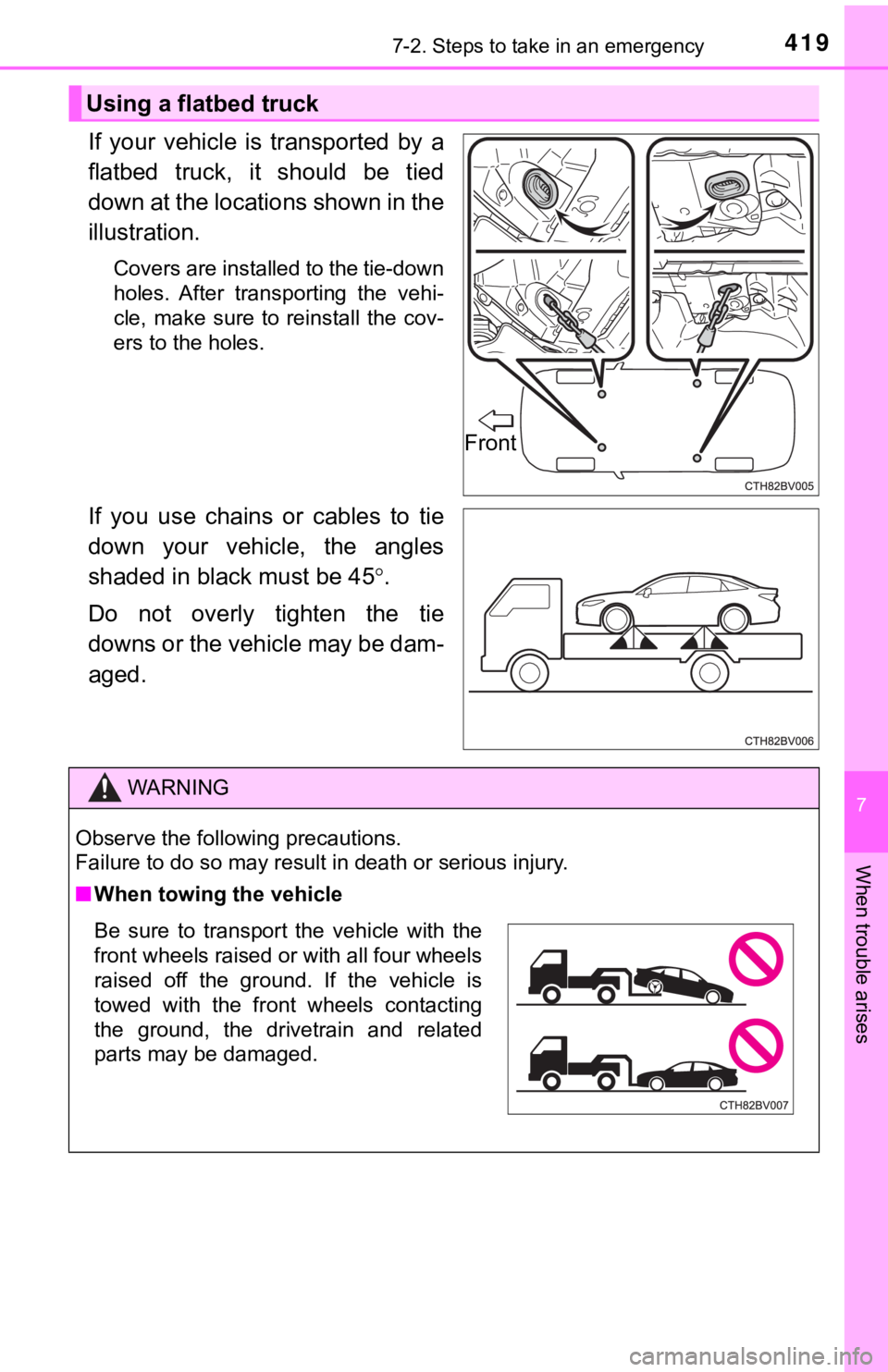
If your vehicle is transported by a
flatbed truck, it should be tied
down at the locations shown in the
illustration.
Covers are installed to the tie-down
holes. After transporting the vehi-
cle, make sure to reinstall the cov-
ers to the holes.
If you use chains or cables to tie
down your vehicle, the angles
shaded in black must be 45.
Do not overly tighten the tie
downs or the vehicle may be dam-
aged.
Using a flatbed truck
Front
WARNING
Observe the following precautions.
Failure to do so may result in death or serious injury.
■ When towing the vehicle
Be sure to transport the vehicle with the
front wheels raised or with all four wheels
raised off the ground. If the vehicle is
towed with the front wheels contacting
the ground, the drivetrain and related
parts may be damaged.
Page 420 of 536

4207-2. Steps to take in an emergency
NOTICE
■To prevent damage to the vehicle when towing using a wheel-lift type
truck
● Do not tow the vehicle from the rear when the engine switch is off. The
steering lock mechanism is not strong enough to hold the front wheels
straight.
● When raising the vehicle, ensure adequate ground clearance for towing at
the opposite end of the raised vehicle. Without adequate clearance, the
vehicle could be damaged while being towed.
■ To prevent damage to the vehicle when towing with a sling-type truck
Do not tow with a sling-type truck, either from the front or re ar.
Page 442 of 536
4427-2. Steps to take in an emergency
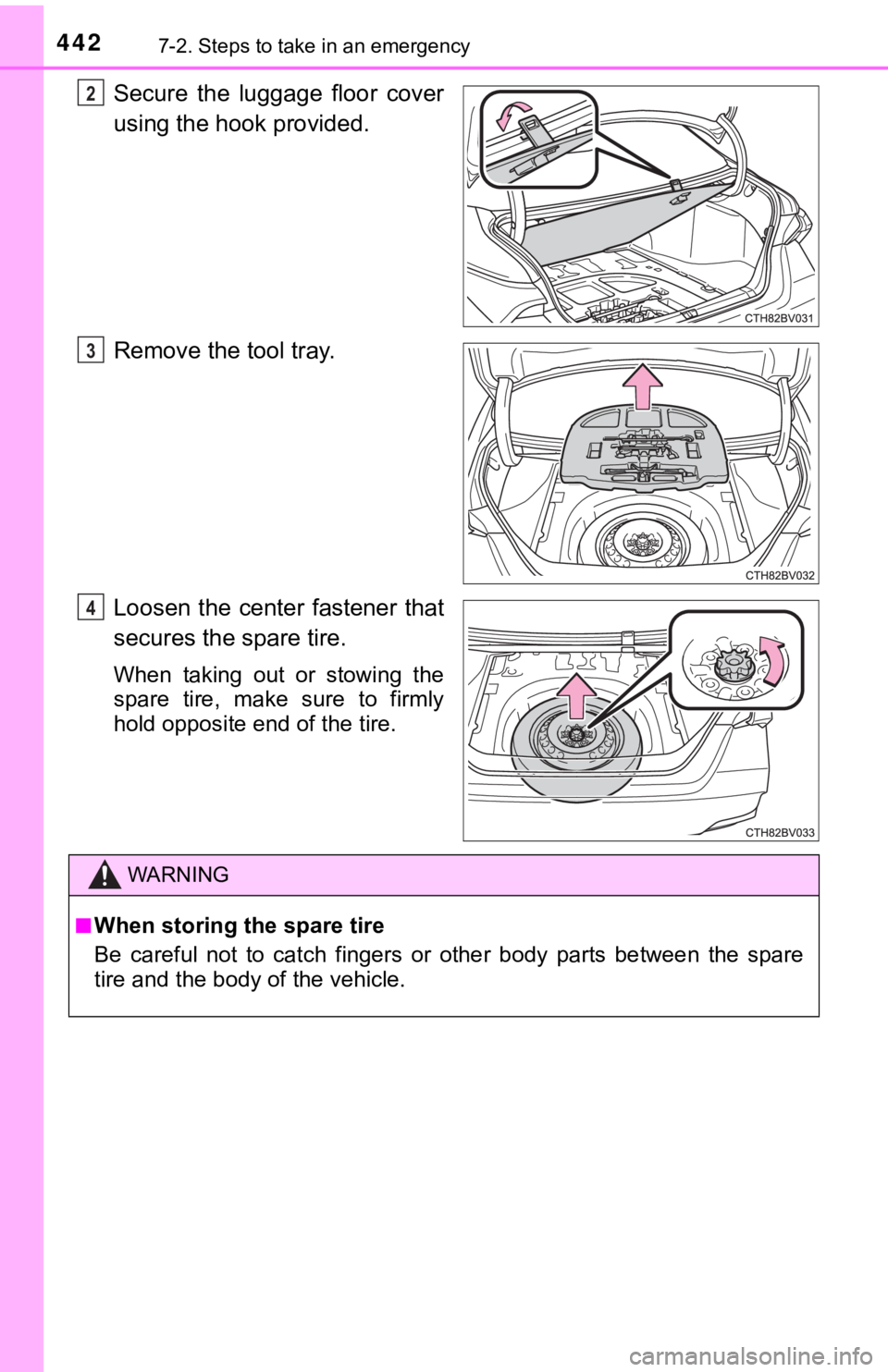
Secure the luggage floor cover
using the hook provided.
Remove the tool tray.
Loosen the center fastener that
secures the spare tire.
When taking out or stowing the
spare tire, make sure to firmly
hold opposite end of the tire.
2
3
4
WARNING
■When storing the spare tire
Be careful not to catch fingers or other body parts between the spare
tire and the body of the vehicle.
Page 463 of 536
4637-2. Steps to take in an emergency
7
When trouble arises
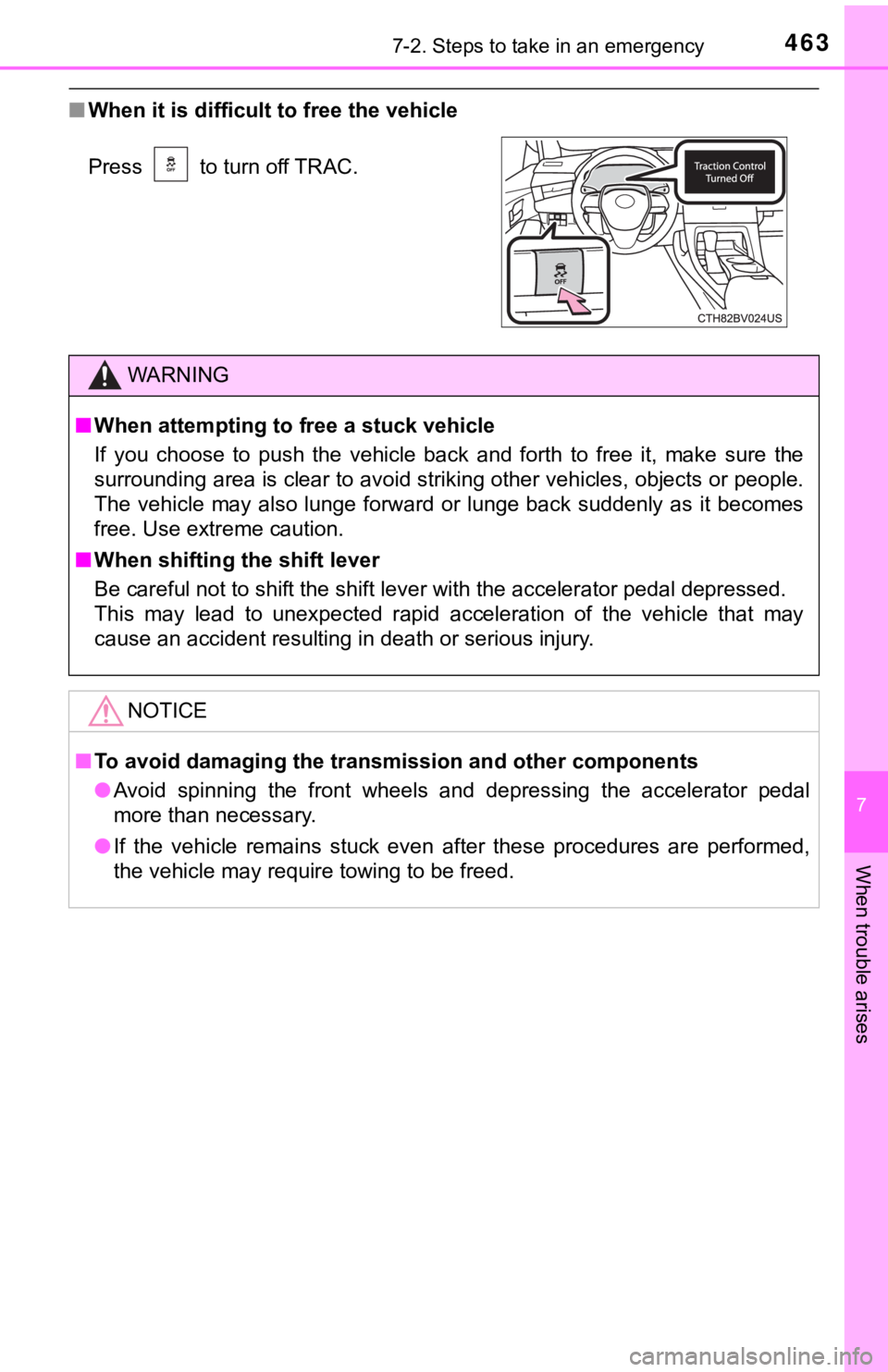
■When it is difficult to free the vehicle
Press to turn off TRAC.
WARNING
■ When attempting to f ree a stuck vehicle
If you choose to push the vehicle back and forth to free it, ma ke sure the
surrounding area is clear to avoid striking other vehicles, obj ects or people.
The vehicle may also lunge forward or lunge back suddenly as it becomes
free. Use extreme caution.
■ When shifting the shift lever
Be careful not to shift the shift lever with the accelerator pe dal depressed.
This may lead to unexpected rapid acceleration of the vehicle t hat may
cause an accident resulting in death or serious injury.
NOTICE
■ To avoid damaging the transmission and other components
● Avoid spinning the front wheels and depressing the accelerator pedal
more than necessary.
● If the vehicle remains stuck even after these procedures are pe rformed,
the vehicle may require towing to be freed.
Page 533 of 536
533Alphabetical index
Tire pressure warning systemInitializing .............................. 389
Installing tire pressure warning valve and
transmitters......................... 389
Registering ID codes ............ 390
Warning light ......................... 427
Tires .......................................... 387 Chains................................... 306
Checking ............................... 387
Glossary................................ 485
If you have a flat tire ............. 438
Inflation pressure .................. 472
Replacing .............................. 438
Rotating tires......................... 387
Size ....................................... 472
Snow tires ............................. 307
Spare tire .............................. 438
Tire pressure warning system ......... ....................... 388
Uniform Tire Quality Grading............................... 483
Warning light ......................... 427
Tools ......................................... 439
Top tether strap ......................... 65
Total load capacity .................. 171
Towing Dinghy towing ....................... 173
Emergency towing ................ 418
Trailer towing ........................ 172
Toyota Entune
*
Toyota parking assist
monitor
*
Toyota Safety Sense P ............ 208 Automatic High Beam ........... 196
Dynamic radar cruise control with full-speed range .......... 238
LDA (Lane Departure Alert
with steering control) .......... 228
PCS (Pre-Collision System) .............................. 216
TRAC (Traction Control) ......... 299
Traction Control (TRAC) ......... 299
Trailer towing .......................... 172
Transmission
Automatic transmission ........ 179
Driving mode select switches ............................. 295
If the shift lever cannot be shifted from P ..................... 183
Paddle shift switches ............ 181
S mode ................................. 180
Trip information ....................... 107
Trip meters ................................. 82
Trunk ........................................ 121 Cargo net .............................. 329
Grocery bag hooks ............... 329
Internal trunk release lever ... 122
Smart key system ................. 121
Trunk light ............................. 122
Trunk opener ........................ 121
Wireless remote control ........ 121
Trunk light Trunk light ............................. 122
Wattage ................................ 474
Turn signal lights Replacing light bulbs................................... 413
Turn signal lever ................... 185
*: Refer to the “NAVIGATION AND MULTIMEDIA SYSTEM OWNER’S MANUAL”.