steering TOYOTA AYGO 2021 Workshop Manual
[x] Cancel search | Manufacturer: TOYOTA, Model Year: 2021, Model line: AYGO, Model: TOYOTA AYGO 2021Pages: 546, PDF Size: 81 MB
Page 457 of 546
4558-2. Steps to take in an emergency
8
When trouble arises
AYGO_OM_Europe_OM9A012E
■To prevent the clutch from overheating (vehicles with a multi-mode man-
ual transmission)
● Do not use the accelerator pedal or starting assist system to hold the vehicle
on a hill.
● On an uphill incline, observe the following whenever possible:
• Maintain a safe distance from the vehicle ahead and avoid unnecessary
starting off and stopping.
• Avoid using E mode on an uphill slope. This will help to avoid unneces-
sary gear changes.
■ Front passenger detection sensor, seat belt reminder and warning
buzzer
● If luggage is placed on the front passenger seat, the front passenger detec-
tion sensor may cause the warning light to flash and the warning buzzer to
sound even if a passenger is not sitting in the seat.
● If a cushion is placed on the seat, the sensor may not detect a passenger,
and the warning light may not operate properly.
■ If the malfunction indicator lamp comes on while driving
The malfunction indicator lamp will come on if the fuel tank becomes com-
pletely empty. If the fuel tank is empt y, refuel the vehicle immediately. The
malfunction indicator lamp will go off after several trips.
If the malfunction indicator lamp does not go off, contact any authorized
Toyota retailer or Toyota authorized repai rer, or any reliable repairer as soon
as possible.
■ Electric power steering system warning light (warning buzzer)
When the battery charge becomes insufficient or the voltage temporarily
drops, the electric power steering system warning light may come on and the
warning buzzer may sound.
■ When the tire pressure warning light comes on (vehicles with the tire
pressure warning system)
Inspect the appearance of the tire to check that the tire is not punctured.
If the tire is punctured: P. 459, 481
If the tire is not punctured:
Check the tire inflation pressure after the tire temperature has lowered suffi-
ciently. Adjust the inflation pressure to the appropriate level and carry out ini-
tialization. ( P. 4 0 6 )
■ The tire pressure warning light may come on due to natural causes
(vehicles with the tire pressure warning system)
The tire pressure warning light may come on due to natural causes such as
natural air leaks and tire inflation pressure changes caused by temperature.
In this case, adjusting the tire inflation pressure is at the specified level and
carry out initialization. ( P. 406)
Page 458 of 546
4568-2. Steps to take in an emergency
AYGO_OM_Europe_OM9A012E
■ If the tire pressure warning light frequently comes on after blinking for
1 minute (vehicles with a tire pressure warning system)
If the tire pressure warning light frequently comes on after blinking for 1 min-
ute when the engine switch is turned on, have it checked by any authorized
Toyota retailer or Toyota authorized repairer, or any reliable repairer.
■ Warning buzzer
In some cases, the buzzer may not be heard because of noisy place or an
audio sound.
WARNING
■ If both the ABS and the brake system warning lights remain on
Stop your vehicle in a safe place immediately and contact any authorized
Toyota retailer or Toyota authorized r epairer, or any reliable repairer. The
vehicle will become extremely unstable during braking, and the ABS system
may fail, which could cause an accident resulting in death or serious injury.
■ When the electric power steering system warning light comes on
The steering wheel may become extremely heavy.
When steering wheel operations are heavier than usual, grip the steering
wheel firmly and operate it using more force than usual.
■ If the tire pressure warning light comes on (vehicles with the tire pres-
sure warning system)
Be sure to observe the following precautions. Failure to do so could cause a
loss of vehicle control and result in death or serious injury.
● Stop your vehicle in a safe place as soon as possible. Adjust the tire infla-
tion pressure immediately.
● If the tire pressure warning light comes on even after tire inflation pressure
adjustment, it is probable that you have a flat tire. Check the tires. If a tire
is flat, change it with the spare tire and have the flat tire repaired by the
nearest any authorized Toyota retailer or Toyota authorized repairer, or
any reliable repairer.
● Avoid abrupt maneuvering and braking. If the vehicle tires deteriorate, you
could lose control of the steering wheel or the brakes.
■ If a blowout or sudden air leakage should occur (vehicles with the tire
pressure warning system)
The tire pressure warning system may not activate immediately.
NOTICE
■ To ensure the tire pressure warning system operates properly (vehi-
cles with the tire pressure warning system)
Do not install tires with different specif ications or makers, as the tire pres-
sure warning system may not operate properly.
Page 460 of 546
4588-2. Steps to take in an emergency
AYGO_OM_Europe_OM9A012E
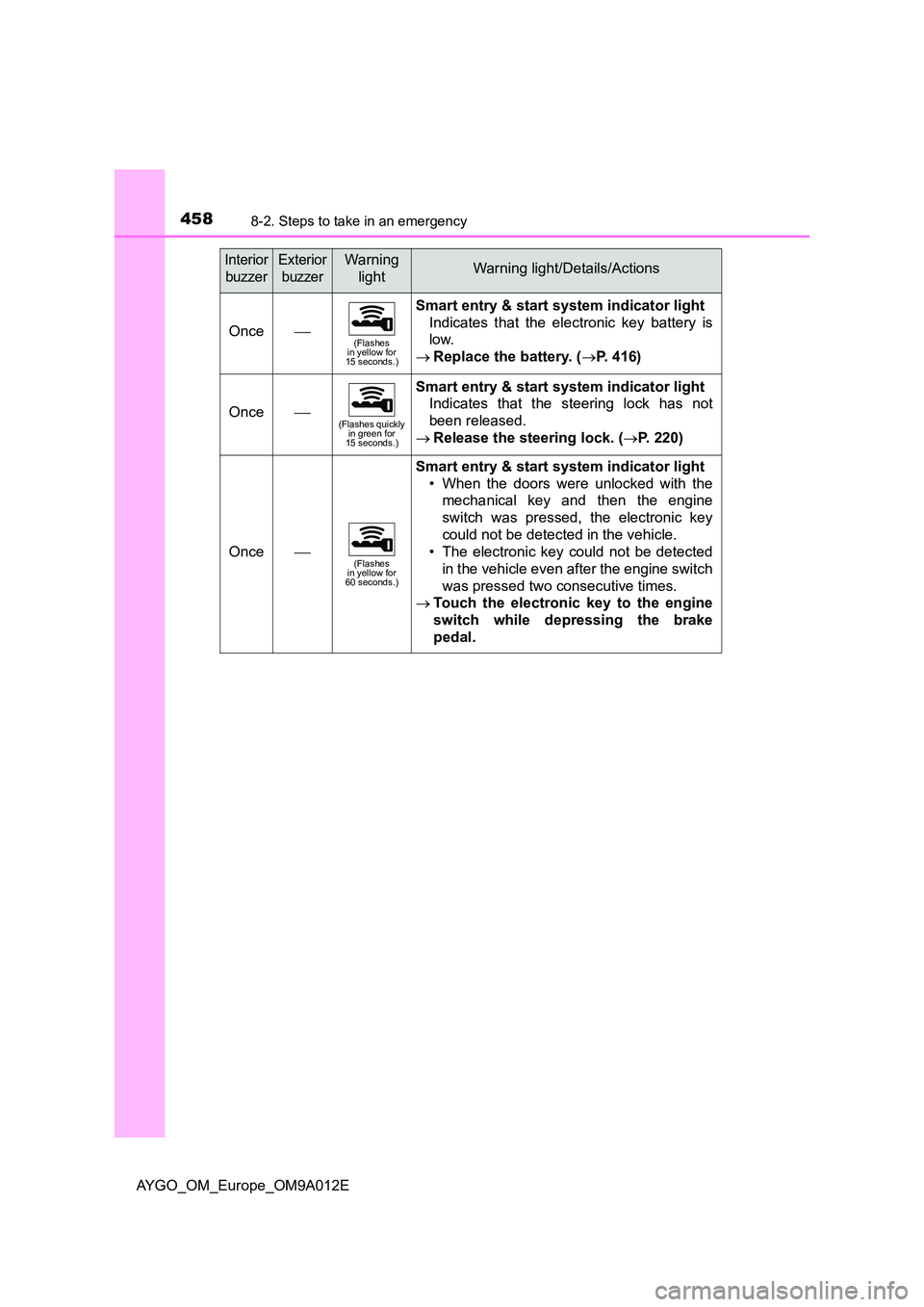
Once(Flashes in yellow for 15 seconds.)
Smart entry & start system indicator light
Indicates that the electronic key battery is
low.
Replace the battery. (P. 416)
Once(Flashes quickly in green for 15 seconds.)
Smart entry & start system indicator light
Indicates that the steering lock has not
been released.
Release the steering lock. (P. 220)
Once(Flashes in yellow for 60 seconds.)
Smart entry & start system indicator light
• When the doors were unlocked with the
mechanical key and then the engine
switch was pressed, the electronic key
could not be detected in the vehicle.
• The electronic key could not be detected
in the vehicle even after the engine switch
was pressed two consecutive times.
Touch the electronic key to the engine
switch while depressing the brake
pedal.
Interior
buzzer
Exterior
buzzer
Warning
lightWarning light/Details/Actions
Page 481 of 546
4798-2. Steps to take in an emergency
8
When trouble arises
AYGO_OM_Europe_OM9A012E
WARNING
■When fixing the flat tire
● Stop your vehicle in a safe and flat area.
● Do not touch the wheels or the area around the brakes immediately after
the vehicle has been driven.
After the vehicle has been driven, the wheels and the area around the
brakes may be extremely hot. Touching these areas with hands, feet or
other body parts may result in burns.
● To avoid risk of burst or severe leakage, do not drop or damage the bottle.
Visually inspect the bottle before use. Do not use a bottle with shock,
crack, scratch, leakage or any other damage. In such case, immediately
replace.
● Connect the valve and hose securely with the tire installed on the vehicle.
● If the hose is not properly connected to the valve, air leakage may occur
as sealant may be sprayed out.
● If the hose comes off the valve while inflating the tire, there is a risk that
the hose will move abruptly due to air pressure.
● After inflation of the tire has completed, the sealant may splatter when the
hose is disconnected or some air is let out of the tire.
● Follow the operation procedure to repair the tire. If the procedures not fol-
lowed, the sealant may spray out.
● Keep back from the tire while it is being repaired, as there is a chance of it
bursting while the repair operation is being performed. If you notice any
cracks or deformation of the tire, turn off (type A) or (off) (type B) the
compressor switch and stop the repair operation immediately.
● The repair kit may overheat if operated for a long period of time. Do not
operate the repair kit continuously for more than 40 minutes.
● Parts of the repair kit become hot during operation. Be careful handling the
repair kit during and after operation. Do not touch the metal part around
the connecting area between the bottle and the compressor. It will be
extremely hot.
● Do not attach the vehicle speed warning sticker to an area other than the
one indicated. If the sticker is attached to an area where an SRS airbag is
located, such as the pad of the steering wheel, it may prevent the SRS air-
bag from operating properly.
Page 482 of 546
4808-2. Steps to take in an emergency
AYGO_OM_Europe_OM9A012E
WARNING
■Driving to spread the liquid sealant evenly
Observe the following precautions to reduce the risk of accidents.
Failure to do so may result in a loss of vehicle control and cause death or
serious injury.
● Drive the vehicle carefully at a low speed. Be especially careful when turn-
ing and cornering.
● If the vehicle does not drive straight or you feel a pull through the steering
wheel, stop the vehicle and check the following:
• Tire condition. The tire may have separated from the wheel.
• Tire inflation pressure. If tire inflation pressure is 130 kPa (1.3 kgf/cm2
or bar, 19 psi) or less, the tire may be severely damaged.
NOTICE
■ When performing an emergency repair
● A tire should only be repaired with the emergency tire puncture repair kit if
the damage is caused by a sharp object such as nail or screw passing
through the tire tread.
Do not remove the sharp object from the tire. Removing the object may
widen the opening and disenable emergenc y repair with the repair kit.
● The repair kit is not waterproof. Make sure that the repair kit is not
exposed to water, such as when it is being used in the rain.
● Do not put the repair kit directly onto dusty ground such as sand at the
side of the road. If the repair kit vacuums up dust etc., a malfunction may
occur.
● Do not turn the bottle upside down when using it, as doing so may cause
damage to the compressor.
■ Handling the emergency tire puncture repair kit
● The repair kit power source should be 12 V DC suitable for vehicle use. Do
not connect the repair kit to any other source.
● If gasoline splatters on the repair kit, the repair kit may deteriorate. Take
care not to allow gasoline to contact it.
● Place the repair kit in a storage to prevent it from being exposed to dirt or
water.
● Store the repair kit in the luggage compartment out of reach of children.
● Do not disassemble or modify the repair kit. Do not subject parts such as
the air pressure gauge to impacts. This may cause a malfunction.
Page 494 of 546
4928-2. Steps to take in an emergency
AYGO_OM_Europe_OM9A012E
WARNING
■When using the compact spare tire
● Remember that the compact spare tire provided is specifically designed
for use with your vehicle. Do not use your compact spare tire on another
vehicle.
● Do not use more than one compact spare tire simultaneously.
● Replace the compact spare tire with a standard tire as soon as possible.
● Avoid sudden acceleration, abrupt steering, sudden braking and shifting
operations that cause sudden engine braking.
■ When the compact spare tire is attached
The vehicle speed may not be correctly detected, and the following systems
may not operate correctly:
• ABS
• Brake assist
• VSC
•TRC
• PCS (Pre-Collision system) (if equipped)
• LDA (Lane Departure Alert) (if equipped)
• EPS
• Tire pressure warning system (if equipped)
■ Speed limit when using the compact spare tire
Do not drive at speeds in excess of 80 km/h (50 mph) when a compact
spare tire is installed on the vehicle.
The compact spare tire is not designed for driving at high speeds. Failure to
observe this precaution may lead to an accident causing death or serious
injury.
■ After using the tools and jack
Before driving, make sure all the tools and jack are securely in place in their
storage location to reduce the possibility of personal injury during a collision
or sudden braking.
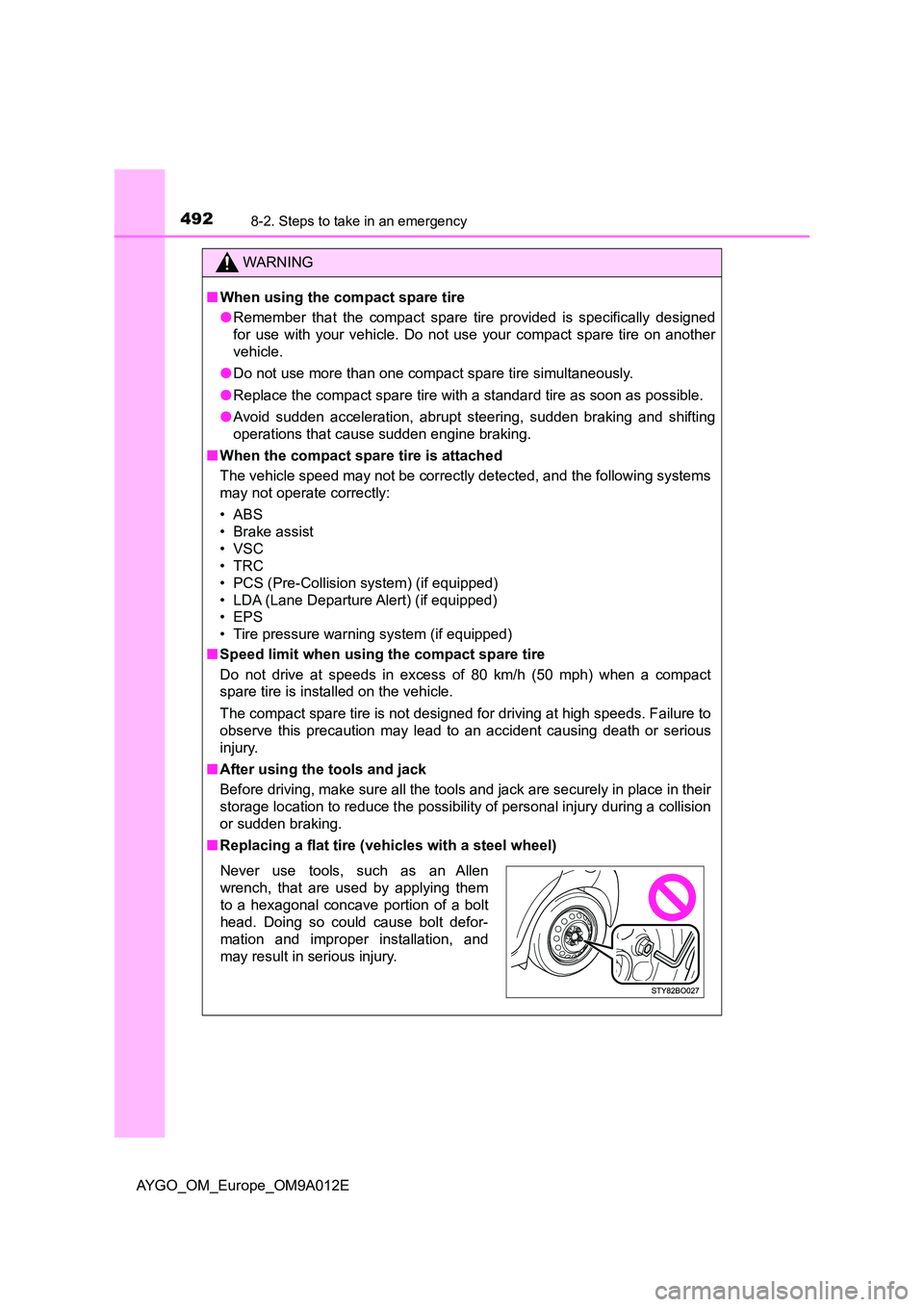
■ Replacing a flat tire (vehicles with a steel wheel)
Never use tools, such as an Allen
wrench, that are used by applying them
to a hexagonal concave portion of a bolt
head. Doing so could cause bolt defor-
mation and improper installation, and
may result in serious injury.
Page 497 of 546

4958-2. Steps to take in an emergency
8
When trouble arises
AYGO_OM_Europe_OM9A012E
One of the following may be the cause of the problem:
● One or both of the battery terminals may be disconnected.
● The battery may be discharged. (P. 500)
● There may be a malfunction in the steering lock system (vehicles
with a smart entry & start system).
Contact any authorized Toyota retailer or Toyota authorized repairer, or any
reliable repairer if the problem cannot be repaired, or if repair procedures
are unknown.
When the engine does not start, the following steps can be used as an
interim measure to start the engine if the engine switch is functioning
normally:
Set the parking brake.
Shift the shift lever to N.
Turn the engine switch to ACCESSORY mode.
Press and hold the engine switch for about 15 seconds while
depressing the brake pedal (multi-mode manual transmission) or
clutch pedal (manual transmission) firmly.
Even if the engine can be started using the above steps, the system
may be malfunctioning. Have the vehicle inspected by any authorized
Toyota retailer or Toyota authorized repairer, or any reliable repairer.
The starter motor does not turn over, the interior lights and head-
lights do not turn on, or the horn does not sound.
Emergency start function
Page 520 of 546
5189-1. Specifications
AYGO_OM_Europe_OM9A012E
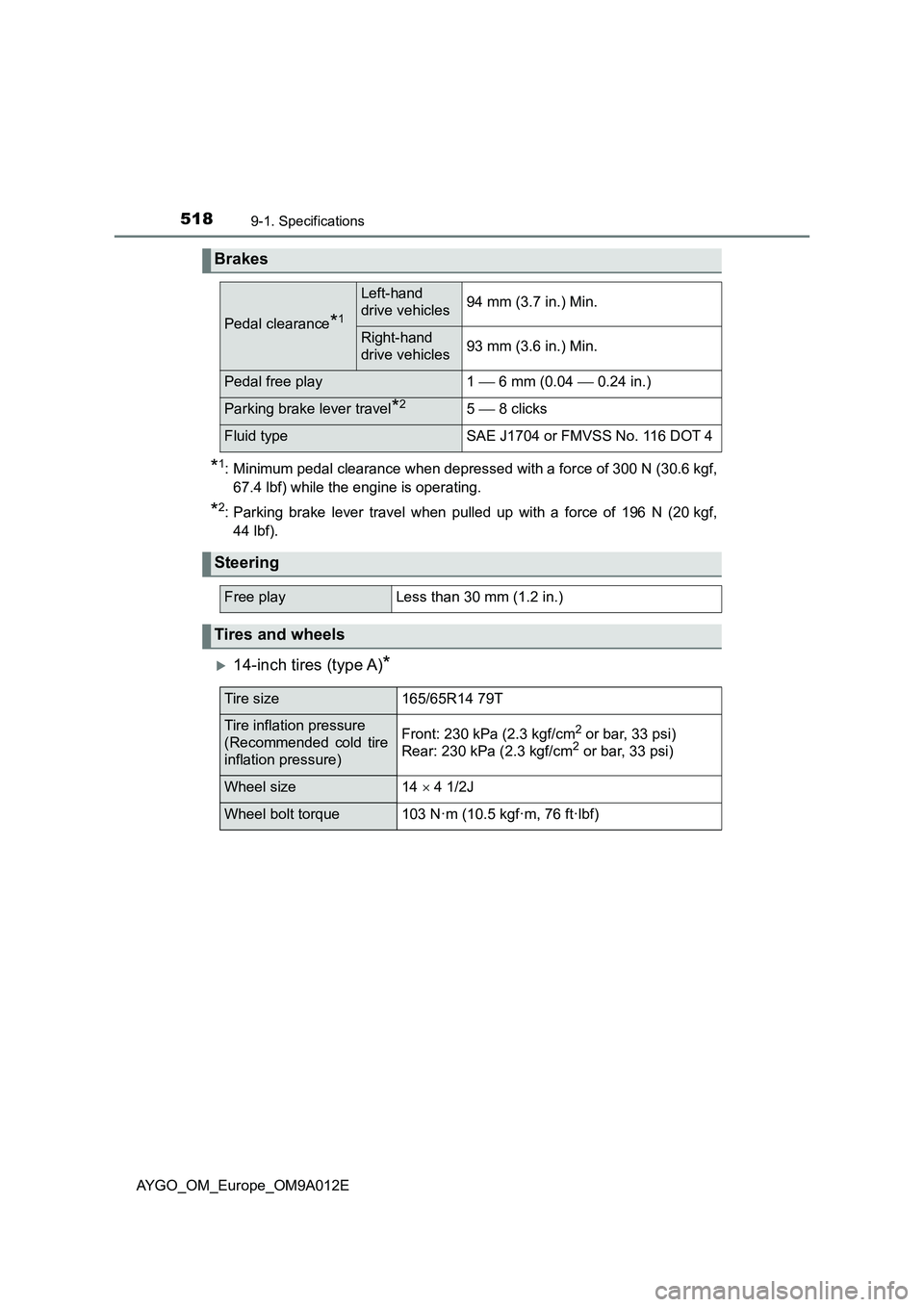
*1: Minimum pedal clearance when depressed with a force of 300 N (30.6 kgf,
67.4 lbf) while the engine is operating.
*2: Parking brake lever travel when pulled up with a force of 196 N (20 kgf,
44 lbf).
14-inch tires (type A)*
Brakes
Pedal clearance*1
Left-hand
drive vehicles94 mm (3.7 in.) Min.
Right-hand
drive vehicles93 mm (3.6 in.) Min.
Pedal free play1 6 mm (0.04 0.24 in.)
Parking brake lever travel*25 8 clicks
Fluid typeSAE J1704 or FMVSS No. 116 DOT 4
Steering
Free playLess than 30 mm (1.2 in.)
Tires and wheels
Tire size165/65R14 79T
Tire inflation pressure
(Recommended cold tire
inflation pressure)Front: 230 kPa (2.3 kgf/cm2 or bar, 33 psi)
Rear: 230 kPa (2.3 kgf/cm2 or bar, 33 psi)
Wheel size14 4 1/2J
Wheel bolt torque103 N·m (10.5 kgf·m, 76 ft·lbf)
Page 529 of 546
527What to do if... (Troubleshooting)
AYGO_OM_Europe_OM9A012E
●Vehicles with a multi-mode manual transmission
Do you turn the key with the brake pedal depressed firmly? ( P. 214)
●Vehicles with a manual transmission
Do you turn the key with the clutch pedal depressed firmly? ( P. 214)
●Is the battery discharged? (P. 500)
●Vehicles with a multi-mode manual transmission
Did you press the engine switch while firmly depressing the brake pedal?
( P. 217)
●Vehicles with a manual transmission
Did you press the engine switch while firmly depressing the clutch pedal?
( P. 217)
●Is the electronic key anywhere detectable inside the vehicle? (P. 144)
●Is the steering wheel unlocked? (P. 220)
●Is the electronic key battery weak or depleted?
In this case, the engine can be started in a temporary way. ( P. 498)
●Is the battery discharged? (P. 500)
●Vehicles without a smart entry & start system
Is the engine switch in the “ON” position?
If you cannot release the shift lever by depressing the brake pedal with the
engine switch in the “ON” position: P. 496
●Vehicles with a smart entry & start system
Is the engine switch in IGNITION ON mode?
If you cannot release the shift lever by depressing the brake pedal with the
engine switch in IGNITION ON mode: P. 496
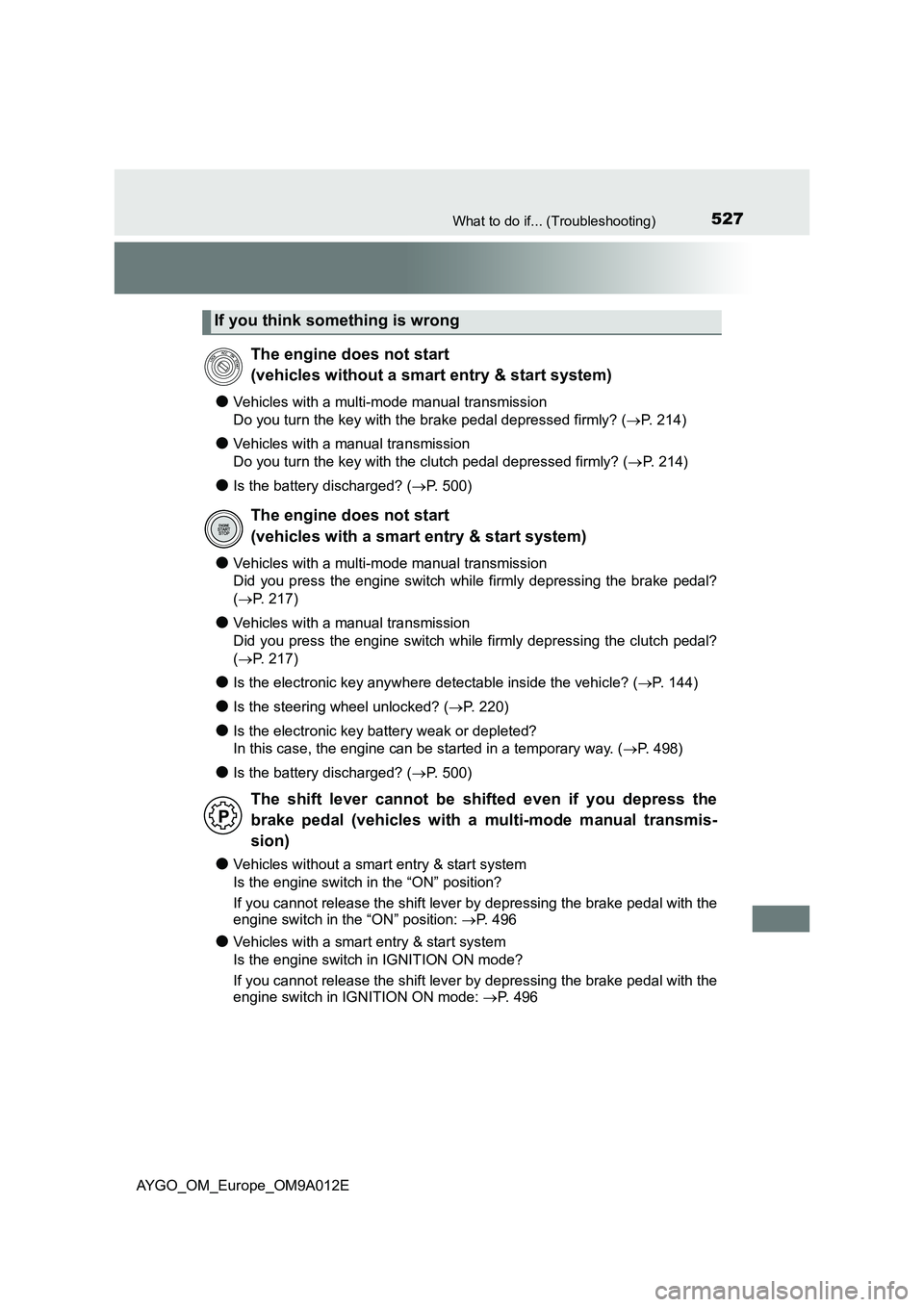
If you think something is wrong
The engine does not start
(vehicles without a smart entry & start system)
The engine does not start
(vehicles with a smart entry & start system)
The shift lever cannot be shifted even if you depress the
brake pedal (vehicles with a multi-mode manual transmis-
sion)
Page 530 of 546
528What to do if... (Troubleshooting)
AYGO_OM_Europe_OM9A012E
●Vehicles without a smart entry & start system
It is locked to prevent theft of the vehicle if the key is removed from the
engine switch. ( P. 2 1 5 )
●Vehicles with a smart entry & start system
It is locked automatically to prevent theft of the vehicle. ( P. 220)
●The auto power off function will be operated if the vehicle is left in ACCES-
SORY or IGNITION ON mode (the engine is not operating) for a period of
time. ( P. 219)
●The seat belt reminder light is flashing
Are the driver and the passengers wearing the seat belts? ( P. 453)
●The brake system warning light is on
Is the parking brake released? ( P. 230)
Depending on the situation, other types of warning buzzer may also
sound. ( P. 449)
●When a warning light turns on, refer to P. 449.
The steering wheel cannot be turned after the engine is
stopped
The engine switch is turned off automatically
(vehicles with a smart entry & start system)
A warning buzzer sounds during driving
A warning light turns on