steering TOYOTA AYGO X 2022 (in English) User Guide
[x] Cancel search | Manufacturer: TOYOTA, Model Year: 2022, Model line: AYGO X, Model: TOYOTA AYGO X 2022Pages: 494, PDF Size: 92.53 MB
Page 79 of 494
77
2
Owner's Manual_Europe_M99V08_en
2-1. Instrument cluster
Vehicle status information and indicators
*1: These lights come on when the
engine switch is turned to ON to indi-
cate that a system check is being
performed. They will turn off after the
engine is started, or after a few sec-
onds. There may be a malfunction in
a system if the lights do not come
on, or turn off. Have the vehicle
inspected by any authorized Toyota
retailer or Toyota authorized repairer,
or any reliable repairer.
*2: This light illuminates on the multi-
information display.
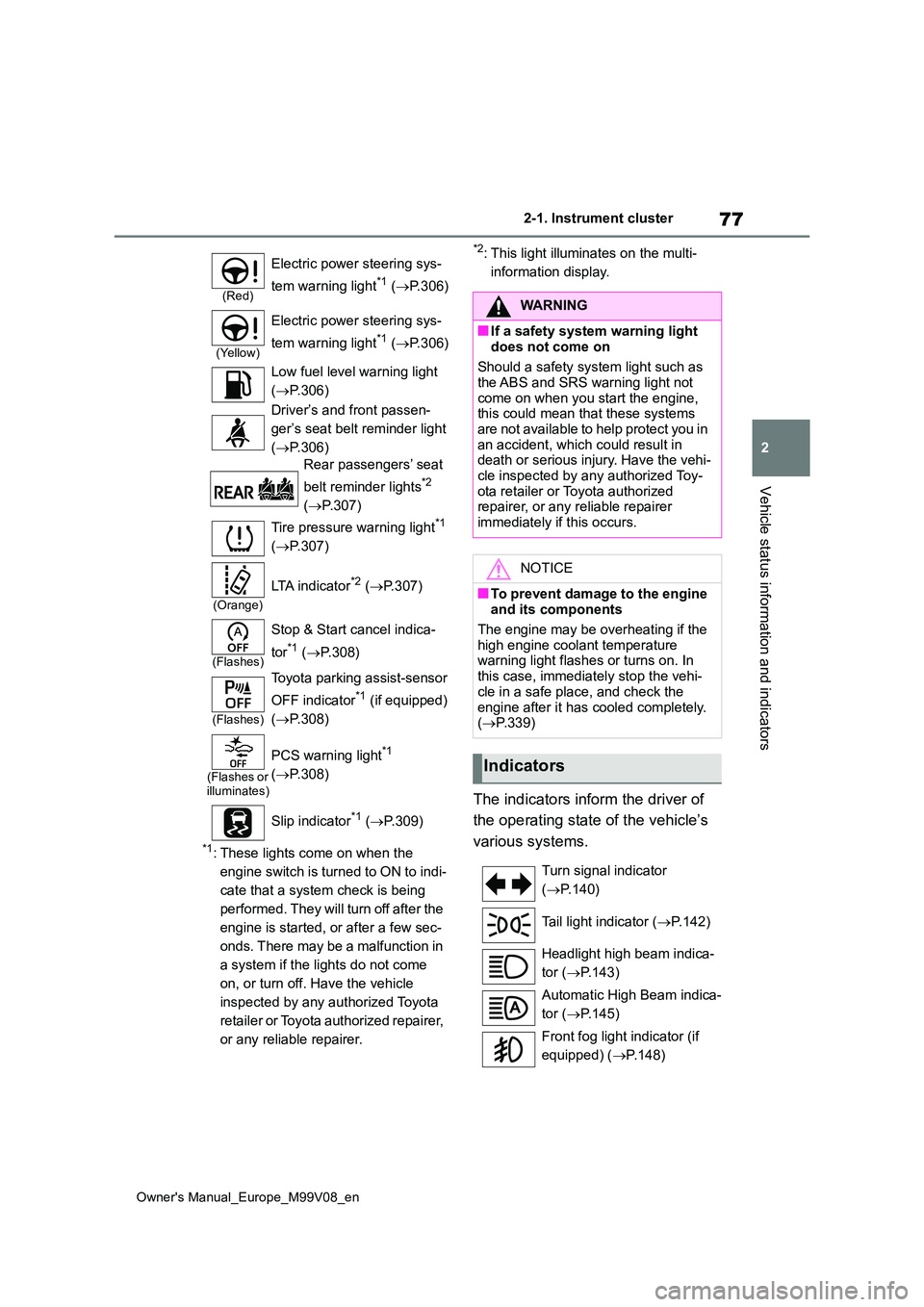
The indicators inform the driver of
the operating state of the vehicle’s
various systems.
(Red)
Electric power steering sys-
tem warning light*1 ( P.306)
(Yellow)
Electric power steering sys-
tem warning light*1 ( P.306)
Low fuel level warning light
( P.306)
Driver’s and front passen-
ger’s seat belt reminder light
( P.306)
Rear passengers’ seat
belt reminder lights*2
( P.307)
Tire pressure warning light*1
( P.307)
(Orange)
LTA indicator*2 (P.307)
(Flashes)
Stop & Start cancel indica-
tor*1 ( P.308)
(Flashes)
Toyota parking assist-sensor
OFF indicator*1 (if equipped)
( P.308)
(Flashes or illuminates)
PCS warning light*1
( P.308)
Slip indicator*1 ( P.309)
WARNING
■If a safety system warning light
does not come on
Should a safety system light such as the ABS and SRS warning light not
come on when you start the engine, this could mean that these systems are not available to help protect you in
an accident, which could result in death or serious injury. Have the vehi-cle inspected by any authorized Toy-
ota retailer or Toyota authorized repairer, or any reliable repairer immediately if this occurs.
NOTICE
■To prevent damage to the engine and its components
The engine may be overheating if the high engine coolant temperature warning light flashes or turns on. In
this case, immediately stop the vehi- cle in a safe place, and check the
engine after it has cooled completely. ( P.339)
Indicators
Turn signal indicator
( P.140)
Tail light indicator ( P.142)
Headlight high beam indica-
tor ( P.143)
Automatic High Beam indica-
tor ( P.145)
Front fog light indicator (if
equipped) ( P.148)
Page 93 of 494
3
91
Owner's Manual_Europe_M99V08_en
3
Before driving
Before driving
3-1. Key information
Keys.................................... 92
3-2. Opening, closing and locking
the doors
Side doors .......................... 96
Back door ........................... 99
Smart entry & start system 102
3-3. Adjusting the seats
Front seats........................ 106
Rear seats ........................ 107
Head restraints ................. 108
3-4. Adjusting the steering wheel
and mirrors
Steering wheel .................. 110
Inside rear view mirror ...... 111
Outside rear view mirrors . 112
3-5. Opening, closing the win-
dows and canvas top
Power windows................. 114
Rear side windows ........... 115
Canvas top ....................... 116
Page 112 of 494
110
Owner's Manual_Europe_M99V08_en
3-4. Adjusting the steering wheel and mirrors
3-4.Adjusting the steering whe el an d mirrors
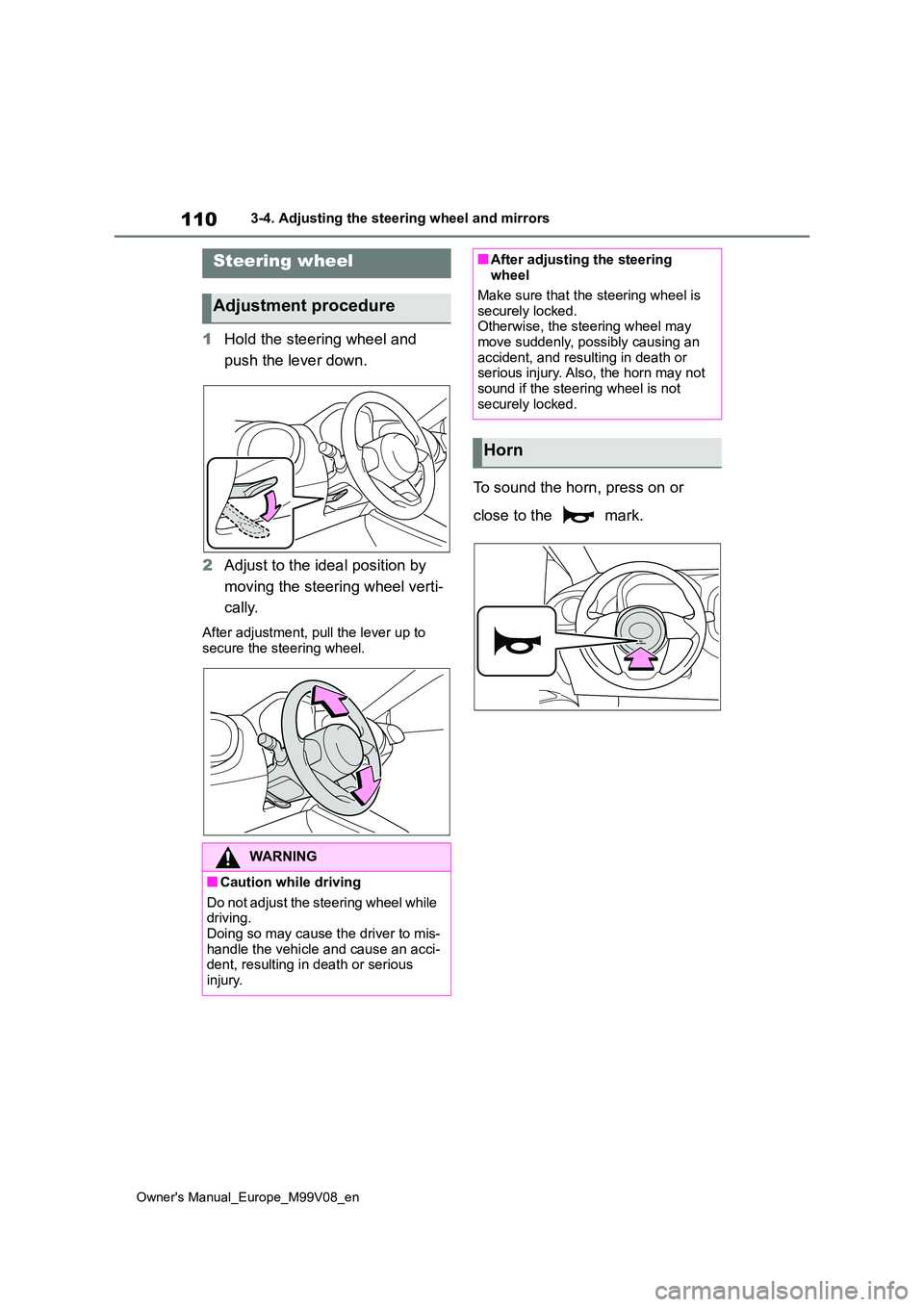
1Hold the steering wheel and
push the lever down.
2 Adjust to the ideal position by
moving the steering wheel verti-
cally.
After adjustment, pull the lever up to
secure the steering wheel.
To sound the horn, press on or
close to the mark.
Steering wheel
Adjustment procedure
WARNING
■Caution while driving
Do not adjust the steering wheel while driving.Doing so may cause the driver to mis-
handle the vehicle and cause an acci- dent, resulting in death or serious injury.
■After adjusting the steering wheel
Make sure that the steering wheel is
securely locked. Otherwise, the steering wheel may move suddenly, possibly causing an
accident, and resulting in death or serious injury. Also, the horn may not sound if the steering wheel is not
securely locked.
Horn
Page 113 of 494
111
3
Owner's Manual_Europe_M99V08_en
3-4. Adjusting the steering wheel and mirrors
Before driving
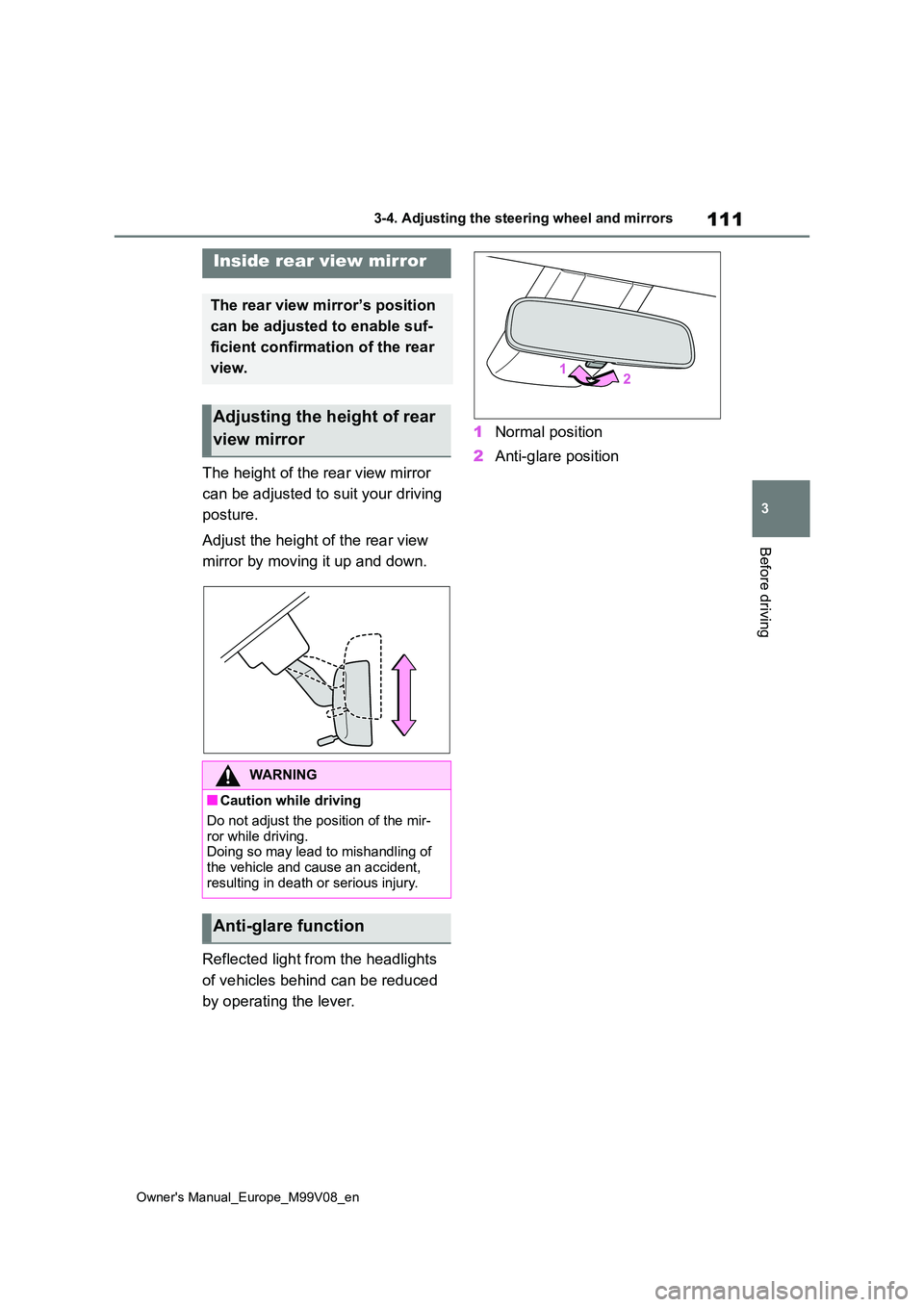
The height of the rear view mirror
can be adjusted to suit your driving
posture.
Adjust the height of the rear view
mirror by moving it up and down.
Reflected light from the headlights
of vehicles behind can be reduced
by operating the lever.
1 Normal position
2 Anti-glare position
Inside rear view mirror
The rear view mirror’s position
can be adjusted to enable suf-
ficient confirmation of the rear
view.
Adjusting the height of rear
view mirror
WARNING
■Caution while driving
Do not adjust the position of the mir-
ror while driving. Doing so may lead to mishandling of the vehicle and cause an accident,
resulting in death or serious injury.
Anti-glare function
Page 114 of 494
112
Owner's Manual_Europe_M99V08_en
3-4. Adjusting the steering wheel and mirrors
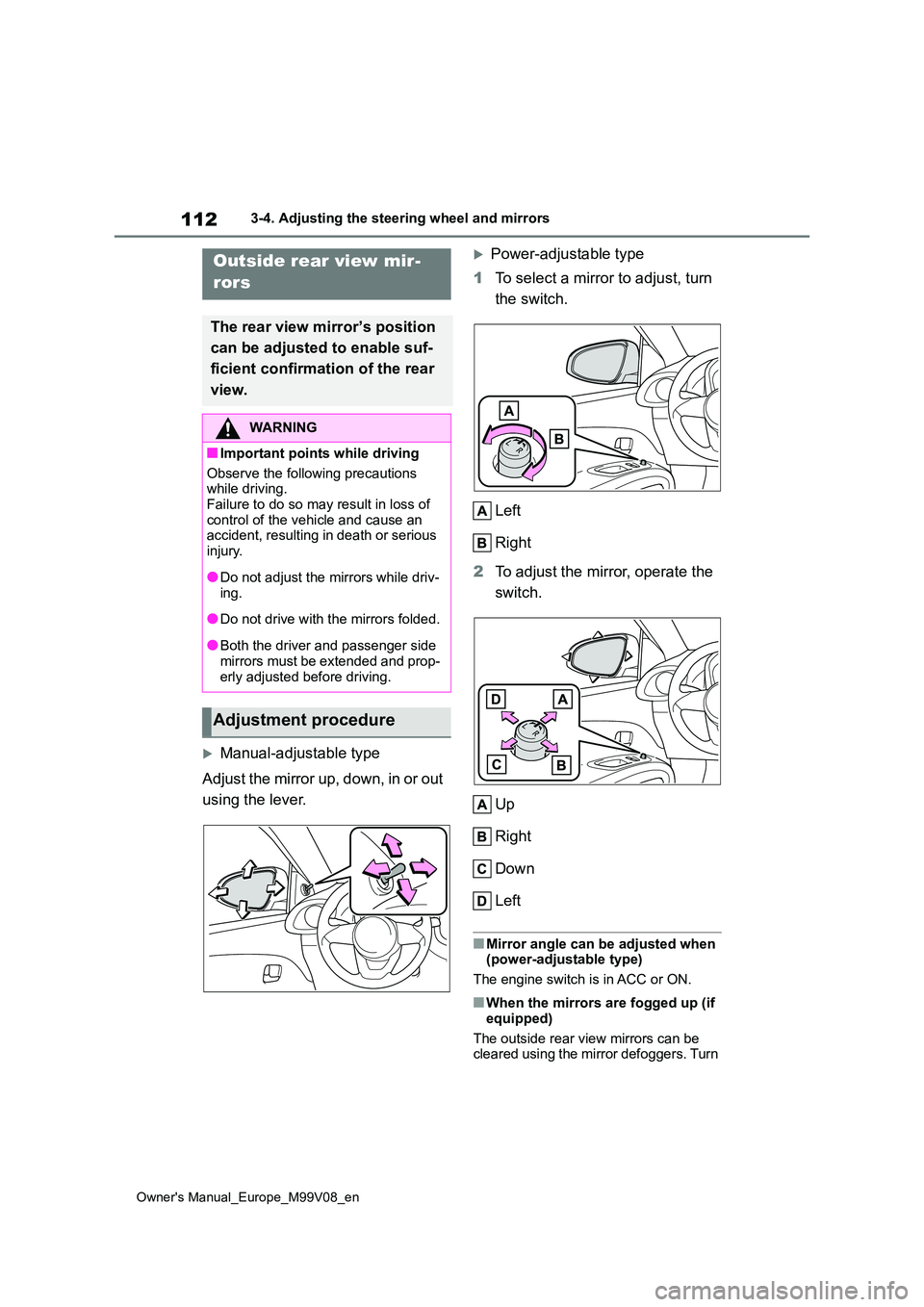
Manual-adjustable type
A dju st the mi rr or u p, d own, in or ou t
using the lever.
Power-adjustable type
1 To select a mirror to adjust, turn
the switch.
Left
Right
2 To adjust the mirror, operate the
switch.
Up
Right
Down
Left
■Mirror angle can be adjusted when (power-adjustable type)
The engine switch is in ACC or ON.
■When the mirrors are fogged up (if
equipped)
The outside rear view mirrors can be cleared using the mirror defoggers. Turn
Outside rear view mir-
rors
The rear view mirror’s position
can be adjusted to enable suf-
ficient confirmation of the rear
view.
WARNING
■Important points while driving
Observe the following precautions while driving.
Failure to do so may result in loss of control of the vehicle and cause an accident, resulting in death or serious
injury.
●Do not adjust the mirrors while driv-
ing.
●Do not drive with the mirrors folded.
●Both the driver and passenger side mirrors must be extended and prop-
erly adjusted before driving.
Adjustment procedure
Page 115 of 494
113
3
Owner's Manual_Europe_M99V08_en
3-4. Adjusting the steering wheel and mirrors
Before driving
on the rear window defogger to turn on
the outside rear view mirror defoggers. ( P.221, 225)
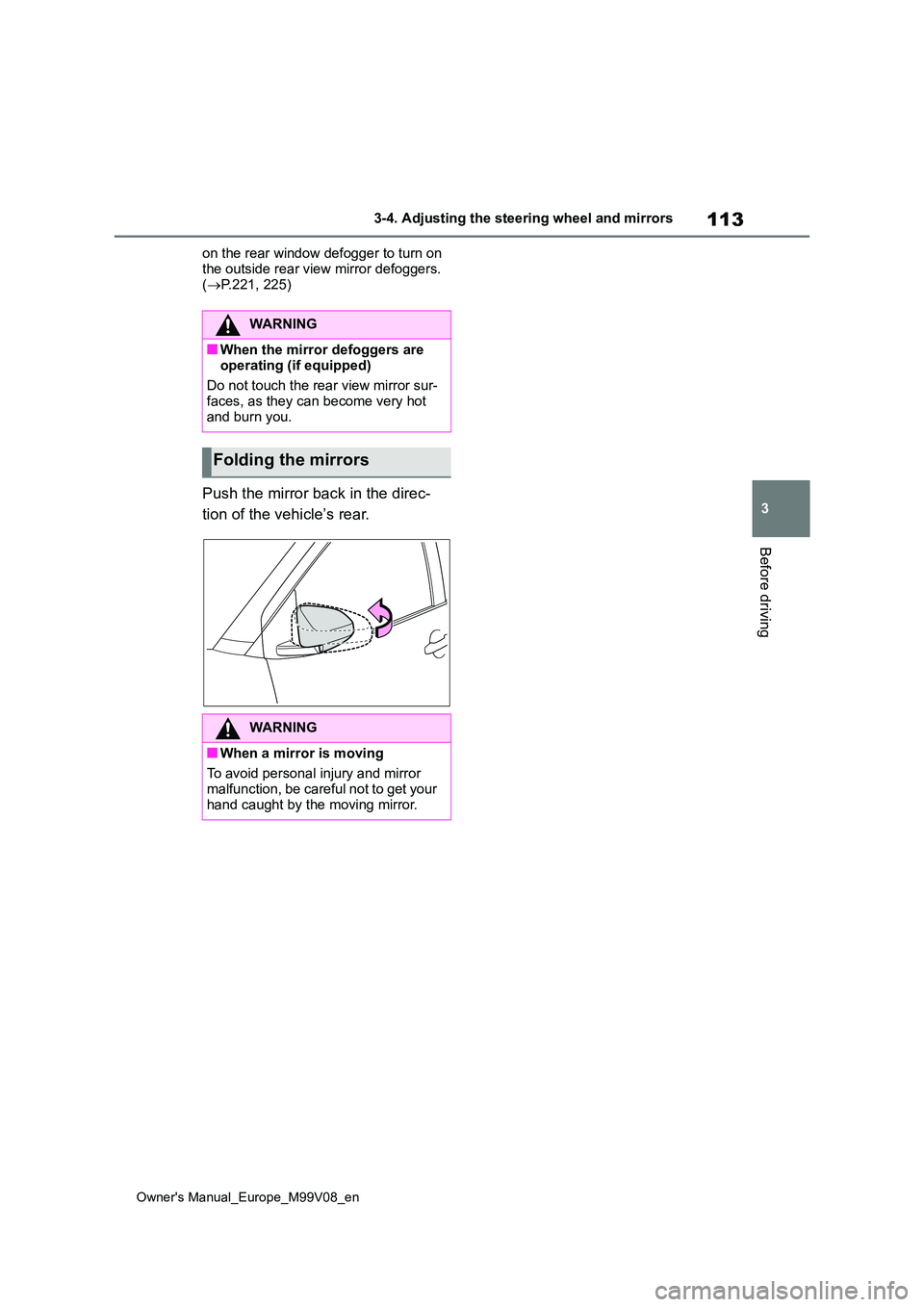
Push the mirror back in the direc-
tion of the vehicle’s rear.
WARNING
■When the mirror defoggers are
operating (if equipped)
Do not touch the rear view mirror sur- faces, as they can become very hot
and burn you.
Folding the mirrors
WARNING
■When a mirror is moving
To avoid personal injury and mirror
malfunction, be careful not to get your hand caught by the moving mirror.
Page 123 of 494
121
4
Owner's Manual_Europe_M99V08_en
4-1. Before driving
Driving
Manual transmission
1 While depressing the clutch
pedal, depress the brake pedal.
2 Set the parking brake. (P.141)
Check that the parking brake indicator
is illuminated.
3 Shift the shift lever to N.
( P.139)
If parking on a hill, shift the shift lever to
1 or R and block the wheels as needed.
4 Turn the engine switch to OFF
to stop the engine.
5 Slowly release the brake pedal.
6 Lock the door, making sure that
you have the key on your per-
son.
■Starting off on a steep uphill
Multidrive
1 Make sure that the parking
brake is set and shift the shift
lever to D.
2 Gently depress the accelerator
pedal.
3 Release the parking brake.
Manual transmission
1 Make sure that the parking
brake is set and shift the shift
lever to 1.
2 Lightly depress the accelerator
pedal at the same time as grad-
ually releasing the clutch pedal.
3 Release the parking brake.
■Driving in the rain
●Drive carefully when it is raining, because visibility will be reduced, the
windows may become fogged-up, and
the road will be slippery.
●Drive carefully when it starts to rain,
because the road surface will be especially slippery.
●Refrain from high speeds when driv-ing on an expressway in the rain, because there may be a layer of water
between the tires and the road sur- face, preventing the steering and brakes from operating properly.
■Engine speed while driving (vehi-
cles with Multidrive)
In the following conditions, the engine speed may become high while driving.
This is due to automatic up-shifting con- trol or down-shifting implementation to meet driving conditions. It does not indi-
cate sudden acceleration.
●The vehicle is judged to be driving
uphill or downhill
●When the accelerator pedal is
released
●When the brake pedal is depressed
while power mode is selected
■Restraining the engine output (Brake Override System)
●When the accelerator and brake ped-als are depressed at the same time, the engine output may be restrained.
●A warning message is displayed on the multi-information display while the
system is operating.
■Breaking in your new Toyota
To extend the life of the vehicle, observ- ing the following precautions is recom-
mended:
●For the first 300 km (186 miles):
Avoid sudden stops.
●For the first 1000 km (621 miles): • Do not drive at extremely high
speeds. • Avoid sudden acceleration.• Do not drive continuously in low
gears. • Do not drive at a constant speed for
Page 124 of 494
122
Owner's Manual_Europe_M99V08_en
4-1. Before driving
extended periods.
■Operating your vehicle in a foreign
country
Comply with the relevant vehicle regis- tration laws and confirm the availability
of the correct fuel. ( P.345)
WARNING
Observe the following precautions. Failure to do so may result in death or
serious injury.
■When starting the vehicle (vehi-
cles with Multidrive)
Always keep your foot on the brake pedal while stopped with the engine
running. This prevents the vehicle from creeping.
■When driving the vehicle
●Do not drive if you are unfamiliar with the location of the brake and
accelerator pedals to avoid depressing the wrong pedal.
• Accidentally depressing the accel- erator pedal instead of the brake pedal will result in sudden accelera-
tion that may lead to an accident.
• When backing up, you may twist
your body around, leading to a diffi- culty in operating the pedals. Make sure to operate the pedals properly.
• Make sure to keep a correct driving posture even when moving the
vehicle only slightly. This allows you to depress the brake and accelera-tor pedals properly.
• Depress the brake pedal using your right foot. Depressing the brake
pedal using your left foot may delay response in an emergency, result-ing in an accident.
●Do not drive the vehicle over or stop the vehicle near flammable materials.
The exhaust system and exhaust gases can be extremely hot. These hot parts may cause a fire if there is
any flammable material nearby.
●During normal driving, do not turn
off the engine. Turning the engine off while driving will not cause loss of steering or braking control, but
the power assist to these systems will be lost. This will make it more difficult to steer and brake, so you
should pull over and stop the vehi- cle as soon as it is safe to do so.However, in the event of an emer-
gency, such as if it becomes impos- sible to stop the vehicle in the normal way: P. 2 9 6
●Use engine braking (downshift) to maintain a safe speed when driving
down a steep hill. Using the brakes continuously may cause the brakes to overheat and
lose effectiveness. ( P.135, 139)
●Do not adjust the positions of the
steering wheel, the seat, or the inside or outside rear view mirrors while driving.
Doing so may result in a loss of vehicle control.
●Always check that all passengers’ arms, heads or other parts of their body are not outside the vehicle.
■When driving on slippery road surfaces
●Sudden braking, acceleration and steering may cause tire slippage and reduce your ability to control
the vehicle.
●Sudden acceleration, engine brak-
ing due to shifting, or changes in engine speed could cause the vehi-cle to skid.
Page 125 of 494
123
4
Owner's Manual_Europe_M99V08_en
4-1. Before driving
Driving
WARNING
●After driving through a puddle, lightly depress the brake pedal to
make sure that the brakes are func- tioning properly. Wet brake pads may prevent the brakes from func-
tioning properly. If the brakes on only one side are wet and not func-tioning properly, steering control
may be affected.
■When shifting the shift lever
●Vehicles with Multidrive: Do not let the vehicle roll backward while a forward driving position is selected,
or roll forward while the shift lever is in R.Doing so may cause the engine to
stall or lead to poor brake and steering performance, resulting in an accident or damage to the vehi-
cle.
●Vehicles with Multidrive: Do not
shift the shift lever to P while the vehicle is moving.Doing so can damage the transmis-
sion and may result in a loss of vehicle control.
●Do no t sh i ft t h e sh if t l e ve r t o R whi l e the vehicle is moving forward.Doing so can damage the transmis-
sion and may result in a loss of vehicle control.
●Do not shift the shift lever to a driv-ing position while the vehicle is moving backward.
Doing so can damage the transmis- sion and may result in a loss of vehicle control.
●Moving the shift lever to N while the vehicle is moving will disengage the
engine from the transmission. Engine braking is not available when N is selected.
●Vehicles with Multidrive: Be careful not to shift the shift lever with the accelerator pedal depressed. Shift-
ing the shift lever to any positions other than P or N may lead to unex-pected rapid acceleration of the
vehicle that may cause an accident and result in death or serious injury.
■If you hear a squealing or scrap-ing noise (brake pad wear indica-tors)
Have the brake pads checked and replaced by any authorized Toyota retailer or Toyota authorized repairer,
or any reliable repairer as soon as possible.
Rotor damage may result if the pads are not replaced when needed.
It is dangerous to drive the vehicle when the wear limits of the brake pads and/or those of the brake discs
are exceeded.
■When the vehicle is stopped
●Do not race the engine. If the vehicle is in any gear other than P (Multidrive) or N, the vehicle
may accelerate suddenly and unex- pectedly, causing an accident.
●Vehicles with Multidrive: In order to prevent accidents due to the vehi-cle rolling away, always keep
depressing the brake pedal while the engine is running, and apply the parking brake as necessary.
●If the vehicle is stopped on an incline, in order to prevent acci-
dents caused by the vehicle rolling forward or backward, always depress the brake pedal and
securely apply the parking brake as needed.
Page 128 of 494
126
Owner's Manual_Europe_M99V08_en
4-1. Before driving
When the following unusual opera-
tion is performed with the accelera-
tor pedal depressed, the engine
output may be restrained.
• When the shift lever is shifted to
R*.
• When the shift lever is shifted
from P or R to forward drive shift
position such as D*.
When the system operates, a mes-
sage appears on the multi-informa-
tion display. Read the message and
follow the instruction.
*: Depending on the situation, the shift
position may not be changed.
■Drive-Start Control (DSC)
When the TRC is turned off ( P.212),
sudden start restraint control also does not operate. If your vehicle have trouble escaping from the mud or fresh snow
due to sudden start restraint control operation, deactivate TRC ( P.212) so that the vehicle may become able to
escape from the mud or fresh snow.
NOTICE
■Avoiding damage to vehicle parts
●Do not turn the steering wheel fully
in either direction and hold it there for an extended period of time.Doing so may damage the power
steering motor.
●When driving over bumps in the
road, drive as slowly as possible to avoid damaging the wheels, under-side of the vehicle, etc.
■If you get a flat tire while driving
A flat or damaged tire may cause the
following situations. Hold the steering wheel firmly and gradually depress the brake pedal to slow down the
vehicle.
●It may be difficult to control your vehicle.
●The vehicle will make abnormal sounds or vibrations.
●The vehicle will lean abnormally.
Information on what to do in case of a flat tire ( P.313, 324)
■When encountering flooded roads
Do not drive on a road that has
flooded after heavy rain, etc. Doing so may cause the following serious dam-age to the vehicle:
●Engine stalling
●Short in electrical components
●Engine damage caused by water immersion
In the event that you drive on a flooded road and the vehicle
becomes flooded or stuck in mud or sand, be sure to have any authorized Toyota retailer or Toyota authorized
repairer, or any reliable repairer check the following:
●Brake function
●Changes in the quantity and quality of the engine oil, transmission fluid, clutch fluid, differential oil, etc.
●Lubricant condition for the bearings and suspension joints (where possi-
ble), and the function of all joints, bearings, etc.
Sudden start restraint con-
trol (Drive-Start Control
[DSC]) (vehicles with Multid-
rive)