air condition TOYOTA AYGO X 2022 (in English) Service Manual
[x] Cancel search | Manufacturer: TOYOTA, Model Year: 2022, Model line: AYGO X, Model: TOYOTA AYGO X 2022Pages: 494, PDF Size: 92.53 MB
Page 242 of 494
240
Owner's Manual_Europe_M99V08_en
5-4. Other interior features
wireless charger, the call sensitivity
and communication speed may be reduced.
■Operation sounds
When the power supply is turned on,
while searching for the portable device a sound will be produced, however this is not a malfunction.
■Cleaning the wireless charger
P. 2 4 8
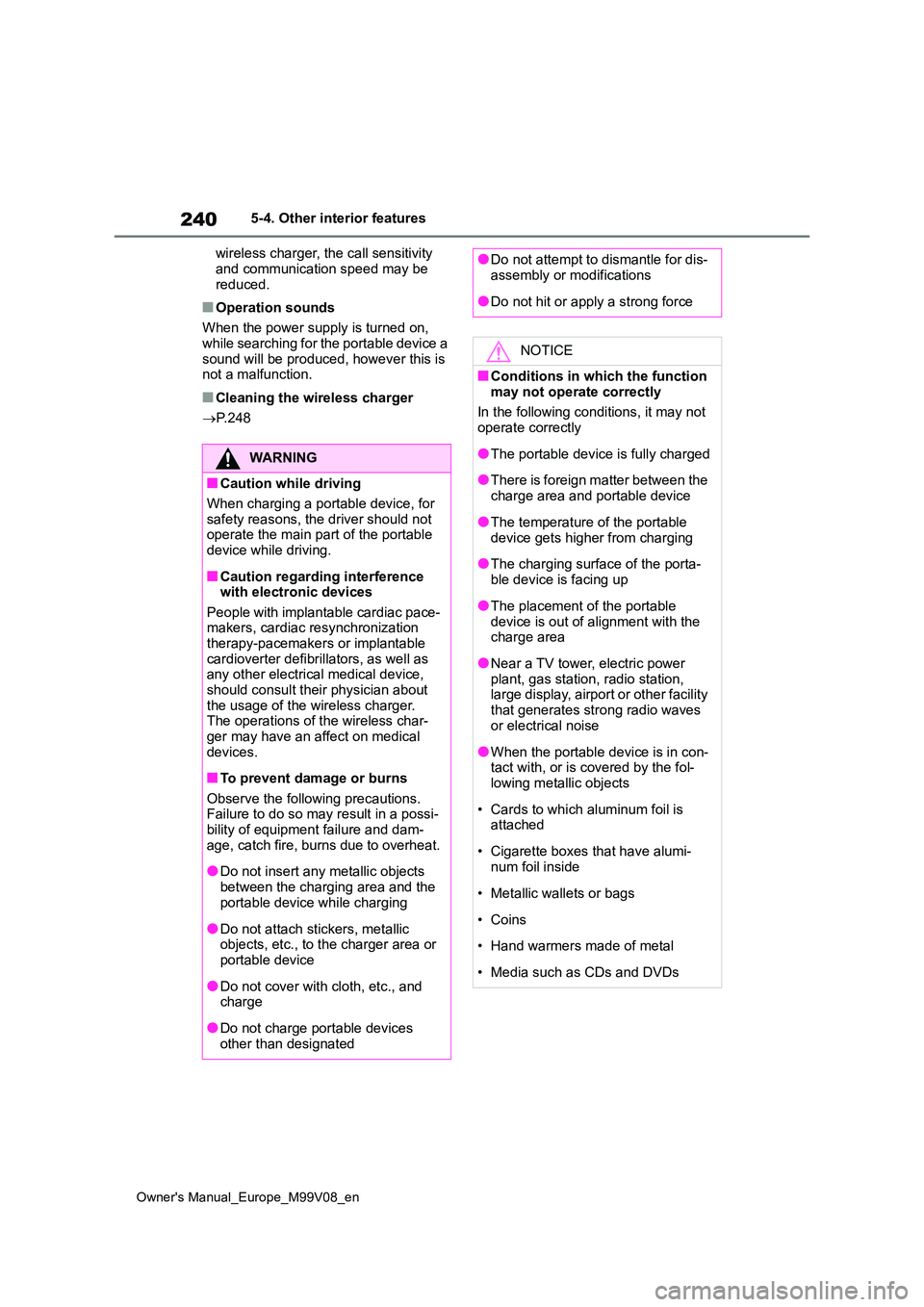
WARNING
■Caution while driving
When charging a portable device, for
safety reasons, the driver should not operate the main part of the portable device while driving.
■Caution regarding interference with electronic devices
People with implantable cardiac pace- makers, cardiac resynchronization therapy-pacemakers or implantable
cardioverter defibrillators, as well as any other electrical medical device, should consult their physician about
the usage of the wireless charger. The operations of the wireless char-ger may have an affect on medical
devices.
■To prevent damage or burns
Observe the following precautions. Failure to do so may result in a possi-bility of equipment failure and dam-
age, catch fire, burns due to overheat.
●Do not insert any metallic objects
between the charging area and the portable device while charging
●Do not attach stickers, metallic objects, etc., to the charger area or portable device
●Do not cover with cloth, etc., and charge
●Do not charge portable devices other than designated
●Do not attempt to dismantle for dis-assembly or modifications
●Do not hit or apply a strong force
NOTICE
■Conditions in which the function may not operate correctly
In the following conditions, it may not operate correctly
●The portable device is fully charged
●There is foreign matter between the
charge area and portable device
●The temperature of the portable
device gets higher from charging
●The charging surface of the porta-
ble device is facing up
●The placement of the portable
device is out of alignment with the charge area
●Near a TV tower, electric power plant, gas station, radio station, large display, airport or other facility
that generates strong radio waves or electrical noise
●When the portable device is in con-tact with, or is covered by the fol-lowing metallic objects
• Cards to which aluminum foil is attached
• Cigarette boxes that have alumi- num foil inside
• Metallic wallets or bags
•Coins
• Hand warmers made of metal
• Media such as CDs and DVDs
Page 245 of 494
6
243
Owner's Manual_Europe_M99V08_en
6
Maintenance and care
Maintenance and care
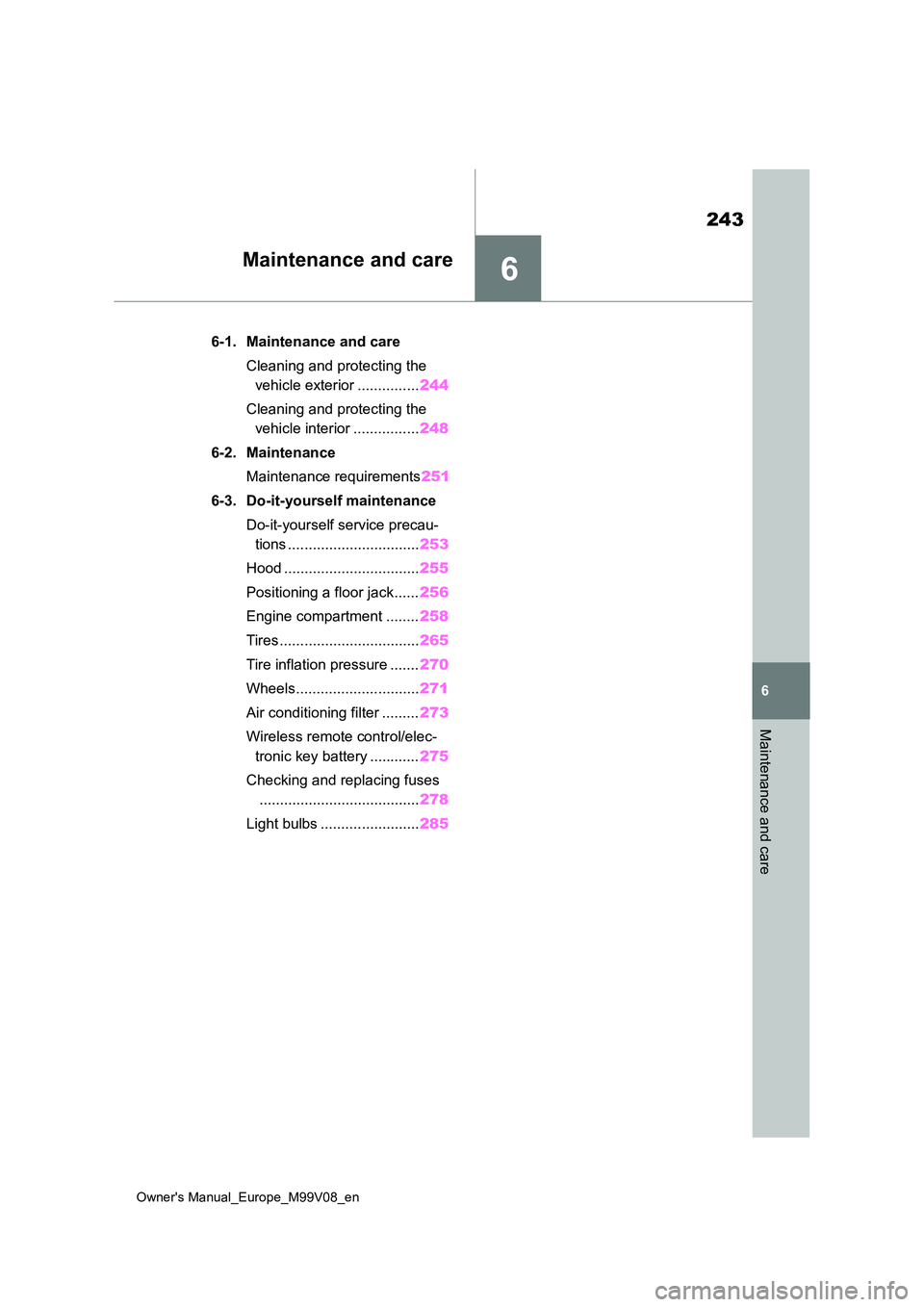
6-1. Maintenance and care
Cleaning and protecting the
vehicle exterior ............... 244
Cleaning and protecting the
vehicle interior ................ 248
6-2. Maintenance
Maintenance requirements 251
6-3. Do-it-yourself maintenance
Do-it-yourself service precau-
tions ................................ 253
Hood ................................. 255
Positioning a floor jack...... 256
Engine compartment ........ 258
Tires .................................. 265
Tire inflation pressure ....... 270
Wheels.............................. 271
Air conditioning filter ......... 273
Wireless remote control/elec-
tronic key battery ............ 275
Checking and replacing fuses
....................................... 278
Light bulbs ........................ 285
Page 249 of 494
247
6
Owner's Manual_Europe_M99V08_en
6-1. Maintenance and care
Maintenance and care
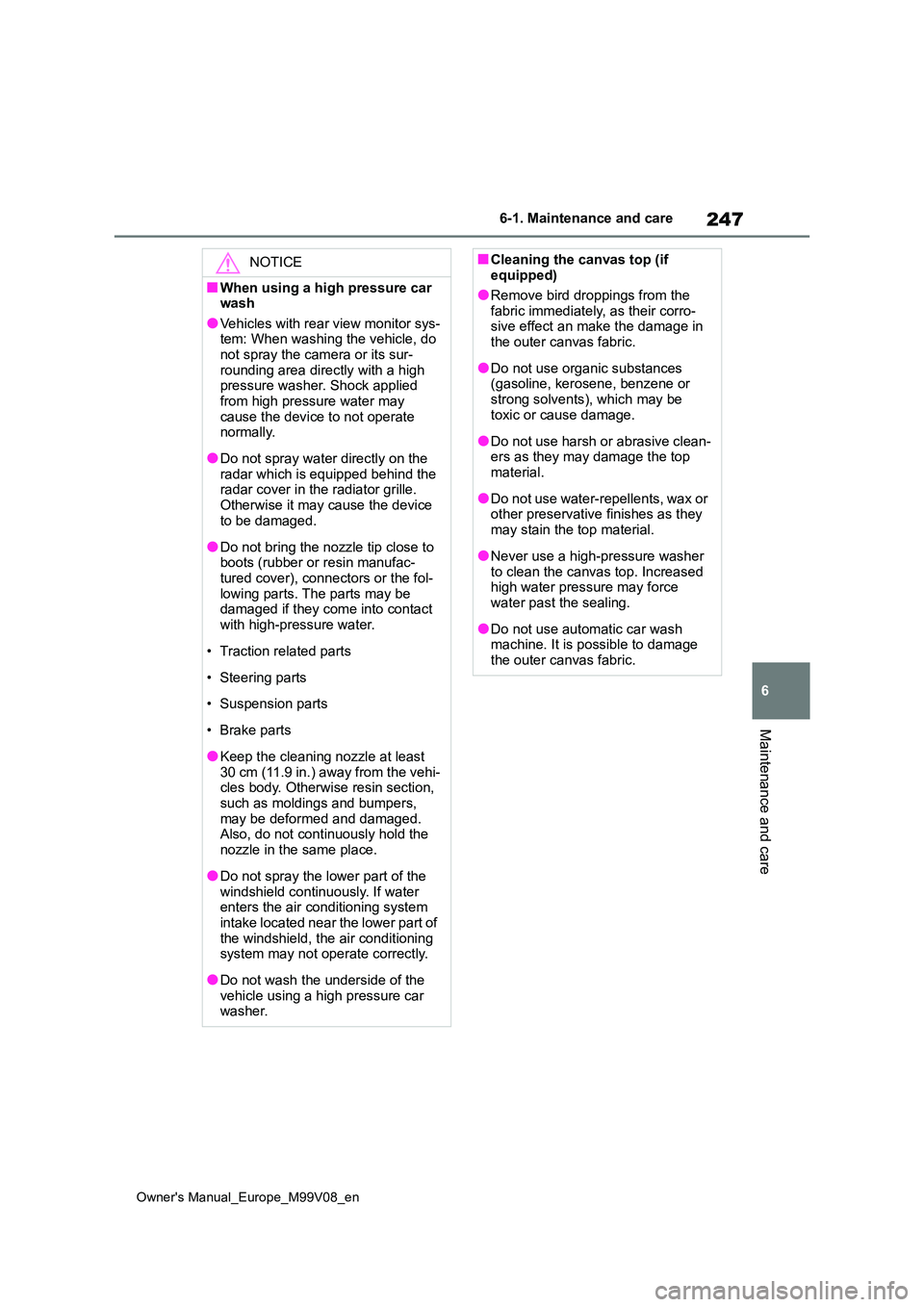
NOTICE
■When using a high pressure car wash
●Vehicles with rear view monitor sys-tem: When washing the vehicle, do not spray the camera or its sur-
rounding area directly with a high pressure washer. Shock applied from high pressure water may
cause the device to not operate normally.
●Do not spray water directly on the radar which is equipped behind the radar cover in the radiator grille.
Otherwise it may cause the device to be damaged.
●Do not bring the nozzle tip close to boots (rubber or resin manufac-tured cover), connectors or the fol-
lowing parts. The parts may be damaged if they come into contact with high-pressure water.
• Traction related parts
• Steering parts
• Suspension parts
• Brake parts
●Keep the cleaning nozzle at least 30 cm (11.9 in.) away from the vehi-cles body. Otherwise resin section,
such as moldings and bumpers, may be deformed and damaged. Also, do not continuously hold the
nozzle in the same place.
●Do not spray the lower part of the
windshield continuously. If water enters the air conditioning system intake located near the lower part of
the windshield, the air conditioning system may not operate correctly.
●Do not wash the underside of the vehicle using a high pressure car washer.
■Cleaning the canvas top (if equipped)
●Remove bird droppings from the
fabric immediately, as their corro- sive effect an make the damage in the outer canvas fabric.
●Do not use organic substances (gasoline, kerosene, benzene or
strong solvents), which may be toxic or cause damage.
●Do not use harsh or abrasive clean-ers as they may damage the top material.
●Do not use water-repellents, wax or other preservative finishes as they
may stain the top material.
●Never use a high-pressure washer
to clean the canvas top. Increased high water pressure may force water past the sealing.
●Do not use automatic car wash machine. It is possible to damage
the outer canvas fabric.
Page 253 of 494
251
6
Owner's Manual_Europe_M99V08_en
6-2. Maintenance
Maintenance and care
6-2.Mainte nance
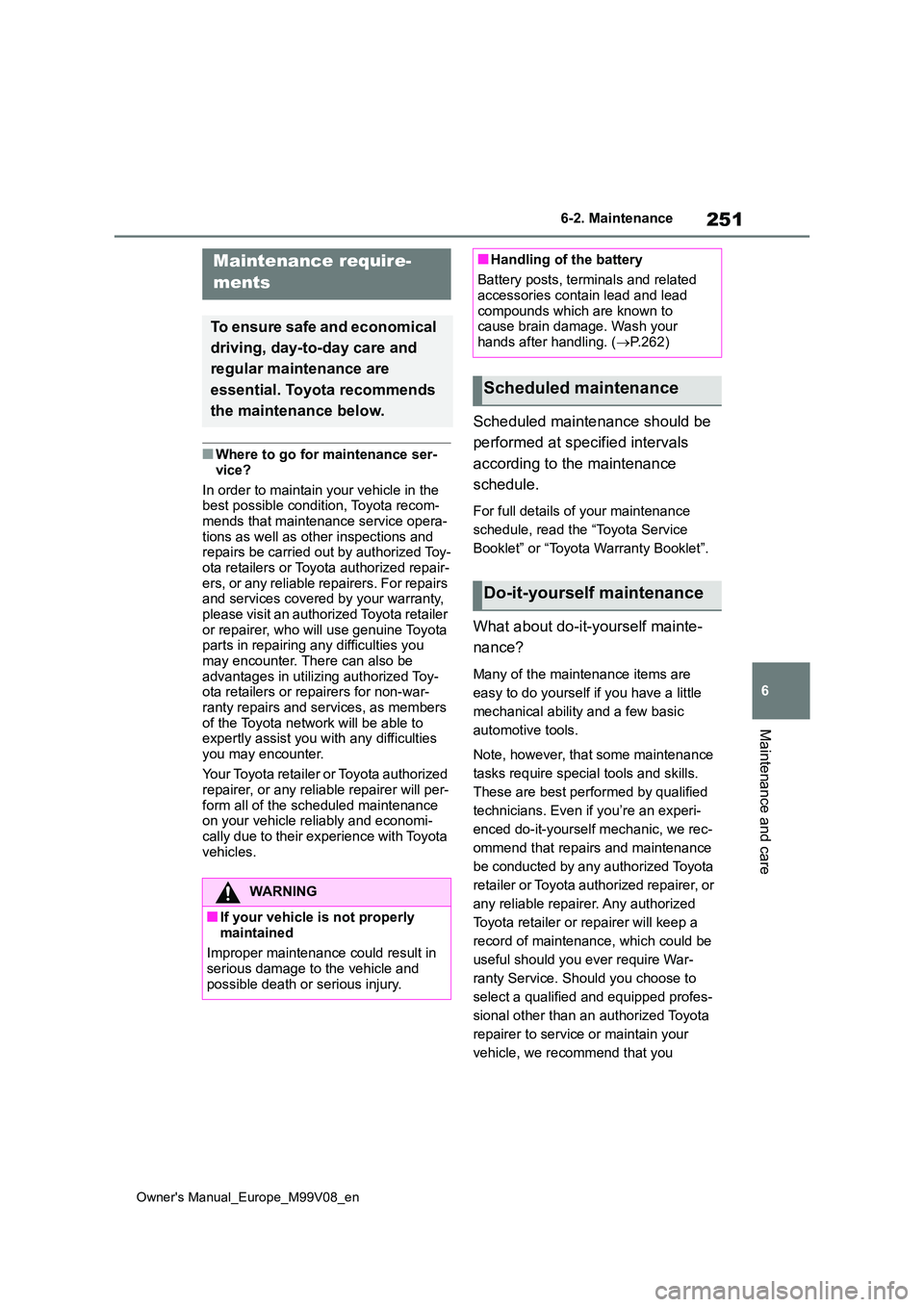
■Where to go for maintenance ser-
vice?
In order to maintain your vehicle in the best possible condition, Toyota recom-
mends that maintenance service opera- tions as well as other inspections and repairs be carried out by authorized Toy-
ota retailers or Toyota authorized repair- ers, or any reliable repairers. For repairs and services covered by your warranty,
please visit an authorized Toyota retailer or repairer, who will use genuine Toyota parts in repairing any difficulties you
may encounter. There can also be advantages in utilizing authorized Toy-ota retailers or repairers for non-war-
ranty repairs and services, as members of the Toyota network will be able to expertly assist you with any difficulties
you may encounter.
Your Toyota retailer or Toyota authorized
repairer, or any reliable repairer will per- form all of the scheduled maintenance on your vehicle reliably and economi-
cally due to their experience with Toyota vehicles.
Scheduled maintenance should be
performed at specified intervals
according to the maintenance
schedule.
For full details of your maintenance
schedule, read the “Toyota Service
Booklet” or “Toyota Warranty Booklet”.
What about do-it-yourself mainte-
nance?
Many of the maintenance items are
easy to do yourself if you have a little
mechanical ability and a few basic
automotive tools.
Note, however, that some maintenance
tasks require special tools and skills.
These are best performed by qualified
technicians. Even if you’re an experi-
enced do-it-yourself mechanic, we rec-
ommend that repairs and maintenance
be conducted by any authorized Toyota
retailer or Toyota authorized repairer, or
any reliable repairer. Any authorized
Toyota retailer or repairer will keep a
record of maintenance, which could be
useful should you ever require War-
ranty Service. Should you choose to
select a qualified and equipped profes-
sional other than an authorized Toyota
repairer to service or maintain your
vehicle, we recommend that you
Maintenance require-
ments
To ensure safe and economical
driving, day-to-day care and
regular maintenance are
essential. Toyota recommends
the maintenance below.
WARNING
■If your vehicle is not properly
maintained
Improper maintenance could result in serious damage to the vehicle and
possible death or serious injury.
■Handling of the battery
Battery posts, terminals and related accessories contain lead and lead
compounds which are known to cause brain damage. Wash your hands after handling. ( P.262)
Scheduled maintenance
Do-it-yourself maintenance
Page 256 of 494
254
Owner's Manual_Europe_M99V08_en
6-3. Do-it-yourself maintenance
WARNING
●Do not leave anything that may burn easily, such as paper and
rags, in the engine compartment.
●Do not smoke, cause sparks or
expose an open flame to fuel or the battery. Fuel and battery fumes are flammable.
●Be extremely cautious when work-ing on the battery. It contains poi-
sonous and corrosive sulfuric acid.
●Take care because brake fluid can
harm your hands or eyes and dam- age painted surfaces. If fluid gets on your hands or in your eyes, flush
the affected area with clean water immediately.If you still experience discomfort,
consult a doctor.
■When working near the electric
cooling fan or radiator grille
Be sure the engine switch is OFF. With the engine switch in ON, the
electric cooling fan may automatically start to run if the air conditioning is on and/or the coolant temperature is
high. ( P.261)
■Safety glasses
Wear safety glasses to prevent flying or falling material, fluid spray, etc. from getting in your eyes.
NOTICE
■If you remove the air cleaner fil-ter
Driving with the air cleaner filter removed may cause excessive engine wear due to dirt in the air.
■If the fluid level is low or high
It is normal for the brake fluid level to go down slightly as the brake pads
wear or when the fluid level in the accumulator is high.If the reservoir needs frequent refill-
ing, it may indicate a serious problem.
Page 268 of 494
266
Owner's Manual_Europe_M99V08_en
6-3. Do-it-yourself maintenance
molded into the sidewall of each tire.
Replace the tires if the treadwear indi-
cators are showing on a tire.
■When to replace your vehicle’s tires
Tires should be replaced if:
●The treadwear indicators are showing on a tire.
●You have tire damage such as cuts, splits, cracks deep enough to expose
the fabric, and bulges indicating inter- nal damage
●A tire goes flat repeatedly or cannot be properly repaired due to the size or location of a cut or other damage
If you are not sure, consult with any authorized Toyota retailer or Toyota authorized repairer, or any reliable
repairer.
■Tire life
Any tire over 6 years old must be checked by a qualified technician even if
it has seldom or never been used, or damage is not obvious.
■Low profile tires (18-inch tires)
Generally, low profile tires will wear
more rapidly and tire grip performance will be reduced on snowy and/or icy roads when compared to standard tires.
Be sure to use snow tires on snowy and/or icy roads and drive carefully at a speed appropriate for road and weather
conditions.
■If the tread on snow tires wears down below 4 mm (0.16 in.)
The effectiveness of the tires as snow
tires is lost.
■Checking the tire valves
When replacing the tires, check the tire
valves for deformation, cracks, and other damage.
WARNING
■When inspecting or replacing tires
Observe the following precautions to prevent accidents.Failure to do so may cause damage
to parts of the drive train as well as dangerous handling characteristics, which may lead to an accident result-
ing in death or serious injury.
●Do not mix tires of different makes,
models or tread patterns. Also, do not mix tires of remarkably different treadwear.
●Do not use tire sizes other than those recommended by Toyota.
●Do not mix differently constructed tires (radial, bias-belted or bias-ply
tires).
●Do not mix summer, all season and
snow tires.
●Do not use tires that have been
used on another vehicle. Do not use tires if you do not know how they were used previously.
NOTICE
■Low profile tires (18-inch tires)
Low profile tires may cause greater damage than usual to the tire wheel when sustaining impact from the road
surface. Therefore, pay attention to the following:
●Be sure to use proper tire inflation pressure. If tires are under-inflated, they may be damaged more
severely.
●Avoid potholes, uneven pavement,
curbs and other road hazards. Fail- ure to do so may lead to severe tire and wheel damage.
Page 272 of 494
270
Owner's Manual_Europe_M99V08_en
6-3. Do-it-yourself maintenance
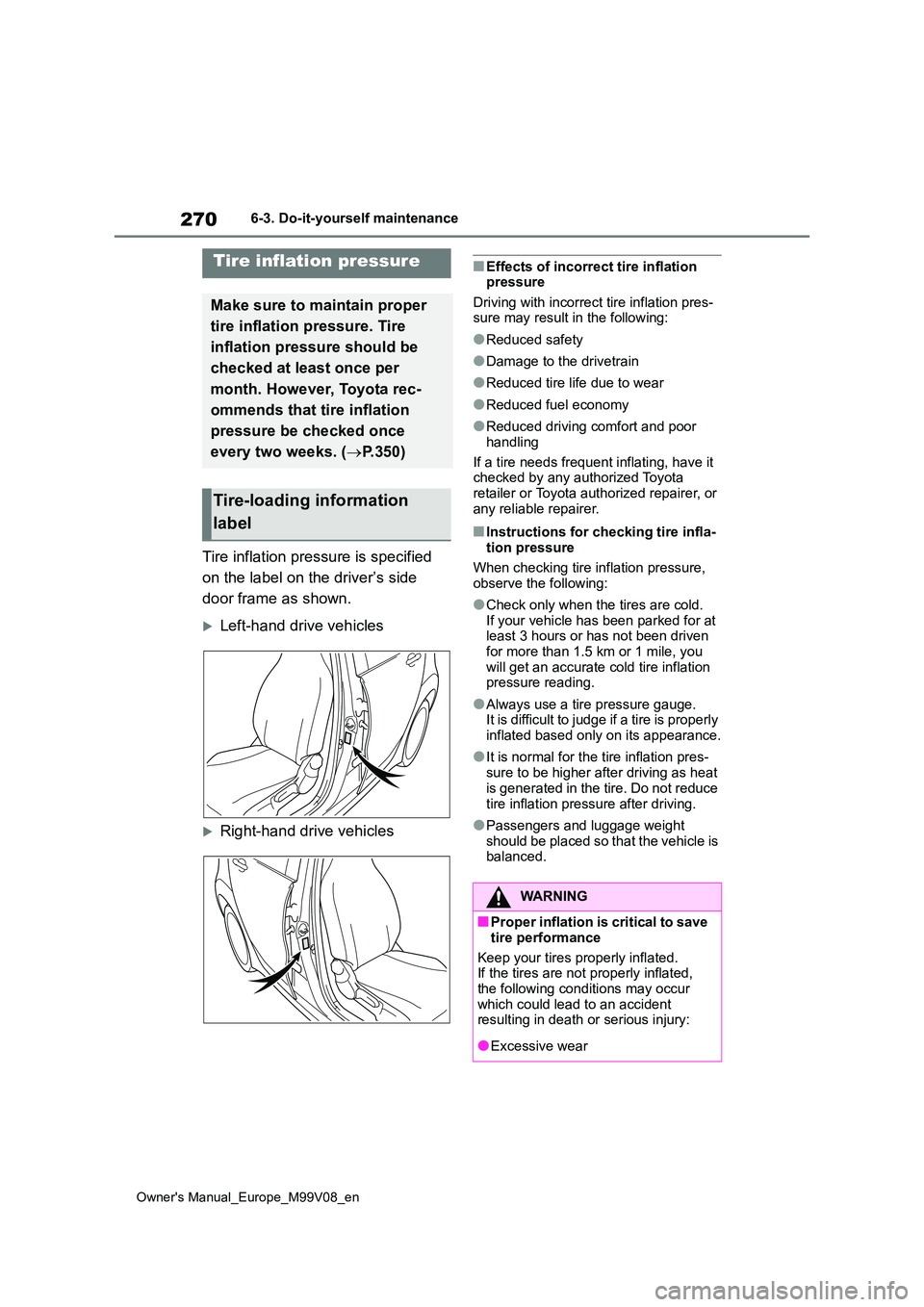
Tire inflation pressure is specified
on the label on the driver’s side
door frame as shown.
Left-hand drive vehicles
Right-hand drive vehicles
■Effects of incorrect tire inflation pressure
Driving with incorrect tire inflation pres- sure may result in the following:
●Reduced safety
●Damage to the drivetrain
●Reduced tire life due to wear
●Reduced fuel economy
●Reduced driving comfort and poor
handling
If a tire needs frequent inflating, have it checked by any authorized Toyota
retailer or Toyota authorized repairer, or any reliable repairer.
■Instructions for checking tire infla-tion pressure
When checking tire inflation pressure, observe the following:
●Check only when the tires are cold.If your vehicle has been parked for at least 3 hours or has not been driven
for more than 1.5 km or 1 mile, you will get an accurate cold tire inflation pressure reading.
●Always use a tire pressure gauge.It is difficult to judge if a tire is properly
inflated based only on its appearance.
●It is normal for the tire inflation pres-
sure to be higher after driving as heat is generated in the tire. Do not reduce
tire inflation pressure after driving.
●Passengers and luggage weight
should be placed so that the vehicle is balanced.
Tire inflation pressure
Make sure to maintain proper
tire inflation pressure. Tire
inflation pressure should be
checked at least once per
month. However, Toyota rec-
ommends that tire inflation
pressure be checked once
every two weeks. ( P.350)
Tire-loading information
label
WARNING
■Proper inflation is critical to save
tire performance
Keep your tires properly inflated. If the tires are not properly inflated,
the following conditions may occur which could lead to an accident resulting in death or serious injury:
●Excessive wear
Page 275 of 494
273
6
Owner's Manual_Europe_M99V08_en
6-3. Do-it-yourself maintenance
Maintenance and care
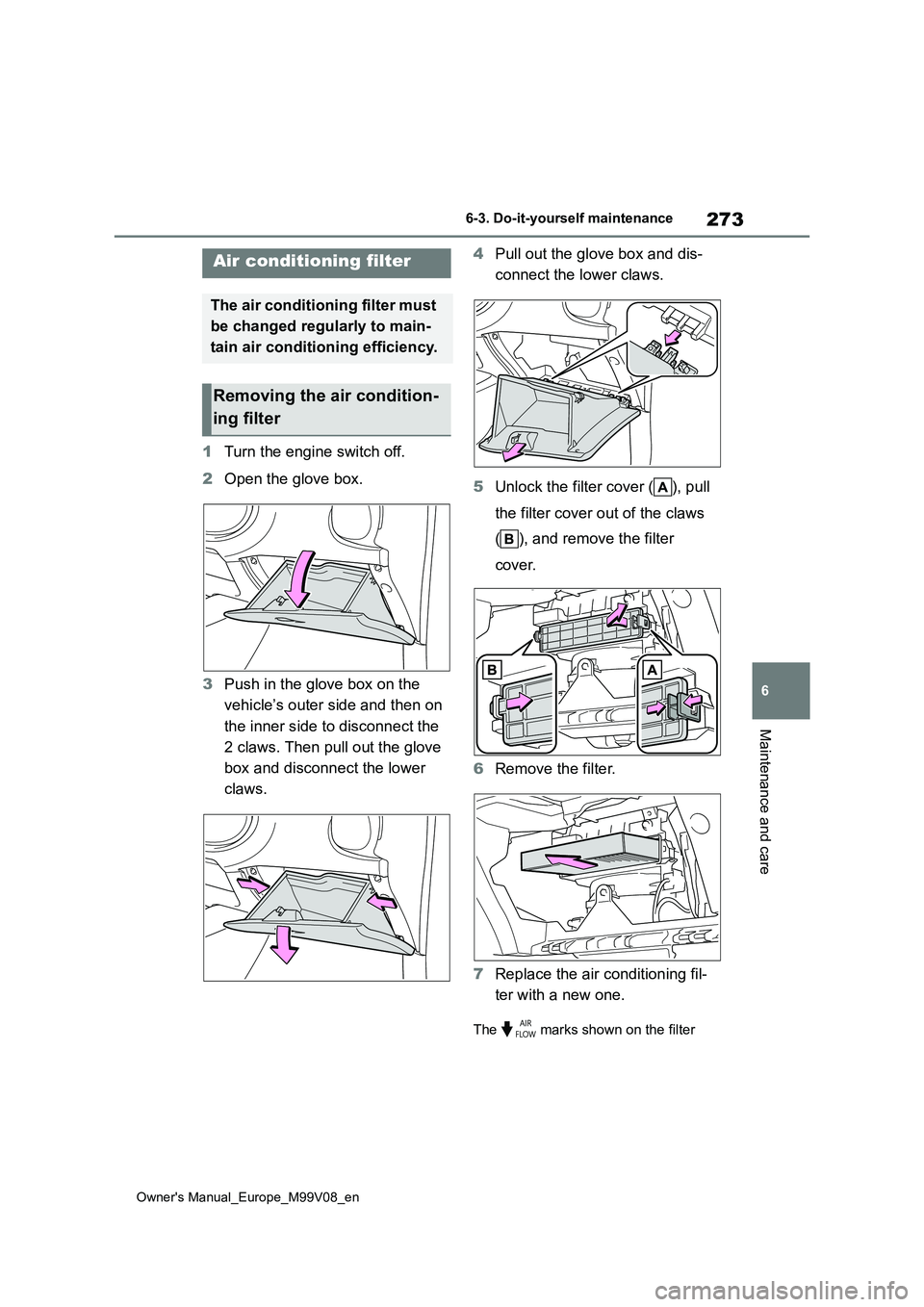
1Turn the engine switch off.
2 Open the glove box.
3 Push in the glove box on the
vehicle’s outer side and then on
the inner side to disconnect the
2 claws. Then pull out the glove
box and disconnect the lower
claws.
4 Pull out the glove box and dis-
connect the lower claws.
5 Unlock the filter cover ( ), pull
the filter cover out of the claws
( ), and remove the filter
cover.
6 Remove the filter.
7 Replace the air conditioning fil-
ter with a new one.
The marks shown on the filter
Air conditioning filter
The air conditioning filter must
be changed regularly to main-
tain air conditioning efficiency.
Removing the air condition-
ing filter
Page 276 of 494
274
Owner's Manual_Europe_M99V08_en
6-3. Do-it-yourself maintenance
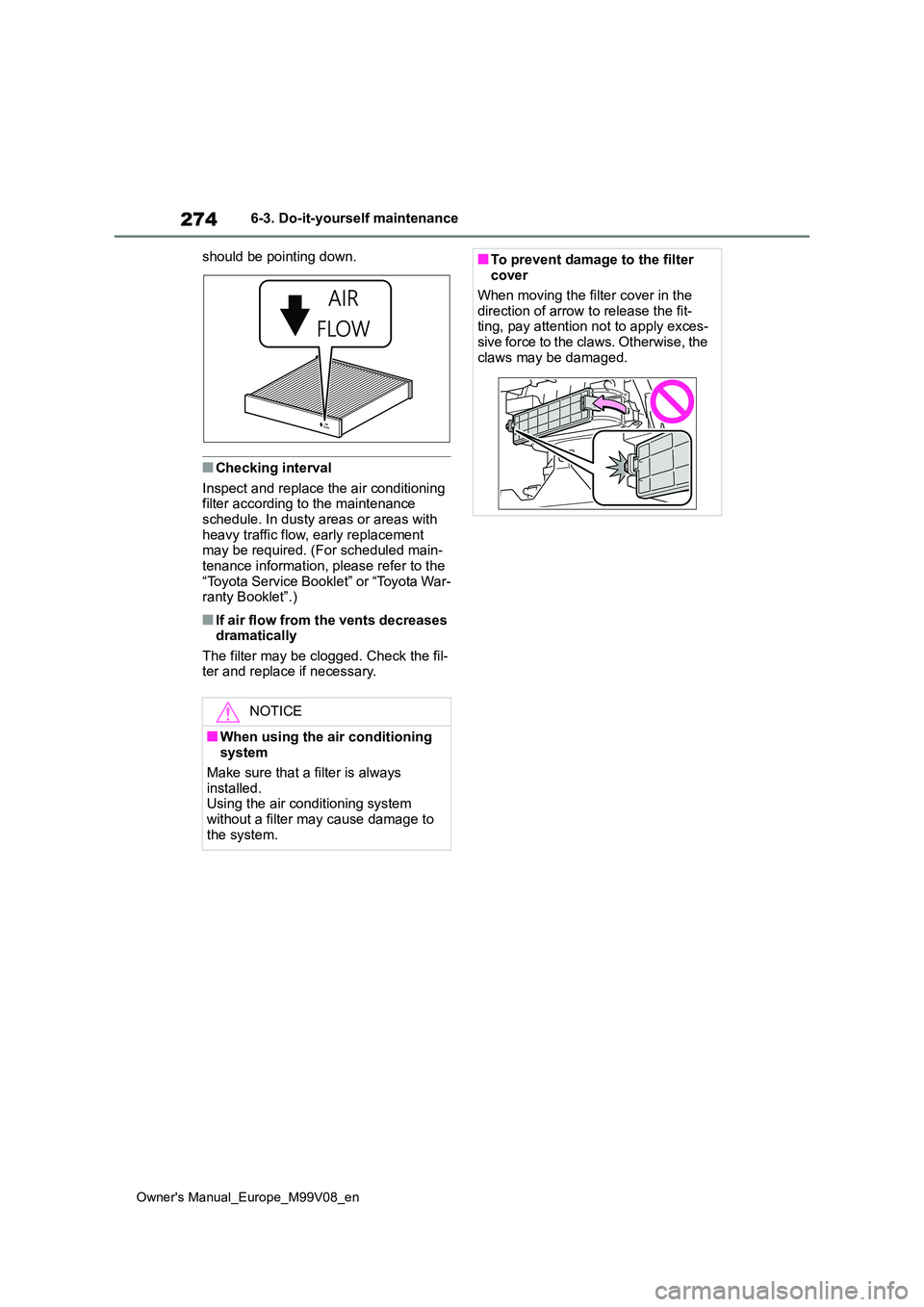
should be pointing down.
■Checking interval
Inspect and replace the air conditioning filter according to the maintenance schedule. In dusty areas or areas with
heavy traffic flow, early replacement may be required. (For scheduled main-tenance information, please refer to the
“Toyota Service Booklet” or “Toyota War- ranty Booklet”.)
■If air flow from the vents decreases dramatically
The filter may be clogged. Check the fil- ter and replace if necessary.
NOTICE
■When using the air conditioning system
Make sure that a filter is always
installed. Using the air conditioning system without a filter may cause damage to
the system.
■To prevent damage to the filter cover
When moving the filter cover in the
direction of arrow to release the fit- ting, pay attention not to apply exces-sive force to the claws. Otherwise, the
claws may be damaged.
Page 298 of 494
296
Owner's Manual_Europe_M99V08_en
7-1. Essential information
7-1.Esse ntial informa tion
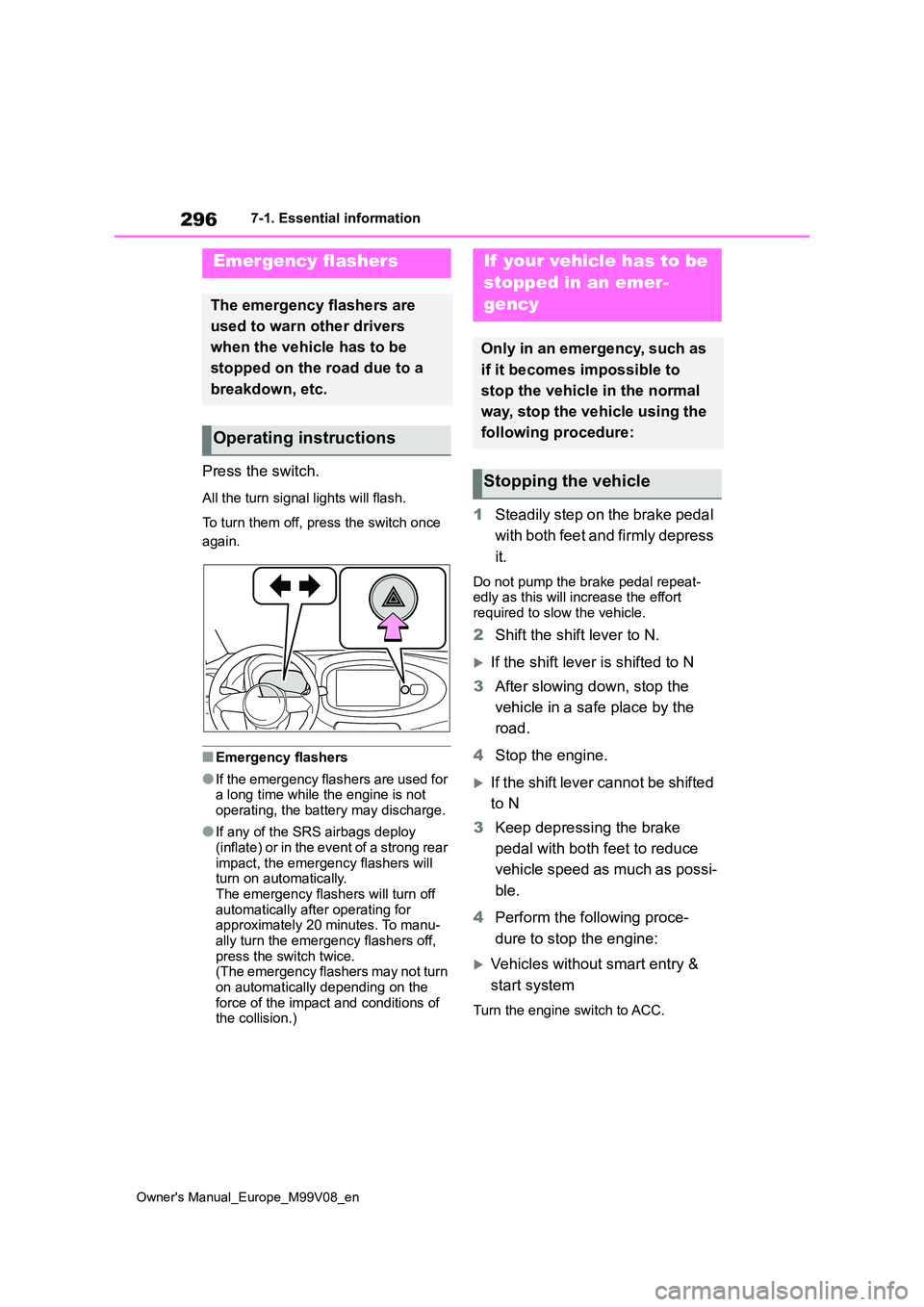
Press the switch.
All the turn signal lights will flash.
To turn them off, press the switch once
again.
■Emergency flashers
●If the emergency flashers are used for a long time while the engine is not
operating, the battery may discharge.
●If any of the SRS airbags deploy
(inflate) or in the event of a strong rear impact, the emergency flashers will turn on automatically.
The emergency flashers will turn off automatically after operating for approximately 20 minutes. To manu-
ally turn the emergency flashers off, press the switch twice.(The emergency flashers may not turn
on automatically depending on the force of the impact and conditions of the collision.)
1 Steadily step on the brake pedal
with both feet and firmly depress
it.
Do not pump the brake pedal repeat- edly as this will increase the effort required to slow the vehicle.
2 Shift the shift lever to N.
If the shift lever is shifted to N
3 After slowing down, stop the
vehicle in a safe place by the
road.
4 Stop the engine.
If the shift lever cannot be shifted
to N
3 Keep depressing the brake
pedal with both feet to reduce
vehicle speed as much as possi-
ble.
4 Perform the following proce-
dure to stop the engine:
Vehicles without smart entry &
start system
Turn the engine switch to ACC.
Emergency flashers
The emergency flashers are
used to warn other drivers
when the vehicle has to be
stopped on the road due to a
breakdown, etc.
Operating instructions
If your vehicle has to be
stopped in an emer-
gency
Only in an emergency, such as
if it becomes impossible to
stop the vehicle in the normal
way, stop the vehicle using the
following procedure:
Stopping the vehicle