towing TOYOTA BZ4X 2022 Owners Manual (in English)
[x] Cancel search | Manufacturer: TOYOTA, Model Year: 2022, Model line: BZ4X, Model: TOYOTA BZ4X 2022Pages: 674, PDF Size: 120.02 MB
Page 5 of 674
3
Owners Manual_Europe_M42D76_en
TABLE OF CONTENTS
1
6
5
4
3
2
8
7
9
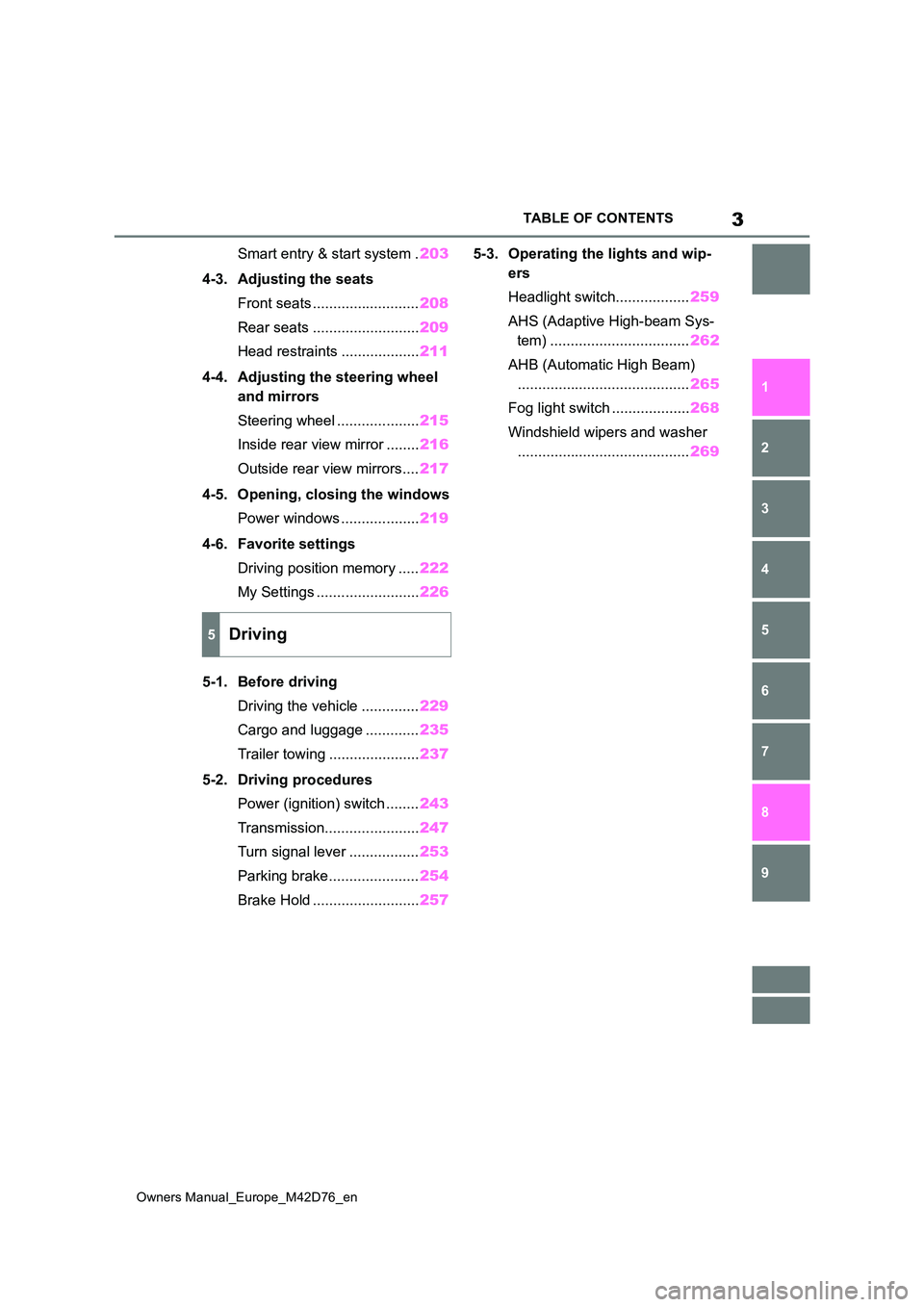
Smart entry & start system . 203
4-3. Adjusting the seats
Front seats .......................... 208
Rear seats .......................... 209
Head restraints ................... 211
4-4. Adjusting the steering wheel
and mirrors
Steering wheel .................... 215
Inside rear view mirror ........ 216
Outside rear view mirrors.... 217
4-5. Opening, closing the windows
Power windows ................... 219
4-6. Favorite settings
Driving position memory ..... 222
My Settings ......................... 226
5-1. Before driving
Driving the vehicle .............. 229
Cargo and luggage ............. 235
Trailer towing ...................... 237
5-2. Driving procedures
Power (ignition) switch ........ 243
Transmission....................... 247
Turn signal lever ................. 253
Parking brake...................... 254
Brake Hold .......................... 257
5-3. Operating the lights and wip-
ers
Headlight switch.................. 259
AHS (Adaptive High-beam Sys-
tem) .................................. 262
AHB (Automatic High Beam)
.......................................... 265
Fog light switch ................... 268
Windshield wipers and washer
.......................................... 269
5Driving
Page 17 of 674
15
Owners Manual_Europe_M42D76_en
Pictorial index
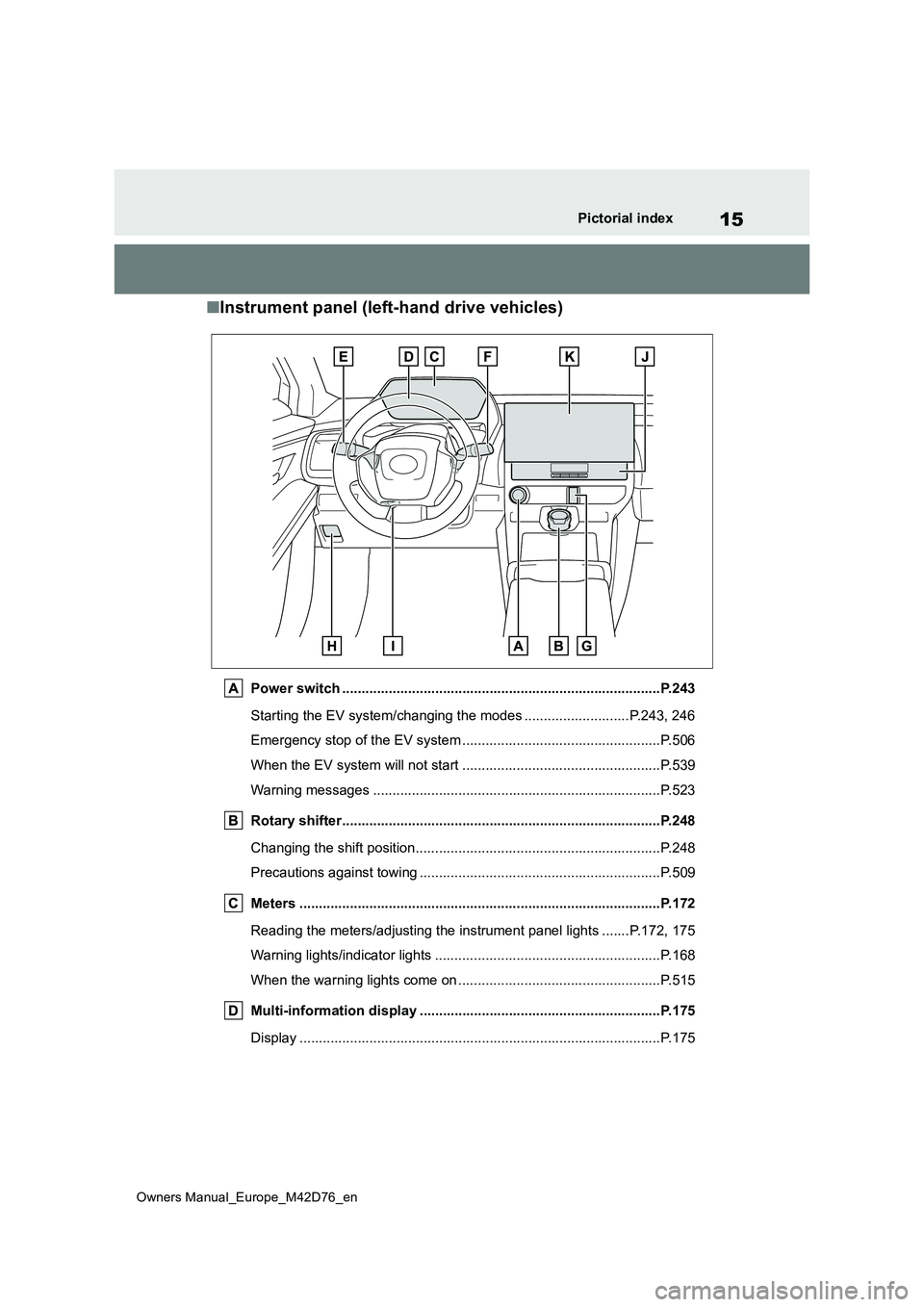
■Instrument panel (left-hand drive vehicles)
Power switch ..................................................................................P.243
Starting the EV system/changing the modes ...................... .....P.243, 246
Emergency stop of the EV system ................................ ...................P.506
When the EV system will not start .............................. .....................P.539
Warning messages ............................................... ...........................P.523
Rotary shifter................................................. .................................P.248
Changing the shift position.................................... ...........................P.248
Precautions against towing ..................................... .........................P.509
Meters ......................................................... ....................................P.172
Reading the meters/adjusting the instrument panel lights ....... P.172, 175
Warning lights/indicator lights ................................ ..........................P.168
When the warning lights come on ................................ ....................P.515
Multi-information display ...................................... ........................P.175
Display ........................................................ .....................................P.175
Page 25 of 674
23
Owners Manual_Europe_M42D76_en
Pictorial index
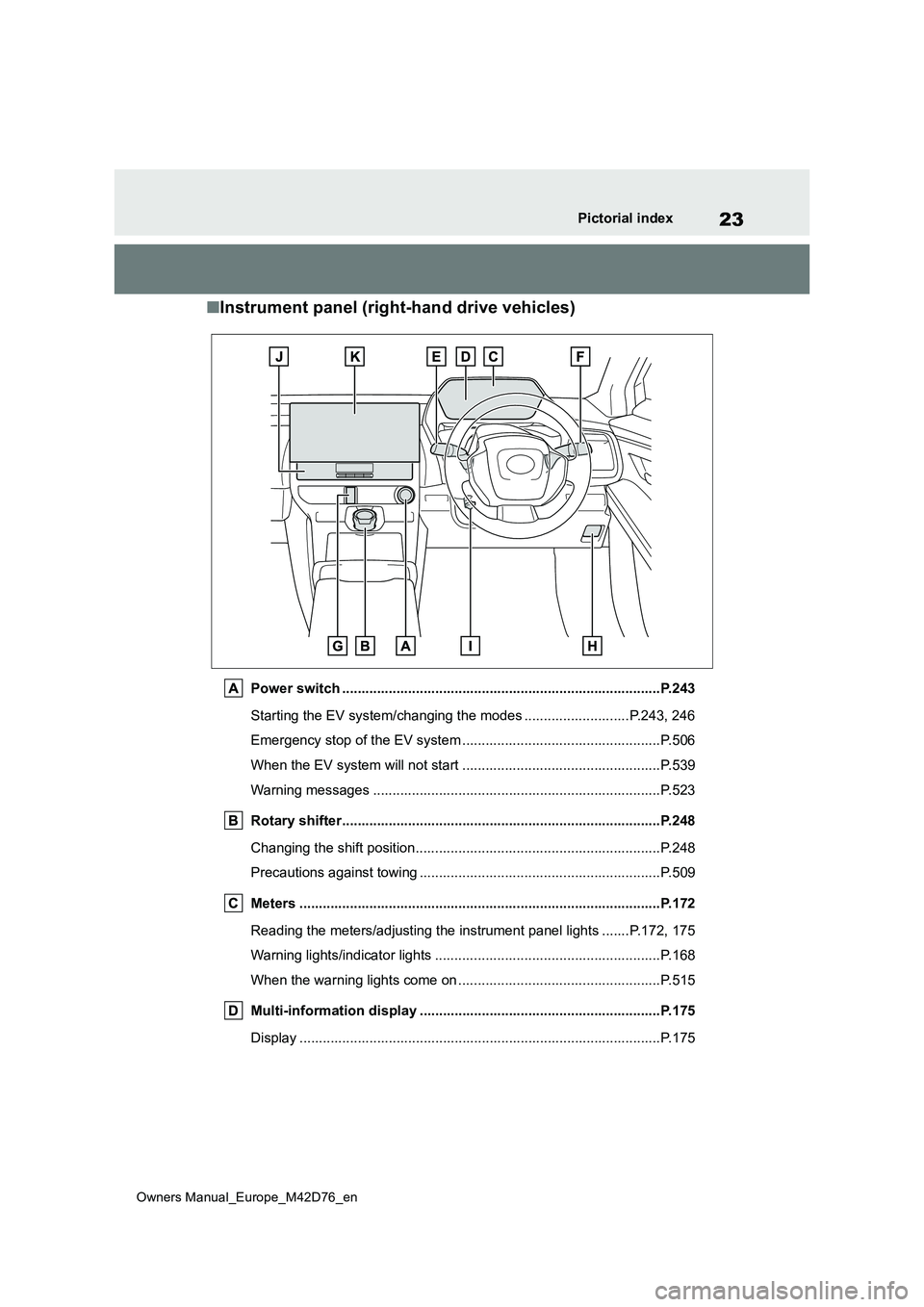
■Instrument panel (right-hand drive vehicles)
Power switch ..................................................................................P.243
Starting the EV system/changing the modes ...................... .....P.243, 246
Emergency stop of the EV system ................................ ...................P.506
When the EV system will not start .............................. .....................P.539
Warning messages ............................................... ...........................P.523
Rotary shifter................................................. .................................P.248
Changing the shift position.................................... ...........................P.248
Precautions against towing ..................................... .........................P.509
Meters ......................................................... ....................................P.172
Reading the meters/adjusting the instrument panel lights ....... P.172, 175
Warning lights/indicator lights ................................ ..........................P.168
When the warning lights come on ................................ ....................P.515
Multi-information display ...................................... ........................P.175
Display ........................................................ .....................................P.175
Page 63 of 674
61
1
Owners Manual_Europe_M42D76_en
1-2. Child safety
For safety and security
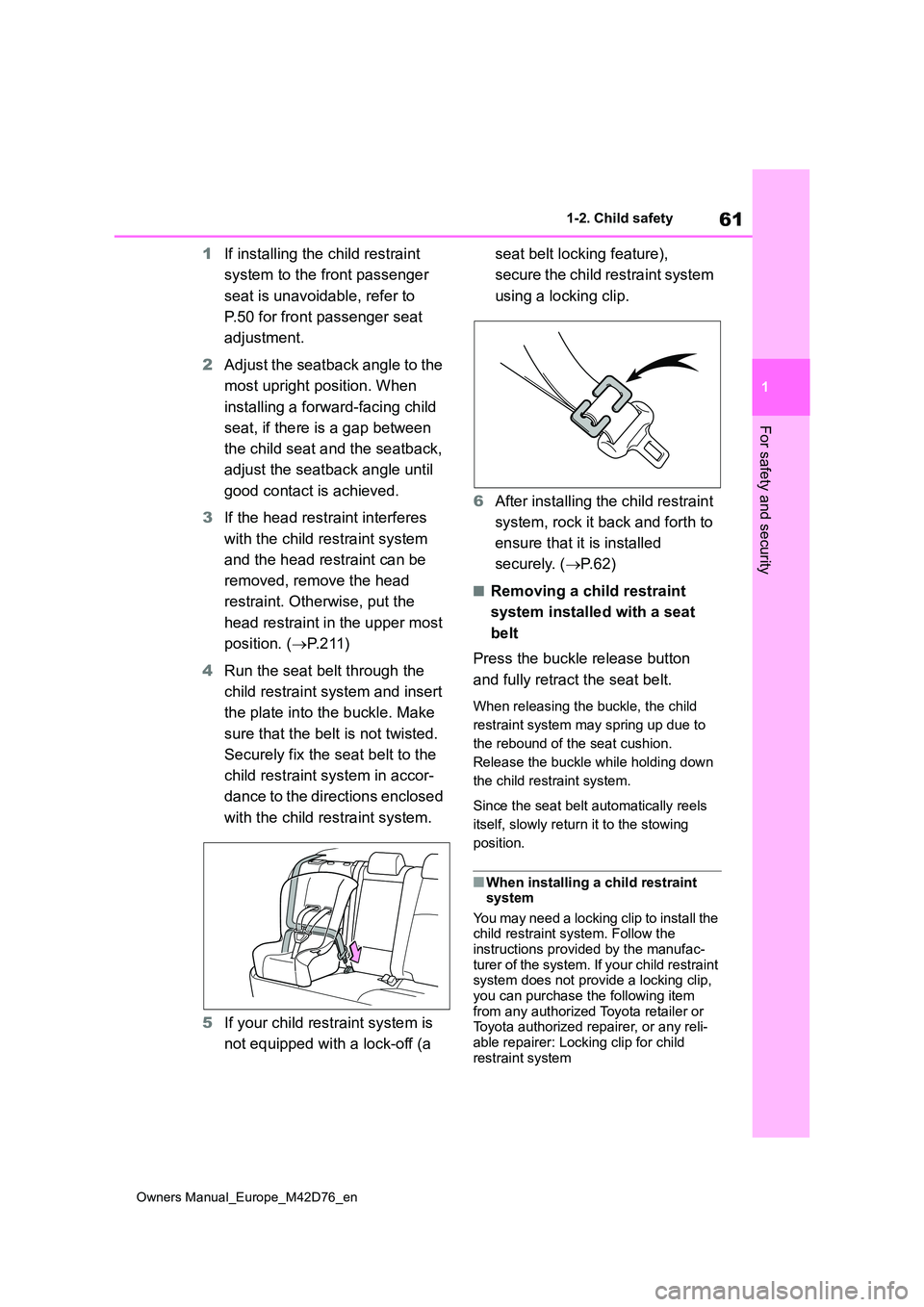
1If installing the child restraint
system to the front passenger
seat is unavoidable, refer to
P.50 for front passenger seat
adjustment.
2 Adjust the seatback angle to the
most upright position. When
installing a forward-facing child
seat, if there is a gap between
the child seat and the seatback,
adjust the seatback angle until
good contact is achieved.
3 If the head restraint interferes
with the child restraint system
and the head restraint can be
removed, remove the head
restraint. Otherwise, put the
head restraint in the upper most
position. ( P. 2 1 1 )
4 Run the seat belt through the
child restraint system and insert
the plate into the buckle. Make
sure that the belt is not twisted.
Securely fix the seat belt to the
child restraint system in accor-
dance to the directions enclosed
with the child restraint system.
5 If your child restraint system is
not equipped with a lock-off (a
seat belt locking feature),
s e c u r e t h e c h i l d r e s t r a i n t s y s t e m
using a locking clip.
6 After installing the child restraint
system, rock it back and forth to
ensure that it is installed
securely. ( P. 6 2 )
■Removing a child restraint
system installed with a seat
belt
Press the buckle release button
and fully retract the seat belt.
When releasing the buckle, the child
restraint system may spring up due to
the rebound of the seat cushion.
Release the buckle while holding down
the child restraint system.
Since the seat belt automatically reels
itself, slowly return it to the stowing
position.
■When installing a child restraint system
You may need a locking clip to install the child restraint system. Follow the
instructions provided by the manufac- turer of the system. If your child restraint system does not provide a locking clip,
you can purchase the following item from any authorized Toyota retailer or Toyota authorized repairer, or any reli-
able repairer: Locking clip for child restraint system
Page 220 of 674
218
Owners Manual_Europe_M42D76_en
4-4. Adjusting the steering wheel and mirrors
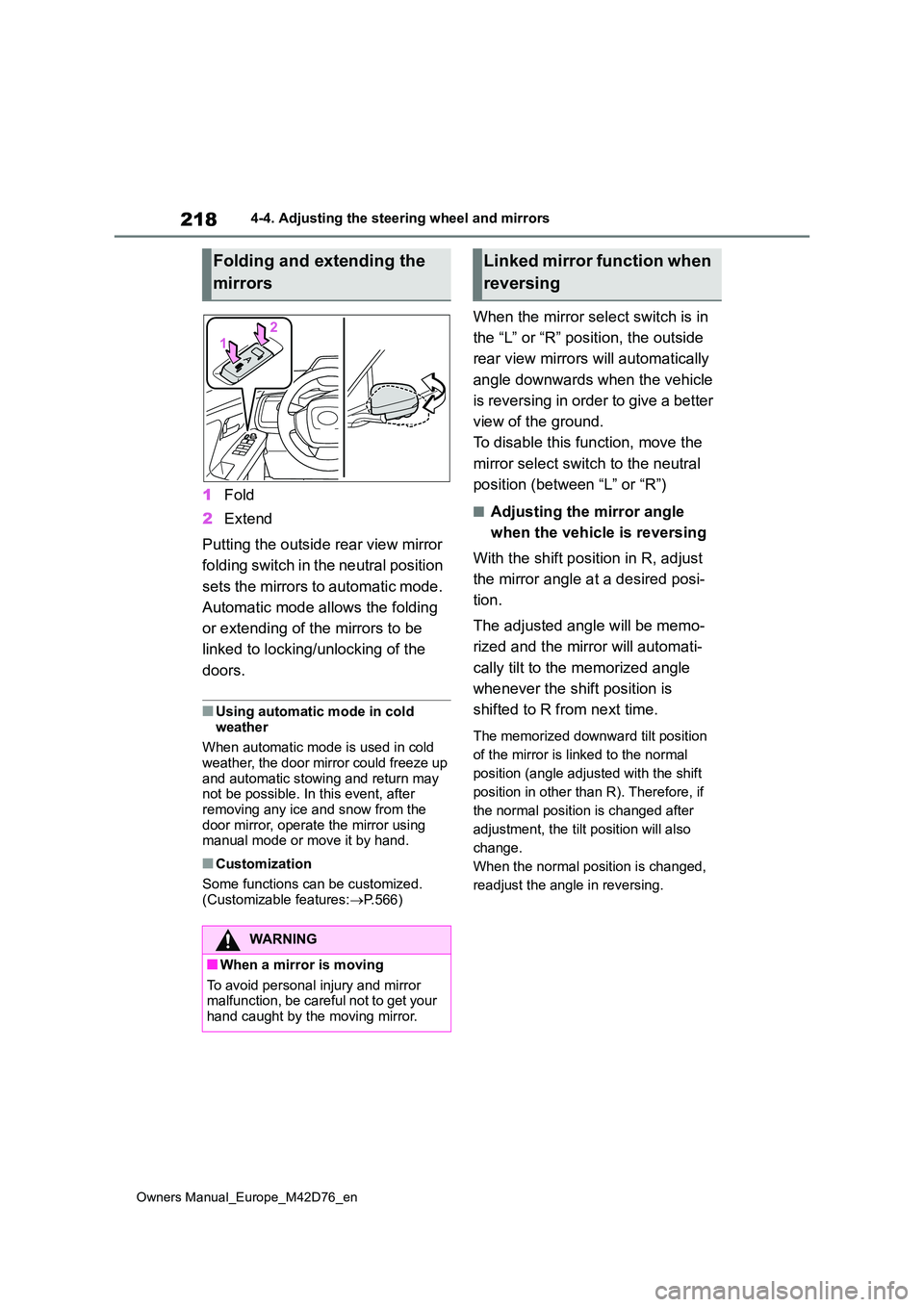
1Fold
2 Extend
Putting the outside rear view mirror
folding switch in the neutral position
sets the mirrors to automatic mode.
Automatic mode allows the folding
or extending of the mirrors to be
linked to locking/unlocking of the
doors.
■Using automatic mode in cold
weather
When automatic mode is used in cold weather, the door mirror could freeze up
and automatic stowing and return may not be possible. In this event, after removing any ice and snow from the
door mirror, operate the mirror using manual mode or move it by hand.
■Customization
Some functions can be customized.
(Customizable features: P.566)
When the mirror select switch is in
the “L” or “R” position, the outside
rear view mirrors will automatically
angle downwards when the vehicle
is reversing in order to give a better
view of the ground.
To disable this function, move the
mirror select switch to the neutral
position (between “L” or “R”)
■Adjusting the mirror angle
when the vehicle is reversing
With the shift position in R, adjust
the mirror angle at a desired posi-
tion.
The adjusted angle will be memo-
rized and the mirror will automati-
cally tilt to the memorized angle
whenever the shift position is
shifted to R from next time.
The memorized downward tilt position
of the mirror is linked to the normal
position (angle adjusted with the shift
position in other than R). Therefore, if
the normal position is changed after
adjustment, the tilt position will also
change.
When the normal position is changed,
readjust the angle in reversing.
Folding and extending the
mirrors
WARNING
■When a mirror is moving
To avoid personal injury and mirror malfunction, be careful not to get your hand caught by the moving mirror.
Linked mirror function when
reversing
Page 229 of 674
5
227
Owners Manual_Europe_M42D76_en
5
Driving
Driving
5-1. Before driving
Driving the vehicle ............ 229
Cargo and luggage ........... 235
Trailer towing .................... 237
5-2. Driving procedures
Power (ignition) switch ...... 243
Transmission .................... 247
Turn signal lever ............... 253
Parking brake ................... 254
Brake Hold ........................ 257
5-3. Operating the lights and wip-
ers
Headlight switch ............... 259
AHS (Adaptive High-beam
System) .......................... 262
AHB (Automatic High Beam)
....................................... 265
Fog light switch ................. 268
Windshield wipers and washer
....................................... 269
5-4. Using the driving support
systems
Software update................ 273
Toyota Safety Sense ......... 275
Driver monitor ................... 282
PCS (Pre-Collision System)
........................................ 283
LTA (Lane Tracing Assist) . 294
LDA (Lane Departure Alert)
........................................ 299
RSA (Road Sign Assist) .... 304
Dynamic radar cruise control
........................................ 307
Cruise control.................... 316
Speed limiter ..................... 318
Emergency Driving Stop Sys-
tem.................................. 321
BSM (Blind Spot Monitor) . 324
SEA (Safe Exit Assist)....... 328
Toyota parking assist-sensor
........................................ 333
RCTA (Rear Crossing Traffic
Alert) ............................... 343
RCD (Rear Camera Detection)
........................................ 348
PKSB (Parking Support Brake)
........................................ 352
Static Objects Front and Rear
of the Vehicle .................. 357
Moving Vehicle Rear of the
Vehicle ............................ 359
Pedestrians Rear of the Vehi-
cle ................................... 361
Page 239 of 674
237
5
Owners Manual_Europe_M42D76_en
5-1. Before driving
Driving
Check the allowable towing capac-
ity, GVM (Gross Vehicle Mass),
MPAC (Maximum Permissible Axle
Capacity), and permissible draw-
bar load before towing. ( P. 5 5 4 )
Toyota recommends the use of the
Toyota hitch/bracket for your vehi-
cle. Other products of a suitable
nature and comparable quality may
also be used.
For vehicle where the towing
device blocks any of the lights or
license plate, the following shall be
observed:
Do not use towing devices that
cannot be easily removed or
repositioned.
Towing devices must be
removed or repositioned when
not in use.
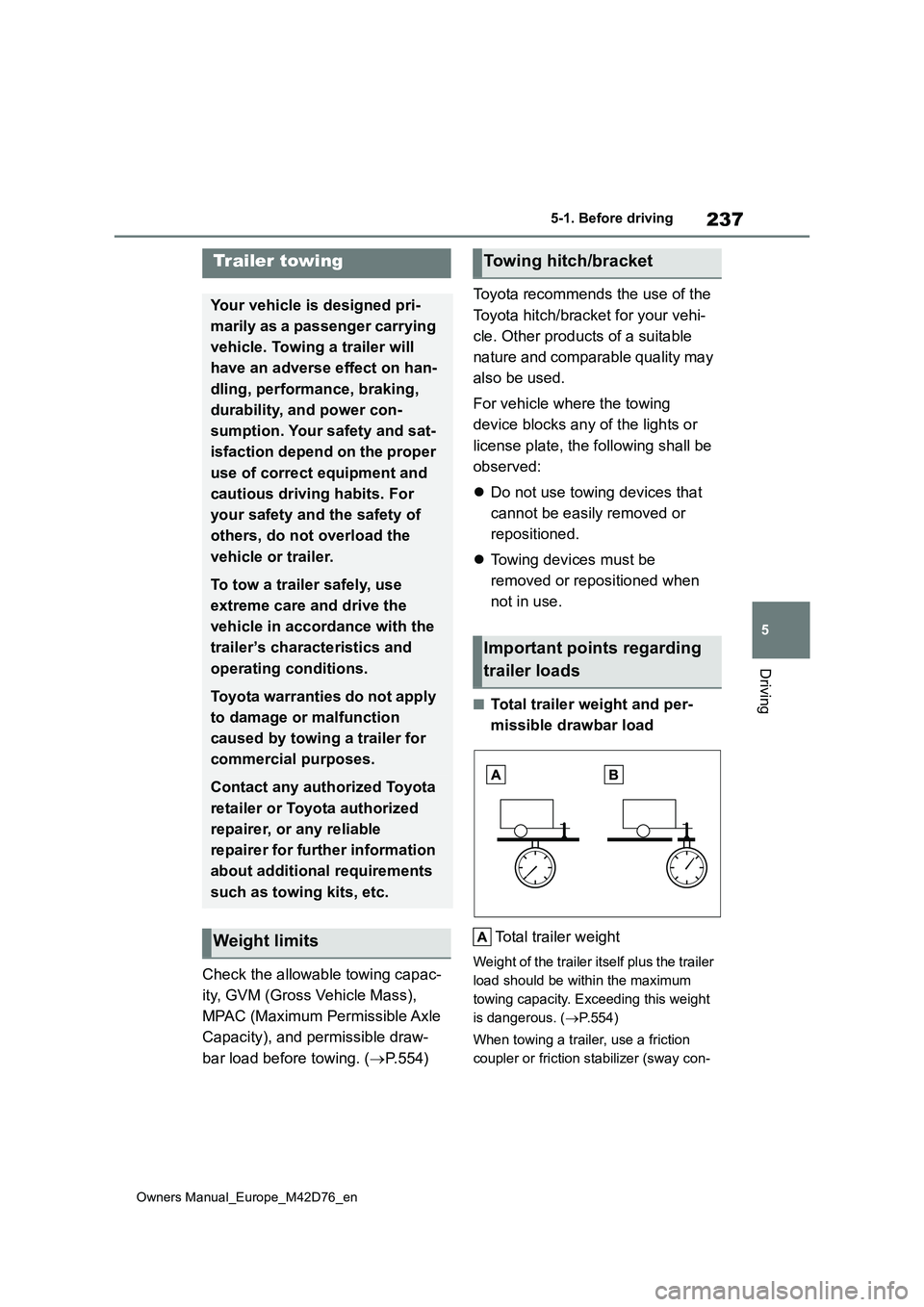
■Total trailer weight and per-
missible drawbar load
Total trailer weight
Weight of the trailer itself plus the trailer
load should be within the maximum
towing capacity. Exceeding this weight
is dangerous. ( P.554)
When towing a trailer, use a friction
coupler or friction stabilizer (sway con-
Trailer towing
Your vehicle is designed pri-
marily as a passenger carrying
vehicle. Towing a trailer will
have an adverse effect on han-
dling, performance, braking,
durability, and power con-
sumption. Your safety and sat-
isfaction depend on the proper
use of correct equipment and
cautious driving habits. For
your safety and the safety of
others, do not overload the
vehicle or trailer.
To tow a trailer safely, use
extreme care and drive the
vehicle in accordance with the
trailer’s characteristics and
operating conditions.
Toyota warranties do not apply
to damage or malfunction
caused by towing a trailer for
commercial purposes.
Contact any authorized Toyota
retailer or Toyota authorized
repairer, or any reliable
repairer for further information
about additional requirements
such as towing kits, etc.
Weight limits
Towing hitch/bracket
Important points regarding
trailer loads
Page 240 of 674
238
Owners Manual_Europe_M42D76_en
5-1. Before driving
trol device).
Permissible drawbar load
Allocate the trailer load so that the
drawbar load is greater than 25 kg
(55.1 lb.) or 4% of the towing capacity.
Do not let the drawbar load exceed the
indicated weight. ( P.554)
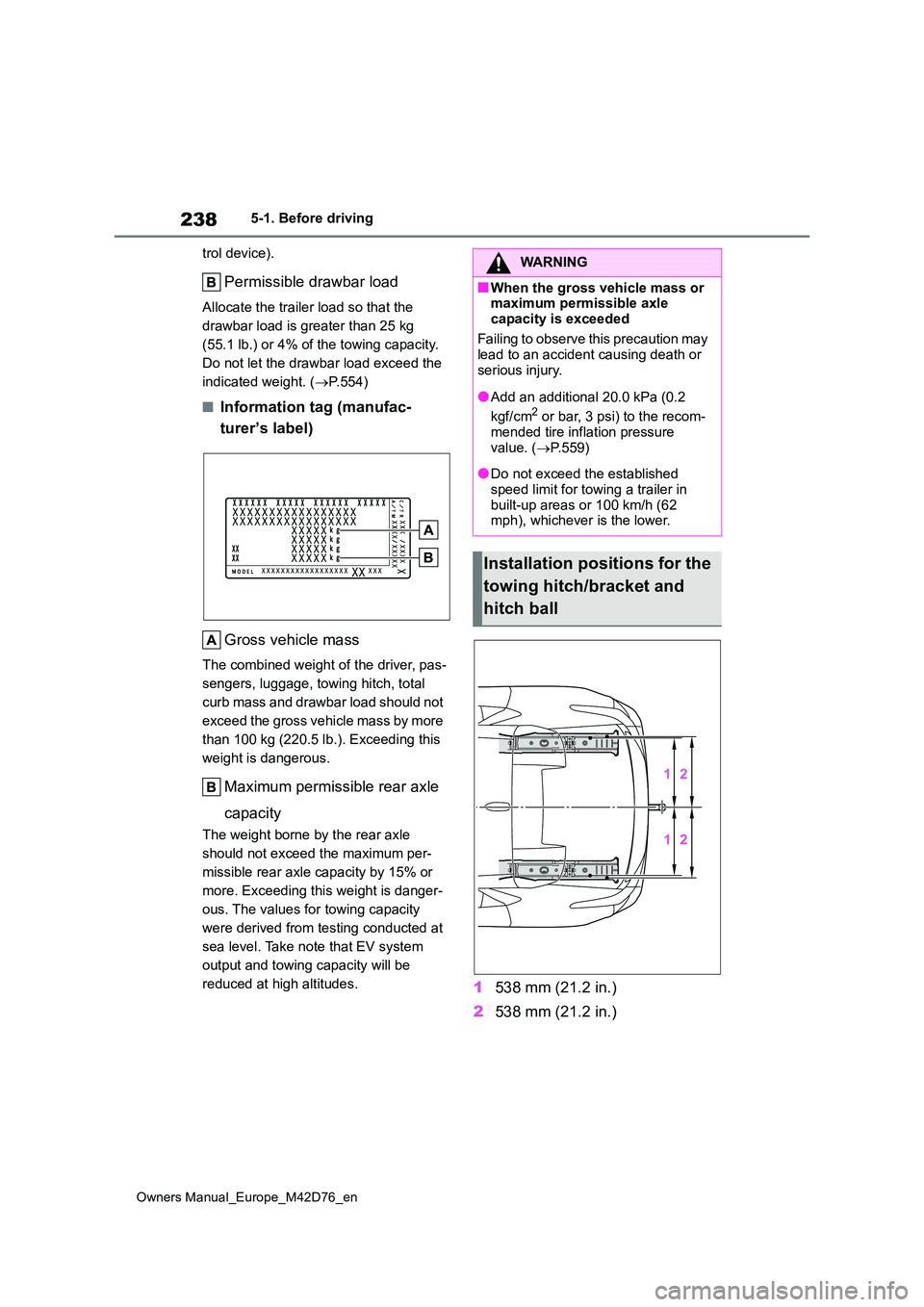
■Information tag (manufac-
turer’s label)
Gross vehicle mass
The combined weight of the driver, pas-
sengers, luggage, towing hitch, total
curb mass and drawbar load should not
exceed the gross vehicle mass by more
than 100 kg (220.5 lb.). Exceeding this
weight is dangerous.
Maximum permissible rear axle
capacity
The weight borne by the rear axle
should not exceed the maximum per-
missible rear axle capacity by 15% or
more. Exceeding this weight is danger-
ous. The values for towing capacity
were derived from testing conducted at
sea level. Take note that EV system
output and towing capacity will be
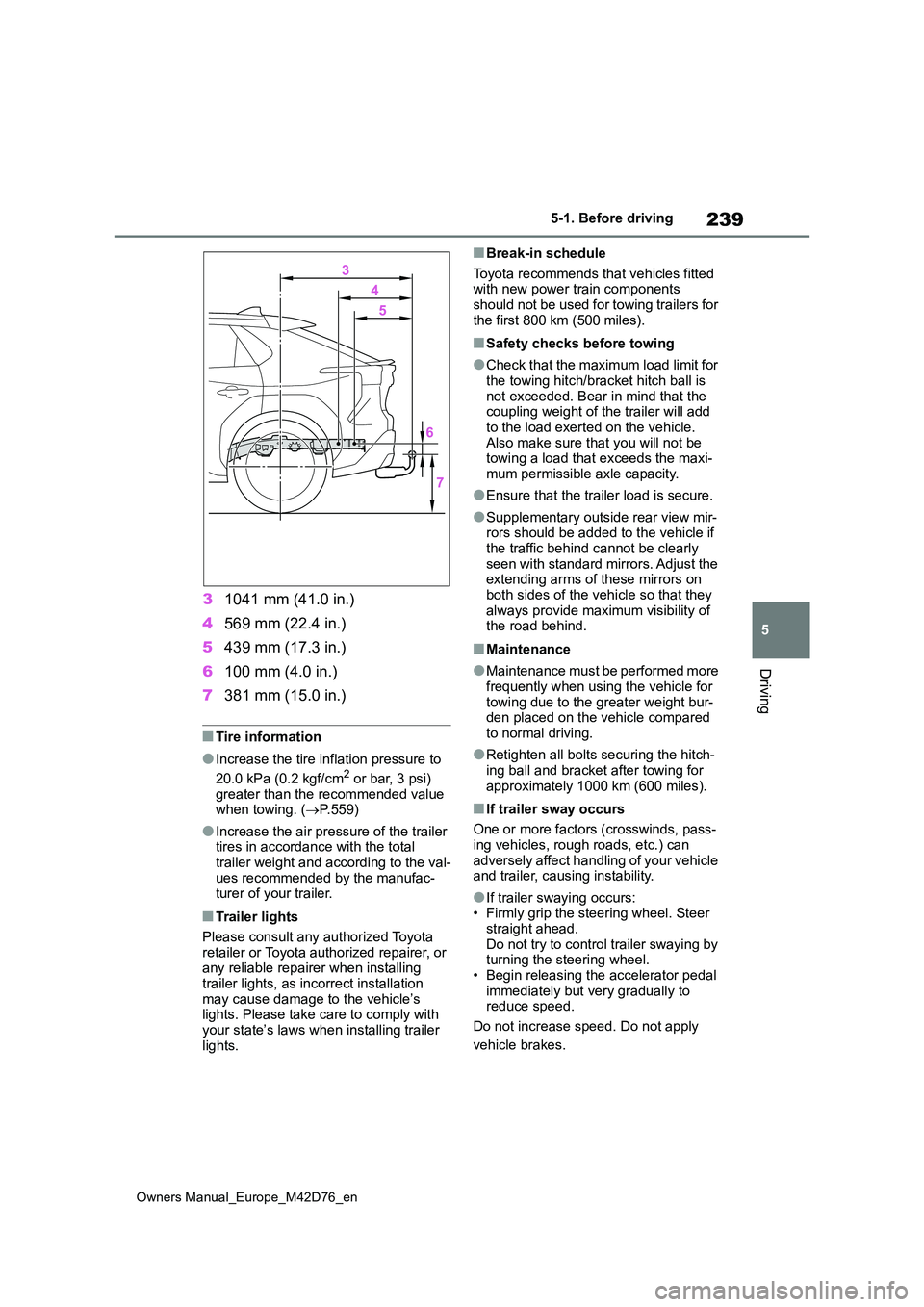
reduced at high altitudes.1 538 mm (21.2 in.)
2 538 mm (21.2 in.)
WARNING
■When the gross vehicle mass or maximum permissible axle
capacity is exceeded
Failing to observe this precaution may lead to an accident causing death or
serious injury.
●Add an additional 20.0 kPa (0.2
kgf/cm2 or bar, 3 psi) to the recom- mended tire inflation pressure
value. ( P.559)
●Do not exceed the established
speed limit for towing a trailer in built-up areas or 100 km/h (62 mph), whichever is the lower.
Installation positions for the
towing hitch/bracket and
hitch ball
Page 241 of 674
239
5
Owners Manual_Europe_M42D76_en
5-1. Before driving
Driving
31041 mm (41.0 in.)
4 569 mm (22.4 in.)
5 439 mm (17.3 in.)
6 100 mm (4.0 in.)
7 381 mm (15.0 in.)
■Tire information
●Increase the tire inflation pressure to
20.0 kPa (0.2 kgf/cm2 or bar, 3 psi) greater than the recommended value when towing. ( P.559)
●Increase the air pressure of the trailer tires in accordance with the total
trailer weight and according to the val- ues recommended by the manufac-turer of your trailer.
■Trailer lights
Please consult any authorized Toyota retailer or Toyota authorized repairer, or any reliable repairer when installing
trailer lights, as incorrect installation may cause damage to the vehicle’s lights. Please take care to comply with
your state’s laws when installing trailer lights.
■Break-in schedule
Toyota recommends that vehicles fitted with new power train components should not be used for towing trailers for
the first 800 km (500 miles).
■Safety checks before towing
●Check that the maximum load limit for
the towing hitch/bracket hitch ball is not exceeded. Bear in mind that the coupling weight of the trailer will add
to the load exerted on the vehicle. Also make sure that you will not be towing a load that exceeds the maxi-
mum permissible axle capacity.
●Ensure that the trailer load is secure.
●Supplementary outside rear view mir- rors should be added to the vehicle if
the traffic behind cannot be clearly seen with standard mirrors. Adjust the extending arms of these mirrors on
both sides of the vehicle so that they always provide maximum visibility of the road behind.
■Maintenance
●Maintenance must be performed more frequently when using the vehicle for
towing due to the greater weight bur- den placed on the vehicle compared to normal driving.
●Retighten all bolts securing the hitch-ing ball and bracket after towing for
approximately 1000 km (600 miles).
■If trailer sway occurs
One or more factors (crosswinds, pass- ing vehicles, rough roads, etc.) can
adversely affect handling of your vehicle and trailer, causing instability.
●If trailer swaying occurs:• Firmly grip the steering wheel. Steer straight ahead.
Do not try to control trailer swaying by turning the steering wheel.• Begin releasing the accelerator pedal
immediately but very gradually to reduce speed.
Do not increase speed. Do not apply
vehicle brakes.
Page 242 of 674
240
Owners Manual_Europe_M42D76_en
5-1. Before driving
If you make no extreme correction with
the steering or brakes, your vehicle and
trailer should stabilize.
●After the trailer swaying has stopped: • Stop in a safe place. Get all occupants out of the vehicle.
• Check the tires of the vehicle and the trailer.• Check the load in the trailer.
Make sure the load has not shifted. Make sure the tongue weight is appro-priate, if possible.
• Check the load in the vehicle. Make sure the vehicle is not over-loaded after occupants get in.
If you cannot find any problems, the
speed at which trailer swaying occurred
is beyond the limit of your particular
vehicle-trailer combination. Drive at a
lower speed to prevent instability.
Remember that swaying of the towing
vehicle-trailer increases as speed
increases.
Your vehicle will handle differently
when towing a trailer. In order to
avoid accident, death or serious
injury, keep the following in mind
when towing:
■Checking connections
between trailer and lights
Stop the vehicle and check the
operation of the connection
between the trailer and lights after
driving for a brief period as well as
before starting off.
■Practicing driving with a cou-
pled trailer
Get the feel for turning, stopping
and reversing with the trailer
coupled by practicing in an area
with no or light traffic.
When reversing with a coupled
trailer, hold the section of the
steering wheel nearest to you
and rotate clockwise to turn the
trailer left or counterclockwise to
turn it right. Always rotate a little
at a time to prevent steering
error. Have someone guide you
when reversing to lessen the risk
of an accident.
■Increasing vehicle-to-vehicle
distance
At a speed of 10 km/h (6 mph), the
distance to the vehicle running
ahead of you should be equivalent
to or greater than the combined
length of your vehicle and trailer.
Avoid sudden braking that may
cause skidding. Otherwise, the
vehicle may spin out of control. This
NOTICE
■When the rear bumper strength- ening material is aluminum
Ensure the steel bracket part does not
come directly in contact with that area.When steel and aluminum come into
contact, there is a reaction similar to corrosion, which will weaken the sec-tion concerned and may result in
damage. Apply a rust inhibitor to parts that will come in contact when attach-ing a steel bracket.
■Do not directly splice trailer lights
Directly splicing trailer lights may damage your vehicle’s electrical sys-tem and cause a malfunction.
Guidance