inflation pressure TOYOTA C-HR 2020 Owners Manual (in English)
[x] Cancel search | Manufacturer: TOYOTA, Model Year: 2020, Model line: C-HR, Model: TOYOTA C-HR 2020Pages: 536, PDF Size: 11.99 MB
Page 4 of 536

TABLE OF CONTENTS4
C-HR_OM_USA_OM10634U5-1. Using the air conditioning
system and defogger
Air conditioning system ..... 298
Heated steering wheel/ seat heaters .................... 306
5-2. Using the interior lights Interior lights list ................ 308• Interior lights ................. 309
• Personal lights .............. 310
5-3. Using the storage features
List of storage features...... 311 • Glove box...................... 312
• Console box .................. 312
• Bottle holders ................ 313
• Cup holders .................. 314
Luggage compartment features ........................... 315
5-4. Using the other interior features
Other interior features ....... 321 • Sun visors ..................... 321
• Vanity mirrors................ 321
• Power outlet .................. 322
• Assist grips ................... 323 6-1. Maintenance and care
Cleaning and protecting the vehicle exterior .......... 326
Cleaning and protecting the vehicle interior ........... 330
6-2. Maintenance Maintenance requirements ................... 333
General maintenance ........ 336
Emission inspection and maintenance (I/M)
programs ......................... 340
6-3. Do-it-yourself maintenance Do-it-yourself service precautions ...................... 341
Hood .................................. 344
Positioning a floor jack....... 346
Engine compartment ......... 347
Tires................................... 362
Tire inflation pressure ........ 372
Wheels............................... 376
Air conditioning filter .......... 379
Wireless remote control/electronic key
battery ............................. 383
Checking and replacing fuses ................................ 387
Headlight aim (vehicles with front fog lights) ......... 391
Light bulbs ......................... 393
5Interior features6Maintenance and care
Page 13 of 536
13Pictorial index
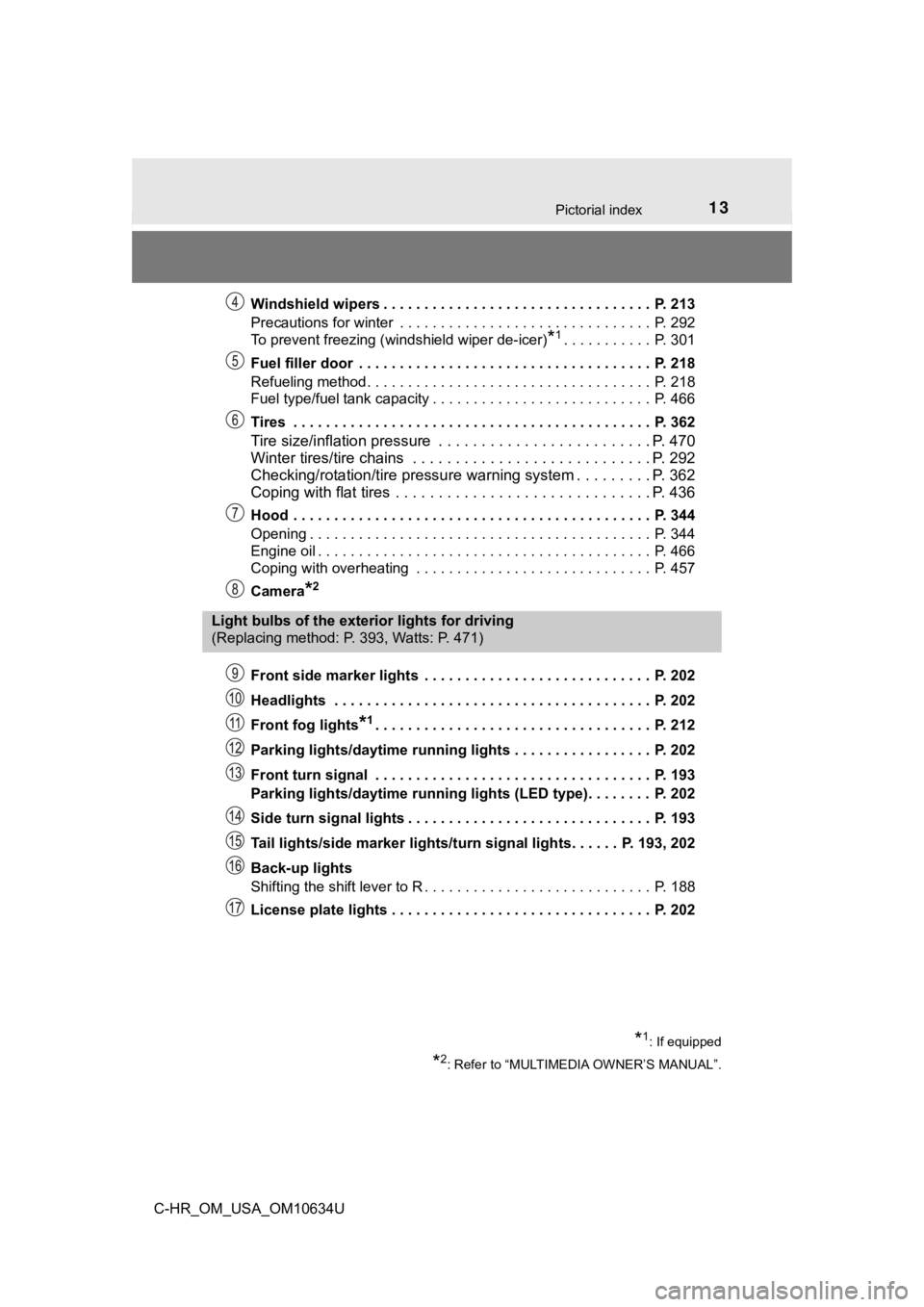
C-HR_OM_USA_OM10634UWindshield wipers . . . . . . . . . . . . . . . . . . . . . . . . . . . . . . . . . P. 213
Precautions for winter . . . . . . . . . . . . . . . . . . . . . . . . . . . . . . . P. 292
To prevent freezing (windshield wiper de-icer)
*1. . . . . . . . . . . P. 301
Fuel filler door . . . . . . . . . . . . . . . . . . . . . . . . . . . . . . . . . . . . P. 218
Refueling method . . . . . . . . . . . . . . . . . . . . . . . . . . . . . . . . . . . P. 218
Fuel type/fuel tank capacity . . . . . . . . . . . . . . . . . . . . . . . . . . . P. 466
Tires . . . . . . . . . . . . . . . . . . . . . . . . . . . . . . . . . . . . . . . . . . . . P. 362
Tire size/inflation pressure . . . . . . . . . . . . . . . . . . . . . . . . . P. 470
Winter tires/tire chains . . . . . . . . . . . . . . . . . . . . . . . . . . . . P. 292
Checking/rotation/tire pressur e warning system . . . . . . . . .P. 362
Coping with flat tires . . . . . . . . . . . . . . . . . . . . . . . . . . . . . . P. 436
Hood . . . . . . . . . . . . . . . . . . . . . . . . . . . . . . . . . . . . . . . . . . . . P. 344
Opening . . . . . . . . . . . . . . . . . . . . . . . . . . . . . . . . . . . . . . . . . . P. 344
Engine oil . . . . . . . . . . . . . . . . . . . . . . . . . . . . . . . . . . . . . . . . . P. 466
Coping with overheating . . . . . . . . . . . . . . . . . . . . . . . . . . . . . P. 457
Camera
*2
Front side marker lights . . . . . . . . . . . . . . . . . . . . . . . . . . . . P. 202
Headlights . . . . . . . . . . . . . . . . . . . . . . . . . . . . . . . . . . . . . . . P. 202
Front fog lights
*1. . . . . . . . . . . . . . . . . . . . . . . . . . . . . . . . . . P. 212
Parking lights/daytime running lights . . . . . . . . . . . . . . . . . P. 202
Front turn signal . . . . . . . . . . . . . . . . . . . . . . . . . . . . . . . . . . P. 193
Parking lights/daytime running lights (LED type). . . . . . . . P. 202
Side turn signal lights . . . . . . . . . . . . . . . . . . . . . . . . . . . . . . P. 193
Tail lights/side marker lights/turn signal lights. . . . . . P. 193, 202
Back-up lights
Shifting the shift lever to R . . . . . . . . . . . . . . . . . . . . . . . . . . . . P. 188
License plate lights . . . . . . . . . . . . . . . . . . . . . . . . . . . . . . . . P. 202
Light bulbs of the exterior lights for driving
(Replacing method: P. 393, Watts: P. 471)
*1: If equipped
*2: Refer to “MULTIMEDIA OWNER’S MANUAL”.
Page 240 of 536

2404-5. Using the driving support systems
C-HR_OM_USA_OM10634U●
In some situations such as the following, sufficient braking fo rce may not be
obtained, preventing the system from performing properly:
• If the braking functions cannot operate to their full extent, such as when
the brake parts are extremely cold, extremely hot, or wet
• If the vehicle is not properly maintained (brakes or tires are excessively
worn, improper tire inflation pressure, etc.)
• When the vehicle is being driven on a gravel road or other sli ppery sur-
face
● Some pedestrians such as the following may not be detected by t he radar
sensor and camera sensor, preventing the system from operating properly:
• Pedestrians shorter than approximately 3.2 ft. (1 m) or taller t han approx-
imately 6.5 ft. (2 m)
• Pedestrians wearing oversized clothing (a rain coat, long skir t, etc.), mak-
ing their silhouette obscure
• Pedestrians who are carrying large baggage, holding an umbrella, etc., hiding part of their body
• Pedestrians who are bending forward or squatting
• Pedestrians who are pushing a stroller, wheelchair, bicycle or other vehi-
cle
• Groups of pedestrians which are close together
• Pedestrians who are wearing white and look extremely bright
• Pedestrians in the dark, such as at night or while in a tunnel
• Pedestrians whose clothing appears to be nearly the same color or
brightness as their surroundings
• Pedestrians near walls, fences, guardrails, or large objects
• Pedestrians who are on a metal object (manhole cover, steel plate, etc.)
on the road
• Pedestrians who are walking fast
• Pedestrians who are changing speed abruptly
• Pedestrians running out from behind a vehicle or a large objec t
• Pedestrians who are extremely close to the side of the vehicle (outside
rear view mirror, etc.)
Page 291 of 536

2914-5. Using the driving support systems
4
Driving
C-HR_OM_USA_OM10634U
WARNING
■When the TRAC/VSC is activated
The slip indicator light flashes. Always drive carefully. Reckless driving may
cause an accident. Exercise particular care when the indicator light flashes.
■ When the TRAC/VSC systems are turned off
Be especially careful and drive at a speed appropriate to the r oad condi-
tions. As these are the systems to help ensure vehicle stabilit y and driving
force, do not turn the TRAC/VSC systems off unless necessary.
■ Replacing tires
Make sure that all tires are of the specified size, brand, trea d pattern and
total load capacity. In addition, make sure that the tires are inflated to the
recommended tire inflation pressure level.
The ABS, TRAC and VSC systems will not function correctly if di fferent tires
are installed on the vehicle.
Contact your Toyota dealer for further information when replaci ng tires or
wheels.
■ Handling of tires and the suspension
Using tires with any kind of problem or modifying the suspensio n will affect
the driving assist systems, and may cause a system to malfuncti on.
Page 325 of 536

325
6Maintenance and care
C-HR_OM_USA_OM10634U6-1. Maintenance and care
Cleaning and protecting the vehicle exterior .......... 326
Cleaning and protecting the vehicle interior ........... 330 6-2. Maintenance
Maintenance requirements ................... 333
General maintenance........ 336
Emission inspection and maintenance (I/M)
programs......................... 340
6-3. Do-it-yourself maintenance
Do-it-yourself service precautions ..................... 341
Hood ................................. 344
Positioning a floor jack ...... 346
Engine compartment ......... 347
Tires .................................. 362
Tire inflation pressure ....... 372
Wheels .............................. 376
Air conditioning filter.......... 379
Wireless remote control/electronic key
battery ............................. 383
Checking and replacing fuses ............................... 387
Headlight aim (vehicles with front fog lights) ......... 391
Light bulbs......................... 393
Page 342 of 536
3426-3. Do-it-yourself maintenance
C-HR_OM_USA_OM10634U
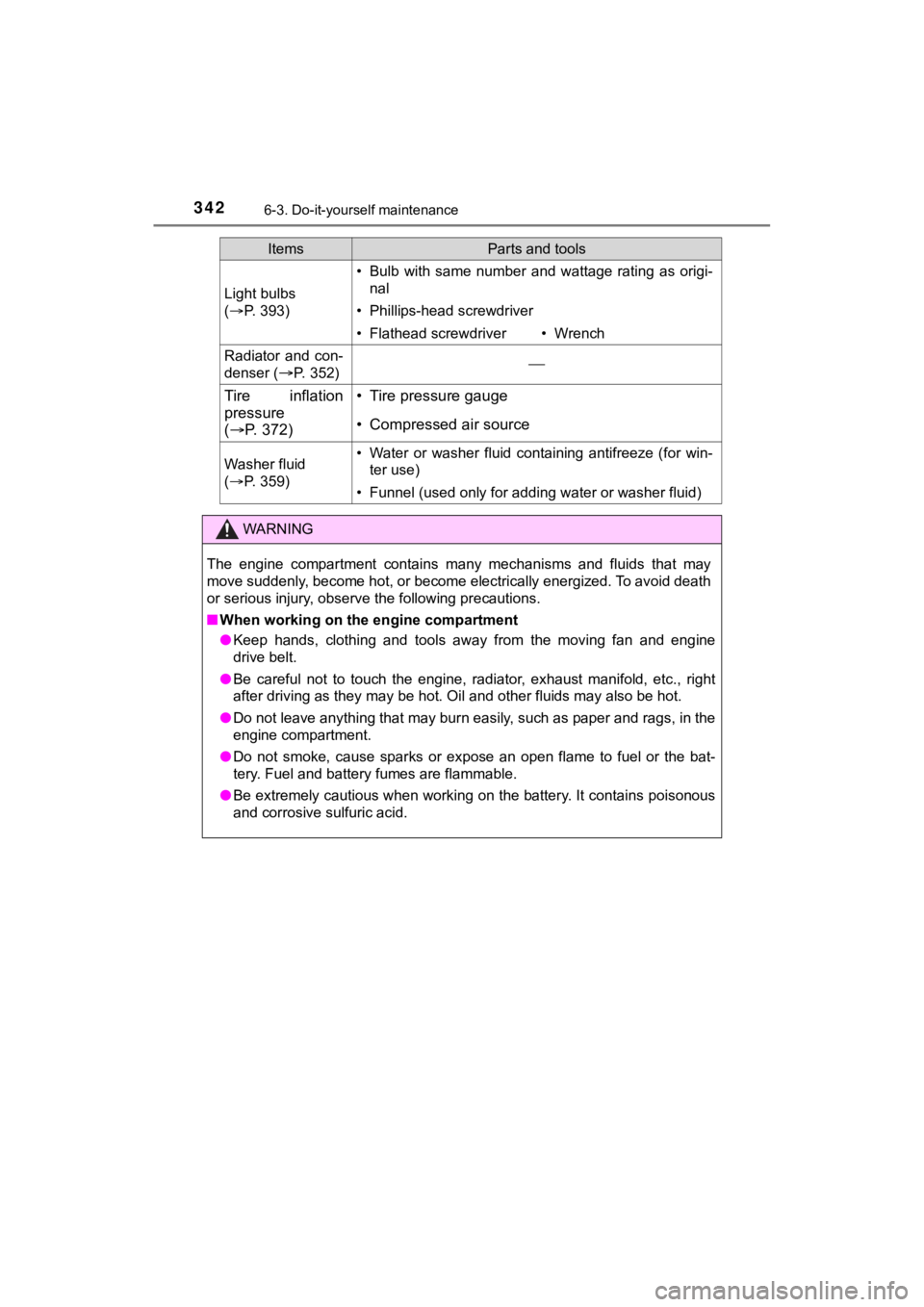
Light bulbs
( P. 3 9 3 )
• Bulb with same number and wattage rating as origi-
nal
• Phillips-head screwdriver
• Flathead screwdriver• Wrench
Radiator and con-
denser (
P. 352)
Tire inflation
pressure
( P. 372)• Tire pressure gauge
• Compressed air source
Washer fluid
( P. 3 5 9 )• Water or washer fluid containing antifreeze (for win-
ter use)
• Funnel (used only for adding water or washer fluid)
WARNING
The engine compartment contains many mechanisms and fluids that may
move suddenly, become hot, or become electrically energized. To avoid death
or serious injury, observe the following precautions.
■When working on the engine compartment
● Keep hands, clothing and tools away from the moving fan and eng ine
drive belt.
● Be careful not to touch the engine, radiator, exhaust manifold, etc., right
after driving as they may be hot. Oil and other fluids may also be hot.
● Do not leave anything that may burn easily, such as paper and r ags, in the
engine compartment.
● Do not smoke, cause sparks or expose an open flame to fuel or t he bat-
tery. Fuel and battery fumes are flammable.
● Be extremely cautious when working on the battery. It contains poisonous
and corrosive sulfuric acid.
ItemsParts and tools
Page 363 of 536

3636-3. Do-it-yourself maintenance
6
Maintenance and care
C-HR_OM_USA_OM10634U
Your vehicle is equipped with a tire pressure warning system that uses
tire pressure warning valves and transmitters to detect low tire infla-
tion pressure before serious problems arise.
If the tire pressure drops below a predetermined level, the dri ver is
warned by a warning light. ( P. 424)
◆Installing tire pressure warn ing valves and transmitters
When replacing tires or wheels, tire pressure warning valves an d
transmitters must also be installed.
When new tire pressure warning valves and transmitters are
installed, new ID codes must be registered in the tire pressure
warning computer and the tire pressure warning system must be
initialized. Have tire pressure warning valves and transmitter ID
codes registered by your Toyota dealer. ( P. 365)
◆Initializing the tire pressure warning system
When the tire size is changed, the tire pressure warning system
must be initialized.
When the tire pressure warning sy stem is initialized, the current tire
inflation pressure is set as the benchmark pressure.
Tire pressure warning system
Page 364 of 536
3646-3. Do-it-yourself maintenance
C-HR_OM_USA_OM10634U■
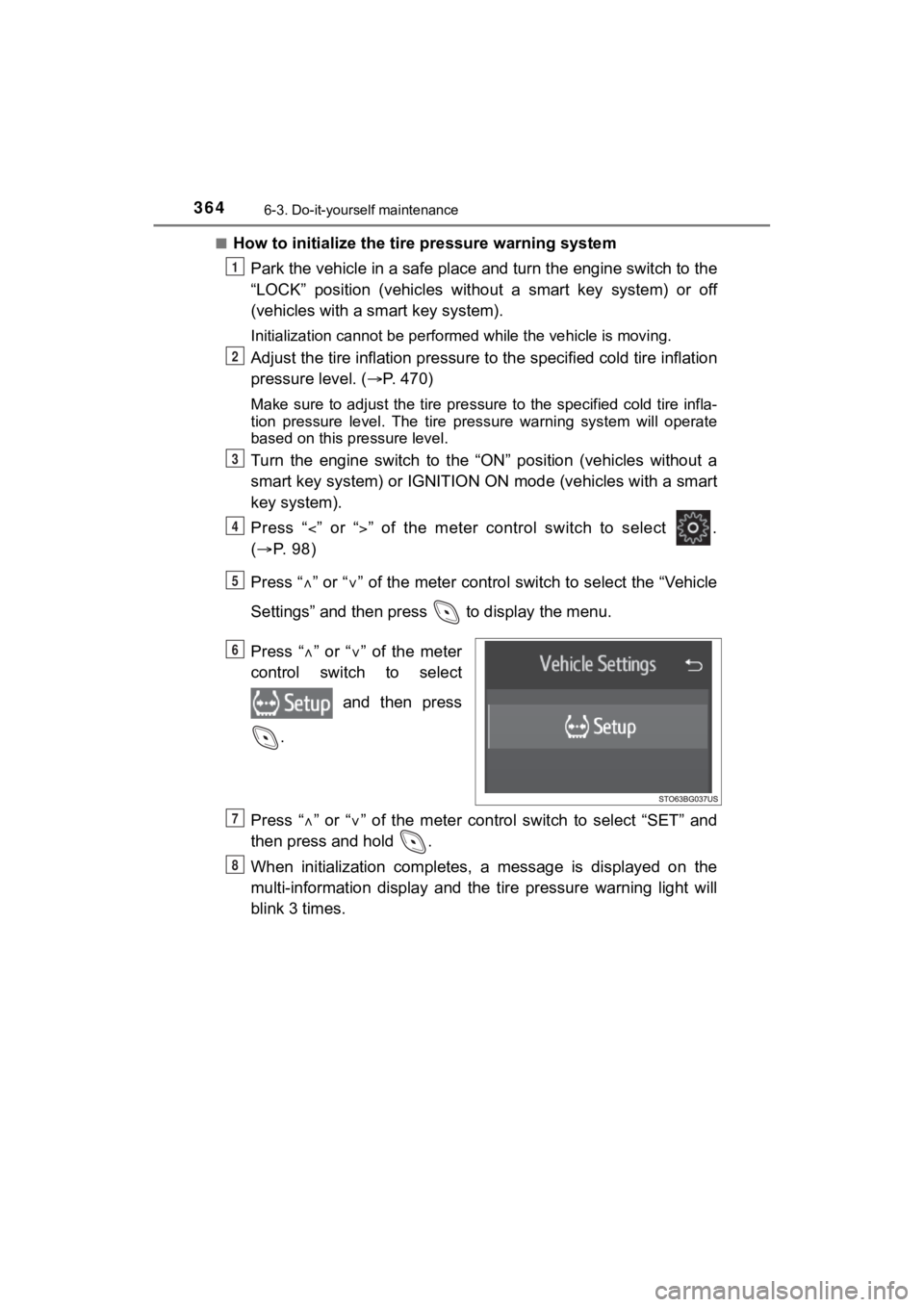
How to initialize the tire pressure warning system
Park the vehicle in a safe plac e and turn the engine switch to the
“LOCK” position (vehicles with out a smart key system) or off
(vehicles with a sm art key system).
Initialization cannot be perfo rmed while the vehicle is moving.
Adjust the tire inflation pressure to the specified cold tire i nflation
pressure level. ( P. 470)
Make sure to adjust the tire pre ssure to the specified cold tire infla-
tion pressure level. The tire pressure warning system will oper ate
based on this pr essure level.
Turn the engine switch to the “ON” position (vehicles without a
smart key system) or IGNITION ON mode (vehicles with a smart
key system).
Press “” or “ ” of the meter control switch to select .
( P. 98)
Press “ ” or “ ” of the meter control switch to select the “Vehicle
Settings” and then press to display the menu.
Press “ ” or “ ” of the meter
control switch to select
and then press
.
Press “ ” or “ ” of the meter control switch to select “SET” and
then press and hold .
When initialization completes, a message is displayed on the
multi-information display and the tire pressure warning light w ill
blink 3 times.
1
2
3
4
5
6
7
8
Page 365 of 536

3656-3. Do-it-yourself maintenance
6
Maintenance and care
C-HR_OM_USA_OM10634U
◆Registering ID codes
The tire pressure warning valve and transmitter is equipped with a
unique ID code. When replacing a tire pressure warning valve an d
transmitter, it is necessary to register the ID code. Have the ID code
registered by your Toyota dealer.
■When to replace your vehicle’s tires
Tires should be replaced if:
●The treadwear indicators are showing on a tire.
●You have tire damage such as cuts, splits, cracks deep enough t o
expose the fabric, and bulges indicating internal damage
●A tire goes flat repeatedly or c annot be properly repaired due to the size
or location of a cut or other damage
If you are not sure, consult with your Toyota dealer.
■Replacing tires and wheels
If the ID code of the tire press ure warning valve and transmitt er is not reg-
istered, the tire pressure warni ng system will not work properly. A f t e r d r i v -
ing for about 20 minutes, the tire pressure warning light blink s for 1
minute and stays on to indi cate a system malfunction.
■Tire life
Any tire over 6 years old must be checked by a qualified techni cian even
if it has seldom or never been u se, or damage is not obvious.
■Routine tire inflation pressure checks
The tire pressure warning system does not replace routine tire inflation
pressure checks. Make sure to chec k tire inflation pressure as part of
your routine of daily vehicle checks.
Page 366 of 536
3666-3. Do-it-yourself maintenance
C-HR_OM_USA_OM10634U■
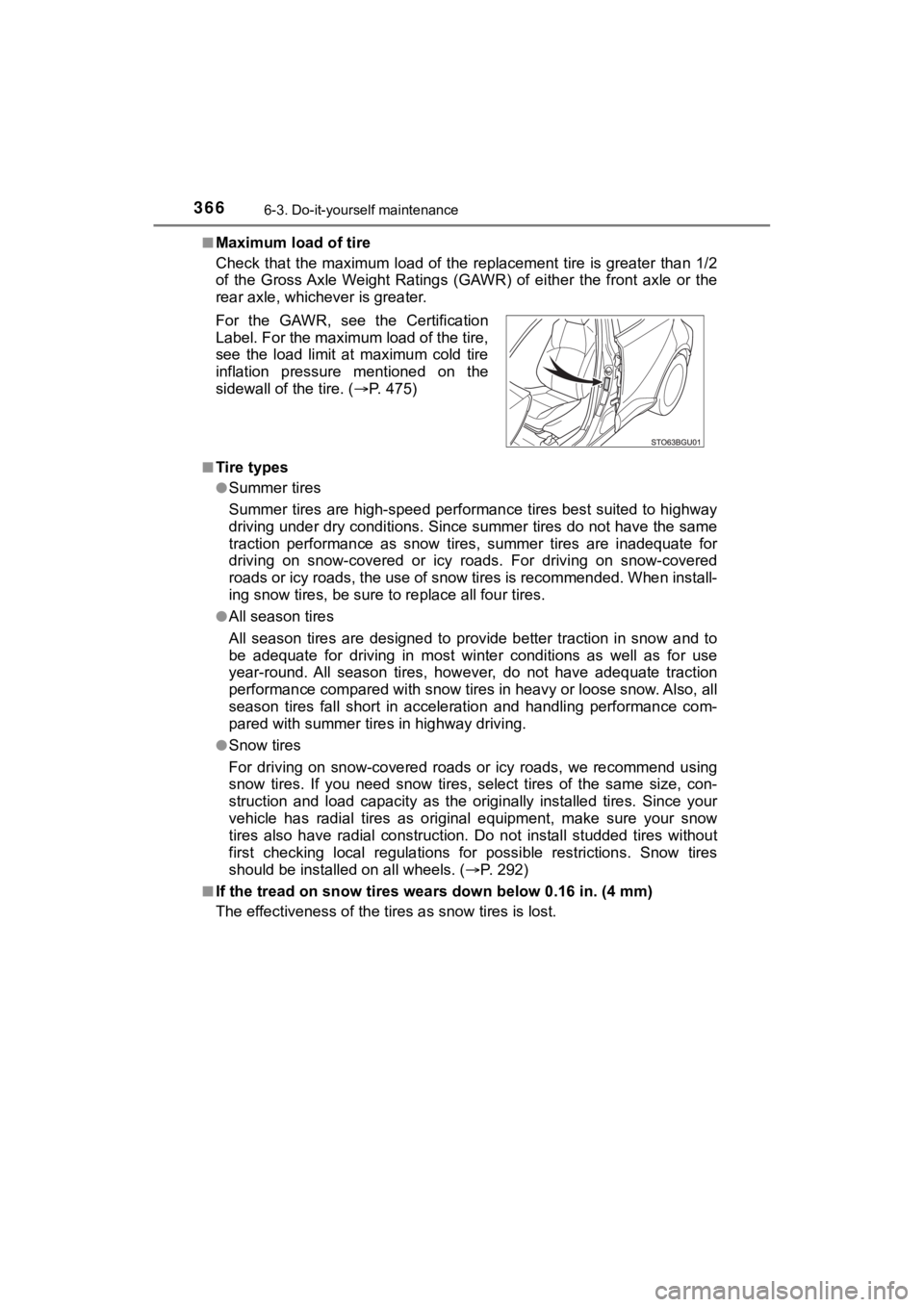
Maximum load of tire
Check that the maximum load of t
he replacement tire is greater than 1/2
of the Gross Axle Weight Ratings (GAWR) of either the front axl e or the
rear axle, whichever is greater.
■Tire types
●Summer tires
Summer tires are high-speed performance tires best suited to hi ghway
driving under dry conditions. Si nce summer tires do not have th e same
traction performance as snow tires, summer tires are inadequate for
driving on snow-covered or icy ro ads. For driving on snow-covered
roads or icy roads, the use of snow tires is recommended. When install-
ing snow tires, be sure to replace all four tires.
●All season tires
All season tires are designed to provide better traction in sno w and to
be adequate for driving in most winter conditions as well as fo r use
year-round. All season tires, however, do not have adequate tra ction
performance compared with snow tires in heavy or loose snow. Al so, all
season tires fall short in acceleration and handling performanc e com-
pared with summer tires in highway driving.
●Snow tires
For driving on snow-covered roads or icy roads, we recommend us ing
snow tires. If you need snow tires, select tires of the same si ze, con-
struction and load capacity as t he originally installed tires. Since your
vehicle has radial tires as original equipment, make sure your snow
tires also have radial construct ion. Do not install studded tires without
first checking local regulations for possible restrictions. Sno w tires
should be install ed on all wheels. ( P. 292)
■If the tread on snow tires wea rs down below 0.16 in. (4 mm)
The effectiveness of the tires as snow tires is lost. For the GAWR, see the Certification
Label. For the maximum load of the tire,
see the load limit at maximum cold tire
inflation pressure mentioned on the
sidewall of the tire. ( P. 4 7 5 )