warning TOYOTA C-HR 2023 Owners Manual
[x] Cancel search | Manufacturer: TOYOTA, Model Year: 2023, Model line: C-HR, Model: TOYOTA C-HR 2023Pages: 814, PDF Size: 112.62 MB
Page 603 of 814
6016-3. Do-it-yourself maintenance
C-HR_HEV_OM_Europe_OM10764E
6
Maintenance and care
WARNING
■Used engine oil
● Used engine oil contains potentially harmful contaminants which may
cause skin disorders such as inflammation and skin cancer, so c are
should be taken to avoid prolonged and repeated contact. To rem ove used
engine oil from your skin, wash thoroughly with soap and water.
● Dispose of used oil and filters only in a safe and acceptable manner. Do
not dispose of used oil and filters in household trash, in sewe rs or onto the
ground. Call any authorized Toyota retailer or Toyota authorize d repairer,
or any reliable repairer service station or auto parts store fo r information
concerning recycling or disposal.
● Do not leave used engine oil within the reach of children.
NOTICE
■To prevent serious engine damage
Check the oil level on a regular basis.
■ When replacing the engine oil
● Be careful not to spill engine oil on the vehicle components.
● Avoid overfilling, or the engine could be damaged.
● Check the oil level on the dipstick every time you refill the vehicle.
● Be sure the engine oil filler cap is properly tightened.
Page 605 of 814
6036-3. Do-it-yourself maintenance
C-HR_HEV_OM_Europe_OM10764E
6
Maintenance and care
■Coolant selection
Only use “Toyota Super Long Life Coolant” or a similar high qua lity ethylene
glycol based non-silicate, non-am ine, non-nitrite, and non-borate coolant with
long-life hybrid organic acid technology.
“Toyota Super Long Life Coolant” is a mixture of 50% coolant an d 50% deion-
ized water. (Minimum temperature: -35 C [-31F])
For more details about coolant, contact any authorized Toyota r etailer or
Toyota authorized repairer, or any reliable repairer.
■ If the coolant level drops within a short time of replenishing
Visually check the radiator, hoses, engine/power control unit c oolant reservoir
caps, drain cock and water pump.
If you cannot find a leak, have any authorized Toyota retailer or Toyota autho-
rized repairer, or any reliable repairer test the cap and check for leaks in the
cooling system.
WARNING
■ When the hybrid system is hot
Do not remove the engine/power control unit coolant reservoir c aps.
The cooling system may be under pressure and may spray hot cool ant if the
cap is removed, causing serious injuries, such as burns.
NOTICE
■ When adding coolant
Coolant is neither plain water nor straight antifreeze. The correct mixture of
water and antifreeze must be used to provide proper lubrication , corrosion
protection and cooling. Be sure to read the antifreeze or coola nt label.
■ If you spill coolant
Be sure to wash it off with water to prevent it from damaging p arts or paint.
Page 606 of 814
6046-3. Do-it-yourself maintenance
C-HR_HEV_OM_Europe_OM10764E
Check the radiator and condenser and clear away any foreign objects.
If either of the above parts is extremely dirty or you are not sure of
their condition, have your vehicle inspected by any authorized To y o t a
retailer or Toyota authorized repairer, or any reliable repaire r.
Check the 12-volt battery as follows.
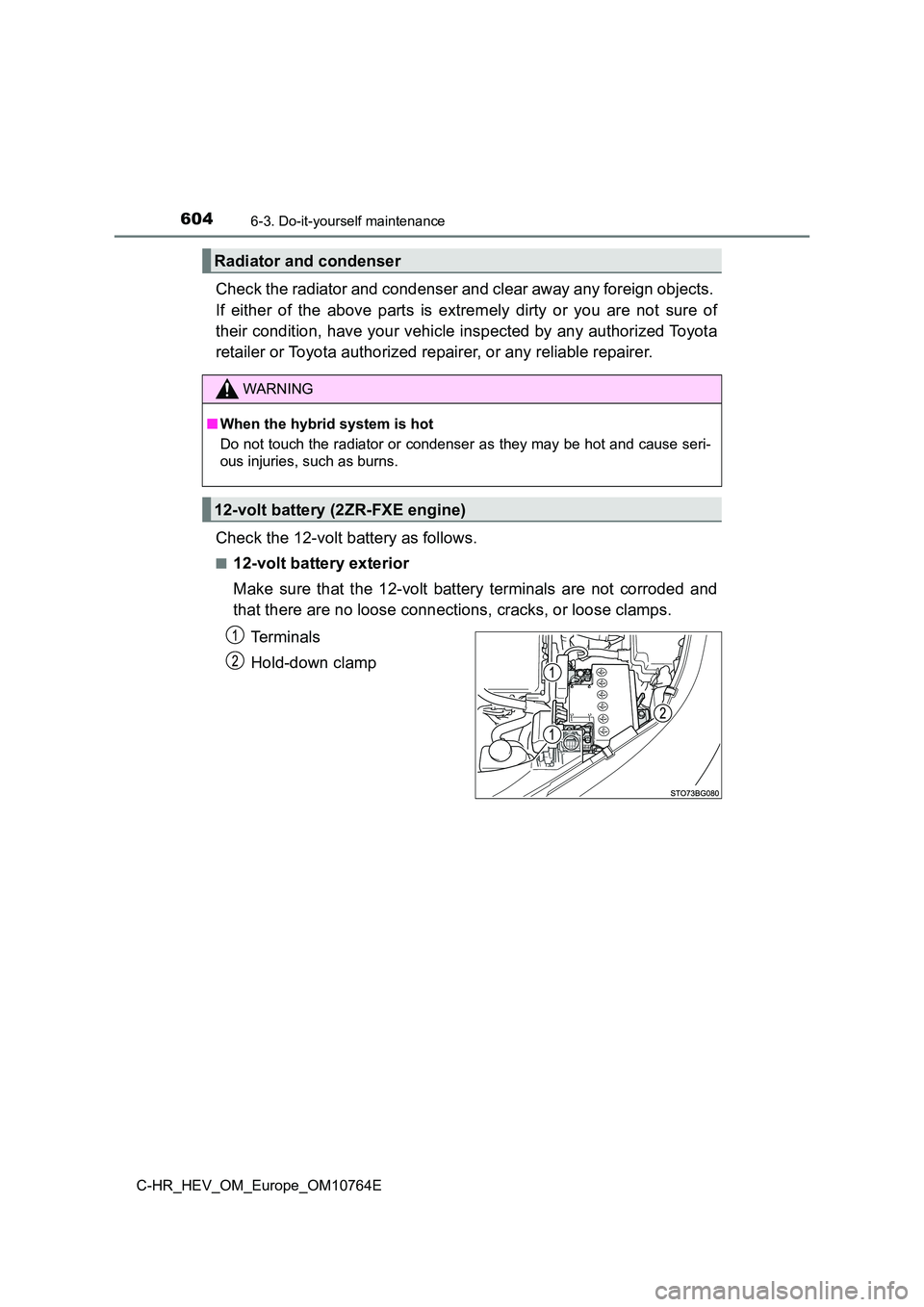
■12-volt battery exterior
Make sure that the 12-volt battery terminals are not corroded a nd
that there are no loose connections, cracks, or loose clamps.
Te r m i n a l s
Hold-down clamp
Radiator and condenser
WARNING
■ When the hybrid system is hot
Do not touch the radiator or condenser as they may be hot and c ause seri-
ous injuries, such as burns.
12-volt battery (2ZR-FXE engine)
Page 609 of 814
6076-3. Do-it-yourself maintenance
C-HR_HEV_OM_Europe_OM10764E
6
Maintenance and care
WARNING
■Chemicals in the 12-volt battery
The 12-volt battery contains poisonous and corrosive sulfuric a cid and may
produce hydrogen gas which is flammable and explosive. To reduc e the risk
of death or serious injury, take the following precautions while working on or
near the 12-volt battery:
● Do not cause sparks by touching the 12-volt battery terminals with tools.
● Do not smoke or light a match near the 12-volt battery.
● Avoid contact with eyes, skin and clothes.
● Never inhale or swallow electrolyte.
● Wear protective safety glasses when working near the 12-volt battery.
● Keep children away from the 12-volt battery.
■ Where to safely charge the 12-volt battery
Always charge the 12-volt battery in an open area. Do not charg e the 12-
volt battery in a garage or closed room where there is insuffic ient ventila-
tion.
■ Emergency measures regarding electrolyte
● If electrolyte gets in your eyes
Flush your eyes with clean water for at least 15 minutes and ge t immedi-
ate medical attention. If possible, continue to apply water wit h a sponge or
cloth while traveling to the nearest medical facility.
● If electrolyte gets on your skin
Wash the affected area thoroughly. If you feel pain or burning, get medical
attention immediately.
● If electrolyte gets on your clothes
It can soak through clothing on to your skin. Immediately take off the cloth-
ing and follow the procedure above if necessary.
● If you accidentally swallow electrolyte
Drink a large quantity of water or milk. Get emergency medical attention
immediately.
Page 610 of 814
6086-3. Do-it-yourself maintenance
C-HR_HEV_OM_Europe_OM10764E
WARNING
■When there is insufficient 12-volt battery fluid
Do not use if there is insufficient fluid in the 12-volt batter y. There is a possi-
ble danger that the 12-volt battery may explode.
■ When disconnecting the 12-volt battery
Do not disconnect the negative (-) terminal on the body side. T he discon-
nected negative (-) terminal may touch the positive (+) termina l, which may
cause a short and result in death or serious injury.
NOTICE
■ When recharging the 12-volt battery
Never recharge the 12-volt battery while the hybrid system is o perating.
Also, be sure all accessories are turned off.
■ When adding distilled water
Avoid overfilling. Water spilled during battery recharging may cause corro-
sion.
Page 611 of 814
6096-3. Do-it-yourself maintenance
C-HR_HEV_OM_Europe_OM10764E
6
Maintenance and care
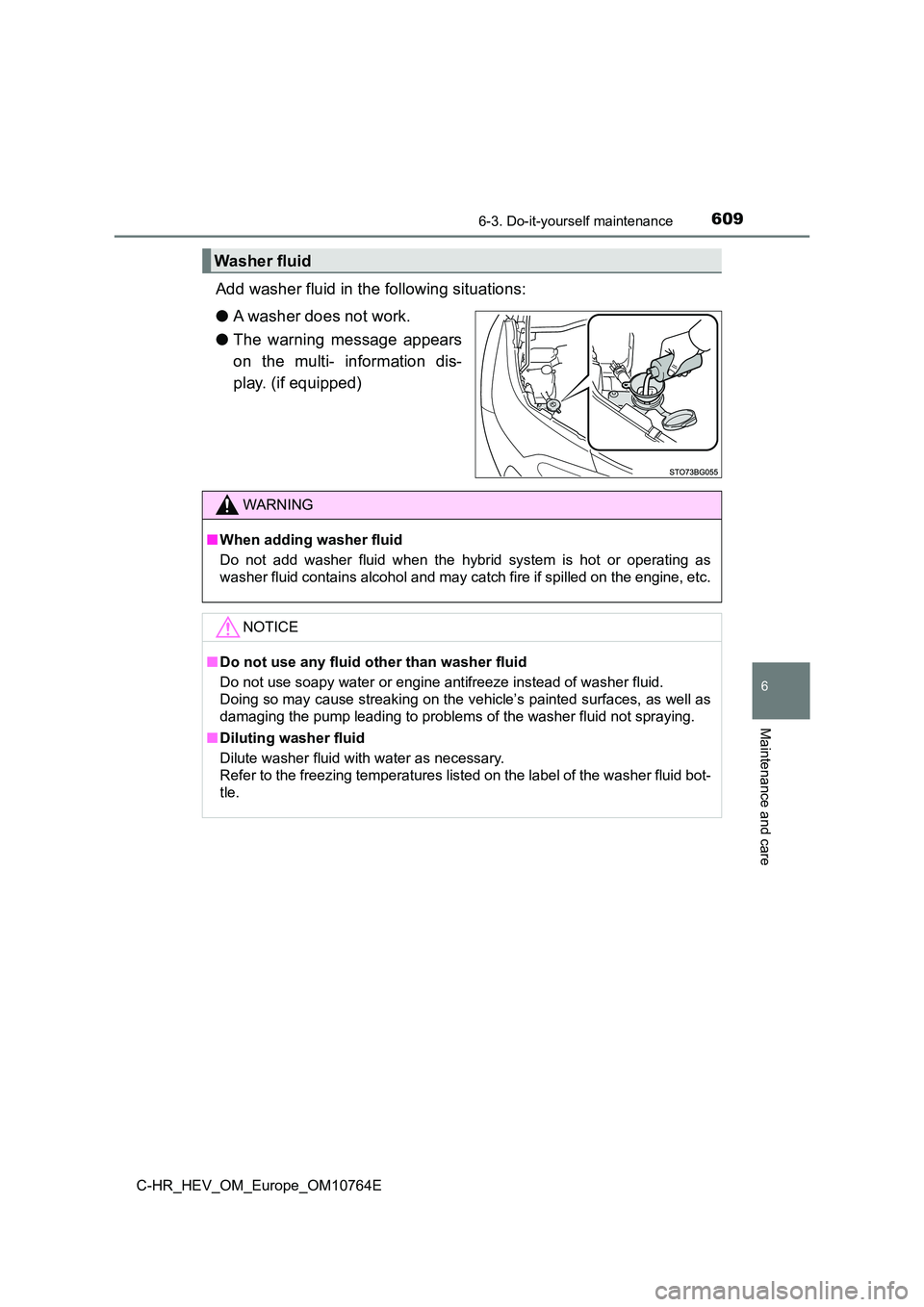
Add washer fluid in the following situations:
● A washer does not work.
● The warning message appears
on the multi- information dis-
play. (if equipped)
Washer fluid
WARNING
■ When adding washer fluid
Do not add washer fluid when the hybrid system is hot or operat ing as
washer fluid contains alcohol and may catch fire if spilled on the engine, etc.
NOTICE
■Do not use any fluid other than washer fluid
Do not use soapy water or engine antifreeze instead of washer f luid.
Doing so may cause streaking on the vehicle’s painted surfaces, as well as
damaging the pump leading to problems of the washer fluid not s praying.
■ Diluting washer fluid
Dilute washer fluid with water as necessary.
Refer to the freezing temperatures listed on the label of the w asher fluid bot-
tle.
Page 614 of 814
6126-3. Do-it-yourself maintenance
C-HR_HEV_OM_Europe_OM10764E
WARNING
■Chemicals in the 12-volt battery
The 12-volt battery contains poisonous and corrosive sulfuric a cid and may
produce hydrogen gas which is flammable and explosive. To reduc e the risk
of death or serious injury, take the following precautions while working on or
near the 12-volt battery:
● Do not cause sparks by touching the 12-volt battery terminals with tools.
● Do not smoke or light a match near the 12-volt battery.
● Avoid contact with eyes, skin and clothes.
● Never inhale or swallow electrolyte.
● Wear protective safety glasses when working near the 12-volt battery.
● Keep children away from the 12-volt battery.
■ Where to safely charge the 12-volt battery
Always charge the 12-volt battery in an open area. Do not charg e the 12-volt
battery in a garage or closed room where there is insufficient ventilation.
■ Emergency measures regarding electrolyte
● If electrolyte gets in your eyes
Flush your eyes with clean water for at least 15 minutes and ge t immedi-
ate medical attention. If possible, continue to apply water wit h a sponge or
cloth while traveling to the nearest medical facility.
● If electrolyte gets on your skin
Wash the affected area thoroughly. If you feel pain or burning, get medical
attention immediately.
● If electrolyte gets on your clothes
It can soak through clothing on to your skin. Immediately take off the cloth-
ing and follow the procedure above if necessary.
● If you accidentally swallow electrolyte Drink a large quantity of water or
milk. Get emergency medical attention immediately.
■ When replacing the 12-volt battery
Use a 12-volt battery designed for this vehicle. Failure to do so may cause
gas (hydrogen) to enter the passenger compartment, causing a fi re or
explosion.
For replacement of the 12-volt battery, contact any authorized To y o t a
retailer or Toyota authorized repairer, or any reliable repaire r.
Page 618 of 814
6166-3. Do-it-yourself maintenance
C-HR_HEV_OM_Europe_OM10764E
Your vehicle is equipped with a tire pressure warning system that uses
tire pressure warning valves and transmitters to detect low tir e infla-
tion pressure before serious problems arise.
If the tire pressure drops below a predetermined level, the dri ver is
warned by a warning light. ( P. 684)
◆Installing tire pressure warning valves and transmitters
When replacing tires or wheels, tire pressure warning valves an d
transmitters must also be installed.
When new tire pressure warning valves and transmitters are
installed, new ID codes must be registered in the tire pressure
warning computer and the tire pressure warning system must be
initialized. Have tire pressure warning valve and transmitter I D
codes registered by any authorized Toyota retailer or Toyota au tho-
rized repairer, or any reliable repairer. ( P. 618)
◆Initializing the tire pressure warning system
When the tire size is changed, the tire pressure warning system
must be initialized.
When the tire pressure warning system is initialized, the curre nt tire
inflation pressure is set as the benchmark pressure.
Tire pressure warning system
Page 619 of 814
6176-3. Do-it-yourself maintenance
C-HR_HEV_OM_Europe_OM10764E
6
Maintenance and care
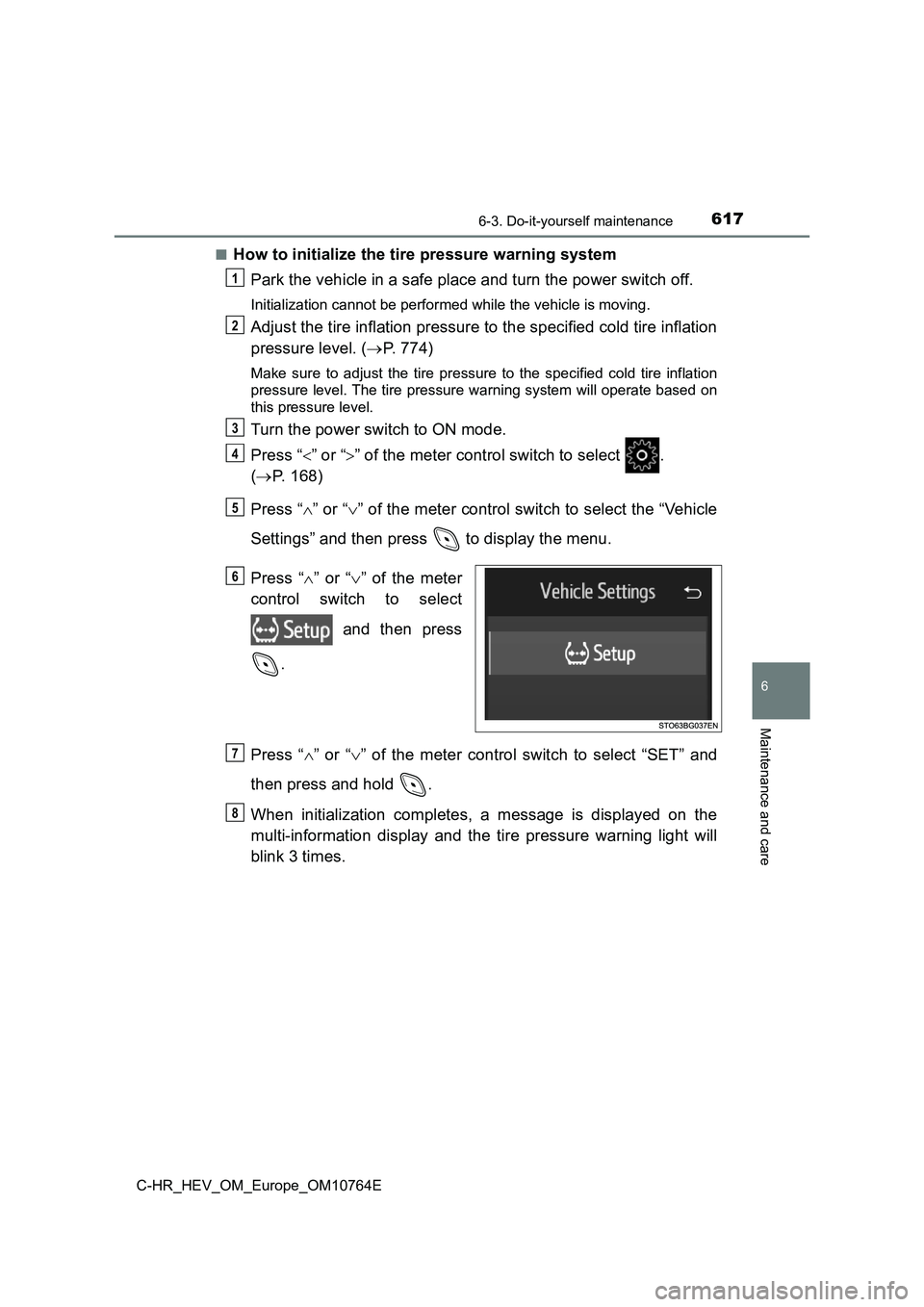
■How to initialize the tire pressure warning system
Park the vehicle in a safe place and turn the power switch off.
Initialization cannot be performed while the vehicle is moving.
Adjust the tire inflation pressure to the specified cold tire i nflation
pressure level. ( P. 774)
Make sure to adjust the tire pressure to the specified cold tire inflation
pressure level. The tire pressure warning system will operate b ased on
this pressure level.
Turn the power switch to ON mode.
Press “ ” or “” of the meter control switch to select .
( P. 168)
Press “ ” or “” of the meter control switch to select the “Vehicle
Settings” and then press to display the menu.
Press “ ” or “” of the meter
control switch to select
and then press
.
Press “ ” or “” of the meter control switch to select “SET” and
then press and hold .
When initialization completes, a message is displayed on the
multi-information display and the tire pressure warning light w ill
blink 3 times.
1
2
3
4
5
6
7
8
Page 620 of 814
6186-3. Do-it-yourself maintenance
C-HR_HEV_OM_Europe_OM10764E
◆Registering ID codes
The tire pressure warning valve and transmitter is equipped wit h a
unique ID code. When replacing a tire pressure warning valve an d
transmitter, it is necessary to register the ID code. Have the ID code
registered by any authorized Toyota retailer or Toyota authoriz ed
repairer, or any reliable repairer.
■ When to replace your vehicle’s tires
Tires should be replaced if:
● The treadwear indicators are showing on a tire.
● You have tire damage such as cuts, splits, cracks deep enough to expose
the fabric, and bulges indicating internal damage.
● A tire goes flat repeatedly or cannot be properly repaired due to the size or
location of a cut or other damage.
If you are not sure, consult with any authorized Toyota retaile r or Toyota
authorized repairer, or any reliable repairer.
■ Replacing tires and wheels
If the ID code of the tire pressure warning valve and transmitt er is not regis-
tered, the tire pressure warning system will not work properly. After driving for
about 10 minutes, the tire pressure warning light blinks for 1 minute and stays
on to indicate a system malfunction.
■ Tire life
Any tire over 6 years old must be checked by a qualified techni cian even if it
has seldom or never been used, or damage is not obvious.
■ Routine tire inflation pressure check
The tire pressure warning system does not replace routine tire inflation pres-
sure checks. Make sure to check tire inflation pressure as part of your routine
of daily vehicle checks.
■ If the tread on snow tires wears down below 4 mm (0.16 in.)
The effectiveness of the tires as snow tires is lost.