ECU TOYOTA C-HR 2023 User Guide
[x] Cancel search | Manufacturer: TOYOTA, Model Year: 2023, Model line: C-HR, Model: TOYOTA C-HR 2023Pages: 814, PDF Size: 112.62 MB
Page 47 of 814
451-1. For safe use
1
For safety and security
C-HR_HEV_OM_Europe_OM10764E
WARNING
■SRS airbag precautions
● The SRS front passenger airbag also deploys with considerable force, and
can cause death or serious injury especially if the front passe nger is very
close to the airbag. The front passenger seat should be as far from the
airbag as possible with the seatback adjusted, so the front pas senger sits
upright.
● Improperly seated and/or restrained infants and children can be killed or
seriously injured by a deploying airbag. An infant or child who is too small
to use a seat belt should be properly secured using a child res traint sys-
tem. Toyota strongly recommends that all infants and children b e placed in
the rear seats of the vehicle and properly restrained. The rear seats are
safer for infants and children than the front passenger seat. ( P. 59)
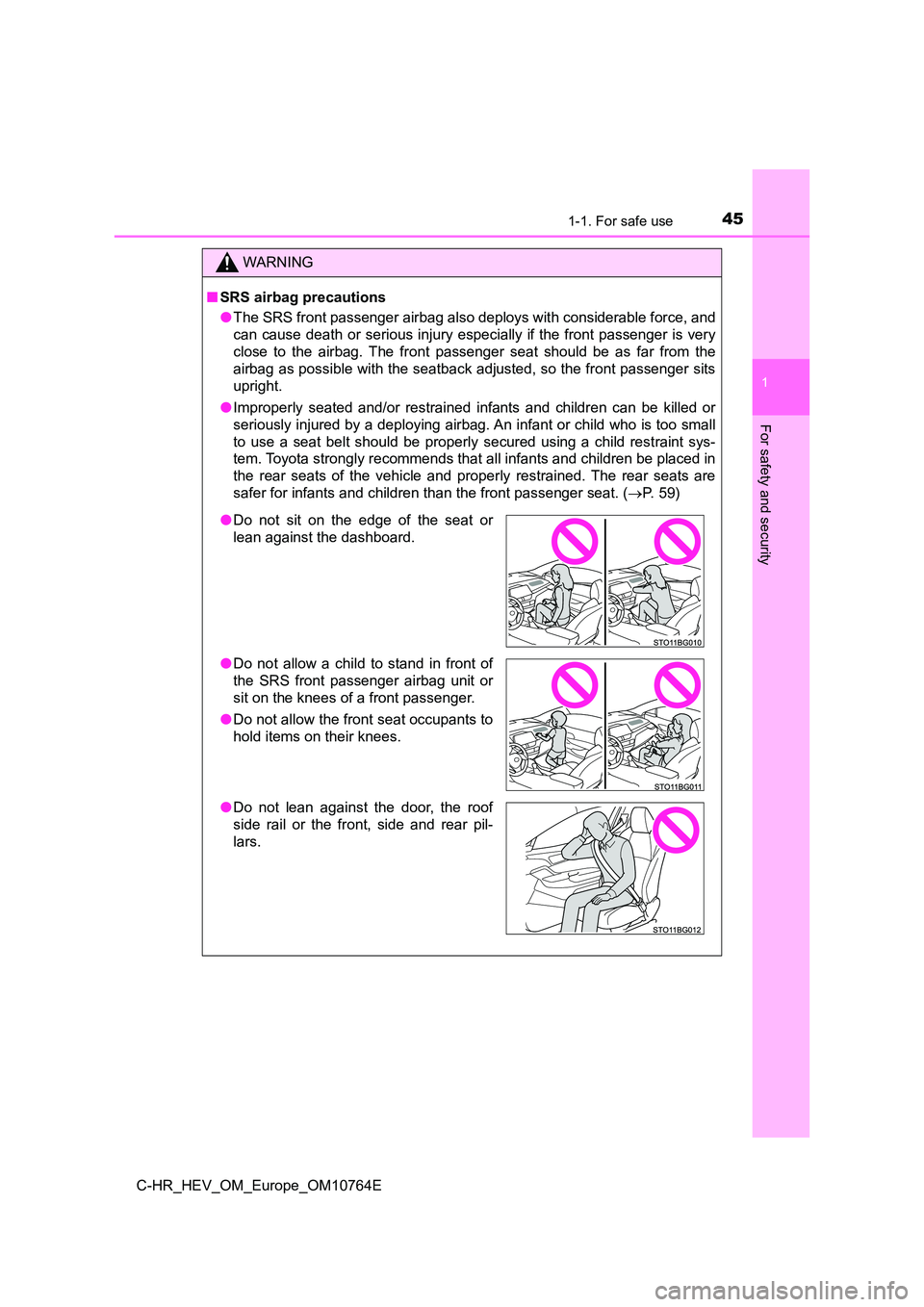
●Do not sit on the edge of the seat or
lean against the dashboard.
● Do not allow a child to stand in front of
the SRS front passenger airbag unit or
sit on the knees of a front passenger.
● Do not allow the front seat occupants to
hold items on their knees.
● Do not lean against the door, the roof
side rail or the front, side and rear pil-
lars.
Page 49 of 814
471-1. For safe use
1
For safety and security
C-HR_HEV_OM_Europe_OM10764E
WARNING
■SRS airbag precautions
● Vehicles with SRS driver’s knee airbag: If a vinyl cover is put on the area
where the SRS driver’s knee airbag will deploy, be sure to remo ve it.
● Do not use seat accessories which cover the parts where the SRS side
airbags inflate as they may interfere with inflation of the SRS airbags.
Such accessories may prevent the side airbags from activating c orrectly,
disable the system or cause the side airbags to inflate acciden tally, result-
ing in death or serious injury.
● Do not strike or apply significant levels of force to the area of the SRS
airbag components or the front doors.
Doing so can cause the SRS airbags to malfunction.
● Do not touch any of the component parts immediately after the SRS
airbags have deployed (inflated) as they may be hot.
● If breathing becomes difficult after the SRS airbags have deployed, open a
door or side window to allow fresh air in, or leave the vehicle if it is safe to
do so. Wash off any residue as soon as possible to prevent skin irritation.
● If the areas where the SRS airbags are stored, such as the steering wheel
pad and front and rear pillar garnishes, are damaged or cracked , have
them replaced by any authorized Toyota retailer or Toyota autho rized
repairer, or any reliable repairer.
Page 51 of 814
491-1. For safe use
1
For safety and security
C-HR_HEV_OM_Europe_OM10764E
■If the SRS airbags deploy (inflate)
● Slight abrasions, burns, bruising, etc., may be sustained from SRS airbags,
due to the extremely high speed depl oyment (inflation) by hot gases.
● A loud noise and white powder will be emitted.
● Parts of the airbag module (steering wheel hub, airbag cover and inflator) as
well as the front seats, parts of the front and rear pillars, a nd roof side rails,
may be hot for several minutes. The airbag itself may also be h ot.
● The windshield may crack.
● The hybrid system will be stopped and fuel supply to the engine will be
stopped. ( P. 123)
● For eCall subscribers, if any of the following situations occur, the system is
designed to send an emergency call to the response center, noti fying them
of the vehicle’s location (without needing to push the “SOS” bu tton) and an
agent will attempt to speak with the occupants to ascertain the level of emer-
gency and assistance required. If the occupants are unable to c ommuni-
cate, the agent automatically treats the call as an emergency a nd helps to
dispatch the necessary emergency services. ( P. 96)
• An SRS airbag is deployed.
• A seat belt pretensioner is activated.
• The vehicle is involved in a severe rear-end collision.
■ SRS airbag deployment conditions (SRS front airbags)
● The SRS front airbags will deploy in the event of an impact that exceeds the
set threshold level (the level of force corresponding to an app roximately 20 -
30 km/h [12 - 18 mph] frontal collision with a fixed wall that does not move or
deform).
However, this threshold veloci ty will be considerably higher in the following
situations:
• If the vehicle strikes an object, such as a parked vehicle or sign pole,
which can move or deform on impact
• If the vehicle is involved in an underride collision, such as a collision in
which the front of the vehicle “underrides”, or goes under, the bed of a
truck
● Depending on the type of collision, it is possible that only the seat belt
pretensioners will activate.
Page 53 of 814
511-1. For safe use
1
For safety and security
C-HR_HEV_OM_Europe_OM10764E
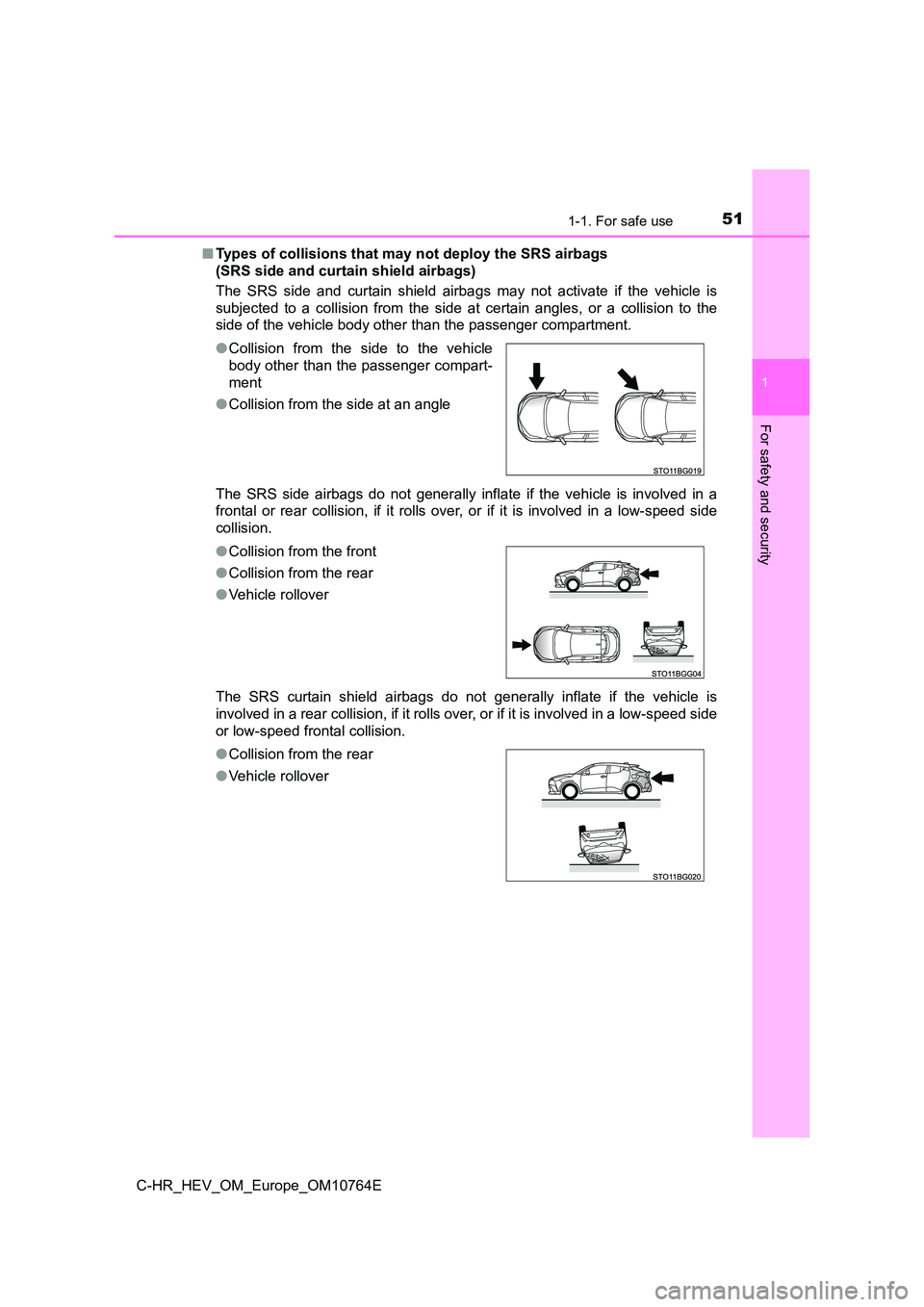
■ Types of collisions that may not deploy the SRS airbags
(SRS side and curtain shield airbags)
The SRS side and curtain shield airbags may not activate if the vehicle is
subjected to a collision from the side at certain angles, or a collision to the
side of the vehicle body other than the passenger compartment.
The SRS side airbags do not generally inflate if the vehicle is involved in a
frontal or rear collision, if it rolls over, or if it is involv ed in a low-speed side
collision.
The SRS curtain shield airbags do not generally inflate if the vehicle is
involved in a rear collision, if it rolls over, or if it is inv olved in a low-speed side
or low-speed frontal collision.
● Collision from the side to the vehicle
body other than the passenger compart-
ment
● Collision from the side at an angle
● Collision from the front
● Collision from the rear
● Vehicle rollover
● Collision from the rear
● Vehicle rollover
Page 55 of 814
531-1. For safe use
1
For safety and security
C-HR_HEV_OM_Europe_OM10764E
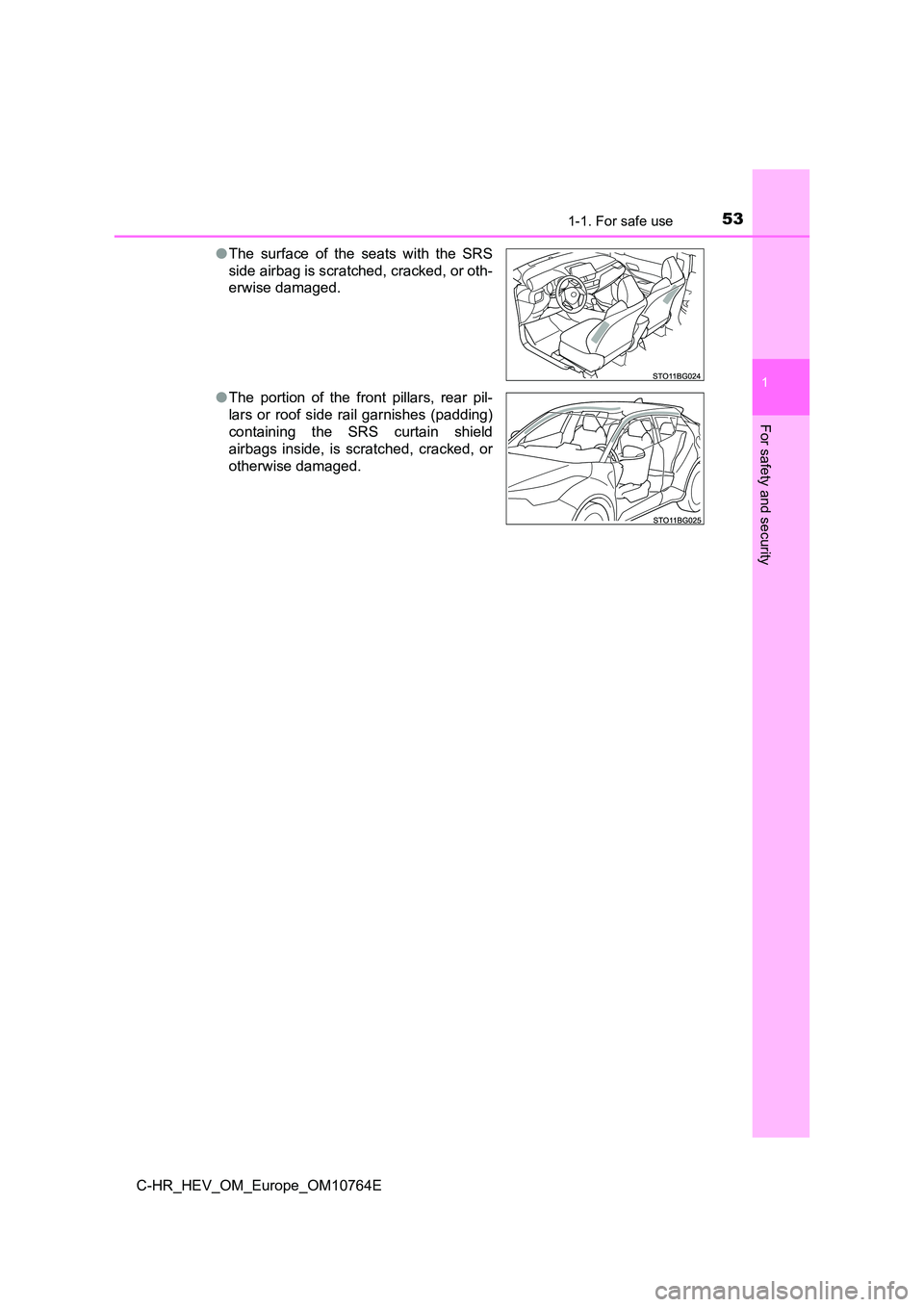
● The surface of the seats with the SRS
side airbag is scratched, cracked, or oth-
erwise damaged.
● The portion of the front pillars, rear pil-
lars or roof side rail garnishes (padding)
containing the SRS curtain shield
airbags inside, is scratched, cracked, or
otherwise damaged.
Page 57 of 814
551-2. Child safety
1
For safety and security
C-HR_HEV_OM_Europe_OM10764E
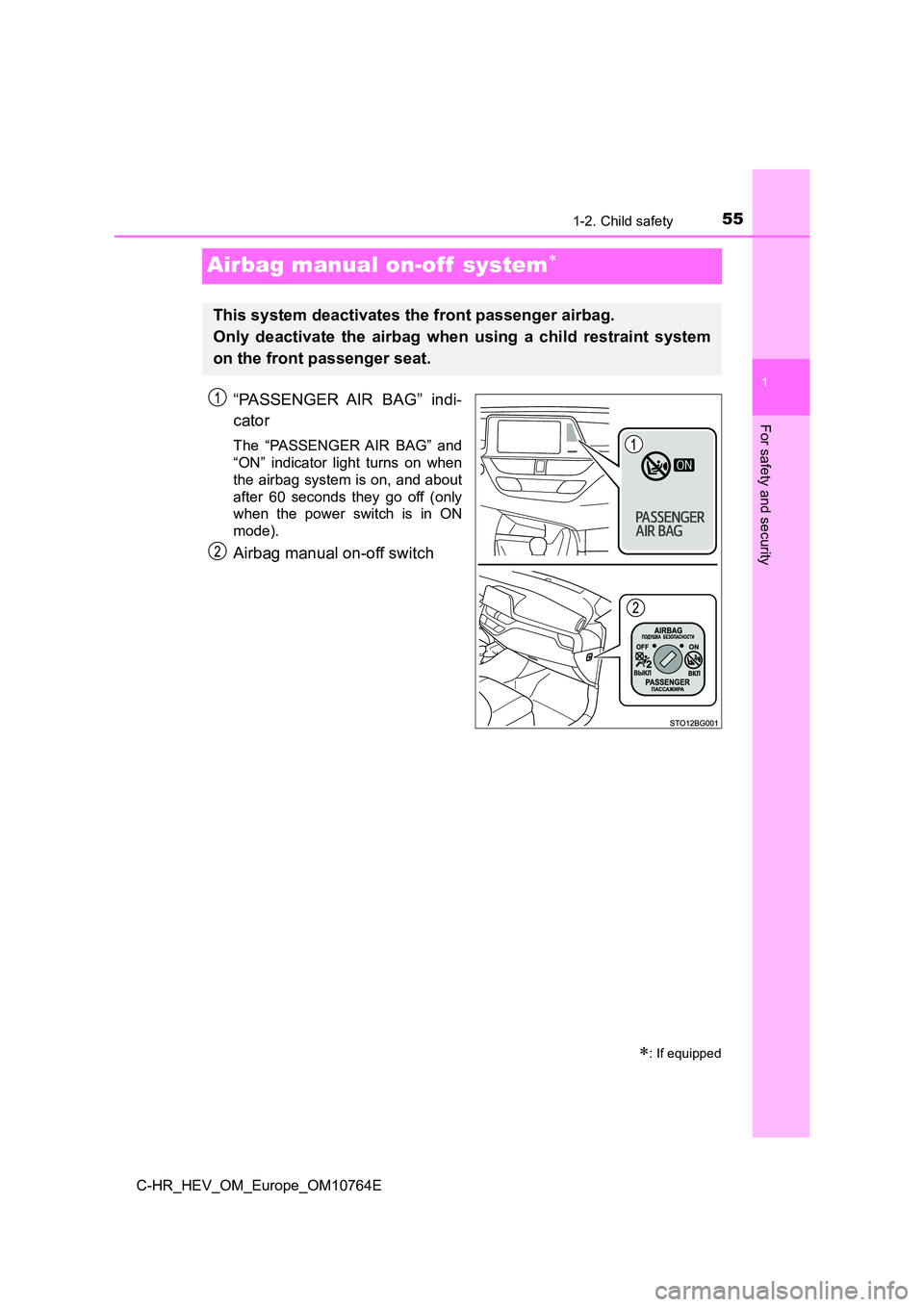
Airbag manual on-off system
“PASSENGER AIR BAG” indi-
cator
The “PASSENGER AIR BAG” and
“ON” indicator light turns on when
the airbag system is on, and about
after 60 seconds they go off (only
when the power switch is in ON
mode).
Airbag manual on-off switch
: If equipped
This system deactivates the front passenger airbag.
Only deactivate the airbag when using a child restraint system
on the front passenger seat.
Page 59 of 814
571-2. Child safety
1
For safety and security
C-HR_HEV_OM_Europe_OM10764E
WARNING
■When installing a child restraint system
For safety reasons, always install a child restraint system in a rear seat. In
the event that the rear seat cannot be used, the front seat can be used as
long as the airbag manual on-off system is set to “OFF”.
If the airbag manual on-off system is left on, the strong impac t of the airbag
deployment (inflation) may cause serious injury or even death.
■ When a child restraint system is not installed on the front passenger
seat
Ensure that the airbag manual on-off system is set to “ON”.
If it is left off, the airbag may not deploy in the event of an accident, which
may result in serious injury or even death.
Page 61 of 814
591-2. Child safety
1
For safety and security
C-HR_HEV_OM_Europe_OM10764E
Child restraint systems
Points to remember................................................................. P. 60
When using a child restraint system ............................ ........... P. 62
Child restraint system compatibility for each seating position
(Except for Reunion and Latin American countries*) .............. P. 66
Child restraint system compatibility for each seating position
(For Reunion) .................................................. ........................ P. 74
Child restraint system compatibility for each seating position
(For Latin American countries*) .............................................. P. 81
Child restraint system installation method ..................... ......... P. 89
• Fixed with a seat belt ........................................ .................. P. 90
• Fixed with an ISOFIX lower anchorage.......................... ..... P. 92
• Using a top tether anchorage .................................. ............ P. 94
*: Guadelope, Martinique and F. Guiana
Before installing a child restraint system in the vehicle, there are
precautions that need to be observed, different types of child
restraint systems, as well as installation methods, etc., writt en in
this manual.
● Use a child restraint system when riding with a small child that
cannot properly use a seat belt. For the child’s safety, instal l the
child restraint system to a rear seat. Be sure to follow the in stalla-
tion method that is in the operation manual enclosed with the
restraint system.
● The use of a Toyota genuine child restraint system is recom-
mended, as it is safer to use in this vehicle. Toyota genuine c hild
restraint systems are made specifically for Toyota vehicles. Th ey
can be purchased at a Toyota dealer.
Table of contents
Page 63 of 814
611-2. Child safety
1
For safety and security
C-HR_HEV_OM_Europe_OM10764E
WARNING
■Handling the child restraint system
If the child restraint system is not properly fixed in place, t he child or other
passengers may be seriously injured or even killed in the event of sudden
braking, sudden swerving, or an accident.
● If the vehicle were to receive a strong impact from an accident, etc., it is
possible that the child restraint system has damage that is not readily visi-
ble. In such cases, do not reuse the restraint system.
● Depending on the child restraint system, installation may be difficult or
impossible. In those cases, check whether the child restraint s ystem is
suitable for installment in the vehicle. ( P. 66, 74, 81) Be sure to install
and observe the usage rules after carefully reading the child r estraint sys-
tem fixing method in this manual, as well as the operation manu al
enclosed with the child restraint system.
● Keep the child restraint system properly secured on the seat even if it is
not in use. Do not store the child restraint system unsecured i n the pas-
senger compartment.
● If it is necessary to detach the child restraint system, remove it from the
vehicle or store it securely in the luggage compartment.
Page 65 of 814
631-2. Child safety
1
For safety and security
C-HR_HEV_OM_Europe_OM10764E
WARNING
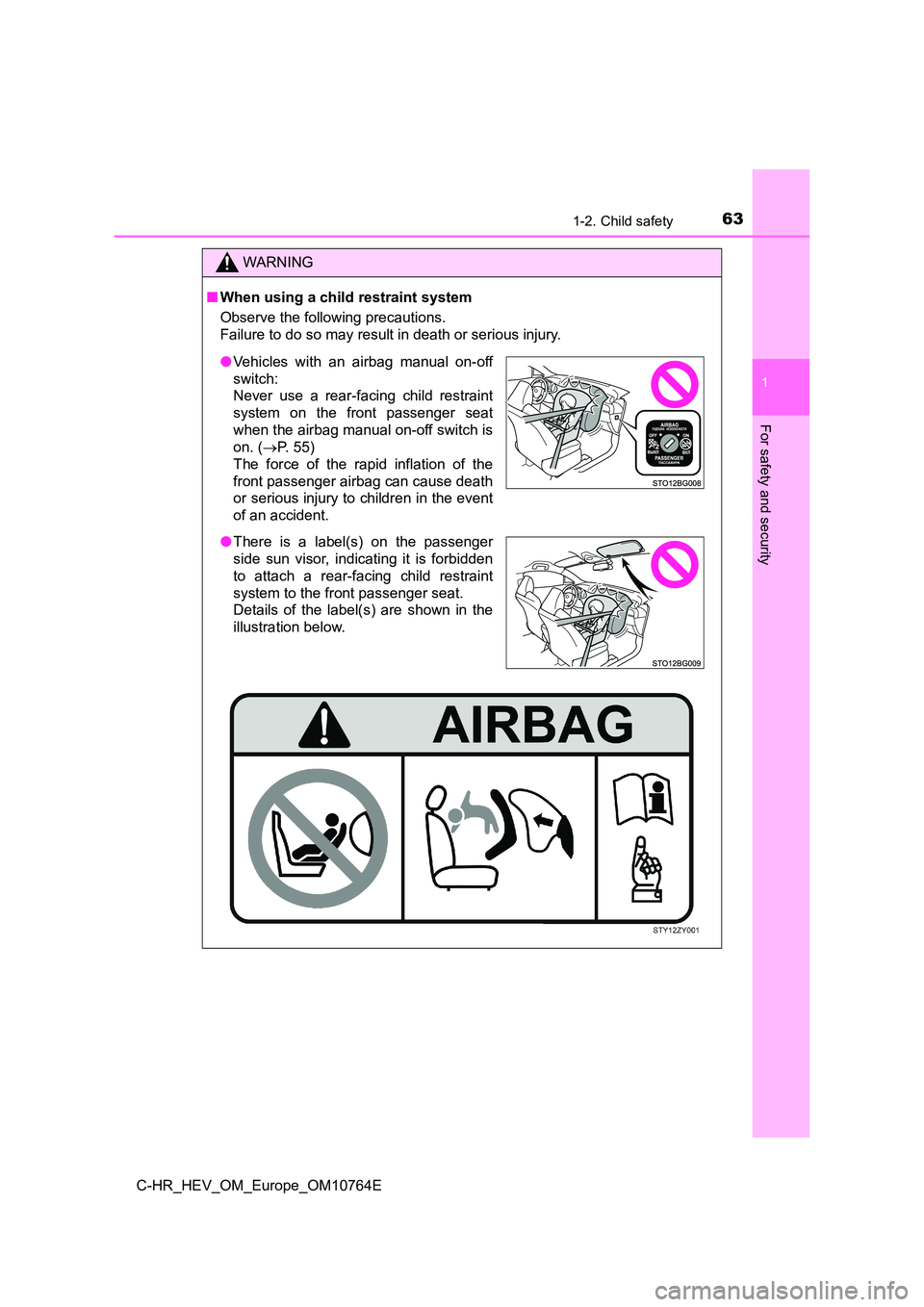
■When using a child restraint system
Observe the following precautions.
Failure to do so may result in death or serious injury.
● Vehicles with an airbag manual on-off
switch:
Never use a rear-facing child restraint
system on the front passenger seat
when the airbag manual on-off switch is
on. ( P. 55)
The force of the rapid inflation of the
front passenger airbag can cause death
or serious injury to children in the event
of an accident.
● There is a label(s) on the passenger
side sun visor, indicating it is forbidden
to attach a rear-facing child restraint
system to the front passenger seat.
Details of the label(s) are shown in the
illustration below.