ECU TOYOTA C-HR 2023 Owner's Manual
[x] Cancel search | Manufacturer: TOYOTA, Model Year: 2023, Model line: C-HR, Model: TOYOTA C-HR 2023Pages: 814, PDF Size: 112.62 MB
Page 67 of 814
651-2. Child safety
1
For safety and security
C-HR_HEV_OM_Europe_OM10764E
WARNING
■When using a child restraint system
● When a junior seat is installed, always ensure that the shoulder belt is
positioned across the center of the child’s shoulder. The belt should be
kept away from the child’s neck, but not so that it could fall off the child’s
shoulder.
● Use child restraint system suitable to the age and size of the child and
install it to the rear seat.
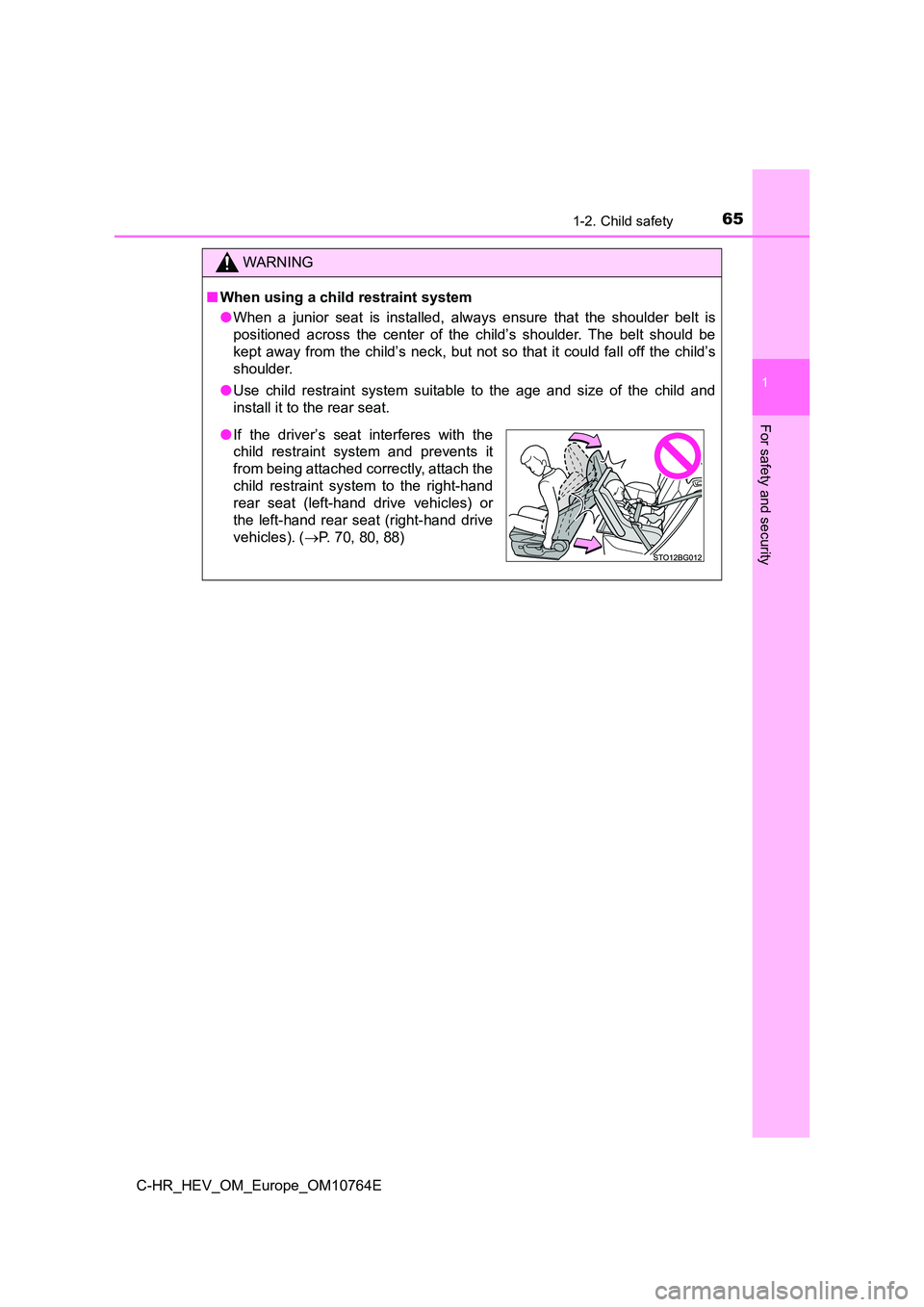
● If the driver’s seat interferes with the
child restraint system and prevents it
from being attached correctly, attach the
child restraint system to the right-hand
rear seat (left-hand drive vehicles) or
the left-hand rear seat (right-hand drive
vehicles). ( P. 70, 80, 88)
Page 69 of 814
671-2. Child safety
1
For safety and security
C-HR_HEV_OM_Europe_OM10764E
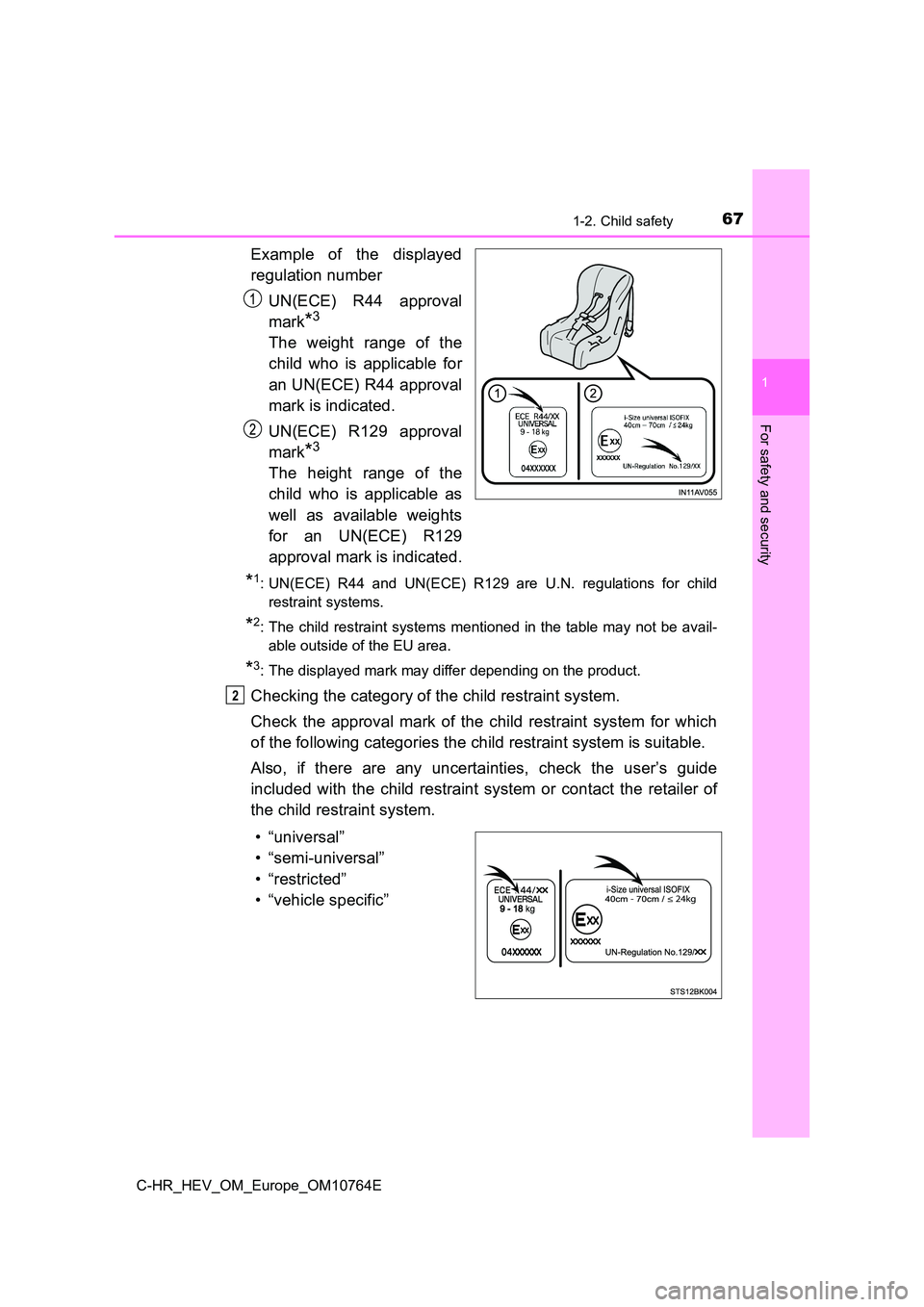
Example of the displayed
regulation number
UN(ECE) R44 approval
mark*3
The weight range of the
child who is applicable for
an UN(ECE) R44 approval
mark is indicated.
UN(ECE) R129 approval
mark*3
The height range of the
child who is applicable as
well as available weights
for an UN(ECE) R129
approval mark is indicated.
*1: UN(ECE) R44 and UN(ECE) R129 are U.N. regulations for child
restraint systems.
*2: The child restraint systems mentioned in the table may not be avail-
able outside of the EU area.
*3: The displayed mark may differ depending on the product.
Checking the category of the child restraint system.
Check the approval mark of the child restraint system for which
of the following categories the child restraint system is suita ble.
Also, if there are any uncertainties, check the user’s guide
included with the child restraint system or contact the retaile r of
the child restraint system.
•“universal”
• “semi-universal”
• “restricted”
• “vehicle specific”
2
Page 71 of 814
691-2. Child safety
1
For safety and security
C-HR_HEV_OM_Europe_OM10764E
*1: Move the front seat fully rearward. If the passenger seat height can be
adjusted, move it to the upper most position.
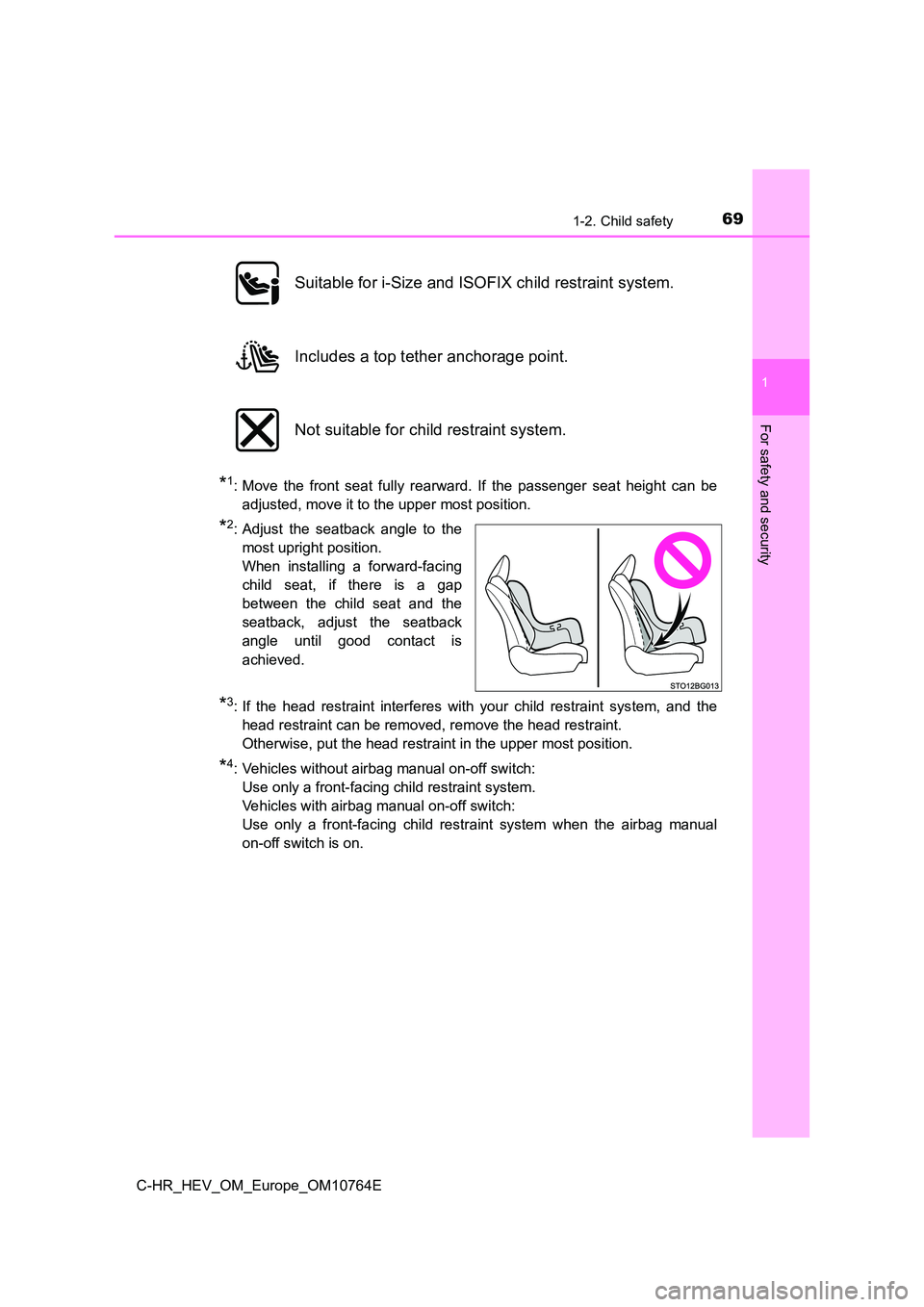
*2: Adjust the seatback angle to the
most upright position.
When installing a forward-facing
child seat, if there is a gap
between the child seat and the
seatback, adjust the seatback
angle until good contact is
achieved.
*3: If the head restraint interferes with your child restraint sys tem, and the
head restraint can be removed, remove the head restraint.
Otherwise, put the head restraint in the upper most position.
*4: Vehicles without airbag manual on-off switch:
Use only a front-facing child restraint system.
Vehicles with airbag manual on-off switch:
Use only a front-facing child restraint system when the airbag manual
on-off switch is on.
Suitable for i-Size and ISOFIX child restraint system.
Includes a top tether anchorage point.
Not suitable for child restraint system.
Page 72 of 814
701-2. Child safety
C-HR_HEV_OM_Europe_OM10764E
When securing some types of child restraint systems in rear seat, it
may not be possible to properly use the seat belts in positions next to
the child restraint without interfering with it or affecting se at belt effec-
tiveness. Be sure your seat belt fits snugly across your should er and
low on your hips. If it does not, or if it interferes with the child restraint,
move to a different position. Failure to do so may result in de ath or
serious injury.
● When installing a child restraint in the rear seats, adjust the front
seat so that it does not interfere with the child or child rest raint
system.
● When installing a child seat with support base, if the child seat
interferes with the seatback when latching it into the support
base, adjust the seatback rearward until there is no interferen ce.
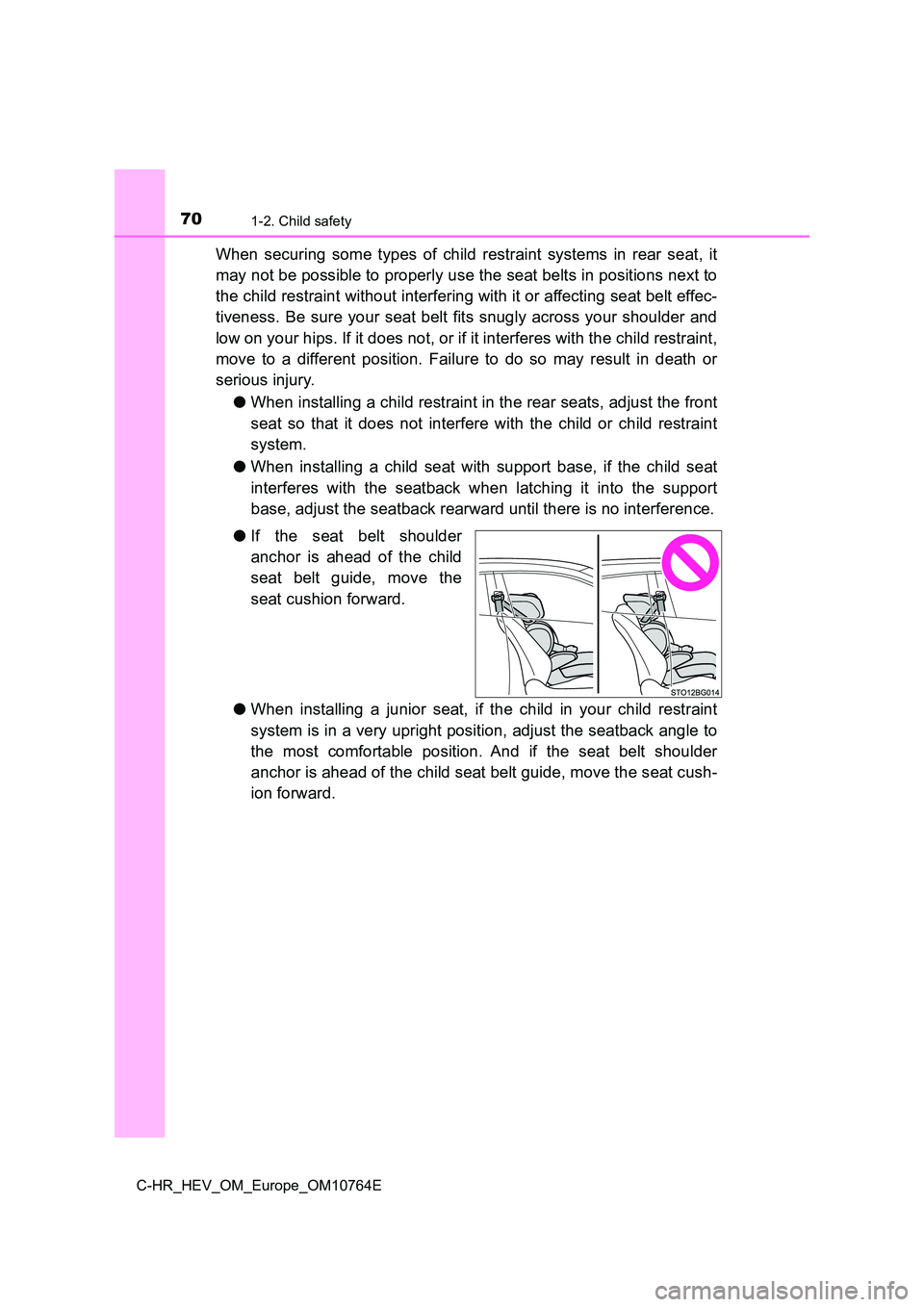
● If the seat belt shoulder
anchor is ahead of the child
seat belt guide, move the
seat cushion forward.
● When installing a junior seat, if the child in your child restraint
system is in a very upright position, adjust the seatback angle to
the most comfortable position. And if the seat belt shoulder
anchor is ahead of the child seat belt guide, move the seat cus h-
ion forward.
Page 73 of 814
711-2. Child safety
1
For safety and security
C-HR_HEV_OM_Europe_OM10764E
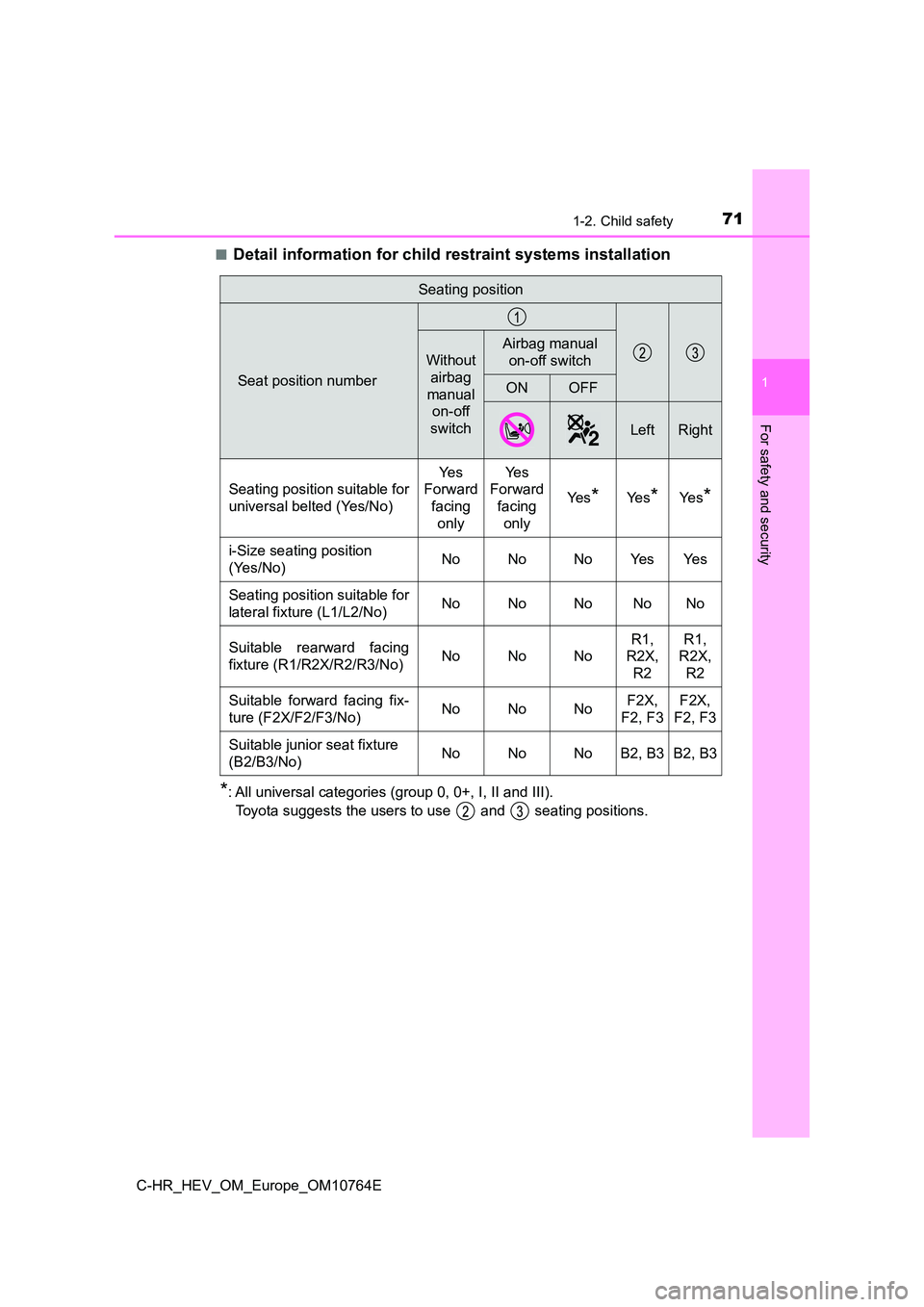
■Detail information for child restraint systems installation
*: All universal categories (group 0, 0+, I, II and III).
Toyota suggests the users to use and seating positions.
Seating position
Seat position number
Without
airbag
manual
on-off
switch
Airbag manual
on-off switch
ONOFF
LeftRight
Seating position suitable for
universal belted (Yes/No)
Ye s
Forward
facing
only
Ye s
Forward
facing
only
Ye s*Ye s*Ye s*
i-Size seating position
(Yes/No)NoNoNoYe sYe s
Seating position suitable for
lateral fixture (L1/L2/No)NoNoNoNoNo
Suitable rearward facing
fixture (R1/R2X/R2/R3/No)NoNoNo
R1,
R2X,
R2
R1,
R2X,
R2
Suitable forward facing fix-
ture (F2X/F2/F3/No)NoNoNoF2X,
F2, F3
F2X,
F2, F3
Suitable junior seat fixture
(B2/B3/No)NoNoNoB2, B3B2, B3
Page 75 of 814
731-2. Child safety
1
For safety and security
C-HR_HEV_OM_Europe_OM10764E
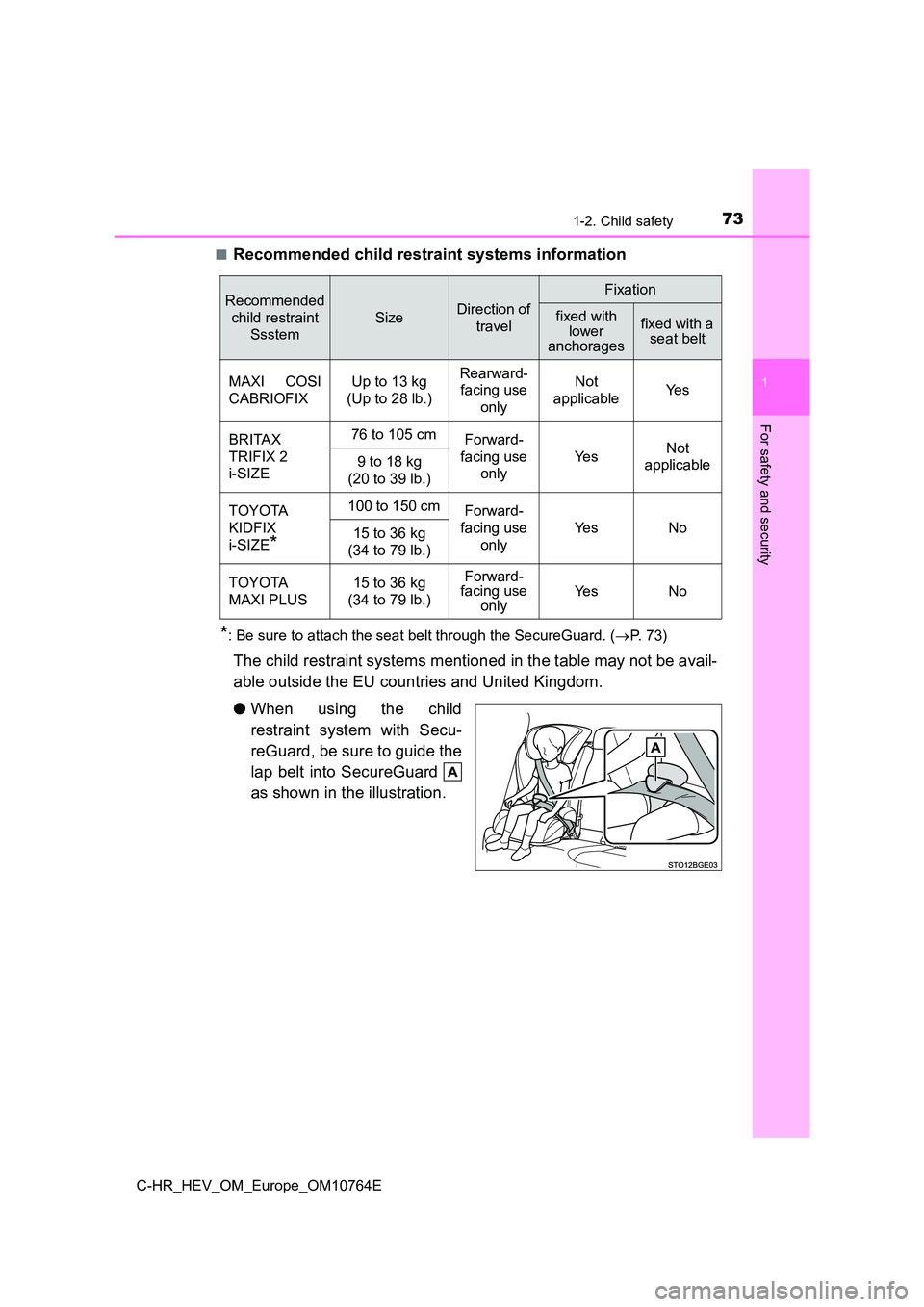
■Recommended child restraint systems information
*: Be sure to attach the seat belt through the SecureGuard. ( P. 73)
The child restraint systems mentioned in the table may not be avail-
able outside the EU countries and United Kingdom.
● When using the child
restraint system with Secu-
reGuard, be sure to guide the
lap belt into SecureGuard
as shown in the illustration.
Recommended
child restraint
Ssstem
SizeDirection of
travel
Fixation
fixed with lower anchorages
fixed with a seat belt
MAXI COSI
CABRIOFIX
Up to 13 kg
(Up to 28 lb.)
Rearward-
facing use
only
Not
applicableYe s
BRITAX
TRIFIX 2
i-SIZE
76 to 105 cmForward-
facing use
only
Ye sNot
applicable9 to 18 kg
(20 to 39 lb.)
TOYOTA
KIDFIX
i-SIZE*
100 to 150 cmForward-
facing use
only
Ye sNo15 to 36 kg
(34 to 79 lb.)
TOYOTA
MAXI PLUS
15 to 36 kg
(34 to 79 lb.)
Forward- facing use onlyYe sNo
Page 77 of 814
751-2. Child safety
1
For safety and security
C-HR_HEV_OM_Europe_OM10764E
*1: UN(ECE) R44 and UN(ECE) R129 are U.N. regulations for child
restraint systems.
*2: The child restraint systems mentioned in the table may not be avail-
able outside of the EU area.
*3: The displayed mark may differ depending on the product.
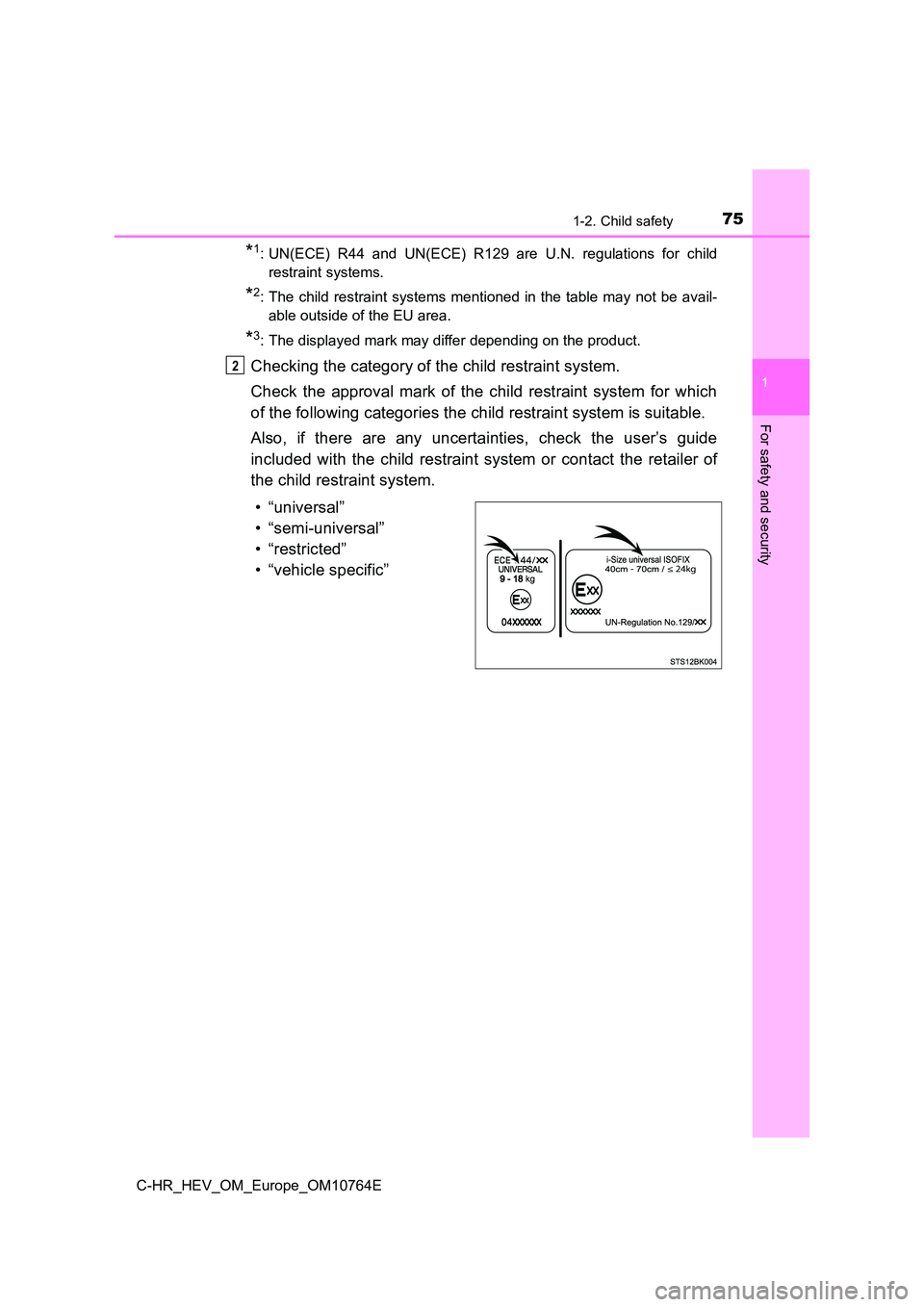
Checking the category of the child restraint system.
Check the approval mark of the child restraint system for which
of the following categories the child restraint system is suita ble.
Also, if there are any uncertainties, check the user’s guide
included with the child restraint system or contact the retaile r of
the child restraint system.
•“universal”
• “semi-universal”
• “restricted”
• “vehicle specific”
2
Page 79 of 814
771-2. Child safety
1
For safety and security
C-HR_HEV_OM_Europe_OM10764E
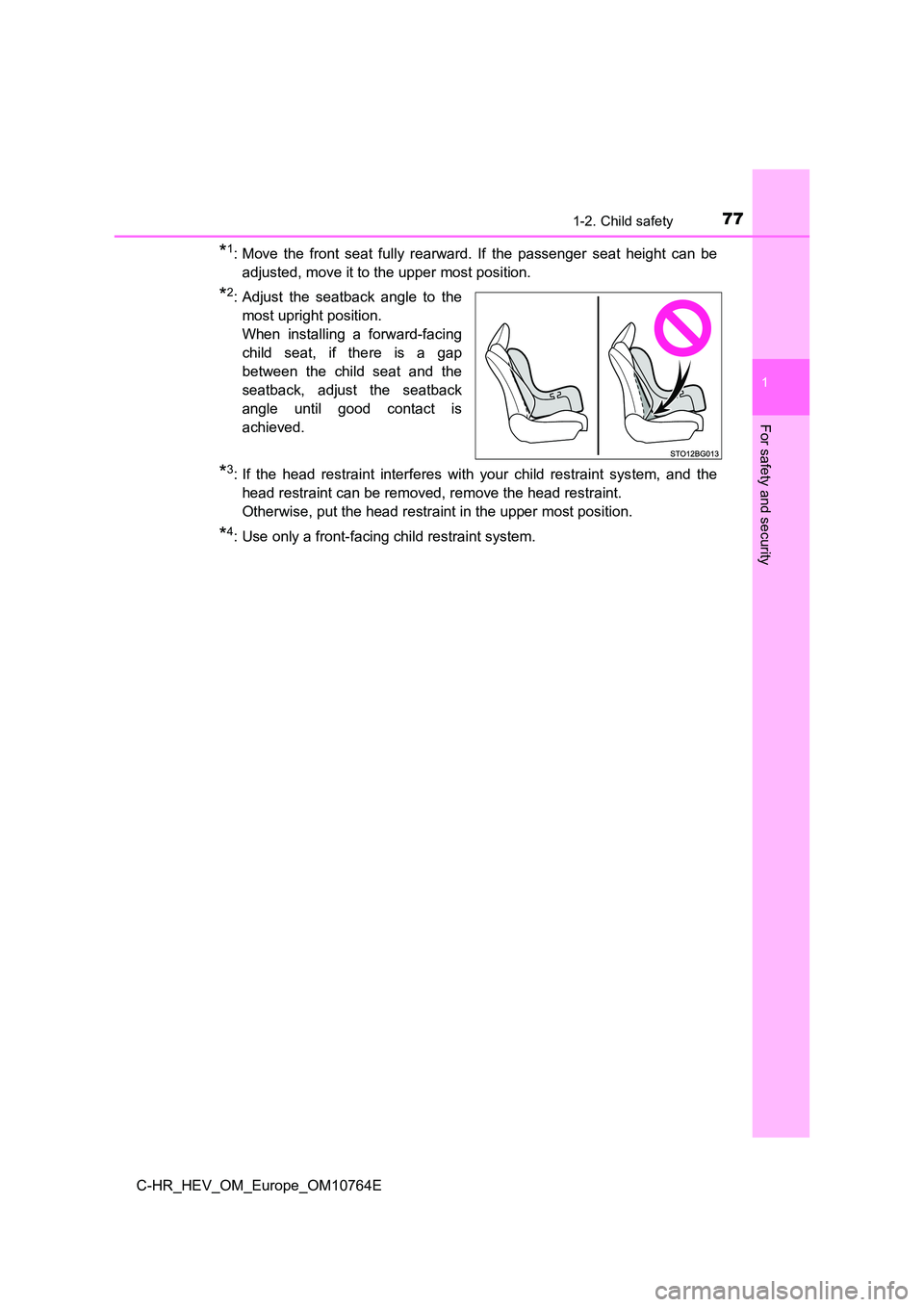
*1: Move the front seat fully rearward. If the passenger seat height can be
adjusted, move it to the upper most position.
*2: Adjust the seatback angle to the
most upright position.
When installing a forward-facing
child seat, if there is a gap
between the child seat and the
seatback, adjust the seatback
angle until good contact is
achieved.
*3: If the head restraint interferes with your child restraint sys tem, and the
head restraint can be removed, remove the head restraint.
Otherwise, put the head restraint in the upper most position.
*4: Use only a front-facing child restraint system.
Page 81 of 814
791-2. Child safety
1
For safety and security
C-HR_HEV_OM_Europe_OM10764E
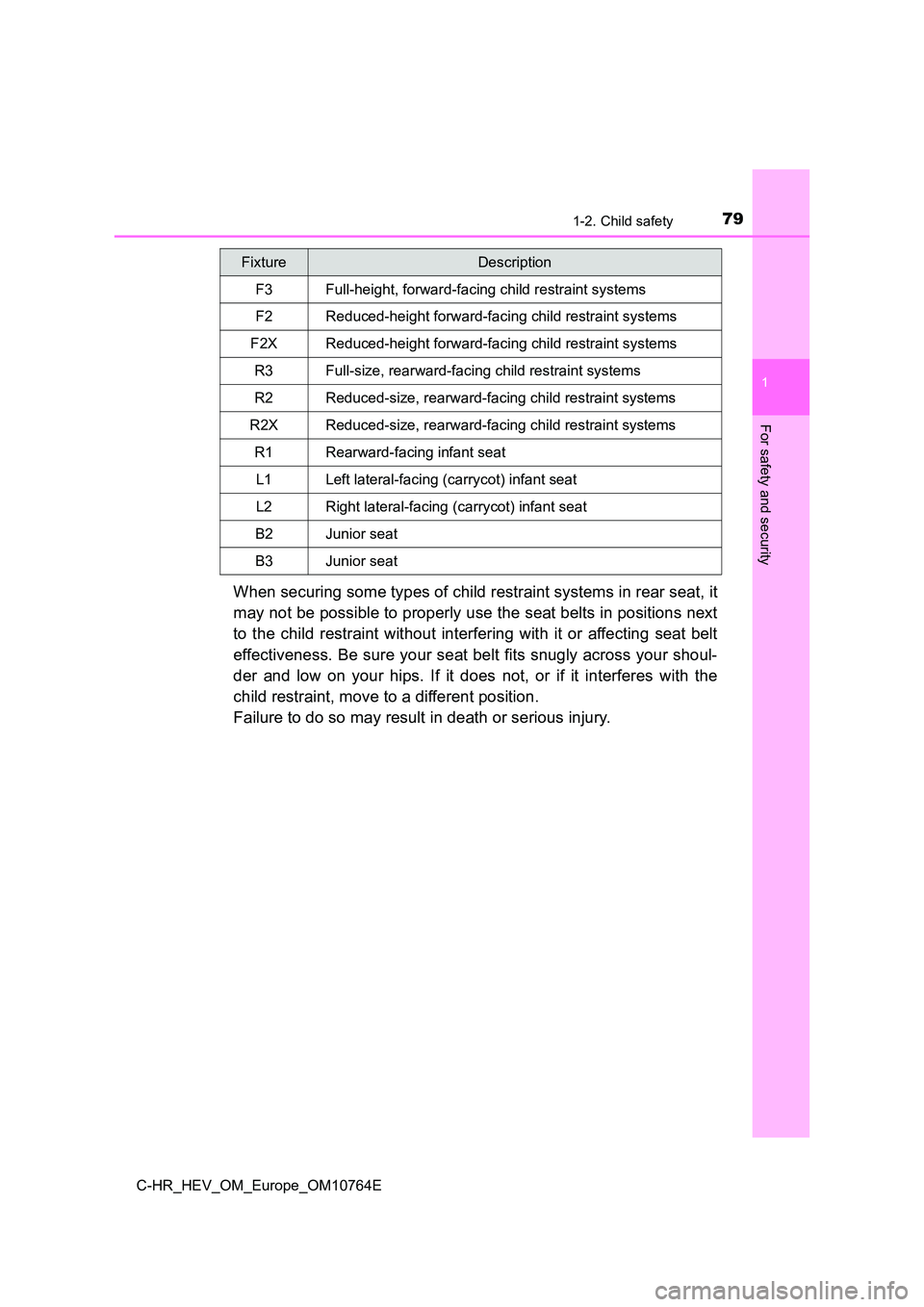
When securing some types of child restraint systems in rear seat, it
may not be possible to properly use the seat belts in positions next
to the child restraint without interfering with it or affecting seat belt
effectiveness. Be sure your seat belt fits snugly across your s houl-
der and low on your hips. If it does not, or if it interferes w ith the
child restraint, move to a different position.
Failure to do so may result in death or serious injury.
FixtureDescription
F3Full-height, forward-facing child restraint systems
F2Reduced-height forward-facing child restraint systems
F2XReduced-height forward-facing child restraint systems
R3Full-size, rearward-facing child restraint systems
R2Reduced-size, rearward-facing child restraint systems
R2XReduced-size, rearward-facing child restraint systems
R1Rearward-facing infant seat
L1Left lateral-facing (carrycot) infant seat
L2Right lateral-facing (carrycot) infant seat
B2Junior seat
B3Junior seat
Page 83 of 814
811-2. Child safety
1
For safety and security
C-HR_HEV_OM_Europe_OM10764E
*: Guadelope, Martinique and F. Guiana
■Child restraint system compatibility for each seating position
Compatibility of each seating position with child restraint sys tems
( P. 83) displays the type of child restraint systems that can be
used and possible seating positions for installation using symb ols.
Also, the recommended child restraint system that is suitable f or
your child can be selected.
Otherwise, check [Recommended child restraint systems and Com-
patibility table] for recommended child restraint systems. ( P. 8 7 )
Check the selected child restraint system together with the fol low-
ing [Before confirming the compatibility of each seating positi on
with child restraint systems].
■Before confirming the compatibility of each seating position
with child restraint systems
Checking the child restraint system standards.
Use a child restraint system that conforms to UN(ECE) R44*1 or
UN(ECE) R129*1, 2.
The following approval mark is displayed on child restraint sys -
tems which are conformed.
Check for an approval mark attached to the child restraint sys-
tem.
Child restraint system compatibility for each seating position
(For Latin American countries*)
1