wheel TOYOTA C-HR 2023 Owner's Manual
[x] Cancel search | Manufacturer: TOYOTA, Model Year: 2023, Model line: C-HR, Model: TOYOTA C-HR 2023Pages: 814, PDF Size: 112.62 MB
Page 275 of 814
2733-4. Adjusting the steering wheel and mirrors
3
Operation of each component
C-HR_HEV_OM_Europe_OM10764E
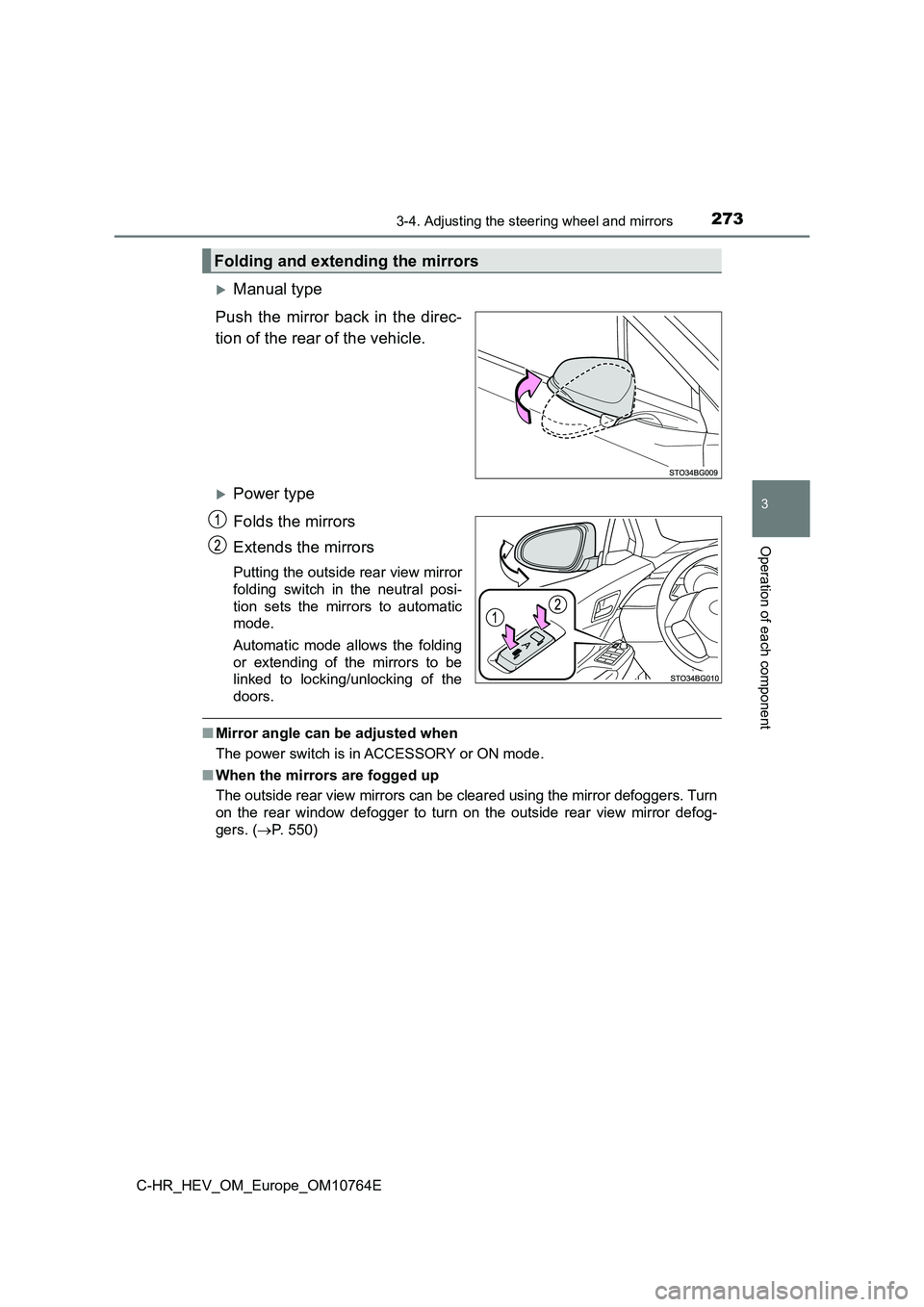
Manual type
Push the mirror back in the direc-
tion of the rear of the vehicle.
Power type
Folds the mirrors
Extends the mirrors
Putting the outside rear view mirror
folding switch in the neutral posi-
tion sets the mirrors to automatic
mode.
Automatic mode allows the folding
or extending of the mirrors to be
linked to locking/unlocking of the
doors.
■ Mirror angle can be adjusted when
The power switch is in ACCESSORY or ON mode.
■ When the mirrors are fogged up
The outside rear view mirrors can be cleared using the mirror d efoggers. Turn
on the rear window defogger to turn on the outside rear view mi rror defog-
gers. ( P. 550)
Folding and extending the mirrors
Page 276 of 814
2743-4. Adjusting the steering wheel and mirrors
C-HR_HEV_OM_Europe_OM10764E
■ Using the automatic folding/extending mirror function in cold weather (if
equipped)
When the automatic folding/ext ending mirror function is used in cold weather,
the outside rear view mirrors could freeze up and automatic fol ding and
extension may not be possible. In this event, remove any ice an d snow from
the outside rear view mirror, then operate the mirror manually by using the
mirror fold switch or moving the mirror by hand.
■ Customization
The automatic mirror folding and extending operation can be cha nged.
(Customizable features: P. 779)
WARNING
■Important points while driving
Observe the following precautions while driving.
Failure to do so may result in loss of control of the vehicle a nd cause an
accident, resulting in death or serious injury.
● Do not adjust the mirrors while driving.
● Do not drive with the mirrors folded.
● Both the driver and passenger side mirrors must be extended and properly
adjusted before driving.
■ When a mirror is moving
To avoid personal injury and mirror malfunction, be careful not to get your
hand caught by the moving mirror.
■ When the mirror defoggers are operating
Do not touch the rear view mirror surfaces, as they can become very hot
and burn you.
Page 285 of 814

2834-1. Before driving
4
Driving
C-HR_HEV_OM_Europe_OM10764E
With the shift lever in D. depress the brake pedal.
Set the parking brake ( P. 324), and shift the shift lever to P
( P. 313, 317).
If parking on a hill, block the wheels as needed.
Press the power switch to stop the hybrid system.
Lock the door, making sure that you have the electronic key on your
person.
With the brake pedal depressed, shift the shift lever to D.
Pull the parking brake switch and parking brake is set manually .
(P. 324)
Release the brake pedal and gently depress the accelerator peda l
to accelerate the vehicle.
Press the parking brake switch and parking brake is released ma n-
ually. (P. 324)
Parking the vehicle
Starting off on a steep uphill
1
2
3
4
1
2
3
4
Page 288 of 814
2864-1. Before driving
C-HR_HEV_OM_Europe_OM10764E
WARNING
Observe the following precautions.
Failure to do so may result in death or serious injury.
■ When driving the vehicle
● Do not drive if you are unfamiliar with the location of the brake and accel-
erator pedals to avoid depressing the wrong pedal.
• Accidentally depressing the accelerator pedal instead of the b rake
pedal will result in sudden acceleration that may lead to an ac cident.
• When backing up, you may twist your body around, leading to a diffi-
culty in operating the pedals. Make sure to operate the pedals properly.
• Make sure to keep a correct driving posture even when moving t he
vehicle only slightly. This allows you to depress the brake and accelera-
tor pedals properly.
• Depress the brake pedal using your right foot. Depressing the brake
pedal using your left foot may delay response in an emergency, result-
ing in an accident.
● The driver should pay extra attention to pedestrians when the vehicle is
powered only by the electric motor (traction motor). As there i s no engine
noise, the pedestrians may misjudge the vehicle’s movement.
Even though the vehicle is equipped with the acoustic vehicle a lerting sys-
tem, drive with care as pedestrians in the vicinity may still n ot notice the
vehicle if the surrounding area is noisy.
● Do not drive the vehicle over or stop the vehicle near flammable materials.
The exhaust system and exhaust gases can be extremely hot. Thes e hot
parts may cause a fire if there is any flammable material nearb y.
● During normal driving, do not turn off the hybrid system. Turning the hybrid
system off while driving will not cause loss of steering or bra king control,
however, power assist to the steering will be lost. This will m ake it more
difficult to steer smoothly, so you should pull over and stop t he vehicle as
soon as it is safe to do so.
In the event of an emergency, such as if it becomes impossible to stop the
vehicle in the normal way: P. 669
● Use engine braking (shift lever to B) to maintain a safe speed when driving
down a steep hill.
Using the brakes continuously may cause the brakes to overheat and lose
effectiveness. ( P. 314, 318)
● Do not adjust the positions of the steering wheel, the seat, or the inside or
outside rear view mirrors while driving.
Doing so may result in a loss of vehicle control.
● Always check that all passengers’ arms, heads or other parts of their body
are not outside the vehicle.
Page 293 of 814

2914-1. Before driving
4
Driving
C-HR_HEV_OM_Europe_OM10764E
NOTICE
■When driving the vehicle
● Do not depress the accelerator and brake pedals at the same time during
driving, as this may restrain the hybrid system output.
● Do not use the accelerator pedal or depress the accelerator and brake
pedals at the same time to hold the vehicle on a hill.
■ When parking the vehicle
Always set the parking brake, and shift the shift lever to P. F ailure to do so
may cause the vehicle to move or the vehicle may accelerate sud denly if
the accelerator pedal is accidentally depressed.
■ Avoiding damage to vehicle parts
● Do not turn the steering wheel fully in either direction and hold it there for
an extended period of time.
Doing so may damage the power steering motor.
● When driving over bumps in the road, drive as slowly as possible to avoid
damaging the wheels, underside of the vehicle, etc.
■ If you get a flat tire while driving
A flat or damaged tire may cause the following situations. Hold the steering
wheel firmly and gradually depress the brake pedal to slow down the vehi-
cle.
● It may be difficult to control your vehicle.
● The vehicle will make abnormal sounds or vibrations.
● The vehicle will lean abnormally.
Information on what to do in case of a flat tire: P. 697, 727
Page 296 of 814

2944-1. Before driving
C-HR_HEV_OM_Europe_OM10764E
Trailer towing
2ZR-FXE engine for Guadeloupe, Martinique, F. Guiana and
Svalbard
Toyota does not recommend
towing a trailer with your vehi-
cle.
Toyota also does not recom-
mend the installation of a tow
hitch or the use of a tow hitch
carrier for a wheelchair,
scooter, bicycle, etc. Your
vehicle is not designed for
trailer towing or for the use of
tow hitch mounted carriers.
Except for 2ZR-FXE engine for Guadeloupe, Martinique, F. Guiana
and Svalbard
Your vehicle is designed primarily as a passenger carrying vehi -
cle. Towing a trailer will have an adverse effect on handling, per-
formance, braking, durability, and fuel consumption. Your safet y
and satisfaction depend on the proper use of correct equipment
and cautious driving habits. For your safety and the safety of
others, do not overload the vehicle or trailer.
To tow a trailer safely, use extreme care and drive the vehicle in
accordance with the trailer’s characteristics and operating con -
ditions.
Toyota warranties do not apply to damage or malfunction
caused by towing a trailer for commercial purposes.
Ask your local authorized Toyota retailer or Toyota authorized
repairer, or any reliable repairer for further details before t owing,
as there are additional legal requirements in some countries.
Page 301 of 814

2994-1. Before driving
4
Driving
C-HR_HEV_OM_Europe_OM10764E
■ If trailer sway occurs
One or more factors (crosswinds, passing vehicles, rough roads, etc.) can
adversely affect handling of your vehicle and trailer, causing instability.
● If trailer swaying occurs:
• Firmly grip the steering wheel. Steer straight ahead.
Do not try to control trailer swaying by turning the steering w heel.
• Begin releasing the accelerator pedal immediately but very gra dually to
reduce speed.
Do not increase speed. Do not apply vehicle brakes.
If you make no extreme correction with the steering or brakes, your vehicle
and trailer should stabilize (if enabled, Trailer Sway Control can also help to
stabilize the vehicle and trailer.).
● After the trailer swaying has stopped:
• Stop in a safe place. Get all occupants out of the vehicle.
• Check the tires of the vehicle and the trailer.
• Check the load in the trailer.
Make sure the load has not shifted.
Make sure the tongue weight is appropriate, if possible.
• Check the load in the vehicle.
Make sure the vehicle is not overloaded after occupants get in.
If you cannot find any problems, the speed at which trailer swa ying occurred
is beyond the limit of your particular vehicle-trailer combinat ion. Drive at a
lower speed to prevent instability. Remember that swaying of th e towing vehi-
cle-trailer increases as speed increases.
NOTICE
■ When the rear bumper strengthening material is aluminum
Ensure the steel bracket part does not come directly in contact with that
area.
When steel and aluminum come into contact, there is a reaction similar to
corrosion, which will weaken the section concerned and may resu lt in dam-
age. Apply a rust inhibitor to parts that will come in contact when attaching a
steel bracket.
Page 302 of 814
3004-1. Before driving
C-HR_HEV_OM_Europe_OM10764E
Your vehicle will handle differently when towing a trailer. In order to
avoid accident, death or serious injury, keep the following in mind
when towing:
■Checking connections between trailer and lights
Stop the vehicle and check the operation of the connection betw een
the trailer and lights after driving for a brief period as well as before
starting off.
■Practicing driving with a coupled trailer
● Get the feel for turning, stopping and reversing with the trailer
coupled by practicing in an area with no or light traffic.
● When reversing with a coupled trailer, hold the section of the
steering wheel nearest to you and rotate clockwise to turn the
trailer left or counterclockwise to turn it right. Always rotat e a little
at a time to prevent steering error. Have someone guide you
when reversing to lessen the risk of an accident.
■Increasing vehicle-to-vehicle distance
At a speed of 10 km/h (6 mph), the distance to the vehicle runn ing
ahead of you should be equivalent to or greater than the combin ed
length of your vehicle and trailer. Avoid sudden braking that m ay
cause skidding. Otherwise, the vehicle may spin out of control. This
is especially true when driving on wet or slippery road surface s.
■Sudden acceleration/steering input/cornering
Executing sharp turns when towing may result in the trailer col liding
with your vehicle. Decelerate well in advance when approaching
turns and take them slowly and carefully to avoid sudden brakin g.
■Important points regarding turning
The wheels of the trailer will travel closer to the inside of t he curve
than the wheels of the vehicle. To make allowance for this, tak e the
turns wider than you would normally do.
Guidance
Page 303 of 814
3014-1. Before driving
4
Driving
C-HR_HEV_OM_Europe_OM10764E
■Important points regarding stability
Vehicle movement resulting from uneven road surfaces and strong
crosswinds will affect handling. The vehicle may also be rocked by
passing buses or large trucks. Frequently check behind when mov -
ing alongside such vehicles. As soon as such vehicle movement
occurs, immediately start to decelerate smoothly by slowly appl ying
the brakes. Always steer the vehicle straight ahead while braki ng.
■Passing other vehicles
Consider the total combined length of your vehicle and trailer and
ensure that the vehicle-to-vehicle distance is sufficient befor e exe-
cuting lane changes.
■Transmission information
To maintain engine braking efficiency and charging system perfo r-
mance when using engine braking, do not use the transmission in
D. Shift the shift lever to B.
■If the engine overheats
Towing a loaded trailer up a long, steep incline in temperature s
exceeding 30 C (85F) may result in the engine overheating. If the
engine coolant temperature gauge indicates that the engine is o ver-
heating, turn the air conditioning off immediately, leave the r oad and
stop the vehicle in a safe place. ( P. 755)
■When parking the vehicle
Always place wheel chocks under the wheels of both the vehicle
and trailer. Firmly set the parking brake and shift the shift l ever to P.
Page 308 of 814

3064-2. Driving procedures
C-HR_HEV_OM_Europe_OM10764E
■ When the ambient temperature is low, such as during winter driving con-
ditions
When starting the hybrid system, the flashing time of the “READ Y” indicator
may be long. Leave the vehicle as it is until the “READY” indic ator is steady
on, as steady means the vehicle is able to move.
■ Conditions affecting operation
P. 208
■ Note for the entry function
P. 209
■ If the hybrid system does not start
● The immobilizer system may not have been deactivated. (P. 129)
Contact any authorized Toyota retailer or Toyota authorized rep airer, or any
reliable repairer.
● Check that the shift lever is securely set in P. The hybrid system may not
start if the shift lever is displaced out of P.
“Shift to P Position to Start.” will be displayed on the multi- information dis-
play.
■ Steering lock
After turning the power switc h off and opening and closing the doors, the
steering wheel will be locked due to the steering lock function . Operating the
power switch again automatically cancels the steering lock.
■ When the steering lock cannot be released
“Push POWER Switch while Turning The
Steering Wheel in Either Direction.” will be
displayed on the multi-information display.
Check that the shift lever is set in P. Press
the power switch while turning the steer-
ing wheel left and right.