sensor TOYOTA CAMRY 2000 Service Repair Manual
[x] Cancel search | Manufacturer: TOYOTA, Model Year: 2000, Model line: CAMRY, Model: TOYOTA CAMRY 2000Pages: 4770, PDF Size: 86.41 MB
Page 1281 of 4770
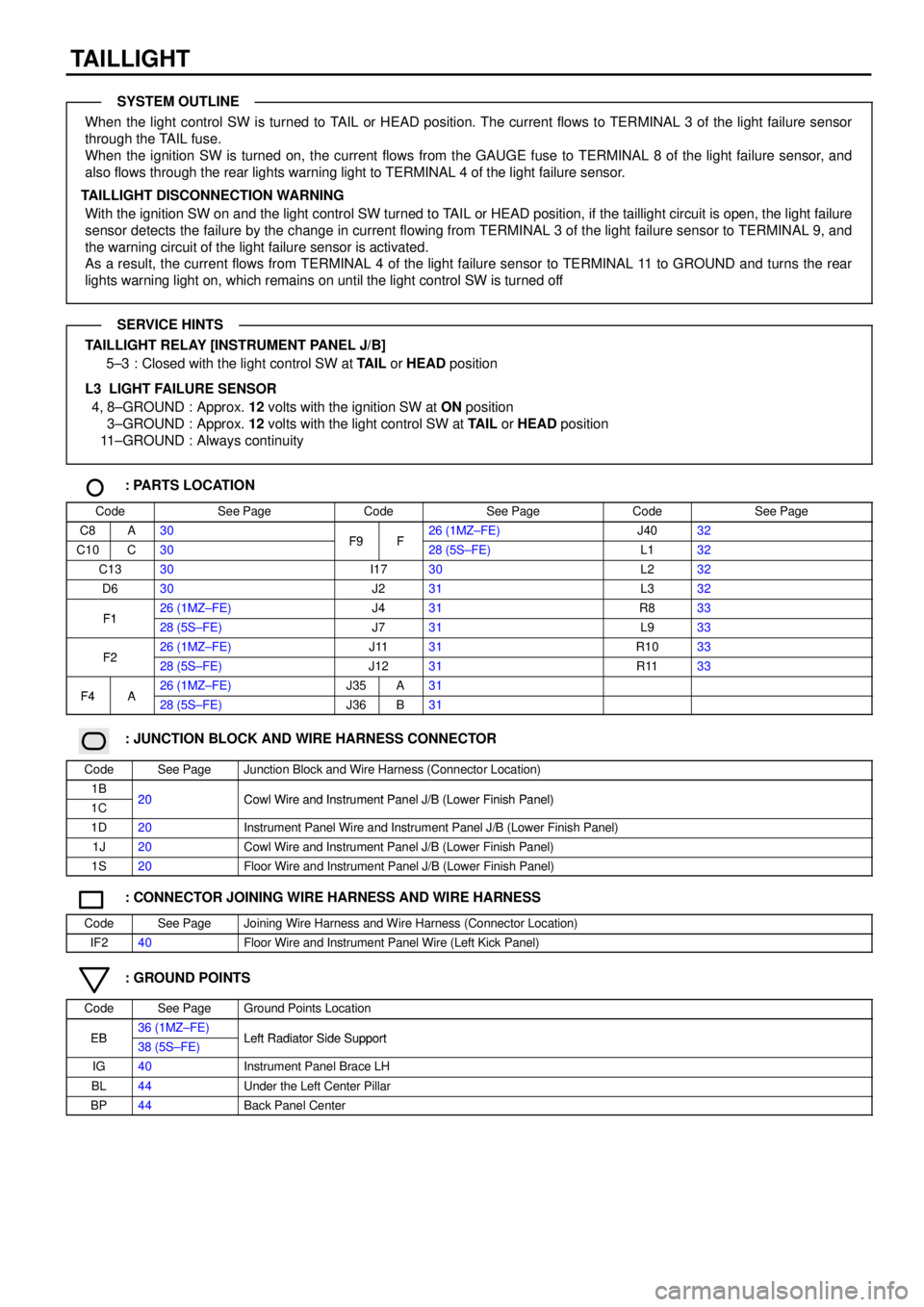
TAILLIGHT
When the light control SW is turned to TAIL or HEAD position. The current flows to TERMINAL 3 of the light failure sensor
through the TAIL fuse.
When the ignition SW is turned on, the current flows from the GAUGE fuse to TERMINAL 8 of the light failure sensor, and
also flows through the rear lights warning light to TERMINAL 4 of the light failure sensor.
TAILLIGHT DISCONNECTION WARNING
With the ignition SW on and the light control SW turned to TAIL or HEAD position, if the taillight circuit is open, the light failure
sensor detects the failure by the change in current flowing from TERMINAL 3 of the light failure sensor to TERMINAL 9, and
the warning circuit of the light failure sensor is activated.
As a result, the current flows from TERMINAL 4 of the light failure sensor to TERMINAL 11 to GROUND and turns the rear
lights warning light on, which remains on until the light control SW is turned off
TAILLIGHT RELAY [INSTRUMENT PANEL J/B]
5±3 : Closed with the light control SW at TAIL or HEAD position
L3 LIGHT FAILURE SENSOR
4, 8±GROUND : Approx. 12 volts with the ignition SW at ON position
3±GROUND : Approx. 12 volts with the light control SW at TAIL or HEAD position
11±GROUND : Always continuity
: PARTS LOCATION
CodeSee PageCodeSee PageCodeSee Page
C8A30F9F26 (1MZ±FE)J4032
C10C30F9F28 (5S±FE)L132
C1330I1730L232
D630J231L332
F126 (1MZ±FE)J431R833F128 (5S±FE)J731L933
F226 (1MZ±FE)J1131R1033F228 (5S±FE)J1231R1133
F4A26 (1MZ±FE)J35A31F4A28 (5S±FE)J36B31
: JUNCTION BLOCK AND WIRE HARNESS CONNECTOR
CodeSee PageJunction Block and Wire Harness (Connector Location)
1B20Cowl Wire and Instrument Panel J/B (Lower Finish Panel)1C20Cowl Wire and Instrument Panel J/B (Lower Finish Panel)
1D20Instrument Panel Wire and Instrument Panel J/B (Lower Finish Panel)
1J20Cowl Wire and Instrument Panel J/B (Lower Finish Panel)
1S20Floor Wire and Instrument Panel J/B (Lower Finish Panel)
: CONNECTOR JOINING WIRE HARNESS AND WIRE HARNESS
CodeSee PageJoining Wire Harness and Wire Harness (Connector Location)
IF240Floor Wire and Instrument Panel Wire (Left Kick Panel)
: GROUND POINTS
CodeSee PageGround Points Location
EB36 (1MZ±FE)Left Radiator Side SupportEB38 (5S±FE)Left Radiator Side Support
IG40Instrument Panel Brace LH
BL44Under the Left Center Pillar
BP44Back Panel Center
SYSTEM OUTLINE
SERVICE HINTS
Page 1349 of 4770
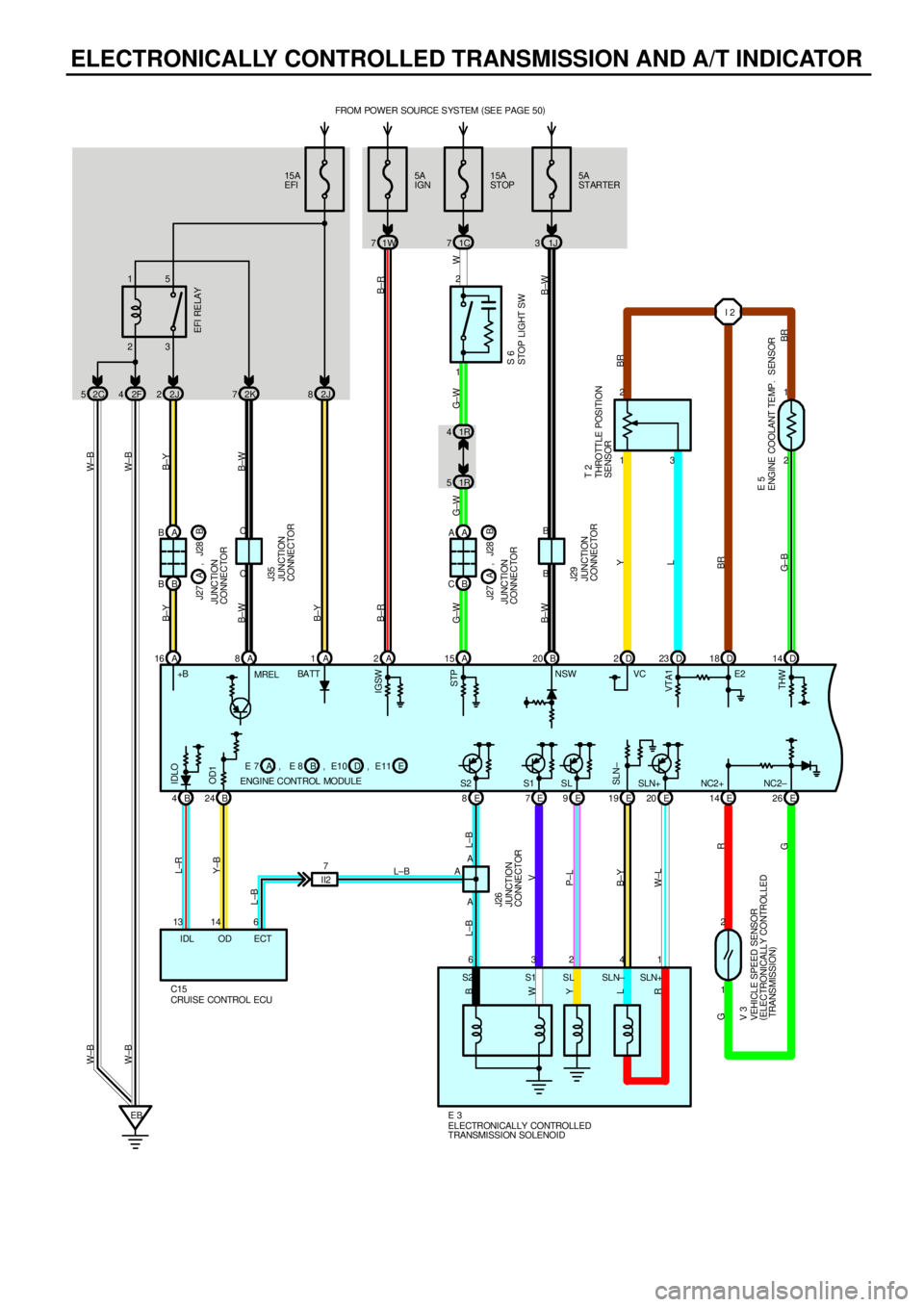
ELECTRONICALLY CONTROLLED TRANSMISSION AND A/T INDICATOR
15A
EFIFROM POWER SOURCE S YS TEM (
SEE PAGE 50)
2J 815A
STOP
1C 7
23 15
2F 42J2
1R 4
1R 51 2
1 2
2 1
A 15 A 1D 2D23 D14 D 18
E 7E9E19 E20 E14 E26 A B
B BI 2
1 2
EBA
63241 A3
G±WB±YB±Y W± B W±B
G± W G±W W
BR
BR G± BL Y
BR L±B L±B
V
P±L
B±Y
W±L
R
G GJUNCTION
CONNECTORB J27 J28AEFI RELAY
SLN+ NC2+ NC2± BA TTVC
STOP LIGHT SW
THROTTLE POSI TI ON
SENSOR
ENGINE COOLANT TEMP. SENSOR
ELECTRONICALLY CONTROLLED
TRANSMISSION SOLENOID
VEHICLE SPEED SENSOR
(
ELECTRONICALLY CONTROLLED
TRANSMISSION)
E 3
V 3S 6
T 2
E 5 B
W
Y
L
R
S2 S1 SL SLN± SLN+ BB24
CRUISE CONTROL ECU C156 13 14
L±BL±R
Y±B
ECT IDL ODA ENGINE CONTROL MODULEB E 7 E 8ADE10 EE11 A 16
B±Y
+B 2C 5
W± B W±B
STP
VTA1
THW IDLO
OD1
SLN± JUNCTION
CONNECTOR J26
L±B5A
IGN
1W 7
A 2
B±RB±R
2K 7
A 8
B±W B±W
C CJUNCTION
CONNECTOR J35
IGSW
S1 SLE2
S25A
STARTER
1J 3
B 20
B±WB±W
B BJUNCTION
CONNECTOR J29
II27
,
,
A A
B C
JUNCTION
CONNECTORB J27 J28A
, , , MRELNSW
4E8
Page 1350 of 4770
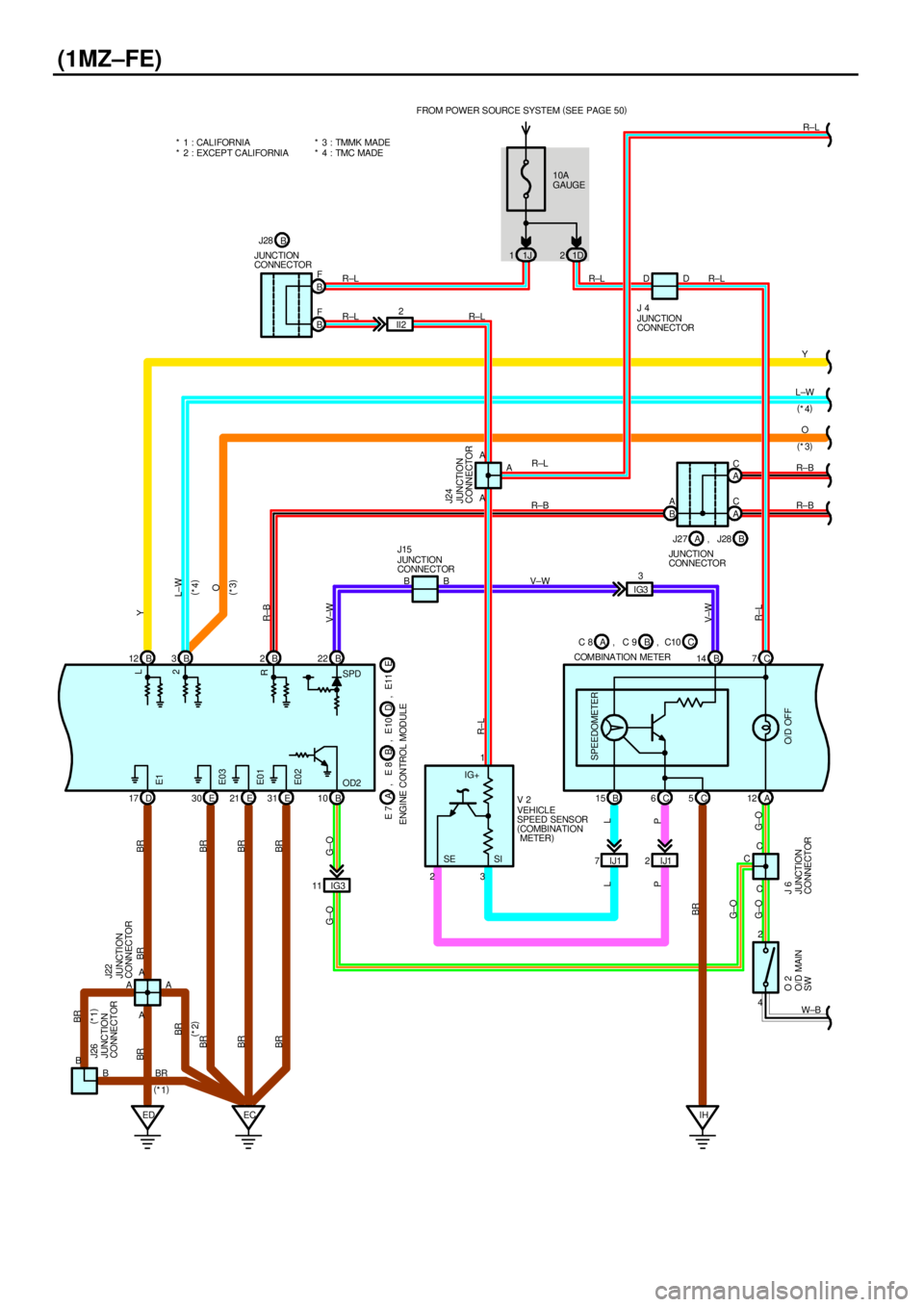
(1MZ±FE)
B 12 B3B2B22
D 17 E21 E31 B10
ED ECIG3 1110A
GAUGE FROM POWER SOURCE SYSTEM (
SEE PAGE 50)
1J 11D2
B 14 C7
B 15 C6A12
IJ1 7IJ12B A
A C A C
IG33
AD
A
B
CC
AA
AD
BA
C
V±W
Y
L±W
R±B
R±B R±L R±L
R±L
V±W
W±B
Y
L±W BR
BR
BR
G±O BR
BR
BR
BRBR
R±L
R±L R±L R±L
V±W
R±L L
P L
P
G±O G±OENGINE CONTROL MODULEB E 7 E 8ADE10 EE11
OD2 SPDJUNCTION
CONNECTORB J27 J28A
COMBINA TION METERB C 8 C 9ACC10 JUNCTION
CONNECTOR J 4
JUNCTION
CONNECTOR J15
JUNCTION
CONNECTOR J 6
O/D MAIN
SW O 2
VEHICLE
SPEED SENSOR
(
COMBINATION
METER) V 2
JUNCTION
CONNECTOR J24
SPEEDOMETER
O/ D OFF G±O G±O
R±L
R±B
R±B
JUNCTION
CONNECTORJ28
B
E 30
BR BRJUNCTION
CONNECTOR J22
C 5
IH
BR
SE SIIG+
L
2
R E1
E03
E01
E02
BF
BF
231
4 2O (
*4)
(
*3)
O
(
*3) (
*4)
,
, , ,
, , II22
B
B
JUNCTION
CONNECTOR J26
A
BR
(
*2) (
*1)
BR
(
*1)* 1 : CALIFORNIA
* 2 : EXCEPT CALIFORNIA* 3 : TMMK MADE
* 4 : TMC MADE
Page 1352 of 4770
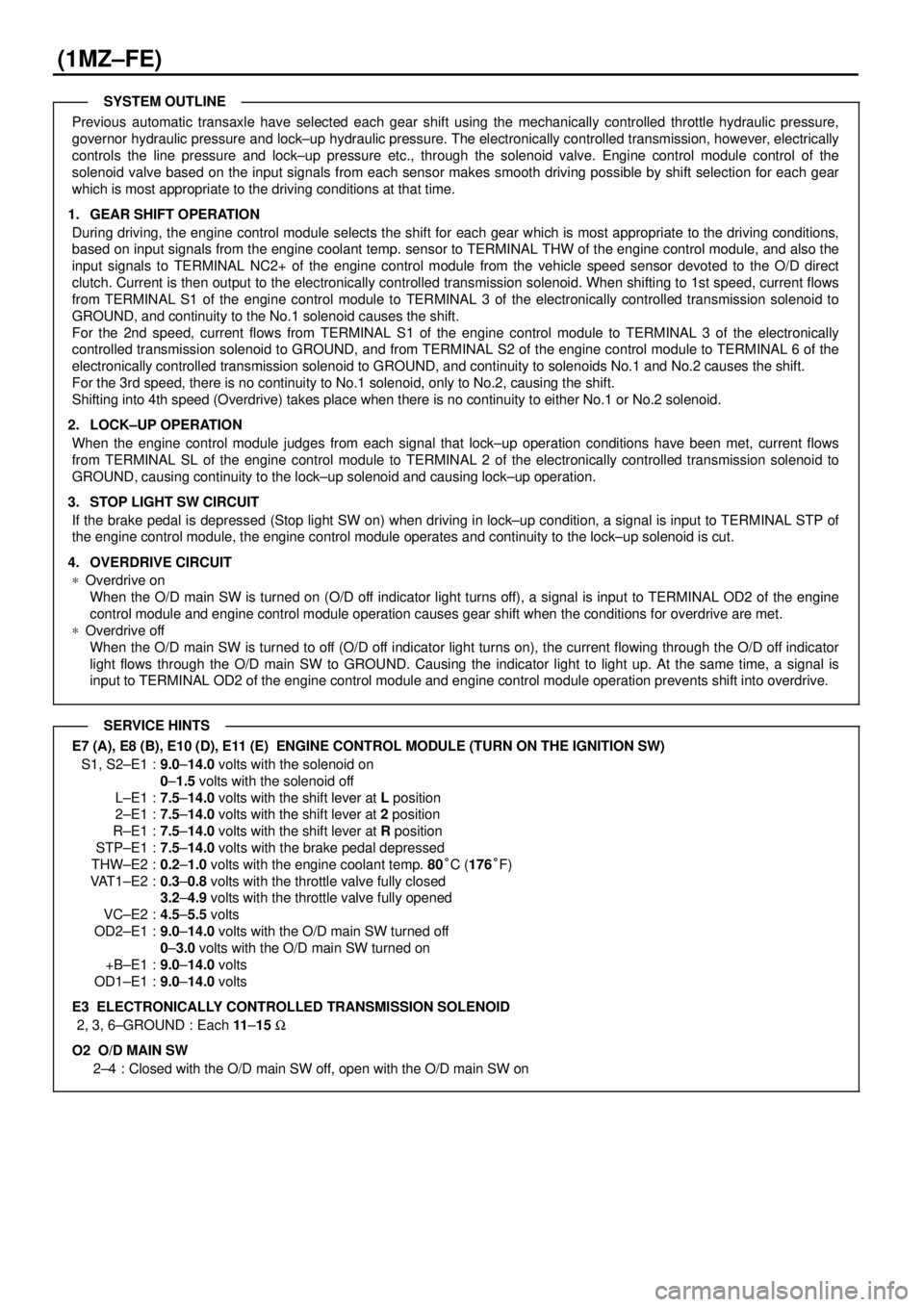
(1MZ±FE)
Previous automatic transaxle have selected each gear shift using the mechanically controlled throttle hydraulic pressure,
governor hydraulic pressure and lock±up hydraulic pressure. The electronically controlled transmission, however, electrically
controls the line pressure and lock±up pressure etc., through the solenoid valve. Engine control module control of the
solenoid valve based on the input signals from each sensor makes smooth driving possible by shift selection for each gear
which is most appropriate to the driving conditions at that time.
1. GEAR SHIFT OPERATION
During driving, the engine control module selects the shift for each gear which is most appropriate to the driving conditions,
based on input signals from the engine coolant temp. sensor to TERMINAL THW of the engine control module, and also the
input signals to TERMINAL NC2+ of the engine control module from the vehicle speed sensor devoted to the O/D direct
clutch. Current is then output to the electronically controlled transmission solenoid. When shifting to 1st speed, current flows
from TERMINAL S1 of the engine control module to TERMINAL 3 of the electronically controlled transmission solenoid to
GROUND, and continuity to the No.1 solenoid causes the shift.
For the 2nd speed, current flows from TERMINAL S1 of the engine control module to TERMINAL 3 of the electronically
controlled transmission solenoid to GROUND, and from TERMINAL S2 of the engine control module to TERMINAL 6 of the
electronically controlled transmission solenoid to GROUND, and continuity to solenoids No.1 and No.2 causes the shift.
For the 3rd speed, there is no continuity to No.1 solenoid, only to No.2, causing the shift.
Shifting into 4th speed (Overdrive) takes place when there is no continuity to either No.1 or No.2 solenoid.
2. LOCK±UP OPERATION
When the engine control module judges from each signal that lock±up operation conditions have been met, current flows
from TERMINAL SL of the engine control module to TERMINAL 2 of the electronically controlled transmission solenoid to
GROUND, causing continuity to the lock±up solenoid and causing lock±up operation.
3. STOP LIGHT SW CIRCUIT
If the brake pedal is depressed (Stop light SW on) when driving in lock±up condition, a signal is input to TERMINAL STP of
the engine control module, the engine control module operates and continuity to the lock±up solenoid is cut.
4. OVERDRIVE CIRCUIT
*Overdrive on
When the O/D main SW is turned on (O/D off indicator light turns off), a signal is input to TERMINAL OD2 of the engine
control module and engine control module operation causes gear shift when the conditions for overdrive are met.
*Overdrive off
When the O/D main SW is turned to off (O/D off indicator light turns on), the current flowing through the O/D off indicator
light flows through the O/D main SW to GROUND. Causing the indicator light to light up. At the same time, a signal is
input to TERMINAL OD2 of the engine control module and engine control module operation prevents shift into overdrive.
E7 (A), E8 (B), E10 (D), E11 (E) ENGINE CONTROL MODULE (TURN ON THE IGNITION SW)
S1, S2±E1 :9.0±14.0 volts with the solenoid on
0±1.5 volts with the solenoid off
L±E1 :7.5±14.0 volts with the shift lever at L position
2±E1 :7.5±14.0 volts with the shift lever at 2 position
R±E1 :7.5±14.0 volts with the shift lever at R position
STP±E1 :7.5±14.0 volts with the brake pedal depressed
THW±E2 :0.2±1.0 volts with the engine coolant temp. 80°C (176°F)
VAT1±E2 :0.3±0.8 volts with the throttle valve fully closed
3.2±4.9 volts with the throttle valve fully opened
VC±E2 :4.5±5.5 volts
OD2±E1 :9.0±14.0 volts with the O/D main SW turned off
0±3.0 volts with the O/D main SW turned on
+B±E1 :9.0±14.0 volts
OD1±E1 :9.0±14.0 volts
E3 ELECTRONICALLY CONTROLLED TRANSMISSION SOLENOID
2, 3, 6±GROUND : Each 11±15 W
O2 O/D MAIN SW
2±4 : Closed with the O/D main SW off, open with the O/D main SW on
SYSTEM OUTLINE
SERVICE HINTS
Page 1357 of 4770
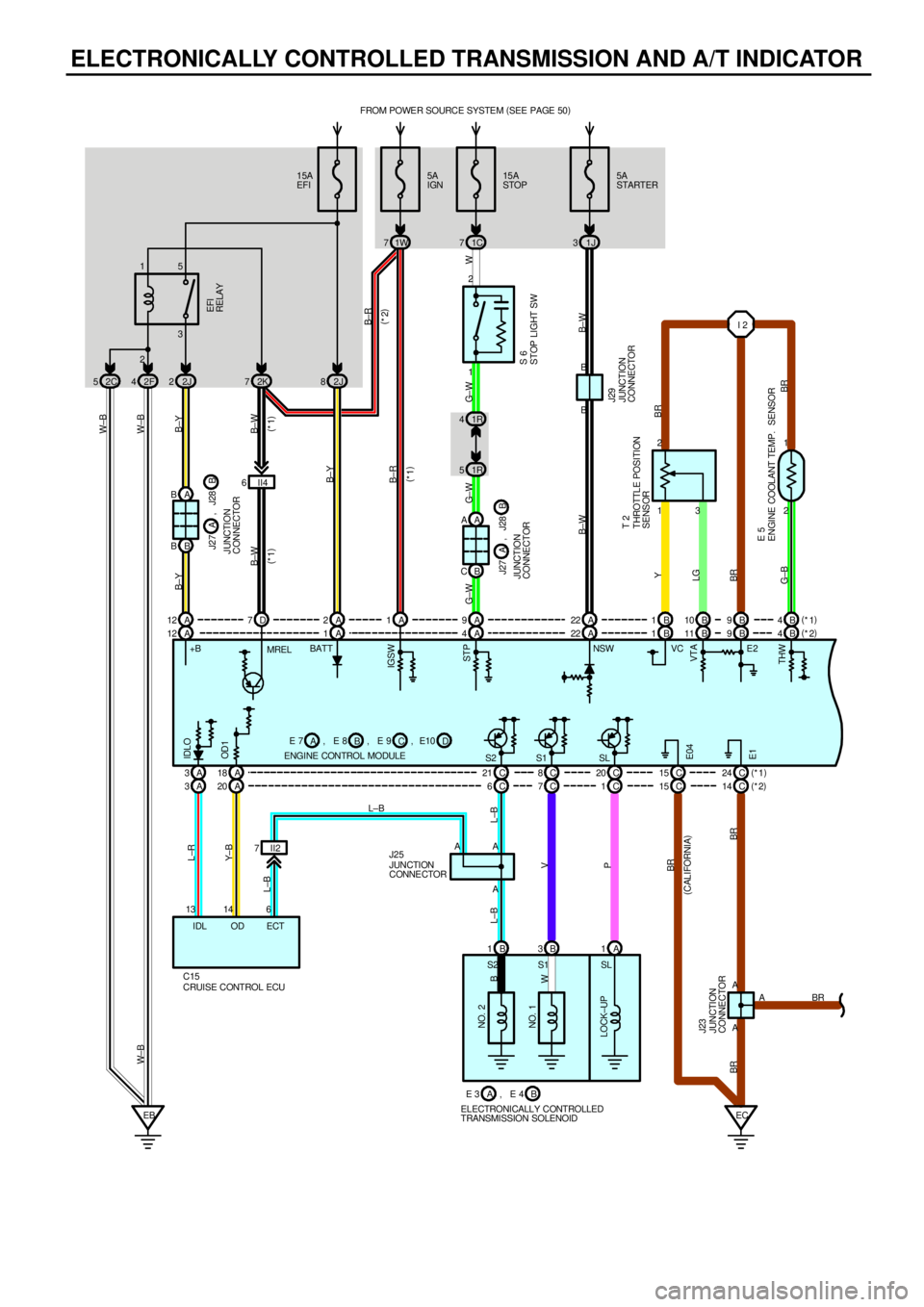
ELECTRONICALLY CONTROLLED TRANSMISSION AND A/T INDICATOR
15A
EFIFROM POWER SOURCE SYSTEM (
SEE PAGE 50)
2J 815A
STOP
1C 7
23 15
2F 42J2
1R 4
1R 51 2
1 2
2 1
A 4 A 1B 1B11 B4 B 9
C 21 C8C20 C24 A B
B BI 2
EBEC A
A A3
AA
G±WB±YB±Y W±B W± B
G± W G± W W
BR
BR G±BLGY
BR L±B L±B
V
P
BR BREFI
RELAY
BATTVC
STOP LIGHT SW
THROTTLE POSITION
SENSOR
ENGINE COOLANT TEMP. SENSORS 6
T 2
E 5 B
W
S2 S1 II2 7 A 3A18
CRUISE CONTROL ECU C156 13 14
L±BL±R
Y± B
ECT IDL ODA ENGINE CONTROL MODULEB ACD A 12
B±Y
+B
JUNCTION
CONNECTOR J23STP
VTA
THW IDLO
OD 1
E1
JUNCTION
CONNE CTOR J25 L±B5A
IGN
1W 7
B±R
2K 7
B±W B±W
IGSW
S1 SLE2
S2B 4 B 9 B 10 B 1 A 9 A 1 A 2 D 7 A 12(
*1)
(
*2) A A
B C
SL
NO. 2
NO. 1
LOCK±UP
B 1B3A1
E 3
ELECTRONICALLY CONTROLLED
TRANSMISSION SOLENOIDB A, E 4C 1 C 7 C 6 A 20 A 3E 7 , E 8 , E 9 , E10
B± R
(
*2)
(
*1)
J27
JUNCTION
CONNECTORB A, J28J27
J UNCTION
CONNECTORB A, J28
II4 6
(
*1) (
*1)
A 22A 225A
STARTER
1J 3
B±W B±W
JUNCTION
CONNECTOR J29
C 14 C 15
C 15
BR
(
CALIFORNIA)
(
*1)
(
*2)
BR B B
E04
MRELNSW 2C 5
W±B
Page 1358 of 4770
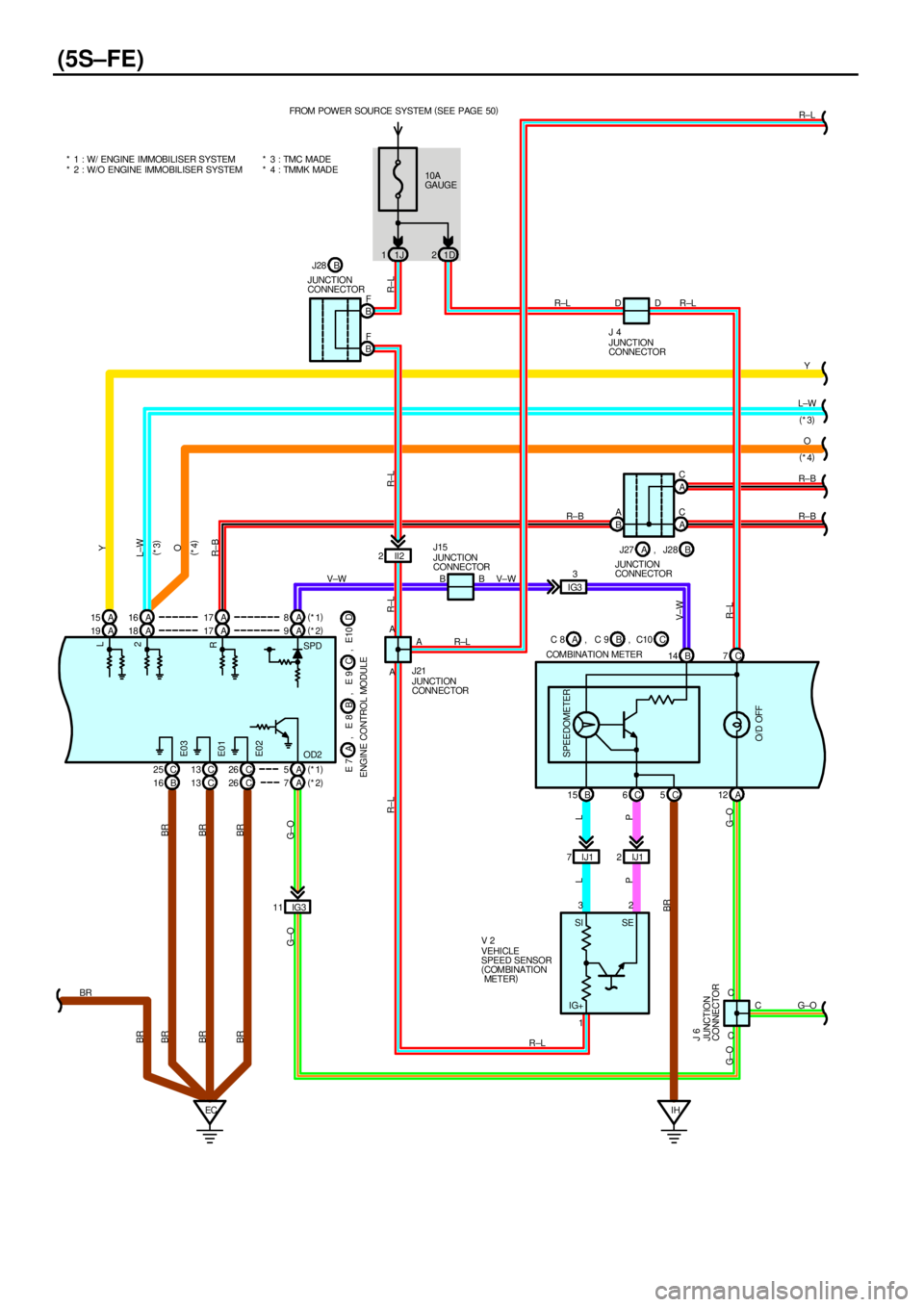
(5S±FE)
A 19 A18 A17 A9
C 13 C26 A5
ECIG3 1110A
GAUGE FROM POWER SOURCE SYSTEM (
SEE PAGE 50)
1J 11D2
B 14 C7
B 15 C6A12 II2 2
IJ1 7IJ12 B A
A CA C D
AB
32
C A
1D
B
A
C V±WY
L±W
R±B
R±B R±L R±L
R±LV±W
G±O
R±L
Y
L±W
BR
BR
G± O BR
BR
BR
R±L R±L R±L R±L
V±W
R±L L
P L
P
G±O G± O
OD2 SPDJUNCTION
CONNECTOR
COMBINATION METERJUNCTION
CONNECTOR J 4
JUNCTION
CONNECTOR J15
VEHICLE
SPEED SENSOR
(
COMBINATION
MET ER) V 2 JUNCTION
CONNECTOR J21SPEEDOMETER
O/ D OFF G±O
R±L
R±B
R±B
C 25
BR BR
C 5
IH
BRSE SI
IG+
L
2
R E03
E01
E02
BF
BF J28
JUNCTION
CONNECTORB
E 7
ENGINE CONTROL MODULEB A, E 8 , CE 9 D, E10B 16 C13 C26 A7(
*1)
(
*2)
BRA 15 A16 A17 A8
C
JUNCTION
CONNECTOR J 6
B C 8 A , C 9 C, C10 (
*1)
(
*2)O
OB J27 A , J28(
*3)
(
*4)(
*3)
(
*4)
IG33 * 1 : W/ ENGINE IMMOBILISER SYSTEM
* 2 : W/O ENGINE IMMOBILISER SYSTEM* 3 : TMC MADE
* 4 : TMMK MADE
Page 1360 of 4770
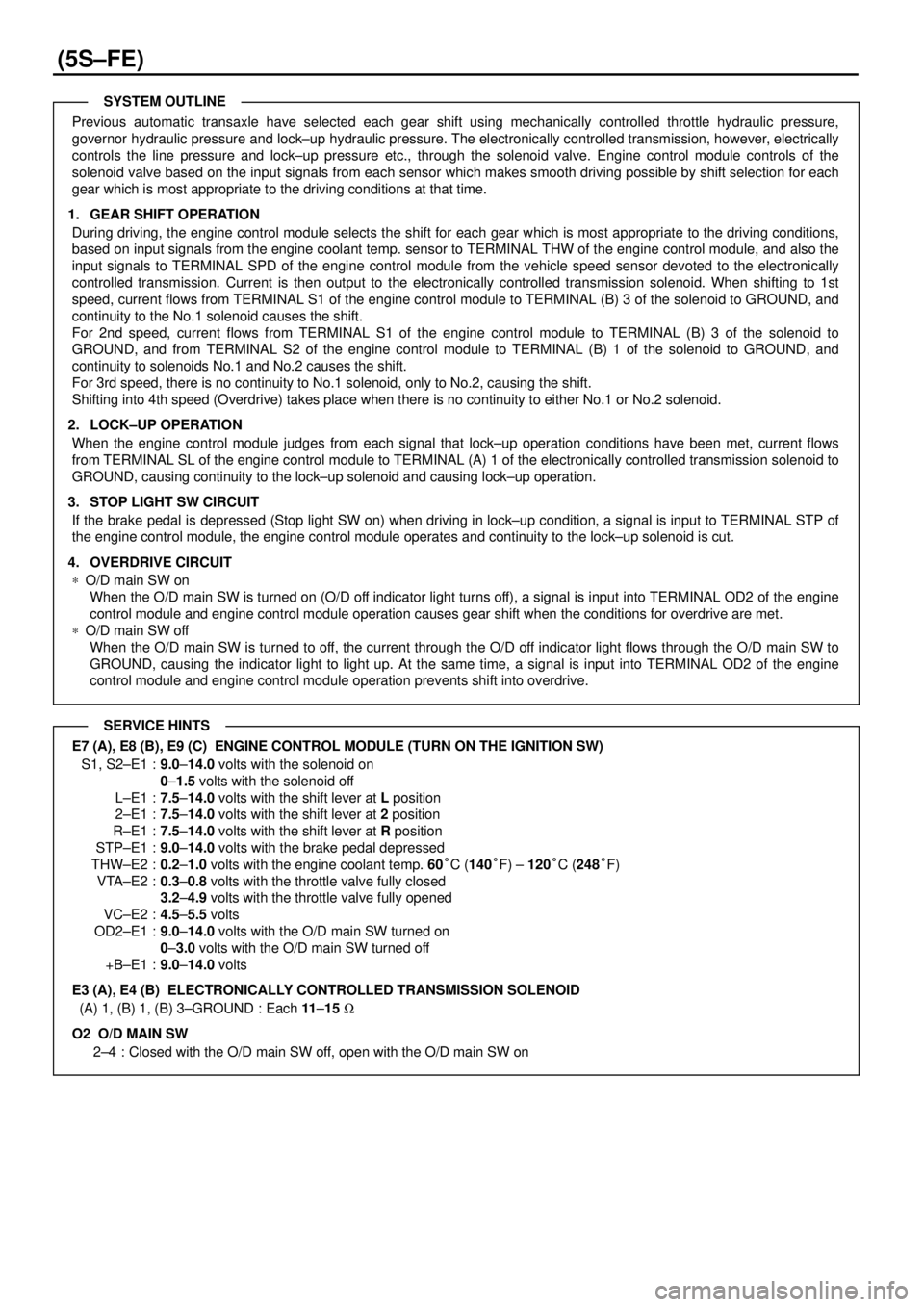
(5S±FE)
Previous automatic transaxle have selected each gear shift using mechanically controlled throttle hydraulic pressure,
governor hydraulic pressure and lock±up hydraulic pressure. The electronically controlled transmission, however, electrically
controls the line pressure and lock±up pressure etc., through the solenoid valve. Engine control module controls of the
solenoid valve based on the input signals from each sensor which makes smooth driving possible by shift selection for each
gear which is most appropriate to the driving conditions at that time.
1. GEAR SHIFT OPERATION
During driving, the engine control module selects the shift for each gear which is most appropriate to the driving conditions,
based on input signals from the engine coolant temp. sensor to TERMINAL THW of the engine control module, and also the
input signals to TERMINAL SPD of the engine control module from the vehicle speed sensor devoted to the electronically
controlled transmission. Current is then output to the electronically controlled transmission solenoid. When shifting to 1st
speed, current flows from TERMINAL S1 of the engine control module to TERMINAL (B) 3 of the solenoid to GROUND, and
continuity to the No.1 solenoid causes the shift.
For 2nd speed, current flows from TERMINAL S1 of the engine control module to TERMINAL (B) 3 of the solenoid to
GROUND, and from TERMINAL S2 of the engine control module to TERMINAL (B) 1 of the solenoid to GROUND, and
continuity to solenoids No.1 and No.2 causes the shift.
For 3rd speed, there is no continuity to No.1 solenoid, only to No.2, causing the shift.
Shifting into 4th speed (Overdrive) takes place when there is no continuity to either No.1 or No.2 solenoid.
2. LOCK±UP OPERATION
When the engine control module judges from each signal that lock±up operation conditions have been met, current flows
from TERMINAL SL of the engine control module to TERMINAL (A) 1 of the electronically controlled transmission solenoid to
GROUND, causing continuity to the lock±up solenoid and causing lock±up operation.
3. STOP LIGHT SW CIRCUIT
If the brake pedal is depressed (Stop light SW on) when driving in lock±up condition, a signal is input to TERMINAL STP of
the engine control module, the engine control module operates and continuity to the lock±up solenoid is cut.
4. OVERDRIVE CIRCUIT
*O/D main SW on
When the O/D main SW is turned on (O/D off indicator light turns off), a signal is input into TERMINAL OD2 of the engine
control module and engine control module operation causes gear shift when the conditions for overdrive are met.
*O/D main SW off
When the O/D main SW is turned to off, the current through the O/D off indicator light flows through the O/D main SW to
GROUND, causing the indicator light to light up. At the same time, a signal is input into TERMINAL OD2 of the engine
control module and engine control module operation prevents shift into overdrive.
E7 (A), E8 (B), E9 (C) ENGINE CONTROL MODULE (TURN ON THE IGNITION SW)
S1, S2±E1 :9.0±14.0 volts with the solenoid on
0±1.5 volts with the solenoid off
L±E1 :7.5±14.0 volts with the shift lever at L position
2±E1 :7.5±14.0 volts with the shift lever at 2 position
R±E1 :7.5±14.0 volts with the shift lever at R position
STP±E1 :9.0±14.0 volts with the brake pedal depressed
THW±E2 :0.2±1.0 volts with the engine coolant temp. 60°C (140°F) ± 120°C (248°F)
VTA±E2 :0.3±0.8 volts with the throttle valve fully closed
3.2±4.9 volts with the throttle valve fully opened
VC±E2 :4.5±5.5 volts
OD2±E1 :9.0±14.0 volts with the O/D main SW turned on
0±3.0 volts with the O/D main SW turned off
+B±E1 :9.0±14.0 volts
E3 (A), E4 (B) ELECTRONICALLY CONTROLLED TRANSMISSION SOLENOID
(A) 1, (B) 1, (B) 3±GROUND : Each 11±15 W
O2 O/D MAIN SW
2±4 : Closed with the O/D main SW off, open with the O/D main SW on
SYSTEM OUTLINE
SERVICE HINTS
Page 1365 of 4770
![TOYOTA CAMRY 2000 Service Repair Manual CRUISE CONTROL
SPEEDOMETER
B 15 C6B14 C10 C 5
IJ1 7IJ12IG33IG25
IH4 5
CRUISE CONTROL
SW [COMB. SW]
CRUISE
CANCELSET/
COAST RESUME/
ACCEL
C12 CMS CCS
3 EP 2 1
D 10A
GAUGE FROM POWER SOURCE SYSTEM (
S](/img/14/57447/w960_57447-1364.png "TOYOTA CAMRY 2000 Service Repair Manual CRUISE CONTROL
SPEEDOMETER
B 15 C6B14 C10 C 5
IJ1 7IJ12IG33IG25
IH4 5
CRUISE CONTROL
SW [COMB. SW]
CRUISE
CANCELSET/
COAST RESUME/
ACCEL
C12 CMS CCS
3 EP 2 1
D 10A
GAUGE FROM POWER SOURCE SYSTEM (
S")
CRUISE CONTROL
SPEEDOMETER
B 15 C6B14 C10 C 5
IJ1 7IJ12IG33IG25
IH4 5
CRUISE CONTROL
SW [COMB. SW]
CRUISE
CANCELSET/
COAST RESUME/
ACCEL
C12 CMS CCS
3 EP 2 1
D 10A
GAUGE FROM POWER SOURCE SYSTEM (
SEE PAGE 50)
1D 2
C 71J 1
B FBF
A D
B B D
1 DAA
10
A2 A
A
D
32DDBB3 A
10 11 12 5 4
10 4 11A
A
A
PI TC SPD CMS CCSD
W±B
R±L
R±L
R±L R±L
R±L
R±L
R±L
B±R
B±R B±R
W W±L V±W LG±RO O
LG±R
LG±R
V±WO V±WBRPL L
P
V±W
O
R±L
R±LR±L
R±L R±L
(
*1 A/T)
(
*2 A/T) (
*2) (
*1)
(
M/T)
(
M/T)
(
A/ T)
JUNCTION
CONNECTOR J24
JUNCTION
CONNECTOR J21
CRUISE CONTROL
CLUTCH SW C14
D POSITION SW
[PARK/NEUTRAL POSITION SW] P 1 JUNCTION
CONNECTOR J 4
VEHICLE SPEED SENSOR
(
COMBINATION METER) V 2
DATA LINK
CONNECTOR 2 D 4
DATA LINK
CONNECTOR 1 D 1
JUNCTION CONNECTOR J 2
JUNCTION CONNECTOR J 3
JUNCTION CONNECTOR J1 5
JUNCTION
CONNECTOR J29
JUNCTION
CONNECTOR
R±L
(
*2)
(
*1)
CRUISE CONTROL ECU C15 COMBINATION METER
BR
CRUISE(
*1)
(
*2)A/D TC TCB
SI SE
IG+II2 2
II3 11 C C 9
B, C10
B J27 A , J28
II2 9
B±R
(
A/T) LG±R
(
*4)
P±B
(
*3)
Page 1367 of 4770

CRUISE CONTROL
Current is applied at all times through the STOP fuse to TERMINAL 2 of the stop light SW.
With the ignition SW turned to on, current flows through the GAUGE fuse to TERMINAL (C) 7 of the combination meter and
the current through the ECU±IG fuse flows to TERMINAL 9 of the cruise control ECU.
When the ignition SW is on and the cruise control SW is turned on, a signal is input from TERMINAL 5 of the cruise control
SW to TERMINAL 11 of the cruise control ECU. As a result, the cruise control ECU functions and the current flows from the
ECU±IG fuse to TERMINAL 9 of the cruise control ECU to TERMINAL 16 to GROUND, and the cruise control system is in a
condition ready for operation.
At the same time, the current through the GAUGE fuse flows to TERMINAL (C) 7 of the cruise control indicator light to
TERMINAL (C) 10 to TERMINAL 4 of the cruise control ECU to TERMINAL 16 to GROUND, causing the cruise control
indicator light to light up, indicating that cruise control is ready for operation.
1. SET OPERATION
When the cruise control SW is turned on and the set SW is pushed with the vehicle speed within the set limit (Approx. 40
km/h, 25 mph to 200 km/h, 124 mph), a signal is input to TERMINAL 10 of the cruise control ECU and the vehicle speed at
the time the set SW is released is memorized in the ECU as the set speed.
2. SET SPEED CONTROL
During cruise control driving, the cruise control ECU compares the set speed memorized in the cruise control ECU with the
actual vehicle speed input into TERMINAL 12 of the cruise control ECU from the speed sensor, and controls the cruise
control actuator to maintain the set speed.
When the actual speed is lower than the set speed, the ECU causes the current to the cruise control actuator to flow from
TERMINAL 15 of the cruise control ECU to TERMINAL 1 of the cruise control actuator to TERMINAL 2 to TERMINAL 7 of
the cruise control ECU. As a result, the motor in the cruise control actuator is rotated to open the than the set speed, the
current to the cruise control actuator flows from TERMINAL 7 of the cruise control ECU to TERMINAL 2 of the cruise control
actuator to TERMINAL 1 to TERMINAL 15 of the cruise control ECU.
This causes the motor in the cruise control actuator to rotate to close the throttle valve and return the throttle cable to
decrease the vehicle speed.
3. COAST CONTROL
During cruise control driving, while the coast SW is on, the cruise control actuator returns the throttle cable to close the
throttle valve and decrease the driving speed. The vehicle speed when the coast SW is turned off is memorized and the
vehicle continues at the new set speed.
4. ACCEL CONTROL
During cruise control driving, while the accel SW is turned on, the cruise control actuator pulls the throttle cable to open the
throttle valve and increase the driving speed.
The vehicle speed when the accel SW is turned off is memorized and the vehicle continues at the new set speed.
5. RESUME CONTROL
Unless the vehicle speed falls below the minimum speed limit (Approx. 40km/h, 25mph) after canceling the set speed by the
cancel SW, pushing the resume SW will cause the vehicle to resume the speed set before cancellation.
6. MANUAL CANCEL MECHANISM
If any of the following operations occurs during cruise control operation, the magnetic clutch of the actuator turns off and the
motor rotates to close the throttle valve and the cruise control is released.
*Placing the shift lever except D position (Park/Neutral position SW except D position). ºSignal is not input to TERMINAL 3
of the cruise control ECUº (A/T)
*Depressing the clutch pedal (Cruise control clutch SW off). ºSignal input to TERMINAL 3 of the cruise control ECUº (M/T)
*Depressing the brake pedal (Stop light SW on). ºSignal input to TERMINAL 2 of the cruise control ECUº
*Pushing the cancel switch (Cancel SW on). ºSignal input to TERMINAL 10 of the cruise control ECUº
*Pushing the cruise switch off ºsignal input to TERMINAL 11 of the cruise control ECUº.
SYSTEM OUTLINE
Page 1375 of 4770
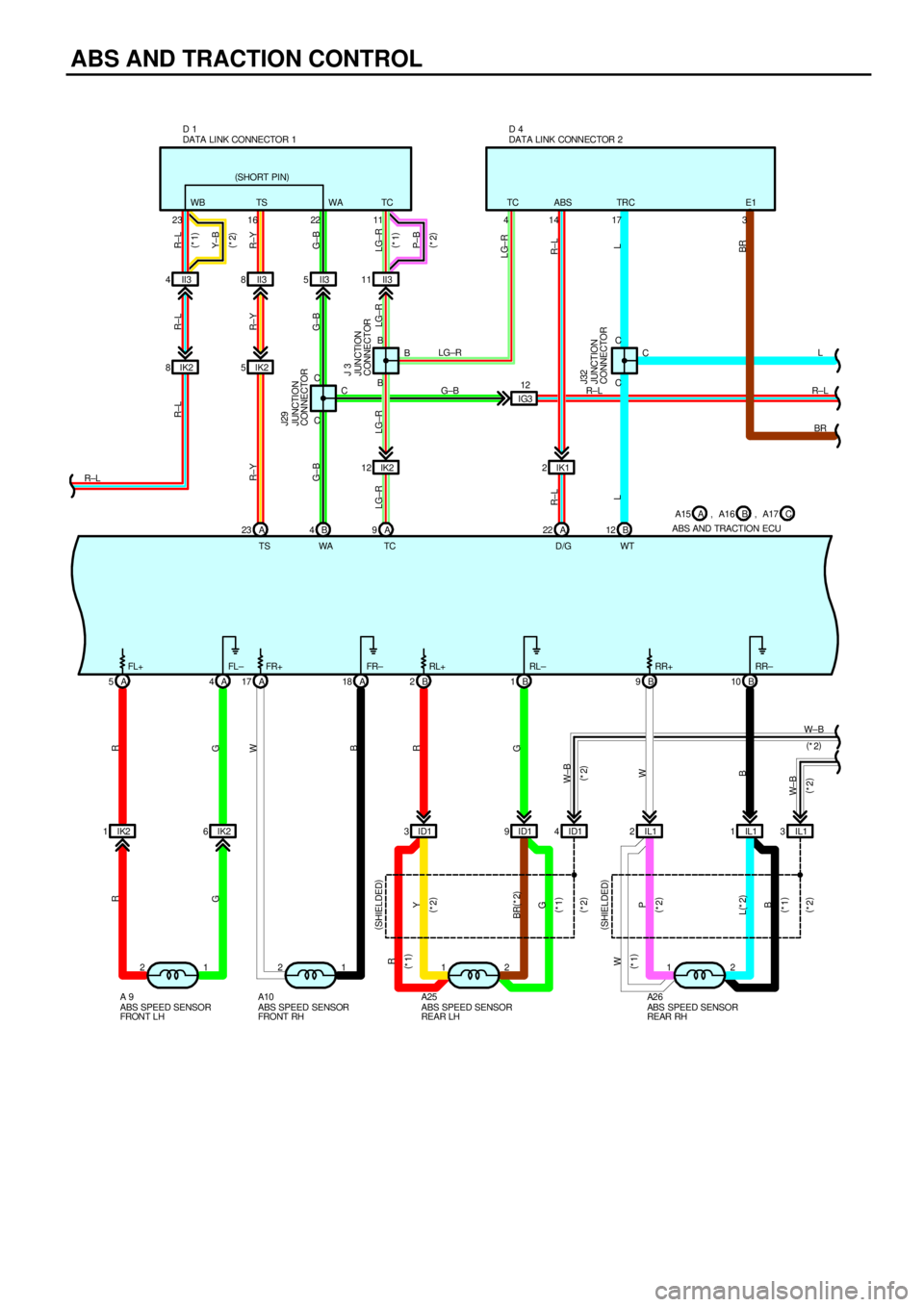
ABS AND TRACTION CONTROL
II3 4II38II35II311
IK2 8IK25
A 23 B4A9IK2 12 IK12
A 22 B12 CB CB
B
C 23 16 22 11 4 14 17
TS WA TC D/G WT TS TC TC ABS TRC
L G±BR±YR±L R±L
R±Y
G±B
LG±R LG±R LG±RR±Y
G±B
R±L
LR±L LG±R
L
R±L DATA LINK CONNECTOR 1 D 1
DATA LINK CONNECTOR 2 D 4
JUNCTION
CONNECTOR J 3 JUNCTION
CONNECTOR J29
ABS AND TRACTION ECU R±L(
SHORT PIN)
WB WA
G±B LG±R
R±L
A 5A4A17 A18 B2B1
1 21221 ID1 3ID19ID14
ABS SPEED SENSOR
FRONT L H A 9
ABS SPEED SENSOR
FRONT RH A10
ABS SPEED SENSOR
REAR LH A25B 9B10
2 1 IL1 2IL11IL13
ABS SPEED SENSOR
REAR RH A2 6 FL+ FL± FR+ FR± RL+ RL± RR+ RR±
B W W±BR
G
W
B
R
G R
G
Y
BR(
*2)
P
L(
*2) (
SHIELDED) (
SHIELDED)
W± B
IG312
R±LE1
BR 3
C C
C
JUNCTION
CONNECTOR J32
A A15 BA16 , C, A17
BRY± B
(
*2)
P± B
(
*2) (
*1)
LG±R
(
*1)
IK2 1IK26
R
(
*1)
G
(
*1) (
*2)
(
*2)
(
*2) W
(
*1)
(
*1) B
(
*2)
W±B
(
*2)
(
*2) (
*2)