353
4-3. Do-it-yourself maintenance
4
Maintenance and care
Engine compar tment
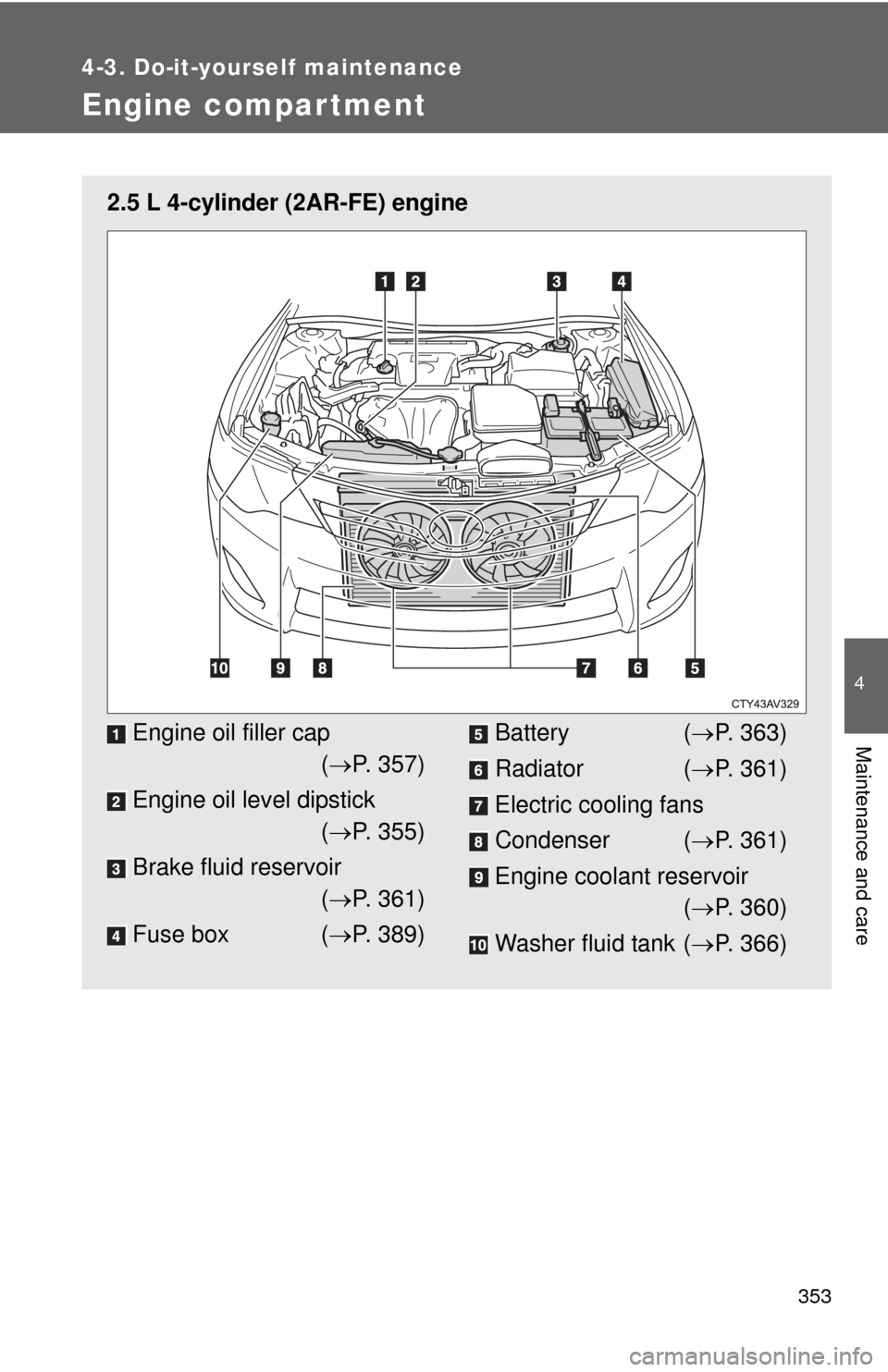
2.5 L 4-cylinder (2AR-FE) engine
Engine oil filler cap( P. 357)
Engine oil level dipstick ( P. 355)
Brake fluid reservoir ( P. 361)
Fuse box ( P. 389)Battery ( P. 363)
Radiator ( P. 361)
Electric cooling fans
Condenser ( P. 361)
Engine coolant reservoir ( P. 360)
Washer fluid tank ( P. 366)
354 4-3. Do-it-yourself maintenance
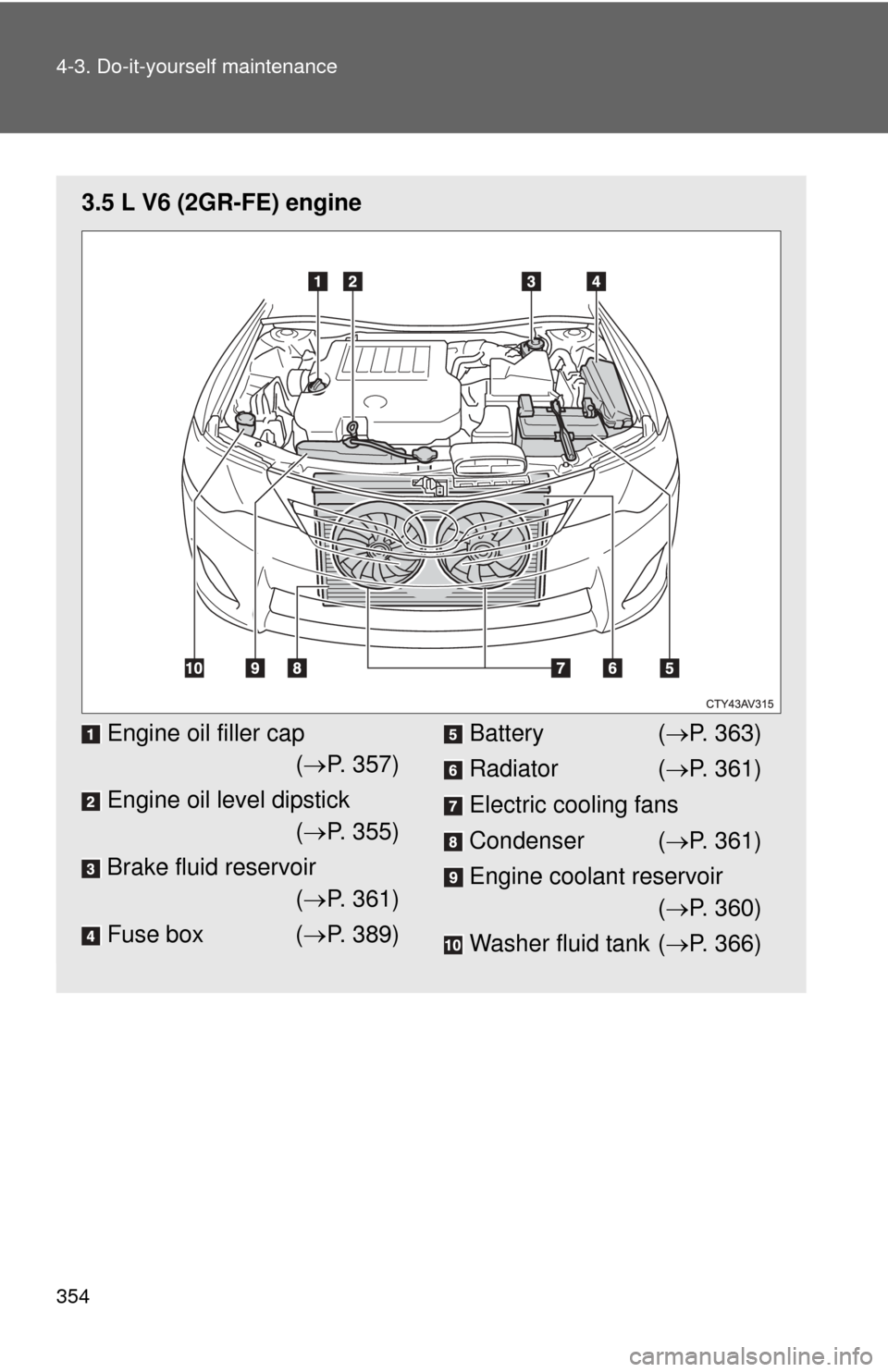
3.5 L V6 (2GR-FE) engine
Engine oil filler cap( P. 357)
Engine oil level dipstick ( P. 355)
Brake fluid reservoir ( P. 361)
Fuse box ( P. 389)Battery ( P. 363)
Radiator ( P. 361)
Electric cooling fans
Condenser ( P. 361)
Engine coolant reservoir ( P. 360)
Washer fluid tank ( P. 366)
360 4-3. Do-it-yourself maintenance
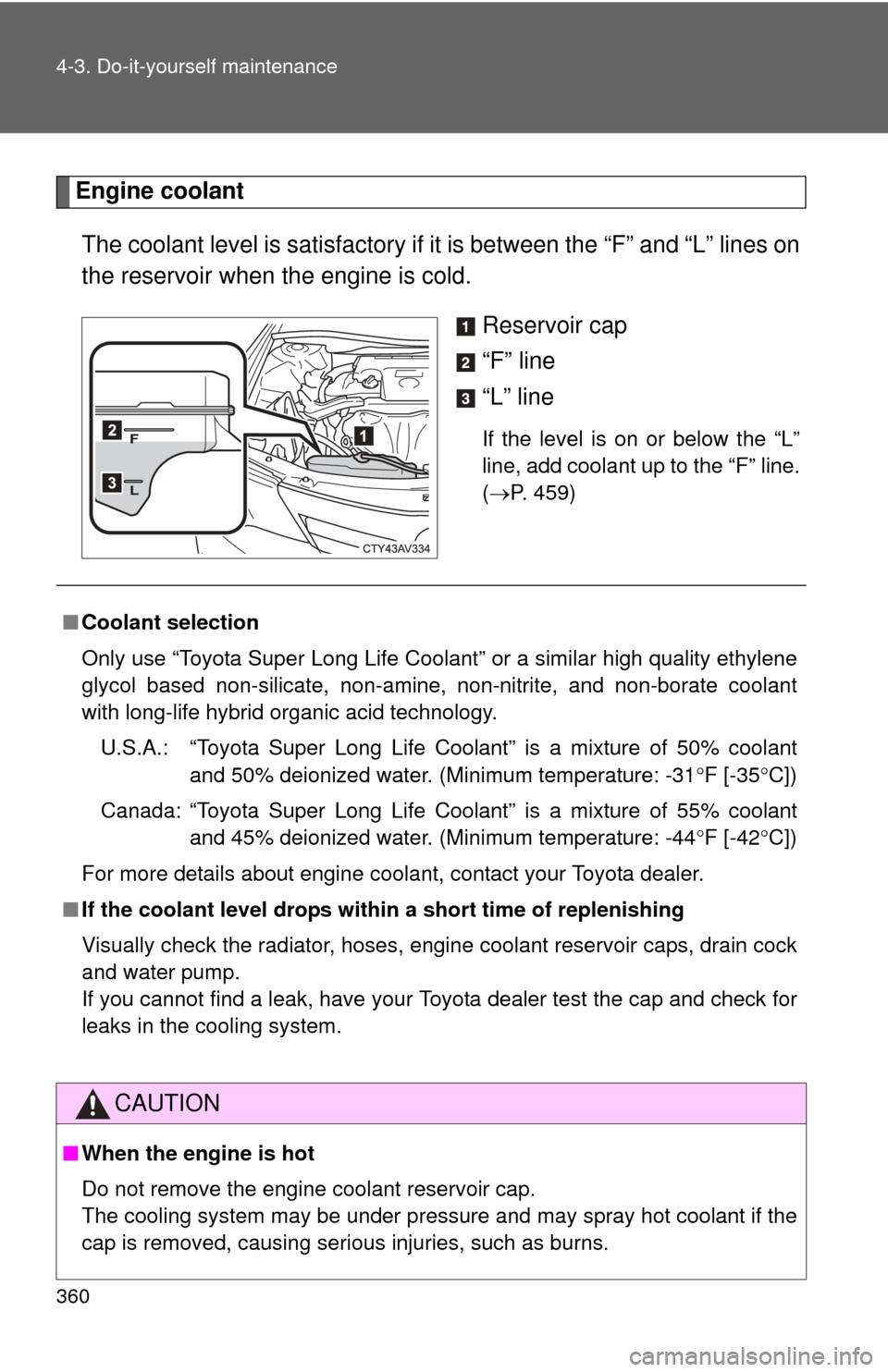
Engine coolantThe coolant level is sati sfactory if it is between the “F” and “L” lines on
the reservoir when the engine is cold.
Reservoir cap
“F” line
“L” line
If the level is on or below the “L”
line, add coolant up to the “F” line.
(P. 459)
■ Coolant selection
Only use “Toyota Super Long Life Coolant” or a similar high quality ethylene
glycol based non-silicate, non-amine, non-nitrite, and non-borate coolant
with long-life hybrid organic acid technology.
U.S.A.: “Toyota Super Long Life Coolant” is a mixture of 50% coolant and 50% deionized water. (Minimum temperature: -31 F [-35 C])
Canada: “Toyota Super Long Life Coolant” is a mixture of 55% coolant and 45% deionized water. (Minimum temperature: -44 F [-42 C])
For more details about engine coolant, contact your Toyota dealer.
■ If the coolant level drops within a short time of replenishing
Visually check the radiator, hoses, engine coolant reservoir caps, drain cock
and water pump.
If you cannot find a leak, have your Toyota dealer test the cap and check for
leaks in the cooling system.
CAUTION
■When the engine is hot
Do not remove the engine coolant reservoir cap.
The cooling system may be under pressure and may spray hot coolant if the
cap is removed, causing serious injuries, such as burns.
460 5-2. Steps to take in an emergency
■Overheating
If you observe the following, your vehicle may be overheating:
●The rightmost segment of the engine coolant temperature display is
flashing or a loss of power is experienced.
● Steam comes out from under the hood.
CAUTION
■To prevent an accident or injury when inspecting under the hood of
your vehicle
● If steam is seen coming from under the hood, do not open the hood until
the steam has subsided. The engine compartment may be very hot, caus-
ing serious injuries such as burns.
● Keep hands and clothing away from the fans and drive belt while the
engine is running.
● Do not loosen the coolant reservoir cap while the engine and radiator are
hot.
Serious injury, such as burns, may result from hot coolant and steam
released under pressure.
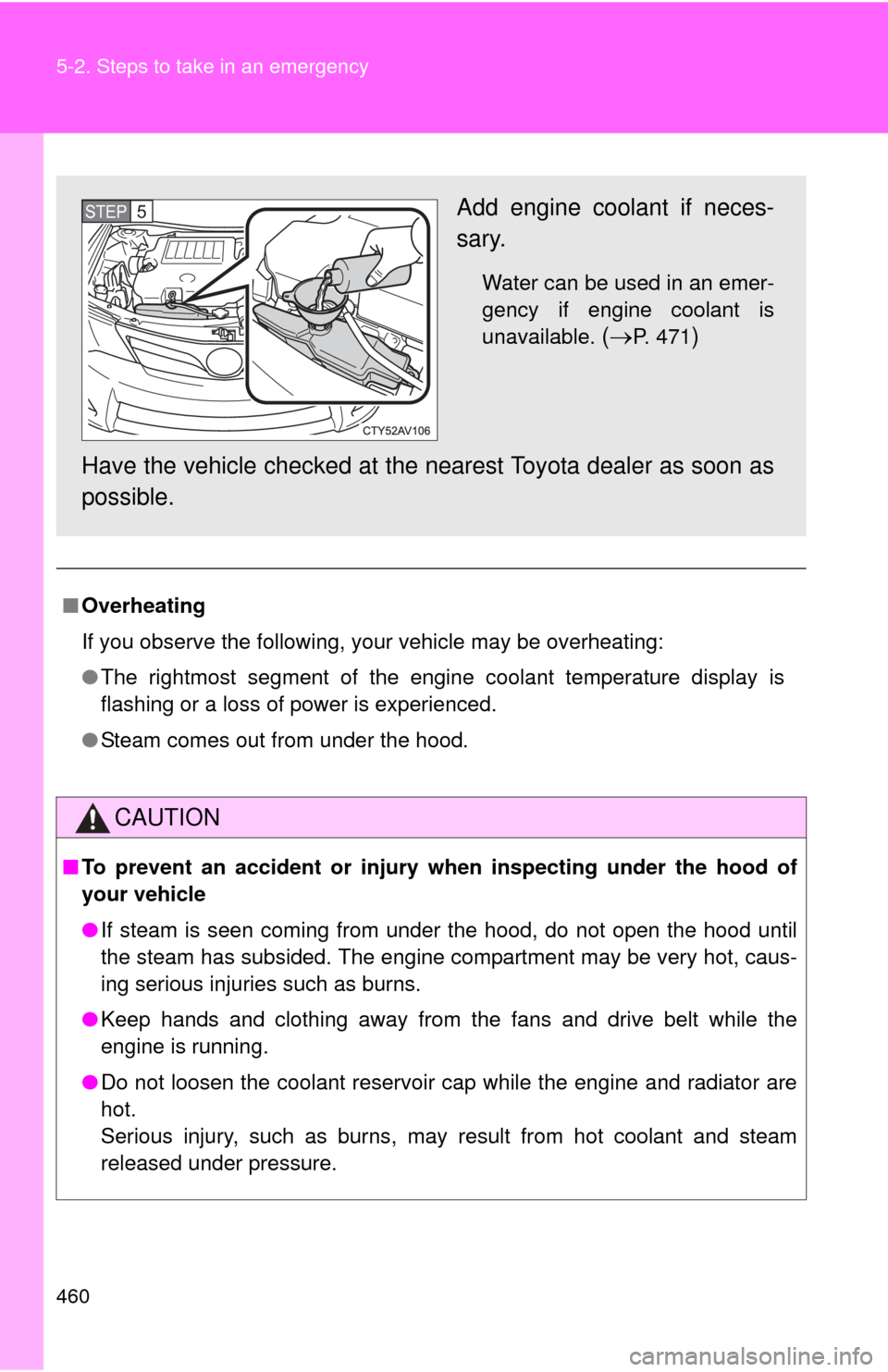
Add engine coolant if neces-
sary.
Water can be used in an emer-
gency if engine coolant is
unavailable.
(P. 471)
Have the vehicle chec ked at the nearest Toyota dealer as soon as
possible.
STEP5