fuel pressure TOYOTA CAMRY V20 1986 Service Information
[x] Cancel search | Manufacturer: TOYOTA, Model Year: 1986, Model line: CAMRY V20, Model: TOYOTA CAMRY V20 1986Pages: 2389, PDF Size: 84.44 MB
Page 1028 of 2389
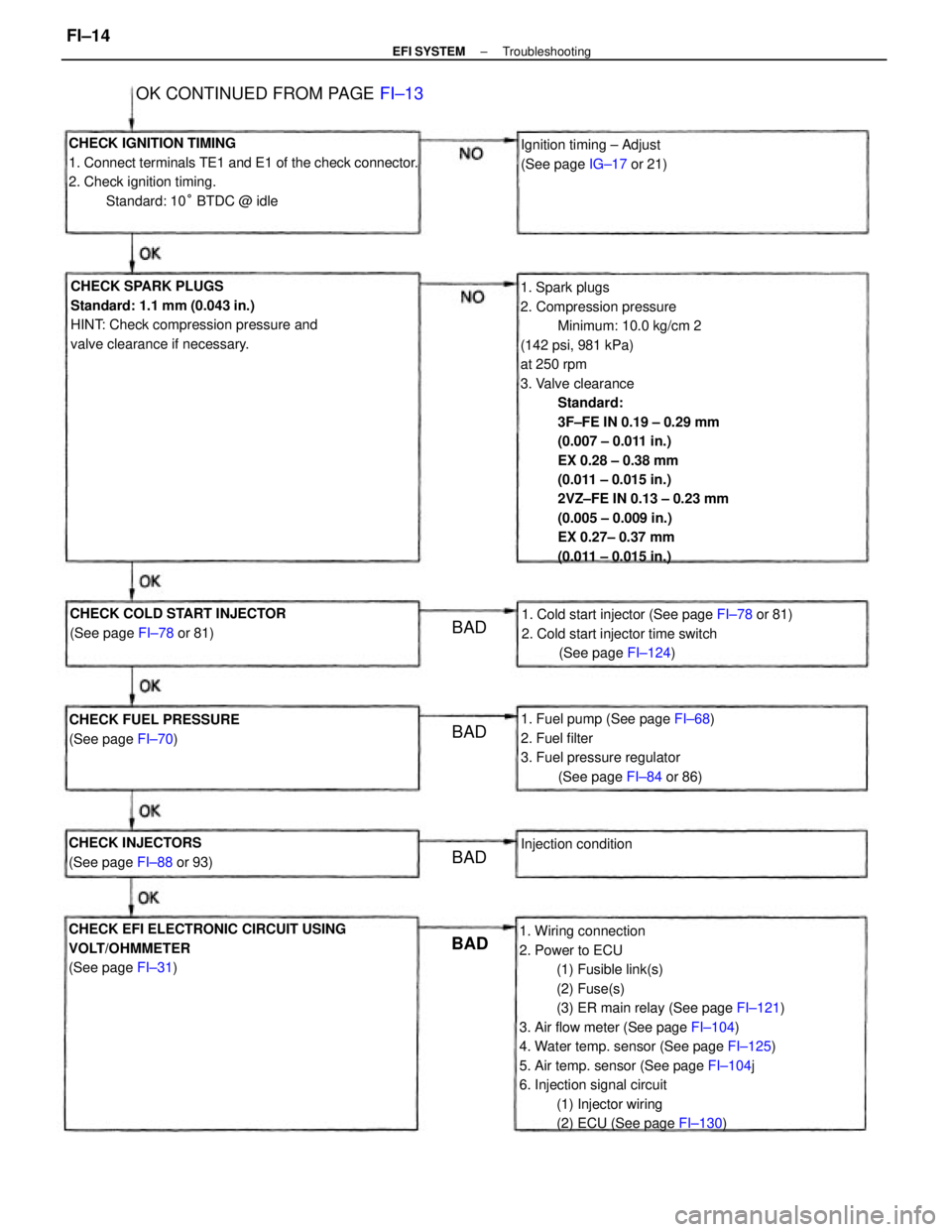
1. Spark plugs
2. Compression pressure
Minimum: 10.0 kg/cm 2
(142 psi, 981 kPa)
at 250 rpm
3. Valve clearance
Standard:
3F±FE IN 0.19 ± 0.29 mm
(0.007 ± 0.011 in.)
EX 0.28 ± 0.38 mm
(0.011 ± 0.015 in.)
2VZ±FE IN 0.13 ± 0.23 mm
(0.005 ± 0.009 in.)
EX 0.27± 0.37 mm
(0.011 ± 0.015 in.)
1. Wiring connection
2. Power to ECU
(1) Fusible link(s)
(2) Fuse(s)
(3) ER main relay (See page FI±121)
3. Air flow meter (See page FI±104)
4. Water temp. sensor (See page FI±125)
5. Air temp. sensor (See page FI±104j
6. Injection signal circuit
(1) Injector wiring
(2) ECU (See page FI±130) CHECK IGNITION TIMING
1. Connect terminals TE1 and E1 of the check connector.
2. Check ignition timing.
Standard: 10° BTDC @ idle
CHECK SPARK PLUGS
Standard: 1.1 mm (0.043 in.)
HINT: Check compression pressure and
valve clearance if necessary.
CHECK EFI ELECTRONIC CIRCUIT USING
VOLT/OHMMETER
(See page FI±31)1. Cold start injector (See page FI±78 or 81)
2. Cold start injector time switch
(See page FI±124)
1. Fuel pump (See page FI±68)
2. Fuel filter
3. Fuel pressure regulator
(See page FI±84 or 86) CHECK COLD START INJECTOR
(See page FI±78 or 81)
OK CONTINUED FROM PAGE FI±13
CHECK FUEL PRESSURE
(See page FI±70)Ignition timing ± Adjust
(See page IG±17 or 21)
CHECK INJECTORS
(See page FI±88 or 93)Injection condition
BADBAD
BAD BAD
± EFI SYSTEMTroubleshootingFI±14
Page 1030 of 2389
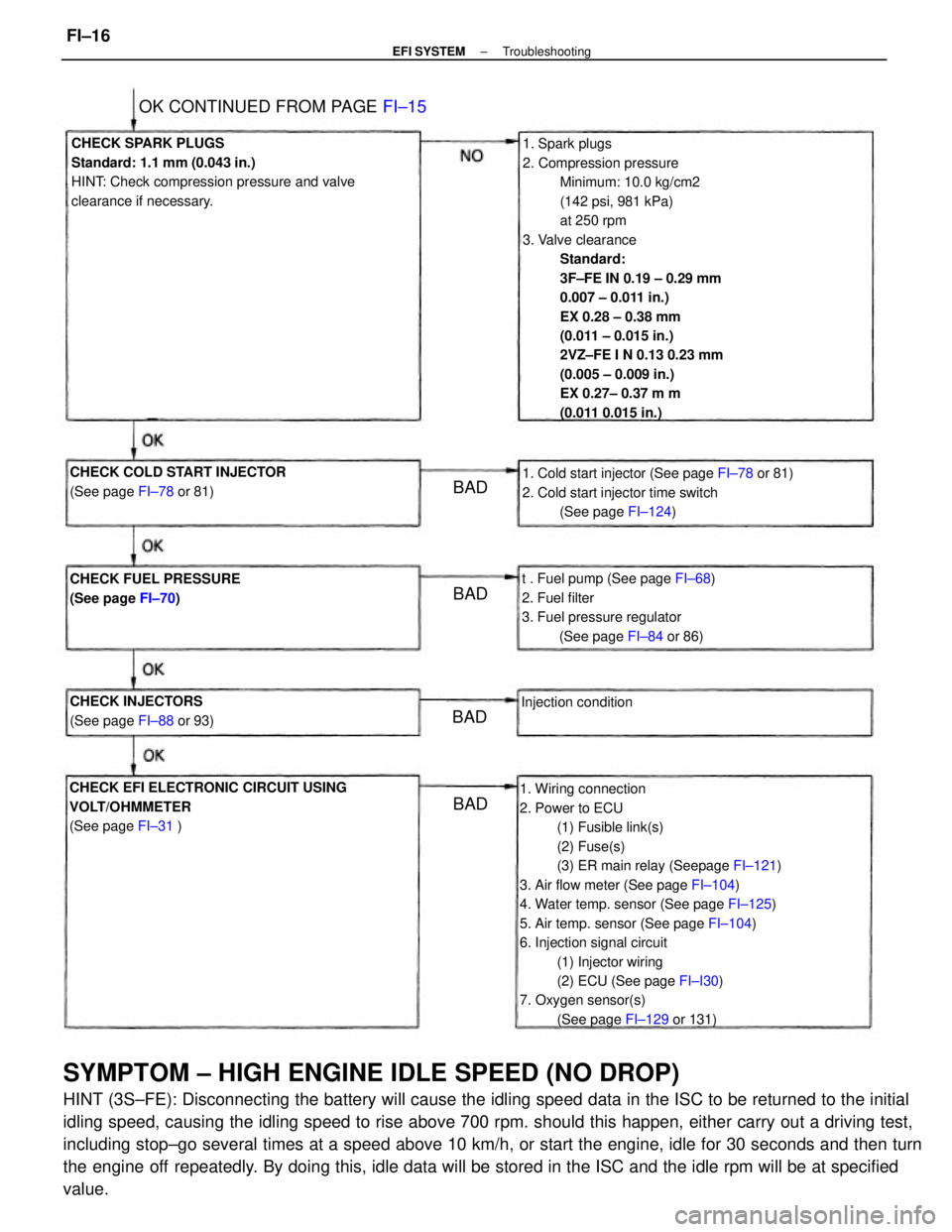
SYMPTOM ± HIGH ENGINE IDLE SPEED (NO DROP)
HINT (3S±FE): Disconnecting the battery will cause the idling speed data in the ISC to be returned to the initial
idling speed, causing the idling speed to rise above 700 rpm. should this happen, either carry out a driving test,
including stop±go several times at a speed above 10 km/h, or start the engine, idle for 30 seconds and then turn
the engine off repeatedly. By doing this, idle data will be stored in the ISC and the idle rpm will be at specified
value.
1. Spark plugs
2. Compression pressure
Minimum: 10.0 kg/cm2
(142 psi, 981 kPa)
at 250 rpm
3. Valve clearance
Standard:
3F±FE IN 0.19 ± 0.29 mm
0.007 ± 0.011 in.)
EX 0.28 ± 0.38 mm
(0.011 ± 0.015 in.)
2VZ±FE I N 0.13 0.23 mm
(0.005 ± 0.009 in.)
EX 0.27± 0.37 m m
(0.011 0.015 in.)
1. Wiring connection
2. Power to ECU
(1) Fusible link(s)
(2) Fuse(s)
(3) ER main relay (Seepage FI±121)
3. Air flow meter (See page FI±104)
4. Water temp. sensor (See page FI±125)
5. Air temp. sensor (See page FI±104)
6. Injection signal circuit
(1) Injector wiring
(2) ECU (See page FI±I30)
7. Oxygen sensor(s)
(See page FI±129 or 131) CHECK SPARK PLUGS
Standard: 1.1 mm (0.043 in.)
HINT: Check compression pressure and valve
clearance if necessary.
CHECK EFI ELECTRONIC CIRCUIT USING
VOLT/OHMMETER
(See page FI±31 )1. Cold start injector (See page FI±78 or 81)
2. Cold start injector time switch
(See page FI±124)
t . Fuel pump (See page FI±68)
2. Fuel filter
3. Fuel pressure regulator
(See page FI±84 or 86) CHECK COLD START INJECTOR
(See page FI±78 or 81)
CHECK FUEL PRESSURE
(See page FI±70)
OK CONTINUED FROM PAGE FI±15
CHECK INJECTORS
(See page FI±88 or 93)Injection condition
BADBAD
BAD
BAD
± EFI SYSTEMTroubleshootingFI±16
Page 1031 of 2389
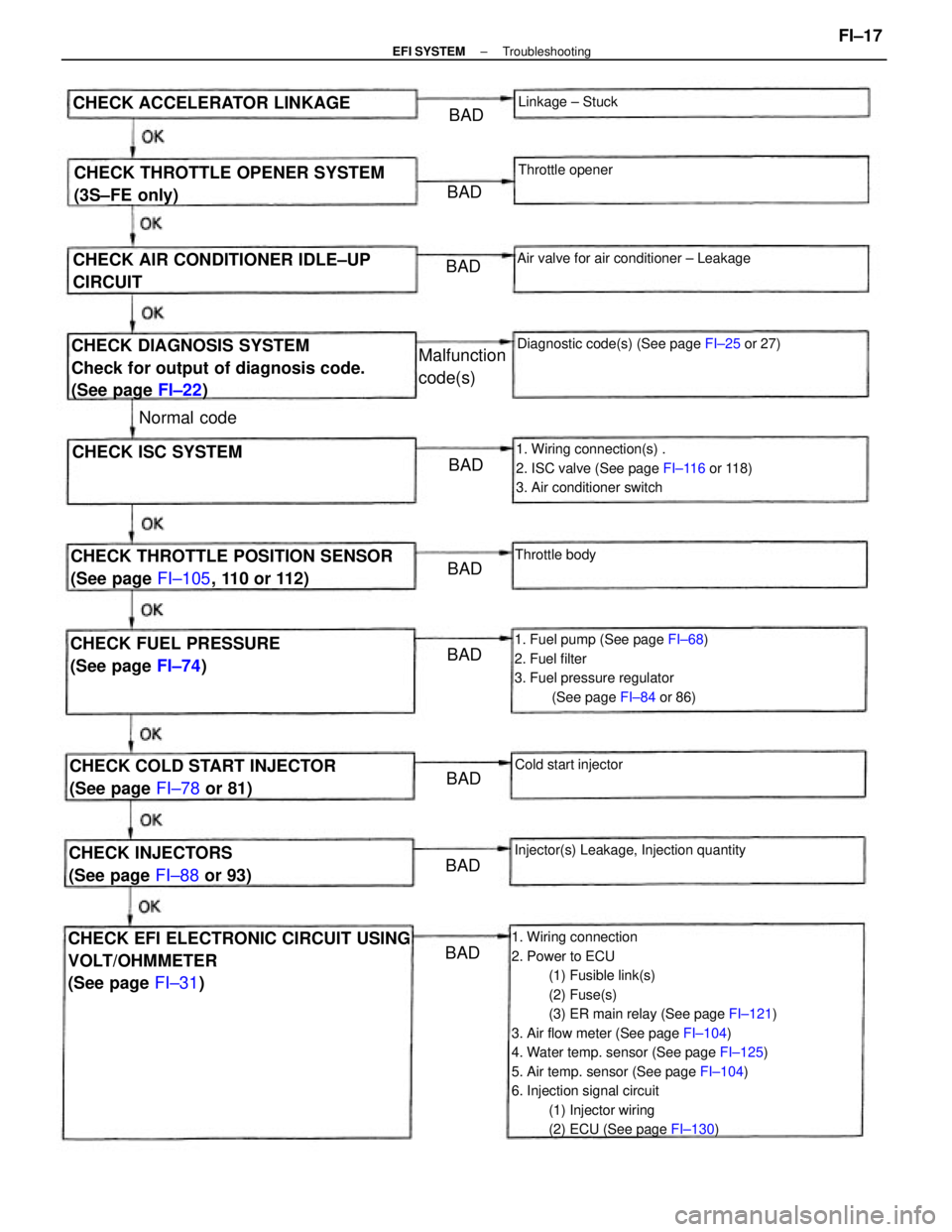
1. Wiring connection
2. Power to ECU
(1) Fusible link(s)
(2) Fuse(s)
(3) ER main relay (See page FI±121)
3. Air flow meter (See page FI±104)
4. Water temp. sensor (See page FI±125)
5. Air temp. sensor (See page FI±104)
6. Injection signal circuit
(1) Injector wiring
(2) ECU (See page FI±130)CHECK EFI ELECTRONIC CIRCUIT USING
VOLT/OHMMETER
(See page FI±31)
1. Fuel pump (See page FI±68)
2. Fuel filter
3. Fuel pressure regulator
(See page FI±84 or 86) 1. Wiring connection(s) .
2. ISC valve (See page FI±116 or 118)
3. Air conditioner switch
CHECK DIAGNOSIS SYSTEM
Check for output of diagnosis code.
(See page FI±22)
CHECK THROTTLE POSITION SENSOR
(See page FI±105, 110 or 112) CHECK THROTTLE OPENER SYSTEM
(3S±FE only)
CHECK AIR CONDITIONER IDLE±UP
CIRCUIT
CHECK COLD START INJECTOR
(See page FI±78 or 81) CHECK FUEL PRESSURE
(See page FI±74)Diagnostic code(s) (See page FI±25 or 27)
Injector(s) Leakage, Injection quantityAir valve for air conditioner ± Leakage
CHECK INJECTORS
(See page FI±88 or 93) CHECK ACCELERATOR LINKAGE
CHECK ISC SYSTEMMalfunction
code(s)
Cold start injectorLinkage ± Stuck
Throttle opener
Throttle body
Normal code
BADBAD
BAD
BADBADBADBAD
BADBAD
± EFI SYSTEMTroubleshootingFI±17
Page 1032 of 2389
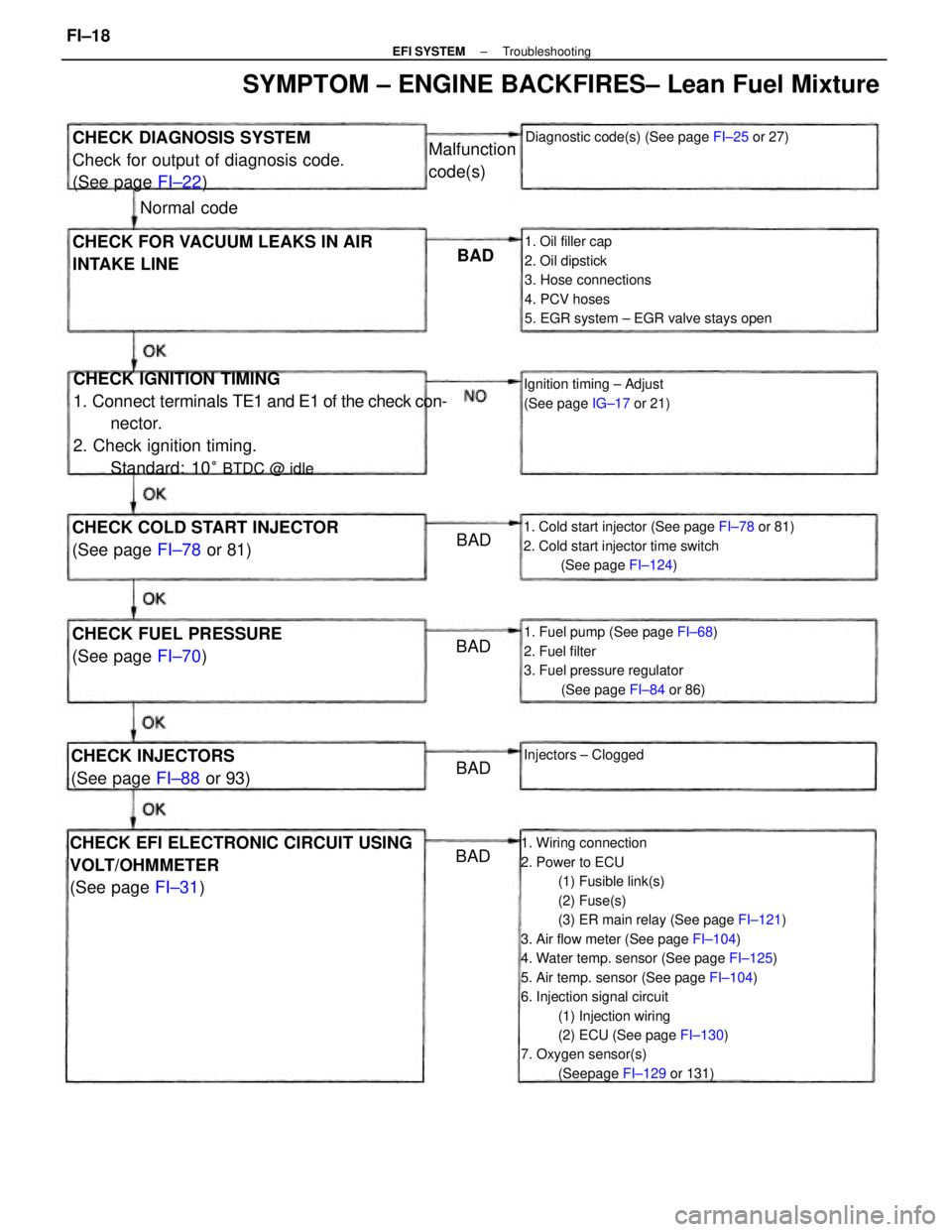
1. Wiring connection
2. Power to ECU
(1) Fusible link(s)
(2) Fuse(s)
(3) ER main relay (See page FI±121)
3. Air flow meter (See page FI±104)
4. Water temp. sensor (See page FI±125)
5. Air temp. sensor (See page FI±104)
6. Injection signal circuit
(1) Injection wiring
(2) ECU (See page FI±130)
7. Oxygen sensor(s)
(Seepage FI±129 or 131)
CHECK IGNITION TIMING
1. Connect terminals TE1 and E1 of the check con-
nector.
2. Check ignition timing.
Standard: 10
° BTDC @ idle
1. Oil filler cap
2. Oil dipstick
3. Hose connections
4. PCV hoses
5. EGR system ± EGR valve stays open
CHECK EFI ELECTRONIC CIRCUIT USING
VOLT/OHMMETER
(See page FI±31)
1. Cold start injector (See page FI±78 or 81)
2. Cold start injector time switch
(See page FI±124)
1. Fuel pump (See page FI±68)
2. Fuel filter
3. Fuel pressure regulator
(See page FI±84 or 86)
CHECK DIAGNOSIS SYSTEM
Check for output of diagnosis code.
(See page FI±22)
SYMPTOM ± ENGINE BACKFIRES± Lean Fuel Mixture
CHECK FOR VACUUM LEAKS IN AIR
INTAKE LINE
CHECK COLD START INJECTOR
(See page FI±78 or 81)
CHECK FUEL PRESSURE
(See page FI±70)
Diagnostic code(s) (See page FI±25 or 27)
Ignition timing ± Adjust
(See page IG±17 or 21)
CHECK INJECTORS
(See page FI±88 or 93)Injectors ± Clogged
Malfunction
code(s)
Normal code
BAD
BAD
BAD BAD
BAD
± EFI SYSTEMTroubleshootingFI±18
Page 1033 of 2389
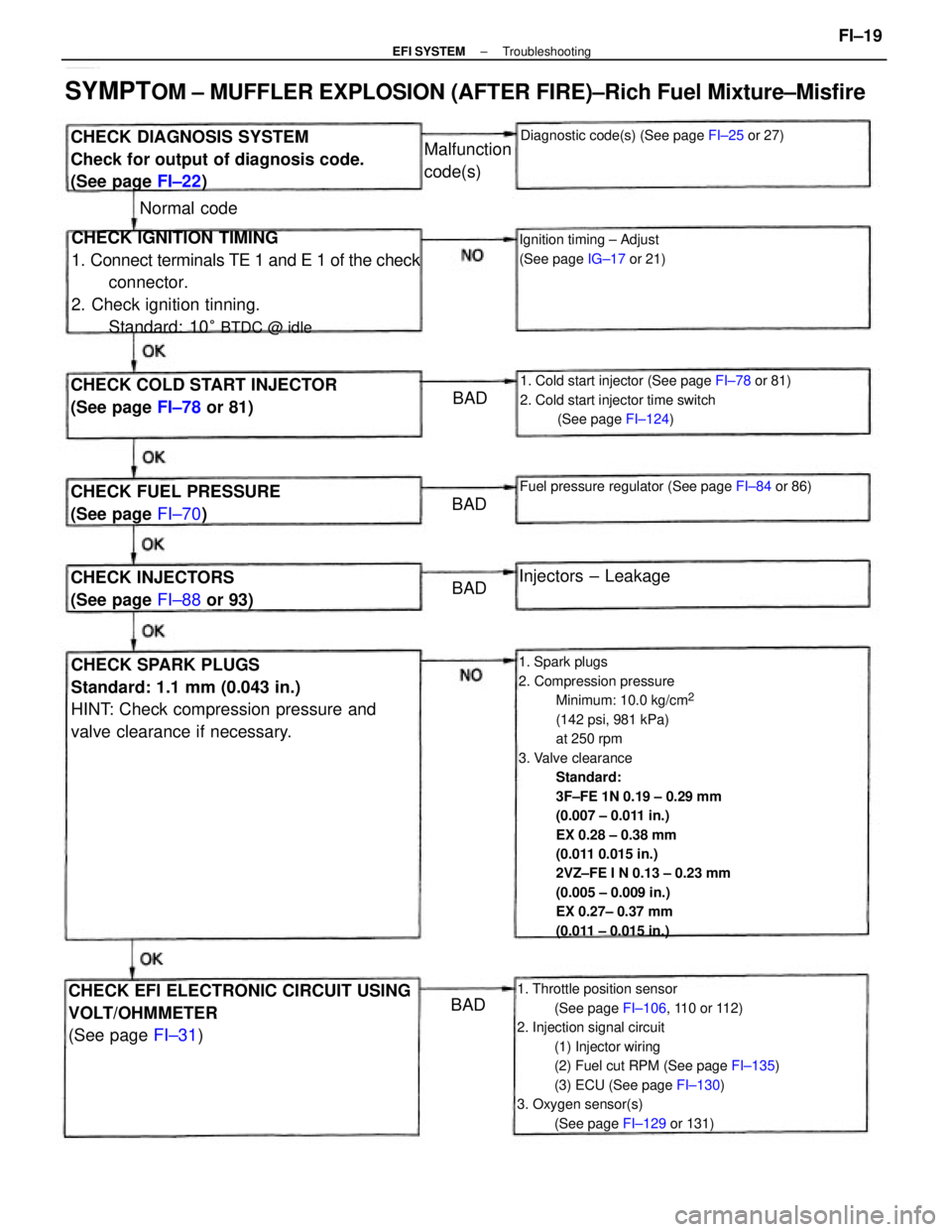
1. Spark plugs
2. Compression pressure
Minimum: 10.0 kg/cm
2
(142 psi, 981 kPa)
at 250 rpm
3. Valve clearance
Standard:
3F±FE 1N 0.19 ± 0.29 mm
(0.007 ± 0.011 in.)
EX 0.28 ± 0.38 mm
(0.011 0.015 in.)
2VZ±FE I N 0.13 ± 0.23 mm
(0.005 ± 0.009 in.)
EX 0.27± 0.37 mm
(0.011 ± 0.015 in.)
1. Throttle position sensor
(See page FI±106, 110 or 112)
2. Injection signal circuit
(1) Injector wiring
(2) Fuel cut RPM (See page FI±135)
(3) ECU (See page FI±130)
3. Oxygen sensor(s)
(See page FI±129 or 131)
CHECK IGNITION TIMING
1. Connect terminals TE 1 and E 1 of the check
connector.
2. Check ignition tinning.
Standard: 10
° BTDC @ idle
CHECK SPARK PLUGS
Standard: 1.1 mm (0.043 in.)
HINT: Check compression pressure and
valve clearance if necessary.
SYMPTOM ± MUFFLER EXPLOSION (AFTER FIRE)±Rich Fuel Mixture±Misfire
CHECK EFI ELECTRONIC CIRCUIT USING
VOLT/OHMMETER
(See page FI±31)
1. Cold start injector (See page FI±78 or 81)
2. Cold start injector time switch
(See page FI±124)
CHECK DIAGNOSIS SYSTEM
Check for output of diagnosis code.
(See page FI±22)
CHECK COLD START INJECTOR
(See page FI±78 or 81)
Fuel pressure regulator (See page FI±84 or 86)CHECK FUEL PRESSURE
(See page FI±70)
Diagnostic code(s) (See page FI±25 or 27)
Ignition timing ± Adjust
(See page IG±17 or 21)
CHECK INJECTORS
(See page FI±88 or 93)Injectors ± Leakage Malfunction
code(s)
Normal code
BAD
BAD
BADBAD
± EFI SYSTEMTroubleshootingFI±19
Page 1034 of 2389
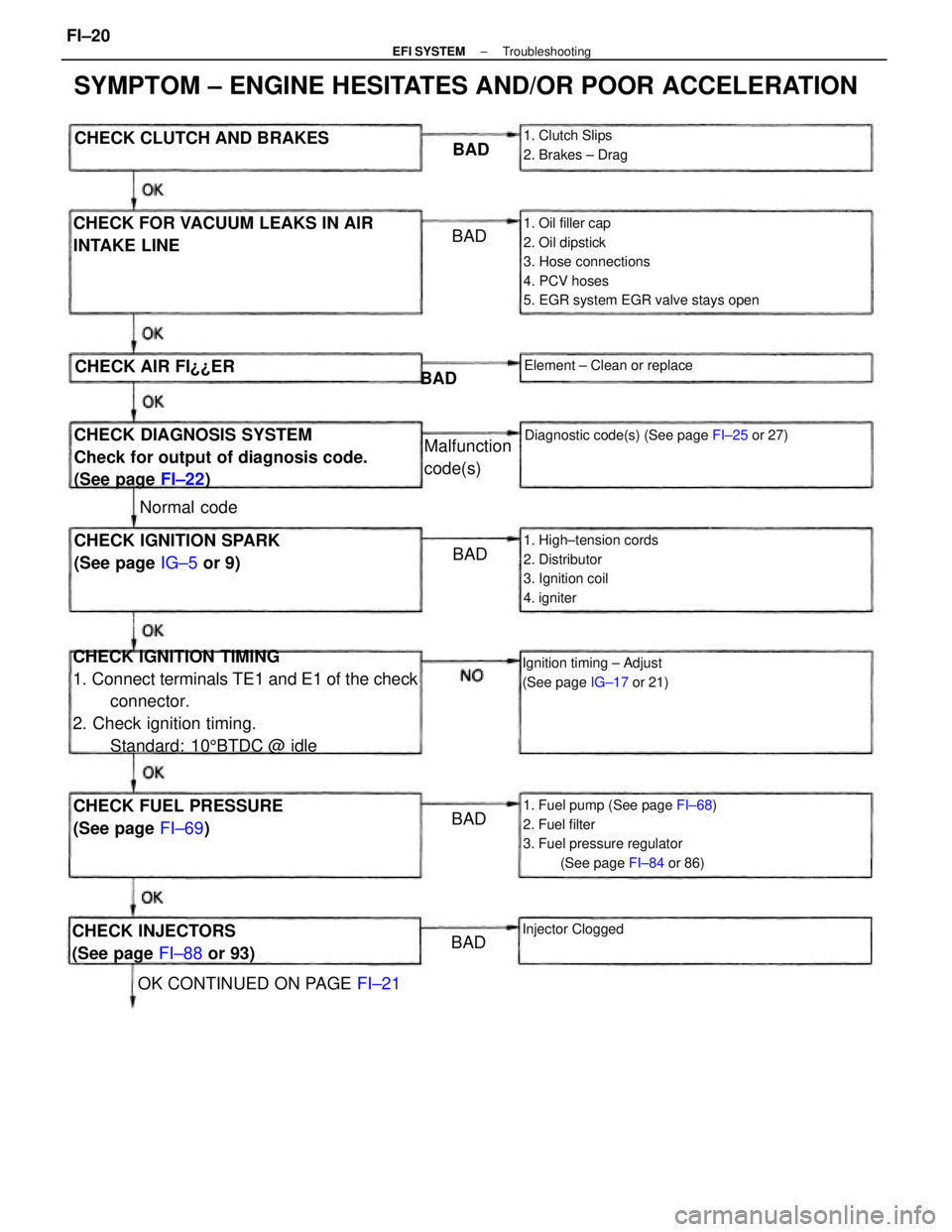
CHECK IGNITION TIMING
1. Connect terminals TE1 and E1 of the check
connector.
2. Check ignition timing.
Standard: 105BTDC @ idle
1. Oil filler cap
2. Oil dipstick
3. Hose connections
4. PCV hoses
5. EGR system EGR valve stays open
SYMPTOM ± ENGINE HESITATES AND/OR POOR ACCELERATION
1. Fuel pump (See page FI±68)
2. Fuel filter
3. Fuel pressure regulator
(See page FI±84 or 86)
CHECK DIAGNOSIS SYSTEM
Check for output of diagnosis code.
(See page FI±22) CHECK FOR VACUUM LEAKS IN AIR
INTAKE LINE
1. High±tension cords
2. Distributor
3. Ignition coil
4. igniterCHECK IGNITION SPARK
(See page IG±5 or 9)
CHECK FUEL PRESSURE
(See page FI±69)
Diagnostic code(s) (See page FI±25 or 27)
Ignition timing ± Adjust
(See page IG±17 or 21)
CHECK INJECTORS
(See page FI±88 or 93)
OK CONTINUED ON PAGE FI±21 CHECK CLUTCH AND BRAKES
1. Clutch Slips
2. Brakes ± Drag
Element ± Clean or replace
Malfunction
code(s)
Injector Clogged
CHECK AIR FI¿¿ER
Normal codeBAD
BADBAD
BADBAD BAD
± EFI SYSTEMTroubleshootingFI±20
Page 1039 of 2389
wInjector circuit
wInjector
wOxygen sensor circuit
Oxygen sensor
wECU
wFuel line pressure
wAir flow meter
wWater temp. sensor
wIgnition system During air±fuel ratio feedback
correction, voltage output from the
main oxygen sensor does exceed a
set valve on the lean side and the
rich side continuously for a certain
period.
When air±fuel ratio feedback
compensation valve or adaptive
control value continues at the upper
(lean) or (rich) limit renewed for a
certain period of time.
wInjector circuit
wInjector
wFuel line pressure
Cold start injector
wAir flow meter
wWater temp. sensor
wECU
Open circuit in VC signal or short
circuit between VC and
E2 when idle contacts are closed.wIgnition circuit (+B, IGT,
IGF)
wIgniter
wECU
Open or short circuit i n sub±
oxygen sensor signal (OX2)wIntake air temp. sensor
circuit
wIntake air temp. sensor
wECU No NE signal to ECU when the
engine speed is above 1,000
rpm. This appears when none of the other
codes (11 thru 71) are identified.
No NE or G signal to ECU
within several seconds after engine
is cracked.
wMain oxygen sensor cir-
cuit
wMain oxygen sensor
wECU wDistributor circuit
wDistributor
wStarter signal circuit
wECU
wWater temp. sensor cir-
cuit
wWater temp. sensor
wECU
wSub±oxygen sensor cir-
cuit
wSub±oxygen sensor
wECU
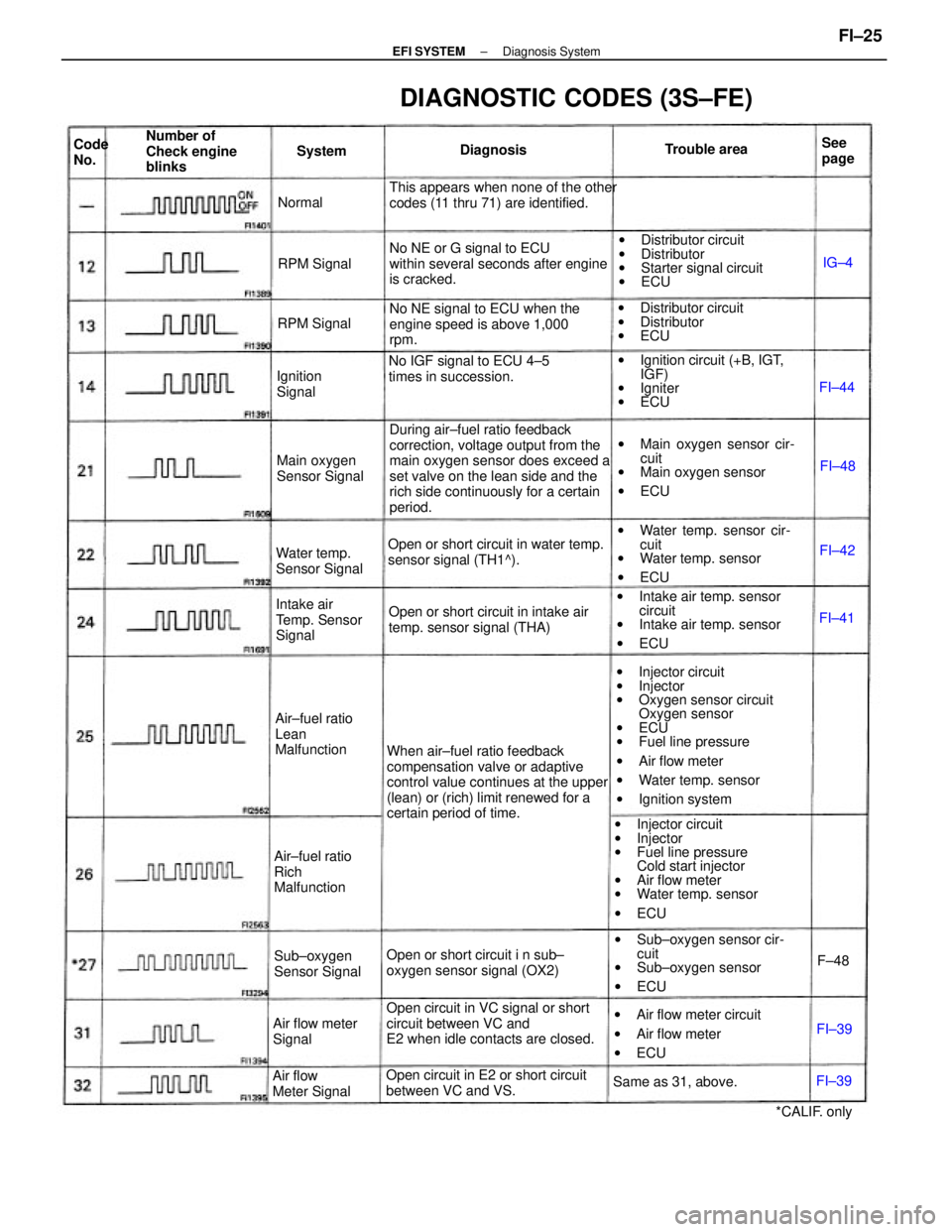
DIAGNOSTIC CODES (3S±FE)
wAir flow meter circuit
wAir flow meter
wECU Open or short circuit in water temp.
sensor signal (TH1^).
Open or short circuit in intake air
temp. sensor signal (THA)
Open circuit in E2 or short circuit
between VC and VS.No IGF signal to ECU 4±5
times in succession.wDistributor circuit
wDistributor
wECU
Intake air
Temp. Sensor
Signal Number of
Check engine
blinks
Air±fuel ratio
Lean
Malfunction
Air±fuel ratio
Rich
MalfunctionMain oxygen
Sensor Signal
Water temp.
Sensor Signal
Sub±oxygen
Sensor Signal
Air flow
Meter SignalAir flow meter
Signal
Same as 31, above.
*CALIF. only Ignition
SignalRPM Signal
RPM SignalTrouble area
DiagnosisSee
page System Code
No.
Normal
FI±42
FI±39FI±48
FI±39F±48FI±41IG±4
FI±44
± EFI SYSTEMDiagnosis SystemFI±25
Page 1041 of 2389
(CALIF.)
wWhen air±fuel ratio feed±
back correction value or adap-
tive control value continues at
the upper (lean)
or lower (rich) limit for a certain
period of time or adaptive con-
trol value is not renewed for a
certain period of time.
wWhen feedback frequency of
air±fuel ratio feed±
back correction or adaptive
control is abnormally
high during feedback condition.
(Others)
wOxygen sensor outputs a lean
signal continuously for several
seconds during air±fuel ratio
feedback correction.
wOpen circuit in oxygen sensor
signal (OX).wWater temp. sensor
wInjector circuit
wInjector
wFuel line pressure
wAir flow meter
wAir intake system
wOxygen sensor circuits
wOxygen sensors
wIgnition system
wECU During air±fuel ratio feedback
correction, voltage output from the
main oxygen sensor does exceed a
set value on the lean side and the
rich side continuously for a certain
period.
Water temp. sensor
wInjector circuit
wInjector
wFuel line pressure
wAir flow meter
wCold start injector
wECU wMain oxygen heater circuit
wMain oxygen sensor heater
wECU wIgniter and ignition coil circuit
wIgniter and ignition coil
wECU
wIntake air temp. sensor circuit
wIntake air temp. sensor
wECU Open or short circuit in main oxygen
sensor heater signal
(HT).No NE signal to ECU when the en-
gine speed is above 1,000
rpm.wDistributor circuit
wDistributor
wStarter signal circuit
wECU
wMain oxygen sensor circuit
wMain oxygen sensor
wECU No NE or G signal to ECU
within 2 seconds after engine has
been cranked.
wWater temp. sensor circuit
wWater temp. sensor
wECU
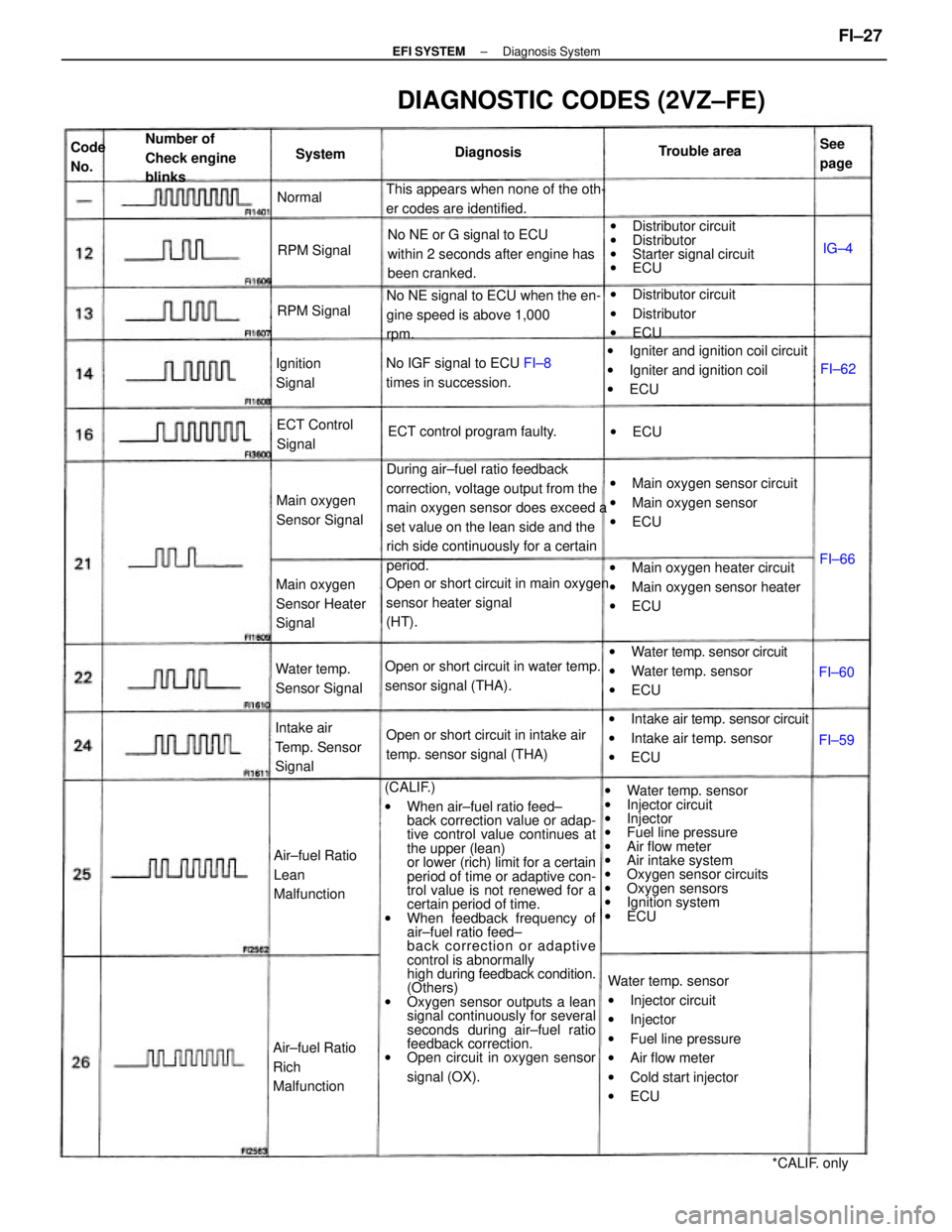
DIAGNOSTIC CODES (2VZ±FE)
Open or short circuit in water temp.
sensor signal (THA).
Open or short circuit in intake air
temp. sensor signal (THA) This appears when none of the oth-
er codes are identified.
wDistributor circuit
wDistributor
wECU
No IGF signal to ECU FI±8
times in succession.
Intake air
Temp. Sensor
Signal
Air±fuel Ratio
Lean
Malfunction Number of
Check engine
blinks
Air±fuel Ratio
Rich
MalfunctionMain oxygen
Sensor Heater
SignalECT control program faulty.
Main oxygen
Sensor Signal
Water temp.
Sensor SignalECT Control
Signal
*CALIF. only Ignition
SignalTrouble area
RPM Signal
RPM SignalDiagnosisSee
page Code
No.System
Normal
wECU
FI±60FI±66
FI±59FI±62IG±4
± EFI SYSTEMDiagnosis SystemFI±27
Page 1047 of 2389
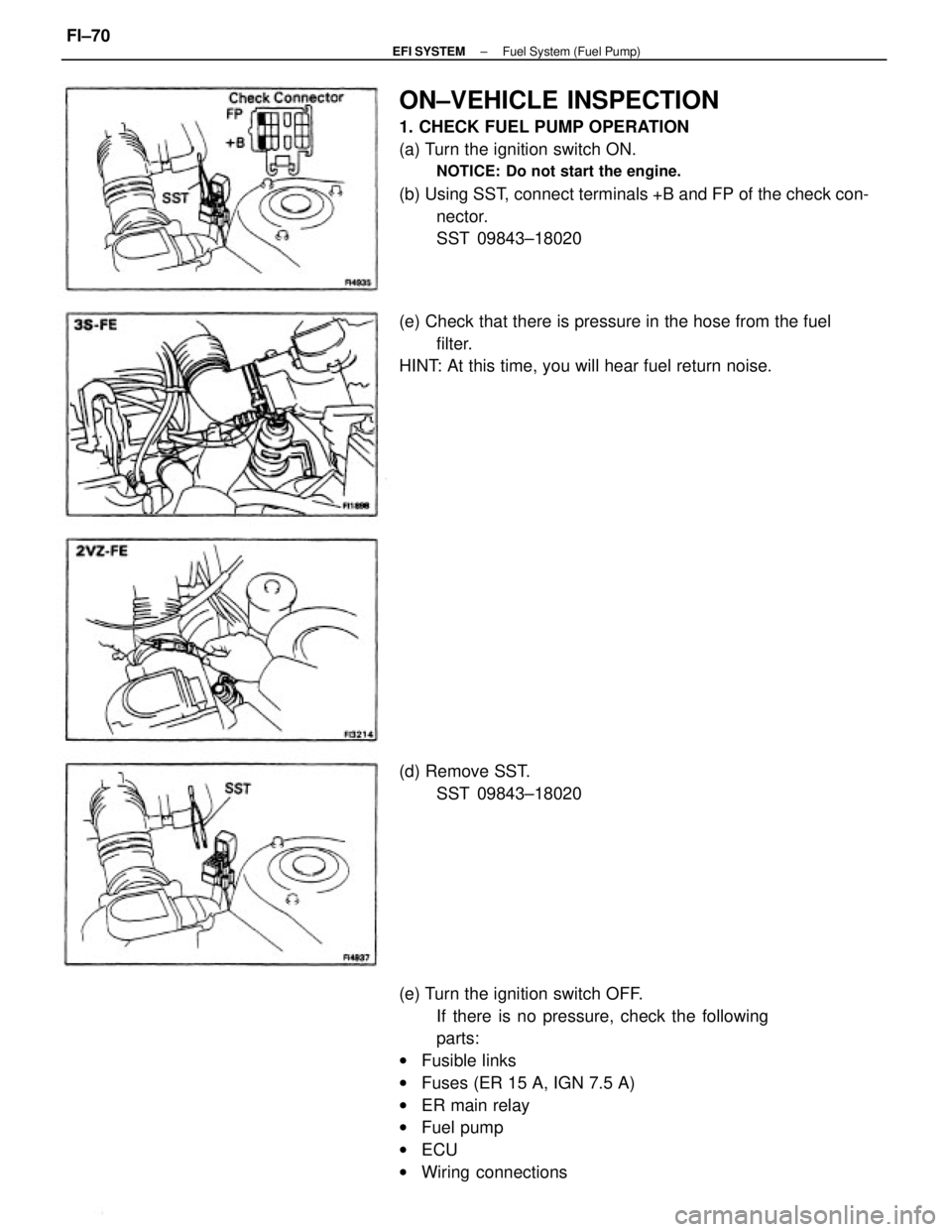
ON±VEHICLE INSPECTION
1. CHECK FUEL PUMP OPERATION
(a) Turn the ignition switch ON.
NOTICE: Do not start the engine.
(b) Using SST, connect terminals +B and FP of the check con-
nector.
SST 09843±18020
(e) Turn the ignition switch OFF.
If there is no pressure, check the following
parts:
wFusible links
wFuses (ER 15 A, IGN 7.5 A)
wER main relay
wFuel pump
wECU
wWiring connections (e) Check that there is pressure in the hose from the fuel
filter.
HINT: At this time, you will hear fuel return noise.
(d) Remove SST.
SST 09843±18020
± EFI SYSTEMFuel System (Fuel Pump)FI±70
Page 1048 of 2389
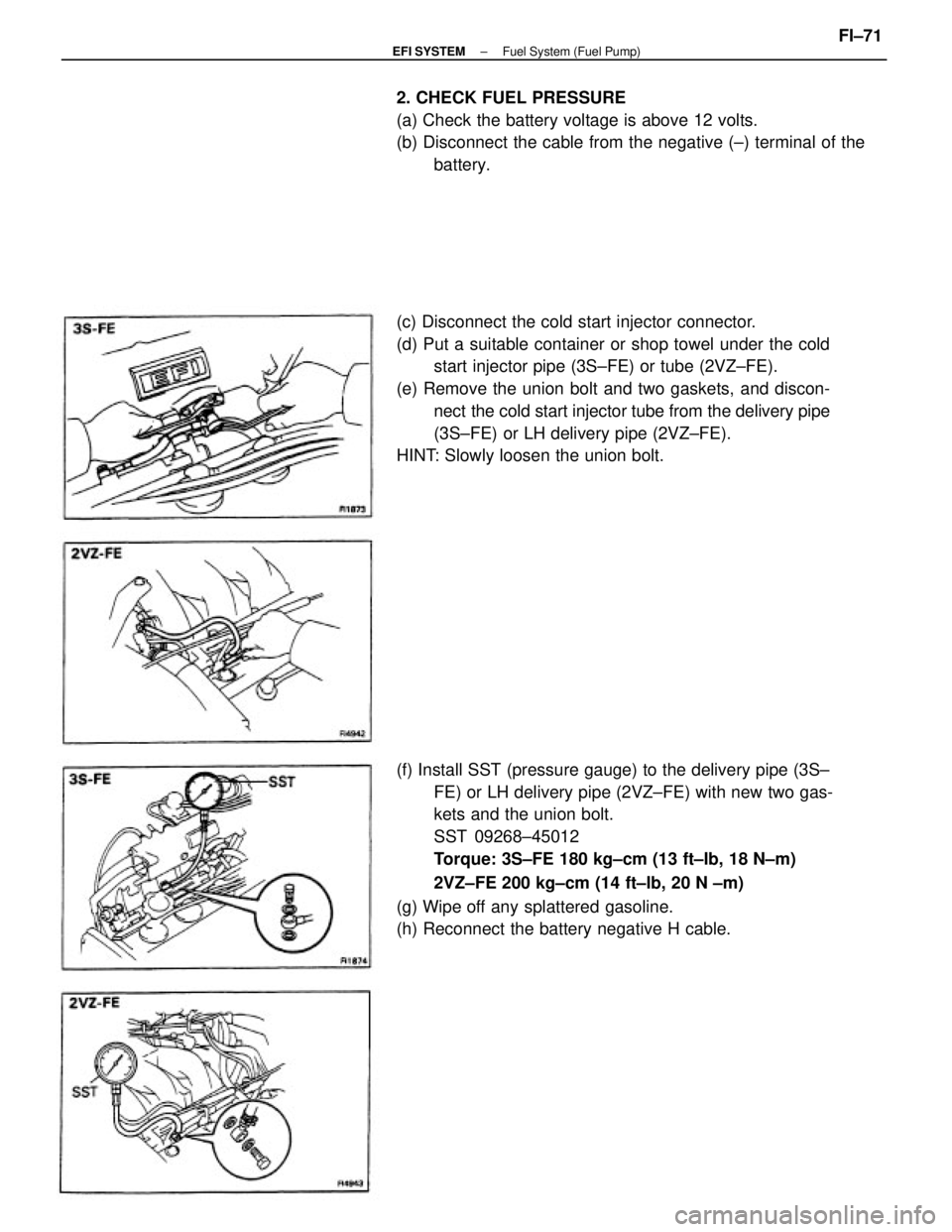
(f) Install SST (pressure gauge) to the delivery pipe (3S±
FE) or LH delivery pipe (2VZ±FE) with new two gas-
kets and the union bolt.
SST 09268±45012
Torque: 3S±FE 180 kg±cm (13 ft±Ib, 18 N±m)
2VZ±FE 200 kg±cm (14 ft±lb, 20 N ±m)
(g) Wipe off any splattered gasoline.
(h) Reconnect the battery negative H cable. (c) Disconnect the cold start injector connector.
(d) Put a suitable container or shop towel under the cold
start injector pipe (3S±FE) or tube (2VZ±FE).
(e) Remove the union bolt and two gaskets, and discon-
nect the cold start injector tube from the delivery pipe
(3S±FE) or LH delivery pipe (2VZ±FE).
HINT: Slowly loosen the union bolt. 2. CHECK FUEL PRESSURE
(a) Check the battery voltage is above 12 volts.
(b) Disconnect the cable from the negative (±) terminal of the
battery.
± EFI SYSTEMFuel System (Fuel Pump)FI±71