engine TOYOTA CAMRY V20 1986 Service Information
[x] Cancel search | Manufacturer: TOYOTA, Model Year: 1986, Model line: CAMRY V20, Model: TOYOTA CAMRY V20 1986Pages: 2389, PDF Size: 84.44 MB
Page 1370 of 2389
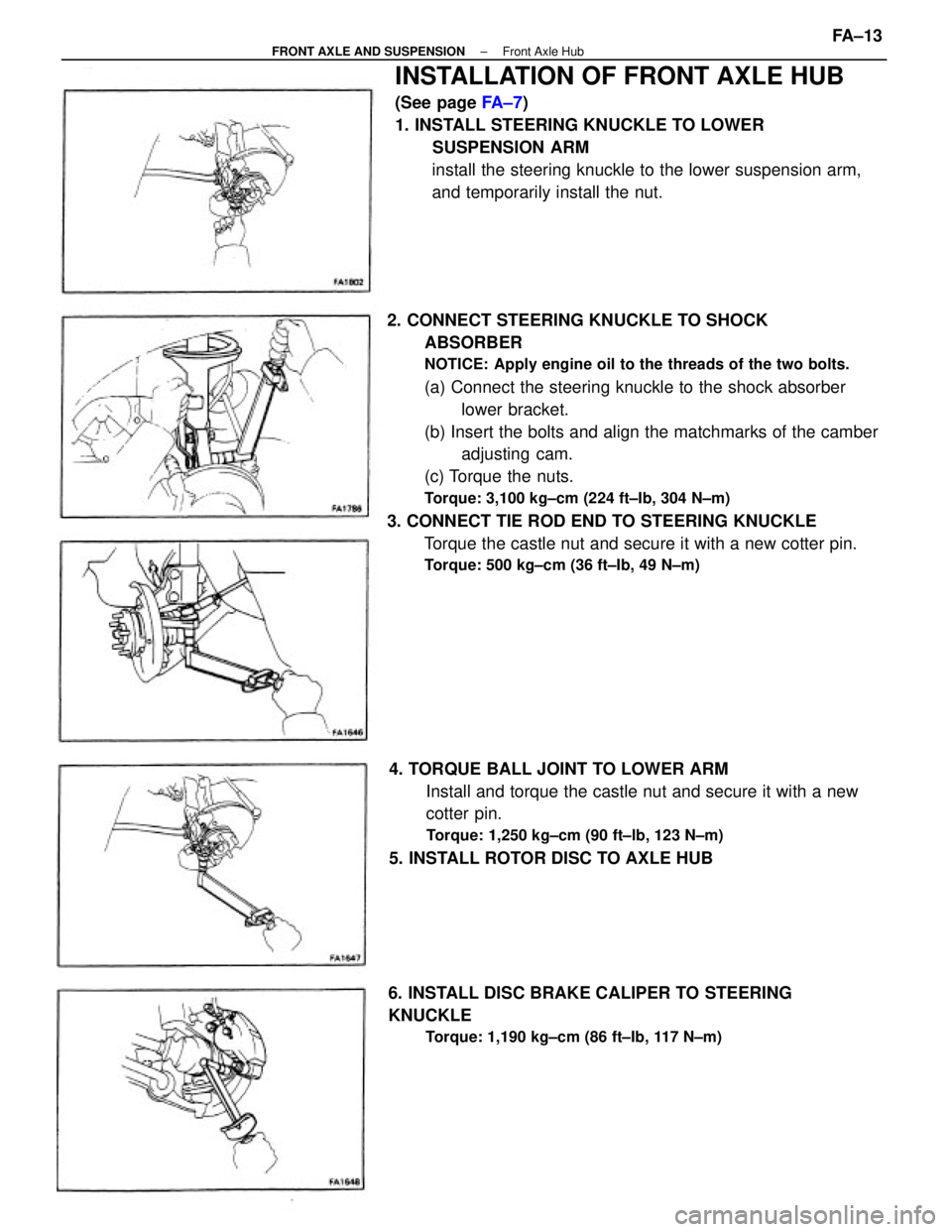
2. CONNECT STEERING KNUCKLE TO SHOCK
ABSORBER
NOTICE: Apply engine oil to the threads of the two bolts.
(a) Connect the steering knuckle to the shock absorber
lower bracket.
(b) Insert the bolts and align the matchmarks of the camber
adjusting cam.
(c) Torque the nuts.
Torque: 3,100 kg±cm (224 ft±Ib, 304 N±m)
3. CONNECT TIE ROD END TO STEERING KNUCKLE
Torque the castle nut and secure it with a new cotter pin.
Torque: 500 kg±cm (36 ft±Ib, 49 N±m)
INSTALLATION OF FRONT AXLE HUB
(See page FA ± 7)
1. INSTALL STEERING KNUCKLE TO LOWER
SUSPENSION ARM
install the steering knuckle to the lower suspension arm,
and temporarily install the nut.
4. TORQUE BALL JOINT TO LOWER ARM
Install and torque the castle nut and secure it with a new
cotter pin.
Torque: 1,250 kg±cm (90 ft±lb, 123 N±m)
5. INSTALL ROTOR DISC TO AXLE HUB
6. INSTALL DISC BRAKE CALIPER TO STEERING
KNUCKLE
Torque: 1,190 kg±cm (86 ft±Ib, 117 N±m)
± FRONT AXLE AND SUSPENSIONFront Axle HubFA±13
Page 1373 of 2389
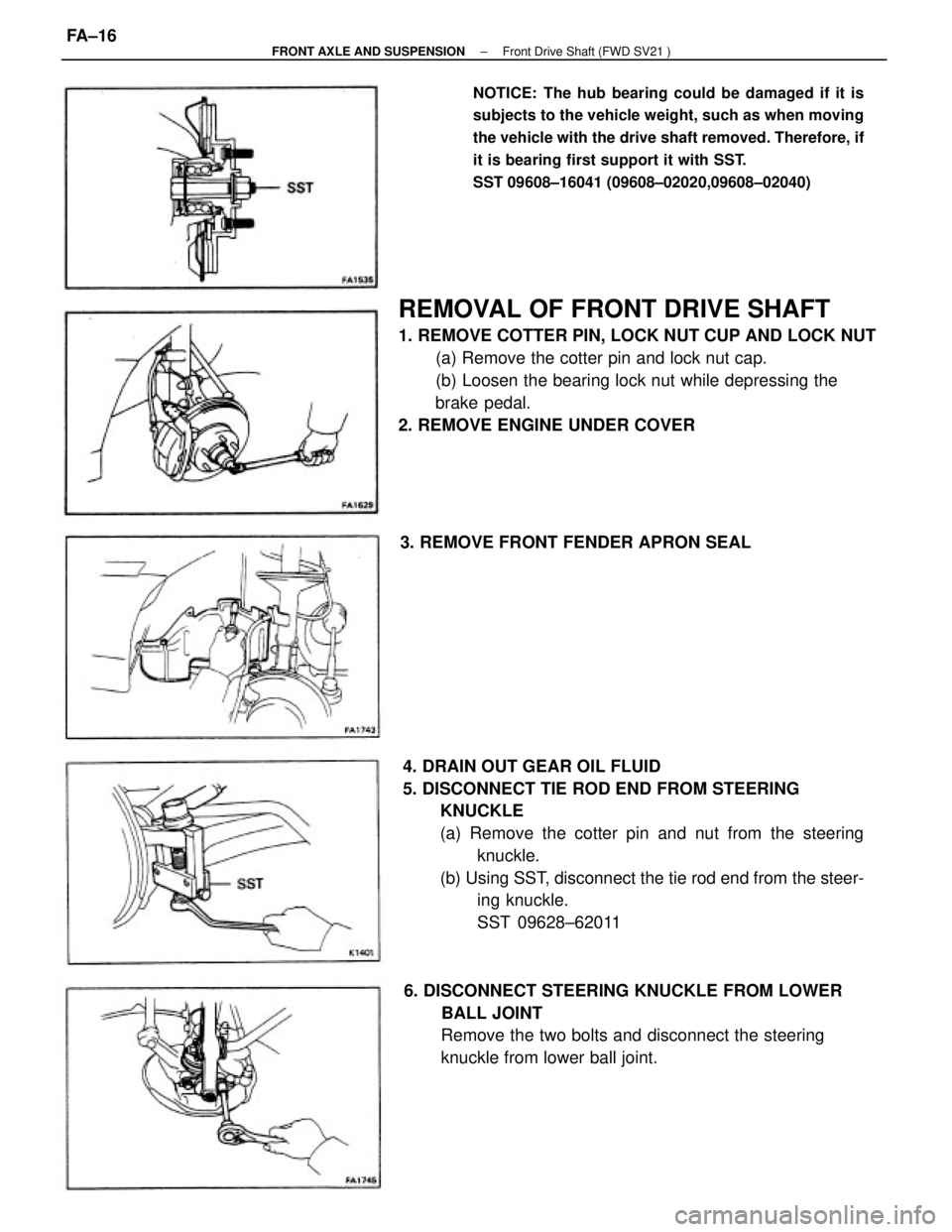
REMOVAL OF FRONT DRIVE SHAFT
1. REMOVE COTTER PIN, LOCK NUT CUP AND LOCK NUT
(a) Remove the cotter pin and lock nut cap.
(b) Loosen the bearing lock nut while depressing the
brake pedal.
2. REMOVE ENGINE UNDER COVER
4. DRAIN OUT GEAR OIL FLUID
5. DISCONNECT TIE ROD END FROM STEERING
KNUCKLE
(a) Remove the cotter pin and nut from the steering
knuckle.
(b) Using SST, disconnect the tie rod end from the steer-
ing knuckle.
SST 09628±62011
NOTICE: The hub bearing could be damaged if it is
subjects to the vehicle weight, such as when moving
the vehicle with the drive shaft removed. Therefore, if
it is bearing first support it with SST.
SST 09608±16041 (09608±02020,09608±02040)
6. DISCONNECT STEERING KNUCKLE FROM LOWER
BALL JOINT
Remove the two bolts and disconnect the steering
knuckle from lower ball joint. 3. REMOVE FRONT FENDER APRON SEAL
± FRONT AXLE AND SUSPENSIONFront Drive Shaft (FWD SV21 )FA±16
Page 1384 of 2389
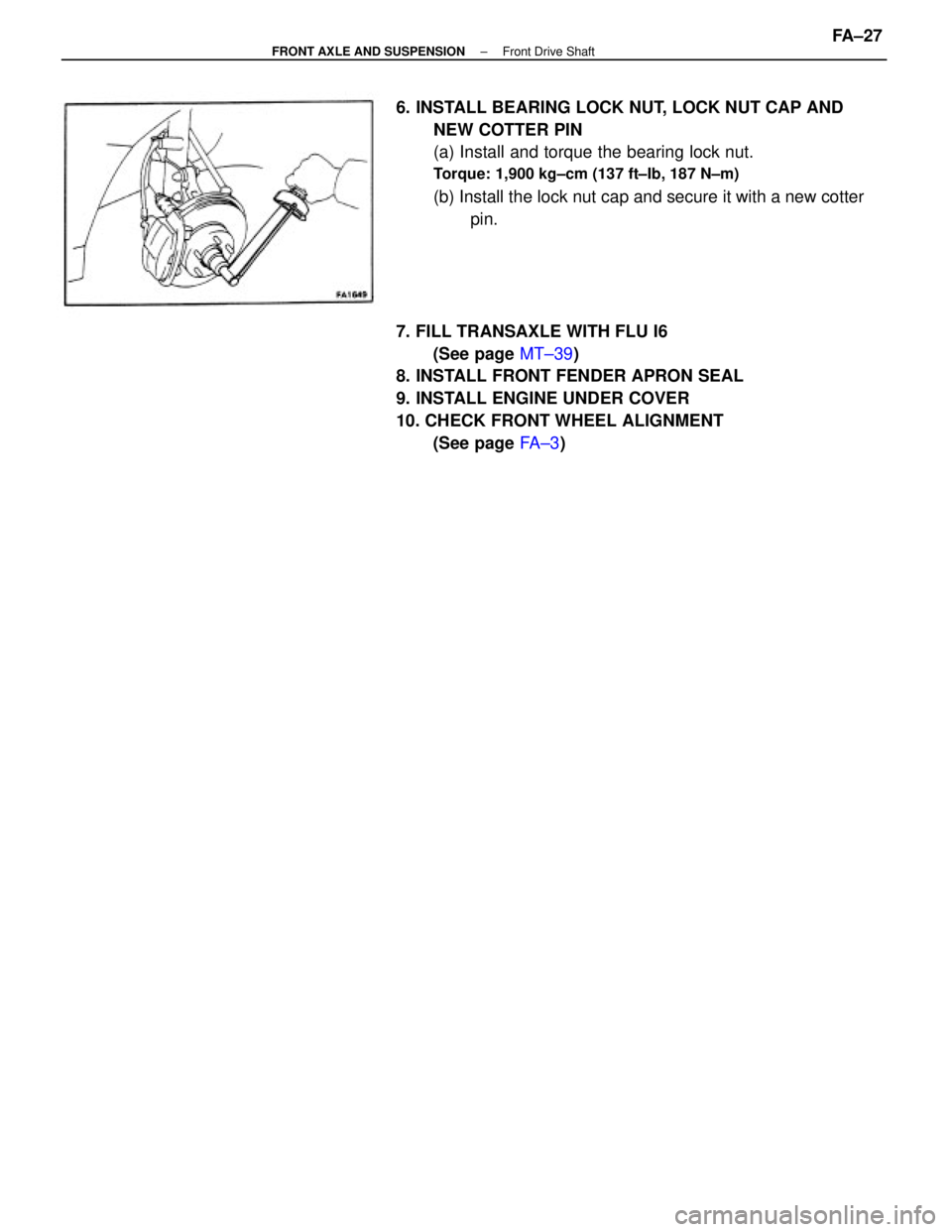
6. INSTALL BEARING LOCK NUT, LOCK NUT CAP AND
NEW COTTER PIN
(a) Install and torque the bearing lock nut.
Torque: 1,900 kg±cm (137 ft±Ib, 187 N±m)
(b) Install the lock nut cap and secure it with a new cotter
pin.
7. FILL TRANSAXLE WITH FLU I6
(See page MT±39)
8. INSTALL FRONT FENDER APRON SEAL
9. INSTALL ENGINE UNDER COVER
10. CHECK FRONT WHEEL ALIGNMENT
(See page FA±3)
± FRONT AXLE AND SUSPENSIONFront Drive ShaftFA±27
Page 1386 of 2389
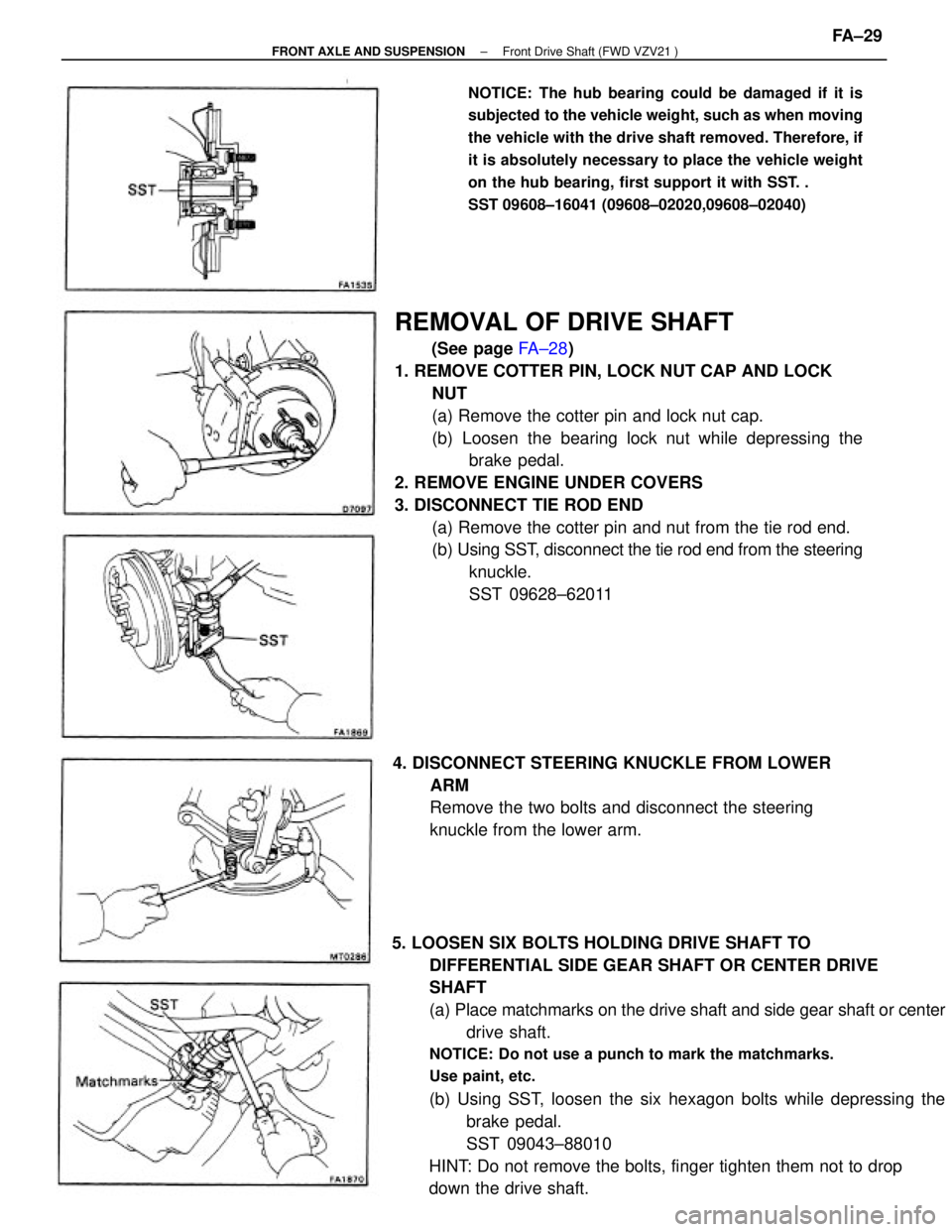
REMOVAL OF DRIVE SHAFT
(See page FA±28)
1. REMOVE COTTER PIN, LOCK NUT CAP AND LOCK
NUT
(a) Remove the cotter pin and lock nut cap.
(b) Loosen the bearing lock nut while depressing the
brake pedal.
2. REMOVE ENGINE UNDER COVERS
3. DISCONNECT TIE ROD END
(a) Remove the cotter pin and nut from the tie rod end.
(b) Using SST, disconnect the tie rod end from the steering
knuckle.
SST 09628±62011
5. LOOSEN SIX BOLTS HOLDING DRIVE SHAFT TO
DIFFERENTIAL SIDE GEAR SHAFT OR CENTER DRIVE
SHAFT
(a) Place matchmarks on the drive shaft and side gear shaft or center
drive shaft.
NOTICE: Do not use a punch to mark the matchmarks.
Use paint, etc.
(b) Using SST, loosen the six hexagon bolts while depressing the
brake pedal.
SST 09043±88010
HINT: Do not remove the bolts, finger tighten them not to drop
down the drive shaft.
NOTICE: The hub bearing could be damaged if it is
subjected to the vehicle weight, such as when moving
the vehicle with the drive shaft removed. Therefore, if
it is absolutely necessary to place the vehicle weight
on the hub bearing, first support it with SST. .
SST 09608±16041 (09608±02020,09608±02040)
4. DISCONNECT STEERING KNUCKLE FROM LOWER
ARM
Remove the two bolts and disconnect the steering
knuckle from the lower arm.
± FRONT AXLE AND SUSPENSIONFront Drive Shaft (FWD VZV21 )FA±29
Page 1397 of 2389
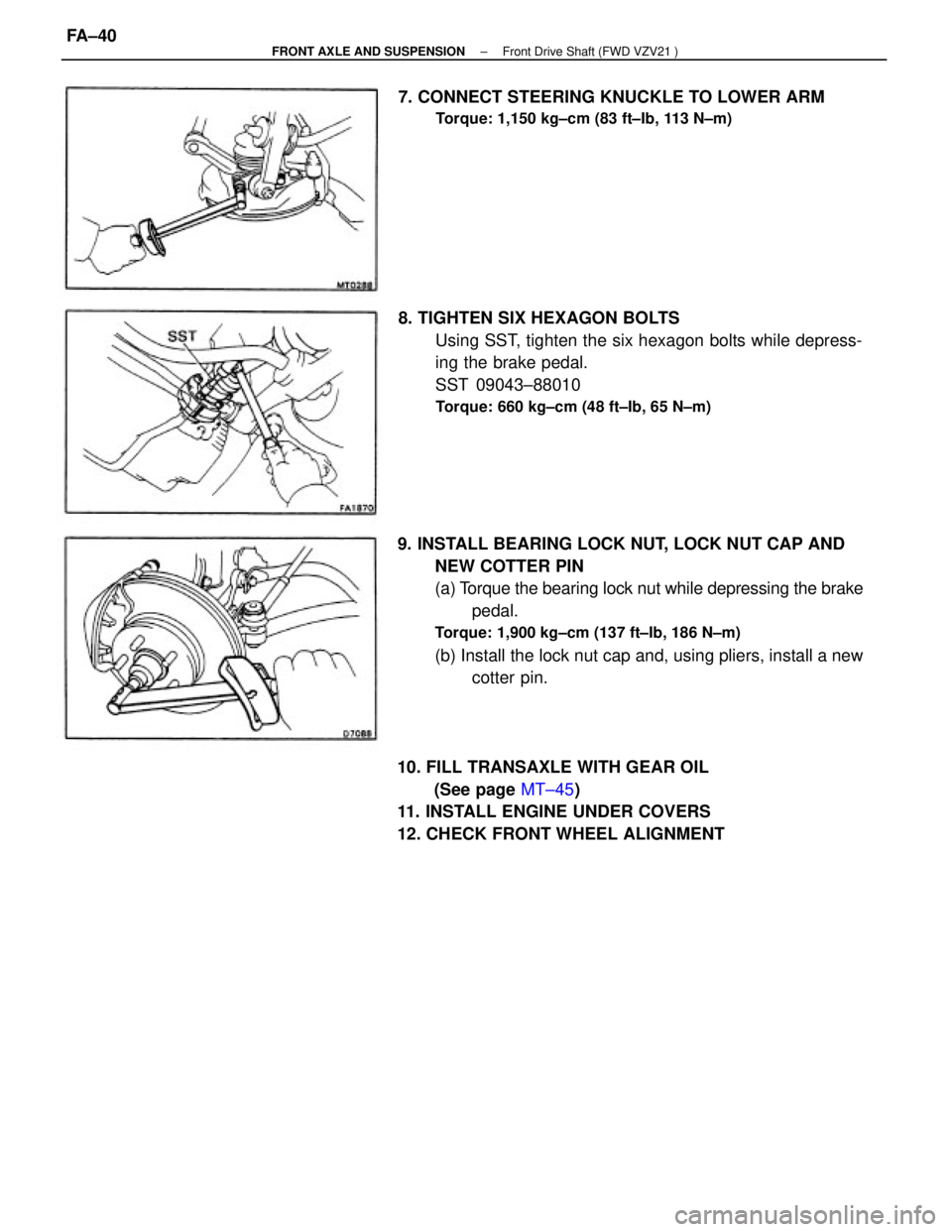
9. INSTALL BEARING LOCK NUT, LOCK NUT CAP AND
NEW COTTER PIN
(a) Torque the bearing lock nut while depressing the brake
pedal.
Torque: 1,900 kg±cm (137 ft±Ib, 186 N±m)
(b) Install the lock nut cap and, using pliers, install a new
cotter pin. 8. TIGHTEN SIX HEXAGON BOLTS
Using SST, tighten the six hexagon bolts while depress-
ing the brake pedal.
SST 09043±88010
Torque: 660 kg±cm (48 ft±Ib, 65 N±m)
10. FILL TRANSAXLE WITH GEAR OIL
(See page MT±45)
11. INSTALL ENGINE UNDER COVERS
12. CHECK FRONT WHEEL ALIGNMENT7. CONNECT STEERING KNUCKLE TO LOWER ARM
Torque: 1,150 kg±cm (83 ft±Ib, 113 N±m)
± FRONT AXLE AND SUSPENSIONFront Drive Shaft (FWD VZV21 )FA±40
Page 1399 of 2389
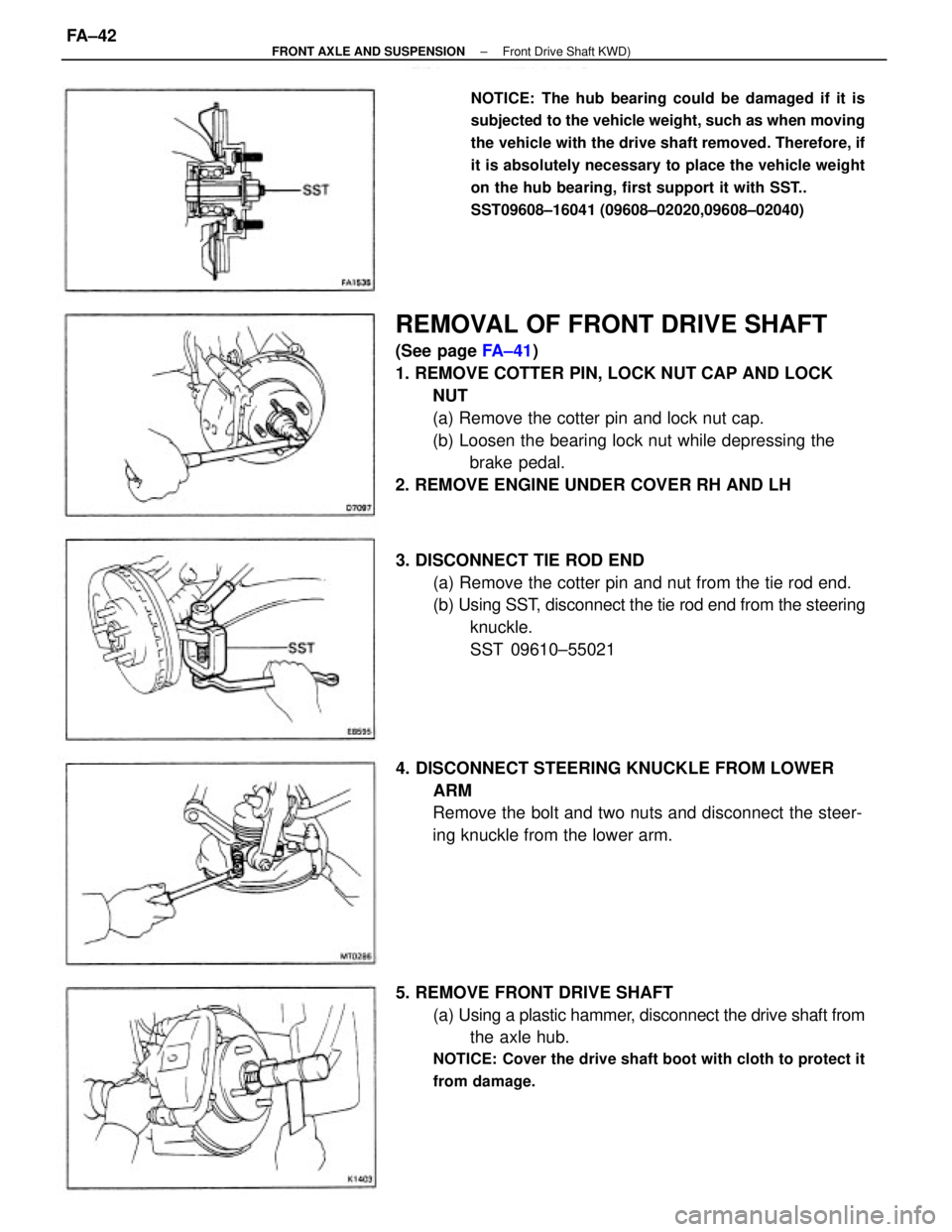
REMOVAL OF FRONT DRIVE SHAFT
(See page FA±41)
1. REMOVE COTTER PIN, LOCK NUT CAP AND LOCK
NUT
(a) Remove the cotter pin and lock nut cap.
(b) Loosen the bearing lock nut while depressing the
brake pedal.
2. REMOVE ENGINE UNDER COVER RH AND LH
3. DISCONNECT TIE ROD END
(a) Remove the cotter pin and nut from the tie rod end.
(b) Using SST, disconnect the tie rod end from the steering
knuckle.
SST 09610±55021
NOTICE: The hub bearing could be damaged if it is
subjected to the vehicle weight, such as when moving
the vehicle with the drive shaft removed. Therefore, if
it is absolutely necessary to place the vehicle weight
on the hub bearing, first support it with SST..
SST09608±16041 (09608±02020,09608±02040)
5. REMOVE FRONT DRIVE SHAFT
(a) Using a plastic hammer, disconnect the drive shaft from
the axle hub.
NOTICE: Cover the drive shaft boot with cloth to protect it
from damage.
4. DISCONNECT STEERING KNUCKLE FROM LOWER
ARM
Remove the bolt and two nuts and disconnect the steer-
ing knuckle from the lower arm.
± FRONT AXLE AND SUSPENSIONFront Drive Shaft KWD)FA±42
Page 1407 of 2389
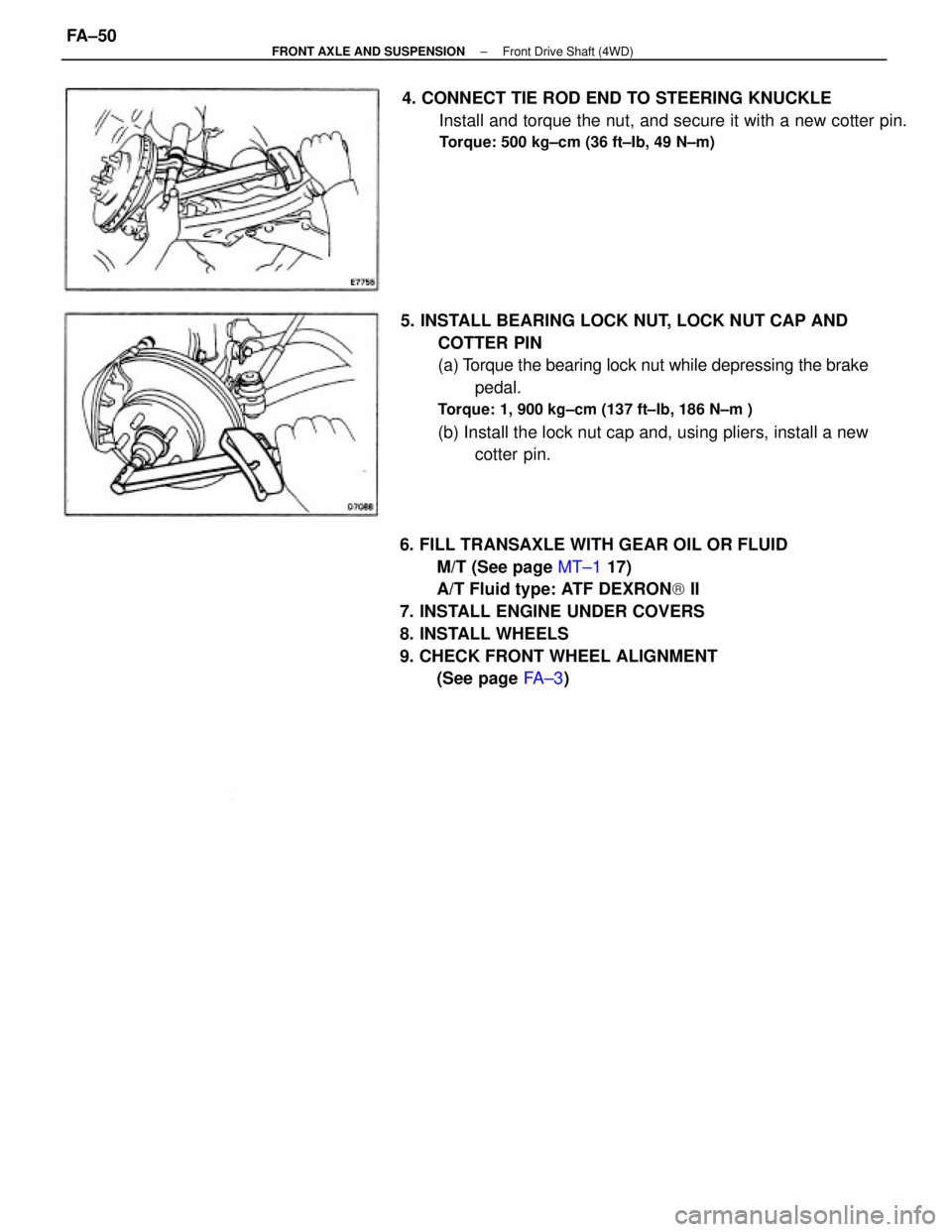
6. FILL TRANSAXLE WITH GEAR OIL OR FLUID
M/T (See page MT±1 17)
A/T Fluid type: ATF DEXRON) II
7. INSTALL ENGINE UNDER COVERS
8. INSTALL WHEELS
9. CHECK FRONT WHEEL ALIGNMENT
(See page FA ± 3) 5. INSTALL BEARING LOCK NUT, LOCK NUT CAP AND
COTTER PIN
(a) Torque the bearing lock nut while depressing the brake
pedal.
Torque: 1, 900 kg±cm (137 ft±Ib, 186 N±m )
(b) Install the lock nut cap and, using pliers, install a new
cotter pin. 4. CONNECT TIE ROD END TO STEERING KNUCKLE
Install and torque the nut, and secure it with a new cotter pin.
Torque: 500 kg±cm (36 ft±Ib, 49 N±m)
± FRONT AXLE AND SUSPENSIONFront Drive Shaft (4WD)FA±50
Page 1417 of 2389
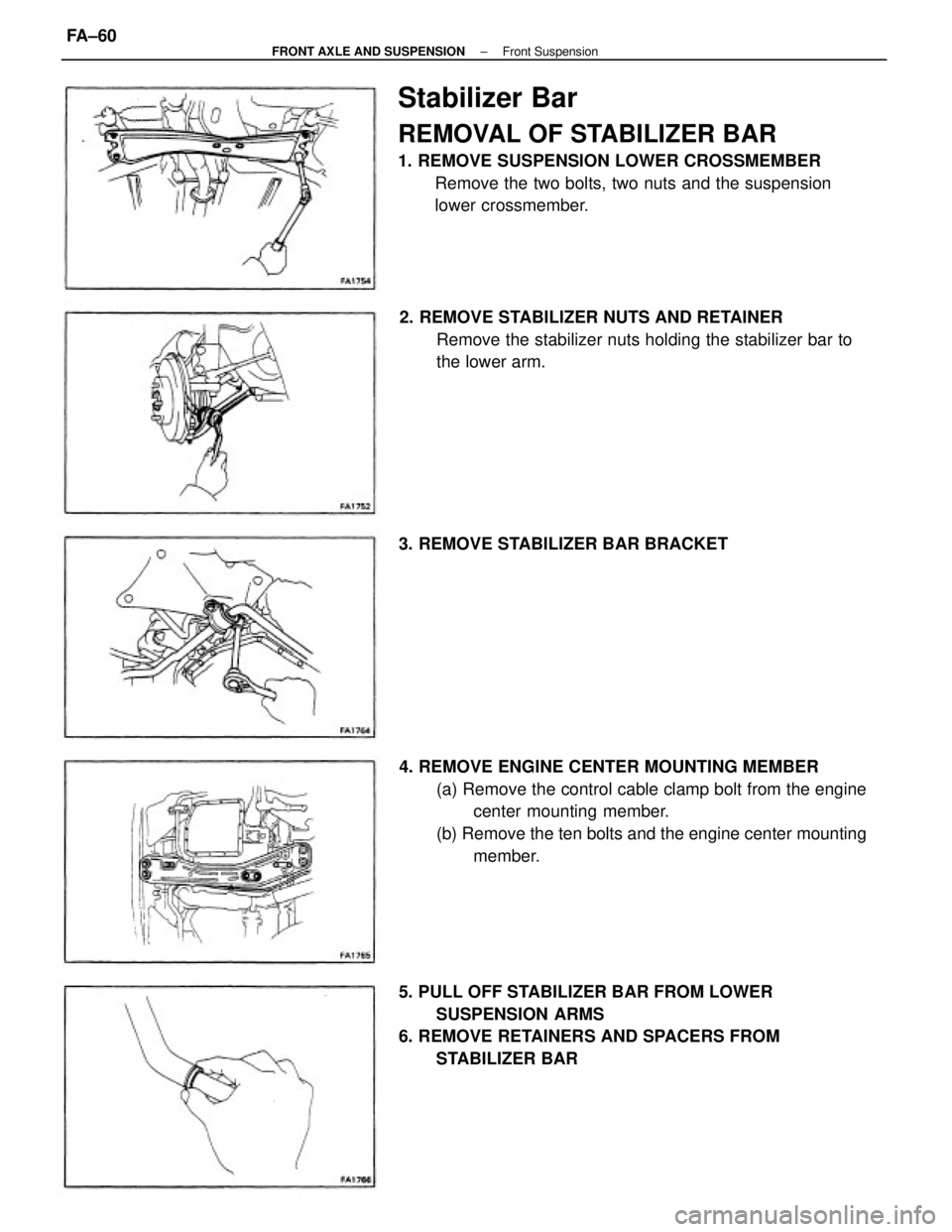
Stabilizer Bar
REMOVAL OF STABILIZER BAR
1. REMOVE SUSPENSION LOWER CROSSMEMBER
Remove the two bolts, two nuts and the suspension
lower crossmember.
4. REMOVE ENGINE CENTER MOUNTING MEMBER
(a) Remove the control cable clamp bolt from the engine
center mounting member.
(b) Remove the ten bolts and the engine center mounting
member.
5. PULL OFF STABILIZER BAR FROM LOWER
SUSPENSION ARMS
6. REMOVE RETAINERS AND SPACERS FROM
STABILIZER BAR 2. REMOVE STABILIZER NUTS AND RETAINER
Remove the stabilizer nuts holding the stabilizer bar to
the lower arm.
3. REMOVE STABILIZER BAR BRACKET
± FRONT AXLE AND SUSPENSIONFront SuspensionFA±60
Page 1418 of 2389
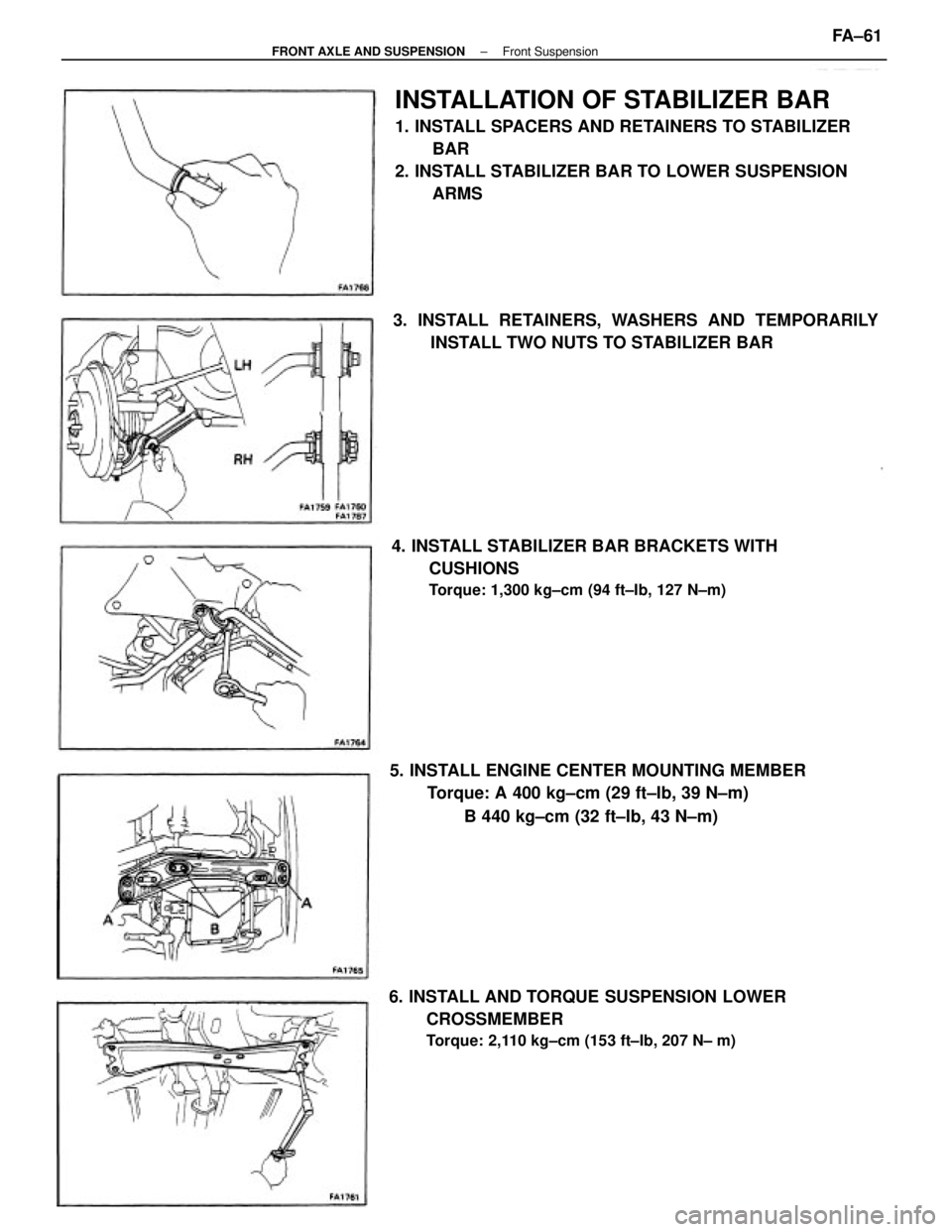
INSTALLATION OF STABILIZER BAR
1. INSTALL SPACERS AND RETAINERS TO STABILIZER
BAR
2. INSTALL STABILIZER BAR TO LOWER SUSPENSION
ARMS
5. INSTALL ENGINE CENTER MOUNTING MEMBER
Torque: A 400 kg±cm (29 ft±Ib, 39 N±m)
B 440 kg±cm (32 ft±Ib, 43 N±m)
6. INSTALL AND TORQUE SUSPENSION LOWER
CROSSMEMBER
Torque: 2,110 kg±cm (153 ft±Ib, 207 N± m)
4. INSTALL STABILIZER BAR BRACKETS WITH
CUSHIONS
Torque: 1,300 kg±cm (94 ft±Ib, 127 N±m)
3. INSTALL RETAINERS, WASHERS AND TEMPORARILY
INSTALL TWO NUTS TO STABILIZER BAR
± FRONT AXLE AND SUSPENSIONFront SuspensionFA±61
Page 1423 of 2389
LY±
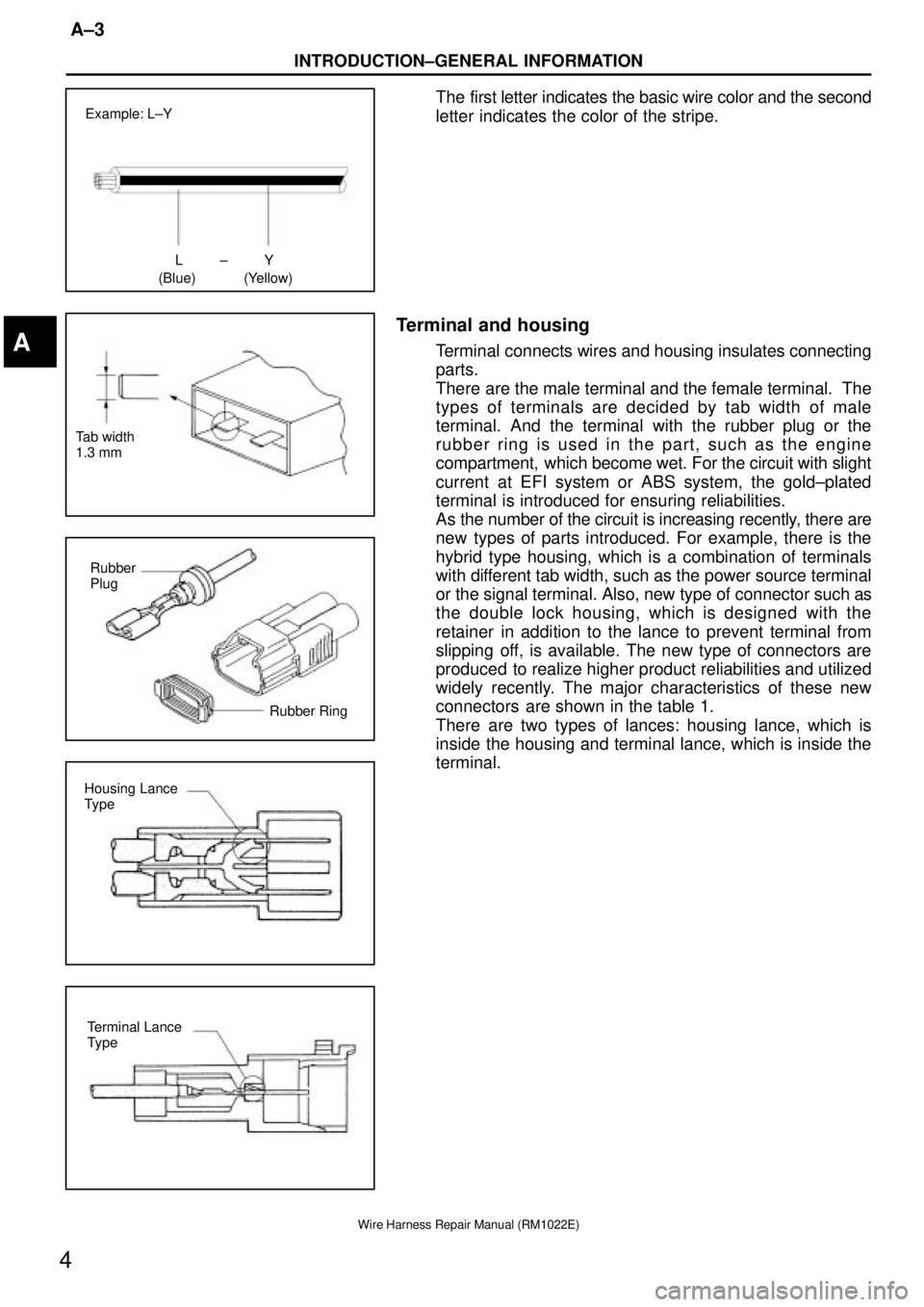
(Blue) (Yellow) Example: L±Y
Tab width
1.3 mm
Rubber
Plug
Rubber Ring
Housing Lance
Type
Terminal Lance
Type
INTRODUCTION±GENERAL INFORMATION
A±3
4
Wire Harness Repair Manual (RM1022E)
The first letter indicates the basic wire color and the second
letter indicates the color of the stripe.
Terminal and housing
Terminal connects wires and housing insulates connecting
parts.
There are the male terminal and the female terminal. The
types of terminals are decided by tab width of male
terminal. And the terminal with the rubber plug or the
rubber ring is used in the part, such as the engine
compartment, which become wet. For the circuit with slight
current at EFI system or ABS system, the gold±plated
terminal is introduced for ensuring reliabilities.
As the number of the circuit is increasing recently, there are
new types of parts introduced. For example, there is the
hybrid type housing, which is a combination of terminals
with different tab width, such as the power source terminal
or the signal terminal. Also, new type of connector such as
the double lock housing, which is designed with the
retainer in addition to the lance to prevent terminal from
slipping off, is available. The new type of connectors are
produced to realize higher product reliabilities and utilized
widely recently. The major characteristics of these new
connectors are shown in the table 1.
There are two types of lances: housing lance, which is
inside the housing and terminal lance, which is inside the
terminal.A