automatic transmission TOYOTA CAMRY V20 1986 Service Information
[x] Cancel search | Manufacturer: TOYOTA, Model Year: 1986, Model line: CAMRY V20, Model: TOYOTA CAMRY V20 1986Pages: 2389, PDF Size: 84.44 MB
Page 649 of 2389
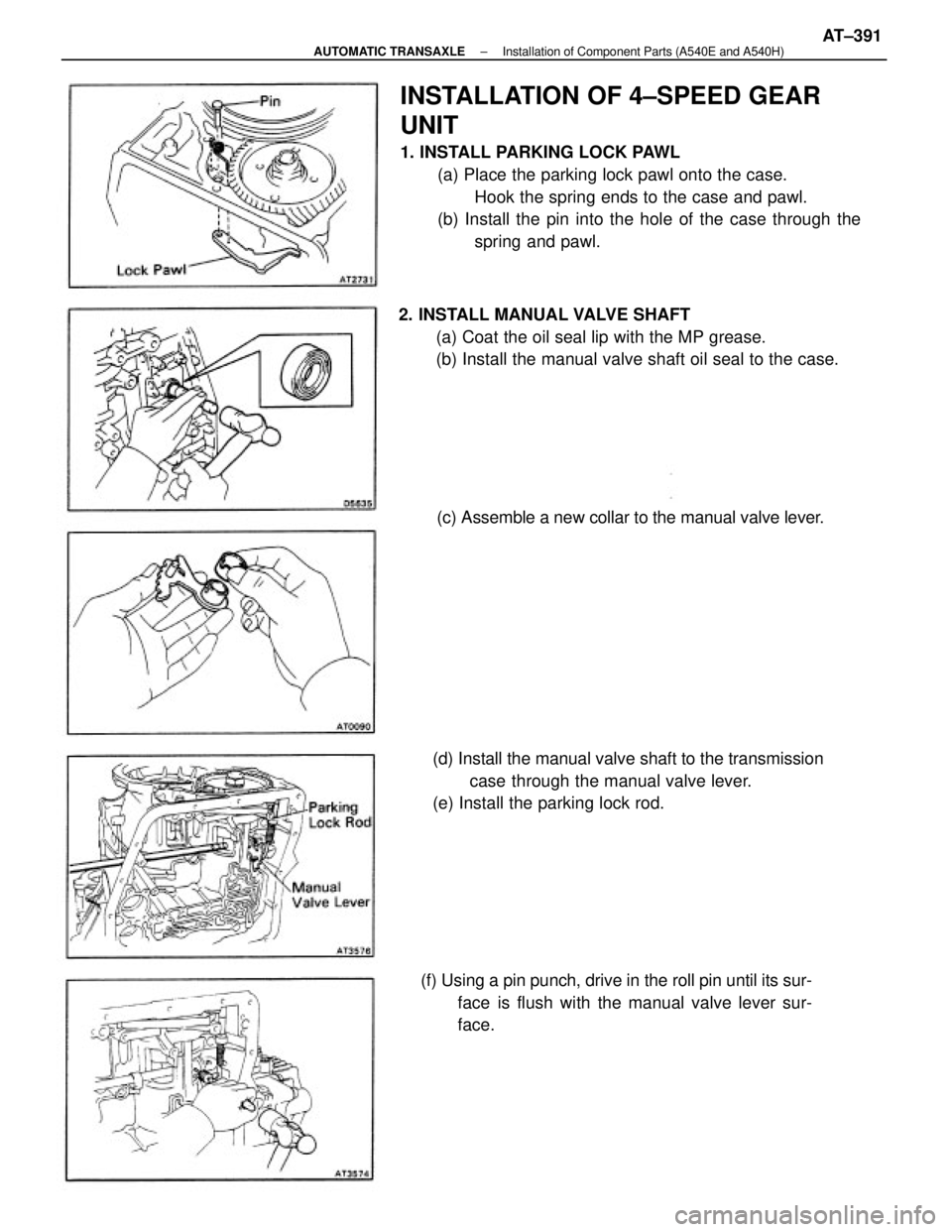
INSTALLATION OF 4±SPEED GEAR
UNIT
1. INSTALL PARKING LOCK PAWL
(a) Place the parking lock pawl onto the case.
Hook the spring ends to the case and pawl.
(b) Install the pin into the hole of the case through the
spring and pawl.
2. INSTALL MANUAL VALVE SHAFT
(a) Coat the oil seal lip with the MP grease.
(b) Install the manual valve shaft oil seal to the case.
(d) Install the manual valve shaft to the transmission
case through the manual valve lever.
(e) Install the parking lock rod.
(f) Using a pin punch, drive in the roll pin until its sur-
face is flush with the manual valve lever sur-
face. (c) Assemble a new collar to the manual valve lever.
± AUTOMATIC TRANSAXLEInstallation of Component Parts (A540E and A540H)AT±391
Page 650 of 2389
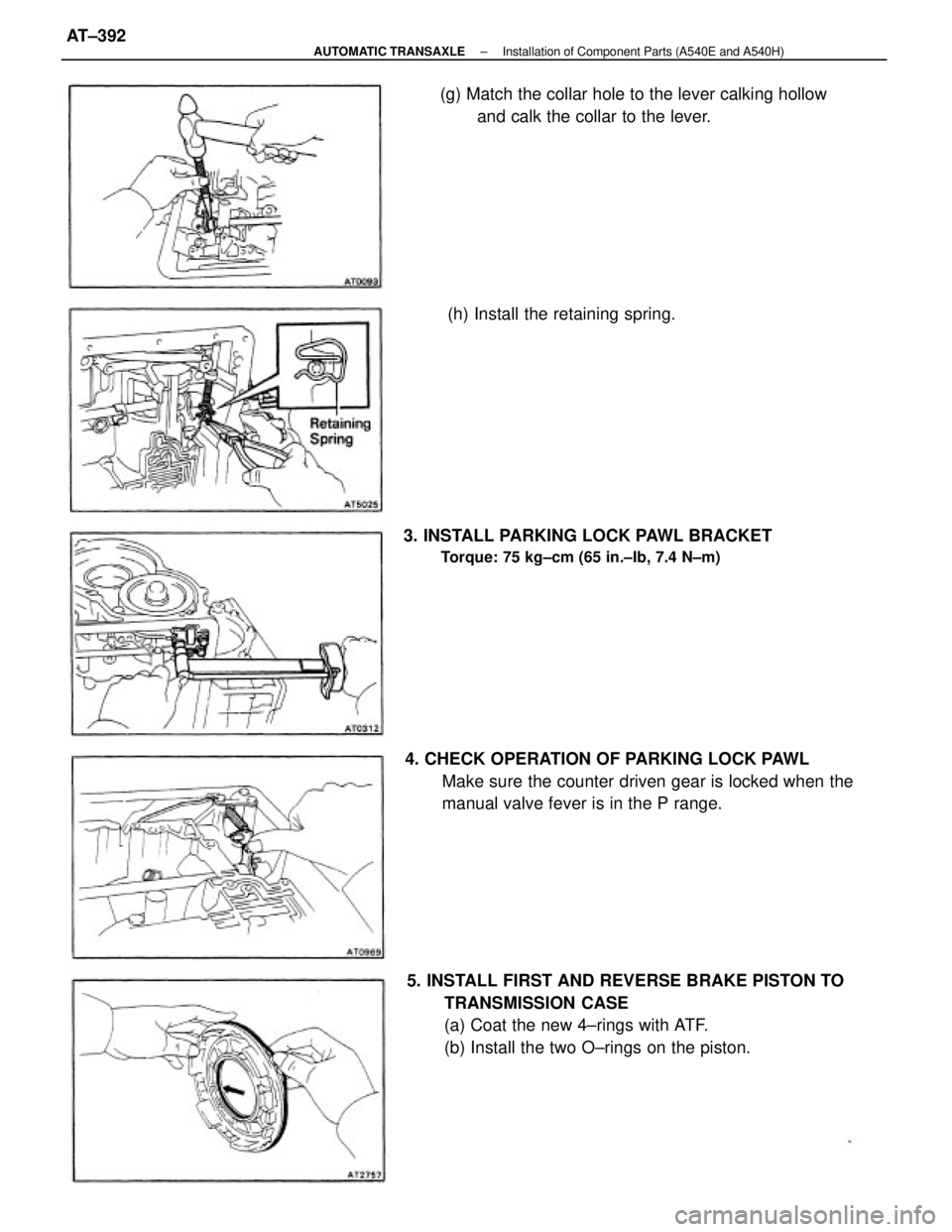
5. INSTALL FIRST AND REVERSE BRAKE PISTON TO
TRANSMISSION CASE
(a) Coat the new 4±rings with ATF.
(b) Install the two O±rings on the piston. 4. CHECK OPERATION OF PARKING LOCK PAWL
Make sure the counter driven gear is locked when the
manual valve fever is in the P range. 3. INSTALL PARKING LOCK PAWL BRACKET
Torque: 75 kg±cm (65 in.±Ib, 7.4 N±m)
(g) Match the collar hole to the lever calking hollow
and calk the collar to the lever.
(h) Install the retaining spring.
± AUTOMATIC TRANSAXLEInstallation of Component Parts (A540E and A540H)AT±392
Page 659 of 2389
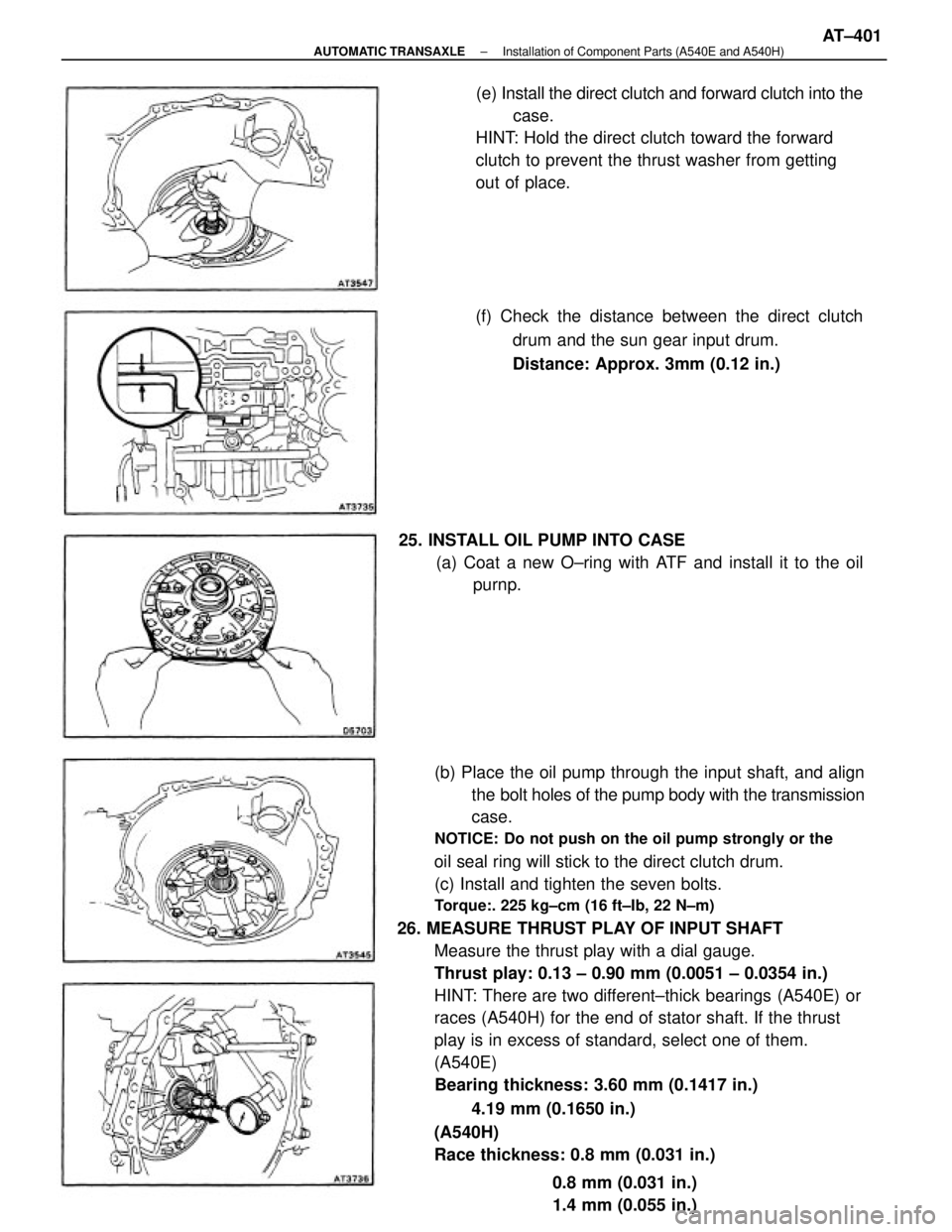
(b) Place the oil pump through the input shaft, and align
the bolt holes of the pump body with the transmission
case.
NOTICE: Do not push on the oil pump strongly or the
oil seal ring will stick to the direct clutch drum.
(c) Install and tighten the seven bolts.
Torque:. 225 kg±cm (16 ft±Ib, 22 N±m)
26. MEASURE THRUST PLAY OF INPUT SHAFT
Measure the thrust play with a dial gauge.
Thrust play: 0.13 ± 0.90 mm (0.0051 ± 0.0354 in.)
HINT: There are two different±thick bearings (A540E) or
races (A540H) for the end of stator shaft. If the thrust
play is in excess of standard, select one of them.
(A540E)
Bearing thickness: 3.60 mm (0.1417 in.)
4.19 mm (0.1650 in.)
(A540H)
Race thickness: 0.8 mm (0.031 in.)(e) Install the direct clutch and forward clutch into the
case.
HINT: Hold the direct clutch toward the forward
clutch to prevent the thrust washer from getting
out of place.
25. INSTALL OIL PUMP INTO CASE
(a) Coat a new O±ring with ATF and install it to the oil
purnp.(f) Check the distance between the direct clutch
drum and the sun gear input drum.
Distance: Approx. 3mm (0.12 in.)
0.8 mm (0.031 in.)
1.4 mm (0.055 in.)
± AUTOMATIC TRANSAXLEInstallation of Component Parts (A540E and A540H)AT±401
Page 989 of 2389
The cooling system is composed of the water jacket (inside the cylinder block and cylinder head), radiator,
water pump, thermostat, electric fan, hoses and other components.
Coolant which is heated in the water jacket is pumped to the radiator, through which an electric fan blows air
to cool the coolant as it passes through. Coolant which has been cooled is then sent back to the engine by
the water pump, where it cools the engine.
The water jacket is a network of channels in the shell of the cylinder block and cylinder head through which
coolant passes. It is designed to provide adequate cooling of the cylinders and combustion chambers which
become heated during engine operation.
RADIATOR
The radiator performs the function of cooling the coolant which has passed through the water jacket and be-
come hot, and it is mounted in the front of the vehicle. The radiator consists of an upper tank and lower tank,
and a core which connects the two tanks. The upper tank contains the inlet for coolant from the water jacket
and the filler inlet. It also has a hose attached through which excess coolant or steam can flow. The lower
tank has an outlet and drain cock for the coolant. The core contains many tubes through which coolant flows
from the upper tank to the lower tank as well as cooling fins which radiate heat away from the coolant in the
tubes.
The air sucked through the radiator by the electric fan, as well as the wind generated by the vehicle's travel,
passes through the radiator, cooling the coolant. Models with automatic transmission include an automatic
transmission fluid cooler built into the lower tank of the radiator. A fan with an electric motor is mounted be-
hind the radiator to assist the flow of air through the radiator. The fan operates when the coolant tempera-
ture becomes high in order to prevent it from becoming too high.
RADIATOR CAP
The radiator cap is a pressure type cap which seals the radiator, resulting in pressurization of the radiator as
the coolant expands. The pressurization prevents the coolant from boiling even when the coolant tempera-
ture exceeds 100°C (212°F). A relief valve (pressurization valve) and a vacuum valve (negative pressure
valve) are built into the radiator cap. The relief valve opens and lets steam escape through the overflow pipe
when the pressure generated inside the cooling system exceeds the limit (coolant temperature: 110 ±
120°C, 230 ± 248°F, pressure; 0.3 ±1.0 kg/cm
2, 4.3 ±14.2 psi, 29.4 ± 98.1 kPa). The vacuum valve opens to
alleviate the vacuum which develops in the coolant system after the engine is stopped and the coolant tem-
perature drops.
The valves's opening allows the coolant in the reservoir tank to return to the cooling system.
RESERVOIR TANK
The reservoir tank is used to catch coolant which overflows the cooling system as a result of volumetric ex-
pansion when the coolant is heated. The coolant in the reservoir rank returns to the radiator when the cool-
ant temperature drops, thus keeping the radiator full at all times and avoiding needless coolant loss. Check
the reservoir tank level to find out if the coolant needs to be replenished.
WATER PUMP
The water pump is used for forced circulation of coolant through the cooling system. It is mounted on the
front of the cylinder block and driven by a timing belt.
THERMOSTAT
The thermostat has a wax type by±pass valve and is mounted in the water inlet housing. The thermostat in-
cludes a type of automatic valve operated by fluctuations in the coolant temperature. This valve closes when
the coolant temperature drops, preventing the circulation of coolant through the engine and thus permitting
the engine to warm up rapidly. The valve opens when the coolant temperature has risen, allowing the cir-
culation of coolant. Wax inside the thermostat expands when heated and contracts when cooled. Heating
the wax thus generates pressure which overpowers the force of the spring which keeps±the valve closed,
thus opening the valve. When the wax cools, its contraction causes the force of the spring to take effect
once more, closing the valve. The thermostat in this engine operates at a temperature of 82°C (180°F).
± COOLING SYSTEMDescriptionCO±3
Page 1007 of 2389
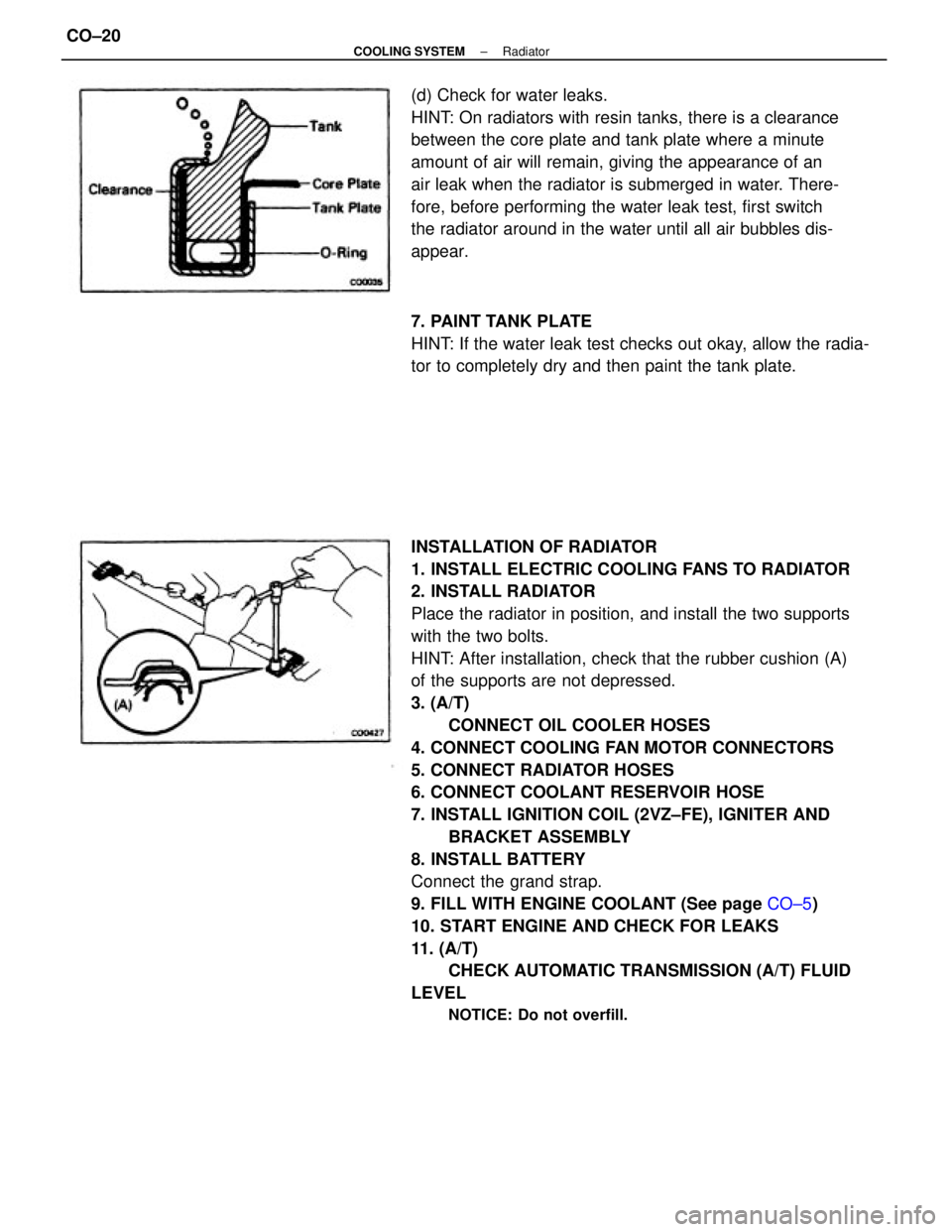
INSTALLATION OF RADIATOR
1. INSTALL ELECTRIC COOLING FANS TO RADIATOR
2. INSTALL RADIATOR
Place the radiator in position, and install the two supports
with the two bolts.
HINT: After installation, check that the rubber cushion (A)
of the supports are not depressed.
3. (A/T)
CONNECT OIL COOLER HOSES
4. CONNECT COOLING FAN MOTOR CONNECTORS
5. CONNECT RADIATOR HOSES
6. CONNECT COOLANT RESERVOIR HOSE
7. INSTALL IGNITION COIL (2VZ±FE), IGNITER AND
BRACKET ASSEMBLY
8. INSTALL BATTERY
Connect the grand strap.
9. FILL WITH ENGINE COOLANT (See page CO±5)
10. START ENGINE AND CHECK FOR LEAKS
11. (A/T)
CHECK AUTOMATIC TRANSMISSION (A/T) FLUID
LEVEL
NOTICE: Do not overfill.
(d) Check for water leaks.
HINT: On radiators with resin tanks, there is a clearance
between the core plate and tank plate where a minute
amount of air will remain, giving the appearance of an
air leak when the radiator is submerged in water. There-
fore, before performing the water leak test, first switch
the radiator around in the water until all air bubbles dis-
appear.
7. PAINT TANK PLATE
HINT: If the water leak test checks out okay, allow the radia-
tor to completely dry and then paint the tank plate.
± COOLING SYSTEMRadiatorCO±20
Page 1036 of 2389
DIAGNOSIS SYSTEM
DESCRIPTION
The ECU contains a built±in, self±diagnosis system which de-
tects troubles within the engine signal network and then flashed
a
warning on the ºCHECKº engine warning light on the instrument
panel flashes.
By analyzing various signals shown in the tables (See pages FI±
25 or 27) the ECU detects system malfunctions which are re-
lated to the various operating parameter sensors or actuator.
The ECU
stores the failure code associated with the detected failure until
the diagnosis system is cleared by removing the EFI fuse with
the ignition switch OFF.
A ºCHECKº engine warning light on the instrument panel informs
the driver that a malfunction has been detected.
The light goes oft automatically when the malfunction has been
cleared.
OUTPUT OF DIAGNOSTIC CODES
To obtain an output of diagnostic codes, proceed as follow:
1. Initial conditions
(a) Battery voltage 11 V or more
(b) Throttle valve fully closed (throttle position sensor IDL
points closed)
(e) Transmission in neutral position
(d) Accessories switched OFF
(e) Engine at normal operating temperature
2. Turn the ignition switch to ON. Do not start the engine.
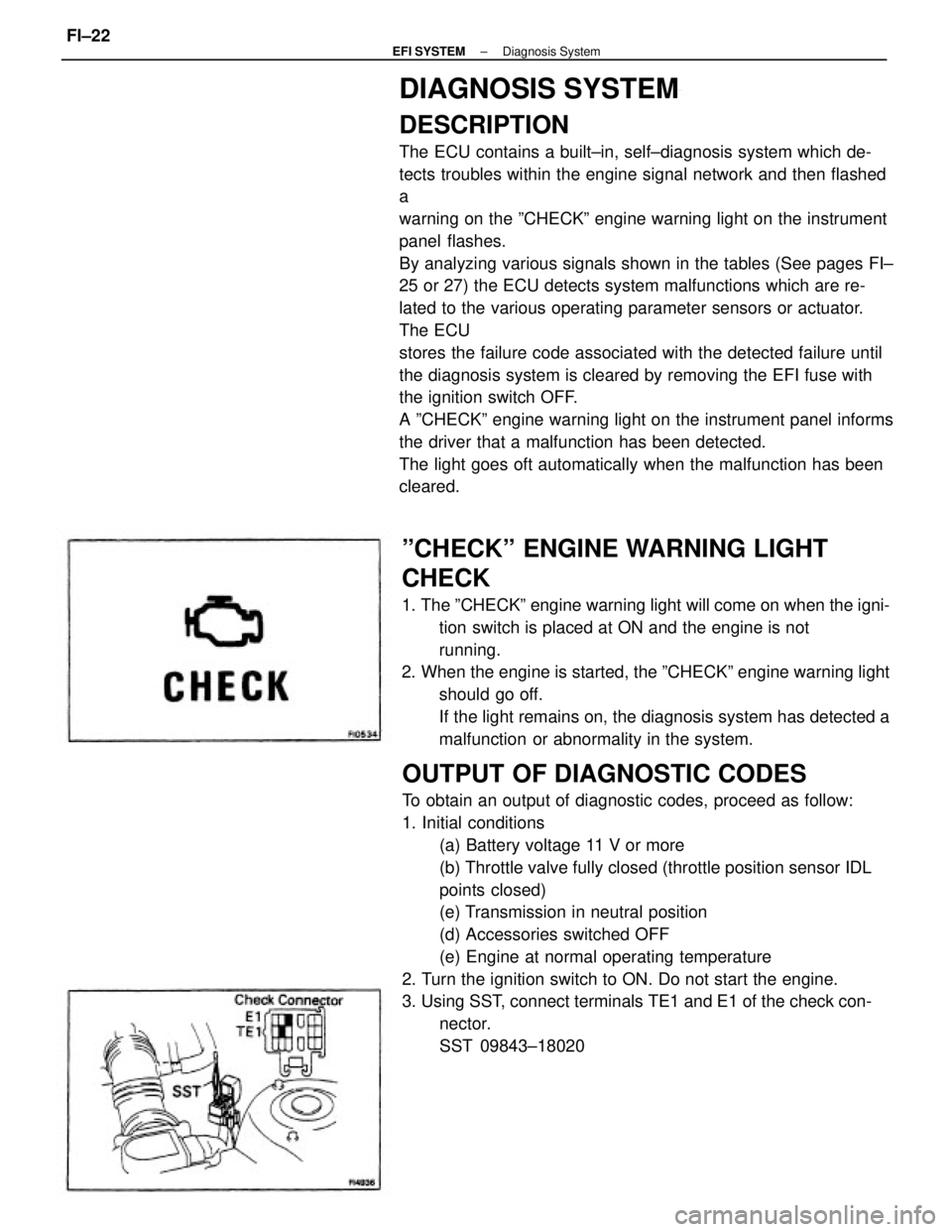
3. Using SST, connect terminals TE1 and E1 of the check con-
nector.
SST 09843±18020
ºCHECKº ENGINE WARNING LIGHT
CHECK
1. The ºCHECKº engine warning light will come on when the igni-
tion switch is placed at ON and the engine is not
running.
2. When the engine is started, the ºCHECKº engine warning light
should go off.
If the light remains on, the diagnosis system has detected a
malfunction or abnormality in the system.
± EFI SYSTEMDiagnosis SystemFI±22
Page 1864 of 2389
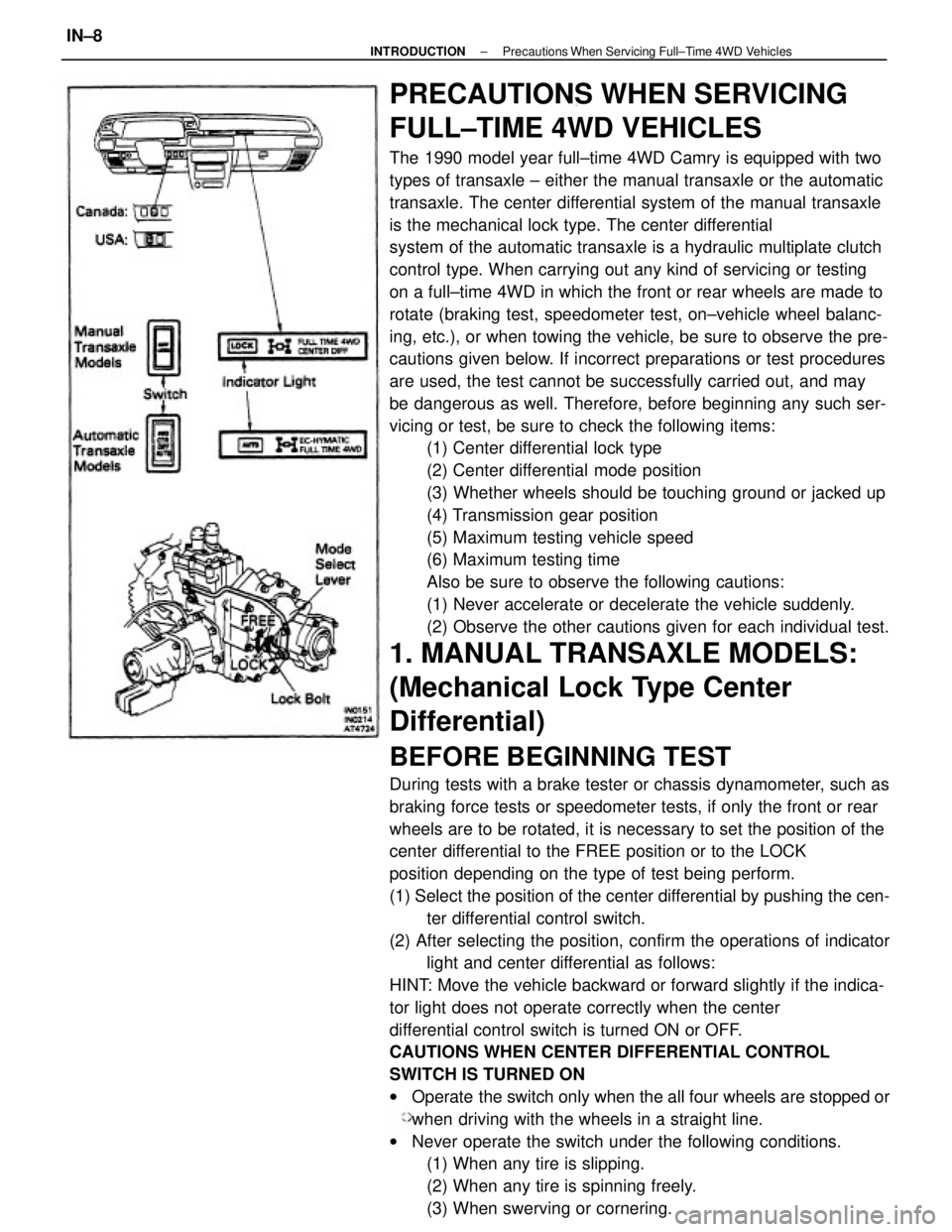
PRECAUTIONS WHEN SERVICING
FULL±TIME 4WD VEHICLES
The 1990 model year full±time 4WD Camry is equipped with two
types of transaxle ± either the manual transaxle or the automatic
transaxle. The center differential system of the manual transaxle
is the mechanical lock type. The center differential
system of the automatic transaxle is a hydraulic multiplate clutch
control type. When carrying out any kind of servicing or testing
on a full±time 4WD in which the front or rear wheels are made to
rotate (braking test, speedometer test, on±vehicle wheel balanc-
ing, etc.), or when towing the vehicle, be sure to observe the pre-
cautions given below. If incorrect preparations or test procedures
are used, the test cannot be successfully carried out, and may
be dangerous as well. Therefore, before beginning any such ser-
vicing or test, be sure to check the following items:
(1) Center differential lock type
(2) Center differential mode position
(3) Whether wheels should be touching ground or jacked up
(4) Transmission gear position
(5) Maximum testing vehicle speed
(6) Maximum testing time
Also be sure to observe the following cautions:
(1) Never accelerate or decelerate the vehicle suddenly.
(2) Observe the other cautions given for each individual test.
1. MANUAL TRANSAXLE MODELS:
(Mechanical Lock Type Center
Differential)
BEFORE BEGINNING TEST
During tests with a brake tester or chassis dynamometer, such as
braking force tests or speedometer tests, if only the front or rear
wheels are to be rotated, it is necessary to set the position of the
center differential to the FREE position or to the LOCK
position depending on the type of test being perform.
(1) Select the position of the center differential by pushing the cen-
ter differential control switch.
(2) After selecting the position, confirm the operations of indicator
light and center differential as follows:
HINT: Move the vehicle backward or forward slightly if the indica-
tor light does not operate correctly when the center
differential control switch is turned ON or OFF.
CAUTIONS WHEN CENTER DIFFERENTIAL CONTROL
SWITCH IS TURNED ON
wOperate the switch only when the all four wheels are stopped or
when driving with the wheels in a straight line.
wNever operate the switch under the following conditions.
(1) When any tire is slipping.
(2) When any tire is spinning freely.
(3) When swerving or cornering.
± INTRODUCTIONPrecautions When Servicing Full±Time 4WD VehiclesIN±8
Page 1865 of 2389
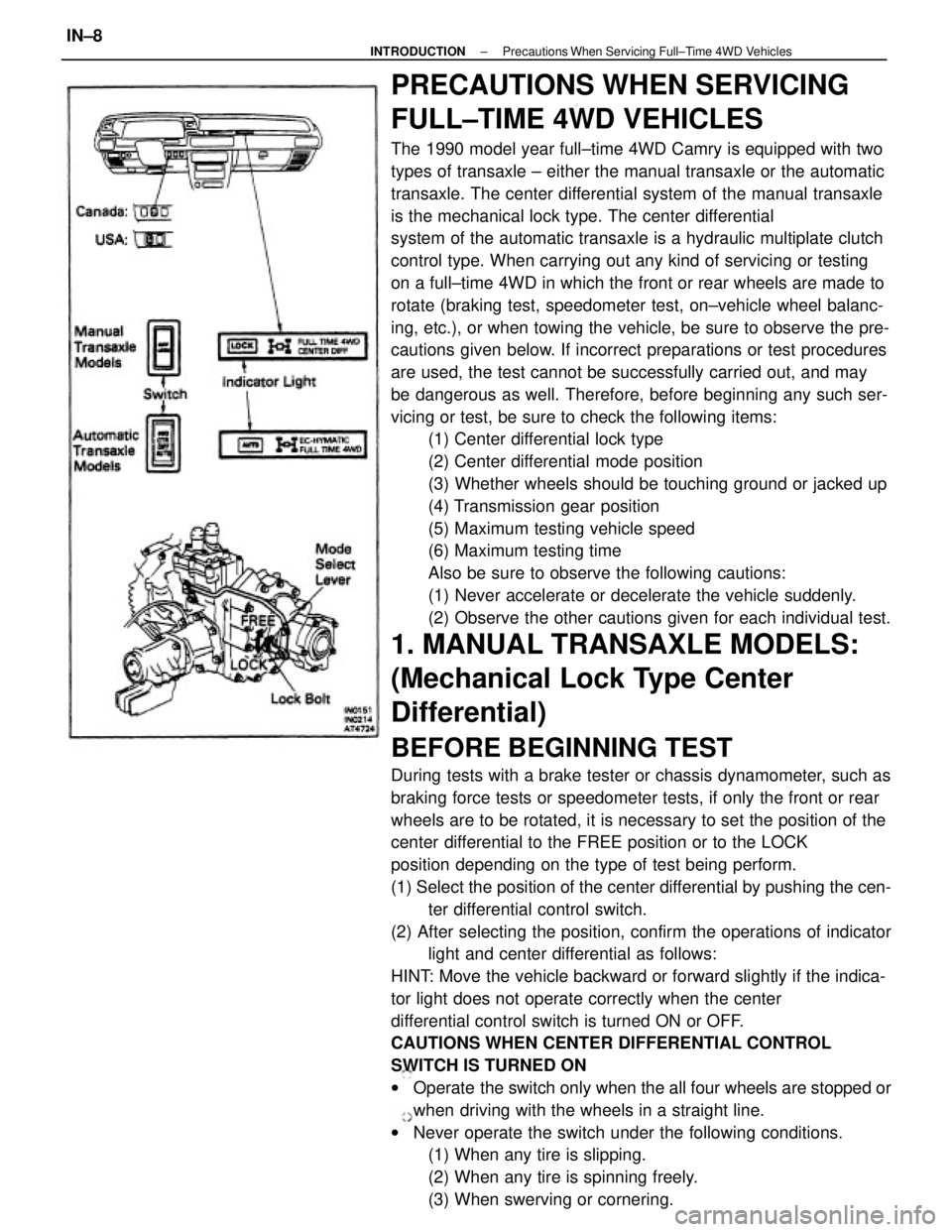
PRECAUTIONS WHEN SERVICING
FULL±TIME 4WD VEHICLES
The 1990 model year full±time 4WD Camry is equipped with two
types of transaxle ± either the manual transaxle or the automatic
transaxle. The center differential system of the manual transaxle
is the mechanical lock type. The center differential
system of the automatic transaxle is a hydraulic multiplate clutch
control type. When carrying out any kind of servicing or testing
on a full±time 4WD in which the front or rear wheels are made to
rotate (braking test, speedometer test, on±vehicle wheel balanc-
ing, etc.), or when towing the vehicle, be sure to observe the pre-
cautions given below. If incorrect preparations or test procedures
are used, the test cannot be successfully carried out, and may
be dangerous as well. Therefore, before beginning any such ser-
vicing or test, be sure to check the following items:
(1) Center differential lock type
(2) Center differential mode position
(3) Whether wheels should be touching ground or jacked up
(4) Transmission gear position
(5) Maximum testing vehicle speed
(6) Maximum testing time
Also be sure to observe the following cautions:
(1) Never accelerate or decelerate the vehicle suddenly.
(2) Observe the other cautions given for each individual test.
1. MANUAL TRANSAXLE MODELS:
(Mechanical Lock Type Center
Differential)
BEFORE BEGINNING TEST
During tests with a brake tester or chassis dynamometer, such as
braking force tests or speedometer tests, if only the front or rear
wheels are to be rotated, it is necessary to set the position of the
center differential to the FREE position or to the LOCK
position depending on the type of test being perform.
(1) Select the position of the center differential by pushing the cen-
ter differential control switch.
(2) After selecting the position, confirm the operations of indicator
light and center differential as follows:
HINT: Move the vehicle backward or forward slightly if the indica-
tor light does not operate correctly when the center
differential control switch is turned ON or OFF.
CAUTIONS WHEN CENTER DIFFERENTIAL CONTROL
SWITCH IS TURNED ON
wOperate the switch only when the all four wheels are stopped or
when driving with the wheels in a straight line.
wNever operate the switch under the following conditions.
(1) When any tire is slipping.
(2) When any tire is spinning freely.
(3) When swerving or cornering.
± INTRODUCTIONPrecautions When Servicing Full±Time 4WD VehiclesIN±8
Page 1885 of 2389
ABBREVIATIONS USED IN THIS
MANUAL
A.B.S. Anti±Lock Brake System
A/C Air Conditioner
ALR Automatic Locking Retractor
Approx. Approximation
A/T, ATM Automatic Transaxle
ATF Automatic Transmission Fluid
B
0 Overdrive Brake
B
1 Second Coast Brake
B
2 Second Brake
B
3 First and Reverse Brake
BDC Bottom Dead Center
BTDC Before Top Dead Center
BVSV Bimetal Vacuum Switching Valve
C
0 Overdrive Clutch
C
1 Forward Clutch
C
2 Direct Clutch
CB Circuit Breaker
DP Dash Pot
CRS Child Restraint System
ECT Electronic Controlled Transaxle
ECU Electronic Controlled Unit
EFI Electronic Fuel Injection
E/G Engine
EGR Exhaust Gas Recirculation
ELR Emergency Locking Retractor
ESA Electronic Spark Advance
EVAP Evaporative (Emission Control)
EX Exhaust (manifold, valve)
Ex. Except
F
0 Overdrive One±Way Clutch
F
1 No. 1 One±Way Clutch
F
2 No. 2 One±Way Clutch
FIPG Formed in Place Gasket
FL Fusible Link
Fr Front
IG Ignition
IN Intake (manifold, valve)
ISC Idle Speed Control
LED Light Emitting Diode
LH Left±Hand
LSPV Load Sensing Proportioning Valve
Max. Maximum
Min. Minimum
MP Multipurpose
M/T, MTM Manual Transaxle
O/D, OD Overdrive
O/S Oversize
PCV Positive Crankcase Ventilation
PKB Parking Brake
± INTRODUCTIONAbbreviations Used in This ManualIN±28
Page 1915 of 2389
18. ACCELERATOR PEDAL
Check the pedal for smooth operation and uneven
pedal effort or catching.
19. CLUTCH PEDAL (See page CL±3)
Check the pedal for smooth operation.
Check that the pedal has the proper freeplay.
20. BRAKE PEDAL (See page BR±6)
(a) Check the pedal for smooth operation.
(b) Check that the pedal has the proper reserve
distance and freeplay.
(c) Check the brake booster function.
21. BRAKES
At a safe place, check that the brakes do not pull
to one side when applied.
22. PARKING BRAKE (See page BR±8)
(a) Check that the lever has the proper travel.
(b) On a safe incline, check that the vehicle is
held securely with only the parking brake
applied.
23. AUTOMATIC TRANSMISSION PARK
MECHANISM
(a) Check the lock release button of the selector
lever for proper and smooth operation.
(b) On a safe incline, check that vehicle is held
securely with the selector lever in the ºPº
position and all brakes released.
UNDER HOOD
24. WINDSHIELD WASHER FLUID
Check that there is sufficient fluid in the tank.
25. ENGINE COOLANT LEVEL
Check that the coolant level is between the
ºFULLº and ºLOWº lines on the see±through reser-
voir.
26. RADIATOR AND HOSES
(a) Check that the front of the radiator is clean
and not blocked with leaves, dirt or bugs.
(b) Check the hoses for cracks, kinks, rot or
loose connections.
27. BATTERY ELECTROLYTE LEVEL
Check that the electrolyte level of all battery cells
is between the upper and lower level lines on the
case. If level is low, add distilled water only.28. BRAKE AND CLUTCH FLUID LEVELS
(a) Check that the brake fluid level is near the
upper level line on the see±through reser-
voir.
(b) Check that the clutch fluid level is within
+ 5 mm (0.20 in.) of the reservoir hem.
29. ENGINE DRIVE BELTS
Check all drive belts for fraying, cracks, wear or
oiliness.
30. ENGINE OIL LEVEL
Check the level on the dipstick with the engine
turned off.
31. POWER STEERING FLUID LEVEL
Check the level.
The level should be in the ºHOTº or ºCOLDº
range depending on the fluid temperature.
32. AUTOMATIC TRANSMISSION FLUID
LEVEL
(a) Park the vehicle on a level surface.
(b) With the engine idling and the parking
brake applied, shift the selector into all
positions from ºPº to ºLº, and then shift
into ºPº.
(c) Pull out the dipstick and wipe off the fluid
with a clean rag. Re±insert the dipstick
and check that the fluid level is in the HOT
range.
(d) Perform this check with the fluid at normal
driving temperature (70 ± 80
°C or
158 ± 176°F).
NOTE: Wait about 30 minutes before check-
ing the fluid level after extended driving at high
speeds i n hot weather, driving i n heavy traffic
or with a trailer.
33. EXHAUST SYSTEM
Visually inspect for cracks, holes or loose sup-
ports.
If any change in the sound of the exhaust oK
smell of the exhaust fumes is noticed, have the
cause located and corrected.
± MAINTENANCEGeneral MaintenanceMA±17