boot TOYOTA CAMRY V20 1986 Service Information
[x] Cancel search | Manufacturer: TOYOTA, Model Year: 1986, Model line: CAMRY V20, Model: TOYOTA CAMRY V20 1986Pages: 2389, PDF Size: 84.44 MB
Page 2161 of 2389
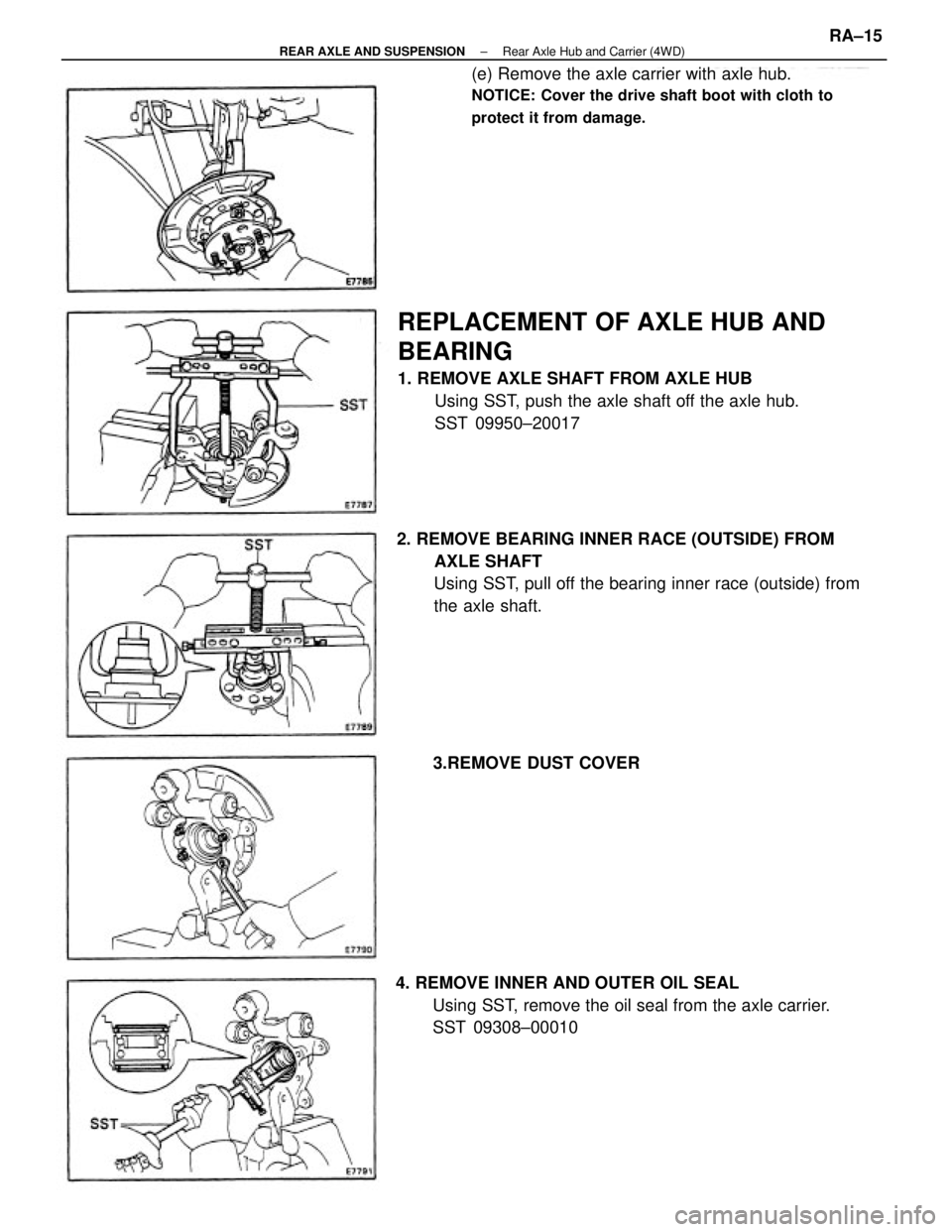
REPLACEMENT OF AXLE HUB AND
BEARING
1. REMOVE AXLE SHAFT FROM AXLE HUB
Using SST, push the axle shaft off the axle hub.
SST 09950±20017
2. REMOVE BEARING INNER RACE (OUTSIDE) FROM
AXLE SHAFT
Using SST, pull off the bearing inner race (outside) from
the axle shaft.(e) Remove the axle carrier with axle hub.
NOTICE: Cover the drive shaft boot with cloth to
protect it from damage.
4. REMOVE INNER AND OUTER OIL SEAL
Using SST, remove the oil seal from the axle carrier.
SST 09308±000103.REMOVE DUST COVER
± REAR AXLE AND SUSPENSIONRear Axle Hub and Carrier (4WD)RA±15
Page 2167 of 2389
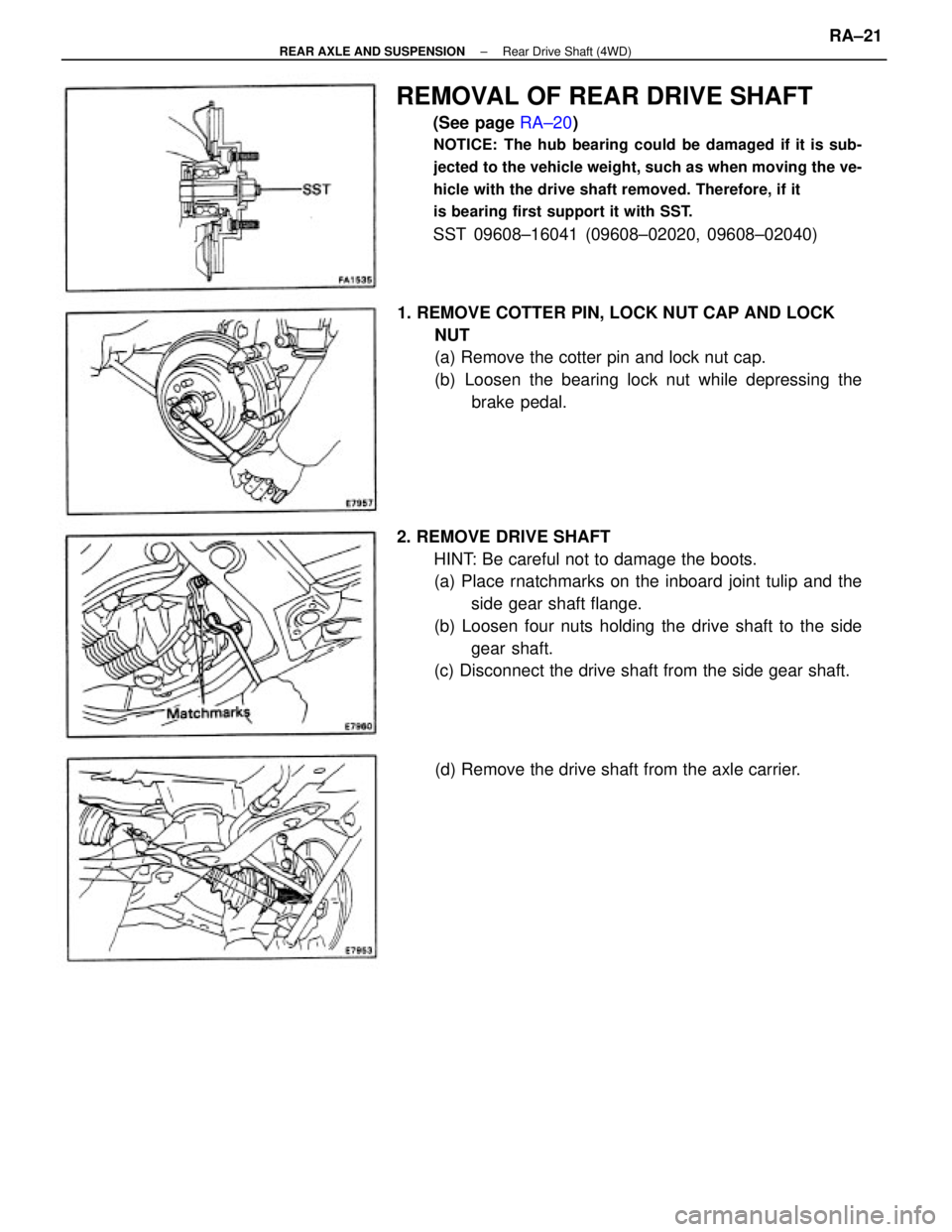
REMOVAL OF REAR DRIVE SHAFT
(See page RA±20)
NOTICE: The hub bearing could be damaged if it is sub-
jected to the vehicle weight, such as when moving the ve-
hicle with the drive shaft removed. Therefore, if it
is bearing first support it with SST.
SST 09608±16041 (09608±02020, 09608±02040)
2. REMOVE DRIVE SHAFT
HINT: Be careful not to damage the boots.
(a) Place rnatchmarks on the inboard joint tulip and the
side gear shaft flange.
(b) Loosen four nuts holding the drive shaft to the side
gear shaft.
(c) Disconnect the drive shaft from the side gear shaft. 1. REMOVE COTTER PIN, LOCK NUT CAP AND LOCK
NUT
(a) Remove the cotter pin and lock nut cap.
(b) Loosen the bearing lock nut while depressing the
brake pedal.
(d) Remove the drive shaft from the axle carrier.
± REAR AXLE AND SUSPENSIONRear Drive Shaft (4WD)RA±21
Page 2168 of 2389
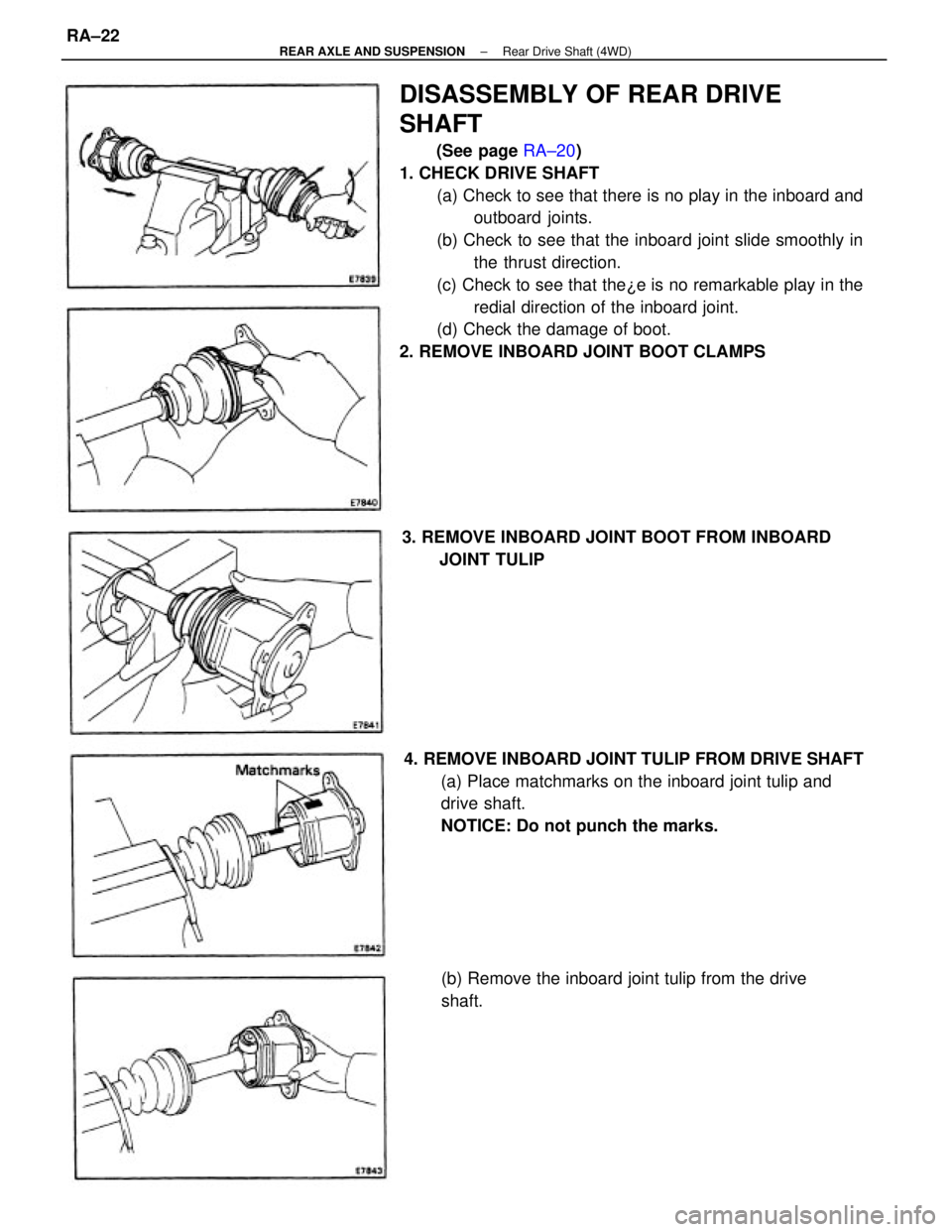
DISASSEMBLY OF REAR DRIVE
SHAFT
(See page RA±20)
1. CHECK DRIVE SHAFT
(a) Check to see that there is no play in the inboard and
outboard joints.
(b) Check to see that the inboard joint slide smoothly in
the thrust direction.
(c) Check to see that the¿e is no remarkable play in the
redial direction of the inboard joint.
(d) Check the damage of boot.
2. REMOVE INBOARD JOINT BOOT CLAMPS
4. REMOVE INBOARD JOINT TULIP FROM DRIVE SHAFT
(a) Place matchmarks on the inboard joint tulip and
drive shaft.
NOTICE: Do not punch the marks. 3. REMOVE INBOARD JOINT BOOT FROM INBOARD
JOINT TULIP
(b) Remove the inboard joint tulip from the drive
shaft.
± REAR AXLE AND SUSPENSIONRear Drive Shaft (4WD)RA±22
Page 2169 of 2389
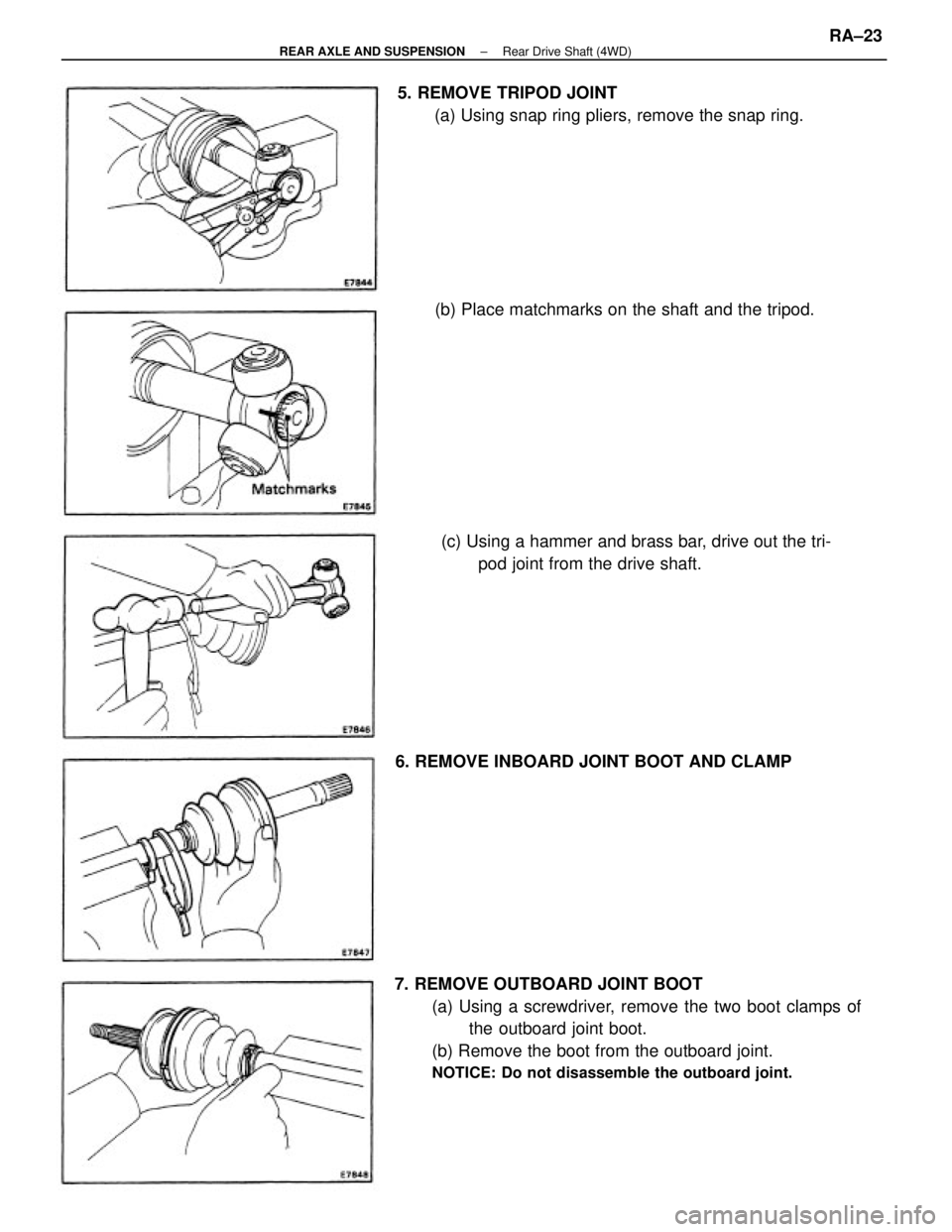
7. REMOVE OUTBOARD JOINT BOOT
(a) Using a screwdriver, remove the two boot clamps of
the outboard joint boot.
(b) Remove the boot from the outboard joint.
NOTICE: Do not disassemble the outboard joint.
5. REMOVE TRIPOD JOINT
(a) Using snap ring pliers, remove the snap ring.
(c) Using a hammer and brass bar, drive out the tri-
pod joint from the drive shaft.
6. REMOVE INBOARD JOINT BOOT AND CLAMP(b) Place matchmarks on the shaft and the tripod.
± REAR AXLE AND SUSPENSIONRear Drive Shaft (4WD)RA±23
Page 2170 of 2389
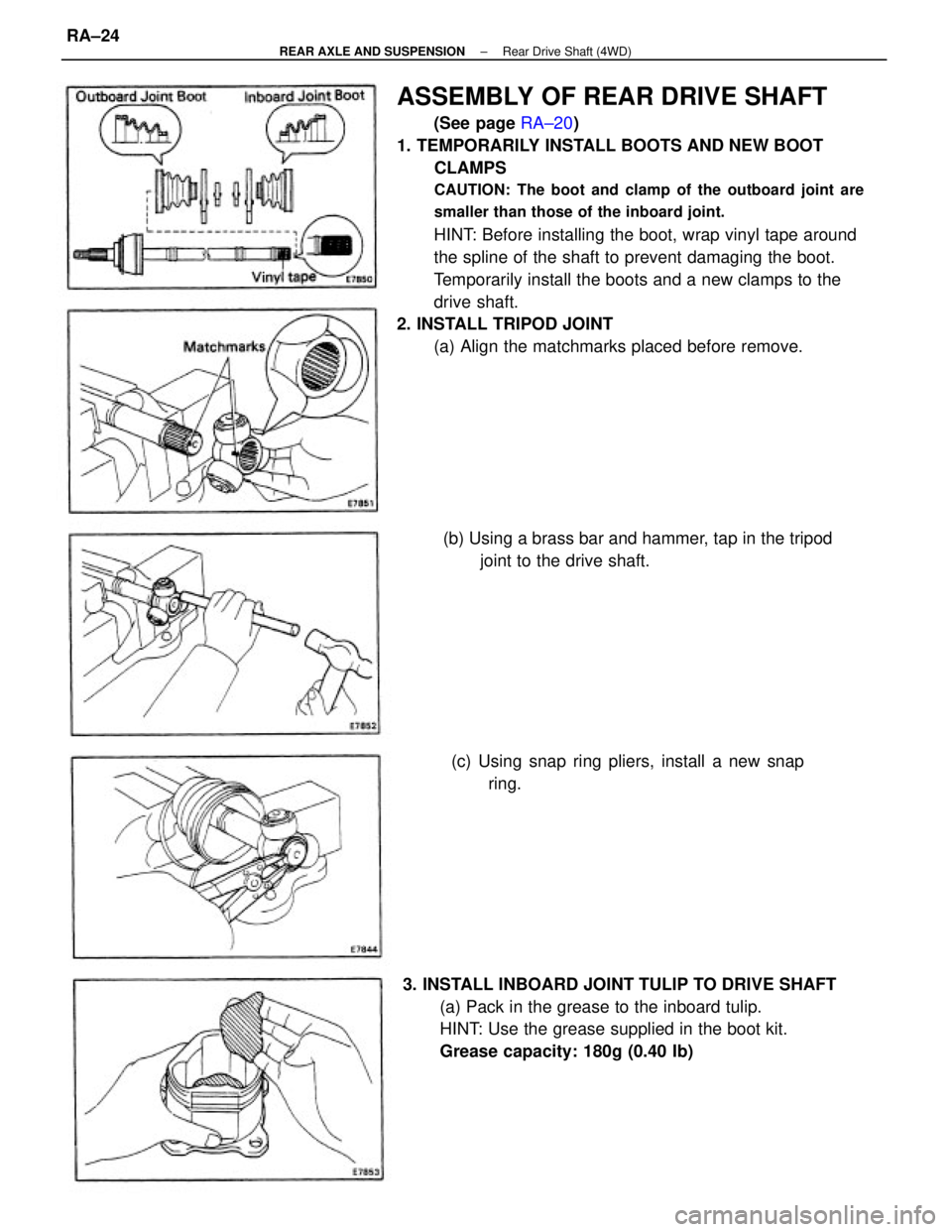
ASSEMBLY OF REAR DRIVE SHAFT
(See page RA±20)
1. TEMPORARILY INSTALL BOOTS AND NEW BOOT
CLAMPS
CAUTION: The boot and clamp of the outboard joint are
smaller than those of the inboard joint.
HINT: Before installing the boot, wrap vinyl tape around
the spline of the shaft to prevent damaging the boot.
Temporarily install the boots and a new clamps to the
drive shaft.
2. INSTALL TRIPOD JOINT
(a) Align the matchmarks placed before remove.
3. INSTALL INBOARD JOINT TULIP TO DRIVE SHAFT
(a) Pack in the grease to the inboard tulip.
HINT: Use the grease supplied in the boot kit.
Grease capacity: 180g (0.40 Ib)(b) Using a brass bar and hammer, tap in the tripod
joint to the drive shaft.
(c) Using snap ring pliers, install a new snap
ring.
± REAR AXLE AND SUSPENSIONRear Drive Shaft (4WD)RA±24
Page 2171 of 2389
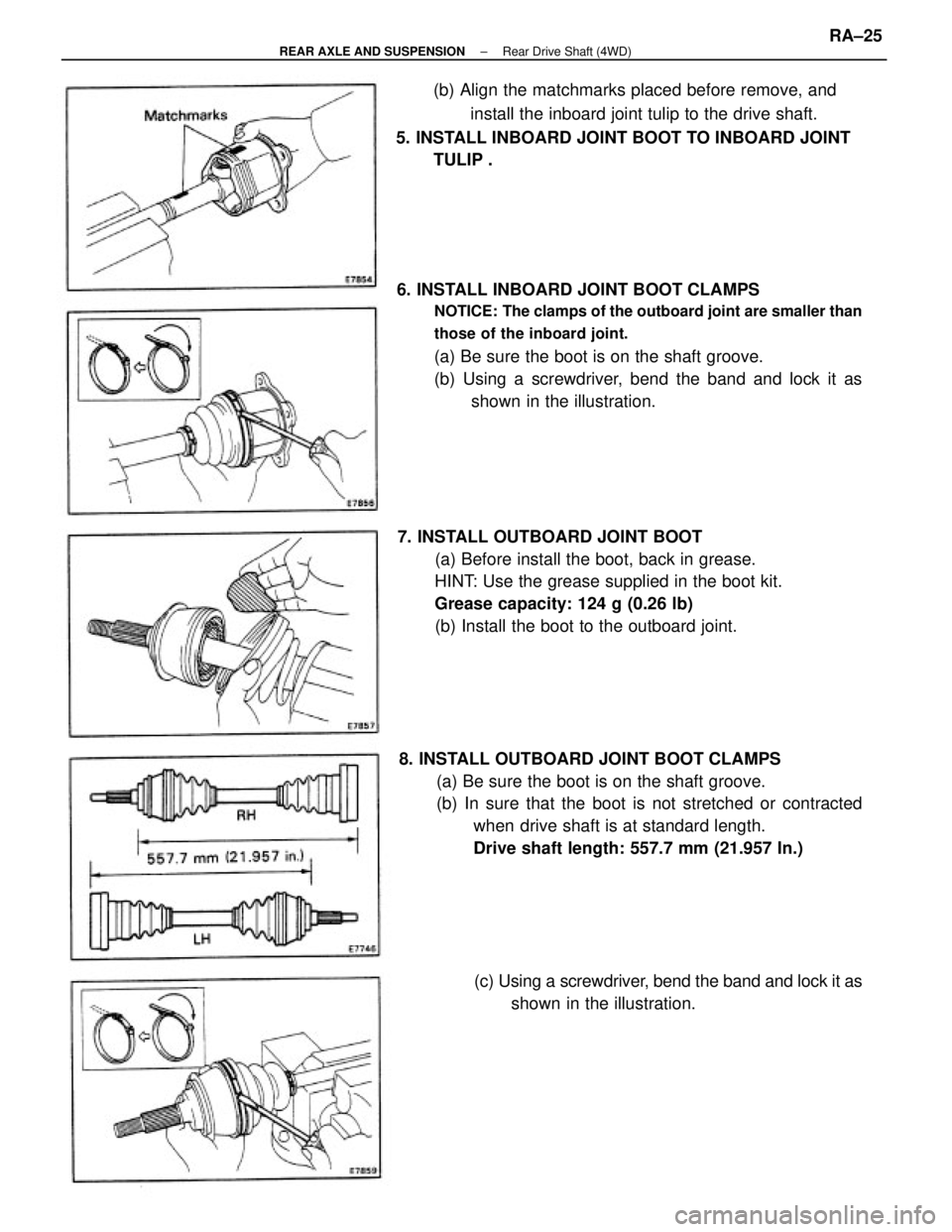
6. INSTALL INBOARD JOINT BOOT CLAMPS
NOTICE: The clamps of the outboard joint are smaller than
those of the inboard joint.
(a) Be sure the boot is on the shaft groove.
(b) Using a screwdriver, bend the band and lock it as
shown in the illustration.
8. INSTALL OUTBOARD JOINT BOOT CLAMPS
(a) Be sure the boot is on the shaft groove.
(b) In sure that the boot is not stretched or contracted
when drive shaft is at standard length.
Drive shaft length: 557.7 mm (21.957 In.) 7. INSTALL OUTBOARD JOINT BOOT
(a) Before install the boot, back in grease.
HINT: Use the grease supplied in the boot kit.
Grease capacity: 124 g (0.26 lb)
(b) Install the boot to the outboard joint. (b) Align the matchmarks placed before remove, and
install the inboard joint tulip to the drive shaft.
5. INSTALL INBOARD JOINT BOOT TO INBOARD JOINT
TULIP .
(c) Using a screwdriver, bend the band and lock it as
shown in the illustration.
± REAR AXLE AND SUSPENSIONRear Drive Shaft (4WD)RA±25
Page 2172 of 2389
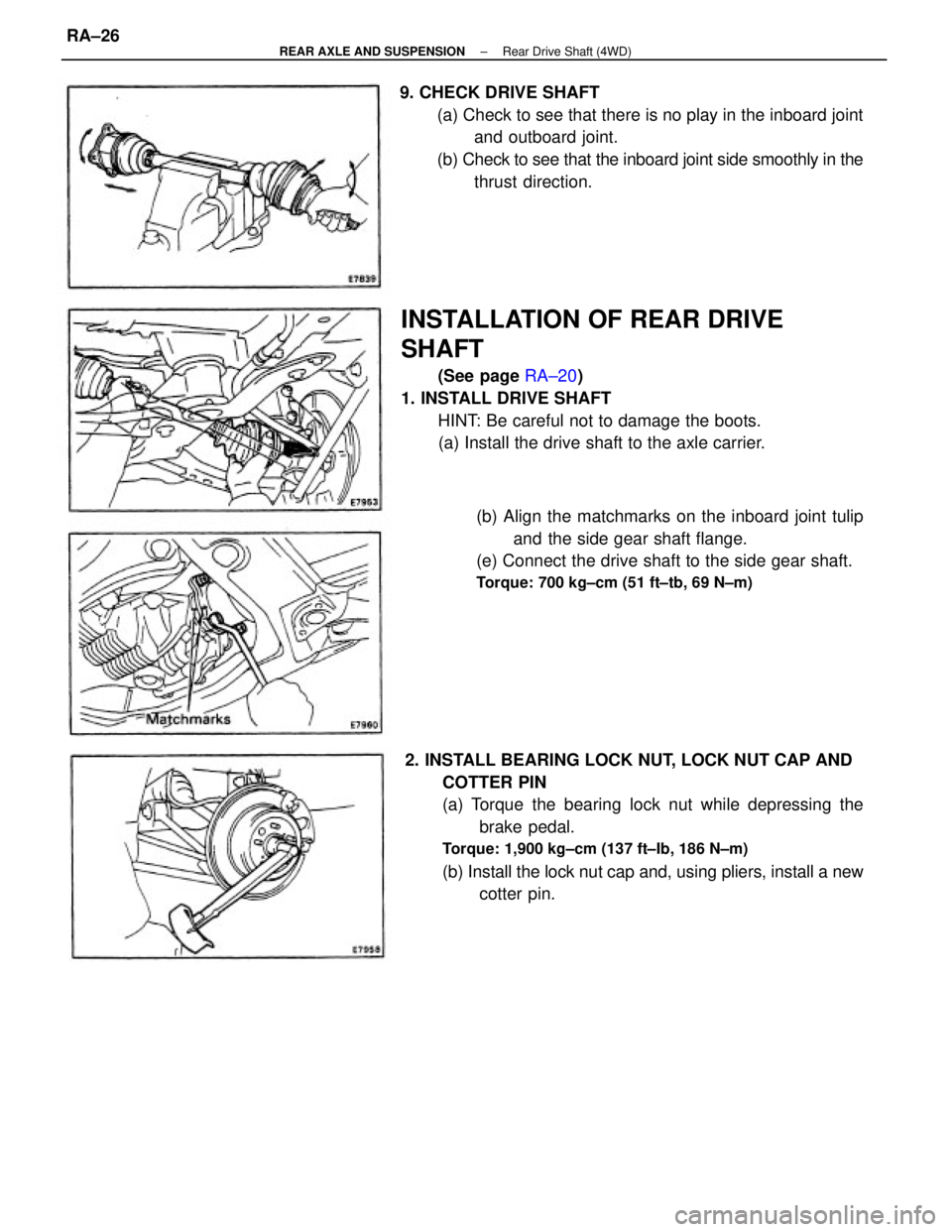
2. INSTALL BEARING LOCK NUT, LOCK NUT CAP AND
COTTER PIN
(a) Torque the bearing lock nut while depressing the
brake pedal.
Torque: 1,900 kg±cm (137 ft±Ib, 186 N±m)
(b) Install the lock nut cap and, using pliers, install a new
cotter pin.
INSTALLATION OF REAR DRIVE
SHAFT
(See page RA±20)
1. INSTALL DRIVE SHAFT
HINT: Be careful not to damage the boots.
(a) Install the drive shaft to the axle carrier. 9. CHECK DRIVE SHAFT
(a) Check to see that there is no play in the inboard joint
and outboard joint.
(b) Check to see that the inboard joint side smoothly in the
thrust direction.
(b) Align the matchmarks on the inboard joint tulip
and the side gear shaft flange.
(e) Connect the drive shaft to the side gear shaft.
Torque: 700 kg±cm (51 ft±tb, 69 N±m)
± REAR AXLE AND SUSPENSIONRear Drive Shaft (4WD)RA±26
Page 2259 of 2389
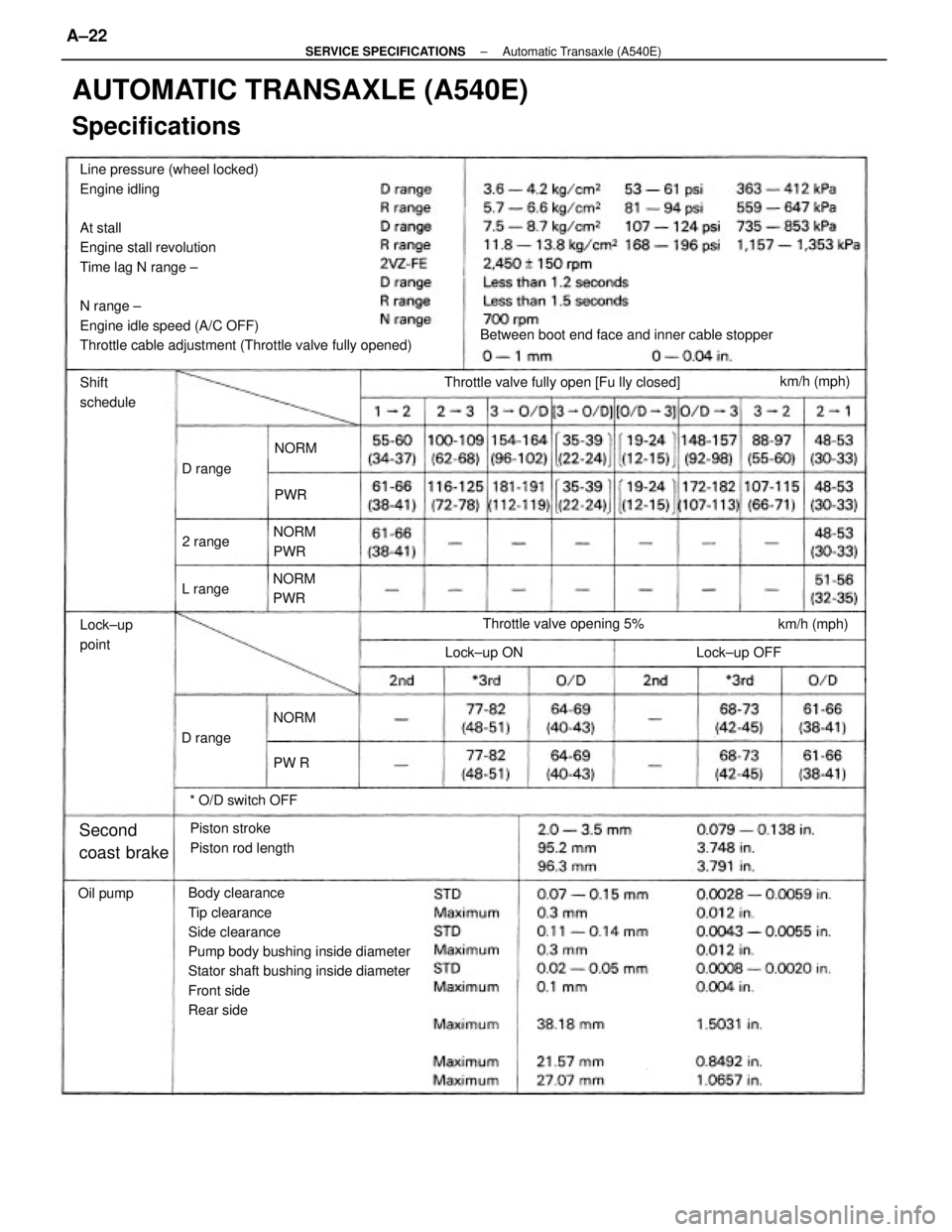
Line pressure (wheel locked)
Engine idling
At stall
Engine stall revolution
Time lag N range ±
N range ±
Engine idle speed (A/C OFF)
Throttle cable adjustment (Throttle valve fully opened)
Body clearance
Tip clearance
Side clearance
Pump body bushing inside diameter
Stator shaft bushing inside diameter
Front side
Rear side
AUTOMATIC TRANSAXLE (A540E)
Specifications
Between boot end face and inner cable stopper
Throttle valve fully open [Fu lly closed]
Piston stroke
Piston rod lengthThrottle valve opening 5%
Second
coast brake
* O/D switch OFF Shift
schedule
Lock±up
pointkm/h (mph)
Lock±up OFFkm/h (mph)
Lock±up ON NORM
PWR
NORM
PWR
Oil pumpD range
D range2 range
L rangeNORM
NORM
PW RPWR
± SERVICE SPECIFICATIONSAutomatic Transaxle (A540E)A±22
Page 2329 of 2389
ON±VEHICLE INSPECTION
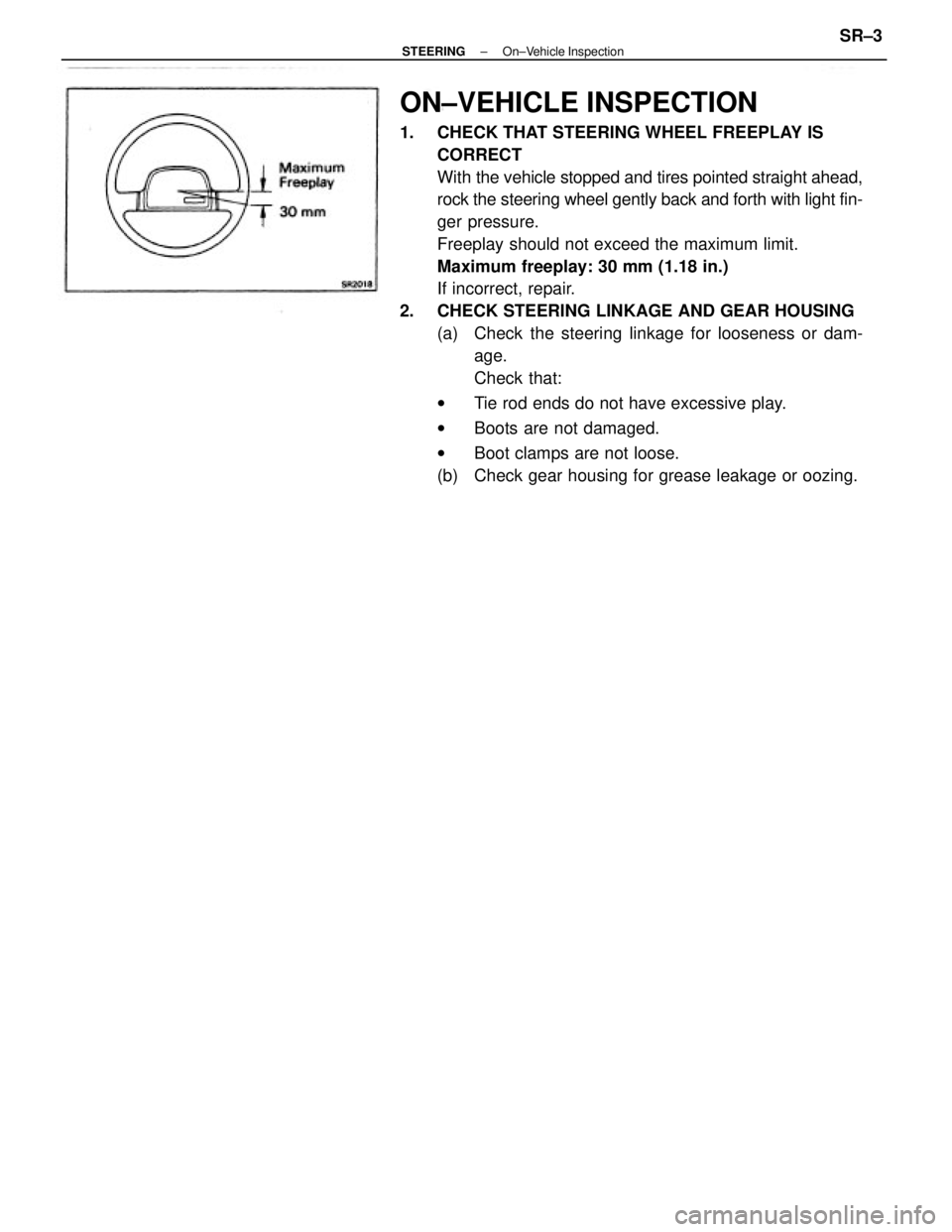
1. CHECK THAT STEERING WHEEL FREEPLAY IS
CORRECT
With the vehicle stopped and tires pointed straight ahead,
rock the steering wheel gently back and forth with light fin-
ger pressure.
Freeplay should not exceed the maximum limit.
Maximum freeplay: 30 mm (1.18 in.)
If incorrect, repair.
2. CHECK STEERING LINKAGE AND GEAR HOUSING
(a) Check the steering linkage for looseness or dam-
age.
Check that:
wTie rod ends do not have excessive play.
wBoots are not damaged.
wBoot clamps are not loose.
(b) Check gear housing for grease leakage or oozing.
± STEERINGOn±Vehicle InspectionSR±3
Page 2378 of 2389
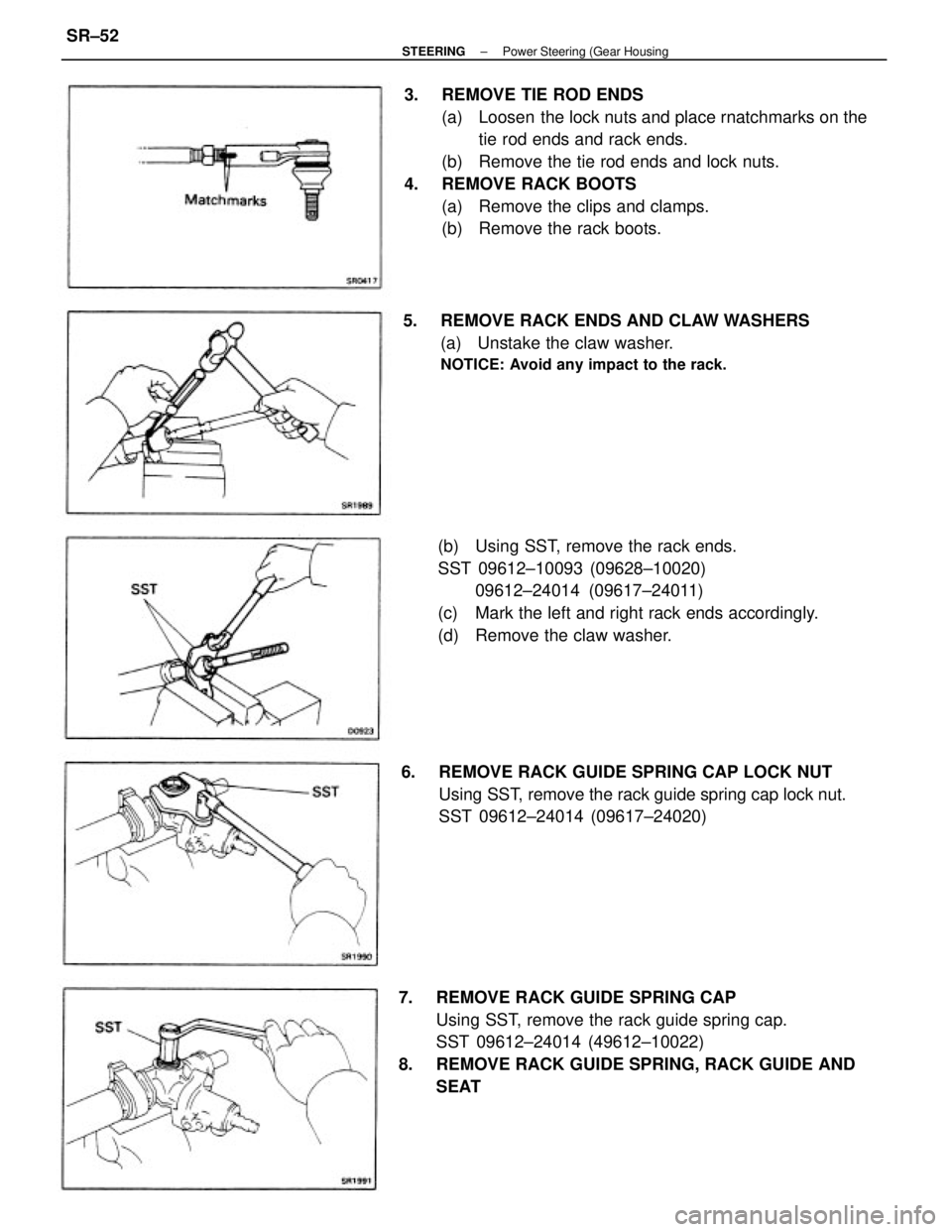
3. REMOVE TIE ROD ENDS
(a) Loosen the lock nuts and place rnatchmarks on the
tie rod ends and rack ends.
(b) Remove the tie rod ends and lock nuts.
4. REMOVE RACK BOOTS
(a) Remove the clips and clamps.
(b) Remove the rack boots.
7. REMOVE RACK GUIDE SPRING CAP
Using SST, remove the rack guide spring cap.
SST 09612±24014 (49612±10022)
8. REMOVE RACK GUIDE SPRING, RACK GUIDE AND
SEAT(b) Using SST, remove the rack ends.
SST 09612±10093 (09628±10020)
09612±24014 (09617±24011)
(c) Mark the left and right rack ends accordingly.
(d) Remove the claw washer.
6. REMOVE RACK GUIDE SPRING CAP LOCK NUT
Using SST, remove the rack guide spring cap lock nut.
SST 09612±24014 (09617±24020) 5. REMOVE RACK ENDS AND CLAW WASHERS
(a) Unstake the claw washer.
NOTICE: Avoid any impact to the rack.
± STEERINGPower Steering (Gear HousingSR±52