engine TOYOTA CELICA 1987 Service Repair Manual
[x] Cancel search | Manufacturer: TOYOTA, Model Year: 1987, Model line: CELICA, Model: TOYOTA CELICA 1987Pages: 346, PDF Size: 35.13 MB
Page 301 of 346
LUBRICATION SYSTENI - Oil Cooler and Oil Pressurr+ Regulator (7M-GTE)
’ 1” - 06Lu-19
---. “, -“-~~yII.
. .
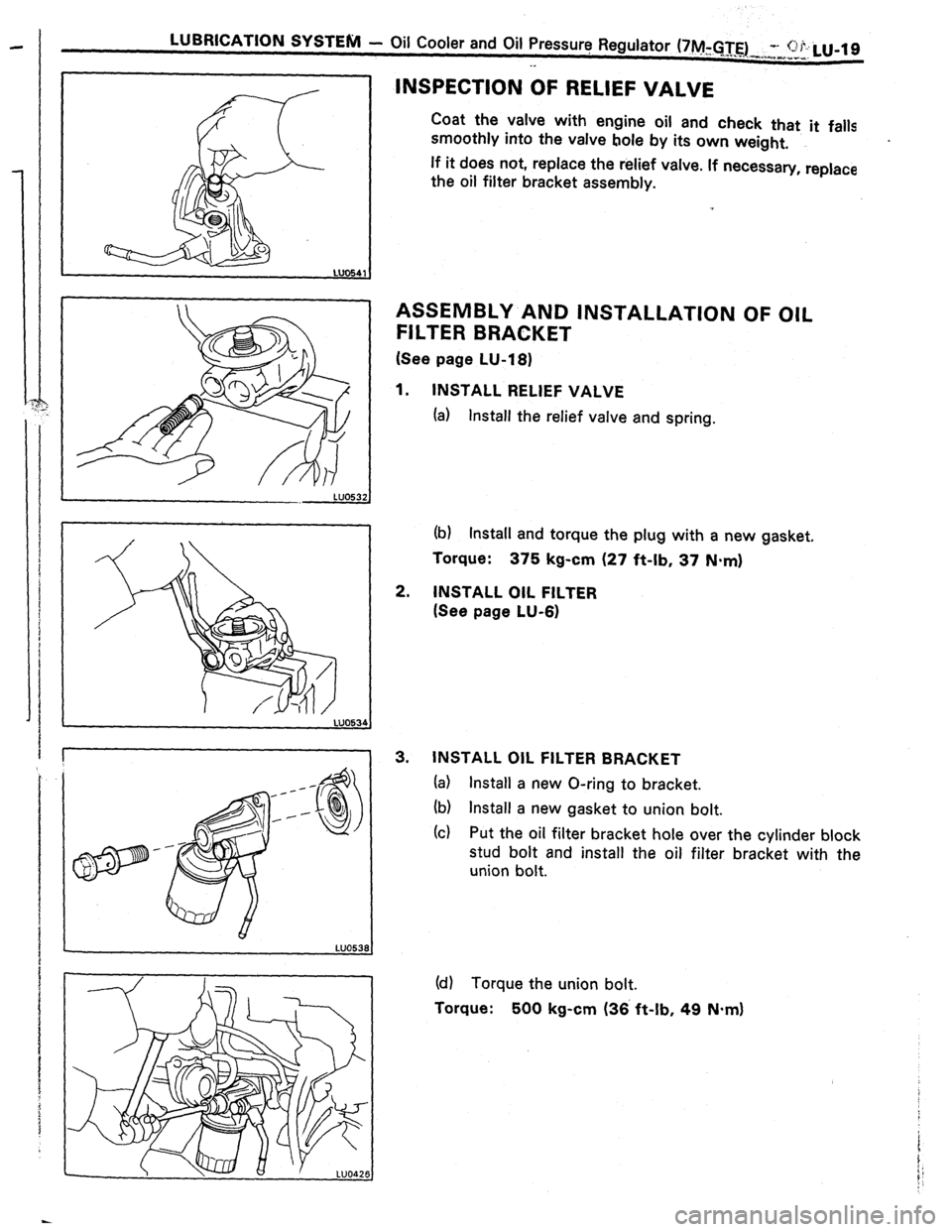
INSPECTION OF RELIEF VALVE
Coat the valve with engine oil and check that it falls
smoothly into the valve hole by its own weight.
If it does not, replace the relief valve. If necessary,
replace
the oil filter bracket assembly.
INSTALLATION OF OIL ASSEMBLY AND
FILTER BRACKET
(See page LU-18)
1. INSTALL RELIEF VALVE
(a) Install the relief valve and spring.
(b) Install and torque the plug with a new gasket.
Torque: 375 kg-cm (27 ft-lb, 37 Nsm)
2.
INSTALL OIL FILTER
(See page LU-8)
3. INSTALL OIL FILTER BRACKET
(a) Install a new O-ring to bracket.
(b) Install a new gasket to union bolt.
(c) Put the oil filter bracket hole over the cylinder block
stud bolt and install the oil filter bracket with the
union bolt.
(d) Torque the union bolt.
Torque: 500 kg-cm (36’ ft-lb, 49 N*mI
Page 303 of 346
A12 : SERVICE SPECIFICATIONS - Enaine.Mechanical
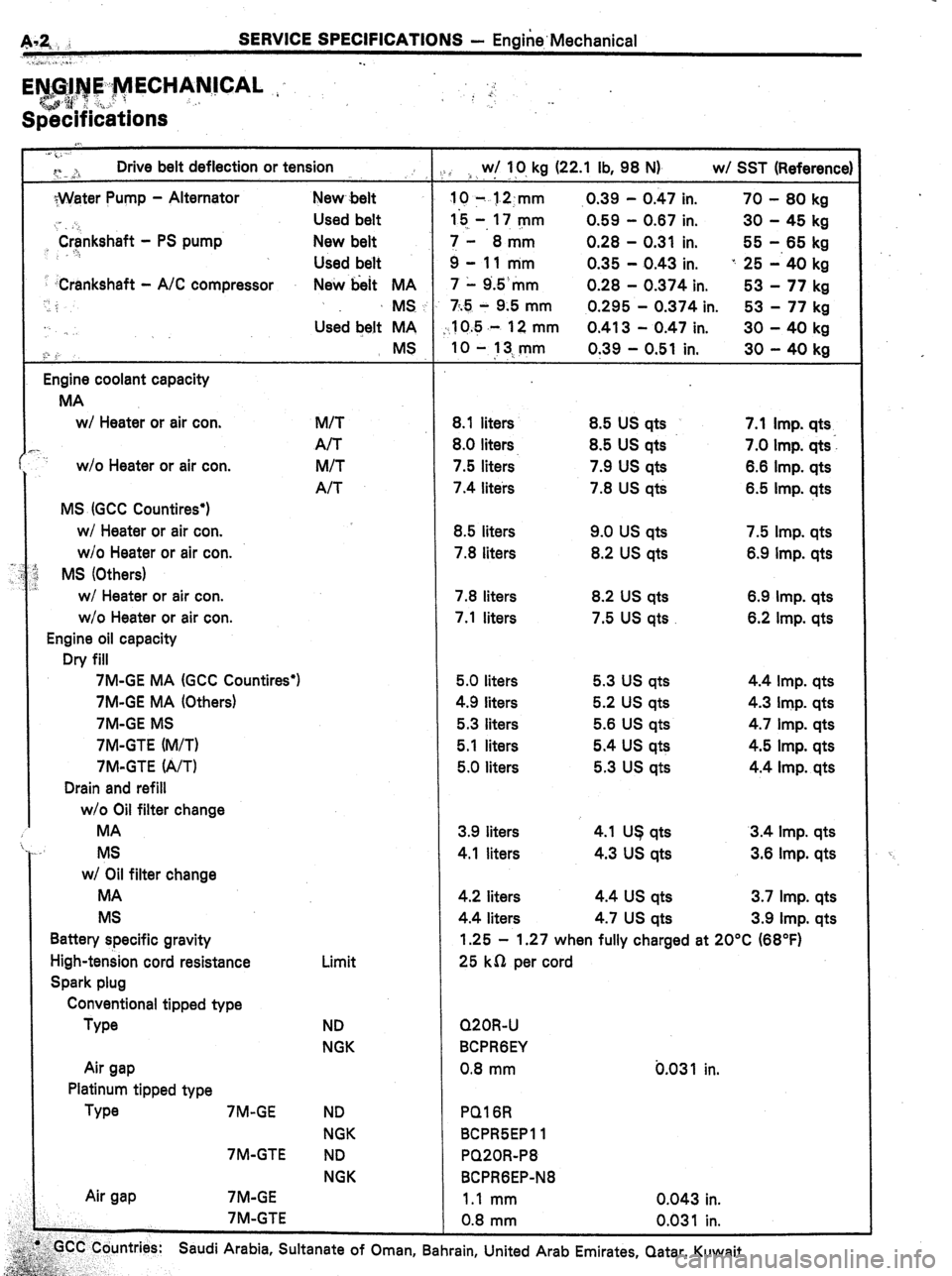
EN$W4~~~WlECHAN~CAL (
‘t&.gy,.::*,. : .,
Speclfrcations
r
: r’
: . .
‘-’ b- ~.
” Drive belt deflection or tension
. . . .,:
;Water Pump - Alternator New belt
,, ‘Crankshaft Used belt
- PS pump New belt
..!
Used belt
-Crankshaft - A/C compressor
New hit MA
,.
‘; MS
Used belt MA
<” : MS
Engine coolant capacity
MA
WI Heater or air con.
,.
w/o Heater or air con.
MS (GCC Countires’)
WI Heater or air con.
w/o Heater or air con.
MS (Others)
w/ Heater or air con.
w/o Heater or air con.
Engine oil capacity
Dry fill
7M-GE MA (GCC Countires’)
7M-GE MA (Others)
7M-GE MS
7M-GTE (M/T)
7M-GTE (A/T)
Drain and refill
w/o Oil filter change
MA
MS
w/ Oil filter change
MA
MS
Battery specific gravity
High-tension cord resistance
Spark plug
Conventional tipped type
We
Air gap
Platinum tipped type
Type 7M-GE
7M-GTE
Air gap 7M-GE
7M-GTE M/T
A/T
M/T
A/T
Limit
ND
NGK
ND
NGK
ND
NGK / w/ IO, kg (22.1 lb, 98 N) w/ SST (Reference)
,. .
IO 7 1.2:mm .0.39 - 0.47 in. 70 - 80 kg
I5 -, 17 mm 0.59 - 0.87 in. 30 - 45 kg
I- 8mm 0.28 - 0.31 in. 55 - 65 kg
3-llmm 0.35 - 0.43 in. ” 25 -‘40 kg
7 1 9.5‘mm 0.28 - 0.374 in. 53 - 77 kg
7;.5 - 9.5 mm 0.295 - 0.374 in. 53 - 77 kg
10.5 .- 12 mm 0.413 - 0.47 in. 30 - 40 kg
IO - 13.,mm
0.39 - 0.51 in. 30 - 40 kg
8.1 liters
8.0 liters.
7.5 liters
7.4 liters
8.5 liters
7.8 liters
7.8 liters
7.1 liters 8.5 US qts
8.5 US qts
7.9 us qts
7.8 US qts
9.0 us qts
8.2 US qts
8.2 US qts
7.5 us qts 7.1 Imp. qts
7.0 Imp. qts:
6.8 Imp. qts
6.5 Imp. qts
7.5 Imp. qts
6.9 Imp. qts
6.9 Imp. qts
6.2 Imp. qts
5.0 liters
4.9 liters
5.3 liters
5.1 liters
5.0 liters 5.3 us qts
5.2 US qts
5.6 US qts
5.4 us qts
5.3 us qts 4.4 Imp. qts
4.3 Imp. qts
4.7 Imp. qts
4.5 Imp. qts
4.4 Imp. qts
3.9 liters 4.1 US qts 3.4 Imp. qts
4.1 liters 4.3 us qts 3.6 Imp. qts
4.2 liters 4.4 us qts 3.7 Imp. qts
4.4 liters 4.7 us qts 3.9 Imp. qts
1.25 - 1.27 when fully charged at 20°C (68°F)
25 kn per cord
Q20R-U
BCPRGEY
0.8 mm b.03 1
PQ16R
8CPR5EPll
PQ20R-P8
BCPRGEP-N8 in.
1.1 mm 0.043 in.
0.8 mm 0.031 in.
,:‘GCC Countries:
~~ s; Saudi Arabia, Sultanate of Oman, Bahrain, United Arab Emirates, Qatar, Kuwait.
p;
.5&.,..‘ .,
gg&-&;,., ;.
Page 319 of 346
ST-2 STARTING SYSTEM - Troubleshooting, Starting System Circuit
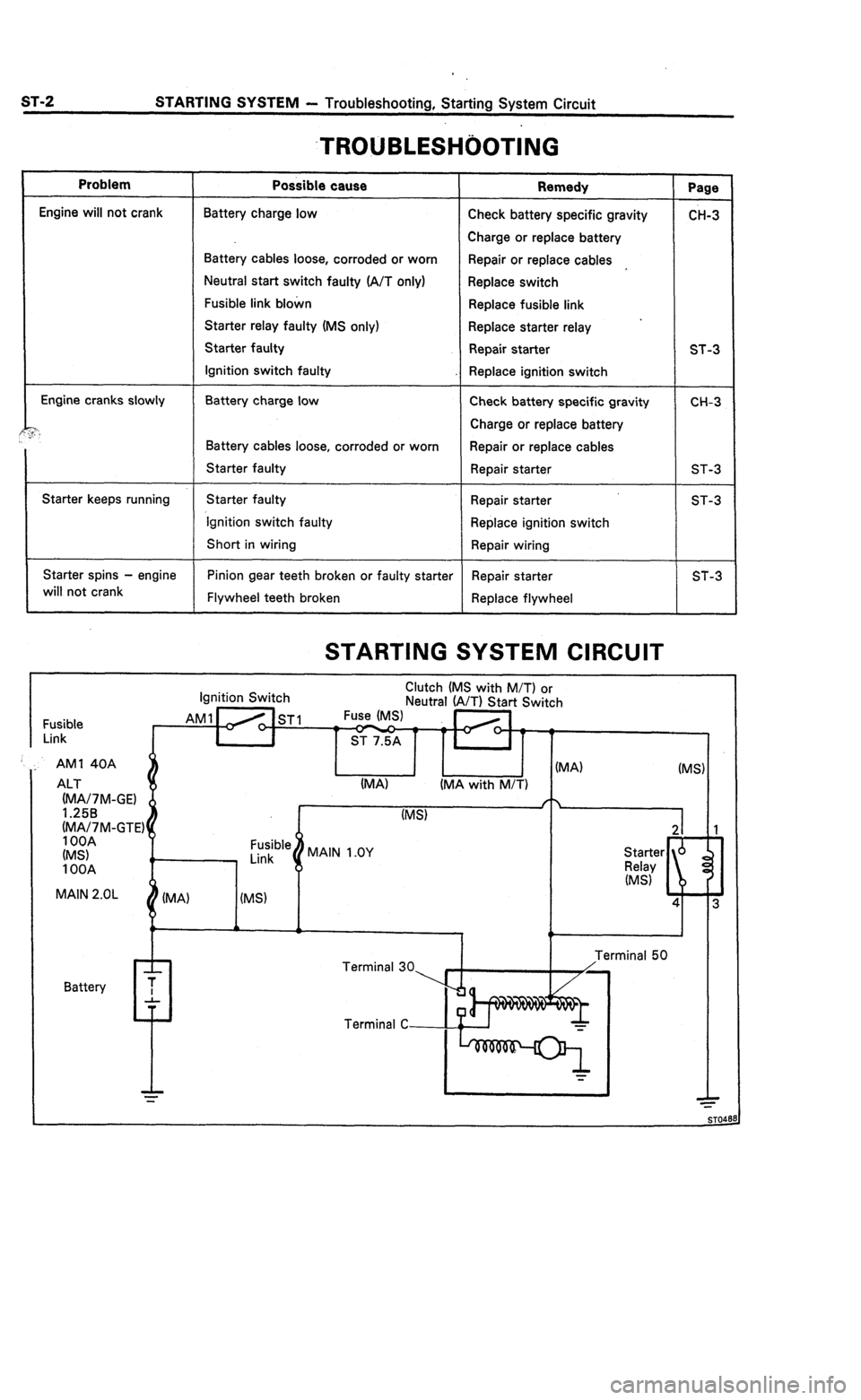
.TROUBLESHi)OTING
Problem
Engine will not crank
Engine cranks slowly
?“.
Starter keeps running
Starter spins - engine
will not crank
Possible cause
Battery charge low
Battery cables loose, corroded or worn
Neutral start switch faulty (A/T only)
Fusible link blown
Starter relay faulty (MS only)
Starter faulty
Ignition switch faulty
Battery charge low
Battery cables loose, corroded or worn
Starter faulty
Starter faulty
‘Ignition switch faulty
Short in wiring
Pinion gear teeth broken or faulty starter
Flywheel teeth broken
Remedy
Check battery specific gravity
Charge or replace battery
Repair or replace cables
Replace switch
Replace fusible link
.
Replace starter relay
Repair starter
Replace ignition switch
Check battery specific gravity
Charge or replace battery
Repair or replace cables
Repair starter
Repair starter
Replace ignition switch
Repair wiring
Repair starter
Replace flywheel
STARTING SYSTEM CIRCUIT
Page
CH-3
ST-3
CH-3
ST-3
ST-3
ST-3
Ignition Switch Clutch (MS with M/T) or
Neutral (A/T) Start Switch
Fusible
Link AM1 Ho ST1 Fuse (MS)
t ST 7.5A
(MA/7M-GTE) ALT (MA) (MA with M/T)
(MS)
MAIN 2.OL
IMA) I IMS) I
AM1 40A
n I I PA) (MS) 1
Battery
I . I T
Page 328 of 346
STARTING SYSTEM
- Staher Relay (MS)
_. ., ST113
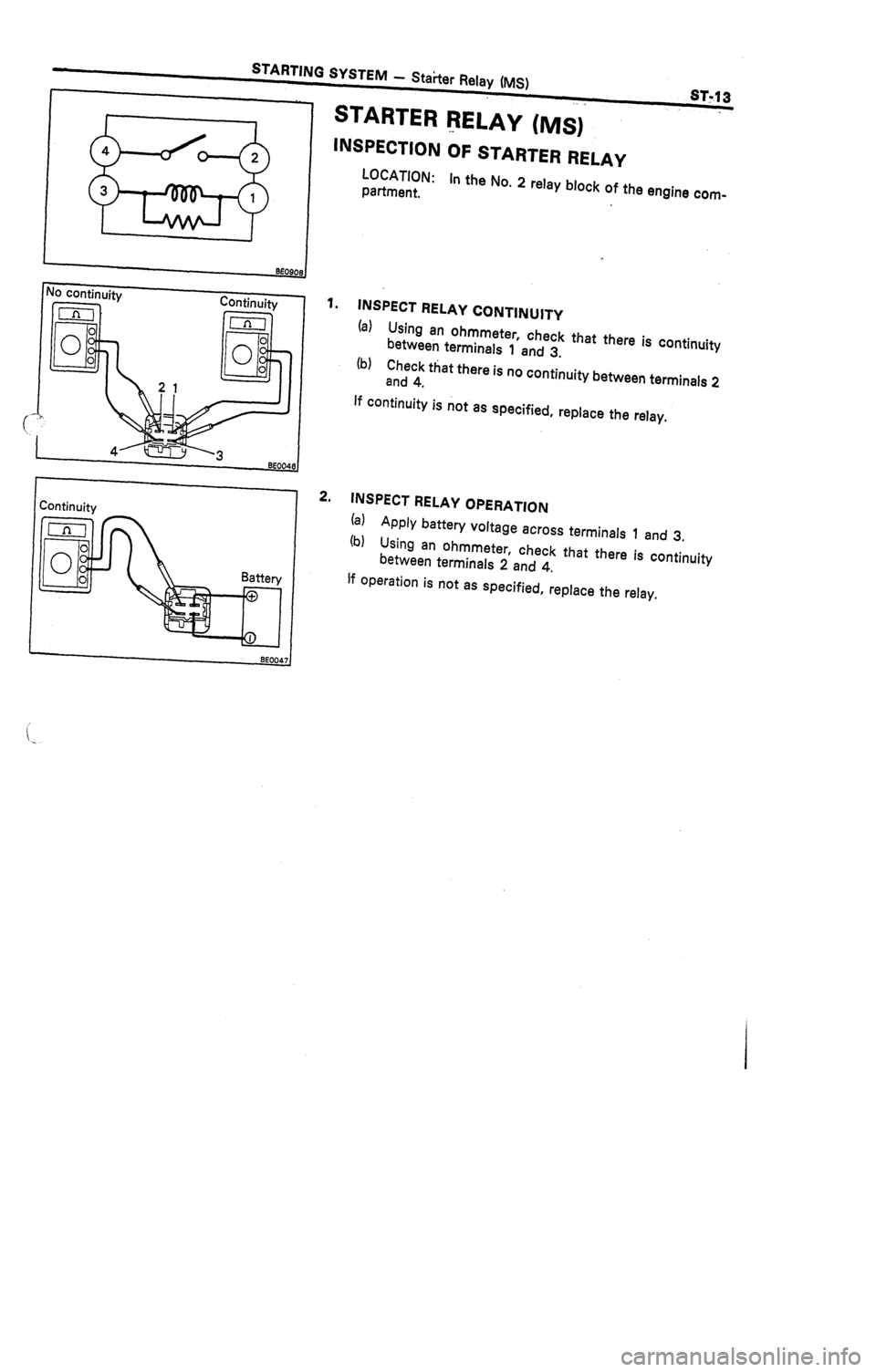
STARTER RELAY (MS)
._
INSPECTION OF STARTER RELAY
LOCATION:
partmen t. In the NO. 2 relay block of the engine com-
Continuity
Inl
Hi
0
0
0
-
Zontinuity
1.
INSPECT RELAY CONTINUITY
(a) Using an ohmmeter, check that there is continuity
lb) between terminals 1 and 3.
zt;cqk that there is no continuity between terminals 2
lf Continuity is not as specified, replace the relay.
2.
INSPECT RELAY OPERATION
(a) Apply battery voltage across terminals 1 and 3.
(b) Using an ohmmeter, check that there
is continuity
between terminals 2 and 4.
If operation is not as specified, replace the relay,
Page 330 of 346
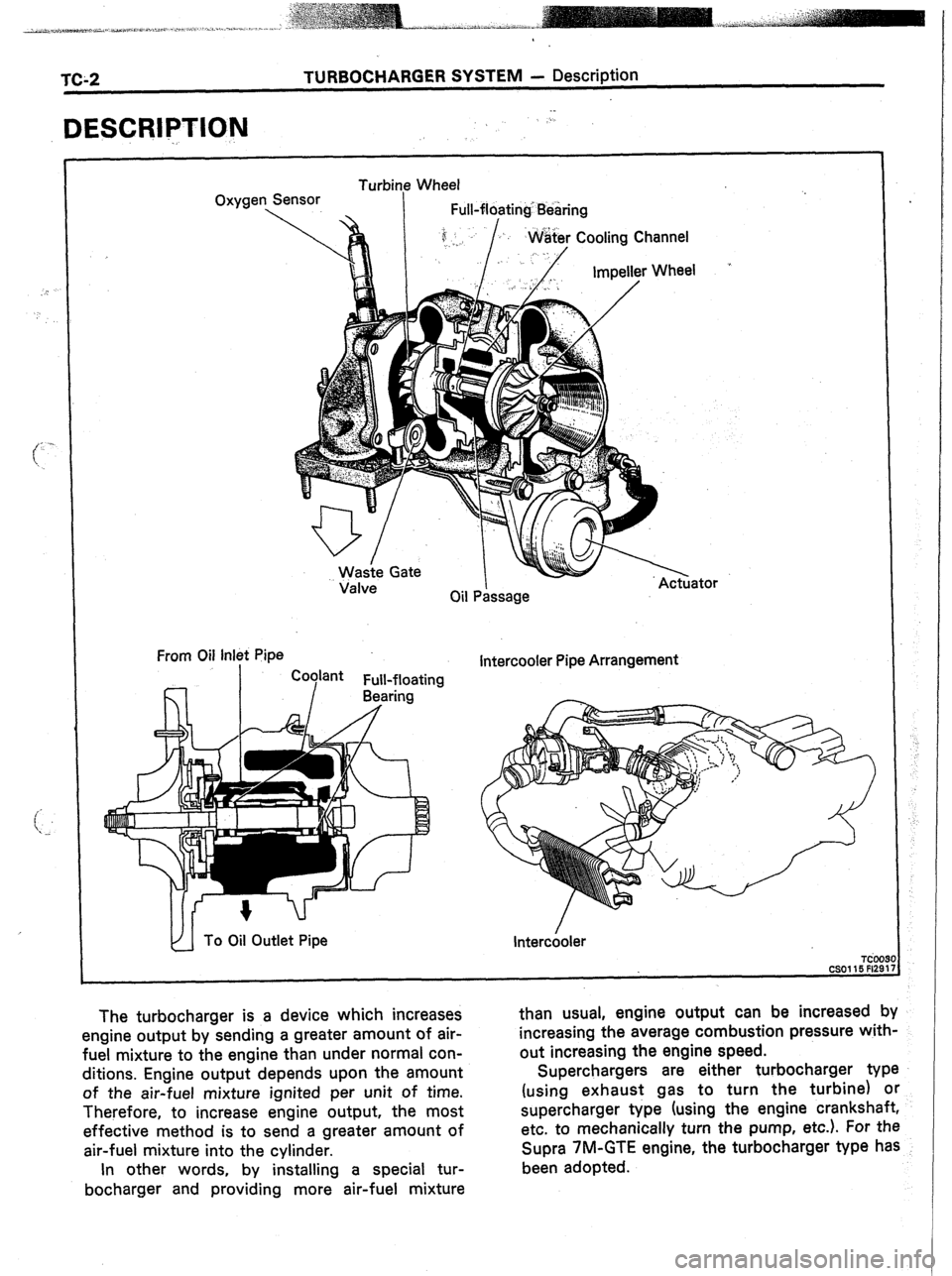
x-2 TURBOCHARGER SYSTEM - Description
.
DESCRIPTION
-.
“
Oxygen
. Turbine Wheel
Sensor
.
I Full-floating Bearing
Valve
Oil P&sage
From Oil Inlet Pipe
Intercooler Pipe Arrangement
TdO
CSOll5 Fl2
The turbocharger is a device which increases
engine output by sending a greater amount of air-
fuel mixture to the engine than under normal con-
ditions. Engine output depends upon the amount
of the air-fuel mixture ignited per unit of time.
Therefore, to increase engine output, the most
effective method is to send a greater amount of
air-fuel mixture into the cylinder. than usual, engine output can be increased by
.
increasing the average combustion pressure with-
out increasing the engine speed.
Superchargers are either turbocharger type
(using exhaust gas to turn the turbine) or
supercharger type (using the engine crankshaft,
etc. to mechanically turn the pump, etc.). For the
Supra 7M-GTE engine, the turbocharger type has
been adopted.
In other words, by installing a special tur-
bocharger and providing more air-fuel mixture
Page 331 of 346
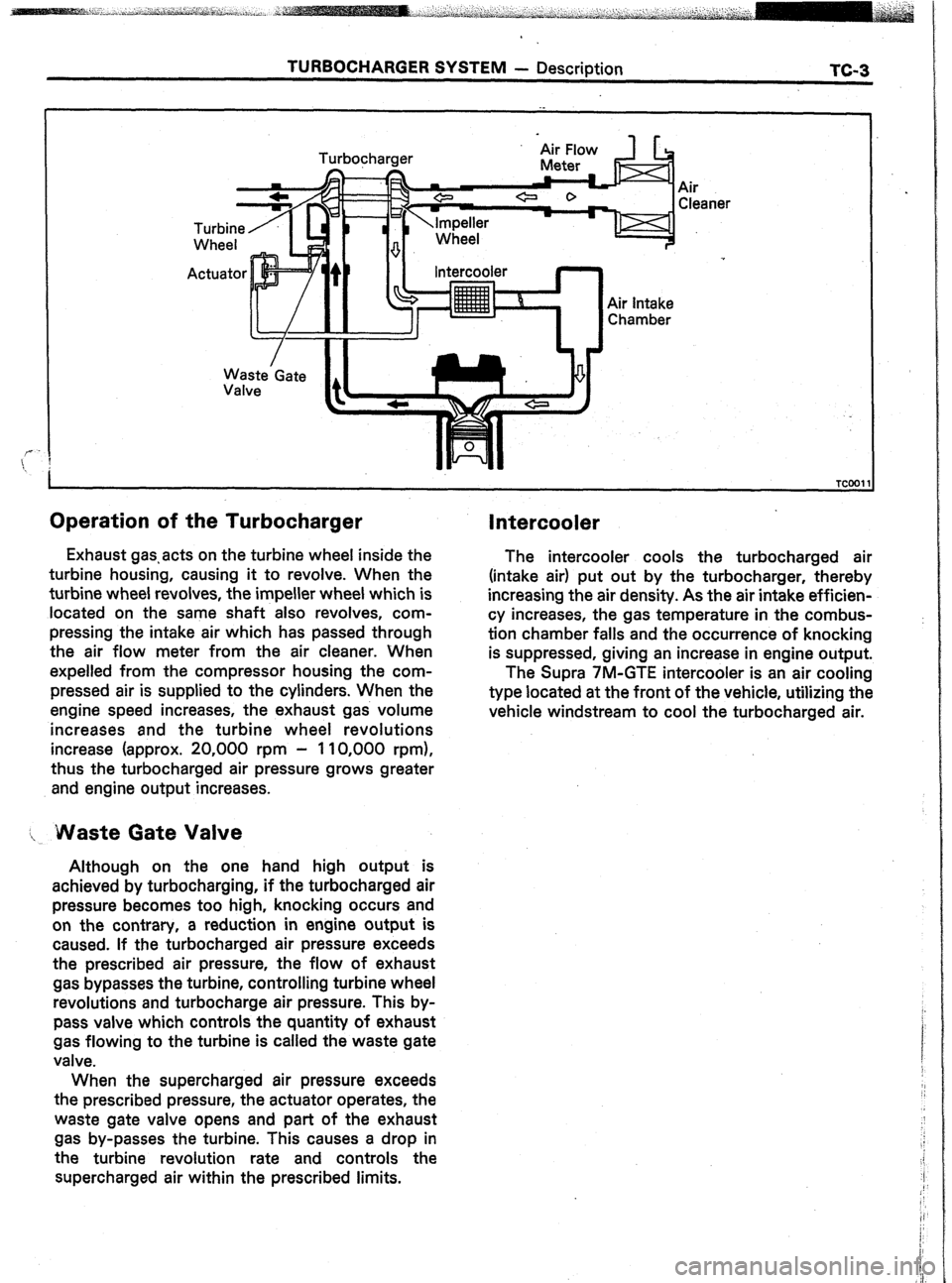
Air
Cleaner
i
Operation of the Turbocharger
Waste’Gate
Valve Intercooler
Air intake
Chamber
Exhaust gas.acts on the turbine wheel inside the
turbine housing, causing it to revolve. When the
turbine wheel revolves, the impeller wheel which is
located on the same shaft also revolves, com-
pressing the intake air which has passed through
the air flow meter from the air cleaner. When
expelled from the compressor housing the com-
pressed air is supplied to the cylinders. When the
engine speed increases, the exhaust gas volume
increases and the turbine wheel revolutions
increase (approx. 20,000 rpm - 110,000 rpm),
thus the turbocharged air pressure grows greater
and engine output increases.
I, Waste Gate Valve
Although on the one hand high output is
achieved by turbocharging, if the turbocharged air
pressure becomes too high, knocking occurs and
on the contrary, a reduction in engine output is
caused. If the turbocharged air pressure exceeds
the prescribed air pressure, the flow of exhaust
gas bypasses the turbine, controlling turbine wheel
revolutions and turbocharge air pressure. This by-
pass valve which controls the quantity of exhaust
gas flowing to the turbine is called the waste gate
valve.
When the supercharged air pressure exceeds
the prescribed pressure, the actuator operates, the
waste gate valve opens and part of the exhaust
gas by-passes the turbine. This causes a drop in
the turbine revolution rate and controls the
supercharged air within the prescribed limits.
Intercooler
The intercooler cools the turbocharged air
(intake air) put out by the turbocharger, thereby
increasing the air density. As the air intake efficien-
cy increases, the gas temperature in the combus-
tion chamber falls and the occurrence of knocking
is suppressed, giving an increase in engine output.
The Supra 7M-GTE intercooler is an air cooling
type located at the front of the vehicle, utilizing the
vehicle windstream to cool the turbocharged air.
Page 332 of 346
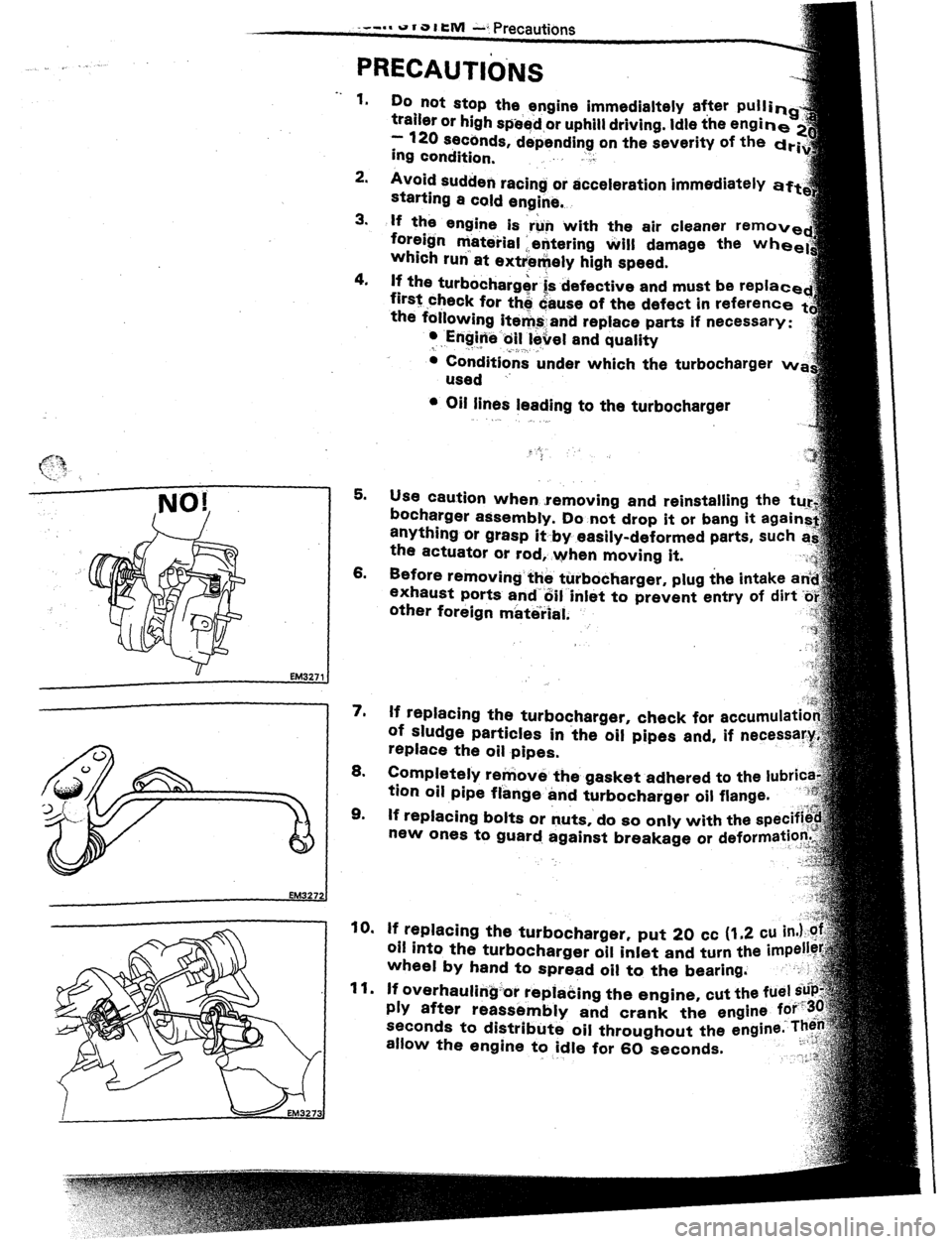
u EM3271
. .
1.
Do not stop the engine immedialtely after pullin
trailer or high speed or uphill driving. Idle the engin
- 126 seccnds, depending on the severity of the drf
ing condition, .,I
2.
Avoid sudden racing or acceleration immediately
starting a cold engine. aft
3.
If the engine is ‘run with the air cleaner remov
foreign material : entering Will damage the whe
which run’ at ext
lf the turbocharger i‘s .defective and must be replac
first check for thd &use of the defect in referent
the foilowing ite&and replace parts if necessary:
l .Engine:oil level and quality
c ,. ,_. .^
. I, .: .’
c Conditions under which the turbocharger MI
used ..
c Oil lines leading to the turbocharger
PRECAUTIO.NS
5.
use caution when .removing and reinstalling the
bocharger assembly. Do not drop it or bang it
anything or grasp it by easily-deformed parts,
the actuator or rod, .when moving it.
6.
other foreign material.
7.
lf replacing the turbocharger, check for accumulati
of sludge particles in the oil pipes and, if necessary
replace the oil pipes.
8.
EM327:
allow the engine
to idle for 60 seconds.
. ,-
Page 333 of 346
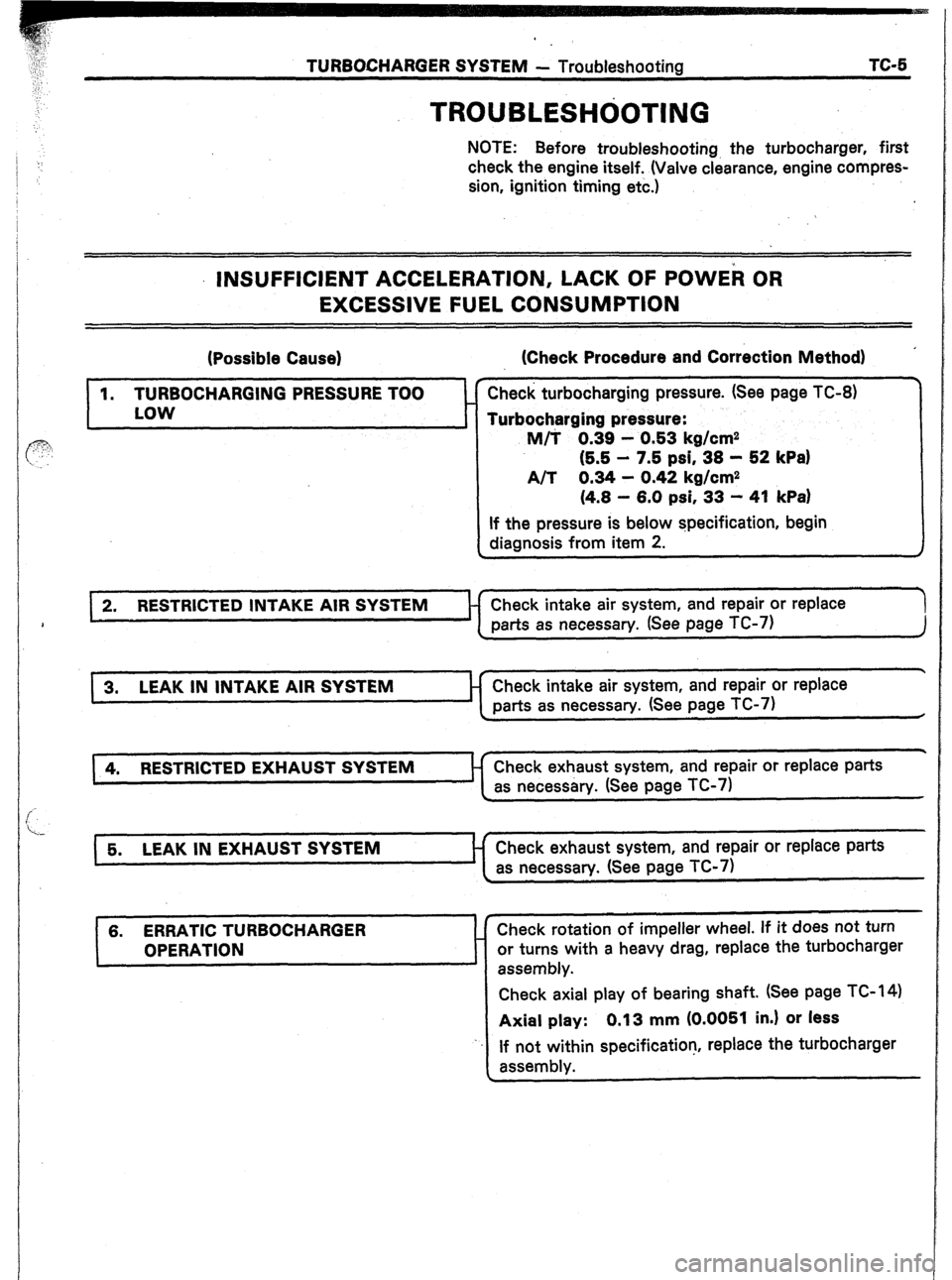
TURBOCHARGER SYSTEM - Troubleshooting TC-5
TROUBLESHdOTlNG
NOTE: Before troubleshooting the turbocharger, first
check the engine itself. (Valve clearance, engine compres-
sion, ignition timing etc.)
INSUFFICIENT ACCELERATION, LACK OF POWEk OR
EXCESSIVE FUEL CONSUMPTION
(Possible Cause)
I
1. TURBOCHARGING PRESSURE TOO
LOW
t
’ (Check Procedure and Correction Method)
Check turbocharging pressure. (See page TC-8)
Turbocharging pressure:
M/T 0.39 - 0.53 kg/cm2
(5.5 - 7.5 psi, 38 - S2 kPa)
A/T 0.34 - 0.42 kg/cm2
(4.8 - 6.0 psi, 33 - 41 kPa)
If the pressure is below specification, begin
diagnosis from item 2.
2. RESTRICTED INTAKE AIR SYSTEM Check intake air system, and repair or replace
‘1
parts as necessary. (See page TC-7)
J
.
3. LEAK IN INTAKE AIR Check intake air system, and repair or replace
parts as necessary. (See page TC-7)
.
4. RESTRICTED EXHAUST SYSTEM Check exhaust system, and repair or replace parts
as necessary. (See page TC-7)
Check exhaust system, and repair or replace parts
as necessary. (See page TC-7)
6. ERRATIC TURBOCHARGER
OPERATION Check rotation of impeller wheel. If it does not turn
or turns with a heavy drag, replace the turbocharger
assembly.
Check axial play of bearing shaft. (See page TC- 14)
Axial play: 0.13 mm (0.0051 in.) or less
If not within specification, replace the turbocharger
assembly.
Page 336 of 346
TC;8 TUWOCHARGER SYSTEM--- Turbocharger
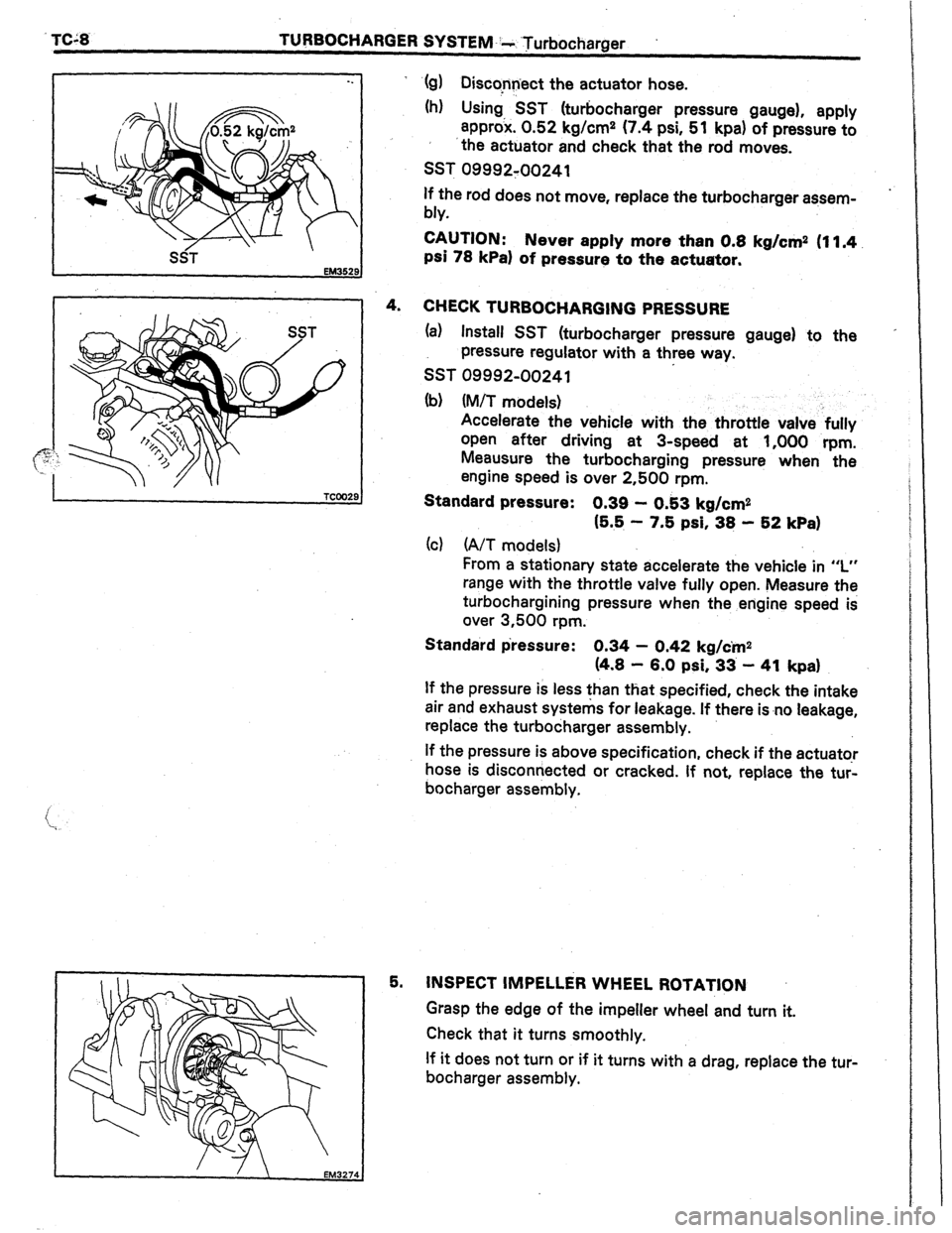
-. ‘(g) Disccnnect the actuator hose.
(h) Using, SST (turbocharger pressure gauge), apply
approx. 0.52 kg/cm2 (7.4 psi, 51 kpa) of pressure to
‘the actuator and check that the rod moves.
SST 09992:00241
SST
EM352!
If the rod does not move, replace the turbocharger aasem-
bly.
CAUTION: Never apply more than 0.8 kg/cm2 (11.4.
psi 78 kPa1 of pressure to the actuator.
4.
CHECK TURBOCHARGING PRESSURE
(a) Install SST (turbocharger pressure gauge) to the
pressure regulator with a three way.
SST 09992-00241
(b) (M/T models)
Accelerate the vehicle with the throttle valve fully
open after driving at 3-speed at 1,000 rpm.
Meausure the turbocharging pressure when the
engine speed is over 2,500 rpm.
Standard pressure:
0.39 - 0.53 kg/cm2
(6.8 - 7.8 psi, 38 - 82 kPa)
(c) (A/T models)
From a stationary state accelerate the vehicle in I”
range with the throttle valve fully open. Measure the
turbochargining pressure when the engine speed is
over 3,500 rpm.
Standard p‘ressure: 0.34 - 0.42 kg/em2
(4.8 - 8.0 psi, 33 - 41 kpa)
If the pressure is less than that specified, check the intake
air and exhaust systems for leakage. If there isno leakage,
replace the turbocharger assembly.
If the pressure is above specification, check if the actuator
hose is disconnected or cracked. If not, replace the turl
bocharger assembly.
I l,Il - 1 5, INSPECT IMPELLiR WHEEL ROTATION
/-L
EM32
Grasp the edge of the impeller wheel and turn it.
Check that it turns smoothly.
If it does not turn or if it turns with a drag, replace the tur
bocharger assembly.
1 :74
Page 344 of 346
TURBOCHARGER SYSTEM - Turbocharaer
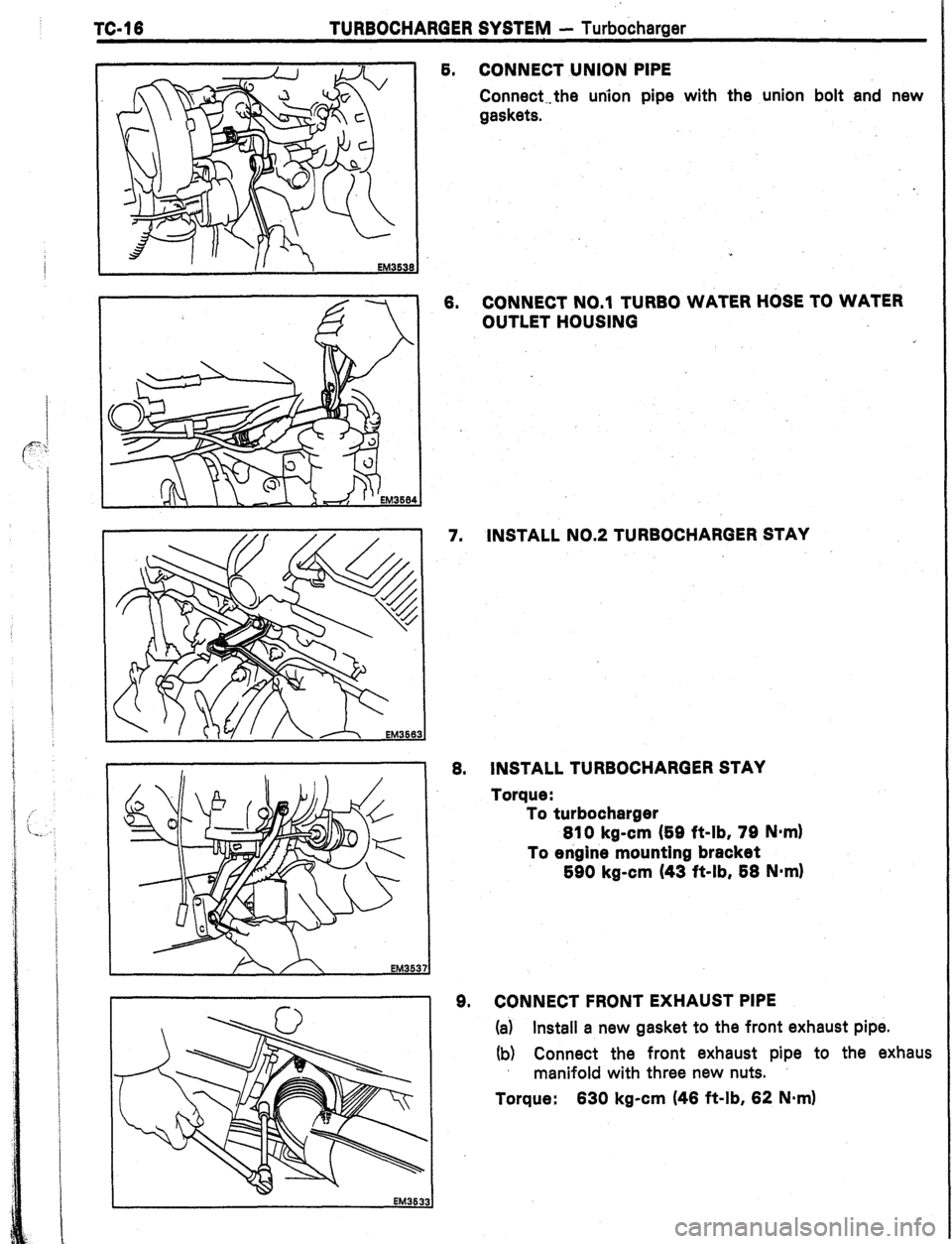
6. CONNECT UNION PIPE
Connect--the uriion pipe with the union bolt and new
gaskets.
’
6-i
6. CONNECT NO.1 TURBO WATER HOSE TO WATER
OUTLET HOUSING
7. INSTALL NO.2 TURBOCHARGER STAY
8. INSTALL TURBOCHARGER STAY
Torque:
To turbocharger
810 kg-cm (59 ft-lb, 70 N-m)
To engine mounting bracket
680 kg-cm (43 ft-lb, 68 N-m)
9. CONNECT FRONT EXHAUST PIPE
(a) Install a new gasket to the front exhaust pipe.
(b) Connect the front exhaust pipe to the exhaus
manifold with three new nuts.
Torque: 630 kg-cm (46 ft-lb, 62 Nem)