engine TOYOTA CELICA 1987 Service Service Manual
[x] Cancel search | Manufacturer: TOYOTA, Model Year: 1987, Model line: CELICA, Model: TOYOTA CELICA 1987Pages: 346, PDF Size: 35.13 MB
Page 120 of 346
EFI SYSTEM - Fuel System
-.
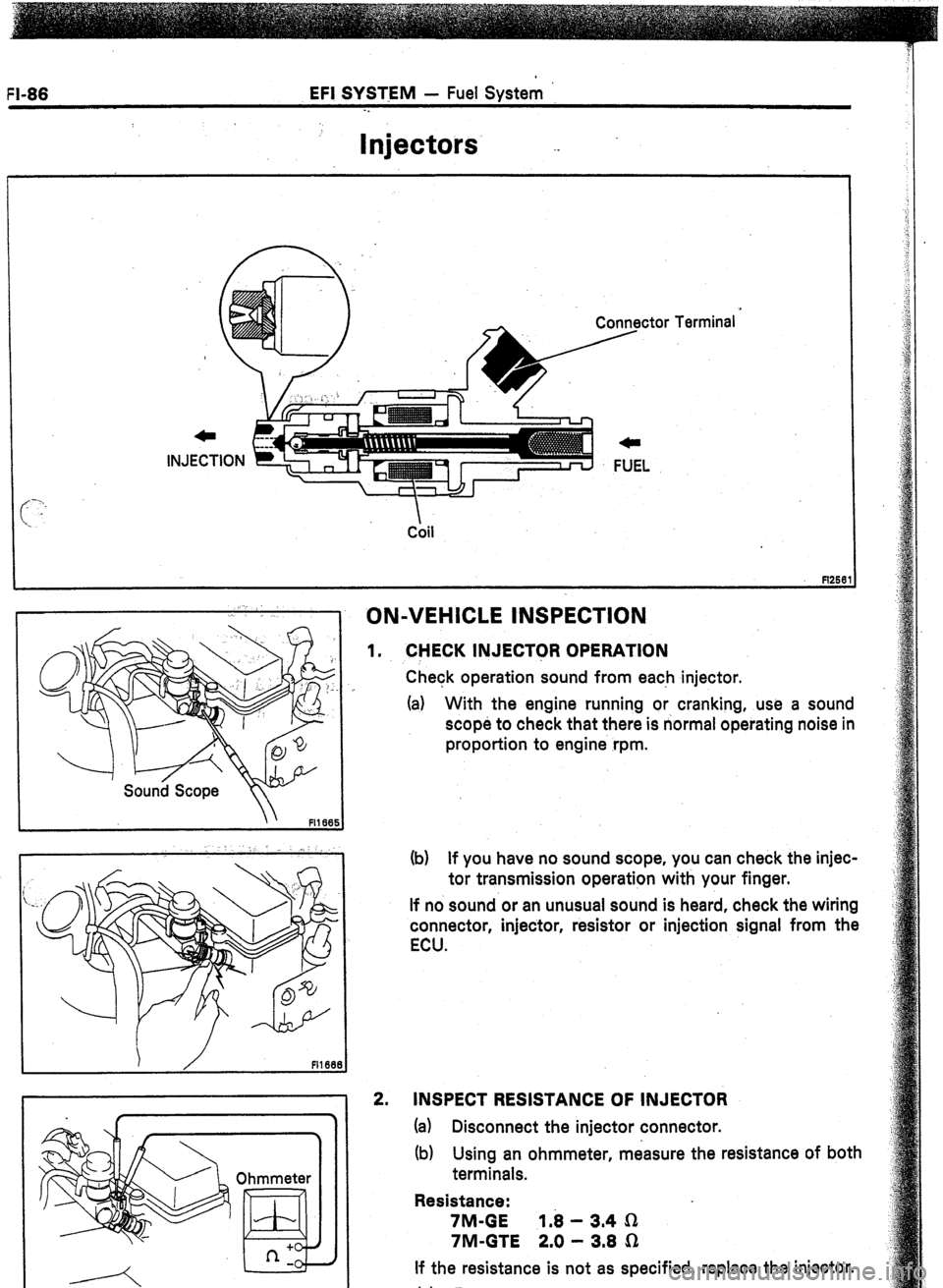
Injectors --
Coil
1 ON-VEHICLE tNSPkTlON
1.
2. CHECK INJECToR OPERATION
Check operation sound from each injector.
(a) With the engine running or cranking, use a sound
scope to check that there is normal operating noise in
proportion to engine rpm.
(b) If you have no sound scope, you can check the injec-
tor transmission operation with your finger.
If no sound or an unusual sound is heard, check the wiring
connector, injector, resistor or injection signal from the
ECU.
INSPECT RESISTANCE OF INJECTOR
(a) Disconnect the injector connector.
(b) Using an ohmmeter, measure the resistance of both
terminals.
Resistance:
7M-GE 1.8 - 3.4 n
7M-GTE 2.0 - 3.8 Q
If the resistance is not as specified, replace the injector.
(c) Reconnect the injector connector.
Page 136 of 346
EFI ,SY$TEM - Air Inducti& System
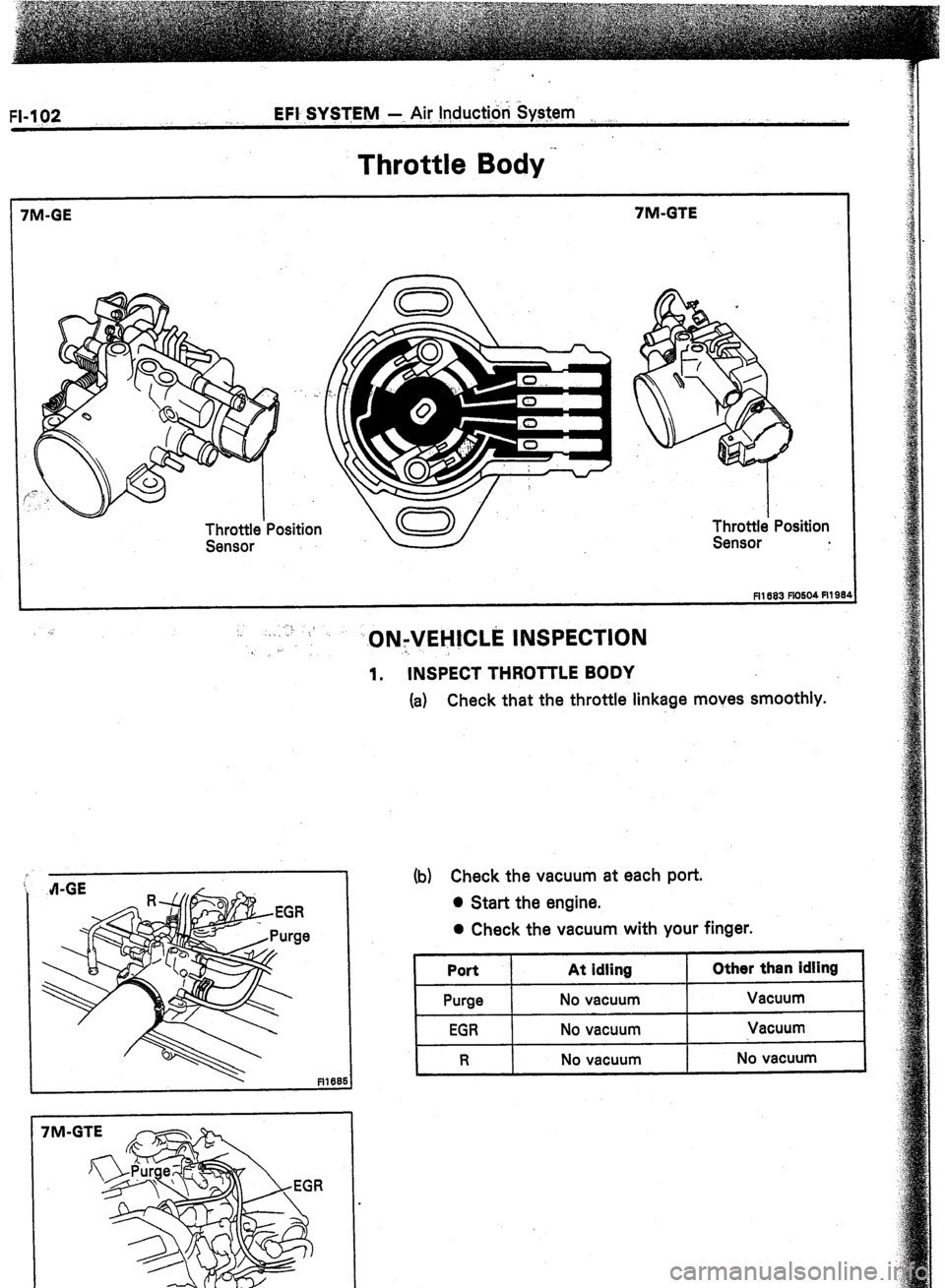
Throttle Body --
‘M-GE 7M-GTE
Throttle’Position
Sensor Throttle’ Position
fl1693 Flo504nl9f
.,.
,. ,F .,’
1 .ON:VEHtCLE INSPECTION
1. INSPECT THROTTLE BODY
(a) Check that the throttle linkage moves smoothly.
(b) Check the vacuum at each port.
0 Start the engine.
0 Check the vacuum with your finger.
Port
Purge
EGR
R
At idling
No vacuum
No vacuum
No vacuum
Other than idling
Vacuum
Vacuum
No vacuum
Page 142 of 346
FI-108 EFI SYSTEM - Air Induction System
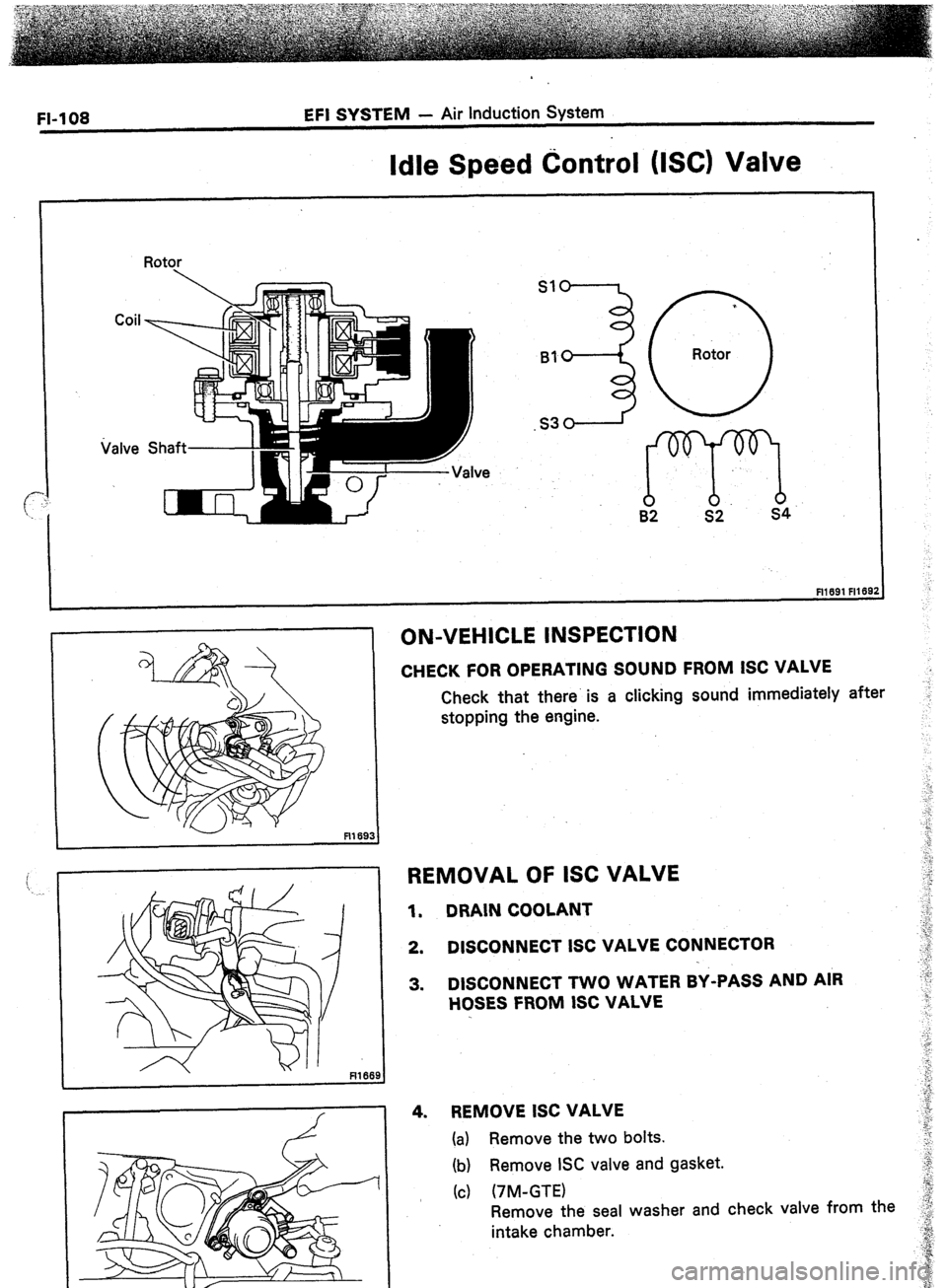
Idle Speed Control (EC) Valve
Rotor
Bl
Q-4
*
0
Rotor
m B2 s2. s4
Fll99lFH6.
,
ON-VEHICLE INSPECTION
CHECK FOR OPERATING SOUND FROM ISC VALVE
Check that there’ is a clicking sound immediately after
stopping the engine.
REMOVAL OF ISC VALVE
1. DRAIN COOLANT
2. DISCONNECT ISC VALVE CONNECTOR
3. DISCONNECT TWO WATER BY-PASS AND AIR
HOSES FROM ISC VALVE
4. REMOVE ISC VALVE
(a) Remove the two bolts.
(b)
Remove ISC valve and gasket.
(cd (7M-GTE)
Remove the seal washer and check valve from the
intake chamber.
Page 156 of 346
22 EFI &STEM - Electronic Control S&m
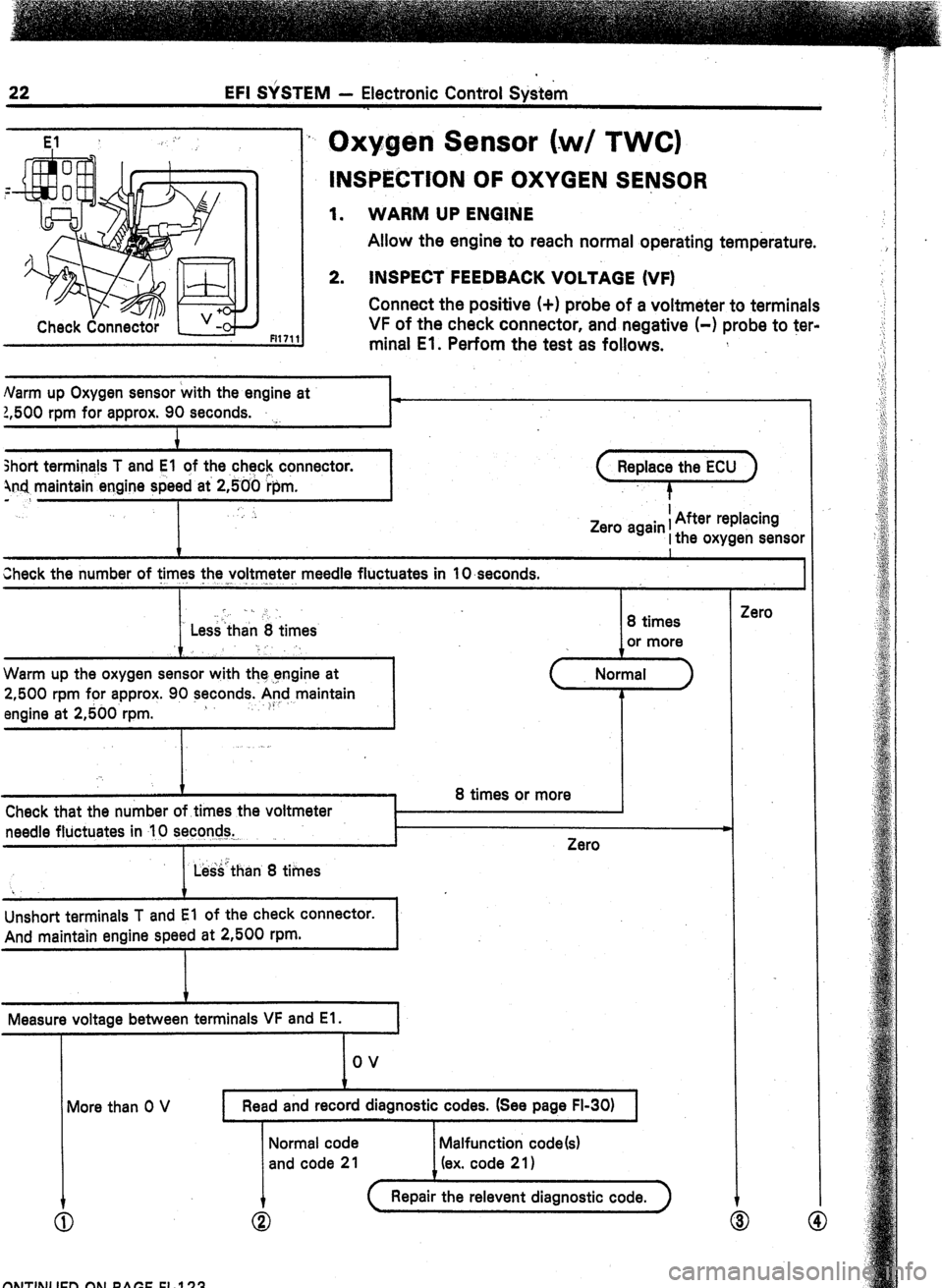
El 7 Oxygen S,ensor (-WI TWC)
INSPECTrON OF OXYGEN SENSOR
1. WARM UP ENGINE
Allow the engine to reach normal operating temperature.
2. INSPECT FEEDBACK VOLTiGE (VFI
Connect the positive (+I probe of a voltmeter to terminals
n1711 VF of the check connector, and negative (-1 probe to ter-
minal El. Perfom the test as follows.
Narm up Oxygen sensor ‘with the engine at
!,500 rpm for approx. 90 seconds.
I
1
short termina!s T and El of the check connector.
4nd maintain engine speed at 2,560 ‘i-pm.
- / (,,,;,,.,,,,
i .
Check the number of times the voltmeter meedle fluctuates in 1 Oseconds. Zero again 1 After replacing
I the oxygen sensor
i ,. ., ;
: . .
Less than 8 times
t. ., .,
Warm up the oxygen sensor with the engine at
,,I
2,500 rpm for approx. 90 seconds. And maintain
engine at 2,500 rpm.
’
I
c
Check that the number of times the voltmeter
needle fluctuates in 10 seconds,
;- 8 times or more
Zero
Leis’~than 8 times
c
Unshort terminals T and El of the check connector.
And maintain engine speed at 2,500 rpm.
Measure voltaae between terminals VF and El.
I
More than 0 V t
Read and record diagnostic codes. (See page FI-30)
I I
Normal code
and code 21 Malfunction code(s)
(ex. code 21)
Repair the relevent diagnostic code.
ONTINUED ON PAGE FI-123 !ero
Page 157 of 346
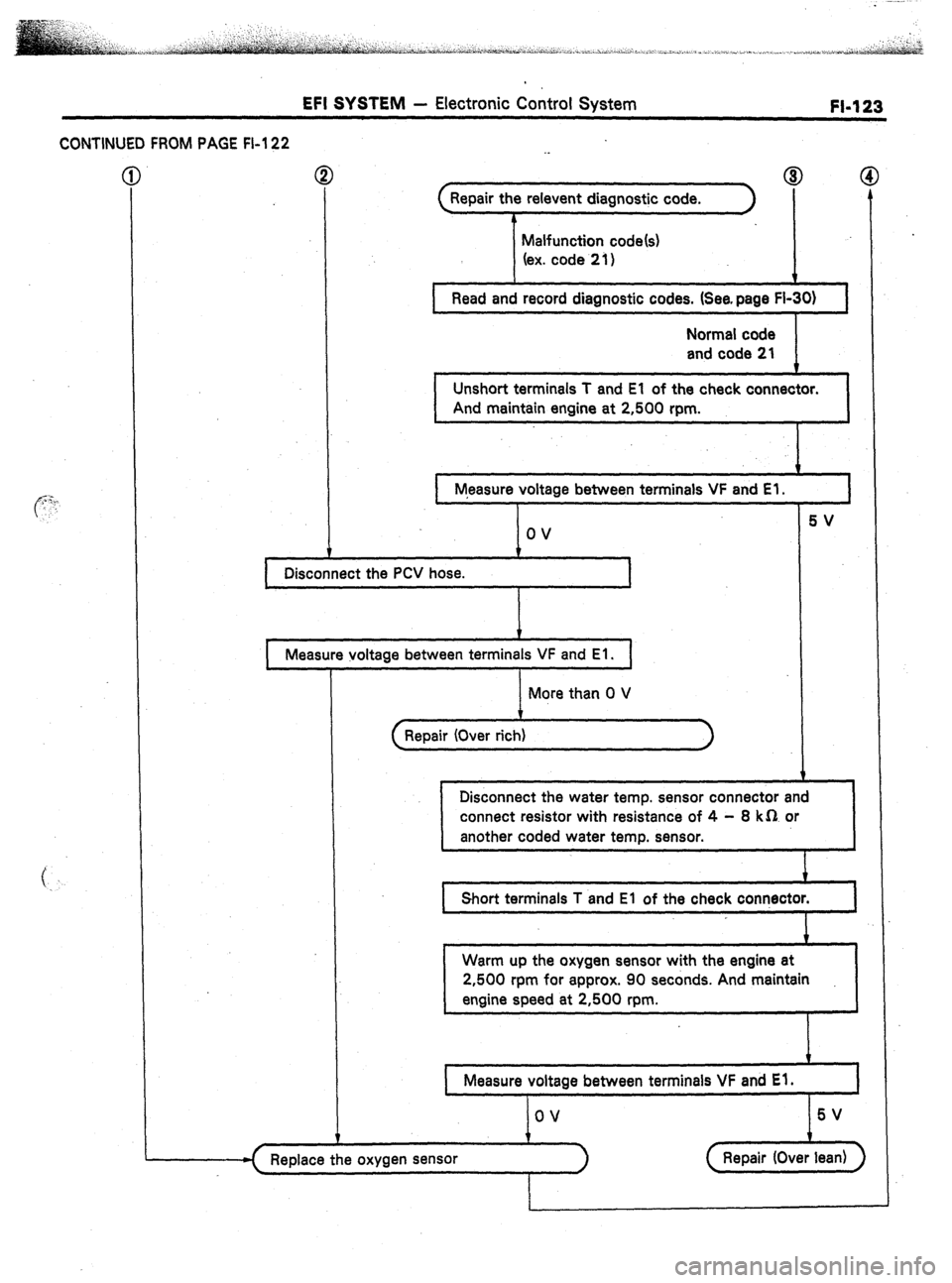
EFI SYSTEM - Electronic Control System FI-123
CONTINUED FROM PAGE FI-122
. .
t
8 (
epair the relevent diagnostic code.
Malfunction code(s)
(ex. code 21)
Read and record diagnostic codes. (See.page FL30)
Normal code
and code 21
t
Unshort terminals T and El of the check connector.
And maintain engine at 2,500 rpm.
I
I
M,easure voltage between terminals VF and El.
ov
t
1
Disconnect the PCV hose.
.
1 Measure voltage between terminals VF and El. 1
t
Replace the oxygen sensor Repair (Over lean) 5V
Disconnect the water temp. sensor connector and
connect resistor with resistance of 4 - 8 kS1 or
another coded water temp. sensor.
1
Short terminals T and El of the check connector.
I
I
Warm up the oxygen sensor with the engine at
I
1 2,500 rpm for approx. 90 seconds. And maintain 1
engine speed at 2,500 rpm.
Measure voltage between terminals VF and El.
I
I 5V
Page 160 of 346
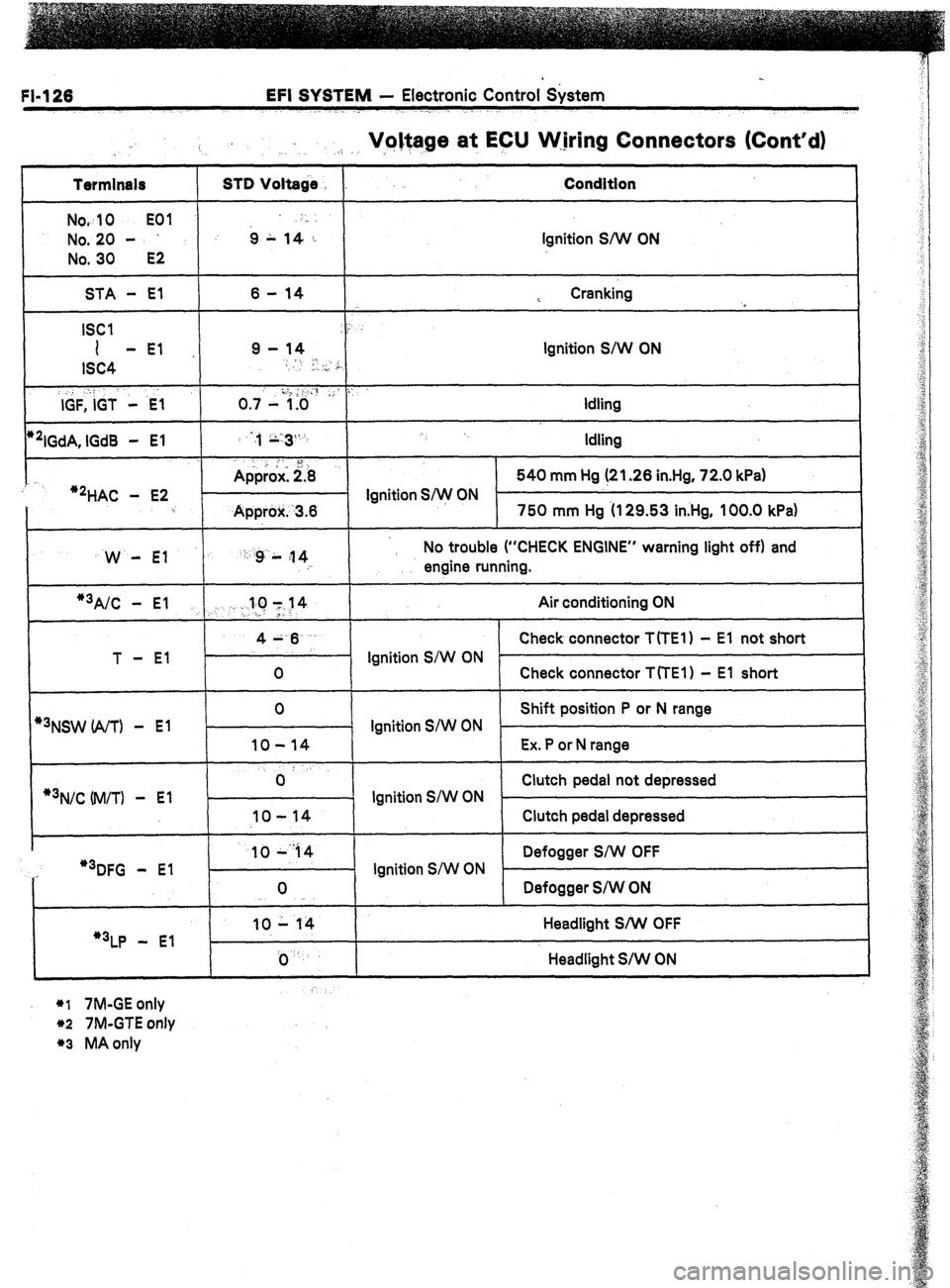
FI-126 EFI SYSTEM - Electronic Control &stem
Voltage at ECU W.jring Connectors (Cont’d)
.:. .I, ,,
Termlnals
Nov
10 EOI
No. 20 -
No. 30
E2
STD Voltage
6 L ,4-,: Condition
Ignition S/W ON
STA - El
ISCI
I -El
ISC4
,, : :
IGF, IGT - .E-1
*‘IGdA, lGd8 - El
:
‘2HAC - E2 6 - 14
9 - 14
-
I, .., ,i,
o .,.- i.;&& ,; ::
:,, ;;:3%
. . 1
Approx: 2.8
- Ignition S/w ON
Approlr. -3.6 L Cranking
,
Ignition S/W ON
Idling
Idling
540 mm Hg (21.26 in.Hg, 72.0 kPa)
750 mm Hg (I 29.53 in.Hg, 100.0 kPa)
W - El ‘: :g L ;I 4
: No trouble (“CHECK ENGINE” warning light off) and
engine running.
1
*3A/C - El .,. . :.llC 1~14 Air conditioning ON
>-
T - El 4A.6
Check connector T(TE1) - El not short
Ignition S/W ON
0 Check connector TfTEl) - El short
*3NSW (A/T) - El
*3N/C Uvl/TI -
El 0
Shift position P or N range
Ignition S/W ON
IO-14 Ex. P or N range
0: Clutch pedal not depressed
- Ignition S/W ON .
IO-14 Clutch pedal depressed
..-
I 1044 1 1 Defogger S/W OFF
I
“3DFG - El
“3LP - El 0
10 - 14
j) ‘. Ignition S/W ON
Defogger S/W ON
Headlight S/W OFF
Headlight S/W ON
*I 7M-GE only
*2 7M-GTE only
*3 MA only
Page 162 of 346
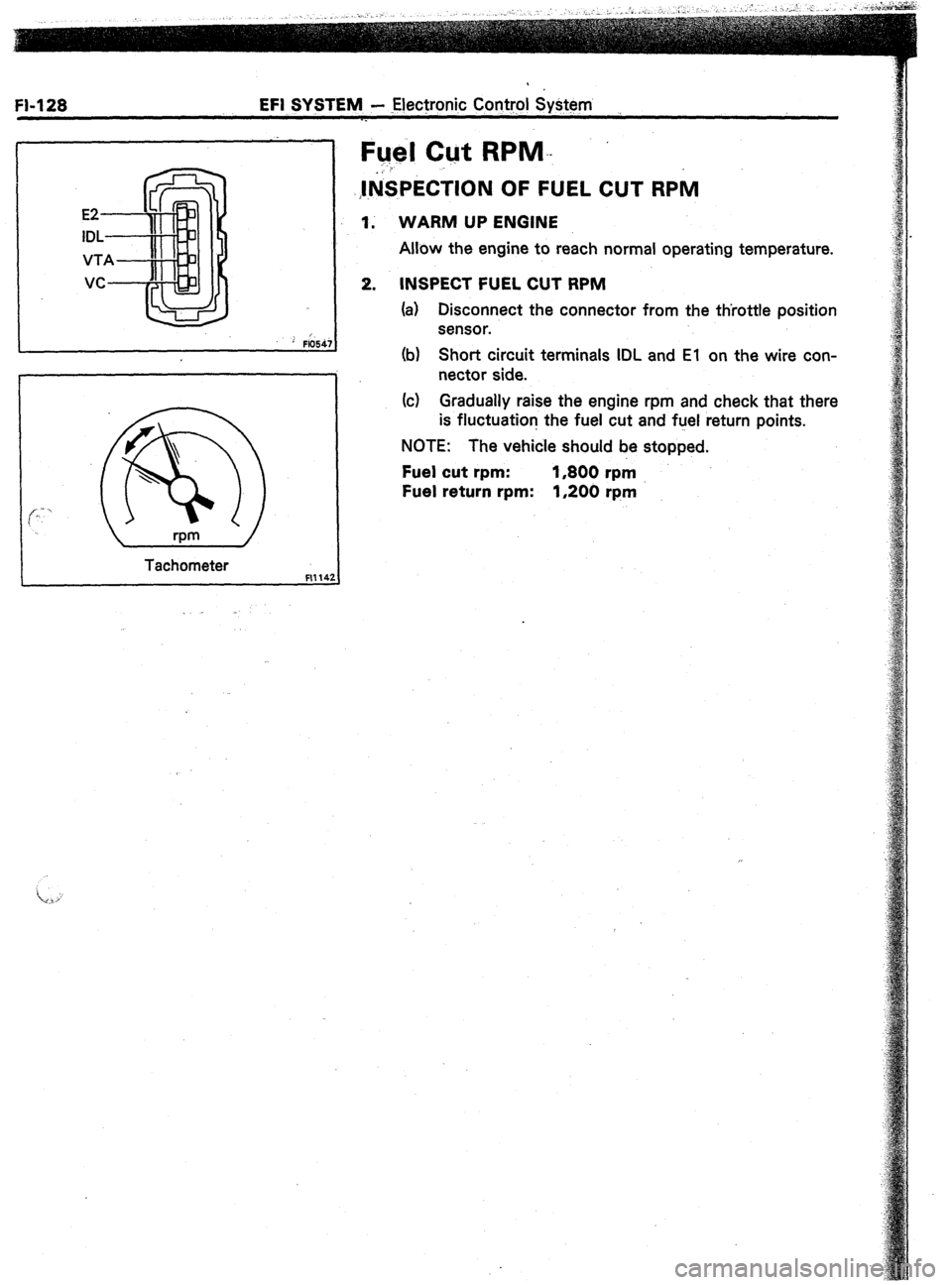
Fl-128 EFI SYSTEM - Electronic Contpl SyStem
c
’ FlO54
Tachometer Fl114:
Fuel Cut RPM--
;INSPECTION OF FUEL CUT RPM
I.
2. WARM UP ENGINE
Allow the engine to reach normal operating temperature.
INSPECT FUEL CUT RPM
(a) Disconnect the connector from the throttle position
sensor.
(b) Short circuit terminals IDL and El on the wire con-
nector side.
(c) Gradually raise the engine rpm and check that there
is fluctuation the fuel cut and fuel return points.
NOTE: The vehicle should be stopped.
Fuel cut rpm:
1,800 rpm
Fuel return rpm: 1,200 rpm
Page 163 of 346
-.
EM-1
I
ENGINE MECHANICAL .’ ../_ :.
F&e.
DESCRIPTION
. . . ..1........111.......~....~.~ E+ -;.’
TROUBLESHOOTING
. . . . . . . . . . . . . . . . n . ma m I. I.
EM-4’ ”
ENGINE TUNE-UP
. . . . . . . . . . . . ..~......~.......
COMPRESSION CHECK
s e . . . . . . . . . . . . . , . . . . . . .
TIMING BELT
,,,..,....................*.*...
EM-28
CYLINDER HEAD
. . . . . . . . . . . . . . ..*............
EM-37
CYLINDER BLOCK
1”1......1...............,..
EM-66
Page 164 of 346
EM-2
ENGINE MECHANICAL - Description
-.
DESCRl.PTlON _
.-. ..‘. /,.
: --
+..>r:*. ,, .,. 2 ,-,. j . .:..,. .-
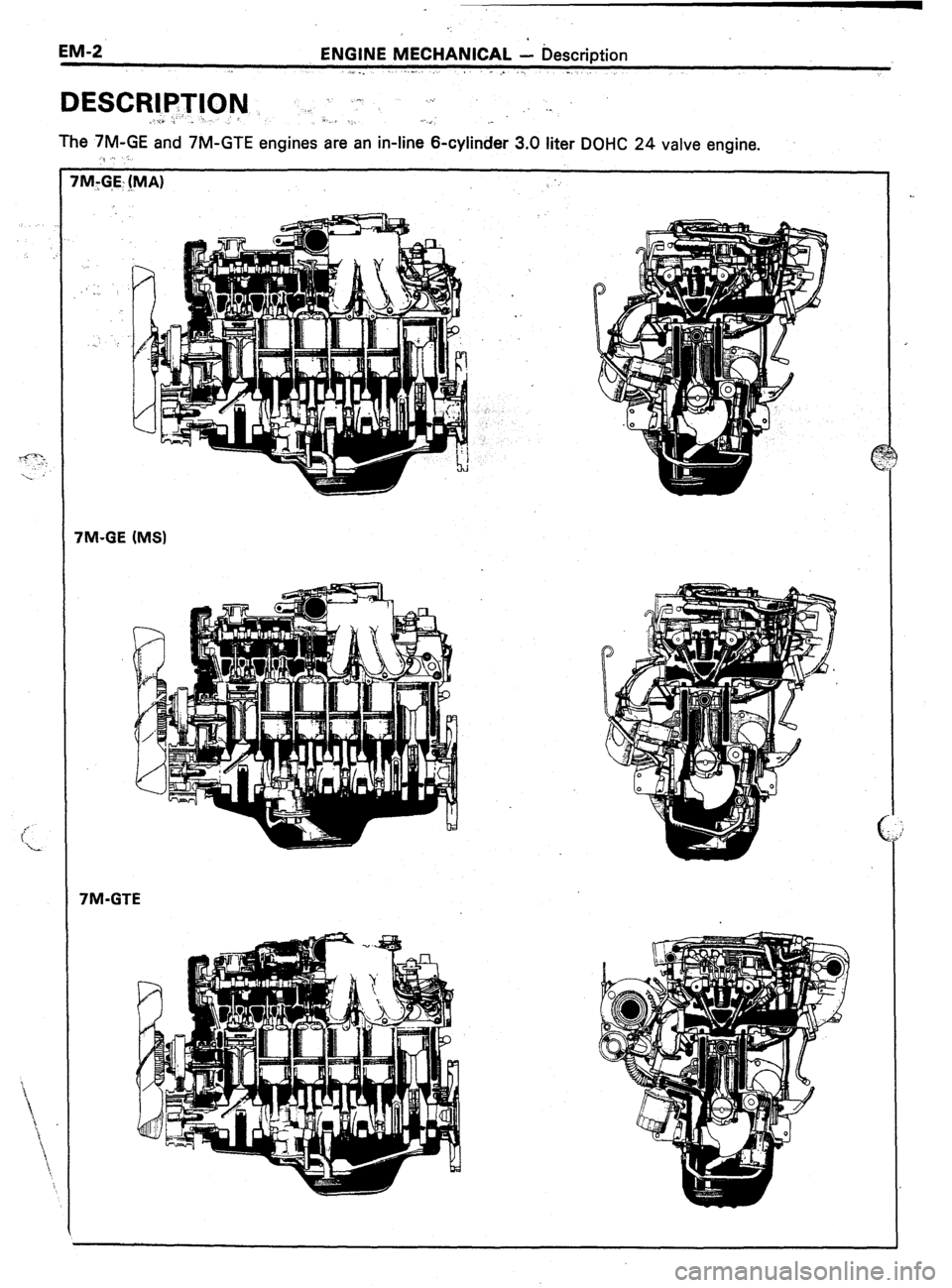
The 7M-GE and 7M-GTE engines are an in-line 6-cylinder 3.0 titer DOHC 24 valve engine. i
‘M:G.E. (MA)
..
: _
7M-GE (MS)
7M-GTE
Page 165 of 346
ENGINE MECHANICAL -, Description
EM-3
The 7M-GE, 7M-GTE engines are an in-line 6-
cylinder engine with the cylinders numbered l-2-
3-4-5-6 from the front. The crankshaft is sup-
ported by 7 bearings specified by the inside of the
crankcase. These bearings are made of kelmet.
.The crankshaft is integrated with 8 weights
which are cast along with it for balancing. Oil holes
‘are built into the crankshaft for supplying oil to the
connecting rods, pistons and other components.
These engine’s ignition order is l-5-3-6-2-4 .
The cylinder head is made of aluminum alloy, with
a cross flow type intake and exhaust layout and
with pent roof type combustion chambers. The
spark plugs are located in the center of the com-
bustion chambers.
Exhaust and intake valves are equipped with
irregular pitch springs with symmetrical ends
made of oil tempered silicon chrome steel wire
which are capable of following the valves even at
,high engine speeds.
Both the exhaust side cam shaft and the. intake
side cam shaft are driven by a single timing belt.
The cam journal is supported at 7 places between
the valve lifters of each cylinder and on the
cylinder head of front end. Lubrication of the cam
journal and cam is accomplished by oil being sup-
plied through the oiler port in the center of the
camshaft.
Adjustment of the valve clearance is done by
means of an outer shim type system, in which
valve adjusting shims are located above the valve
lifters. This permits replacement of the shims
without removal of the camshafts.
The resin timing belt cover is made in 2 pieces.
Pistons are made of highly temperature-resis-
tant aluminum alloy, and depressions are built into
the piston head to prevent interference with
valves.
Piston pins are the full-floating type, with the
pins fastened to neither the piston boss nor the
connecting rods. Instead, snap rings are fitted on
both ends of the pins, preventing the pins from
falling out.
The No. 1 compression ring is made of stainless
steel and the No. 2 compression ring is made of
cast iron. The oil ring is made of a combination of
stainless steel. The outer diameter of each piston
ring is slightly larger than the diameter of the
piston
and the flexibility of the rings allows them
to hug the cylinder walls when they are mounted
on the piston. Compression rings No. 1 and No. 2
work to prevent the leakage of gas from the
cylinder and the oil ring works to scrape oil off the
cylinder walls to prevent it from entering the com-
bustion chamber.
The cylinder block is made of cast iron. It has 6
cylinders which are approximately 1.6 times the
length of the piston stroke. The top of the cylin- ders is closed off by the cylinder head and the
lower end of the cylinders becomes the crankcase,
in which the crankshaft is installed. In addition,- the
cylinder block contains a water jacket, through
which coolant is pumped to cool the cylinders.
The .oil pan is bolted onto the botiom of the
cylinder block. The oil pan is an oil reservoir made .
of pressed steel sheet. A dividing plate’is included
-inside the oil pan to keep sufficient oil in the bot-
tom of the pan even when the vehicle is tilted. This
dividing plate also prevent5 the oil from making
waves when the vehicle is stopped suddenly and
thus shifting the oil away from the oil pump suc-
tion pipe.