coolant TOYOTA CELICA 1987 Service Repair Manual
[x] Cancel search | Manufacturer: TOYOTA, Model Year: 1987, Model line: CELICA, Model: TOYOTA CELICA 1987Pages: 346, PDF Size: 35.13 MB
Page 23 of 346
. COOLING SYSTEM - Description
co;3
RESERVOIR TANK
The reservoir tank is used to catch coolant
which overflows the cooling systein as a result of
volumetric expansion when the coolant is heated.
The coolant in the reservoir tank returns to the
radiator when the coolant temperature drops, thus
keeping the radiator full at all times and avoiding
needless coolant loss. Check the reservoir tank
level to learn if the coolant needs to be rep-
lenished.
WATER PUMP
The water pump is used for forced circulation of
coolant through the cooling system. It is mounted
on the front of the cylinder block and driven by a
V-ribbed belt,
THERMOSTAT I The cooling system is composed of the water
jacket (inside the cylinder block and cylinder head),
radiator, water pump, thermostat, cooling fan,
hoses and other components.
Coolant which is heated in the water
jacket is
pumped to the radiator, through which a cooling
fan blows air to cool the coolant as it passes
through. Coolant which has been cooled is then
sent back to the engine by the water pump, where
it cools the engine.
The water jacket is a network of channels in the
shell of the cylinder block and cylinder head
through which coolant passes. It is designed to
provide adequate cooling of the cylinders are com-
bustion chambers which become the hottest dur-
ing engine operation.
F(/ “ IATOR
The radiator performs the function of cooling
the coolant which has passed through the water
jacket and become hot, and is mounted in the front
of the vehicle. The radiator consists of an upper
tank and ‘lower tank, and a core which connects
the two tanks. The upper tank contains the inlet for
coolant from the water jacket and the filter inlet. It
also has a hose attached through which excess
coolant or steam can flow. The lower tank contains
the outlet for coolant and the drain cock. The core
contains many tubes through which coolant flows
from the upper tank to the lower tank as well as
cooling fins which radiate heat away from the coo-
lant in the tubes. The air sucked through the radia-
tor by cooling fan, as well as the wind generated
by the vehicle’s travel, passes through the radia-
tor, cooling it. Models with automatic transmission
incrl*-le an automatic transmission fluid cooler built
in:.
.le lower tank of the radiator.
RADIATOR CAP
The radiator cap is a pressure type can which
seals the radiator, resulting in pressurization of the
radiator as the coolant expands. The pressuriza-
tion prevents the coolant from boiling even when
the coolant temperature exceeds 100°C. A relief
valve (pressurization valve) and a vacuum valve
(negative pressure valve) are built into the radiator
zap. The relief valve opens and lets steam escape
:hrough the overflow pipe when the pressure
3enerated inside the cooling system exceeds the
imit (coolant temperature:
110 - 1 20°C, (230
- 248”F), pressure; 0.3 - 1 .O kg/cmz, (4.3 - 14.2
)si, 29.4 - 98.1 kPa). The vacuum valve opens to
3ljeviate the vacuum which develops in the coolant
system after the engine is stopped and the coolant
emperature drops. The valve’s opening allows the
)ressure in the cooling system to return to the
Qclant in the reservoir tank. The thermostat has a wax type and is mounted
in the. water outlet housing. The thermostat
includes a type of automatic valve operated by
fluctuations in the coolant temperature. This valve
closes when the coolant temperature drops, pre-
venting the circulation of coolant through the
engine and thus permitting the engine to warm up
rapidly. The valve opens when the coolant tem-
perature has risen, allowing the circulation of coo-
lant. Wax inside the thermostat expands when
heated and contracts when cooled. Heating the
wax thus generates pressure which overpowers
the force of the spring which keeps the valve
closed, thus opening the valve. When the wax
cools, its contraction causes the force of the
spring to take effect once more, closing the valve.
The thermostat in this engine operates at a tem-
perature of 88”C(19O”F).
I
I
Page 25 of 346
COOLING SYSTEM i Check and Replacement of Engine Coolant
co-5
._
CHECK AND REPLACEMENT OF
ENGINE COOLANT
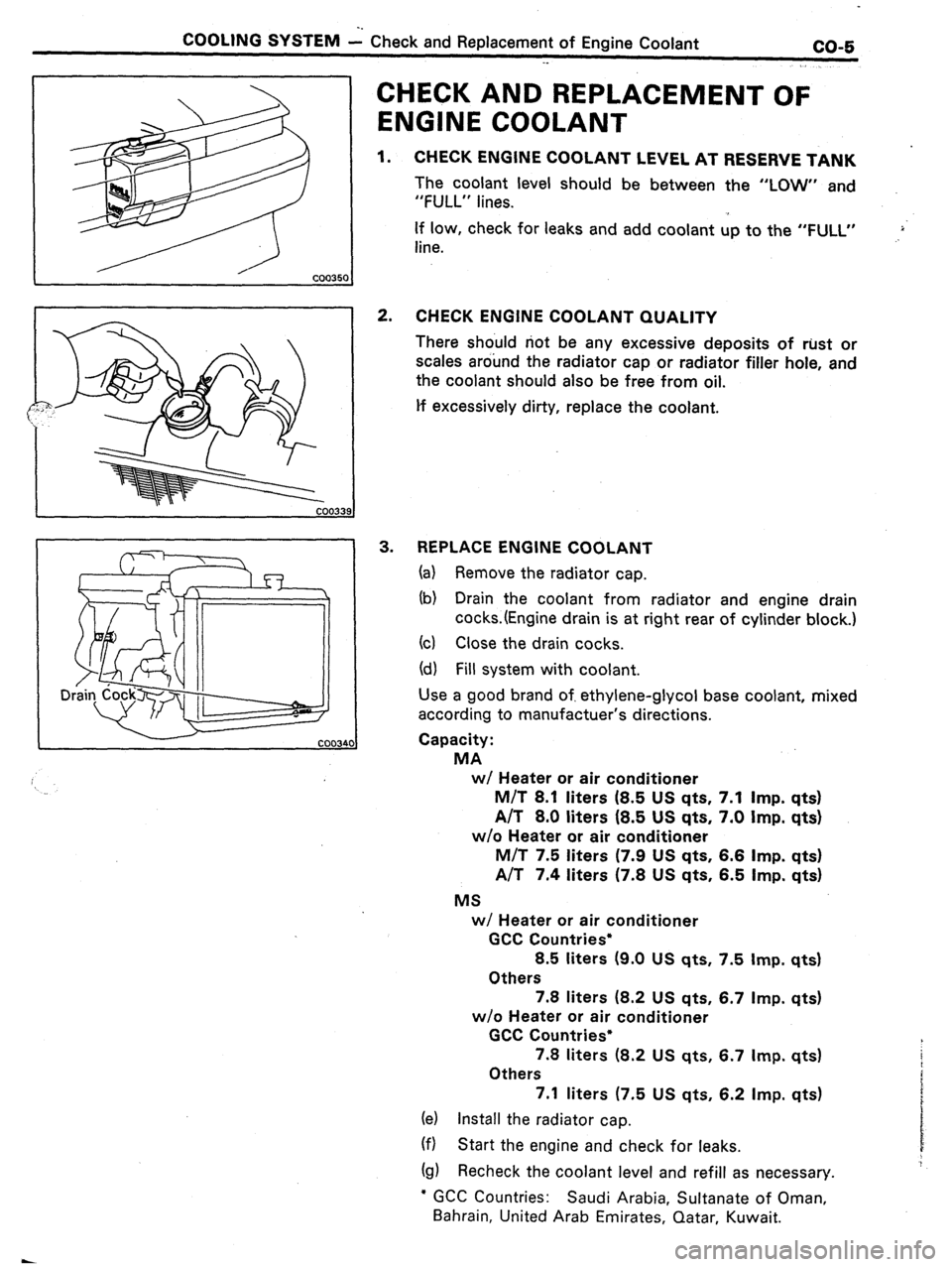
1. CHECK ENGINE COOLANT LEVEL AT RESERVE TANK
The coolant level should be between the “LOW” and
“FULL” lines.
If low, check for leaks and add coolant up to the “FULL”
line. .,>‘
2. CHECK ENGINE COOLANT QUALITY
There should not be any excessive deposits of rust or
scales around the radiator cap or radiator filler hole, and
the coolant should also be free from oil.
lf excessively dirty, replace the coolant.
3. REPLACE ENGINE COOLANT
(a) Remove the radiator cap.
(b) Drain the coolant from radiator and engine drain
cocks.(Engine drain is at right rear of cylinder block.)
(cl Close the drain cocks.
(d) Fill system with coolant.
Use a good brand of. ethylene-glycol base coolant, mixed
according to manufactuer’s directions.
Capacity:
MA
w/ Heater or air conditioner
M/T 8.1 liters (8.5 US qts. 7.1 Imp. qts)
A/T 8.0 liters (8.5 US qts, 7.0 Imp. qts)
w/o Heater or air conditioner
M/T 7.5 liters (7.9 US qts, 6.6
Imp. qts)
A/T 7.4 liters (7.8 US qts, 6.5 Imp. qts)
MS
w/ Heater or air conditioner
GCC Countries*
8.5 liters (9.0 US qts, 7.5 Imp. qts)
Others
7.8 liters (8.2 US qts, 6.7 Imp. qts)
w/o Heater or air conditioner
GCC Countries*
7.8 liters (8.2 US qts, 6.7 Imp. qts)
Others
7.1 liters (7.5 US qts, 6.2 Imp. qts)
(e) Install the radiator cap.
(f) Start the engine and check for leaks.
(g) Recheck the coolant level and refill as necessary.
l GCC Countries: Saudi Arabia, Sultanate of Oman,
Bahrain, United Arab Emirates, Qatar, Kuwait.
Page 29 of 346
COOLING SYSTEM - Radiator
-,... ~‘e:,.,,’ _,
CLEANING OF RADIATOR _ ---w..w- -...,.
Using water or steam cleaner, remove mud and dirt from
the radiator core.
CAUTION: If using’ high-pressure, type cleaner, be
careful not to deform the fins of the radiator core. Keep
a distance of more than 40 - 50 cm (15.75 - 19.69 in.)
between the radiator core and cleaner nozzle when
the cleaner nozzle pressure is 30 - 35 kg/cm2 (427 -
1
498 psi, 2,942 - 3,432 kPa1.
I lNSPECTlON.OF RADIATOR
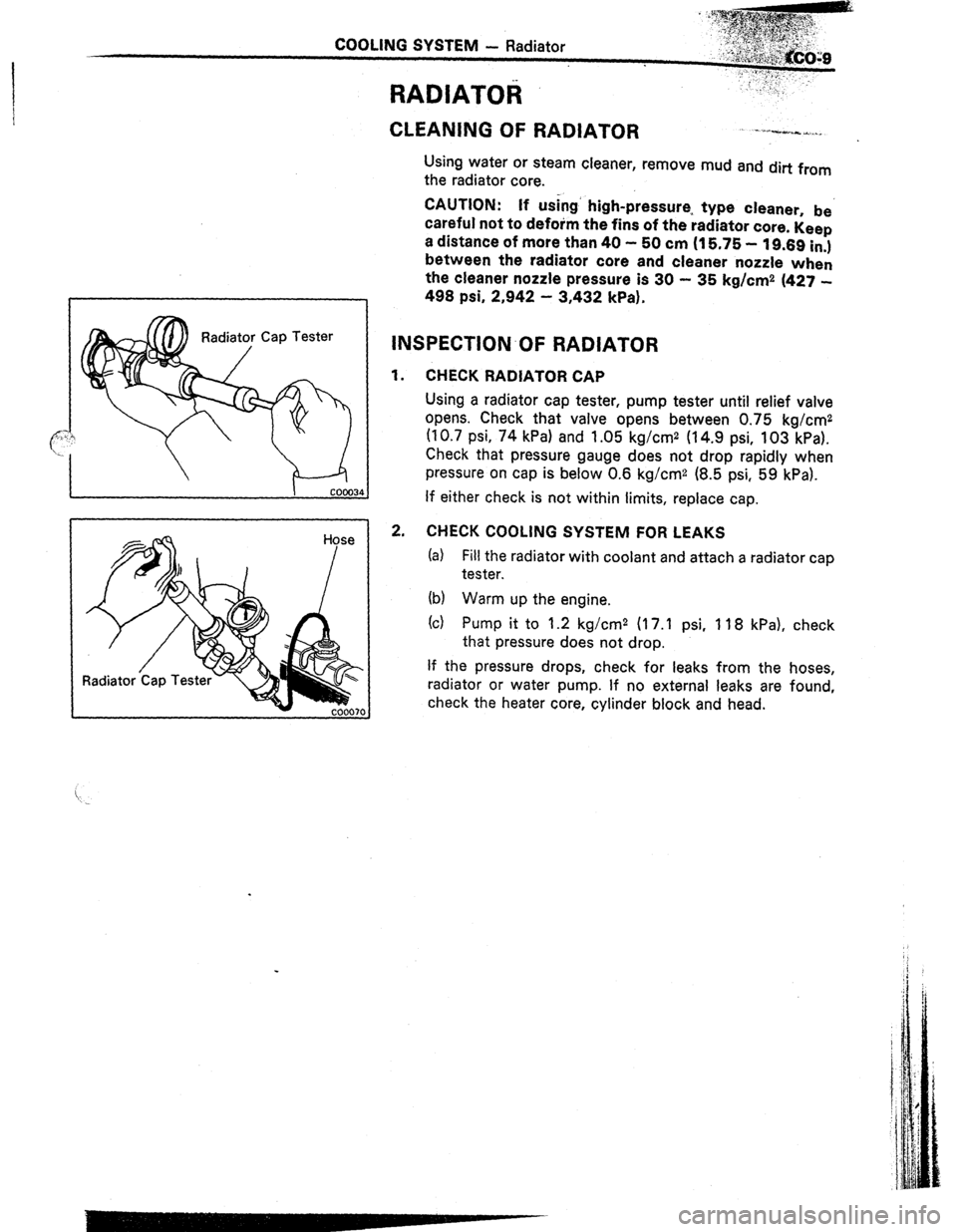
t 1. CHECK RADIATOR CAP
Using a radiator cap tester, pump tester until relief valve
opens. Check that valve opens between 0.75 kg/cm2
(10.7 psi, 74 kPa) and 1.05 kg/cm2 (14.9 psi, 103 kPa).
Check that pressure gauge does not drop rapidly when
pressure on cap is below 0.6 kg/cm2 (8.5 psi, 59 kPa).
!J If either check is not within limits, replace cap.
1 2. CHECK COOLING SYSTEM FOR LEAKS
(a) Fill the radiator with coolant and attach a radiator cap
tester.
(b) Warm up the engine.
(c) Pump it to 1.2 kg/cm2 117.1 psi, 118 kPa), check
that pressure does not drop.
If the pressure drops, check for leaks from the hoses,
radiator or water pump. If no external
leaks are found,
check the heater core, cylinder block
and head.
Page 40 of 346
1-6 EFI SYSTEM - System Description
‘he .EFI system is composed of 3 basic sub
;ystems; Fuel Induction, Air Induction and
Ziectronic Control.
FUEL SYSTEM
An electric fuel pump supplies sufficient fuel,
under a constant pressure, to the injectors. These
injectors inject a metered quantity of fuel into the
intake manifold in accordance with signals from
the ECU (Electronic Control Unit).
AIR INDUCTION SYSTEM
The air induction system provides sufficient air for
engine operation.
[3: ‘I
i&TRONIC CONTROL SYSTEM
The 7M-GE, 7M-GTE engines are equipped wifh a
Toyota Computer Control System (TCCS) which
centrally controls the EFI, ESA, Diagnosis systems,
etc. by means of an Electronic Control Unit (ECU -
for-merly EFI computer) employing a microcom-
puter.
By means of the ECU, the TCCS controls the
following functions:
1. Electronic Fuel injection (EFI)
The ECU receivers signals from,various sen-
sors indicating changing engine operating
conditions such as:
Exhaust oxygen content (w/ TWC)
Intake air volume
i Intake air temperature
Coolant temperature
Engine rpm
Vehicle speed
Acceleration/deceleration etc.
These signals are utilized by the ECU to
determine the injection duration necessary for
an optimum air-fuel ratio.
2. Electronic Spark Advance (ESA)
The ECU is programmed with data for
optimum ignition timing under any and all
operating conditions. Using data provided by
sensors which monitor various engine func-
tions (rpm, A/C signal, coolant temperature,
etc.), the microcomputer (ECU) triggers the
spark at precisely the right instant. (See IG
section) 3. Idle Speed Control (IX)
The ECU is programmed with, target idling
speed values to respond to different engine
conditions (coolant temperature, air condi-
tioner on/off, etc.). Sensors transmit signals
to the ECU which control the flow of air
through the bypass of the throttle valve and
adjust idle speed to the target value.
(See pages FI-53, 7 1, 108) ’
4. Diagnosis
The ECU detects any malfunctions or abnor-
malities in the sensor network and tights the
“CHECK ENGINE” warning light on the instru-
ment panel. At the same time, the trouble is
identified and a diagnostic code is recorded
by the ECU.
5. Fail-Safe Function ’
In the event of computer malfunction, a back-
up circuit will take over to provide minimal
drivability. Simultaneously, the “CHECK
ENGINE” warning light will come on.
Page 65 of 346
EFI SYSTEM
- Diagnosis System
FI-31
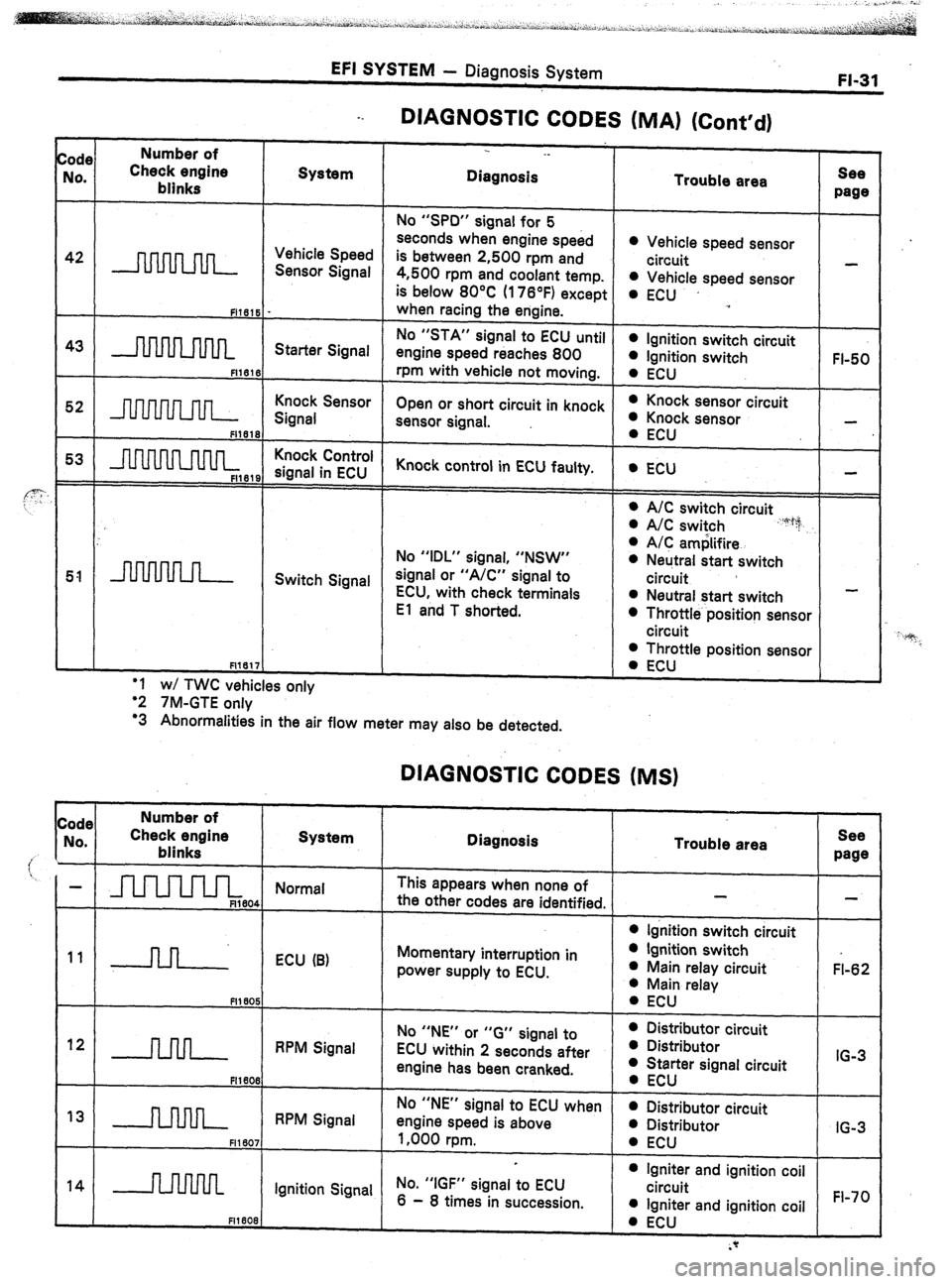
DIAGNOSTIC CODES (MA) (Cont’d) __
:odc
No. Number of
Check engine
blinks Diagnosis System See
page
FL50 Trouble area
l Vehicle speed sensor
circuit
l Vehicle speed sensor
. ECU ’
I
l Ignition switch circuit
l Ignition switch
l ECU
l Knock sensor circuit
l Knock sensor
l ECU
. ECU
l A/C switch circuit
l A/C switch ‘“q
l A/C am&fire
l Neutral start switch
circuit ’
l Neutral start switch
0 Throttle position sensor
circuit
l Throttle position sensor
l ECU Vehicle Speed
Sensor Signal
Starter Signal No “SPD” signal for 5
seconds when engine speed
is between 2,500 rpm and
4,500 rpm and coolant temp.
is below 80°C (176’F) except
when racing the engine.
No “STA” signal to ECU until
engine speed reaches 800
rpm with vehicle not moving.
Knock Sensor
Signal Open or short circuit in knock
sensor signal. 42
FI161
FHBl
Fl181
FIlei
52
Knock control in ECU faulty. Knock Control
signal in ECU
No “IDL” signal, “NSW”
signal or “A/C” signal to
ECU, with check terminals
El and T shorted. Switch Signal
‘1 WI TWC vehicles only
‘2 7M-GTE only
“3 Abnormalities in the air flow meter may also be detected.
DIAGNOSTIC CODES (MS)
Number of
Check engine
System
blinks
m Normal
fl1604
nn ECU (B) Diagnosis
This appears when none of
the other codes are identified.
Momentary interruption in
power supply to ECU. Trouble area See
page
l Ignition switch circuit
l Ignition switch
l Main relay circuit
l Main relay
l ECU FI-62
l Distributor circuit
0 Distributor
l Starter signal circuit
. ECU IG-3
l Distributor circuit
l Distributor
. ECU IG-3
l Igniter and ignition coil 11
FI1605
n nn RPM Signal No “NE” or “G” signal to
ECU within 2 seconds after
engine has been cranked.
FHBOB
nnnn, RPM Signal No “NE” signal to ECU when
engine speed is above
Fl1807 1,000 rpm. 12
-
13
-
14
-LJUlJUL 1 Ignition Signal 1 * No. “IGF” signal to ECU
6 - 8 times in succession. circuit
0 Igniter and ignition coil
. ECU
.t Fl-70
Page 71 of 346
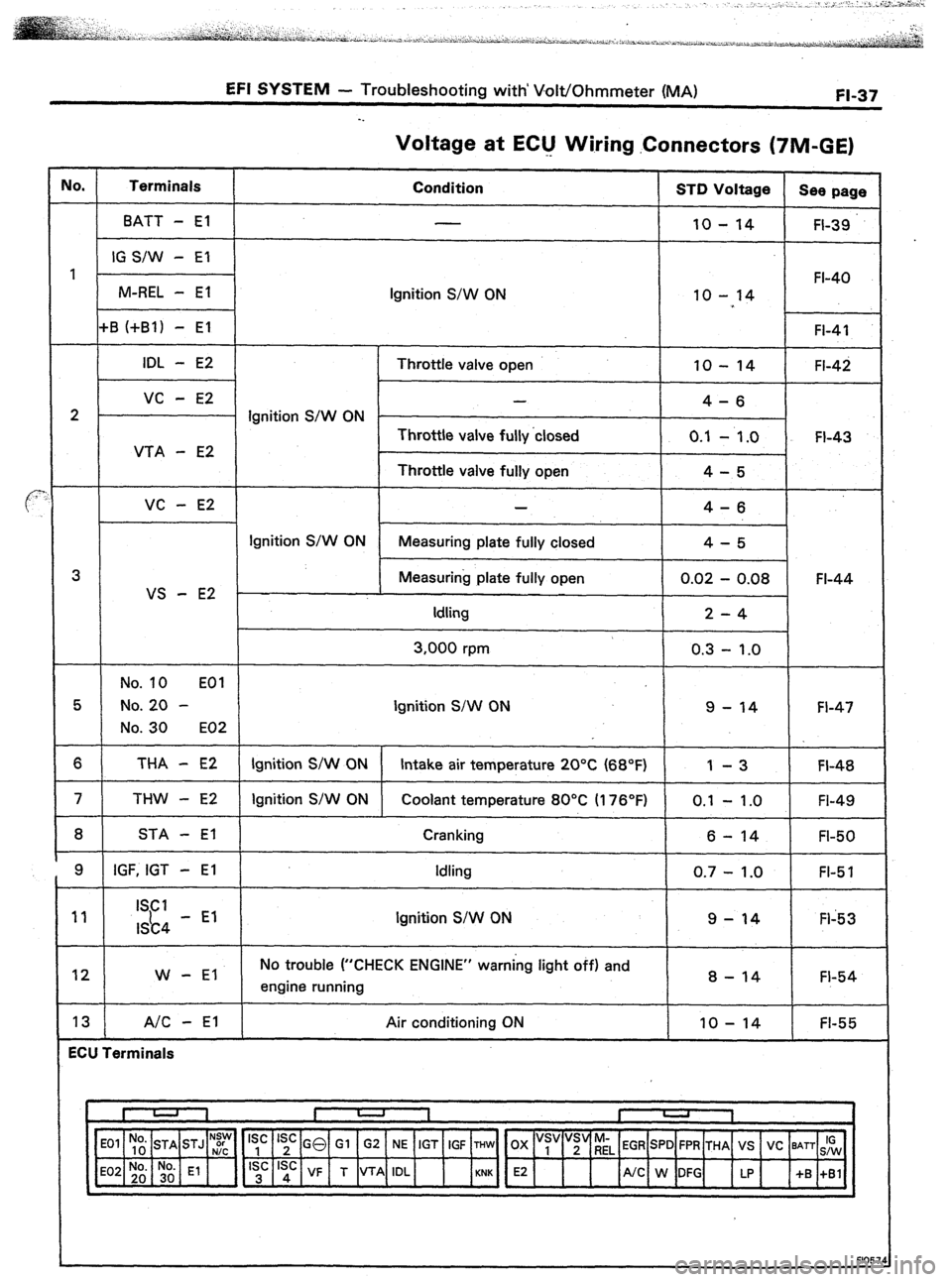
EFI SYSTEM - Troubleshooting with’ Volt/Ohmmeter (MA) FI-37
Voltage at EClJ Wiring .Connectors (TIM-GE)
IO. Terminals
Condition STD Voltage
See page
BATT - El
10 - 14 FI-39
IG S/W - El
1 FI-40
M-REL - El
Ignition S/W ON 10 - 14
+B (+Bl) - El FI-41
IDL - E2 Throttle valve open 10 - 14 FI-42
vc - E2 -
4-6
2 Ignition S/W ON -
Throttle valve fully ‘closed 0.1
- 1.0 FI-43
VTA - E2
Throttle valve fully open 4-5
VC - E2 4-6
Ignition S/W ON
Measuring plate fully closed 4-5
3 Measuring plate fully open 0.02 - 0.08 FI-44
VS - E2
Idling 2-4
3,000 rpm 0.3 - 1.0
No. 10 EOI
5 No. 20 - Ignition S/W ON 9 - 14 FI-47
No. 30 E02
6 THA - E2 Ignition S/W ON Intake air temperature 20°C (68°F) 1 -3 FI-48
7 THW - E2 Ignition S/W ON Coolant temperature 80°C II 76’F) 0.1 - 1 .O
FI-49
8 STA - El Cranking
6 - 14 FI-50
9 IGF, IGT - El Idling
0.7 - 1.0 FI-5 1
11 ISCI
I&4 - El Ignition S/W ON 9-14 Fl-53
12 W - El No trouble (“CHECK ENGINE” warning light off) and
engine running 8 - 14 FI-54
13 A/C - El Air conditioning ON IO - 14 FI-55
ECU Terminals
‘~,~] E2 4
/UC W:G up +S :,:I
N:y Is’ Is’ GO Gl G2 NE IGT IGF THW OX “s, “;“riL EGR SPD FPR THA VS VC BATT IG
F1057
Page 72 of 346
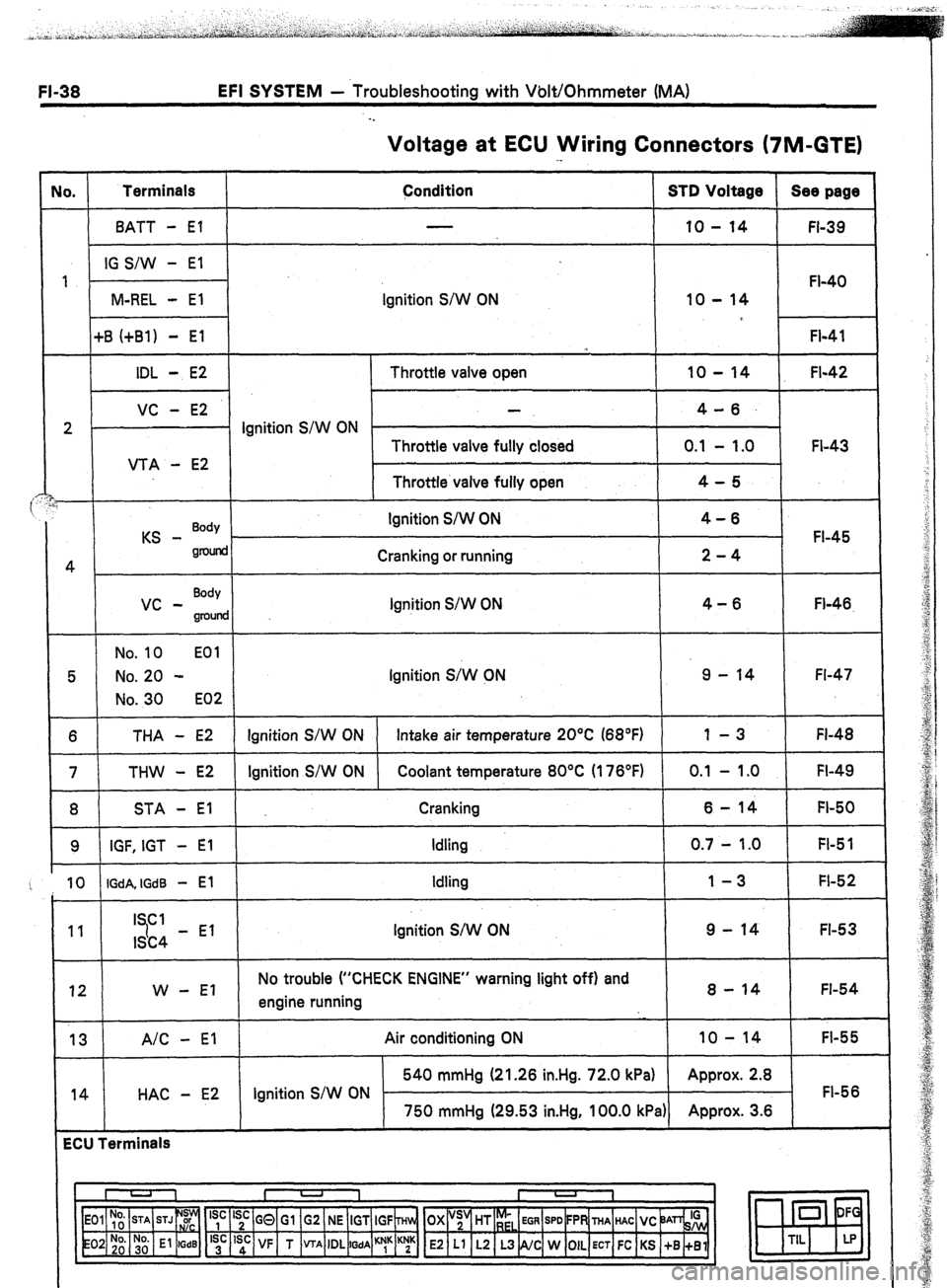
EFI SYSTEM - Troubleshooting with Volt/Ohmmeter (MA)
. .
Voltage at ECU Wiring Connectors (7M-GTE)
No. Terminals
Condition STD Voltage Sea page
BATT - El 10 - 14
FI-39
IG S/W - El
1
FI-40
M-REL - El Ignition S/W ON 10 - 14
+B (+Bl) - El
FI-41
*
IDL - E2 Throttle valve open 10 - 14 FI-42
VC - E2 4-6.
2 . Ignition S/W ON
Throttle valve fully closed 0.1 - 1.0 FI-43
VTA - E2
Throttle valve fully open 4-5
i
KS - Body Ignition S/W ON 4-6
FI-45
gnMid
4 Cranking or running 2-4
vc - Body
Ignition S/W ON 4-6
groulld Fl-46.
No. 10 EOl
5 No. 20 - Ignition S;W CN 9 - 14 Fl-47
No. 30 E02
6 THA - E2 Ignition S/W ON Intake air temperature 20°C (68°F) 1 -3 FI-48
7 THW - E2 Ignition S/W ON Coolant temperature 80°C (176°F) 0.1 - 1 .O FI-49
8 STA - El Cranking 6-14 FI-50
9 IGF, IGT - El Idling 0.7 - 1.0 FI-5 1
10 IGdA, IGdB - El Idling 1-3 FI-52
11 I Cl
7 9 - 14 FI-53
ISC4 - El Ignition S/W ON
12 W - El No trouble (“CHECK ENGINE” warning light off) and
engine running 8 - 14 FI-54
13 A/C - El
14 HAC - E2 Air conditioning ON 10 - 14
FI-55
540 mmHg (21.26 in.Hg. 72.0 kPa) Approx. 2.8
Ignition S/W ON FI-56
750 mmHg (29.53 in.Hg, 100.0 kPa) Approx. 3.6
ECU Terminals
I U 1 I -
I
1
‘yc ‘;c GQ Gl G2 NE IGT IGF ~Hln, OX “;’ HT r;,
EGR SPD FPR THA HAC VC ‘JAn& 0 DF
‘;’ ‘sd: VF T VTA IDL
WA ““1” K;K E2 Ll L2 L3 NC W OIL ECT FC KS +B +Bl m
TIL LP
Page 83 of 346
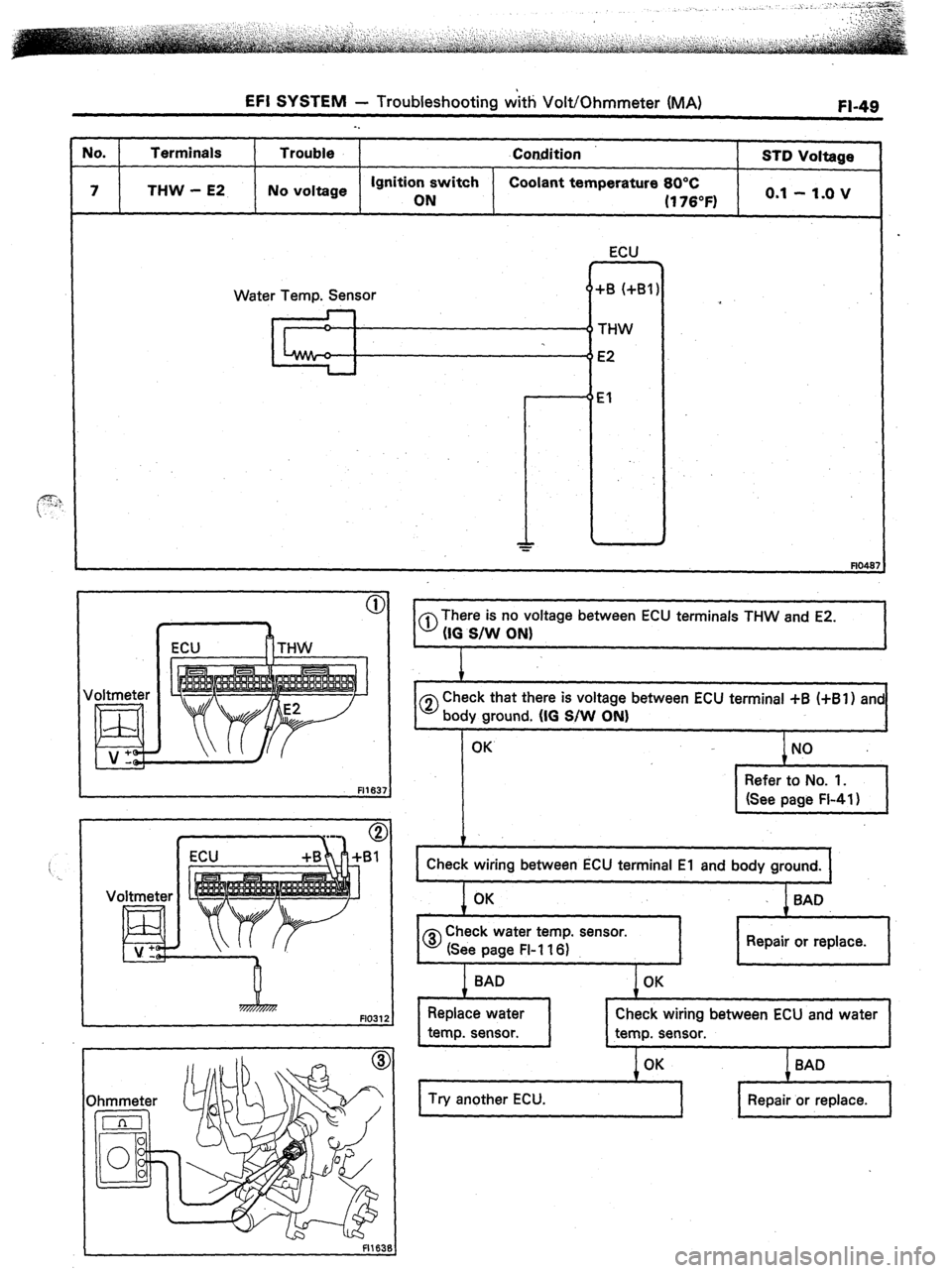
EFI SYSTEM - Troubleshooting with Volt/Ohmmeter (MA) Fl-49
-.
No.
Terminals Trouble
Condition
STD Voltage
7 THW - E2 No voltage ignition switch
Coolant temperature 80°C
ON (1780~) o-q - l-0 V
ECU
Water Temp. Sensor
. iB (+Bll
THW
E2
El
Jf /
Voltmeter
n F1031:
1
0 There is no voltage between ECU terminals THW and E2.
(IO S/W ON)
1 i
CD Check that there is voltage between ECU terminal +B (+Bl) and
body ground. (IG S/W ON)
1
OK
NO
Refer to No. 1.
(See page FI-41)
Check wiring between ECU terminal El and body ground.
OK
, 1
0 Check water temp. sensor.
(See page FI-1 161
I I
Try another ECU. OK
Check wiring between ECU and water
temp. sensor.
OK BAD
Repair or replace.
Page 93 of 346
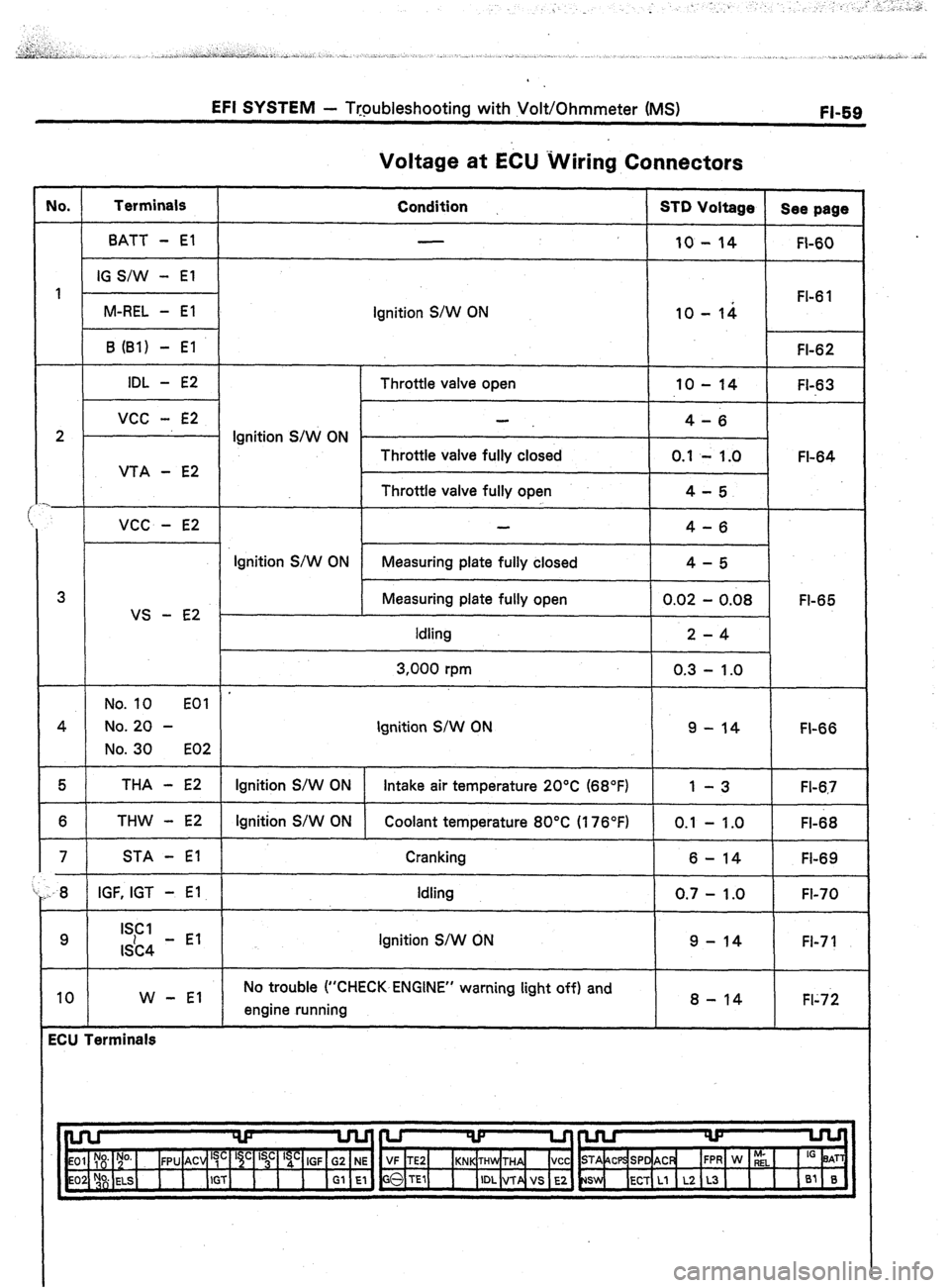
EFI SYSTEM - Ttpbleshooting with Volt/Ohmmeter (MS)
FL59
IO.
I Terminals
BATT - El
IG S/W - El
M-REL - El
2P-
I UTA - E2
3
US - E2
THA - E2
THW - E2
.B / IGF, IGT - El
9 ISCI
lSC4 - El
10
I W - El
ECU Terminals
Voltage at ECU Wiring Connectors
Condition STD Voltage ’
10 - 14
ignition S/W ON
10 - 14
Throttle valve open 10 - 14
4-6
Ignition S/W ON .
Throttle valve fully closed 0.1 - 1.0
Throttle valve fully open
4-5
4-6
Ignition S/W ON Measuring plate fully closed
4-5
Measuring plate fully open
0.02 - 0.08
Idling 2-4
3,000 rpm 0.3 - 1 .o
Ignition S/W ON 9
- 14 FI-66
Ignition S/W ON Intake air temperature 20°C (68°F) 1
-3
Ignition S/W ON
Coolant temperature 80°C (176°F) 0.1 - 1.0
Cranking
6 - 14
Idling 0.7 - 1.0
Ignition S/W ON
9 - 14
No trouble (“CHECK-ENGINE” warning light off) and
engine running 8 - 14 See page
FI-60
FI-6 1
FI-62
FI-63
FI-64
Fl-65
Fl-6.7
FI-68
FI-69
Fl-70
FI-7 1
Fl;72
Page 102 of 346
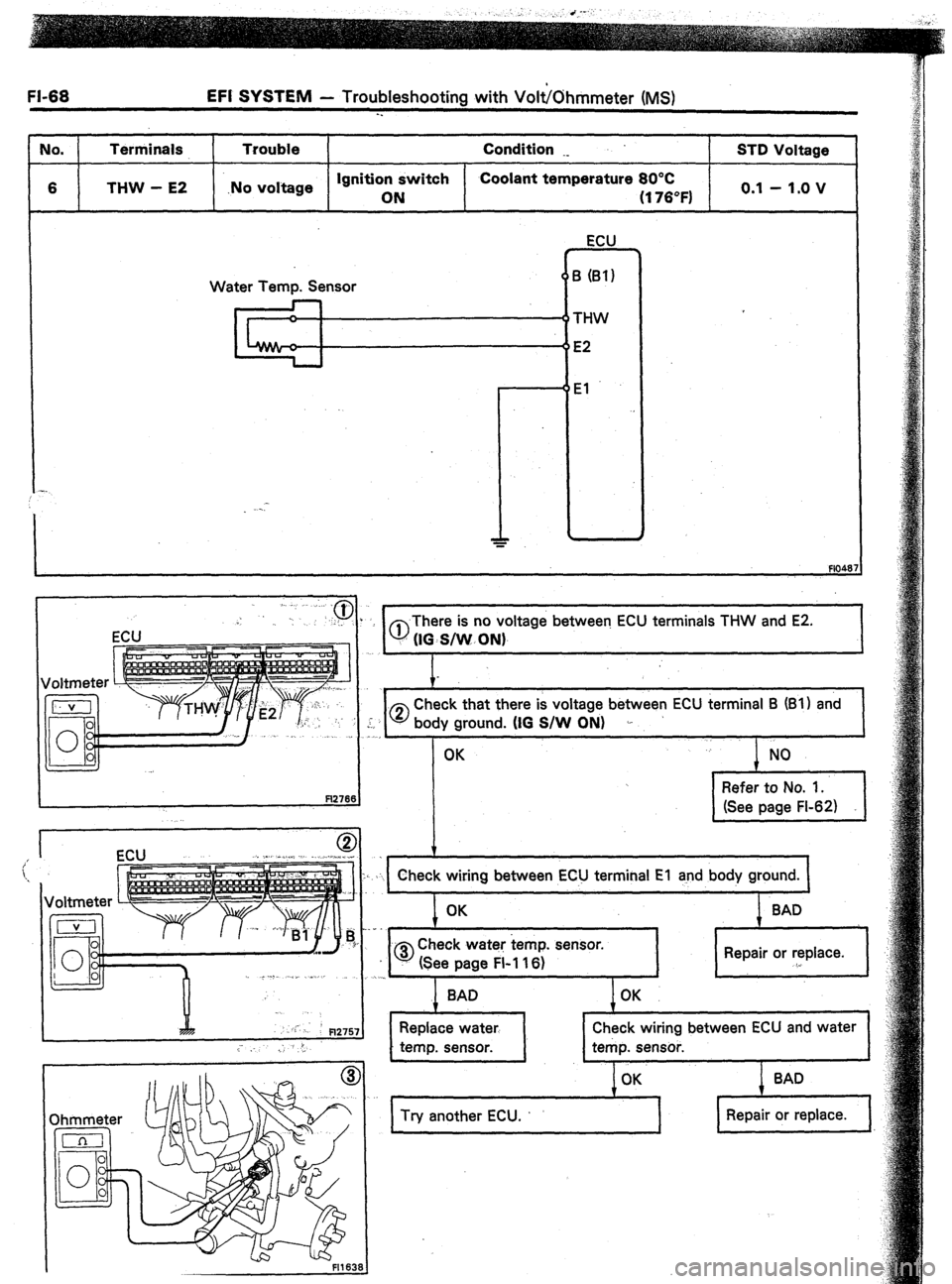
EFI SYSTEM
- Troubleshooting with Voltkhmmeter (MS)
-.
No. 1
Terminals
I Trouble
I Condition ._
I STD Voltage
6 THW - E2 .No voltage Ignition switch Coolant temperature 80°C
ON (, 760F) 0.1 - 1.0 v
Water Temp. Sensor
. ECU
5 031)
THW
E2
:1
ECU I terminals THW and E2.
I
0 There is no voltage between ECU
(IG S/W ON)
I-
:.
0 Check that there is voltage between ECU terminal B (61) and
body ground. (IG S/W ON) -
1
OK NO
I
I 8 1
I
Refer to No. 1.
(See page FL62)
I
I I . -
I
Check wiring between ECU terminal El and body ground.
I BAD
Check water temp. sensor.
Repair or replace.
BAD
Replace water
temp. sensor. OK
Check wiring between ECU and water
I temp. sensor.
OK BAD
Try another ECU. 1 Repair or replace. 1