towing TOYOTA COROLLA 2019 Owners Manual (in English)
[x] Cancel search | Manufacturer: TOYOTA, Model Year: 2019, Model line: COROLLA, Model: TOYOTA COROLLA 2019Pages: 608, PDF Size: 10.15 MB
Page 3 of 608

3
1
9 8 6 5
4
3
2
COROLLA_TMMMS_TMMC_U
10
7
3-1. Key informationKeys .................................. 102
3-2. Opening, closing and locking the doors
Doors................................. 108
Trunk ................................. 117
Smart key system.............. 122
3-3. Adjusting the seats Front seats ........................ 130
Rear seats ......................... 132
Head restraints .................. 134
3-4. Adjusting the steering wheel and mirrors
Steering wheel .................. 137
Inside rear view mirror....... 139
Outside rear view mirrors ............................. 141
3-5. Opening and closing the windows
Power windows ................. 143
Moon roof .......................... 147 4-1. Before driving
Driving the vehicle ............. 152
Cargo and luggage ............ 163
Vehicle load limits .............. 166
Trailer towing ..................... 167
Dinghy towing (vehicles with a continuously
variable transmission) ..... 168
Dinghy towing (vehicles with a manual
transmission) ................... 169
4-2. Driving procedures Engine (ignition) switch (vehicles without a
smart key system) ........... 171
Engine (ignition) switch (vehicles with a
smart key system) ........... 174
Continuously variable transmission (vehicles
without paddle shift
switches) ......................... 181
Continuously variable transmission (vehicles
with paddle shift
switches) ......................... 184
Manual transmission.......... 189
Turn signal lever ................ 191
Parking brake .................... 192
4-3. Operating the lights and wipers
Headlight switch ................ 193
Automatic High Beam ........ 198
Windshield wipers and washer ...................... 202
3Operation of each
component4Driving
Page 16 of 608
16Pictorial index
COROLLA_TMMMS_TMMC_U
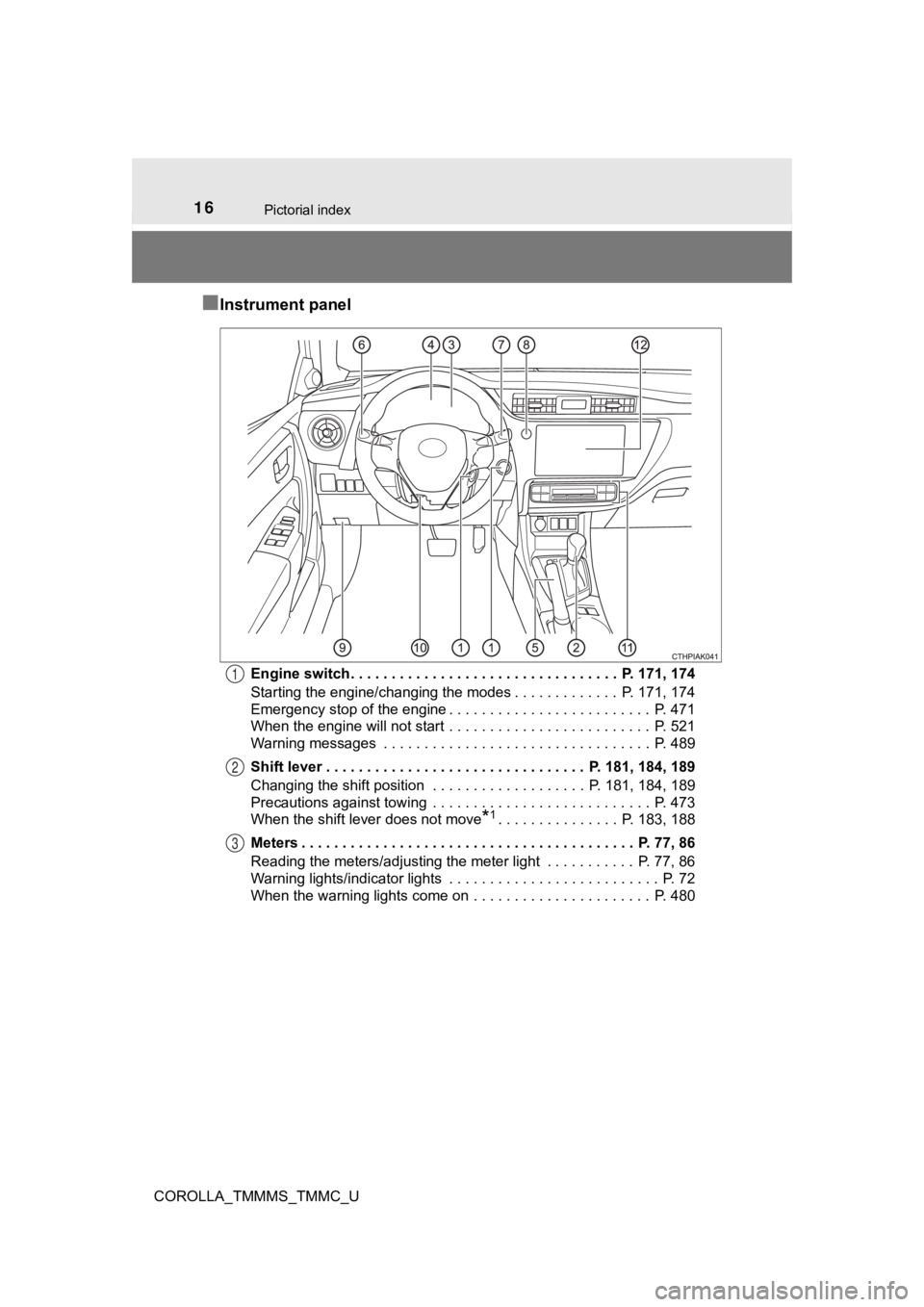
■Instrument panel
Engine switch . . . . . . . . . . . . . . . . . . . . . . . . . . . . . . . . . P. 171, 174
Starting the engine/changing the modes . . . . . . . . . . . . . P. 171, 174
Emergency stop of the engine . . . . . . . . . . . . . . . . . . . . . . . . . P. 471
When the engine will not start . . . . . . . . . . . . . . . . . . . . . . . . . P. 521
Warning messages . . . . . . . . . . . . . . . . . . . . . . . . . . . . . . . . . P. 489
Shift lever . . . . . . . . . . . . . . . . . . . . . . . . . . . . . . . . P. 181, 184, 189
Changing the shift position . . . . . . . . . . . . . . . . . . . P. 181, 184, 189
Precautions against towing . . . . . . . . . . . . . . . . . . . . . . . . . . . P. 473
When the shift lever does not move
*1. . . . . . . . . . . . . . . P. 183, 188
Meters . . . . . . . . . . . . . . . . . . . . . . . . . . . . . . . . . . . . . . . . . P. 77, 86
Reading the meters/adjusting the meter light . . . . . . . . . . . P. 77, 86
Warning lights/indicator lights . . . . . . . . . . . . . . . . . . . . . . . . . . P. 72
When the warning lights come on . . . . . . . . . . . . . . . . . . . . . . P. 480
1
2
3
Page 151 of 608

151
4Driving
COROLLA_TMMMS_TMMC_U4-1. Before driving
Driving the vehicle ............. 152
Cargo and luggage ........... 163
Vehicle load limits ............. 166
Trailer towing..................... 167
Dinghy towing (vehicles with a continuously
variable transmission) ..... 168
Dinghy towing (vehicles with a manual
transmission)................... 169
4-2. Driving procedures Engine (ignition) switch (vehicles without a
smart key system) ........... 171
Engine (ignition) switch (vehicles with a
smart key system) ........... 174
Continuously variable transmission
(vehicles without paddle
shift switches) ................. 181
Continuously variable transmission
(vehicles with paddle
shift switches) ................. 184
Manual transmission ......... 189
Turn signal lever................ 191
Parking brake .................... 192 4-3. Operating the lights
and wipers
Headlight switch ................ 193
Automatic High Beam ....... 198
Windshield wipers and washer ..................... 202
4-4. Refueling Opening the fuel tank cap .......................... 204
4-5. Using the driving support systems
Toyota Safety Sense P ..... 207
PCS (Pre-Collision System) .... 214
LDA (Lane Departure Alert
with steering control) ....... 226
Dynamic radar cruise control ............................. 235
Rear view monitor system ............................ 247
Driving assist systems ...... 257
4-6. Driving tips Winter driving tips ............. 263
Page 163 of 608

1634-1. Before driving
4
Driving
COROLLA_TMMMS_TMMC_U
Cargo capacity depends on the total weight of the occupants.
(Cargo capacity) = (Total load capacity) — (Total weight of occ upants)
Steps for Determining Correct Load Limit —
(1) Locate the statement “The co mbined weight of occupants and
cargo should never exceed XXX kg or XXX lbs.” on your vehicle’s
placard.
(2) Determine the combined weight of the driver and passengers t hat
will be riding in your vehicle.
(3) Subtract the combined weight of the driver and passengers fr om
XXX kg or XXX lbs.
(4) The resulting figure equals the available amount of cargo an d lug-
gage load capacity.
For example, if the “XXX” amount equals 1400 lbs. and there wil l be
five 150 lb passengers in your vehicle, the amount of available
cargo and luggage load capacity is 650 lbs. (1400 750 (5150) =
650 lbs.)
(5) Determine the combined weight of luggage and cargo being loa ded
on the vehicle. That weight may n ot safely exceed the available
cargo and luggage load capac ity calculated in Step 4.
(6) If your vehicle will be towing a trailer, load from your tra iler will be
transferred to your vehicle. Consult this manual to determine h ow
this reduces the available cargo and luggage load capacity of y our
vehicle.
( P. 1 6 6 )
Toyota does not recommend towing a trailer with your vehicle. Y our
vehicle is not desig ned for trailer towing.
Cargo and luggage
Take notice of the following information about storage precau-
tions, cargo capacity and load:
Capacity and distribution
Page 166 of 608

1664-1. Before driving
COROLLA_TMMMS_TMMC_U
◆Total load capacity (vehicle capacity weight): (P. 5 3 8 )
Total load capacity means the co mbined weight of occupants, cargo
and luggage.
◆Seating capacity: 5 occupants (Front 2, Rear 3)
Seating capacity means the max imum number of occupants whose
estimated average weight is 1 50 lb. (68 kg) per person.
◆Towing capacity
Toyota does not recommend towing a trailer with your vehicle.
◆Cargo capacity
Cargo capacity may increase or decrease depending on the weight
and the number of occupants.
■Total load capacity and seating capacity
These details are also described on the tire and loading inform ation label.
( P. 448)
Vehicle load limits
Vehicle load limits include total load capacity, seating capaci ty,
towing capacity and cargo capacity.
WARNING
■Overloading the vehicle
Do not overload the vehicle.
It may not only cause damage to the tires, but also degrade steering
and braking ability, res ulting in an accident.
Page 167 of 608
1674-1. Before driving
4
Driving
COROLLA_TMMMS_TMMC_U
Trailer towing
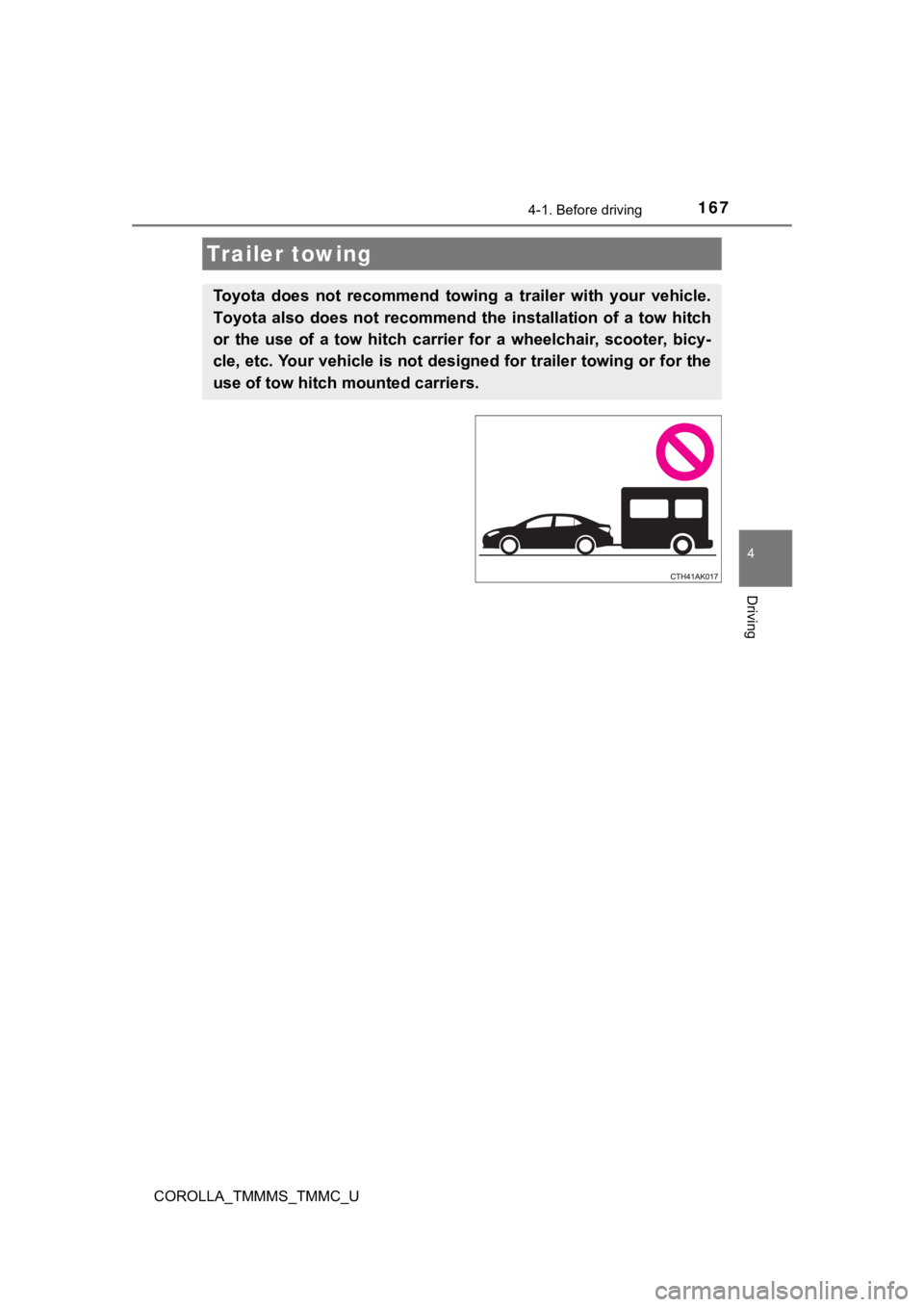
Toyota does not recommend towing a trailer with your vehicle.
Toyota also does not recommend the installation of a tow hitch
or the use of a tow hitch carrier for a wheelchair, scooter, bi cy-
cle, etc. Your vehicle is not des igned for trailer towing or for the
use of tow hitch mounted carriers.
Page 168 of 608

1684-1. Before driving
COROLLA_TMMMS_TMMC_U
Dinghy towing (vehicles with a continu-
ously variable transmission)
Your vehicle is not designed to be dinghy towed (with 4 wheels
on the ground) behind a motor home.
NOTICE
■To avoid serious damage to your vehicle
Do not tow your vehicle with four wheels on the ground.
Page 169 of 608
1694-1. Before driving
4
Driving
COROLLA_TMMMS_TMMC_U
To prevent damage to your vehicle, perform the following procedures
before towing.
Shift the shift lever to N.
Turn the engine switch to the “ACC” position (without a smart k ey
system) or ACCESSORY mode (w ith a smart key system).
( P. 171, 176)
Ensure that the audio system and other powered devices are turn ed off.
Release the parking brake.
After towing, leave the engine in idle for at least 3 minutes before driving
the vehicle.
■ Necessary equipment and accessories
Specialized equipment and accessories are required for dinghy t owing. Con-
tact the service branch of the motor home manufacturer regardin g recom-
mended equipment.
Dinghy towing (vehicles with a manual
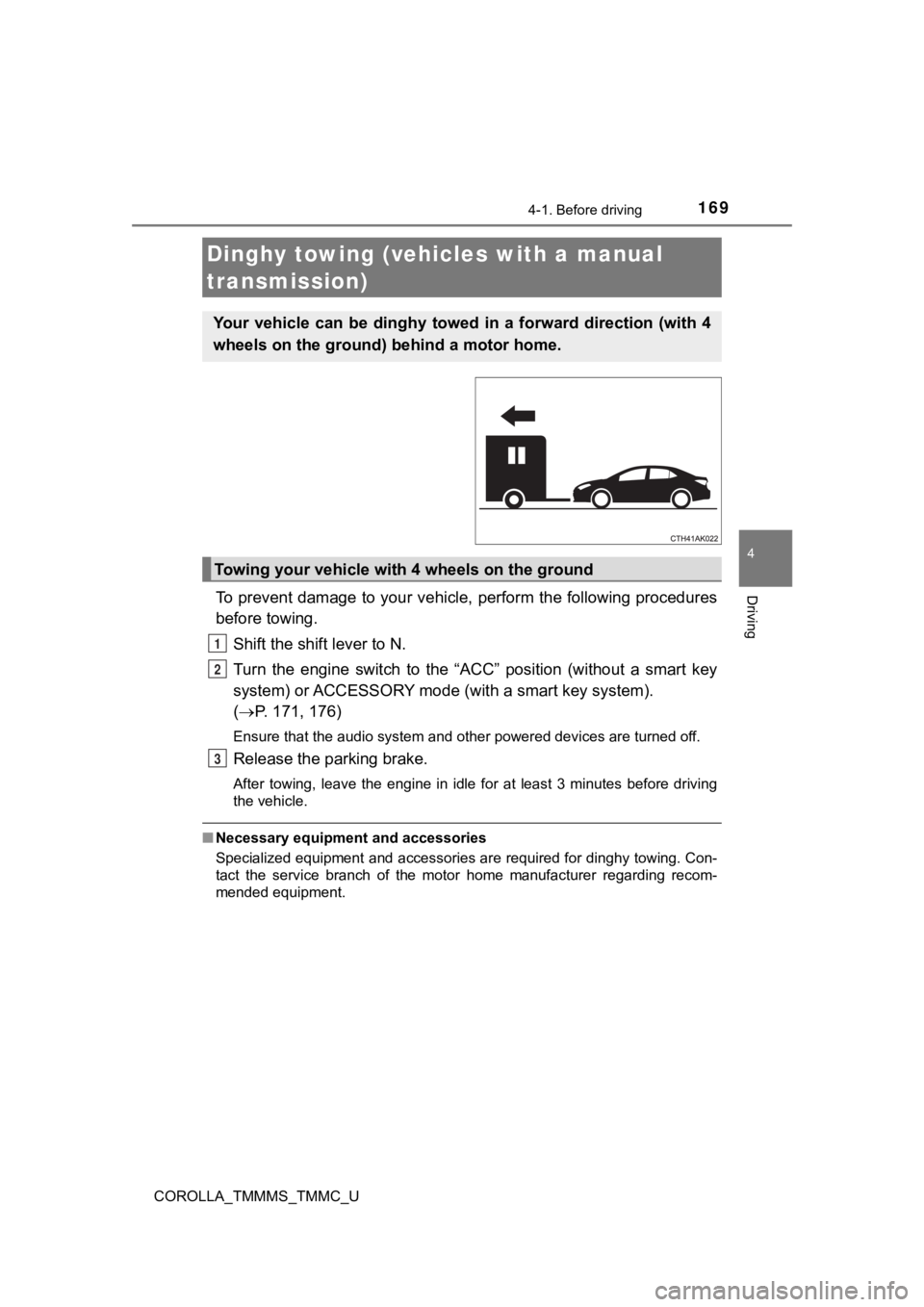
transmission)
Your vehicle can be dinghy towed in a forward direction (with 4
wheels on the ground) b ehind a motor home.
Towing your vehicle with 4 wheels on the ground
1
2
3
Page 170 of 608

1704-1. Before driving
COROLLA_TMMMS_TMMC_U
NOTICE
■Dinghy towing direction
■ To prevent the steer ing from locking
Vehicles without a smart key system: Ensure the engine switch i s in the
“ACC” position.
Vehicles with a smart key system: Ensure the engine switch is in ACCES-
SORY mode.
Do not tow the vehicle backwards.
Doing so may cause serious damage.
Page 216 of 608

2164-5. Using the driving support systems
COROLLA_TMMMS_TMMC_U
WARNING
■When to disable the pre-collision system
In the following situations, disable the system, as it may not operate prop-
erly, possibly leading to an accident resulting in death or ser ious injury:
● When the vehicle is being towed
● When your vehicle is towing another vehicle
● When transporting the vehicle via truck, boat, train or similar means of
transportation
● When the vehicle is raised on a lift with the engine running an d the tires
are allowed to rotate freely
● When inspecting the vehicle using a drum tester such as a chass is dyna-
mometer or speedometer tester, or when using an on vehicle whee l bal-
ancer
● When a strong impact is applied to the front bumper or front gr ille, due to
an accident or other reasons
● If the vehicle cannot be driven in a stable manner, such as when the vehi-
cle has been in an accident or is malfunctioning
● When the vehicle is driven in a sporty manner or off-road
● When the tires are not properly inflated
● When the tires are very worn
● When tires of a size other than specified are installed
● When tire chains are installed
● When a compact spare tire or an emergency tire puncture repair kit is used
● If equipment (snow plow, etc.) that may obstruct the radar sens or or cam-
era sensor is temporarily installed to the vehicle