trailer TOYOTA COROLLA HATCHBACK 2022 (in English) Owner's Manual
[x] Cancel search | Manufacturer: TOYOTA, Model Year: 2022, Model line: COROLLA HATCHBACK, Model: TOYOTA COROLLA HATCHBACK 2022Pages: 758, PDF Size: 155.26 MB
Page 304 of 758
3024-5. Using the driving support systems
vehicle cannot be detected.
*2: The greater the difference in speed between your vehicle and the detected vehi-
cle is, the farther away the vehicle will be detected, causing the outside rear view
mirror indicator to illuminate or flash.
■The Blind Spot Monitor is opera-
tional when
The Blind Spot Monitor is operational
when all of the following conditions are
met:
●The Blind Spot Monitor is on.
●The shift lever is in a position other
than R.
●The vehicle speed is greater than
approximately 16 km/h (10 mph).
■The Blind Spot Monitor will detect a
vehicle when
The Blind Spot Monitor will detect a
vehicle present in the detection area in
the following situations:
●A vehicle in an adjacent lane over-
takes your vehicle.
●You overtake a vehicle in adjacent
lane slowly.
●Another vehicle enters the detection
area when it changes lanes.
■Conditions under which the system will not detect a vehicle
The Blind Spot Monitor is not designed
to detect the following types of vehicles
and/or objects:
●Small motorcycles, bicycles, pedestri-
ans, etc.*
●Vehicles traveling in the opposite
direction
●Guardrails, walls, signs, parked vehi-
cles and similar stationary objects*
●Following vehicles that are in the
same lane*
●Vehicles traveling 2 lanes away from
your vehicle*
●Vehicles which are being overtaken
rapidly by your vehicle*
*: Depending on the conditions, detec-
tion of a vehicle and/or object may
occur.
■Conditions under which the system may not function correctly
●The Blind Spot Monitor may not detect vehicles correctly in the following situ-
ations:
• When the sensor is misaligned due to a strong impact to the sensor or its
surrounding area
• When mud, snow, ice, a sticker, etc. is covering the sensor or surrounding
area on the rear bumper
• When driving on a road surface that is wet with standing water during bad
weather, such as heavy rain, snow, or
fog • When multiple vehicles are approach-
ing with only a small gap between
each vehicle • When the distance between your vehi-
cle and a following vehicle is short
• When there is a significant difference in speed between your vehicle and
the vehicle that enters the detection
area • When the difference in speed
between your vehicle and another
vehicle is changing • When a vehicle enters a detection
area traveling at about the same
speed as your vehicle • As your vehicle starts from a stop, a
vehicle remains in the detection area
• When driving up and down consecu-
tive steep inclines, such as hills, dips in the road, etc.
• When driving on roads with sharp
bends, consecutive curves, or uneven surfaces
• When vehicle lanes are wide, or when
driving on the edge of a lane, and the vehicle in an adjacent lane is far away
from your vehicle
• When towing a trailer
Page 317 of 758
315
4
4-5. Using the driving support systems
Driving
■Conditions under which the system
will not detect a vehicle
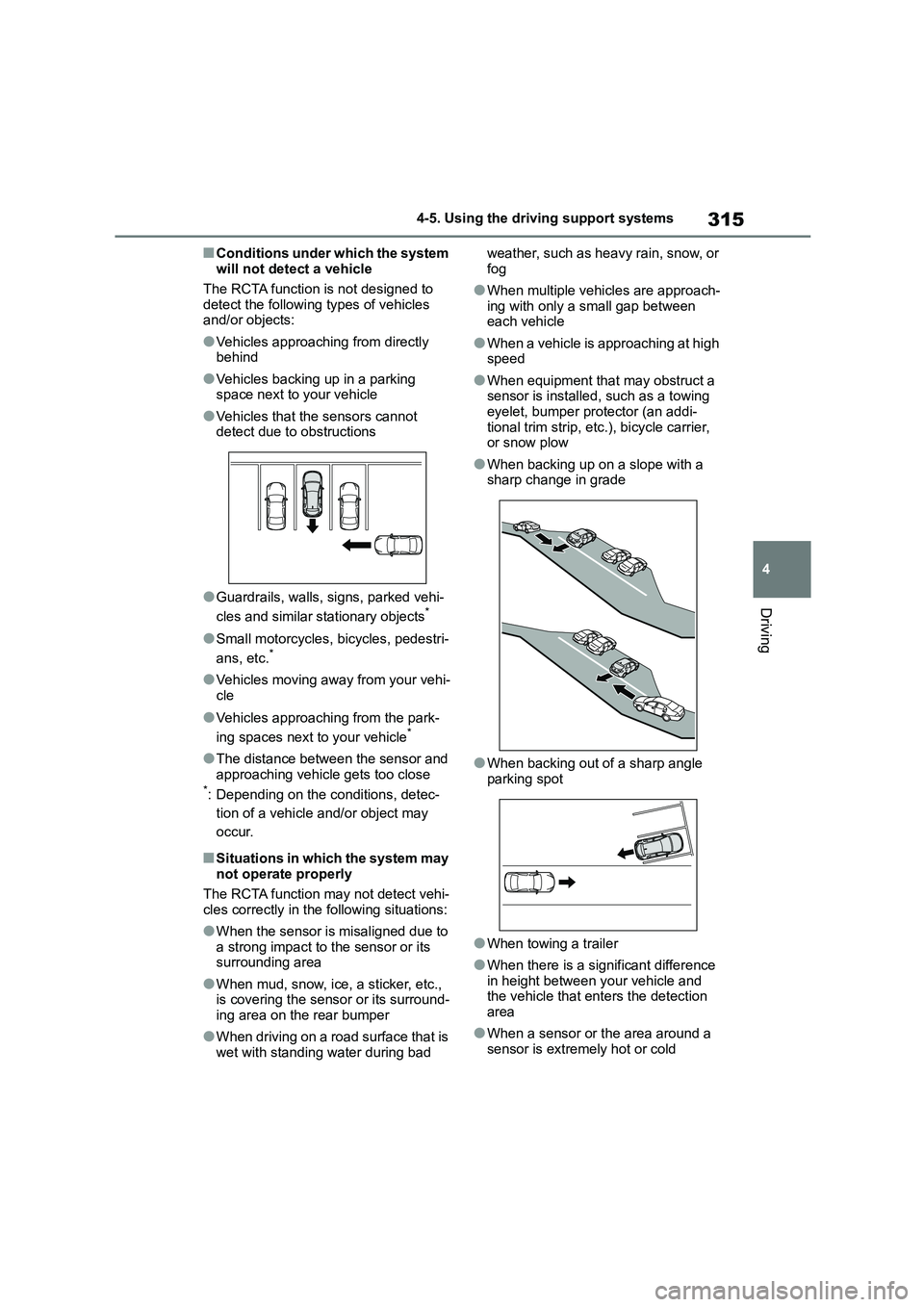
The RCTA function is not designed to
detect the following types of vehicles
and/or objects:
●Vehicles approaching from directly
behind
●Vehicles backing up in a parking
space next to your vehicle
●Vehicles that the sensors cannot
detect due to obstructions
●Guardrails, walls, signs, parked vehi-
cles and similar stationary objects*
●Small motorcycles, bicycles, pedestri-
ans, etc.*
●Vehicles moving away from your vehi- cle
●Vehicles approaching from the park-
ing spaces next to your vehicle*
●The distance between the sensor and
approaching vehicle gets too close*: Depending on the conditions, detec-
tion of a vehicle and/or object may
occur.
■Situations in which the system may not operate properly
The RCTA function may not detect vehi-
cles correctly in the following situations:
●When the sensor is misaligned due to
a strong impact to the sensor or its surrounding area
●When mud, snow, ice, a sticker, etc.,
is covering the sensor or its surround- ing area on the rear bumper
●When driving on a road surface that is wet with standing water during bad
weather, such as heavy rain, snow, or
fog
●When multiple vehicles are approach-
ing with only a small gap between each vehicle
●When a vehicle is approaching at high speed
●When equipment that may obstruct a sensor is installed, such as a towing
eyelet, bumper protector (an addi-
tional trim strip, etc.), bicycle carrier, or snow plow
●When backing up on a slope with a sharp change in grade
●When backing out of a sharp angle
parking spot
●When towing a trailer
●When there is a significant difference in height between your vehicle and
the vehicle that enters the detection
area
●When a sensor or the area around a
sensor is extremely hot or cold
Page 359 of 758
357
4
4-5. Using the driving support systems
Driving
■ABS (Anti-lock Brake System)
Helps to prevent wheel lock when
the brakes are applied suddenly, or
if the brakes are applied while driv-
ing on a slippery road surface
■Brake assist
Generates an increased level of
braking force after the brake pedal
is depressed when the system
detects a panic stop situation
■VSC (Vehicle St ability Control)
Helps the driver to control skidding
when swerving suddenly or turning
on slippery road surfaces.
■VSC+ (Vehicle Stability Con-
trol+)
Provides cooperative control of the
ABS, TRC, VSC and EPS.
Helps to maintain directional stabil-
ity when swerving on slippery road
surfaces by controlling steering per-
formance.
■Trailer Sway Control
Helps the driver to control trailer
sway by selectively applying brake
pressure for individual wheels and
reducing driving torque when trailer
sway is detected.
■TRC (Traction Control)
Helps to maintain drive power and
prevent the drive wheels from spin-
ning when starting the vehicle or
accelerating on slippery roads
■Active Cornering Assist (ACA)
Helps to prevent the vehicle from
drifting to the outer side by perform-
ing inner wheel brake control when
attempting to acce lerate while turn-
ing
■Hill-start assist control
Helps to reduce the backward
movement of the vehicle when
starting on an uphill
■EPS (Electric Po wer Steering)
Employs an electric motor to
reduce the amount of effort needed
to turn the steering wheel.
■Emergency brake signal
When the brakes are applied sud-
denly, the emergency flashers auto-
matically flash to alert the vehicle
behind.
■Secondary Collision Brake (if
equipped)
When the SRS airbag sensor
detects a collisi on and the system
operates, the brakes and brake
lights are automatically controlled
Driving assist systems
To keep driving safety and per-
formance, the following sys-
tems operate au tomatically in
response to various driving sit-
uations. Be aware, however,
that these systems are supple-
mentary and should not be
relied upon too heavily when
operating the vehicle.
Summary of the driving
assist systems
Page 360 of 758
3584-5. Using the driving support systems
to reduce the vehicle speed and
help reduce the poss ibility of further
damage due to a secondary colli-
sion.
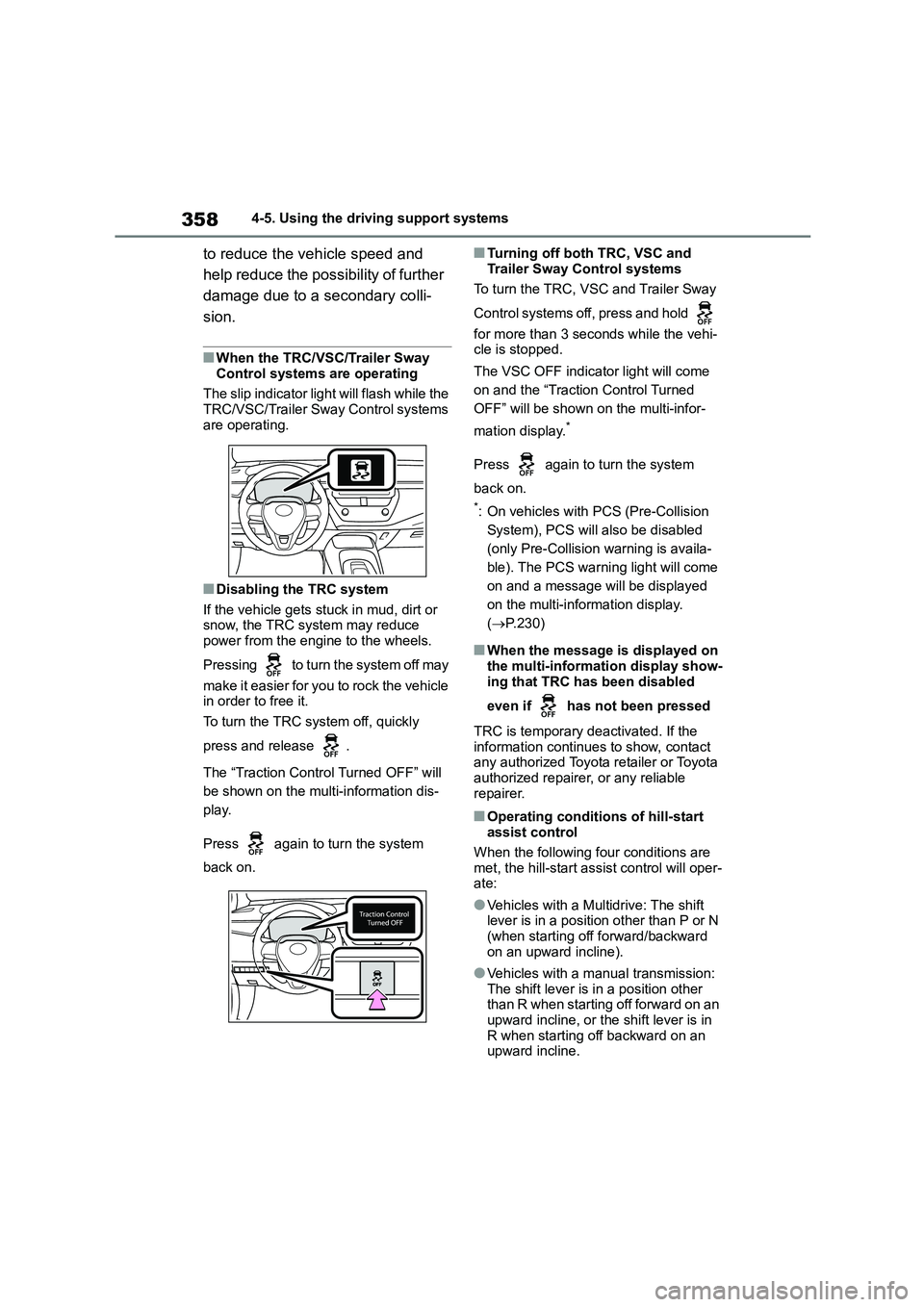
■When the TRC/VSC/Trailer Sway
Control systems are operating
The slip indicator light will flash while the
TRC/VSC/Trailer Sway Control systems
are operating.
■Disabling the TRC system
If the vehicle gets stuck in mud, dirt or snow, the TRC system may reduce
power from the engine to the wheels.
Pressing to turn the system off may
make it easier for you to rock the vehicle
in order to free it.
To turn the TRC system off, quickly
press and release .
The “Traction Control Turned OFF” will
be shown on the multi-information dis-
play.
Press again to turn the system
back on.
■Turning off both TRC, VSC and
Trailer Sway Control systems
To turn the TRC, VSC and Trailer Sway
Control systems off, press and hold
for more than 3 seconds while the vehi- cle is stopped.
The VSC OFF indicator light will come
on and the “Traction Control Turned
OFF” will be shown on the multi-infor-
mation display.*
Press again to turn the system
back on.
*: On vehicles with PCS (Pre-Collision
System), PCS will also be disabled
(only Pre-Collision warning is availa-
ble). The PCS warning light will come
on and a message will be displayed
on the multi-information display.
( P.230)
■When the message is displayed on
the multi-information display show- ing that TRC has been disabled
even if has not been pressed
TRC is temporary deactivated. If the information continues to show, contact
any authorized Toyota retailer or Toyota
authorized repairer, or any reliable repairer.
■Operating conditions of hill-start
assist control
When the following four conditions are met, the hill-start assist control will oper-
ate:
●Vehicles with a Multidrive: The shift
lever is in a position other than P or N
(when starting off forward/backward
on an upward incline).
●Vehicles with a manual transmission:
The shift lever is in a position other than R when starting off forward on an
upward incline, or the shift lever is in
R when starting off backward on an upward incline.
Page 361 of 758
359
4
4-5. Using the driving support systems
Driving
●The vehicle is stopped
●The accelerator pedal is not
depressed
●The parking brake is not engaged
■Automatic system cancelation of
hill-start assist control
The hill-start assist control will turn off in any of the following situations:
●Vehicles with a Multidrive: The shift lever is shifted to P or N.
●Vehicles with a manual transmission: The shift lever is shifted to R when
starting off forward on an upward
incline, or the shift lever is shifted to other than R when starting off back-
ward on an upward incline.
●The accelerator pedal is depressed
●The parking brake is engaged
●2 seconds at maximum elapsed after
the brake pedal is released
■Sounds and vibrations caused by the ABS, brake assist, VSC, Trailer
Sway Control, TRC and hill-start
assist control systems
●A sound may be heard from the
engine compartment when the brake pedal is depressed repeatedly, when
the engine is started or just after the
vehicle begins to move. This sound does not indicate that a malfunction
has occurred in any of these systems.
●Any of the following conditions may
occur when the above systems are
operating. None of these indicates that a malfunction has occurred.
• Vibrations may be felt through the
vehicle body and steering. • A motor sound may be heard also
after the vehicle comes to a stop.
• The brake pedal may pulsate slightly
after the ABS is activated. • The brake pedal may move down
slightly after the ABS is activated.
■Active Cornering Assist operation
sounds and vibrations
When the Active Cornering Assist is
operated, operation sounds and vibra-
tions may be generated from the brake
system, but this is not a malfunction.
■EPS operation sound
When the steering wheel is operated, a
motor sound (whirring sound) may be
heard. This does not indicate a malfunc- tion.
■Automatic reactivation of TRC,
Trailer Sway Control and VSC sys-
tems
After turning the TRC, Trailer Sway Con-
trol and VSC systems off, the systems
will be automatically re-enabled in the following situations:
●When the engine switch is turned off
●If only the TRC system is turned off,
the TRC will turn on when vehicle speed increases.
If both the TRC and VSC systems are
turned off, automatic re-enabling will not occur when vehicle speed
increases.
■Operating conditions of Active Cor-
nering Assist
The system operates when the following
occurs.
●TRC/VSC can operate
●The driver is attempting to accelerate while turning
●The system detects that the vehicle is drifting to the outer side
●The brake pedal is released
■Reduced effectiv eness of the EPS system
The effectiveness of the EPS system is
reduced to prevent the system from overheating when there is frequent
steering input over an extended period
of time. The steering wheel may feel
heavy as a result. Should this occur, refrain from excessive steering input or
stop the vehicle and turn the engine off.
The EPS system should return to nor- mal within 10 minutes.
Page 363 of 758
361
4
4-5. Using the driving support systems
Driving
WA R N I N G
●When Active Cornering Assist fre-
quently operates, Active Cornering
Assist may temporarily stop operat- ing to ensure proper operation of
the brakes, TRC and VSC.
■Hill-start assist control does not
operate effectively when
●Do not overly rely on hill-start assist
control. Hill-start assist control may not operate effectively on steep
inclines and roads covered with ice.
●Unlike the parking brake, hill-start
assist control is not intended to hold
the vehicle stationary for an extended period of time. Do not
attempt to use hill-start assist con-
trol to hold the vehicle on an incline, as doing so may lead to an acci-
dent.
■When the TRC/VSC/Trailer Sway
Control is activated
The slip indicator light flashes. Always drive carefully. Reckless driving may
cause an accident. Exercise particular
care when the indicator light flashes.
■When the TRC/VSC/Trailer Sway
Control systems are turned off
Be especially careful and drive at a
speed appropriate to the road condi-
tions. As these are the systems to help ensure vehicle stability and driv-
ing force, do not turn the
TRC/VSC/Trailer Sway Control sys- tems off unless necessary.
Trailer Sway Control is part of the
VSC system and will not operate if VSC is turned off or experiences a
malfunction.
■Replacing tires
Make sure that all tires are of the
specified size, brand, tread pattern
and total load capacity. In addition, make sure that the tires are inflated to
the recommended tire inflation pres-
sure level. The ABS, TRC Trailer Sway Control
and VSC systems w ill not function
correctly if different tires are installed on the vehicle.
Contact any authorized Toyota retailer
or Toyota authorized repairer, or any reliable repairer for further information
when replacing tires or wheels.
■Handling of tires and the suspen-
sion
Using tires with any kind of problem or modifying the suspension will affect
the driving assist systems, and may
cause a system to malfunction.
■Trailer Sway Control precaution
The Trailer Sway Control system is not able to reduce trailer sway in all
situations. Depending on many fac-
tors such as the conditions of the vehicle, trailer, road surface and driv-
ing environment, the Trailer Sway
Control system may not be effective. Refer to your trailer owner's manual
for information on how to tow your
trailer properly.
■If trailer sway occurs
Observe the following precautions. Failing to do so may cause death or
serious injury.
●Firmly grip the steering wheel.
Steer straight ahead. Do not try to
control trailer sway by turning the
steering wheel.
●Begin releasing the accelerator
pedal immediately but very gradu- ally to reduce speed.
Do not increase speed. Do not
apply vehicle brakes.
Page 364 of 758
3624-5. Using the driving support systems
WA R N I N G
If you make no extreme correction
with the steering or brakes, your vehi-
cle and trailer should stabilize. ( P.170)
■Secondary Collision Brake (if equipped)
Do not rely solely upon the Secondary
Collision Brake. This system is
designed to help reduce the possibil- ity of further damage due to a second-
ary collision, however, that effect
changes according to various condi- tions. Overly relying on the system
may result in death or serious injury.
Page 553 of 758
551
8
8-2. Steps to take in an emergency
When trouble arises
WA R N I N G
■When using the full-size spare
tire
●Replace the full-size spare tire with a standard tire as soon as possible.
●Avoid sudden acceleration, abrupt steering, sudden braking and shift-
ing operations that cause sudden
engine braking.
■When using the compact spare
tire
●Remember that the compact spare tire provided is specifically
designed for use with your vehicle.
Do not use your compact spare tire on another vehicle.
●Do not use more than one compact spare tires simultaneously.
●Replace the compact spare tire with a standard tire as soon as possible.
●Avoid sudden acceleration, abrupt steering, sudden braking and shift-
ing operations that cause sudden
engine braking.
■When the compact spare tire is
attached
The vehicle speed may not be cor-
rectly detected, an d the following sys-
tems may not operate correctly:
• ABS & Brake assist
• VSC
•TRC
• Automatic High Beam (if equipped)
• AHS (Adaptive High-beam Sys-
tem) (if equipped)
• Cruise control (if equipped)
• Dynamic radar cruise control with full-speed range (if equipped)
• Dynamic radar cruise control (if equipped)
• EPS
• Trailer Sway Control (if equipped)
• PCS (Pre-Collision System) (if
equipped)
• LTA (Lane Tracing Assist) (if
equipped)
• LDA (Lane Departure Alert with
steering control) (if equipped)
• Tire pressure warning system (if
equipped)
• Toyota parking assist-sensor (if
equipped)
• PKSB (Parking Support Brake) (if
equipped)
• BSM (Blind Spot Monitor) (if
equipped)
• Rear view monitor system (if
equipped)
• S-IPA (Simple Intelligent Parking
Assist System) (if equipped)
• Navigation system (if equipped)
■Speed limit when using the com- pact spare tire
Do not drive at speeds in excess of 80
km/h (50 mph) when a compact spare tire is installed on the vehicle.
The compact spare tire is not designed for driving at high speeds.
Failure to observe this precaution
may lead to an accident causing death or serious injury.
■After using the tools and jack
Before driving, make sure all the tools and jack are securely in place in their
storage location to reduce the possi-
bility of personal injury during a colli- sion or sudden braking.
Page 576 of 758
5749-1. Specifications
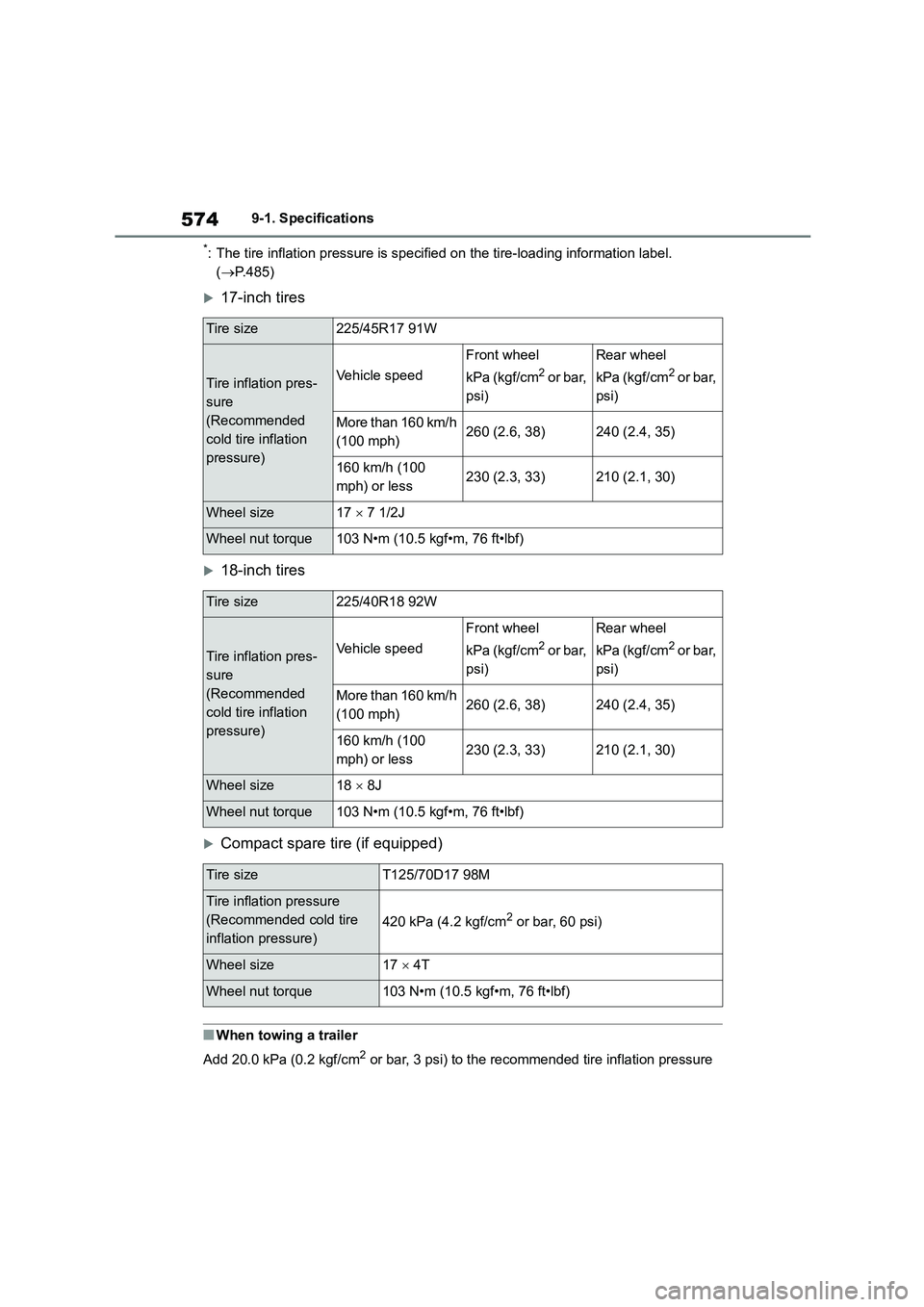
*: The tire inflation pressure is specified on the tire-loading information label.
( P.485)
17-inch tires
18-inch tires
Compact spare tire (if equipped)
■When towing a trailer
Add 20.0 kPa (0.2 kgf/cm2 or bar, 3 psi) to the recommended tire inflation pressure
Tire size225/45R17 91W
Tire inflation pres-
sure
(Recommended
cold tire inflation
pressure)
Vehicle speed
Front wheel
kPa (kgf/cm2 or bar,
psi)
Rear wheel
kPa (kgf/cm2 or bar,
psi)
More than 160 km/h
(100 mph)260 (2.6, 38)240 (2.4, 35)
160 km/h (100
mph) or less230 (2.3, 33)210 (2.1, 30)
Wheel size17 7 1/2J
Wheel nut torque103 N•m (10.5 kgf•m, 76 ft•lbf)
Tire size225/40R18 92W
Tire inflation pres-
sure
(Recommended
cold tire inflation
pressure)
Vehicle speed
Front wheel
kPa (kgf/cm2 or bar,
psi)
Rear wheel
kPa (kgf/cm2 or bar,
psi)
More than 160 km/h
(100 mph)260 (2.6, 38)240 (2.4, 35)
160 km/h (100
mph) or less230 (2.3, 33)210 (2.1, 30)
Wheel size18 8J
Wheel nut torque103 N•m (10.5 kgf•m, 76 ft•lbf)
Tire sizeT125/70D17 98M
Tire inflation pressure
(Recommended cold tire
inflation pressure)
420 kPa (4.2 kgf/cm2 or bar, 60 psi)
Wheel size17 4T
Wheel nut torque103 N•m (10.5 kgf•m, 76 ft•lbf)
Page 604 of 758
602Alphabetical Index
Electronic roof sunshade switches
................................................. 154
Emergency flashers switch ........ 502
Engine switch ..................... 177, 178
Heated steering wheel switch .... 434
Ignition switch .................... 177, 178
Light switches ............................ 195
LTA (Lane-Tracing Assist) switch236
Meter control switches ............... 100
Outside rear view mirror switches
................................................. 148
Panoramic moon roof switches .. 154
Parking brake switch .................. 189
PKSB (Parking Support Brake)
switch....................................... 318
Power door lock switch .............. 122
Power window switches ............. 151
RCTA switch............................... 312
Rear window and outside rear view
mirror defoggers switch ........... 427
Seat heater switches.................. 434
“SOS” button ................................ 69
Speed limitter switch .................. 273
Stop & Start cancel switch ......... 287
Talk switch.................................. 396
Telephone switch ....................... 396
Toyota parking assist-sensor switch
................................................. 304
Vehicle-to-vehicle distance switch
......................................... 249, 261
VSC OFF switch ........................ 358
Window lock switch .................... 153
Windshield wiper and washer switch
................................................. 206
T
Tachometer ............................... 89, 93
Tail lights
Light switch ................................ 195
Replacing light bulbs .................. 497
Talk switch .................................... 396
Telephone switch.......................... 396
Theft deterrent system
Alarm............................................ 81
Double locking system ................. 80
Engine immobilizer system .......... 79
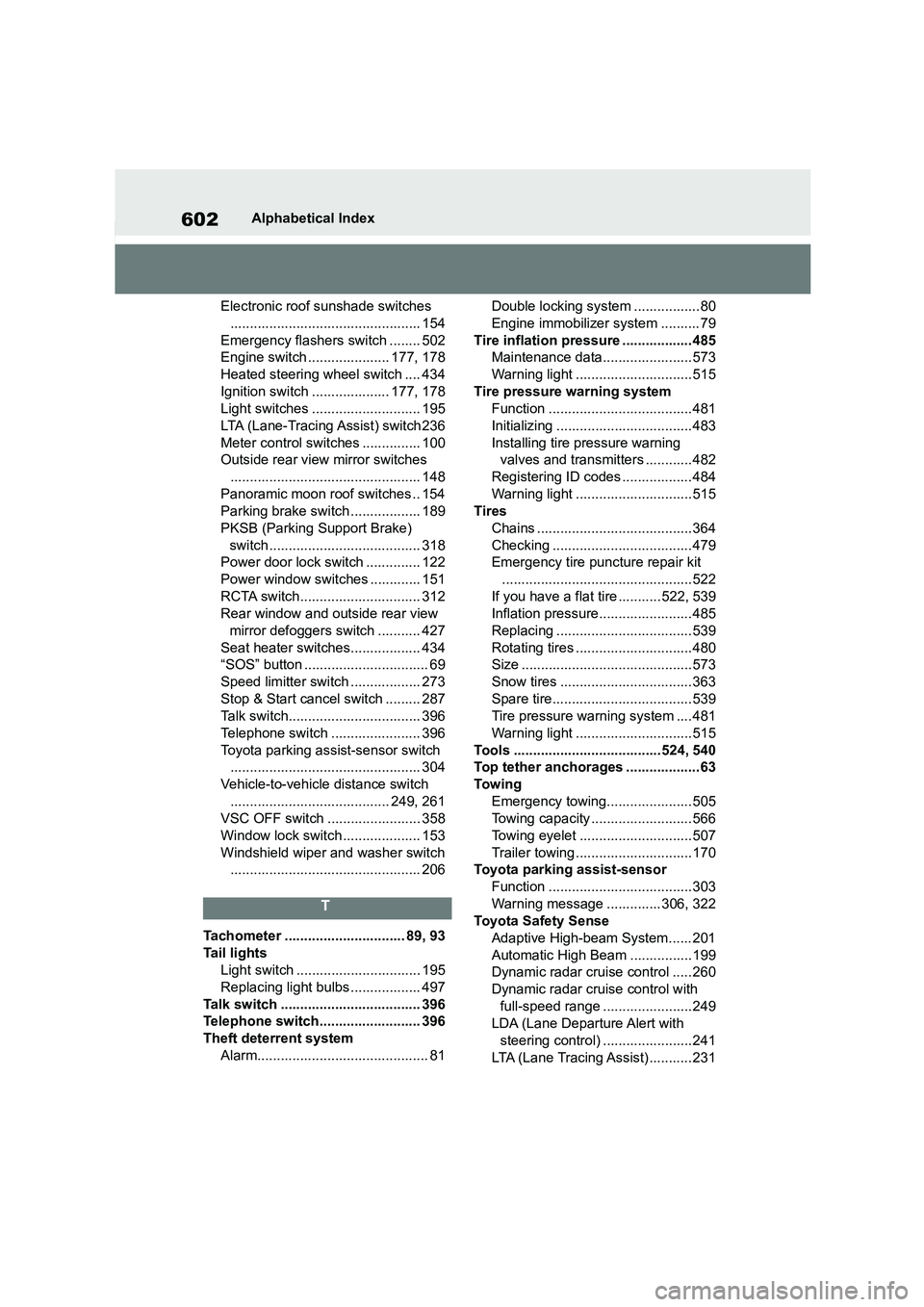
Tire inflation pressure ..................485
Maintenance data....................... 573
Warning light ..............................515
Tire pressure warning system
Function .....................................481
Initializing ...................................483
Installing tire pressure warning
valves and transmitters ............482
Registering ID codes .................. 484
Warning light ..............................515
Tires
Chains ........................................364
Checking .................................... 479
Emergency tire puncture repair kit
.................................................522
If you have a flat tire ........... 522, 539
Inflation pressure........................485
Replacing ...................................539
Rotating tires ..............................480
Size ............................................573
Snow tires .................................. 363
Spare tire.................................... 539
Tire pressure warning system .... 481
Warning light ..............................515
Tools ......................................524, 540
Top tether anchorages ................... 63
To w i n g
Emergency towing...................... 505
Towing capacity ..........................566
Towing eyelet .............................507
Trailer towing ..............................170
Toyota parking assist-sensor
Function .....................................303
Warning message .............. 306, 322
Toyota Safety Sense
Adaptive High-beam System...... 201
Automatic High Beam ................199
Dynamic radar cruise control ..... 260
Dynamic radar cruise control with
full-speed range .......................249
LDA (Lane Departure Alert with
steering control) .......................241
LTA (Lane Tracing Assist) ........... 231