automatic transmission TOYOTA COROLLA HATCHBACK 2022 Owners Manual (in English)
[x] Cancel search | Manufacturer: TOYOTA, Model Year: 2022, Model line: COROLLA HATCHBACK, Model: TOYOTA COROLLA HATCHBACK 2022Pages: 758, PDF Size: 155.26 MB
Page 5 of 758
3TABLE OF CONTENTS
1
6
5
4
3
2
9
8
7
Engine (ignition) switch (vehicles
with a smart entry & start sys-
tem) .................................. 178
Multidrive ............................ 182
Manual transmission ........... 186
Turn signal lever ................. 189
Parking brake...................... 189
Brake Hold .......................... 192
4-3. Operating the lights and wip-
ers
Headlight switch.................. 195
Automatic High Beam ......... 199
AHS (Adaptive High-beam Sys-
tem) .................................. 201
Fog light switch ................... 205
Windshield wipers and washer
.......................................... 206
Rear window wiper and washer
.......................................... 209
4-4. Refueling
Opening the fuel tank cap ... 211
4-5. Using the driving support sys-
tems
Toyota Safety Sense ........... 213
PCS (Pre-Collision System)
.......................................... 224
LTA (Lane Tracing Assist) ... 231
LDA (Lane Departure Alert with
steering control) ................ 241
Dynamic radar cruise control
with full-speed range ........ 249
Dynamic radar cruise control
.......................................... 260
Cruise control...................... 271
Speed limiter ....................... 273
RSA (Road Sign Assist) ...... 276
Stop & Start system ............ 280
BSM (Blind Spot Monitor) ... 288
Toyota parking assist-sensor
.......................................... 303
RCTA (Rear Crossing Traffic
Alert) function ................... 312
PKSB (Parking Support Brake)
.......................................... 317
Parking Support Brake function
(static objects) .................. 324
Parking Support Brake function
(rear-crossing vehicles) .... 327
S-IPA (Simple Intelligent Parking
Assist System) .................. 329
Driving mode select switch
.......................................... 355
Exhaust Gas Filter system .. 356
Driving assist systems ........ 357
4-6. Driving tips
Winter driving tips ............... 363
5-1. Basic Operations
Audio system types............. 368
Using the steering wheel audio
switches ............................ 369
USB port ............................. 370
5-2. Using the audio system
Optimal use of the audio system
..........................................371
5-3. Using the radio
Radio operation .................. 373
5-4. Playing an audio CD and
MP3/WMA discs
CD player operation ............ 375
5-5. Using an external device
Listening to an iPod ............ 381
Listening to USB memory device
.......................................... 386
5Audio system
Page 132 of 758
1303-2. Opening, closing and locking the doors
with instep (toe up) to activate 2
sensors.
• Vehicles with a genuine Toyota
towing hitch vertical detachable:
Refer to Installation Instructions.
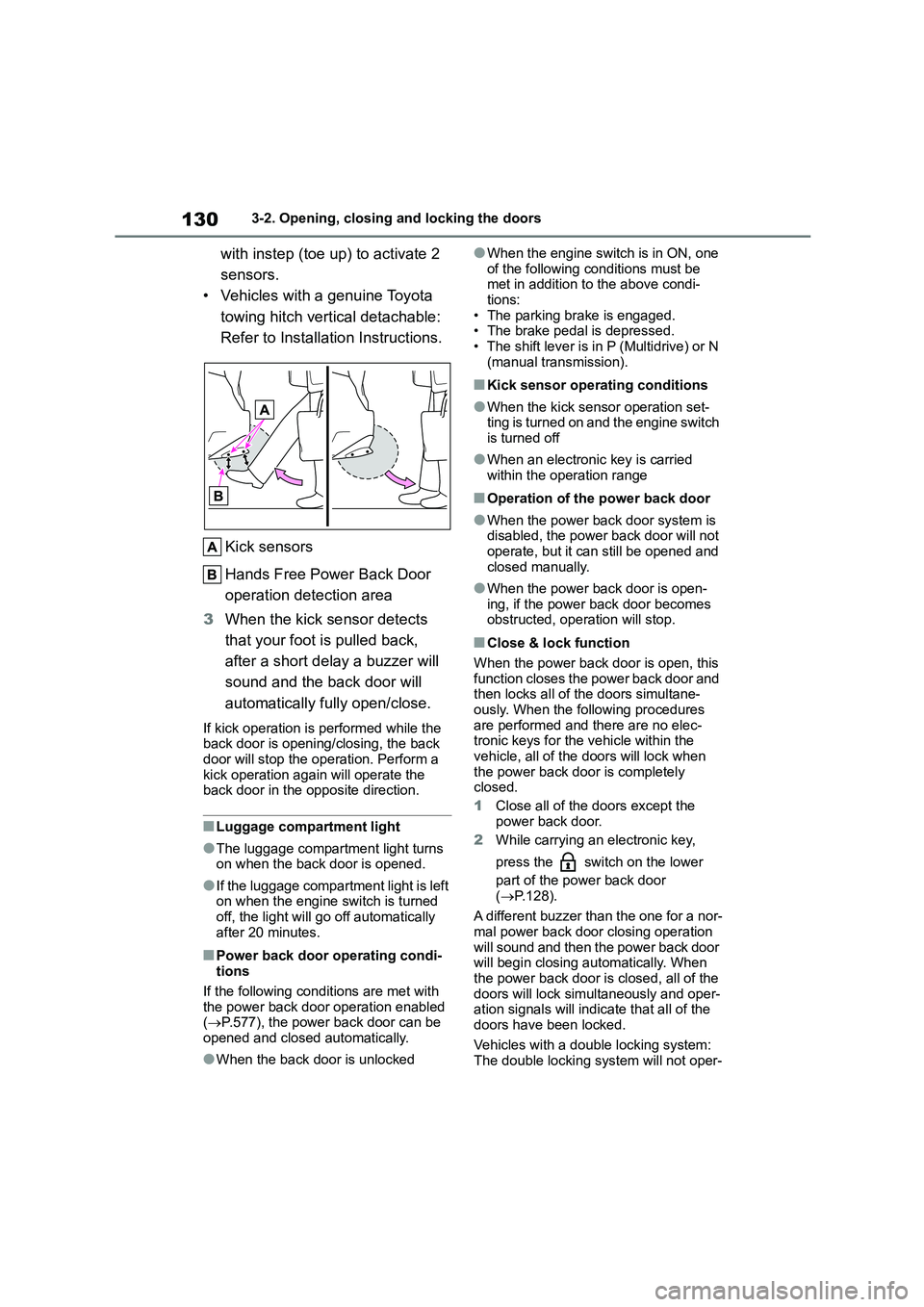
Kick sensors
Hands Free Power Back Door
operation detection area
3 When the kick sensor detects
that your foot is pulled back,
after a short delay a buzzer will
sound and the back door will
automatically fully open/close.
If kick operation is performed while the
back door is opening/closing, the back door will stop the operation. Perform a
kick operation again will operate the
back door in the opposite direction.
■Luggage compartment light
●The luggage compartment light turns
on when the back door is opened.
●If the luggage compartment light is left
on when the engine switch is turned off, the light will go off automatically
after 20 minutes.
■Power back door operating condi-
tions
If the following conditions are met with
the power back door operation enabled
( P.577), the power back door can be opened and closed automatically.
●When the back door is unlocked
●When the engine switch is in ON, one
of the following conditions must be met in addition to the above condi-
tions:
• The parking brake is engaged. • The brake pedal is depressed.
• The shift lever is in P (Multidrive) or N
(manual transmission).
■Kick sensor operating conditions
●When the kick sensor operation set-
ting is turned on and the engine switch is turned off
●When an electronic key is carried within the operation range
■Operation of the power back door
●When the power back door system is disabled, the power back door will not
operate, but it can still be opened and
closed manually.
●When the power back door is open-
ing, if the power back door becomes obstructed, operation will stop.
■Close & lock function
When the power back door is open, this
function closes the power back door and then locks all of the doors simultane-
ously. When the following procedures
are performed and there are no elec- tronic keys for the vehicle within the
vehicle, all of the doors will lock when
the power back door is completely closed.
1 Close all of the doors except the
power back door.
2 While carrying an electronic key,
press the switch on the lower
part of the power back door
( P.128).
A different buzzer than the one for a nor-
mal power back door closing operation will sound and then the power back door
will begin closing automatically. When
the power back door is closed, all of the doors will lock simultaneously and oper-
ation signals will indicate that all of the
doors have been locked.
Vehicles with a double locking system:
The double locking syst em will not oper-
Page 161 of 758
4
159
4
Driving
Driving
.4-1. Before driving
Driving the vehicle ............ 161
Cargo and luggage ........... 168
Trailer towing .................... 170
4-2. Driving procedures
Engine (ignition) switch (vehi-
cles without a smart entry &
start system) ................... 177
Engine (ignition) switch (vehi-
cles with a smart entry & start
system) ........................... 178
Multidrive .......................... 182
Manual transmission ......... 186
Turn signal lever ............... 189
Parking brake ................... 189
Brake Hold ........................ 192
4-3. Operating the lights and wip-
ers
Headlight switch ............... 195
Automatic High Beam ....... 199
AHS (Adaptive High-beam
System) .......................... 201
Fog light switch ................. 205
Windshield wipers and washer
....................................... 206
Rear window wiper and washer
....................................... 209
4-4. Refueling
Opening the fuel tank cap
....................................... 211
4-5. Using the driving support
systems
Toyota Safety Sense......... 213
PCS (Pre-Collision System)
........................................ 224
LTA (Lane Tracing Assist)
........................................ 231
LDA (Lane Departure Alert with
steering control) .............. 241
Dynamic radar cruise control
with full-speed range ...... 249
Dynamic radar cruise control
........................................ 260
Cruise control.................... 271
Speed limiter ..................... 273
RSA (Road Sign Assist) .... 276
Stop & Start system .......... 280
BSM (Blind Spot Monitor)
........................................ 288
Toyota parking assist-sensor
........................................ 303
RCTA (Rear Crossing Traffic
Alert) function ................. 312
PKSB (Parking Support Brake)
........................................ 317
Parking Support Brake function
(static objects) ................ 324
Parking Support Brake function
(rear-crossing vehicles) .. 327
S-IPA (Simple Intelligent Park-
ing Assist System) .......... 329
Driving mode select switch
........................................ 355
Exhaust Gas Filter system
........................................ 356
Driving assist systems ...... 357
Page 164 of 758
1624-1. Before driving
Vehicles with a smart entry &
start system: Press the engine
switch to stop the engine.
4 Slowly release the brake pedal.
5 Lock the door, making sure that
you have the key on your per-
son.
If parking on a hill, block the wheels as
needed.
Manual transmission
1 While depressing the clutch
pedal, depress the brake pedal.
2 If the parking brake is in manual
mode, set the parking brake.
( P.189)
Check that the parking brake indicator
is illuminated.
3 Shift the shift lever to N.
( P.186)
If parking on a hill, shift the shift lever to
1 or R and block the wheels as needed.
4 Vehicles without a smart entry &
start system: Turn the engine
switch to OFF to stop the
engine.
Vehicles with a smart entry &
start system: Press the engine
switch to stop the engine.
5 Slowly release the brake pedal.
6 Lock the door, making sure that
you have the key on your per-
son.
■Starting off on a steep uphill
Multidrive
1 Make sure that the parking
brake is set and shift the shift
lever to D.
2 Gently depress the accelerator
pedal.
3 Release the parking brake.
Manual transmission
1 Make sure that the parking
brake is set and shift the shift
lever to 1.
2 Lightly depress the accelerator
pedal at the same time as grad-
ually releasing the clutch pedal.
3 Release the parking brake.
■Driving in the rain
●Drive carefully when it is raining,
because visibility will be reduced, the
windows may become fogged-up, and the road will be slippery.
●Drive carefully when it starts to rain, because the road surface will be
especially slippery.
●Refrain from high speeds when driv-
ing on an expressway in the rain,
because there may be a layer of water between the tires and the road sur-
face, preventing the steering and
brakes from operating properly.
■Engine speed while driving (vehi-
cles with a Multidrive)
In the following conditions, the engine
speed may become high while driving.
This is due to automatic up-shifting con- trol or down-shifting implementation to
meet driving conditions. It does not indi-
cate sudden acceleration.
●The vehicle is judged to be driving
uphill or downhill
●When the accelerator pedal is
released
●When the brake pedal is depressed
while Sport mode is selected
■Restraining the engine output (Brake Override System)
●When the accelerator and brake ped-
Page 183 of 758
181
4
4-2. Driving procedures
Driving
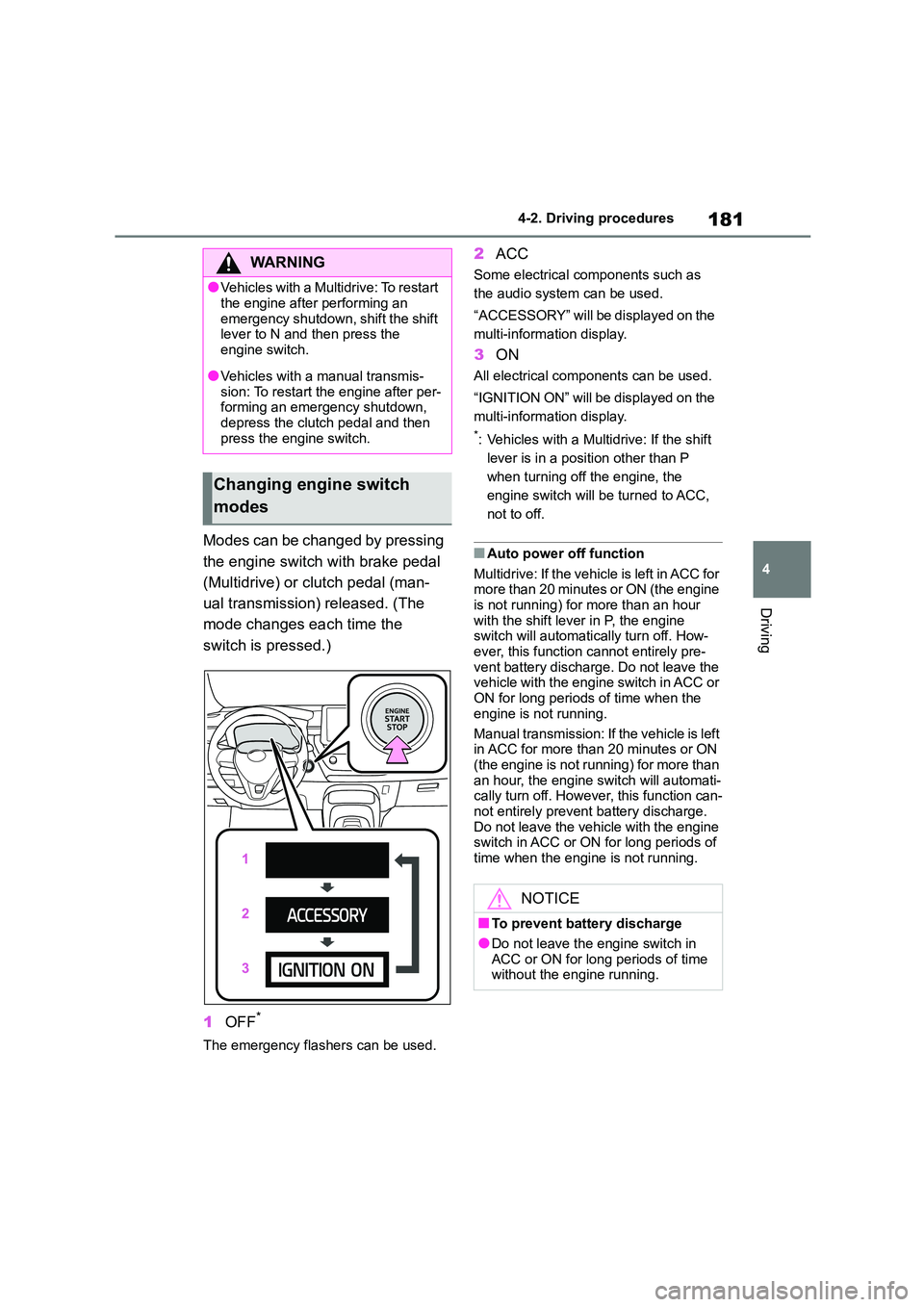
Modes can be changed by pressing
the engine switch with brake pedal
(Multidrive) or clutch pedal (man-
ual transmission) released. (The
mode changes each time the
switch is pressed.)
1 OFF*
The emergency flashers can be used.
2ACC
Some electrical components such as
the audio system can be used.
“ACCESSORY” will be displayed on the
multi-information display.
3 ON
All electrical components can be used.
“IGNITION ON” will be displayed on the
multi-information display.
*: Vehicles with a Multidrive: If the shift
lever is in a position other than P
when turning off the engine, the
engine switch will be turned to ACC,
not to off.
■Auto power off function
Multidrive: If the vehicle is left in ACC for more than 20 minutes or ON (the engine
is not running) for more than an hour
with the shift lever in P, the engine switch will automatically turn off. How-
ever, this function cannot entirely pre-
vent battery discharge. Do not leave the vehicle with the engine switch in ACC or
ON for long periods of time when the
engine is not running.
Manual transmission: If the vehicle is left
in ACC for more than 20 minutes or ON
(the engine is not running) for more than
an hour, the engine switch will automati- cally turn off. However, this function can-
not entirely prevent battery discharge.
Do not leave the vehicle with the engine switch in ACC or ON for long periods of
time when the engine is not running.
WA R N I N G
●Vehicles with a Multidrive: To restart
the engine after performing an
emergency shutdown, shift the shift lever to N and then press the
engine switch.
●Vehicles with a manual transmis-
sion: To restart the engine after per-
forming an emergency shutdown,
depress the clutch pedal and then press the engine switch.
Changing engine switch
modes
NOTICE
■To prevent battery discharge
●Do not leave the engine switch in
ACC or ON for long periods of time
without the engine running.
Page 187 of 758
185
4
4-2. Driving procedures
Driving
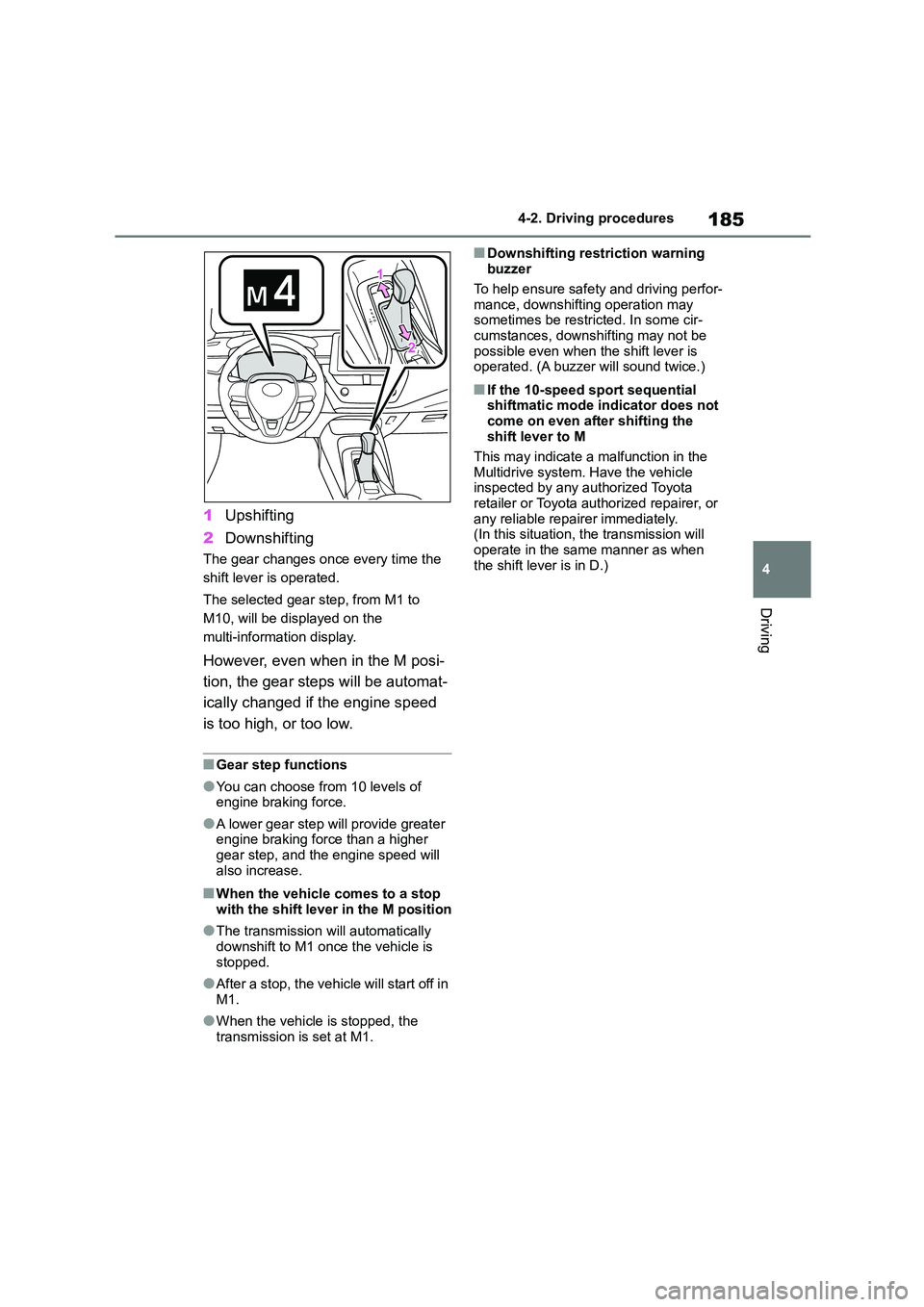
1 Upshifting
2 Downshifting
The gear changes once every time the
shift lever is operated.
The selected gear step, from M1 to
M10, will be displayed on the
multi-information display.
However, even when in the M posi-
tion, the gear step s will be automat-
ically changed if the engine speed
is too high, or too low.
■Gear step functions
●You can choose from 10 levels of
engine braking force.
●A lower gear step will provide greater
engine braking force than a higher
gear step, and the engine speed will also increase.
■When the vehicle comes to a stop
with the shift lever in the M position
●The transmission will automatically
downshift to M1 once the vehicle is
stopped.
●After a stop, the vehicle will start off in
M1.
●When the vehicle is stopped, the
transmission is set at M1.
■Downshifting restriction warning
buzzer
To help ensure safety and driving perfor-
mance, downshifting operation may
sometimes be restrict ed. In some cir- cumstances, downshifting may not be
possible even when the shift lever is
operated. (A buzzer will sound twice.)
■If the 10-speed sport sequential shiftmatic mode indicator does not
come on even after shifting the
shift lever to M
This may indicate a malfunction in the
Multidrive system. Have the vehicle
inspected by any authorized Toyota retailer or Toyota authorized repairer, or
any reliable repairer immediately.
(In this situation, the transmission will operate in the same manner as when
the shift lever is in D.)
Page 192 of 758
1904-2. Driving procedures
parking brake
• Operate the parking brake switch
while depressing the brake pedal.
• Using the parking brake automatic
release function, the parking brake
can be released by depressing the
accelerator pedal. When using this
function, slowly depress the acceler-
ator pedal.
Make sure that the parking brake indi-
cator and parking brake light turn off.
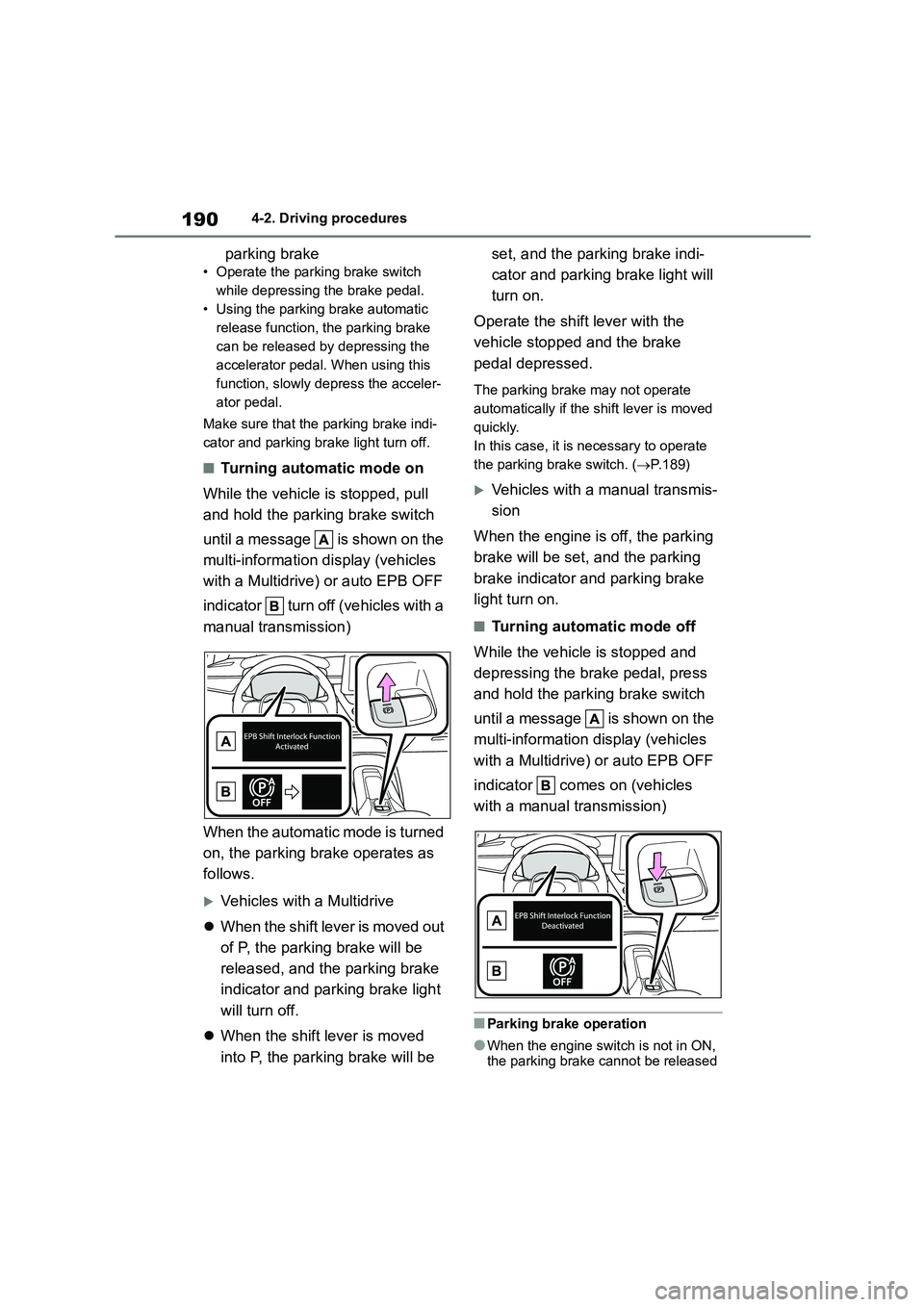
■Turning automatic mode on
While the vehicle is stopped, pull
and hold the parking brake switch
until a message is shown on the
multi-information display (vehicles
with a Multidrive ) or auto EPB OFF
indicator turn off (vehicles with a
manual transmission)
When the automatic mode is turned
on, the parking brake operates as
follows.
Vehicles with a Multidrive
When the shift lever is moved out
of P, the parking brake will be
released, and the parking brake
indicator and parking brake light
will turn off.
When the shift lever is moved
into P, the parking brake will be
set, and the parking brake indi-
cator and parking brake light will
turn on.
Operate the shift lever with the
vehicle stopped and the brake
pedal depressed.
The parking brake may not operate
automatically if the shift lever is moved
quickly.
In this case, it is necessary to operate
the parking brake switch. ( P.189)
Vehicles with a manual transmis-
sion
When the engine is off, the parking
brake will be set, and the parking
brake indicator and parking brake
light turn on.
■Turning automatic mode off
While the vehicle is stopped and
depressing the brake pedal, press
and hold the parking brake switch
until a message is shown on the
multi-information display (vehicles
with a Multidrive) or auto EPB OFF
indicator comes on (vehicles
with a manual transmission)
■Parking brake operation
●When the engine switch is not in ON, the parking brake cannot be released
Page 274 of 758
2724-5. Using the driving support systems
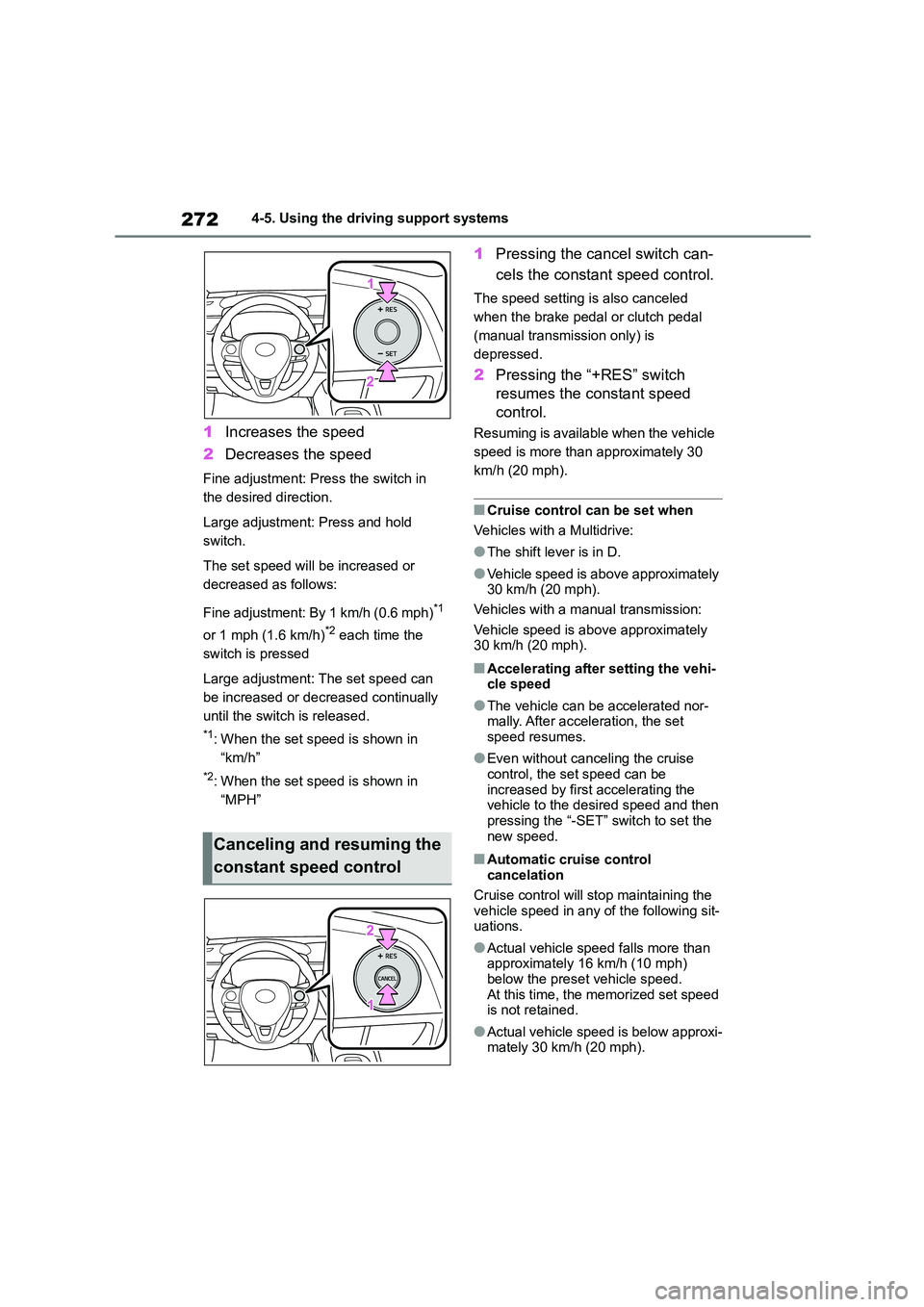
1Increases the speed
2 Decreases the speed
Fine adjustment: Press the switch in
the desired direction.
Large adjustment: Press and hold
switch.
The set speed will be increased or
decreased as follows:
Fine adjustment: By 1 km/h (0.6 mph)*1
or 1 mph (1.6 km/h)*2 each time the
switch is pressed
Large adjustment: The set speed can
be increased or decreased continually
until the switch is released.
*1: When the set speed is shown in
“km/h”
*2: When the set speed is shown in
“MPH”
1 Pressing the cancel switch can-
cels the constant speed control.
The speed setting is also canceled
when the brake pedal or clutch pedal
(manual transmission only) is
depressed.
2 Pressing the “+RES” switch
resumes the constant speed
control.
Resuming is available when the vehicle
speed is more than approximately 30
km/h (20 mph).
■Cruise control can be set when
Vehicles with a Multidrive:
●The shift lever is in D.
●Vehicle speed is above approximately 30 km/h (20 mph).
Vehicles with a manual transmission:
Vehicle speed is above approximately 30 km/h (20 mph).
■Accelerating after setting the vehi-
cle speed
●The vehicle can be accelerated nor-
mally. After acceleration, the set
speed resumes.
●Even without canceling the cruise
control, the set speed can be
increased by first accelerating the vehicle to the desired speed and then
pressing the “-SET” switch to set the
new speed.
■Automatic cruise control cancelation
Cruise control will stop maintaining the
vehicle speed in any of the following sit- uations.
●Actual vehicle speed falls more than approximately 16 km/h (10 mph)
below the preset vehicle speed.
At this time, the memorized set speed is not retained.
●Actual vehicle speed is below approxi-mately 30 km/h (20 mph).
Canceling and resuming the
constant speed control
Page 284 of 758
2824-5. Using the driving support systems
■Stopping the engine
1 With the clutch pedal fully
depressed, depress the brake
pedal, and stop the vehicle.
2 Shift the shift lever to N
( P.186), and release the
clutch pedal.
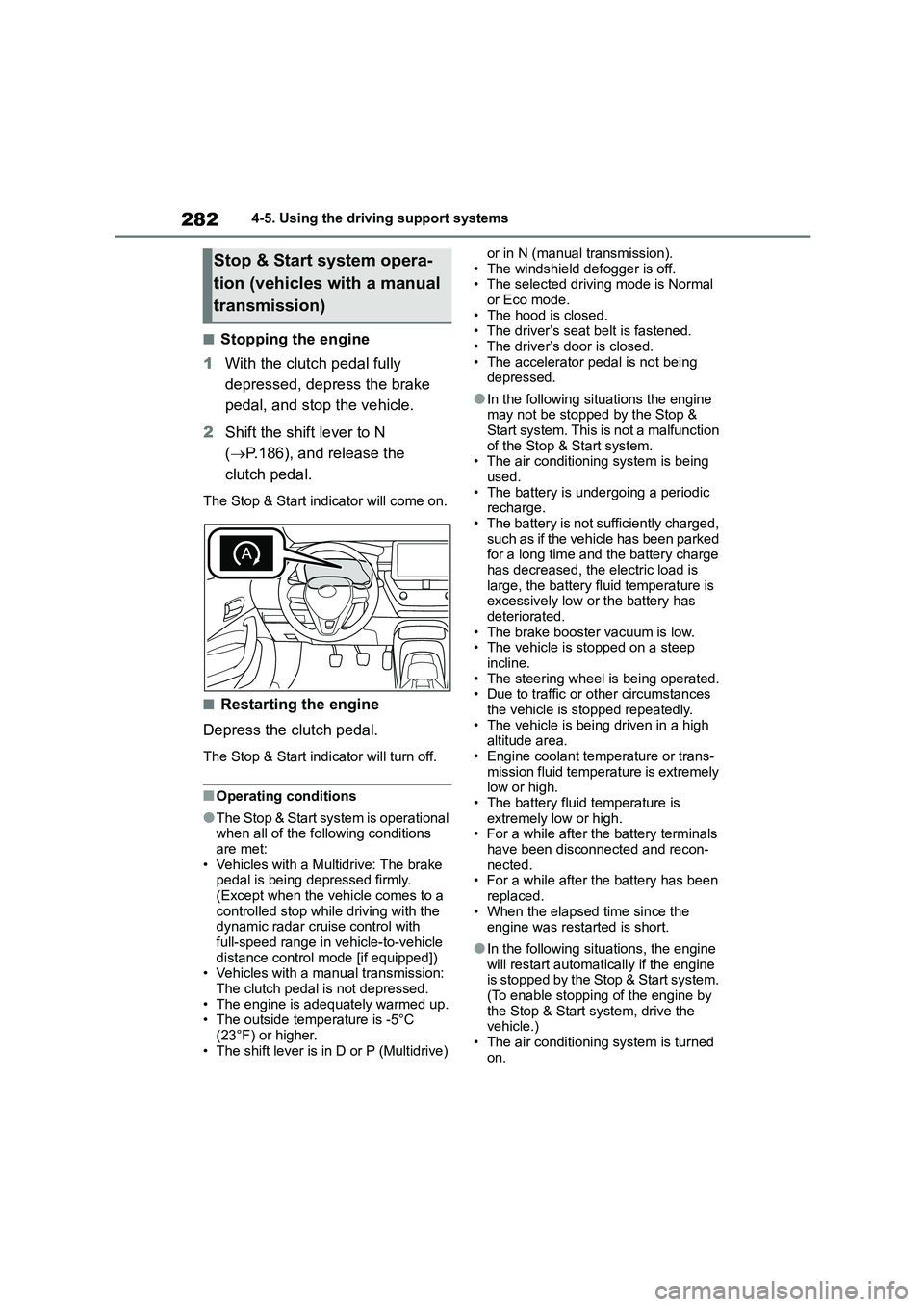
The Stop & Start indicator will come on.
■Restarting the engine
Depress the clutch pedal.
The Stop & Start indicator will turn off.
■Operating conditions
●The Stop & Start system is operational
when all of the following conditions are met:
• Vehicles with a Multidrive: The brake
pedal is being depressed firmly. (Except when the vehicle comes to a
controlled stop while driving with the
dynamic radar cruise control with
full-speed range in vehicle-to-vehicle distance control mode [if equipped])
• Vehicles with a manual transmission:
The clutch pedal is not depressed. • The engine is adequately warmed up.
• The outside temperature is -5°C
(23°F) or higher. • The shift lever is in D or P (Multidrive)
or in N (manual transmission).
• The windshield defogger is off. • The selected driving mode is Normal
or Eco mode.
• The hood is closed. • The driver’s seat belt is fastened.
• The driver’s door is closed.
• The accelerator pedal is not being depressed.
●In the following situations the engine may not be stopped by the Stop &
Start system. This is not a malfunction
of the Stop & Start system. • The air conditioning system is being
used.
• The battery is undergoing a periodic recharge.
• The battery is not sufficiently charged,
such as if the vehicle has been parked for a long time and the battery charge
has decreased, the electric load is
large, the battery fluid temperature is excessively low or the battery has
deteriorated.
• The brake booster vacuum is low. • The vehicle is stopped on a steep
incline.
• The steering wheel is being operated. • Due to traffic or other circumstances
the vehicle is stopped repeatedly.
• The vehicle is being driven in a high altitude area.
• Engine coolant temperature or trans-
mission fluid temperature is extremely low or high.
• The battery fluid temperature is
extremely low or high. • For a while after the battery terminals
have been disconnected and recon-
nected. • For a while after the battery has been
replaced.
• When the elapsed time since the
engine was restarted is short.
●In the following situations, the engine
will restart automatically if the engine is stopped by the Stop & Start system.
(To enable stopping of the engine by
the Stop & Start system, drive the vehicle.)
• The air conditioning system is turned
on.
Stop & Start system opera-
tion (vehicles with a manual
transmission)
Page 288 of 758
2864-5. Using the driving support systems
• The battery charge amount may be
low.
The engine is restarted to prioritize
battery charging. Operating the engine
for a short while allows the system to
recover.
●When the engine cannot be restarted
by the Stop & Start system
“Shift to N and Press Clutch” (vehi-
cles with a manual transmission)
When the engine is stopped by the
Stop & Start system, the shift lever was
moved to a position other than N without
depressing the clutch pedal.
■Stop & Start system warning mes- sages
If a system malfuncti on occurs, a warn-
ing message will be displayed on the multi-information display to inform the
driver of the need for caution. ( P.520)
■If the Stop & Start cancel indicator
continues to flash
The system may be malfunctioning.
Have the vehicle inspected by any
authorized Toyota retailer or Toyota authorized repairer, or any reliable
repairer.
WA R N I N G
■When the Stop & Start system is
operating
●Depress the brake pedal and apply
the parking brake when necessary
while the engine is stopped by the
Stop & Start system (while the Stop & Start indicator is on). (Except
when the brake hold system is
operating or when the vehicle comes to a controlled stop while
driving with the dynamic radar
cruise control with full-speed range in vehicle-to-vehicle distance con-
trol mode*)
●Do not leave the vehicle while the engine is stopped by the Stop &
Start system (while the Stop & Start
indicator is on). An accident may occur due to the
automatic engine start function.
●Ensure that the engine is not
stopped by the Stop & Start system
while the vehicle is in a poorly venti- lated area. The engine may restart
due to the automatic engine start
function, causing exhaust gases to collect and enter the vehicle, possi-
bly resulting in death or a serious
health hazard.
*: Vehicles with a dynamic radar
cruise control with full-speed range
NOTICE
■To ensure the system operates
correctly
If any of the following situations occur,
the Stop & Start syst em may not oper-
ate correctly. Have your vehicle checked by any authorized Toyota
retailer or Toyota authorized repairer,
or any reliable repairer.
●While the driver’s seat belt is fas-
tened, the driver’s and front pas- senger’s seat belt reminder light
flashes.
●Even though the driver’s seat belt is
not fastened, the driver’s and front
passenger’s seat belt reminder light does not illuminate.
●Even though the driver’s door is closed, the open door warning light
is illuminated or the interior light is
illuminated when the interior light switch is in the door position.