wheel TOYOTA COROLLA HATCHBACK 2022 Owners Manual (in English)
[x] Cancel search | Manufacturer: TOYOTA, Model Year: 2022, Model line: COROLLA HATCHBACK, Model: TOYOTA COROLLA HATCHBACK 2022Pages: 758, PDF Size: 155.26 MB
Page 4 of 758
2TABLE OF CONTENTS
For your information ........................6
Reading this manual........................ 9
How to search ............................... 10
Pictorial index ................................ 11
1-1. For safe use
Before driving........................ 30
For safe driving ..................... 31
Seat belts .............................. 33
SRS airbags.......................... 37
Exhaust gas precautions ...... 45
1-2. Child safety
Airbag manual on-off system
............................................ 46
Riding with children............... 47
Child restraint systems ......... 48
1-3. Emergency assistance
eCall...................................... 69
1-4. Theft deterrent system
Engine immobilizer system ... 79
Double locking system .......... 80
Alarm .................................... 81
2-1. Instrument cluster
Warning lights and indicators
............................................ 84
Gauges and meters (4.2-inch
display) ............................... 89
Gauges and meters (7-inch dis-
play) .................................... 93
Multi-information display ....... 99
Head-up display .................. 106
Fuel consumption information
.......................................... 110
3-1. Key information
Keys .................................... 114
3-2. Opening, closing and locking
the doors
Side doors........................... 119
Back door............................ 124
Smart entry & start system
.......................................... 136
3-3. Adjusting the seats
Front seats .......................... 141
Rear seats .......................... 142
Head restraints ................... 144
3-4. Adjusting the steering wheel
and mirrors
Steering wheel .................... 146
Inside rear view mirror ........ 147
Outside rear view mirrors.... 148
3-5. Opening and closing the win-
dows
Power windows ................... 151
Panoramic moon roof ......... 154
4-1. Before driving
Driving the vehicle .............. 161
Cargo and luggage ............. 168
Trailer towing ...................... 170
4-2. Driving procedures
Engine (ignition) switch (vehicles
without a smart entry & start
system) ............................. 177
1For safety and security
2Vehicle status information
and indicators
3Before driving
4Driving
Page 5 of 758
3TABLE OF CONTENTS
1
6
5
4
3
2
9
8
7
Engine (ignition) switch (vehicles
with a smart entry & start sys-
tem) .................................. 178
Multidrive ............................ 182
Manual transmission ........... 186
Turn signal lever ................. 189
Parking brake...................... 189
Brake Hold .......................... 192
4-3. Operating the lights and wip-
ers
Headlight switch.................. 195
Automatic High Beam ......... 199
AHS (Adaptive High-beam Sys-
tem) .................................. 201
Fog light switch ................... 205
Windshield wipers and washer
.......................................... 206
Rear window wiper and washer
.......................................... 209
4-4. Refueling
Opening the fuel tank cap ... 211
4-5. Using the driving support sys-
tems
Toyota Safety Sense ........... 213
PCS (Pre-Collision System)
.......................................... 224
LTA (Lane Tracing Assist) ... 231
LDA (Lane Departure Alert with
steering control) ................ 241
Dynamic radar cruise control
with full-speed range ........ 249
Dynamic radar cruise control
.......................................... 260
Cruise control...................... 271
Speed limiter ....................... 273
RSA (Road Sign Assist) ...... 276
Stop & Start system ............ 280
BSM (Blind Spot Monitor) ... 288
Toyota parking assist-sensor
.......................................... 303
RCTA (Rear Crossing Traffic
Alert) function ................... 312
PKSB (Parking Support Brake)
.......................................... 317
Parking Support Brake function
(static objects) .................. 324
Parking Support Brake function
(rear-crossing vehicles) .... 327
S-IPA (Simple Intelligent Parking
Assist System) .................. 329
Driving mode select switch
.......................................... 355
Exhaust Gas Filter system .. 356
Driving assist systems ........ 357
4-6. Driving tips
Winter driving tips ............... 363
5-1. Basic Operations
Audio system types............. 368
Using the steering wheel audio
switches ............................ 369
USB port ............................. 370
5-2. Using the audio system
Optimal use of the audio system
..........................................371
5-3. Using the radio
Radio operation .................. 373
5-4. Playing an audio CD and
MP3/WMA discs
CD player operation ............ 375
5-5. Using an external device
Listening to an iPod ............ 381
Listening to USB memory device
.......................................... 386
5Audio system
Page 6 of 758
4TABLE OF CONTENTS
5-6. Using Bluetooth® devices
Bluetooth® audio/phone...... 391
Using the steering wheel
switches ............................ 396
Register a Bluetooth® device
.......................................... 396
5-7. “SETUP” menu
Using the “SETUP” menu
(“Bluetooth” menu)............ 398
Using the “SETUP” menu (“TEL”
menu) ............................... 400
5-8. Bluetooth® Audio
Operating a Bluetooth® enabled
portable player .................. 404
5-9. Bluetooth® Phone
Making a phone call ............ 406
When receiving a phone call
.......................................... 407
Speaking on the phone ....... 407
5-10. Bluetooth®
Bluetooth®.......................... 409
6-1. Using the air conditioning
system and defogger
Manual air conditioning system
.......................................... 422
Automatic air conditioning sys-
tem.................................... 427
Heated steering wheel/seat
heaters.............................. 434
6-2. Using the interior lights
Interior lights list .................. 436
6-3. Using the storage features
List of storage features ....... 439
Luggage compartment features
.......................................... 442
6-4. Other interior features
Other interior features ......... 451
7-1. Maintenance and care
Cleaning and protecting the
vehicle exterior ................. 460
Cleaning and protecting the
vehicle interior .................. 463
7-2. Maintenance
Maintenance requirements
.......................................... 466
7-3. Do-it-yourself maintenance
Do-it-yourself service precau-
tions .................................. 468
Hood ................................... 470
Positioning a floor jack ........ 471
Engine compartment........... 472
Tires .................................... 479
Tire inflation pressure ......... 485
Wheels ................................ 487
Air conditioning filter ........... 489
Wireless remote control/elec-
tronic key battery .............. 490
Checking and replacing fuses
.......................................... 494
Light bulbs .......................... 497
8-1. Essential information
Emergency flashers ............ 502
If your vehicle has to be stopped
in an emergency ............... 502
6Interior features
7Maintenance and care
8When trouble arises
Page 19 of 758
17Pictorial index
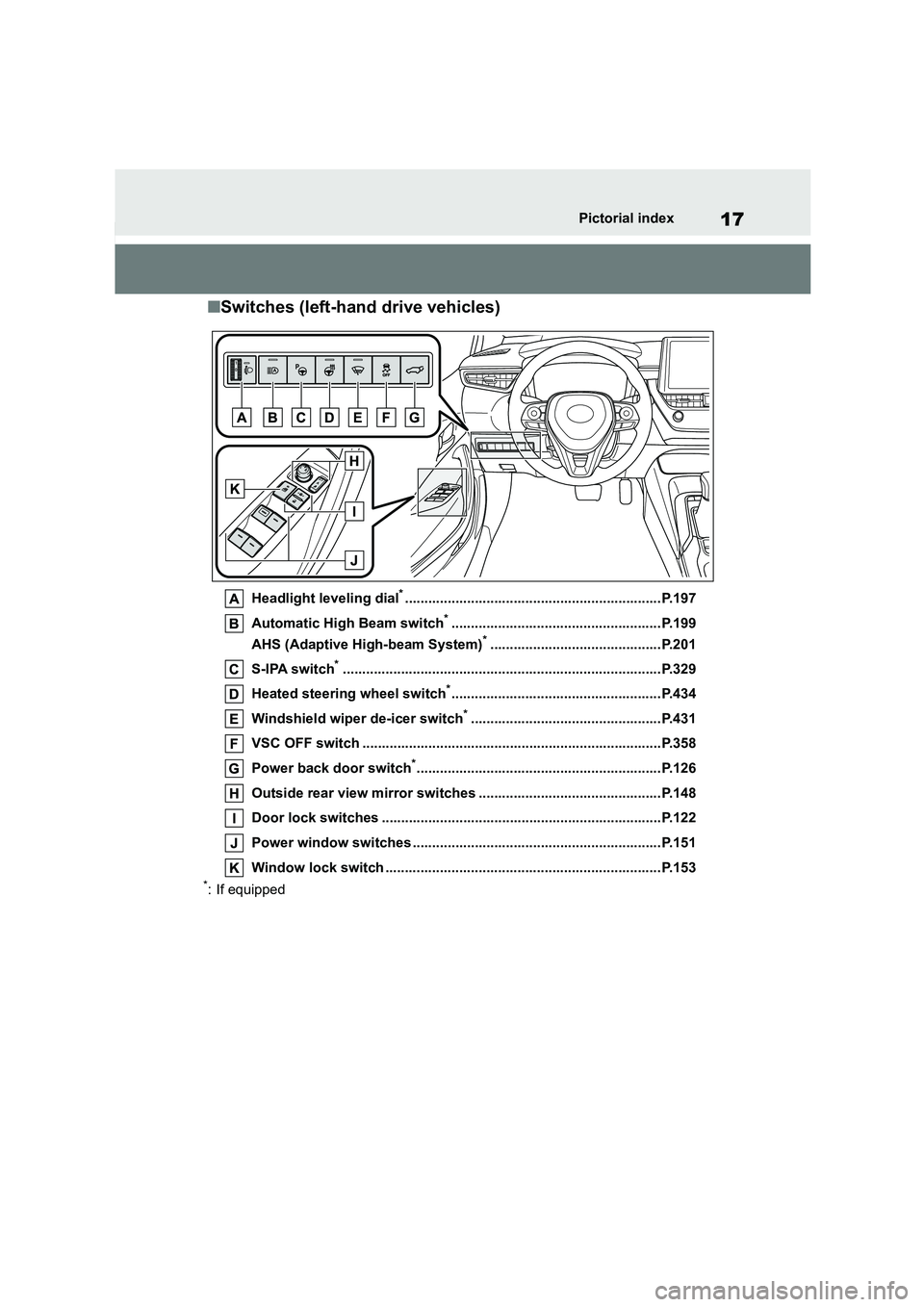
■Switches (left-hand drive vehicles)
Headlight leveling dial*..................................................................P.197
Automatic High Beam switch*......................................................P.199
AHS (Adaptive High-beam System)*............................................P.201
S-IPA switch*..................................................................................P.329
Heated steering wheel switch*......................................................P.434
Windshield wiper de-icer switch*.................................................P.431
VSC OFF switch .............................................................................P.358
Power back door switch*...............................................................P.126
Outside rear view mirror switches ...............................................P.148
Door lock switches ........................................................................P.122
Power window switches ................................................................P.151
Window lock switch .......................................................................P.153
*: If equipped
Page 26 of 758
24Pictorial index
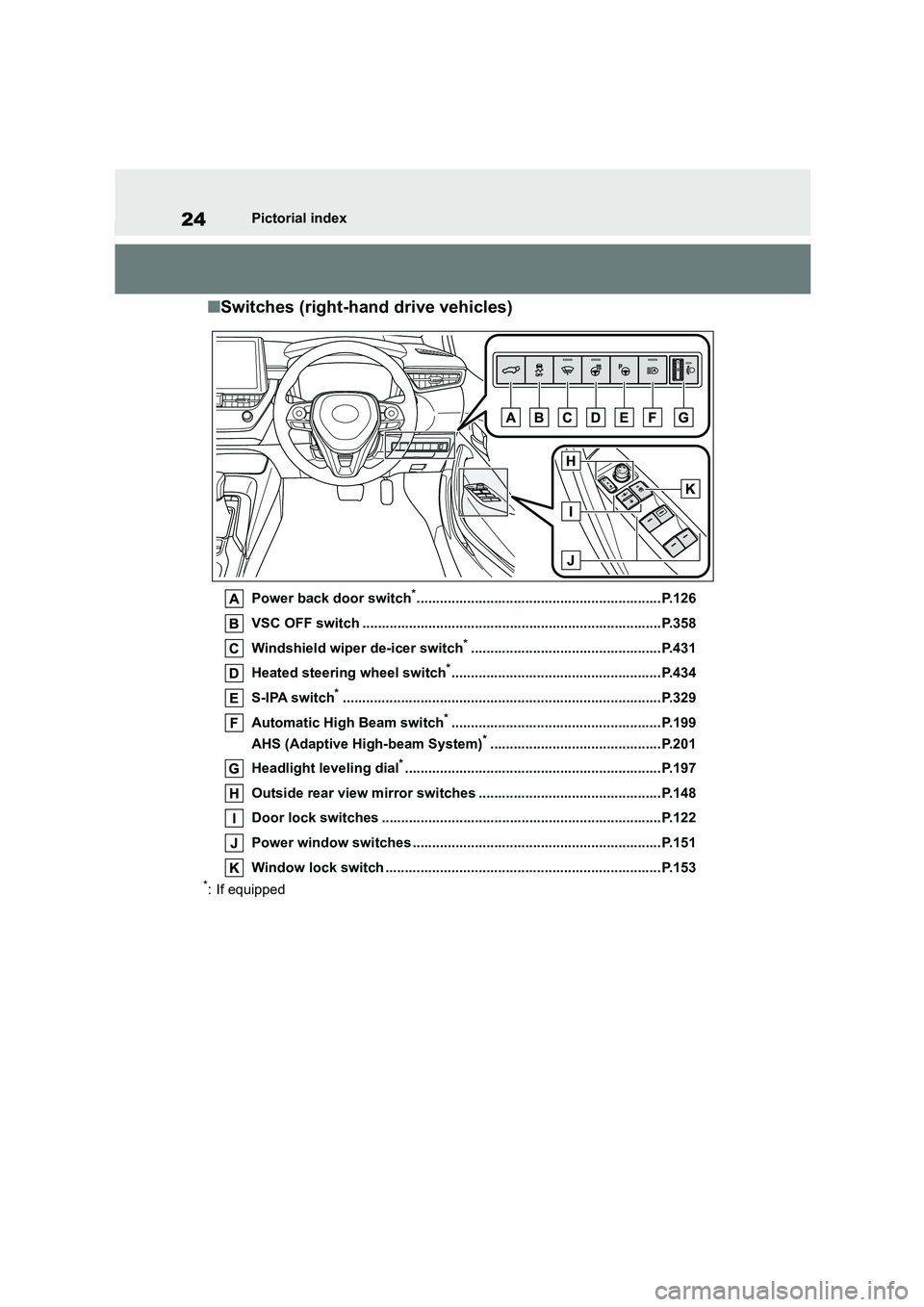
■Switches (right-hand drive vehicles)
Power back door switch*...............................................................P.126
VSC OFF switch .............................................................................P.358
Windshield wiper de-icer switch*.................................................P.431
Heated steering wheel switch*......................................................P.434
S-IPA switch*..................................................................................P.329
Automatic High Beam switch*......................................................P.199
AHS (Adaptive High-beam System)*............................................P.201
Headlight leveling dial*..................................................................P.197
Outside rear view mirror switches ...............................................P.148
Door lock switches ........................................................................P.122
Power window switches ................................................................P.151
Window lock switch .......................................................................P.153
*: If equipped
Page 33 of 758
31
1
1-1. For safe use
For safety and security
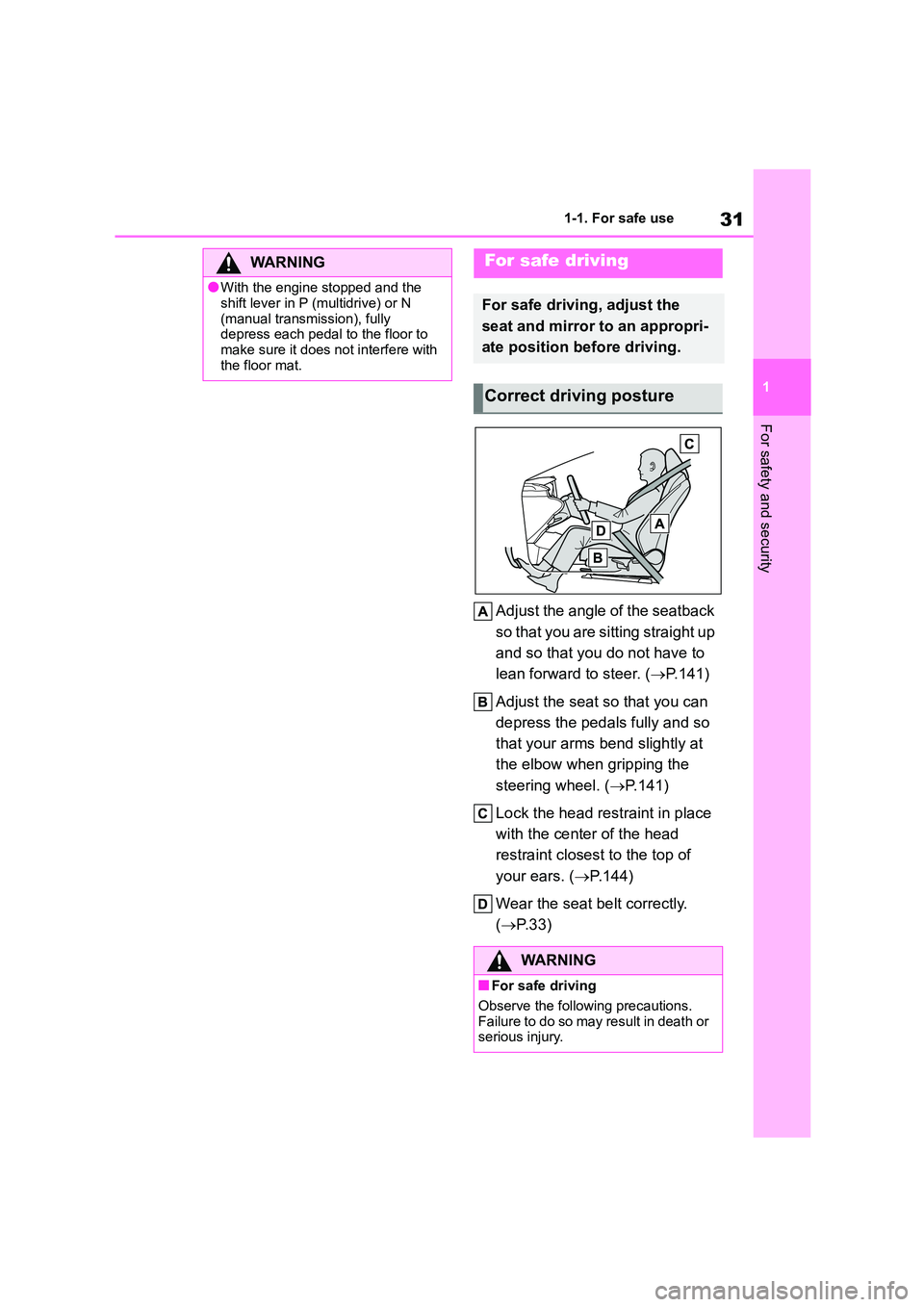
Adjust the angle of the seatback
so that you are sitting straight up
and so that you do not have to
lean forward to steer. ( P.141)
Adjust the seat so that you can
depress the pedals fully and so
that your arms bend slightly at
the elbow when gripping the
steering wheel. ( P.141)
Lock the head restraint in place
with the center of the head
restraint closest to the top of
your ears. ( P. 1 4 4 )
Wear the seat belt correctly.
( P. 3 3 )
WA R N I N G
●With the engine stopped and the
shift lever in P (multidrive) or N
(manual transmission), fully depress each pedal to the floor to
make sure it does not interfere with
the floor mat.
For safe driving
For safe driving, adjust the
seat and mirror to an appropri-
ate position before driving.
Correct driving posture
WA R N I N G
■For safe driving
Observe the following precautions.
Failure to do so may result in death or serious injury.
Page 41 of 758
39
1
1-1. For safe use
For safety and security
may be sustained from SRS airbags,
due to the extremely high speed deployment (inflation) by hot gases.
●A loud noise and white powder will be emitted.
●Parts of the airbag module (steering wheel hub, airbag cover and inflator)
as well as the front seats, parts of the
front and rear pillars, and roof side rails, may be hot for several minutes.
The airbag itself may also be hot.
●The windshield may crack.
●The brakes and stop lights will be con- trolled automatically. ( P.357)
●The interior lights will turn on automat- ically. ( P.437)
●The emergency flashers will turned on automatically. ( P.502)
●Fuel supply to the engine will be stopped. ( P.510)
●Vehicles with eCall: If any of the fol-
lowing situations occur, the system is
designed to send an emergency call*
to the eCall control center, notifying
them of the vehicle’s location (without needing to push the “SOS” button)
and an agent will attempt to speak
with the occupants to ascertain the level of emergency and assistance
required. If the occupants are unable
to communicate, the agent automati- cally treats the call as an emergency
and helps to dispatch the necessary
emergency services. ( P. 6 9 ) • An SRS airbag is deployed.
• A seat belt pretensioner is activated.
• The vehicle is involved in a severe rear-end collision.*: In some cases, the call cannot be
made. ( P. 7 0 )
■SRS airbag deployment conditions (SRS front airbags)
●The SRS front airbags will deploy in the event of an impact that exceeds
the set threshold le vel (the level of
force corresponding to an approxi- mately 20 - 30 km/h [12 - 18 mph]
frontal collision with a fixed wall that
does not move or deform).
However, this threshold velocity will be
considerably higher in the following situ-
ations: • If the vehicle strikes an object, such
as a parked vehicle or sign pole,
which can move or deform on impact • If the vehicle is involved in an
underride collision, such as a collision
in which the front of the vehicle “underrides”, or goes under, the bed
of a truck
■SRS airbag deployment conditions
(SRS side and curtain shield airbags)
●The SRS side and curtain shield airbags will deploy in the event of an
impact that exceeds the set threshold
level (the level of force corresponding to the impact force produced by an
approximately 1500 kg [3300 lb.] vehi-
cle colliding with the vehicle cabin from a direction perpendicular to the
vehicle orientation at an approximate
speed of 20 - 30 km/h [12 - 18 mph]).
●Both SRS curtain shield airbags may
deploy in the event of a severe side collision.
●Both SRS curtain shield airbags may also deploy in the event of a severe
frontal collision.
■Conditions under which the SRS
airbags may deploy (inflate), other than a collision
The SRS front airbags and SRS side
and curtain shield airbags may also deploy if a serious impact occurs to the
underside of your vehicle. Some exam-
ples are shown in the illustration.
●Hitting a curb, edge of pavement or
hard surface
●Falling into or jumping over a deep
hole
●Landing hard or falling
Page 43 of 758
41
1
1-1. For safe use
For safety and security
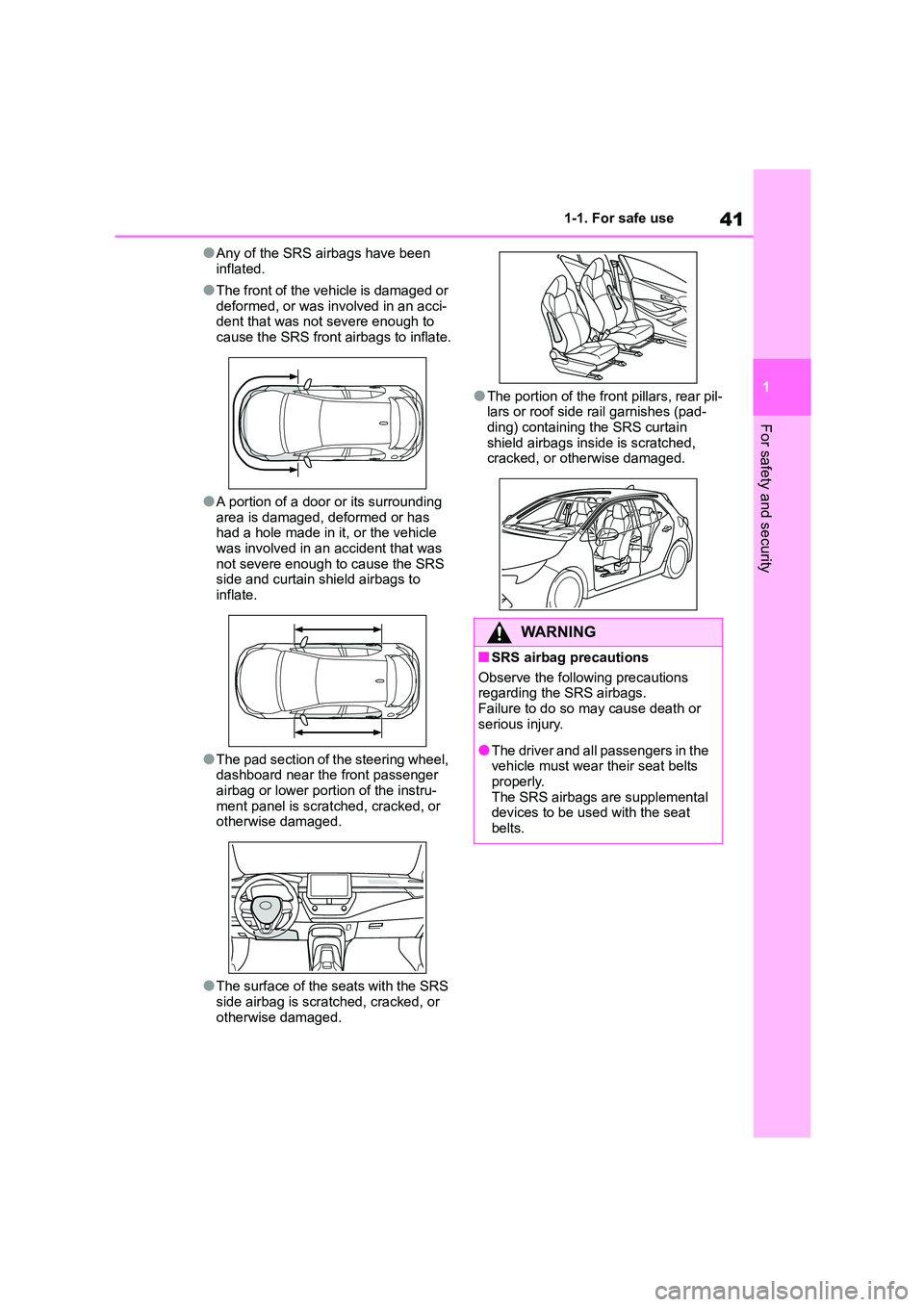
●Any of the SRS airbags have been
inflated.
●The front of the vehicle is damaged or
deformed, or was involved in an acci- dent that was not severe enough to
cause the SRS front airbags to inflate.
●A portion of a door or its surrounding
area is damaged, deformed or has
had a hole made in it, or the vehicle was involved in an accident that was
not severe enough to cause the SRS
side and curtain shield airbags to inflate.
●The pad section of the steering wheel, dashboard near the front passenger
airbag or lower portion of the instru-
ment panel is scratched, cracked, or otherwise damaged.
●The surface of the seats with the SRS side airbag is scratched, cracked, or
otherwise damaged.
●The portion of the front pillars, rear pil-
lars or roof side rail garnishes (pad- ding) containing the SRS curtain
shield airbags inside is scratched,
cracked, or otherwise damaged.
WA R N I N G
■SRS airbag precautions
Observe the following precautions
regarding the SRS airbags.
Failure to do so may cause death or serious injury.
●The driver and all passengers in the vehicle must wear their seat belts
properly.
The SRS airbags are supplemental devices to be used with the seat
belts.
Page 44 of 758
421-1. For safe use
WA R N I N G
●The SRS driver airbag deploys with
considerable force, and can cause
death or serious injury especially if the driver is very close to the
airbag.
Since the risk zone for the driver’s airbag is the first 50 - 75 mm (2 - 3 in.)
of inflation, placing yourself 250 mm
(10 in.) from your driver airbag pro-
vides you with a clear margin of safety. This distance is measured
from the center of the steering wheel
to your breastbone. If you sit less than 250 mm (10 in.) away now, you can
change your driving position in sev-
eral ways:
• Move your seat to the rear as far as
you can while still reaching the ped-
als comfortably.
• Slightly recline the back of the seat.
Although vehicle designs vary, many drivers can achieve the 250
mm (10 in.) distance, even with the
driver seat all the way forward, sim- ply by reclining the back of the seat
somewhat. If reclining the back of
your seat makes it hard to see the road, raise yourself by using a firm,
non-slippery cushion, or raise the
seat if your vehicle has that feature.
• If your steering wheel is adjustable,
tilt it downward. This points the airbag toward your chest instead of
your head and neck.
The seat should be adjusted as rec-
ommended above, while still main-
taining control of the foot pedals, steering wheel, and your view of the
instrument panel controls.
●The SRS front passenger airbag also deploys with considerable
force, and can cause death or seri-
ous injury especially if the front pas- senger is very close to the airbag.
The front passenger seat should be
as far from the airbag as possible with the seatback adjusted, so the
front passenger sits upright.
●Improperly seated and/or restrained
infants and children can be killed or
seriously injured by a deploying airbag. An infant or child who is too
small to use a seat belt should be
properly secured using a child restraint system. Toyota strongly
recommends that all infants and
children be placed in the rear seats of the vehicle and properly
restrained. The rear seats are safer
for infants and children than the front passenger seat. (P. 4 8 )
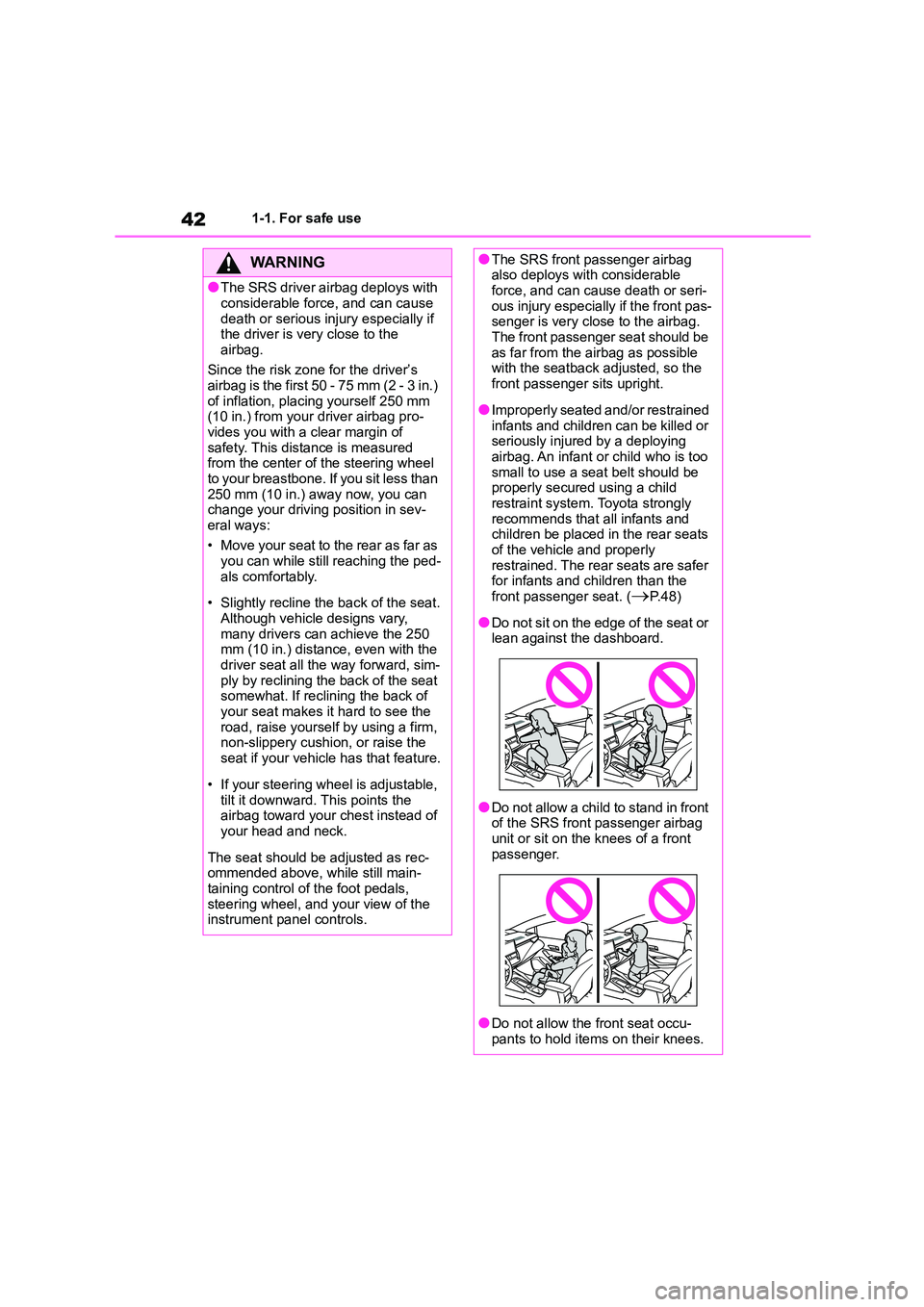
●Do not sit on the edge of the seat or lean against the dashboard.
●Do not allow a child to stand in front of the SRS front passenger airbag
unit or sit on the knees of a front
passenger.
●Do not allow the front seat occu-
pants to hold items on their knees.
Page 45 of 758
43
1
1-1. For safe use
For safety and security
WA R N I N G
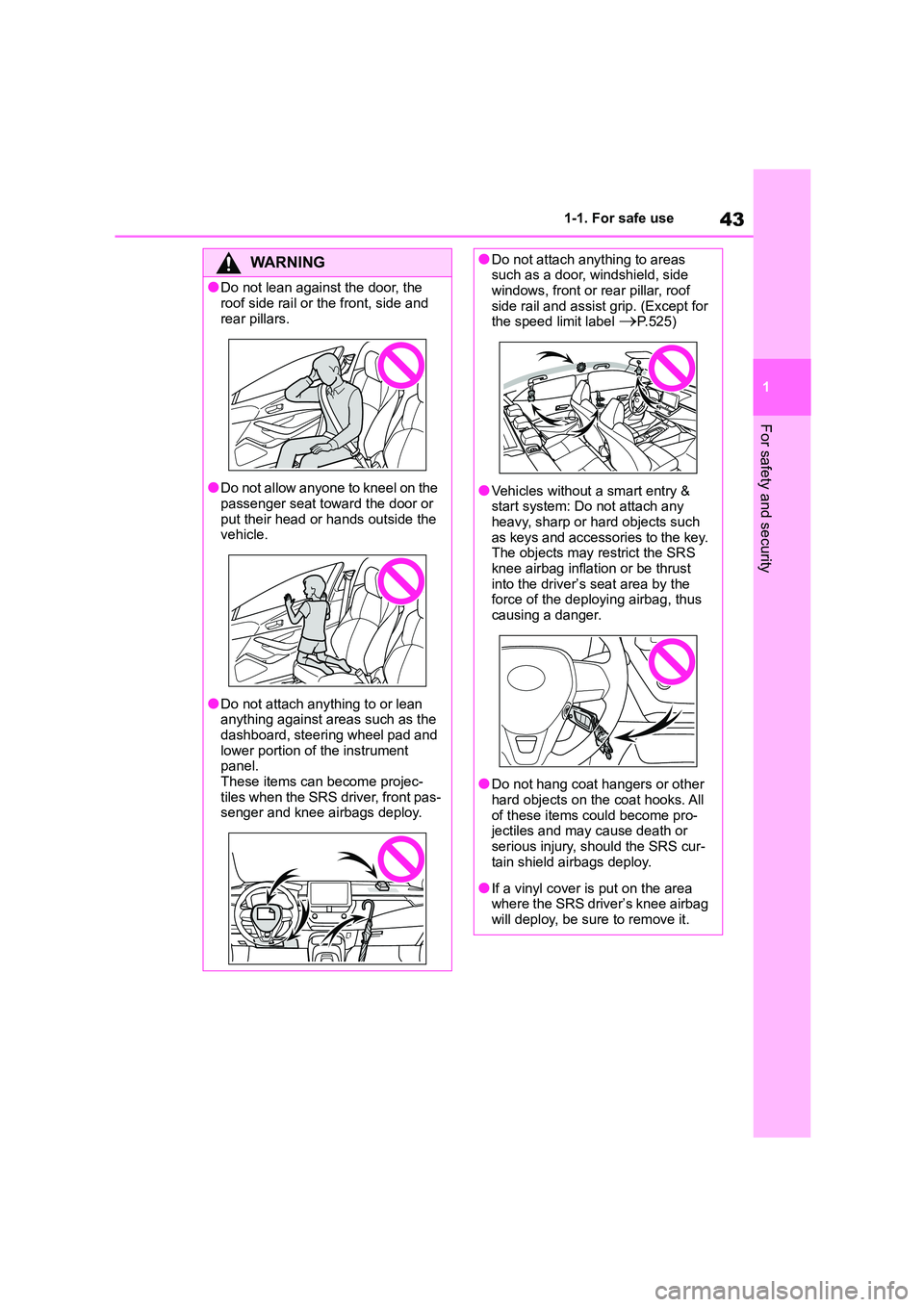
●Do not lean against the door, the
roof side rail or the front, side and
rear pillars.
●Do not allow anyone to kneel on the
passenger seat toward the door or
put their head or hands outside the vehicle.
●Do not attach anything to or lean anything against areas such as the
dashboard, steering wheel pad and
lower portion of the instrument panel.
These items can become projec-
tiles when the SRS driver, front pas- senger and knee airbags deploy.
●Do not attach anything to areas such as a door, windshield, side
windows, front or rear pillar, roof
side rail and assist grip. (Except for the speed limit label P.525)
●Vehicles without a smart entry & start system: Do not attach any
heavy, sharp or hard objects such
as keys and accessories to the key. The objects may restrict the SRS
knee airbag inflation or be thrust
into the driver’s seat area by the force of the deploying airbag, thus
causing a danger.
●Do not hang coat hangers or other
hard objects on the coat hooks. All
of these items could become pro- jectiles and may cause death or
serious injury, should the SRS cur-
tain shield airbags deploy.
●If a vinyl cover is put on the area
where the SRS driver’s knee airbag will deploy, be sure to remove it.